51J Judge Advocate
When you purchase through links on our site, we may receive compensation at no extra cost to you.
The Air Force JAG is one of the few officer jobs where the professional qualification comes first and the Air Force then teaches you how to apply it in uniform. You are not coming in to become a lawyer. You are coming in as one. That changes the nature of the field from the start. A 51J officer can prosecute, defend, advise commanders, handle claims, work fiscal law, and support operations in ways most civilian lawyers will not touch for years.
JAG is a specialty accession path, but candidates comparing routes into the Air Force can still use the AFOQT study guide as background on officer expectations.
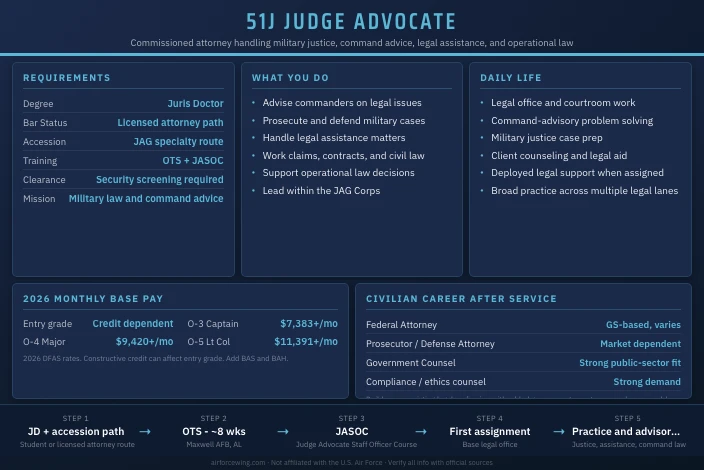
Job Role and Responsibilities
51J Judge Advocates provide legal advice and legal services across military justice, operational law, civil law, claims, labor law, contract law, and legal assistance. They serve as commissioned attorneys inside the Air Force Judge Advocate General’s Corps and advise commanders on the legal consequences of military decisions.
Leadership Scope
A new JAG officer can be in a courtroom, a claims office, a command legal review, or a deployment planning meeting within the first year of service. That breadth is unusual for a junior attorney in any practice setting, but it is standard for Air Force JAGs. At the O-3 level, a Captain may serve as the Chief of Military Justice for a wing, managing the prosecution of courts-martial, advising commanders on administrative discipline, and overseeing a team of paralegals. The same officer may also handle legal assistance appointments for Airmen dealing with wills, powers of attorney, family law issues, or landlord disputes.
Senior JAG officers move into Staff Judge Advocate (SJA) roles at wings and major commands, where they serve as the principal legal advisor to commanders with thousands of Airmen under their authority. That advisory relationship, where the lawyer speaks directly and candidly to a colonel or general officer, is one of the most demanding and rewarding aspects of senior JAG service.
Mission Contribution
This field keeps commanders inside the law while protecting due process, supporting Airmen and families, and handling the legal framework around military operations. Few officer jobs simultaneously touch daily personnel problems, criminal prosecution, international law, and strategic command advice the way JAG does. An SJA who briefs a wing commander on the law of armed conflict in advance of an air strike is doing something fundamentally different from a civilian attorney billing hours on a contract dispute, and that distinction defines the appeal of military legal practice for many who choose it.
Career Breadth
The Air Force JAG page makes the breadth clear: student accessions, licensed attorneys, active-duty military applicants, and reserve-component pathways all exist within the same legal corps structure. An attorney who wants to enter while still in law school has a different path than one who has been practicing for five years, and both are welcome in the same career field.
Salary and Benefits
Officer Base Pay
JAG officers receive standard officer base pay under the 2026 DFAS military pay tables.
| Rank | Grade | Typical YOS | Monthly Base Pay |
|---|---|---|---|
| O-1 / O-2 entry credit varies | Junior officer | Entry dependent | $4,150-$6,485 |
| Captain | O-3 | Common early career grade | $7,383-$8,376 |
| Major | O-4 | Mid-career | $9,420-$10,402 |
| Lieutenant Colonel | O-5 | Senior field grade | $11,391-$12,395 |
Entry grade depends on accession status and any constructive service credit based on prior legal experience. An attorney who has practiced for several years before commissioning may receive constructive credit that places them at O-2 or O-3 at entry rather than O-1. That grade credit meaningfully affects both pay and promotion timeline.
Allowances
Beyond base pay, JAG officers receive the full military allowances package. Basic Allowance for Housing (BAH) is tax-free and calibrated to duty-station location and dependent status. Officers assigned to bases in high-cost areas such as the San Francisco Bay Area, Washington D.C., or Hawaii receive substantially higher BAH rates that can add $2,000 or more per month in tax-free compensation beyond base pay.
- BAH: location based, tax-free
- BAS: $328.48 monthly, tax-free
- TRICARE Prime: medical, dental, and vision coverage at low or no cost
- BRS and TSP matching: government matches up to 5% of base pay after 26 months
- Student loan repayment programs may be available depending on accession timing and Air Force program availability
For attorneys carrying law school debt, the total compensation package, including BAH, BAS, and the absence of private practice overhead costs, often compares favorably to entry-level associate positions at civilian firms, particularly outside major metropolitan markets.
Civilian Value
This field does not create a new profession after service because JAGs are already attorneys when they enter. The value that military service adds is accelerated courtroom experience, command advisory credibility, government-law depth, and operational legal practice in areas most civilian attorneys never touch. A JAG who has tried multiple courts-martial, deployed as the theater legal advisor, and served as an SJA for a wing has a legal record that opens doors at the Department of Justice, federal agencies, defense firms, and senior in-house counsel positions.

Qualifications and Eligibility
Education And Licensing
The Air Force JAG site states the basic path clearly: a law degree, legal qualification, and officer accession.
| Requirement | Current Public Baseline |
|---|---|
| Law degree | JD from an ABA-accredited law school for the licensed-attorney path |
| Bar status | Licensed-attorney path requires bar admission in at least one U.S. jurisdiction |
| Accession route | Student, licensed attorney, active-duty military applicant, or reserve-component pathway |
| Training | OTS plus Judge Advocate Staff Officer Course at Maxwell AFB, AL |
| Security screening | Standard officer security investigation required as part of accession |
Student accessions allow law students in their second or third year to apply for a guaranteed slot, commission after graduation and bar passage, and enter the Air Force after completing OTS and JASOC. This path is particularly competitive and allows motivated law students to plan their transition into uniform while still in school.
Licensed-attorney applicants who have already passed the bar and been practicing, in government, private practice, or other settings, bring experience that affects their accession grade and their early assignment profile. The Air Force values that experience because senior legal offices benefit from attorneys who already understand how practice works before they put on a uniform.
Training Accessions
The public JAG pages explain that new officers start with Officer Training School (OTS) and then move into the Judge Advocate Staff Officer Course (JASOC) at Maxwell AFB. OTS is approximately eight weeks and focuses on military officer fundamentals, professional customs, and Air Force culture. JASOC is the JAG-specific course covering military justice under the Uniform Code of Military Justice (UCMJ), the Manual for Courts-Martial, military administrative law, legal assistance practice, claims procedures, and the full range of JAG practice areas.
JASOC does not turn civilians into lawyers. It turns lawyers into military legal practitioners. That distinction matters. Students arrive already knowing how to practice law; the course teaches them how to apply that skill in a military legal office.
Candidates still comparing officer routes can use the AFOQT study guide for general accession context, but the real gate here is the JD and bar pathway.
Upon Commissioning
New JAGs commission as attorneys entering military legal practice, not as general line officers later assigned to law. That means their first assignment is in a base legal office where they start practicing military law from day one, not after a rotation through other duties first.

Work Environment
Setting And Schedule
JAG work happens in legal offices, courtrooms, command staff spaces, conference rooms, and deployed legal environments. Some assignments look and feel like conventional law practice: client intake, legal research, document drafting, court appearances, and file management. Others look more like command advisory work inside a military headquarters, where the attorney briefs senior leaders on legal risks and frameworks in real time.
The pace varies by assignment. A wing legal office at a high-tempo operational base handling a heavy military justice caseload can run very demanding hours, particularly in the weeks surrounding a court-martial. Legal offices at quieter bases or staff assignments may have more predictable schedules but still carry meaningful responsibility in their advisory roles.
Client And Command Balance
One day may include advising a commander on adverse action against a senior NCO, handling legal assistance appointments for Airmen dealing with personal legal issues, and reviewing a contract for a base procurement action. That variety is real, and it characterizes JAG practice in ways that civilian attorneys, who specialize much more narrowly, rarely experience. The breadth is part of the field’s appeal and part of its workload. Attorneys who thrive on variety find military legal practice energizing. Those who prefer deep specialization sometimes find the breadth harder to navigate.
Officer-NCO Dynamic
JAG officers rely heavily on paralegal specialists (5J0X1) and legal-services NCOs who manage caseloads, support court-martial preparation, handle legal assistance administrative processing, and maintain the operational functioning of the legal office. The best legal offices operate as integrated teams, not attorney-only shops. Officers who invest in their paralegal corps, assign work thoughtfully, and develop their NCOs professionally build legal offices that outperform those where the attorneys try to do everything themselves.
Training and Skill Development
Training Pipeline
| Phase | Location | Length | Focus |
|---|---|---|---|
| Officer Training School | Maxwell AFB, AL | Approximately 8 weeks | Officer accession and Air Force fundamentals |
| Judge Advocate Staff Officer Course (JASOC) | Maxwell AFB, AL | Current Air Force JAG course length | Military law and JAG practice areas |
| First assignment OJT | Base legal office | 12-24 months | Military justice, legal assistance, command advice |
The Air Force JAG site explicitly confirms that new officers begin with OTS and then move into JASOC, both at Maxwell AFB, Alabama. This two-step pipeline is one of the most clearly documented accession paths on the Air Force public recruiting site, which reflects the structured nature of the legal profession and the JAG Corps’ deliberate approach to officer development.
After initial training, new JAGs enter their first legal office and begin practicing under the supervision of more experienced attorneys. Early career development includes both formal JAG professional development programs and informal mentorship from experienced SJAs and senior officers in the field. The Air Force JAG Corps maintains a centralized career management system that tracks attorney development across practice areas and helps ensure officers get exposure to military justice, civil law, legal assistance, and operational law across their early assignments.
Candidates weighing other officer paths can still review the AFOQT study guide for context, but JAG selection is ultimately driven by legal credentials and the application package, not by AFOQT scores.
Career Progression and Advancement
Timeline
| Rank | Grade | Typical Timeline | Development Focus |
|---|---|---|---|
| Junior Judge Advocate | O-1 to O-3 depending on credit | Entry | Core legal practice and military law |
| Captain / Major | O-3 / O-4 | Early to mid-career | Chief of justice, defense counsel, civil law, command advice |
| Lieutenant Colonel | O-5 | Senior field grade | Staff Judge Advocate and senior legal leadership |
| Colonel | O-6 | Senior career stage | Major command legal leadership and headquarters roles |
Promotion Drivers
The field rewards broad legal competence, excellent judgment under pressure, courtroom credibility, strong command-advice records, and leadership inside the legal office. Officers who develop expertise across multiple JAG practice areas, who earn their colleagues’ respect through sound legal reasoning and client-centered practice, and who demonstrate that they can advise commanders candidly and clearly build promotion records that reflect all of those qualities.
The Air Defense Counsel (ADC) role, in which a JAG officer represents accused Airmen in courts-martial, is particularly important for early career development because it builds courtroom skills and legal judgment that no other assignment replicates as efficiently. Officers who avoid the ADC role miss a developmental experience that senior JAGs consistently cite as formative.
Joint and interagency assignments at the O-4 level, including tours at combatant commands or defense agencies, build the joint professional military education credit that matters for senior promotion. Senior SJA positions at major commands and headquarters require officers with demonstrated legal depth, command advisory credibility, and organizational leadership across large legal office teams.
Physical Demands and Medical Evaluations
Fitness Standards
JAG officers take the standard Air Force Fitness Assessment. No aviation or special-duty physical standard is attached to 51J.
| Component | Max Points |
|---|---|
| 1.5-mile run | 60 |
| Push-ups | 10 |
| Sit-ups | 10 |
| Waist or body composition | 20 |
Standard officer accession medical requirements apply at commissioning. Ongoing fitness assessments are required twice annually throughout the career, at the same standards as all non-aviation Air Force officers adjusted for age.
Deployed JAG officers may operate in environments with limited facilities and demanding physical conditions, even in a legal advisory role. Officers who maintain solid fitness throughout their career, not just enough to pass the test, are better prepared for the full range of what military service can require. Courts-martial preparation during high-tempo periods can involve long hours at a desk, which makes deliberate fitness habits professionally important as well as personally beneficial.
Deployment and Duty Stations
Deployment Tempo
JAGs do deploy because commanders still need legal advice, rules-of-engagement guidance, claims handling, and Airman legal assistance in deployed environments. Deployed JAG officers may serve as the theater legal advisor to a joint task force commander, supporting targeting decisions and rules of engagement with international law analysis, or they may run a deployed legal office providing legal assistance to service members at a forward location. The specific role depends on the deployment and the unit being supported.
Deployment length typically follows Air Force standard rotation cycles of 90 to 179 days, though joint task force legal positions may extend longer depending on operational requirements. Tempo across a career varies significantly depending on unit and assignment, but JAGs should plan for at least one to two deployment experiences across a 20-year career.
Duty Stations
Every major installation with a legal office can host JAG billets, which gives the field a broad base footprint across the United States and overseas. Officers may serve at large operational wings, joint bases, headquarters organizations such as the Pentagon and Air Force Legal Operations Agency, combatant command staffs, and international locations. The Air Force has JAG offices at installations in Europe, the Pacific, and the Middle East, providing geographic variety across a career.
The Air Force Legal Operations Agency provides centralized management and oversight of the JAG Corps, and senior officers with strong records often serve in leadership roles there or at MAJCOM legal offices that provide staff support across large organizations.
Risk, Safety, and Legal Considerations
Main Risks
The primary risks in this career field are ethical, professional, and legal rather than physical. Every JAG officer holds a bar license that exists independent of military service, and actions that violate professional ethics rules can result in bar discipline alongside military consequences. The biggest professional risks include:
- Providing incorrect or inadequately researched legal advice to commanders who then act on it
- Mishandling privileged or sensitive client information in either the attorney-client or government-attorney contexts
- Poor courtroom preparation that affects the outcome of a court-martial
- Conflicts between the commander-advisor role and individual client representation obligations
- Judgment failures under operational pressure when legal analysis needs to be both fast and accurate
Control Measures
This field relies on professional ethics training, peer review of significant legal opinions, supervision from more senior attorneys, and continuing legal education requirements that apply to both bar maintenance and military professional development. Legal credibility is the center of gravity for every JAG officer. Attorneys who develop a reputation for sound judgment, honest analysis, and ethical practice build careers that sustain them. Those who cut corners on legal research or shade advice to tell commanders what they want to hear rather than what is accurate damage their careers and, more seriously, damage the commanders and Airmen who relied on that advice.
Impact on Family and Personal Life
Compared with many operational officer jobs, JAG offers more predictable day-to-day life at home station. Courts-martial are scheduled events, legal assistance is appointment-based, and command advisory work, while sometimes urgent, rarely generates the sustained 24-hour operational tempo of a combat aviation or special operations assignment. That relative predictability is attractive for officers who want a demanding, meaningful career that also leaves room for a stable family life.
Deployments, PCS moves, and the occasional emergency that requires long hours regardless of time of day still affect home life. Military justice cases involving serious crimes carry emotional weight that attorneys take home even when they do not take files home. Legal assistance clients with serious family, financial, or criminal problems are stressful to serve effectively. Officers who build good boundaries and support structures at home tend to sustain the career longer and with less personal cost.
PCS frequency is similar to other officer fields, roughly every two to three years. The Air Force assignment system manages JAG placements centrally through the Air Force Legal Operations Agency, which gives the field somewhat more predictability in assignment management compared with some other officer communities. Officers who express informed assignment preferences through that system and build records that make them competitive have real influence over where they serve.
Reserve and Air National Guard
Component Availability
The Air Force JAG pages explicitly include reserve-component paths. That makes 51J one of the specialty officer fields with strong active and reserve relevance. Reserve and ANG JAG officers hold the same bar qualifications and legal credentials as their active-duty counterparts and fulfill the same legal advisory mission for their units.
Many reserve JAG officers maintain civilian legal careers in private practice, government agencies, or corporate roles while simultaneously serving in reserve legal positions. That combination builds legal depth across two practice settings simultaneously, which is professionally rare and valuable. A civilian federal prosecutor who is also a reserve JAG officer has a legal background that is difficult to match from either path alone.
Civilian Integration
This field integrates exceptionally well with civilian legal careers because military JAG service is itself a legal career with direct civilian application. Government attorneys, federal prosecutors, Department of Defense civilian lawyers, and defense contractors all value the combination of military justice experience, command advisory credibility, and operational legal practice that JAG service provides. The military adds courtroom experience, government-law depth, and command-advisory seasoning that civilian entry-level associates often do not accumulate for many years.
Post-Service Opportunities
Civilian Career Paths
| Civilian Role | Typical Fit |
|---|---|
| Federal attorney at DOJ, USAO, or federal agency | Strong fit after military government-law and prosecution experience |
| State or federal prosecutor or defense attorney | Strong courtroom crossover from courts-martial experience |
| Corporate or contract counsel | Good fit for civil law, fiscal law, and government contracting backgrounds |
| Government ethics and compliance counsel | Strong after command-law and administrative law experience |
| In-house defense industry counsel | High demand for cleared attorneys with operational legal experience |
Veterans of 51J careers return to civilian legal practice with a record that civilian-track attorneys of the same age rarely match. Military attorneys who have tried contested courts-martial, served as Staff Judge Advocate for a wing, and deployed as theater legal advisors bring a combination of courtroom experience, institutional leadership, and operational legal practice that is genuinely rare. Federal hiring programs, including veteran preference and Schedule A hiring authority, also provide additional competitive advantages in government legal positions.
Some JAG veterans pursue advanced degrees such as an LLM in military law, national security law, or government contracting to deepen specific expertise that complements their military service background. Others move directly into senior government positions without additional education, leveraging their active-duty record as the primary credential.
Is This a Good Job for You? The Right (and Wrong) Fit
51J is a strong fit for attorneys who want to practice law inside a military institution and who find genuine appeal in the combination of courtroom work, command advisory roles, and public service. The field compresses years of legal development into a short early-career window, rewards officers who want breadth before depth, and builds courtroom experience that civilian associates at large firms often wait years to accumulate.
It is not a fit for someone exploring officer life without a clear commitment to legal practice. The credential requirements, the JD, bar admission, and the accession process, are too demanding for casual exploration. It is also not the right choice for attorneys who need a narrow specialized practice from day one and are unwilling to rotate through military justice, legal assistance, civil law, and operational law as an early-career generalist.
The right fit is an attorney who sees military service as an opportunity to practice in contexts that civilian practice cannot replicate, who wants to advise leaders at the highest operational levels, and who is genuinely motivated by public service and the unique legal environment that the military creates.
Air Force officer candidates take the AFOQT for commissioning and career-field placement. See our AFOQT study guide for the 6-composite breakdown and a 30-day plan.
Or go straight to an AFOQT study course.

More Information
- Review the Air Force JAG overview page
- Review the Air Force JAG careers page
- If you are still comparing officer accession routes broadly, the AFOQT study guide gives useful context
Explore more Air Force legal officer careers and compare the enlisted support side at 5J0X1 Paralegal and 5J0X2 Legal Services.