Air Force Targeting Intelligence Officer: A 14N Mission Path
Targeting intelligence officers help turn intelligence into assessments that inform operational decisions. In the Air Force, targeting is work within the 14N Intelligence Officer field, not a separate career code or a guaranteed first assignment. The officer route also differs from the enlisted 1N8X1 targeting analyst career.
Choosing this path means considering both the mission and the wider intelligence career. The sections below explain the public responsibilities, the boundaries between analysis and command decisions, and the questions to settle before treating a targeting interest as an assignment offer.
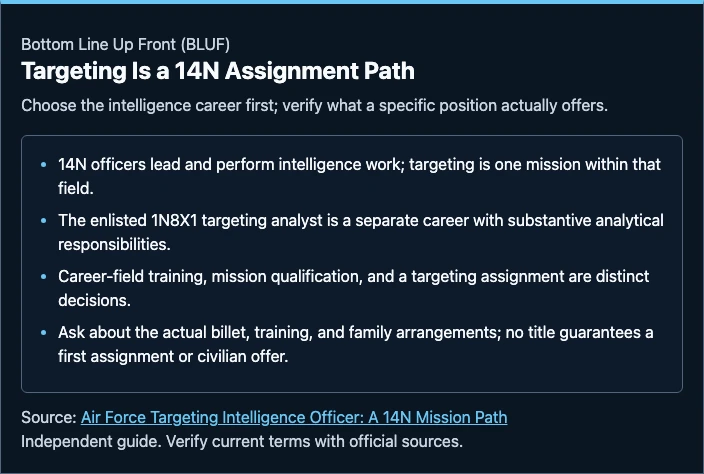
- 14N officers lead and perform intelligence work; targeting is one mission within that field.
- The enlisted 1N8X1 targeting analyst is a separate career with substantive analytical responsibilities.
- Career-field training, mission qualification, and a targeting assignment are distinct decisions.
- Ask about the actual billet, training, and family arrangements; no title guarantees a first assignment or civilian offer.
Source: Air Force Targeting Intelligence Officer: A 14N Mission Path
Independent guide. Verify current terms with official sources.
On this page
Wing Duty is supported by purchases through our links, which may earn us a commission.
What Targeting Intelligence Officers Do
A targeting assignment puts an intelligence officer’s analysis close to operational decisions. The officer helps explain what the available intelligence supports and brings that assessment into mission planning. The Air Force’s public 14NX duties include performing intelligence activities as well as leading them, overseeing the integration of collected information, and connecting intelligence with combat operations.
That combination matters when comparing this work with a purely supervisory job. Officers need enough analytical understanding to explain the assessment while also directing intelligence work and coordinating with other organizations. Leading a team does not remove the responsibility to understand its conclusions.
The broader 14N Intelligence Officer profile covers the parent career field. This specialty page concentrates on targeting work within that field; the recruiting site’s 14NX description covers a wider set of intelligence duties.
From Information to a Targeting Recommendation
Information becomes useful to a commander when analysts explain its meaning for the decision at hand. Joint intelligence doctrine describes intelligence as a combination of quantitative analysis and qualitative judgment, with room for competing interpretations. It explicitly calls for analysts to communicate their confidence in their conclusions because intelligence is not an exact science. Joint Publication 2-0
For an applicant, this explains why the work requires more than finding information quickly. A report can contain a specific observation without settling the larger question, and an assessment can be useful while still uncertain. The important skill is explaining how strongly the evidence supports the conclusion so the recipient can give it appropriate weight.
Targeting also involves coordinated intelligence production. The publicly indexed text of Air Force targeting doctrine describes intelligence staff integrating and prioritizing production in support of the air component, alongside operations staff responsibilities for target nomination and development. A targeting recommendation therefore belongs within a command process; an intelligence officer’s job title does not itself confer independent authority to approve a strike.
An Air Operations Center Is a Team
An Air Operations Center (AOC) brings intelligence support into a wider planning and operations organization. U.S. Air Forces Central describes its Intelligence, Surveillance and Reconnaissance Division as providing analysis, collection planning, and targeting support to the commander, the operations center, and subordinate units. Its stated purpose includes helping leadership make decisions. AFCENT’s division overview
This relationship explains why targeting work cannot be understood as one officer working alone with a list. Intelligence personnel contribute to a larger organization with operational objectives and other professional responsibilities. The AFCENT description is a public example of that relationship, rather than a promise that every targeting officer receives the same assignment or performs every function described there.
Legal advice is another contribution to command decisions. In a published account of operations-center work, the Air Force described legal advisers working alongside other experts to help commanders consider intelligence, available capabilities, desired effects, and legal requirements. That historical account illustrates the collaboration; it is not a current staffing chart. Air Force explanation of operational legal advice
Officer and Enlisted Targeting Work Compared
The enlisted 1N8X1 Targeting Analyst is a separate career from the commissioned 14N Intelligence Officer. Both contribute to intelligence work, so the useful distinction is not “officers think, enlisted Airmen enter data.” The Air Force explicitly assigns substantive analytical duties to enlisted targeting analysts.
Its 1N8X1 career description includes target development, support to target-system analysis, and combat assessment. It also lists mission-planning support and assessments of threats and vulnerabilities. These responsibilities make the enlisted specialty directly relevant if the targeting mission interests you more than the commissioned-officer route itself.
| Comparison | 14N officer | 1N8X1 enlisted analyst |
|---|---|---|
| Public career emphasis | Lead and perform intelligence work; oversee analysis and integrate intelligence with operations | Perform targeting analysis and development; support planning and assessment |
| Breadth of the listed career | Intelligence duties extending beyond targeting | A career description centered on targeting |
| What the title establishes | Commissioned intelligence career field | Enlisted targeting specialty |
Read those descriptions as career outlines, not an absolute division of every task. The officer description includes performing analysis, while the enlisted description includes planning support and target-list responsibilities. Neither supports a claim that officers exclusively make assessments or that enlisted analysts have no role in planning.
If you are weighing the two routes, compare the 1N8X1 Targeting Analyst profile with the parent officer profile. Keep the choice of commissioning separate from your interest in a particular mission: they are related decisions, but they answer different questions.
Judgment, Uncertainty, and Civilian Harm
Targeting intelligence can contribute to decisions with lethal consequences. Current Air Force targeting doctrine states that preventing, mitigating, and responding to civilian harm should be integrated into mission objectives and targeting. It also describes judge advocates assisting commanders and planners with legal review before execution. AFDP 3-60, Targeting
The stakes are visible in public investigations. In its May 2024 release about a May 2023 strike in Syria, U.S. Central Command reported that U.S. forces misidentified the intended target and killed a civilian. CENTCOM acknowledged the harm and identified improvements to its targeting processes, while withholding classified findings. CENTCOM’s investigation findings
That case establishes a real consequence of misidentification; it does not establish what every targeting officer experiences. When assessing personal fit, take seriously both the analytical uncertainty and the consequences of the work. Producing a clear assessment means preserving its limits, even when a decision-maker needs an answer.
How to Reach Targeting Work Through 14N
The entry decision is whether to pursue an intelligence officer commission, with targeting as an assignment interest. The Air Force intelligence officer career page identifies 14NX as the officer field and lists the Air Force Academy, Air Force Reserve Officer Training Corps, and Officer Training School as commissioning routes. A commission and a particular targeting assignment are different decisions; ask what the program can actually offer before treating an interest as a commitment.
Use this sequence to organize your preparation:
- Confirm the commissioning route. Ask the responsible admissions office, detachment, or officer recruiter about eligibility, selection, and the current application schedule for your circumstances.
- Check education and testing requirements. Have the recruiter confirm how your degree meets the current 14N education matrix, rather than assuming that any bachelor’s degree qualifies. The recruiting page lists the Air Force Officer Qualifying Test (AFOQT); confirm the requirements that apply to your program before planning test preparation.
- Distinguish 14N selection from targeting placement. Ask when career-field selection occurs, when assignment preferences are considered, and whether the opportunity under discussion is an actual position or a possible future path.
- Plan for training and qualification. Request the expected sequence and explain any constraints that could affect attendance, relocation, or family arrangements.
The April 2026 officer classification directory, pages 73–74 identifies 14N1 as entry, 14N3 as qualified, and 14N4 as staff. It places targeting within 14N duties rather than giving it a separate targeting suffix, and it directs applicants to Appendix A for education requirements. Those distinctions matter when a conversation uses “targeting intelligence officer” as a job description: ask for the underlying specialty and position requirements.
For applicants whose commissioning route requires the AFOQT, an AFOQT preparation course can organize examination practice. It does not qualify an intelligence officer, confer a clearance, or secure a targeting assignment. A study guide is another preparation option; both links are affiliate links.

Training and Assignment Are Separate Gates
Officer preparation develops the military officer; intelligence training develops career-field knowledge. Goodfellow Air Force Base identifies its 14N Intelligence Officer Course at the 315th Training Squadron. Do not read a commissioning-school duration as the length of the complete intelligence training path.
The April 2026 directory requires the Intelligence Officer Initial Skills Course for 14N1. For 14N3, it requires mission qualification and at least 36 months performing intelligence functions; that experience requirement does not mean an officer must wait 36 months before receiving any targeting-related work. Qualification for an assigned mission and the award of a qualified career-field code are related but distinct questions.
Ask the gaining organization which training applies to the actual duty. Useful questions include whether additional instruction precedes arrival, what supervised learning follows arrival, and how the unit decides an officer is ready to perform assigned responsibilities. Avoid building a personal timeline around an old course length or another officer’s experience at a different unit.
Security eligibility is another requirement, not a substitute for professional competence. The directory requires a current Tier 5 background investigation, with an interim Top Secret provision for entry-level award. You should resolve personal eligibility questions through the authorized recruiting and security process rather than asking an informal contact to predict an adjudication.
Work Setting and Family Decisions
Evaluate the position’s working conditions separately from its mission label. “Targeting” alone does not tell a family the duty location, work schedule, or expected time away, and this article cannot establish a deployment frequency for the whole field. A useful conversation asks about the specific unit and distinguishes its present arrangements from what could change.
Before making a family plan, seek answers about:
- Daily hours: whether the position uses a normal duty schedule, recurring shifts, or a different schedule during exercises and operations.
- Time away: what training travel and other absences the unit can discuss, including how much notice families usually receive.
- Workplace restrictions: what personal devices and communications are permitted, and how family members should make urgent contact.
- Relocation: which location is confirmed, which is still a preference, and when written orders will clarify the move.
Ask for practical detail without requesting sensitive information. For example, “How should a spouse reach someone during an emergency?” is more useful for family planning than asking what a particular targeting team is working on.
Do not commit to housing or childcare based only on a general career description. Goodfellow publishes in-processing guidance for incoming 14N students, including information relevant to temporary-duty and permanent-change-of-station students. Confirm the instructions attached to the actual orders before making arrangements.
Career Development and Civilian Transfer
For career planning, distinguish becoming proficient in targeting from deciding that every later assignment must remain in targeting. Ask a supervisor or career-field adviser how a proposed position would develop analytical expertise and officer responsibilities, and which later opportunities it could support. A useful answer explains the learning and experience involved rather than promising a promotion or a permanent niche.
Civilian comparisons should begin with the work an employer needs. The Intelligence Community lists all-source, geospatial, and other intelligence analyst careers, so there are several areas to investigate beyond a civilian title containing “targeting.” Compare an actual vacancy’s requirements with demonstrable experience in research, analysis, written assessments, and communication.
Military experience does not remove an employer’s selection process. For example, the FBI intelligence analyst hiring process includes a writing assessment and structured interview, and its education and experience requirements vary by role and grade. Its conditional offers also depend on further requirements, including the background investigation and agency needs.
Use those requirements to identify development goals while still serving. If a desired job emphasizes a technical method or a particular kind of analysis, determine whether the proposed assignment will provide that experience rather than relying on the 14N title alone. Discussing a possible transition is sensible; treating a clearance or military position as a guaranteed civilian offer is not a sound career plan.
Questions to Ask Before Choosing the Path
Bring separate questions to the recruiter and to someone familiar with the prospective unit. The recruiter can address the accession process; the unit can explain the position within the limits of what it may share publicly.
- What exactly is being offered: a commissioning opportunity, consideration for 14N, or selection for a specific position?
- Which current education, testing, and security requirements apply to this application?
- At what point can an applicant express a targeting preference, and what remains undecided afterward?
- Which training and qualification requirements apply to this position, and who confirms their completion?
- How much of the position involves analytical work, and how much involves leading people or coordinating work?
- Which schedule, travel, and relocation details are confirmed well enough for family planning?
Finally, consider the broader career choice: would intelligence officer service still appeal if the first assignment did not involve targeting? If the answer depends entirely on one mission, resolve that uncertainty before accepting a path whose confirmed terms are broader.
Where to Go Next
Use the 14N Intelligence Officer profile for the broader career, and the 14N versus 14F comparison when weighing intelligence against information operations. The free AFOQT guide explains test preparation where it applies. Confirm the current program and position requirements with the responsible office before making commitments.