71S Special Investigations Officer
Most Air Force officers lead Airmen on a flight line or inside an operations center. AFOSI officers lead federal law enforcement agents in criminal investigations, counterintelligence operations, and fraud cases that span continents. The jurisdiction covers every Air Force and Space Force installation on earth, and the missions range from prosecuting felonies on base to countering foreign intelligence services trying to steal defense secrets.
If you commission as a 71S Special Investigations Officer, you’re not just an Air Force officer, you are a credentialed federal law enforcement agent. That distinction shapes everything from your training pipeline to your career options after you leave the service.
Preparing for the officer commissioning process starts with the AFOQT. A competitive score strengthens your commissioning package for any career field, including 71S.
Job Role and Responsibilities
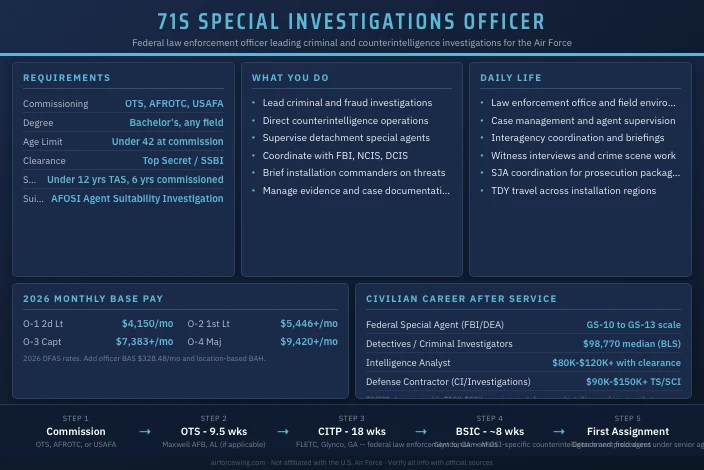
71S Special Investigations Officers are commissioned officers who lead federal criminal investigations, counterintelligence programs, and fraud inquiries across Air Force and Space Force installations worldwide. As the Department of the Air Force’s primary federal law enforcement and counterintelligence organization, AFOSI officers direct investigative teams, coordinate with the FBI, NCIS, and other federal agencies, and brief senior commanders on threats to installations, personnel, and defense programs.
Command and Leadership Scope
At the flight level, a 71S officer leads a detachment of special agents, typically enlisted agents and civilian special agents, covering one or more installations. Detachment commanders manage caseloads, supervise active investigations, coordinate with base legal offices, and serve as the senior law enforcement advisor to the installation commander. As officers advance, they move into supervisory positions overseeing multiple detachments within a region.
At the O-4 to O-5 level, officers serve as Special Agents in Charge (SAICs) of field investigative regions or staff positions at AFOSI headquarters at Marine Corps Base Quantico, Virginia. The most senior officers. O-6 colonels, lead major units or serve as key staff officers within AFOSI’s organizational structure reporting to the Inspector General of the Air Force.
Specific Roles and Shredouts
| AFSC | Designation | Description |
|---|---|---|
| 71S1 | Special Investigations Officer | Entry-level; field agent and investigative duties |
| 71S2 | Special Investigations Officer | Mid-level; supervisory and program management |
| 71S3 | Special Investigations Officer | Senior; command, staff, and policy responsibilities |
| 71SX | Special Investigations Officer (general) | Career field designator across all levels |
Special Experience Identifiers (SEIs) within this field denote qualifications in counterintelligence operations, technical surveillance, forensic science support, and protective service operations.
Mission Contribution
AFOSI is the Department of the Air Force’s major investigative service, established in 1948. The agency protects Air Force and Space Force personnel and assets from criminal activity, foreign intelligence collection, and insider threats. AFOSI officers direct investigations into crimes that affect readiness, drug trafficking, sexual assault, theft of government property, cybercrime, and procurement fraud, as well as counterintelligence operations targeting adversary recruitment of Air Force personnel.
The interagency dimension sets this career field apart from most. AFOSI officers work directly with the FBI Joint Terrorism Task Forces, Defense Criminal Investigative Service (DCIS), NCIS, CID, and civilian law enforcement agencies on cases that cross jurisdictions. That working relationship produces a professional network and investigative depth that few military career fields can match.
Technology and Systems
AFOSI officers use federal law enforcement databases, including NCIC, classified government networks for threat reporting, and AFOSI’s centralized ICON Center, the Department of the Air Force’s hub for integrating investigative and counterterrorism threat data. Officers also manage technical surveillance assets, coordinate forensic laboratory support, and employ commercially available intelligence tools for open-source research.
Salary and Benefits
Officer Base Pay
All military pay uses 2026 DFAS rates. Basic pay depends on grade and years of service. Officers also receive Basic Allowance for Housing (BAH), which varies by duty station and dependent status, plus Basic Allowance for Subsistence (BAS) of $328.48 per month for officers. Before any of these rates apply, you need to commission, and strong AFOQT scores are the first step in every commissioning package.
| Grade | Title | Years of Service | Monthly Basic Pay |
|---|---|---|---|
| O-1 | 2d Lt | Less than 2 | $4,150 |
| O-2 | 1st Lt | 2 years | $5,446 |
| O-3 | Capt | 4 years | $7,383 |
| O-3 | Capt | 6 years | $7,737 |
| O-4 | Maj | 10 years | $9,420 |
| O-5 | Lt Col | 14 years | $10,715 |
Special Pay
AFOSI officers do not receive aviation career incentive pay or rated flight pay, but they may qualify for special duty assignment pay (SDAP) during certain assignments. Officers who serve in high-cost overseas locations receive overseas cost-of-living allowances. Law Enforcement Availability Pay (LEAP), which supplements federal civilian agent pay, does not apply to military members, pay is military basic pay plus applicable allowances.
Additional Benefits
Active-duty officers receive TRICARE Prime at no enrollment cost, covering medical, mental health, prescriptions, and hospitalization. Dental care is provided at military treatment facilities. BAH for officers is grade-dependent and location-based, an O-3 in a high-cost duty station can receive more than $2,500 per month in housing allowance.
The Blended Retirement System (BRS) provides a pension equal to 40% of high-36 average basic pay at 20 years, plus Thrift Savings Plan matching up to 5% of basic pay. Officers are also eligible for the Post-9/11 GI Bill and Air Force Tuition Assistance ($4,500 per year) for graduate education while on active duty.
Work-Life Balance
Investigative work does not follow a standard 9-to-5 schedule. Cases drive the tempo. A major investigation, a felony assault, a drug trafficking case, a counterintelligence referral, can generate surge periods with extended hours and travel on short notice. Between major cases, the pace at a single-installation detachment is more predictable. Officers in staff assignments at headquarters or region levels generally work structured hours with heavier travel requirements.
Annual leave accrues at 30 days per year. The Air Force has a strong use-or-lose culture, and most officers are able to take meaningful vacation time outside peak operational periods.
Qualifications and Eligibility
Commissioning Requirements
AFOSI selects its 71S officers through a separate board process. Candidates must first commission through one of the three standard Air Force sources, then be selected by the AFOSI selection board. The board reviews academic credentials, writing samples, and a required interview with an AFOSI detachment commander.
AFOSI runs a stand-alone suitability investigation separate from the standard background investigation process. This Agent Suitability Investigation (ASI) evaluates emotional stability, judgment, and personal history. A favorable ASI is required before attending AFOSI training, not just a security clearance.
| Commissioning Source | GPA Minimum | Degree Requirements | Age Limit | Key Prerequisites |
|---|---|---|---|---|
| OTS | Competitive (varies by board) | Bachelor’s degree, any field | Under 42 at commissioning | AFOQT passing score, favorable ASI |
| AFROTC | Competitive (varies by board) | Bachelor’s degree in progress | Under 42 at commissioning | AFOQT passing score, favorable ASI |
| USAFA | N/A | Bachelor’s degree (awarded at graduation) | N/A | AFOSI selection board, favorable ASI |
Additional eligibility requirements beyond commissioning:
- Less than 12 years total active military service at time of selection
- No more than six years commissioned service at time of selection
- Must qualify to bear firearms (no disqualifying criminal history)
- Normal color vision required
- Valid state driver’s license
- Ability to speak and write English clearly
- No history of emotional instability
Test Requirements
All Air Force officer candidates must take the Air Force Officer Qualifying Test (AFOQT). AFOSI does not publish a separate minimum score for the 71S career field beyond the standard passing threshold. Competitive packages combine the AFOQT score with GPA, interview performance, and the ASI outcome. There is no TBAS requirement for this non-rated career field.
Candidates should treat the AFOQT seriously. A strong score, particularly in the verbal and quantitative composite areas, signals the analytical and writing ability that AFOSI values in agents who will write investigative reports and testify in federal proceedings. Use an AFOQT study guide to prepare for all tested areas before submitting your commissioning package.
Career Field Assignment
AFOSI conducts its own selection process separate from the standard AFPC career field assignment process. Interested candidates must contact an AFOSI recruiter or detachment commander for an interview, submit a completed application package, and receive a favorable ASI outcome before a 71S assignment can be made. Slots are limited and the board selects based on overall package quality.
Officers selected for 71S enter active duty at O-1 (2d Lt) and incur a standard Active Duty Service Commitment (ADSC). The specific ADSC is tied to training investment and may be updated; confirm with an AFOSI recruiter for current requirements.
Work Environment
Setting and Schedule
AFOSI officers work in a law enforcement environment that blends office work, field investigations, and interagency coordination. Day-to-day work includes reviewing case files, supervising investigative activities, interviewing witnesses, coordinating with prosecutors in the Staff Judge Advocate office, and briefing commanders. Major cases pull officers to crime scenes, federal courthouses, and off-installation locations.
Most assignments are on or near Air Force installations, but AFOSI operates worldwide. Officers assigned to AFOSI region headquarters or headquarters at Quantico work in a staff environment with higher TDY tempo. Overseas assignments expose officers to joint and combined law enforcement work with host-nation agencies.
Leadership and Chain of Command
71S officers sit above their enlisted and civilian agents in the supervisory chain but below region and headquarters staff. The officer-agent relationship in AFOSI differs from the standard military officer-NCO dynamic. Enlisted AFOSI agents and civilian special agents are credentialed investigators in their own right, and the officer’s role is to direct, coordinate, and supervise caseloads rather than to micromanage individual investigative techniques. Senior NCOs in AFOSI detachments carry significant investigative experience that newer officers should treat as a professional resource.
Staff versus Command
Early in a career, officers lead detachments (command-equivalent positions). Mid-career, they rotate through staff positions at region headquarters or AFOSI headquarters covering program management, resource management, or policy. Senior officers alternate between SAIC command billets and key staff positions. AFOSI is a relatively small organization, which means officers get meaningful command experience earlier than in larger career fields.
Job Satisfaction and Retention
AFOSI attracts officers who want to do law enforcement work rather than traditional military operational roles. The mission is distinct from most Air Force career fields, and officers who want investigative careers tend to stay through their initial obligation and beyond. Officers with strong civilian law enforcement interest sometimes transition to FBI, DEA, or other federal agencies after their ADSC, the AFOSI credential and clearance are highly valued. Those who remain find a career field with genuine variety: no two investigative portfolios are the same.
Key factors that influence retention:
- Federal credential portability: AFOSI training and FLETC graduation qualify officers for lateral moves to other federal law enforcement agencies
- Investigative autonomy: Detachment commanders run their own caseloads with limited micromanagement from higher echelons
- Interagency exposure: Regular collaboration with FBI, DEA, DHS, and NCIS builds a professional network most military officers never access
- Career field size: The small career field means officers reach meaningful command positions earlier than in larger AFSCs
- Clearance value: TS/SCI clearance maintained throughout service significantly increases post-service earning potential
Training and Skill Development
Pre-Commissioning Training
Officers commission through OTS (9.5 weeks at Maxwell AFB, AL), AFROTC, or the Air Force Academy. None of these programs include AFOSI-specific training, that begins after commissioning and selection into the 71S career field.
Initial Skills Training
The 71S training pipeline is more extensive than most non-rated officer career fields because AFOSI graduates must be credentialed federal law enforcement agents before their first field assignment.
| Phase | Location | Length | Focus |
|---|---|---|---|
| Officer Training School | Maxwell AFB, AL | 9.5 weeks | Officer fundamentals, leadership, Air Force culture |
| Criminal Investigator Training Program (CITP) | FLETC, Glynco, GA | 18 weeks | Federal law enforcement: investigative techniques, legal authorities, firearms, arrest procedures |
| Basic Special Investigators Course (BSIC) | Glynco, GA | ~8 weeks | AFOSI-specific: counterintelligence methods, Air Force jurisdiction, agency procedures, reporting formats |
| First Unit Assignment | Worldwide | Ongoing | On-the-job development under supervision of senior agents |
The Criminal Investigator Training Program at the Federal Law Enforcement Training Centers (FLETC) is the same foundational course completed by agents from many federal agencies. Graduating from CITP puts AFOSI officers alongside DEA, Secret Service, and Homeland Security Investigations counterparts in terms of baseline credentials.
Professional Military Education
- Squadron Officer School (SOS): Required for O-3 promotion board competitiveness. Completed in-residence at Maxwell AFB or by distance learning. Covers leadership fundamentals and joint operations context.
- Air Command and Staff College (ACSC): Eligible at the O-4 level. In-residence program at Maxwell AFB, AL covers joint warfighting and operational strategy.
- Air War College (AWC): Senior officer program for O-5 and O-6. Covers national security strategy and senior leadership.
Additional Training
Officers can pursue advanced counterintelligence training, forensic science programs, and joint intelligence courses throughout their careers. AFOSI coordinates with the Defense Intelligence Agency and other intelligence community members to provide specialized training not available through standard Air Force channels. The Community College of the Air Force (CCAF) has accredited AFOSI training courses, meaning agents can earn college credits toward a degree while completing their pipeline training. Officers building toward a commission can review officer test preparation resources to understand the full AFOQT scope before entering the pipeline.
Career Progression and Advancement
Career Timeline
| Rank | Grade | Typical Time-in-Grade | Key Developmental Positions |
|---|---|---|---|
| 2d Lt | O-1 | 18 months | AFOSI training pipeline, new agent under mentorship |
| 1st Lt | O-2 | 2 years | Field agent duties, first supervisory experience |
| Capt | O-3 | 4 years | Detachment commander (KD position), case supervision |
| Maj | O-4 | 4-5 years | Region staff, SAIC billet, AFOSI HQ staff |
| Lt Col | O-5 | 4-5 years | SAIC command, senior staff, joint assignment |
| Col | O-6 | Varies | Major unit command, AFOSI HQ senior leadership |
The detachment commander assignment at the O-3 level is the primary Key Developmental (KD) position for career progression. Officers who skip or delay this KD assignment are at a disadvantage for O-4 promotion boards.
Promotion System
O-1 through O-3 promotions are essentially automatic with time in service and satisfactory performance. O-4 and above require selection by a centralized Air Force promotion board. The board evaluates officer performance reports, the breadth and quality of assignments, PME completion, and advanced degrees.
Current promotion rates for the 71S career field are not publicly published at the AFSC level. Historically, small career fields show variable rates that track closely with overall Air Force officer promotion rates. Contact AFPC or an AFOSI career manager for current board statistics.
Cross-Training and Broadening
Mid-career officers can apply for joint assignments with the Defense Intelligence Agency, NCIS, FBI task forces, and combatant command J2 staffs. ROTC instructor duty, Air Force fellowships, and Congressional liaison positions are available as broadening assignments. Officers who want to move to another career field after their 71S ADSC can apply for retraining, though movement out of a specialized career field like AFOSI is board-dependent.
Building a competitive file in this field requires: outstanding OPR ratings, completion of the KD detachment commander assignment, in-residence PME, advanced education (AFIT-funded master’s degrees are available), and joint assignment exposure.
Physical Demands and Medical Evaluations
Fitness Standards
All Air Force officers take the same Air Force Fitness Assessment. There are no AFSC-specific fitness standards that differ from the standard test.
| Component | Maximum Points | Minimum Requirement |
|---|---|---|
| 1.5-Mile Run | 60 points | Must meet component minimum |
| Waist Circumference / Body Composition | 20 points | Must meet component minimum |
| Push-Ups (1 minute) | 10 points | Must meet component minimum |
| Sit-Ups (1 minute) | 10 points | Must meet component minimum |
| Total | 100 points | 75 points minimum composite |
Standards are age- and gender-normed. Verify current scoring tables and component minimums at af.mil.
Career Field-Specific Physical Requirements
71S officers carry physical requirements beyond the standard FA that reflect the law enforcement nature of the mission:
- Firearms qualification: Officers must pass the initial firearms course at FLETC and maintain annual qualification with the government-issued sidearm throughout their AFOSI career. Failure to qualify results in removal from field investigative duties until requalified.
- Defensive tactics proficiency: FLETC and the Basic Special Investigators Course include arrest techniques, control holds, and self-defense instruction. Officers maintain these skills through periodic refresher training.
- Driver’s license: A valid driver’s license is mandatory for the duration of service in this career field. Investigative work routinely involves driving to interview sites, surveillance locations, and coordination meetings across installation boundaries.
- Color vision: Normal color vision is required at entry.
- Flight physical: Not required. However, the agent selection interview (ASI) process evaluates physical and emotional suitability beyond the standard commissioning medical exam, and adverse findings can disqualify candidates.
The physical demands during active investigations can be unpredictable. Officers may conduct extended surveillance operations requiring hours of sustained alertness, execute search warrants that involve forced entry with tactical support, or travel on short notice to coordinate with agencies at distant locations. While the job is not physically demanding in the way combat arms career fields are, officers who let their fitness lapse find the operational tempo harder to sustain.
Deployment and Duty Stations
Deployment Details
AFOSI officers deploy consistent with Air Force-wide deployment policies. AFOSI agents support contingency operations and have historically deployed to combat zones to conduct counterintelligence and criminal investigation support for Air Force units in theater. Deployment tempo varies significantly by assignment. Officers at a stateside installation detachment may go a full tour without a combat deployment. Officers in expeditionary support roles or assigned to AFOSI units that support combatant command requirements will deploy more frequently.
TDY travel is a consistent feature of this career field regardless of deployment status. Investigators often travel to coordinate with other agencies, attend federal proceedings, or support cases that cross installation boundaries.
Duty Stations
AFOSI maintains detachments at Air Force and Space Force installations worldwide. Major concentrations include:
- AFOSI Headquarters: Marine Corps Base Quantico, Virginia
- Continental United States (CONUS): detachments at every major Air Force installation
- Europe: units aligned with USAFE bases in Germany, United Kingdom, Italy
- Indo-Pacific: units at bases in Japan, South Korea, Guam, Hawaii
- Middle East and Africa: rotational and forward-deployed support
Assignments are managed by AFPC with input from AFOSI. Officers typically do not spend more than four years at the same duty station. Geographic preferences are considered but are not guaranteed.
Risk, Safety, and Legal Considerations
Job Hazards
AFOSI officers conduct law enforcement operations that carry inherent physical risk. The primary hazard categories include:
- Subject contact risk: Executing search warrants, conducting surveillance, and apprehending subjects involve exposure to potentially dangerous individuals. Officers are trained, equipped, and authorized to carry firearms in the performance of their duties.
- Command and supervisory liability: An officer whose agents commit misconduct or procedural errors during an investigation can face scrutiny even when they were not directly involved. Documentation discipline and supervision quality matter in ways that have real career consequences.
- Counterintelligence exposure: Officers working CI cases interact with individuals under investigation for espionage or foreign intelligence contact, which creates inherent personal security considerations.
Safety Protocols
AFOSI applies standard law enforcement safety protocols:
- Threat assessment before every warrant execution, arrest, or high-risk interview
- Team-based operations for high-risk activities, coordinating with Security Forces or dedicated AFOSI response teams
- ORM frameworks applied to investigative operations, documenting risk factors and mitigation measures
- Staff Judge Advocate coordination before executing warrants or arrest actions to ensure legal compliance
Legal and Command Responsibility
71S officers hold federal law enforcement authority. That authority comes with significant legal accountability. Officers are responsible for ensuring investigations comply with the Manual for Courts-Martial, the Uniform Code of Military Justice (UCMJ), and applicable federal law. Evidentiary errors, improper search and seizure procedures, or violations of subjects’ rights can result in case dismissal and adverse command action against the responsible officer.
Officers must maintain a thorough working relationship with the installation Staff Judge Advocate. Cases heading to court-martial require close coordination to build prosecution-ready evidence packages.
Impact on Family and Personal Life
Family Considerations
The AFOSI assignment model involves regular PCS moves, typically every three to four years. Families must be comfortable relocating, since duty station options span the globe. PCS frequency in this career field is comparable to other mid-sized Air Force career fields.
Key lifestyle factors for AFOSI families:
| Factor | Impact | Mitigation |
|---|---|---|
| PCS frequency | Every 3-4 years, worldwide | AFOSI detachments at most major installations; geographic preferences considered |
| Schedule unpredictability | Active cases can extend hours on short notice | Not shift work, but caseload-driven; peaks during investigative surges |
| Classification constraints | Officers cannot discuss active cases at home | A&FRC and Key Spouse Program provide family support networks |
| TDY travel | Frequent short-notice trips for coordination and federal proceedings | Typically days, not months; less disruptive than deployment cycles |
| Overseas tours | 15-24 month accompanied tours in Europe, Indo-Pacific, Middle East | BAH adjusted for location; on-base housing often available |
The Airman and Family Readiness Center (A&FRC) at most installations provides relocation assistance, spouse employment resources, and financial counseling. The Key Spouse Program connects families within a unit during deployments and transitions. AFOSI’s geographically distributed structure means that families often end up at desirable installation locations, the career field is not concentrated at just a few bases.
Dual-Military Couples
The Air Force uses the Married Military Couple Program to co-locate dual-military couples when possible. AFOSI’s worldwide distribution helps, but co-location is not guaranteed. Couples should discuss assignment preferences early with their respective career managers.
TDY travel, sometimes unpredictable in timing and duration, is the more frequent family impact for 71S officers compared to sustained deployment absences. Officers who communicate openly with their families about the demands of investigative work and set realistic expectations about schedule flexibility report better household adjustment than those who treat the unpredictability as something the family will just absorb on its own.
Reserve and Air National Guard
Component Availability
AFOSI has Reserve component positions for officer special agents. The Air Force Reserve Command maintains AFOSI Individual Mobilization Augmentee (IMA) positions and traditional reserve unit positions at selected locations. The Air National Guard does not maintain 71S officer positions. AFOSI is a federal active-duty and Reserve Command function.
Reserve component 71S officers are rare. Most AFOSI officers are active-duty. If you are specifically interested in Reserve participation in federal law enforcement, confirm current billet availability with AFOSI’s Reserve component recruiting office.
Commissioning and Transfer
Reserve 71S candidates commission through the same paths as active-duty officers. Active-duty 71S officers who separate after their ADSC can request affiliation with an Air Force Reserve unit if billets are available. Continuity of the security clearance is the primary enabling factor, a lapsed or revoked clearance ends participation in this career field.
Drill Commitment and Pay
The standard Reserve commitment is one Unit Training Assembly weekend per month plus two weeks of Annual Tour. Reserve AFOSI officers may be called for additional training, exercises, or ADOS (Active Duty Operational Support) tours to backfill active-duty requirements. An O-3 Reservist earns approximately two days of basic pay per drill weekend based on the current DFAS rate of $7,383 per month (at four years of service), roughly $492 per drill day.
Benefits Comparison
| Category | Active Duty | Air Force Reserve | Air National Guard |
|---|---|---|---|
| Commitment | Full-time | ~39 days/year minimum | ~39 days/year minimum |
| Monthly Base Pay (O-3) | $7,383+ | Drill weekends only | N/A (not available for 71S) |
| Healthcare | TRICARE Prime (free) | TRICARE Reserve Select (premiums apply) | N/A |
| Education | Post-9/11 GI Bill, TA | Limited GI Bill eligibility by activation | N/A |
| Deployment Tempo | Varies by assignment | Mobilization possible | N/A |
| Command Opportunities | Yes, detachment command | Limited; IMA billets exist | N/A |
| Retirement System | BRS pension at 20 years | Points-based Reserve retirement | N/A |
Post-Service Opportunities
Transition to Civilian Life
AFOSI officers leave the service with a federal law enforcement credential, an active Top Secret/SCI clearance, and documented investigative experience that civilian agencies actively recruit. The combination is rare and commands competitive compensation in the federal and defense contractor hiring markets.
Transition programs including Transition Assistance Program (TAP) and Hiring Our Heroes help separating officers connect with employers. Federal agency hiring, particularly at the FBI, DEA, and DHS components, often includes veterans’ preference and explicit outreach to AFOSI alumni.
Civilian Career Prospects
| Civilian Job Title | BLS Median Annual Salary | Job Outlook (2024-2034) |
|---|---|---|
| Detectives and Criminal Investigators | $98,770 | ~3% growth |
| FBI / Federal Special Agent | Varies by GS grade; GS-10 to GS-13 common | Stable federal demand |
| Intelligence Analyst | $80,000-$120,000+ (clearance premium) | Strong defense sector demand |
| Compliance and Fraud Examiner | $75,000-$110,000 | Above-average growth |
| Defense Contractor (Investigative/CI) | $90,000-$150,000+ with TS/SCI | Strong demand |
The TS/SCI clearance carried by most separating 71S officers is worth $10,000-$30,000 in additional annual compensation in the defense contractor and intelligence community hiring markets, compared to otherwise identical civilian candidates without a clearance.
Graduate Education and Credentials
The AFOSI training pipeline produces agents who have completed federal law enforcement certifications equivalent to those held by other federal agencies. The CCAF has accredited AFOSI academy courses for college credit. Officers using the Post-9/11 GI Bill can pursue law school, an MBA, or graduate programs in criminal justice, national security, or public policy. The GI Bill covers full in-state tuition at public universities or up to $29,920.95 per academic year at private institutions.
Is This a Good Job for You?
The Right Fit
The ideal 71S candidate combines intellectual curiosity with practical judgment. Investigations require patience, writing discipline, and the ability to manage ambiguity, cases rarely hand you answers. Candidates with backgrounds in criminal justice, political science, history, foreign languages, or STEM fields all succeed in this career field; the degree field matters less than the candidate’s analytical and communication ability.
| Trait | Why It Matters for 71S |
|---|---|
| Strong writing skills | Investigative reports and court-ready packages are core deliverables |
| Comfort with ambiguity | Cases rarely present clear answers early; you piece together evidence over weeks or months |
| Leadership initiative | Detachment commanders own cases, agent development, and commander confidence |
| Interagency diplomacy | Daily coordination with FBI, NCIS, local law enforcement requires professional credibility |
| Ethical judgment | Federal law enforcement authority demands officers who can apply it responsibly |
You should want to lead a team, not just be part of one. Detachment commanders own their cases, their agents’ development, and their installation commander’s confidence in law enforcement on the base. That accountability is the core of the job.
What Might Push You Away
The workload during active investigations is unpredictable. If you need schedule certainty, this career field will frustrate you. Officers in high-caseload detachments, particularly those near large bases with active criminal trends, can work extended hours for weeks at a stretch.
The career field is also small. Promotion competition is real, and officers who miss the KD detachment commander assignment early often struggle to rebuild a competitive file. PCS frequency is another pressure point for officers who want geographic stability.
Career Alignment
For officers who want a 20-year career in federal law enforcement leadership, 71S is one of the most direct paths available in uniform. For officers who plan to separate after four to six years, the career field delivers credentials and a clearance that translate immediately to high-demand civilian roles. The one-and-done path works well here, the credential value after a single ADSC is substantial.
Officers looking for a flying career, combat arms experience, or the traditional flight line officer culture will find 71S a poor fit. The mission is law enforcement and intelligence, not operations.
More Information
Contact an AFOSI recruiter or your nearest AFOSI detachment to arrange the required interview. You can find contact information through osi.af.mil. Candidates pursuing an officer commission through any source should start AFOQT study guide as early as possible, the test is required for all commissioning paths and competitive scores improve your overall package.
This site is not affiliated with the U.S. Air Force or any government agency. Verify all information with official Air Force sources before making enlistment or career decisions.
Explore more Air Force Intelligence officer careers such as the 14N Intelligence Officer and 14F Information Operations Officer.