16F Foreign Area Officer
Most officers spend their careers within a single lane. A 16F Foreign Area Officer is built differently. You spend the first seven to ten years doing operational work in your base career field, flying missions, managing intelligence operations, directing civil engineering, or whatever brought you into the Air Force, then you apply to become a different kind of officer entirely. The FAO program pulls mid-career captains and majors out of their home career fields, trains them in a foreign language at the Defense Language Institute, sends them to graduate school for a regionally focused advanced degree, and plants them overseas for in-region immersion. What comes out is an officer the Air Force deploys to embassy attaché offices, Defense Intelligence Agency billets, and combatant command political-military staffs to do work that blends operational expertise with deep regional knowledge. It’s a demanding path, and not all applicants get selected. But for officers who want their career to operate at the intersection of military operations and international diplomacy, there is no cleaner route in the Air Force.
Job Role and Responsibilities
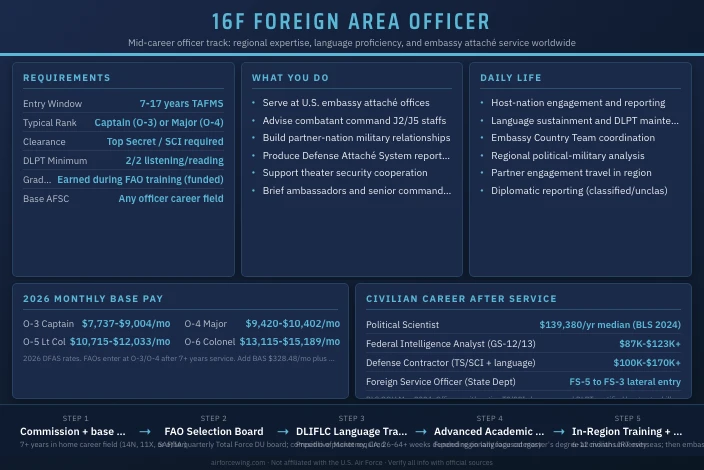
The 16F Foreign Area Officer is a mid-career functional area that designates officers as regional experts and language-enabled representatives of the U.S. Air Force in political-military environments. FAOs serve at U.S. embassy defense attaché offices, Defense Intelligence Agency (DIA) billets, combatant command J2 and J5 staffs, and Pentagon international affairs positions. They build partner-nation relationships, advise senior leaders on regional security dynamics, support theater security cooperation programs, and represent Air Force interests in multi-national and interagency settings.
Command and Leadership Scope
The 16F AFSC does not have its own command structure in the traditional sense. FAOs are not assigned to lead 16F flights or squadrons. They serve in billets where regional expertise and language skill are the primary requirement, working within organizations commanded by officers from other career fields. At an attaché office, a FAO might be one of two or three military officers representing the U.S. Air Force in a country’s capital. At a combatant command headquarters, they work on political-military planning teams reporting to senior joint officers.
The leadership profile is one of influence without direct command. FAOs regularly brief ambassadors, flag officers, and foreign defense officials. Getting those relationships right, and keeping them productive, is the core professional skill of the career field.
Specific Roles and Designations
The 16F AFSC uses suffix designators to denote regional specialization and specific assignment types. Per AFI 16-109, non-rated officers carry AFSC 16F; rated officers (pilots, combat systems officers) carry 16Z upon certification.
| Designation | Regional Focus | Assignment Types |
|---|---|---|
| 16F (core) | Assigned by SAF/IA | Attaché office, DIA, COCOM J2/J5, Pentagon |
| 16F suffix C-H | Region-specific (Africa, Europe, Middle East, Asia, Americas, or others) | Embassy attaché, security cooperation, theater HQ |
| 16F3A | Attaché-qualified | Minimum 12 months experience in an attaché position required |
| 16Z | Rated FAO (pilot/CSO) | Same billet set as 16F; retains rated status |
Special Experience Identifiers mark additional qualifications such as attaché duty, DIA assignments, and specific language certifications above the minimum standard.
Mission Contribution
The Air Force operates in coalition environments on every major theater. To sustain those coalitions, it needs officers who understand why a partner-nation air force makes the decisions it does, who can work through cultural and language barriers without a translator in the room, and who can represent U.S. Air Force positions in settings that blend diplomacy and military operations. That is the FAO’s function.
At the operational level, FAOs on combatant command J5 staffs participate in theater campaign planning, security cooperation program design, and foreign partner engagement. At the strategic level, FAOs in DIA billets or on Air Staff international affairs positions contribute to national-level assessments and policy decisions that shape how the U.S. military postures globally. In an attaché office, the FAO is often the primary face of U.S. air power to a foreign government for the duration of a two- to three-year tour.
Technology, Equipment, and Systems
The tools of a FAO billet are less technical than those of most officer career fields. FAOs work primarily on classified and unclassified computer networks, diplomatic communication systems, and the relational infrastructure of military-to-military engagement. In an attaché office, reporting flows through the Defense Attaché System to DIA and the combatant command. At COCOM staffs, FAOs use the same planning and command systems as other joint officers.
Language tools matter here in ways they don’t in most military careers. FAOs use the Defense Language Proficiency Test (DLPT) system for annual certification and receive Foreign Language Proficiency Bonus (FLPB) tied to maintaining their DLPT scores. Officers who score at or above 3/3 (listening/reading) can recertify every two years rather than annually.
Salary and Benefits
Base Pay
The 16F is a mid-career functional area. Officers enter the program between 7 and 10 years of commissioned service, typically as captains (O-3) or majors (O-4). Pay is set by DFAS and applies across all career fields. The commissioning-stage AFOQT is required years before FAO selection, candidates planning this path should approach AFOQT study guide as an early investment in a long career trajectory.
| Rank | Grade | Typical Time in Service | Monthly Base Pay |
|---|---|---|---|
| Captain | O-3 | 6-10 years | $7,737-$8,376 |
| Major | O-4 | 10-16 years | $9,420-$10,402 |
| Lieutenant Colonel | O-5 | 16-22 years | $11,391-$12,395 |
| Colonel | O-6 | 22+ years | $14,113-$15,189 |
Figures from DFAS 2026 military pay tables.
Special and Incentive Pay
FAOs qualify for the Foreign Language Proficiency Bonus (FLPB) based on maintaining DLPT certification in their assigned language. Bonus amounts vary by language category (difficulty tier) and proficiency level achieved. Some languages and proficiency tiers carry higher rates than others.
Officers assigned overseas to embassy attaché offices receive Post Allowance and Living Quarters Allowance (LQA) in lieu of standard BAH in CONUS assignments. These overseas allowances are determined by the State Department’s standardized rates for the specific country and vary significantly. An officer in a high-cost capital city can receive substantially more in LQA than domestic BAH would provide.
The 16F career field does not carry an accession bonus. Some DIA and combatant command billets may qualify for special duty assignment pay depending on the billet designation.
Additional Benefits
Basic Allowance for Subsistence (BAS) for officers is $328.48 per month (2026 rate). This is a flat national rate regardless of duty location.
Active-duty officers receive TRICARE Prime at no enrollment fee with no deductible and no copays. Coverage includes medical, dental, vision, mental health, and prescriptions. Officers assigned overseas access TRICARE Overseas coverage.
The Blended Retirement System (BRS) provides a 20-year pension at 40% of the average of the highest 36 months of basic pay. The government contributes 1% of base pay to TSP automatically and matches up to an additional 4% when the officer contributes. For a mid-career captain or major entering the FAO program, the retirement horizon is real and worth calculating.
Work-Life Balance
FAO billets are spread worldwide. Garrison tempo in a CONUS assignment at a MAJCOM or Pentagon international affairs billet resembles a standard government workweek, with surges during exercises and high-level engagements. Overseas attaché tours run two to three years in one location, which creates more geographic stability than the typical PCS cycle but requires the entire family to relocate internationally.
The Air Force provides 30 days of paid leave annually. Officers on overseas assignments typically have access to more tourism and travel opportunities than CONUS counterparts. The tradeoff is distance from extended family and the logistical complexity of international relocation.
Qualifications and Eligibility
How FAO Selection Works
The 16F program is not a commissioning-stage assignment. You cannot request it as a new officer. You must spend your initial career in a different officer career field, then apply through the FAO selection board after meeting the service requirements.
Per AFI 16-109, officers must have at least 7 years of commissioned active duty service and less than 17 years of Total Active Federal Military Service (TAFMS) before being considered for FAO training and education. The program is designed for experienced mid-career officers, not new lieutenants.
Commissioning Sources
There is no direct commission into the 16F AFSC. Officers enter from any commissioning source (ROTC, OTS, USAFA) as long as they have the required time in service and come from a qualifying base career field. All three sources require the AFOQT, which is taken years before the FAO window opens.
| Requirement | Detail |
|---|---|
| Minimum years of commissioned service | 7 years |
| Maximum TAFMS at time of selection | Less than 17 years |
| Typical rank at application | Captain (O-3) to Major (O-4) |
| Base career fields | Any Air Force officer AFSC; 14N, 11X, and operational AFSCs are common |
| Degree requirement | Bachelor’s at commissioning; graduate degree earned during FAO training |
| Citizenship | U.S. citizen; no dual citizenship with the assigned region’s country |
| Security clearance | Top Secret/SCI required; TS/SCI must be in place before selection |
Test Requirements
The AFOQT is required at commissioning for your original career field, not specifically for FAO selection. Officers interested in international affairs careers should maximize their AFOQT Verbal scores during initial commissioning, strong language aptitude correlates with success in the Defense Language Institute pipeline and matters to selection boards.
FAO selection boards do not require the TBAS. If you are an ROTC cadet or OTS applicant planning a long-term path toward FAO designation, preparing thoroughly for the AFOQT early in your career leaves more options open as you advance.
The FAO Selection Board
The Secretary of the Air Force International Affairs (SAF/IA) office runs quarterly Total Force FAO Direct Utilization (DU) boards. Officers who meet the eligibility criteria submit an application packet that includes:
- Officer Performance Reports (OPRs) showing operational performance in their base career field
- Demonstrated interest in international affairs (regional travel, language study, cultural engagement)
- Letter of endorsement from their commander
- Career field manager concurrence
- Statement of regional preference
SAF/IA assigns the regional specialization based on Air Force needs and applicant preferences. You do not choose your region with certainty; the Air Force matches officers to regional requirements. Prior language exposure, regional experience, or documented cultural engagement in a specific area strengthens a candidate’s case for a preferred region.
Career Field Assignment and AFSC Award
Officers selected for FAO training carry AFSC 92F0 (student) during their training program. Upon completing all certification requirements, graduate degree, language proficiency, and in-region experience, the officer’s core AFSC converts to 16F (non-rated) or 16Z (rated officers retaining aviation AFSC).
The 16F3A shredout designates attaché-qualified FAOs and requires a minimum of 12 months of experience in a defense attaché position. This shredout matters for certain DIA assignments and senior security cooperation billets.
The FAO program is competitive. Historical boards have selected roughly 50 to 70 officers per year across all regional tracks. A strong operational record in your base career field is the baseline. Officers with documented language study, international experience, or regional academic coursework are more competitive.
Upon Entry to the Program
Officers entering FAO training remain on active duty and continue drawing pay in their current grade. The training and education phase represents a significant time investment on the Air Force’s part, which is why the eligibility window (7 to 17 years TAFMS) is deliberately narrow. Officers who complete the program incur a service obligation tied to their new career field assignment.
Work Environment
Setting and Schedule
FAO billets cover a wide range of working environments, and the day-to-day feel varies significantly by assignment type:
| Assignment Type | Setting | Schedule | Primary Interaction |
|---|---|---|---|
| Embassy attaché office | Small office in U.S. embassy compound | Flexible; host-nation engagement drives hours | Foreign military officials, embassy Country Team |
| COCOM J5 staff | Military headquarters (Germany, Hawaii, FL) | Staff cycle; long days during exercises | Joint staff, partner-nation liaisons |
| Pentagon / Air Staff | Washington DC government office | Standard weekday; surges during testimony and delegation visits | Senior Air Force leadership, interagency partners |
| DIA billet | Bolling AFB / off-site DIA facility | Intelligence production schedule | DIA analysts, attaché system managers |
The unifying feature of FAO work is interaction with foreign nationals. Unlike most military billets, FAOs spend significant time working directly with host-nation military officials, embassy personnel, and partner-nation liaison officers. That interaction is the job, not a byproduct of it.
Leadership and Chain of Command
FAOs operate in a matrix of military and diplomatic authority that most officers never encounter. At an embassy, the defense attaché office sits within the Country Team led by the Ambassador. The senior defense attaché, who may be an O-6 from any service, reports through both the combatant command and the DIA chain. An Air Force FAO in that office works for both the attaché and, through the combatant command, for COCOM air component leadership.
The interagency dimension is constant. FAOs collaborate with State Department Foreign Service Officers, CIA station personnel, and other embassy country team members. These are not military relationships with clear rank-based authority. FAOs who approach the embassy environment with the expectation of straightforward military hierarchy find it jarring. The ones who succeed learn quickly to project credibility through expertise and relationships, not rank.
Staff vs. Command Roles
FAO billets are almost entirely staff roles. The career field does not have its own command track. Officers in FAO assignments typically hold staff positions at DIA, combatant command headquarters, the Air Staff, or in attaché offices. Career progression in the 16F field is measured by the quality and scope of the billets served rather than progression from flight commander to squadron commander in the conventional sense.
This is a structural difference from most officer career fields. Officers must understand going in that they are trading a conventional command track for a specialized functional track. For promotion boards, FAOs compete within career field management systems that recognize the unique billet structure. A well-documented record of consequential international assignments carries the same board weight as conventional command experience within the FAO career field context.
Job Satisfaction and Retention
Officers who select the FAO track typically do so because they want a career with more geographic variety, direct engagement with foreign cultures, and work that blends military operations with diplomacy and international affairs. Retention in the FAO community tends to be high among officers who chose the field deliberately.
The most common sources of dissatisfaction reported by FAOs are the sustained demand for language maintenance (the DLPT certification requirement never stops), the difficulty of transitioning back to their base career field between FAO assignments, and the uncertainty around whether FAO service will be recognized fairly by promotion boards that are dominated by officers from conventional career fields.
Training and Skill Development
The FAO Training Pipeline
FAO training is one of the longest and most intensive officer development programs in the Air Force. After selection, officers complete three main phases before their first FAO assignment.
The total training pipeline from selection to first FAO billet runs approximately two to three years, depending on language category and program sequencing. The table below summarizes the phases.
| Phase | Location | Length | Focus |
|---|---|---|---|
| Language Training (DLIFLC) | Presidio of Monterey, CA | 26-64+ weeks (language-dependent) | Foreign language to DLPT 2/2+ standard |
| Advanced Academic Degree | Civilian university (funded) | 12+ months | Regional studies, international affairs, security studies |
| In-Region Training (IRT) | Assigned region, overseas | 6-12 months | Language immersion, partner-nation engagement, regional expertise |
| First FAO Assignment | Embassy, DIA, COCOM, or Air Staff | 2-3 years | Full FAO duties in designated billet |
Professional Military Education
PME follows the same Air Force timeline as all other officer career fields:
- Squadron Officer School (SOS): Completed as a Captain, typically before or during FAO training. In-residence at Maxwell AFB for 8 weeks or by correspondence.
- Air Command and Staff College (ACSC): Completed as a Major, required for O-5 promotion. In-residence at Maxwell AFB (one year) or by distance learning.
- Air War College (AWC): For O-6 candidates and select O-5s. One year in residence at Maxwell AFB.
The FAO graduate degree program counts as part of the officer’s advanced academic degree portfolio, which matters for promotion records. Officers should ensure their OPRs clearly document both the academic credential and the operational relevance of their regional expertise.
Annual Language Certification
Language maintenance is a career-long requirement, not a one-time box to check. Per AFI 16-109, FAOs must certify in their assigned language annually in a minimum of two modalities (listening and reading at minimum). Officers scoring at or above 3/3 on the DLPT may recertify every two years. All FAOs take the Oral Proficiency Interview (OPI) biennially.
Foreign Language Proficiency Bonus (FLPB) is tied directly to annual DLPT scores. Officers who let their language skills erode lose both the bonus and career competitiveness for FAO billets. Language sustainment is an ongoing professional investment, not a background activity.
Failing to maintain minimum DLPT scores can result in the officer’s 16F AFSC suffix being suspended and career field reassignment. Language skills are not optional in this career field.
Career Progression and Advancement
Career Path
| Rank | Grade | Typical Timeline | Key FAO Billets |
|---|---|---|---|
| Captain | O-3 | 7-10 years (FAO entry window) | Language training, AAD, IRT |
| Major | O-4 | 10-16 years | First embassy or DIA billet, COCOM J5 staff |
| Lieutenant Colonel | O-5 | 16-22 years | Senior attaché position, DIA section chief, MAJCOM international affairs |
| Colonel | O-6 | 22+ years | Defense Attaché (country chief), Air Staff international affairs director, senior DIA position |
O-1 to O-3 promotions are automatic based on time in service with satisfactory performance. O-4 selection runs at approximately 80% Air Force-wide. O-5 selection drops to the 70-75% range. O-6 is roughly 50% and represents a genuinely competitive milestone.
Promotion System
FAO officers are promoted within their broader peer group, they do not compete exclusively against other 16F officers. Promotion boards evaluate the Officer Performance Report record, stratification language, PME completion, key developmental assignments, and joint duty credit.
The challenge for FAOs is translating non-standard billet experience into language that resonates with promotion board members who may never have served in an attaché office. Strong OPRs from FAO assignments need to frame the operational and strategic impact of the work clearly. An officer who spent three years in Warsaw as an attaché needs their record to show what that produced, not just where they were stationed.
Joint duty credit matters significantly for senior promotions. Most FAO billets, particularly at combatant commands, DIA, and combined attaché offices with joint manpower billets, qualify for joint duty assignment credit. Officers should verify joint credit eligibility for each billet before arriving.
Cross-Training and Broadening
Officers do not permanently abandon their base career field when they enter FAO training. The program is designed so that FAOs alternate between their primary career field and FAO-designated billets throughout their careers. That alternation keeps the officer operationally current and provides breadth that purely international-track officers would not have.
Broadening options relevant to the FAO career field include:
- Congressional fellowships: Highly competitive; places officers in congressional staff positions for one year, building relationships with the legislative branch that serve a long international affairs career
- National Security Council or NSC-level staff rotations: Available to senior FAOs with the right background and relationships
- Exchange officer programs: Assignments to partner-nation air force staffs, often complementary to FAO regional specialization
- Defense attaché selection: The most prestigious FAO assignment, country chief billets at major embassies are O-6 positions that represent the top of the functional career ladder
Physical Demands and Medical Evaluations
Physical Requirements
All Air Force officers take the Air Force Fitness Assessment annually. The 16F career field has no additional physical requirements beyond the standard assessment.
Air Force Fitness Assessment Standards
| Component | Max Points | Notes |
|---|---|---|
| 1.5-Mile Run | 60 | Primary aerobic component |
| Waist Circumference | 20 | Body composition measure |
| Push-Ups (1 min) | 10 | Muscular fitness |
| Sit-Ups (1 min) | 10 | Muscular fitness |
| Total | 100 | Minimum passing: 75 |
Standards are age- and gender-normed. Each component has a minimum threshold regardless of composite score. Verify current standards at af.mil.
Medical Requirements
The 16F career field requires no flight physical and carries no aviation medical standards. Officers must meet standard commissioning physical requirements and remain medically qualified for worldwide deployment. International assignments in some regions may carry country-specific medical screening requirements, typically administered through the State Department medical program for embassy-assigned personnel.
The TS/SCI clearance requirement extends into the periodic reinvestigation process. Officers with foreign contacts, which is inherent to FAO work, must report those contacts through the proper channels. FAOs are briefed on contact reporting requirements as part of their initial security in-brief for each overseas assignment. These obligations continue after retirement or separation.
Deployment and Duty Stations
Deployment Details
FAO deployment patterns differ from most Air Force career fields. Overseas attaché assignments are not deployments in the conventional sense, they are permanent change of station (PCS) moves to a foreign country for two to three years, usually accompanied by family. The distinction matters for family planning and financial benefits.
DIA and COCOM billets may involve temporary duty (TDY) travel throughout the assigned region for partner engagement, exercises, and conferences. Officers in these positions can expect frequent international travel, sometimes dozens of trips per year to different countries.
Traditional combat deployments are less common for FAOs than for their base career field peers, though officers can and do deploy in support of contingency operations when regional expertise is needed. The more common pattern is sustained presence in a region through rotational engagement and a long-term assignment, rather than 90 to 180 day combat rotations.
Duty Station Options
FAO billets span the globe. Primary U.S.-based locations include:
- Pentagon (Washington DC area): Air Staff international affairs, Joint Staff J5, and policy positions
- Defense Intelligence Agency HQ (Bolling AFB, DC area): Attaché system management, regional analysis, and senior FAO positions
- COCOM headquarters: USINDOPACOM (Hawaii), USEUCOM (Germany), USCENTCOM (Florida), USAFRICOM (Germany), USSOUTHCOM (Florida)
- AFPC, Maxwell AFB: Program management and career field oversight positions
Overseas assignments at embassy attaché offices span all U.S.-represented countries, with the largest Air Force attaché presence in major allies and strategically significant partner nations. The exact billet inventory changes annually based on diplomatic relationships and Air Force priorities.
Officer assignments are managed through AFPC with input from SAF/IA and the combatant commands. FAOs submit assignment preferences, and the career field manager works to balance officer development needs against billet requirements. Language assignment is a significant constraint, a Russian-specialized FAO cannot fill a Mandarin-required billet.
Risk, Safety, and Legal Considerations
Job Hazards
FAOs in embassy attaché offices serve in foreign countries that may carry elevated physical security risks. The State Department assigns security threat levels to each country, and officers are briefed on local conditions before arriving. Protest activity, criminal risk, and in some regions active threat from state or non-state actors are part of the operating environment FAOs must take seriously.
The more persistent risk is legal and professional. FAOs handle sensitive intelligence reporting through the Defense Attaché System and interact with foreign officials in ways that generate counterintelligence interest. Being targeted for recruitment by a foreign intelligence service is an occupational hazard of the career field, not a theoretical concern. Officers receive thorough counterintelligence briefings and must report foreign contacts, including social relationships developed in the course of normal diplomatic engagement.
Safety Protocols
Embassy security follows State Department Regional Security Officer (RSO) protocols. Key safety measures include:
- Pre-departure training: Officers serving in higher-threat environments complete the Foreign Affairs Counter Threat (FACT) course or equivalent before arriving in country
- RSO coordination: The Regional Security Officer at each embassy manages threat briefings, movement protocols, and emergency evacuation planning
- ORM frameworks: The Air Force applies Operational Risk Management to FAO activities, though the risk profile is more diplomatic and counterintelligence-oriented than kinetic
- Contact reporting: Mandatory reporting of all foreign contacts through proper channels, managed by the officer’s security manager and the embassy counterintelligence element
Legal and Command Responsibility
FAOs operate in environments governed simultaneously by U.S. military law (UCMJ), Status of Forces Agreements (SOFAs), and host-nation law. The legal framework for actions taken at an embassy or in a foreign country is more complex than CONUS or standard deployed environments. Officers receive legal briefings specific to each country assignment and have access to the Air Force Judge Advocate system for guidance.
Contact reporting obligations survive retirement. FAOs who held attaché positions or DIA billets carry continuing obligations to report foreign government contacts and potential recruitment attempts, even after separation from active duty. This is a real and ongoing legal requirement, not a formality.
Impact on Family and Personal Life
Family Considerations
The FAO lifestyle is genuinely different from most Air Force careers, and not everyone’s family adapts to it easily. International assignments mean pulling children out of school systems, potentially enrolling them in Department of Defense Dependents Schools (DoDDS) or local international schools, and building a life in a country where English may not be the primary language.
| Family Factor | Challenge | Support Available |
|---|---|---|
| Children’s schooling | Frequent school changes; DoDDS or international schools overseas | DoDDS enrollment, Interstate Compact for military children |
| Spouse employment | Work authorizations not automatic in foreign countries | Embassy-affiliated positions (limited), A&FRC career counseling |
| Language barrier | Living in countries where English is not the primary language | Cultural orientation through Foreign Service Institute |
| Social network | Rebuilding community every 2-3 years in unfamiliar countries | Embassy social networks, A&FRC, Key Spouse Program |
The Airman and Family Readiness Center (A&FRC) provides pre-deployment and pre-PCS counseling that covers international assignments. The State Department’s Foreign Service Institute also offers cultural orientation and family support resources for embassy-assigned families.
One genuine advantage: FAO families see the world in a way that few military families do. Three-year assignments in foreign capitals, travel across the assigned region, and deep cultural immersion are part of the lifestyle. For families who embrace it, the experience is often cited as one of the most valuable of a military career.
The Overseas Security Environment
Not all FAO assignments are in safe, comfortable capital cities. Officers and families assigned to countries with elevated security threat levels may face movement restrictions, mandatory vehicle convoys, and limitations on where children can attend school. The State Department and DoDDS systems provide support, but the family must be willing to accept those constraints. Officers should discuss the range of possible assignments honestly with their families before applying for the FAO program.
Dual-Military and Family Planning
When both spouses are active-duty officers, overseas FAO assignments create unique challenges. Join-spouse policy accommodates co-location when operationally feasible, but overseas billets have fixed manning requirements and cannot always absorb a second officer simply because their spouse is assigned there. Couples in this situation should plan early and engage AFPC to understand what options exist before the assignment process begins.
Reserve and Air National Guard
Component Availability
The 16F FAO career field exists in both the Air Force Reserve and the Air National Guard, though the billet count is smaller than in active duty. Line officers from the AFR and ANG who meet the eligibility requirements can apply through the same quarterly Total Force DU board process that active-duty officers use.
Commissioning Paths
Reserve and ANG FAOs commission through the same three paths (ROTC with a Reserve component contract, OTS, or transfer from active duty). Most Reserve and ANG FAOs are former active-duty officers who completed FAO training on active duty, separated, and then affiliated with a Reserve or ANG unit holding 16F billets. Direct-entry FAO training from the Reserve or ANG is available but less common.
Drill and Training Commitment
Standard Reserve and ANG commitment is one Unit Training Assembly (UTA) weekend per month plus 15 days of annual tour. FAO billets in the Reserve and ANG frequently require additional days for language certification (annual DLPT), specialized training, and international exercise participation. Officers holding active FAO assignments in the Reserve typically have higher annual day counts than their non-FAO Reserve counterparts.
Part-Time Pay
An O-4 (Major) with 12 years of service earns approximately $9,888 per month on active duty. The same officer drilling one weekend per month earns roughly four days of equivalent pay per drill weekend, approximately $1,318 per month when drilling. Annual tour adds approximately 15 days of additional pay. Language proficiency bonuses apply to Reserve and ANG FAOs as well, proportional to the days served.
Benefits Differences
| Feature | Active Duty | Air Force Reserve | Air National Guard |
|---|---|---|---|
| Commitment | Full-time | 1 UTA/mo + 15 days/yr | 1 UTA/mo + 15 days/yr |
| Monthly Pay (O-4) | $9,420-$10,402 | ~$1,318/drill weekend | ~$1,318/drill weekend |
| Healthcare | TRICARE Prime (free) | TRICARE Reserve Select (premium-based) | TRICARE Reserve Select + state options |
| Education | TA up to $4,500/yr + GI Bill | Federal TA + GI Bill (pro-rated) | State tuition waivers vary + GI Bill |
| Retirement | 20-year pension (BRS) | Points-based at age 60 | Points-based at age 60 |
| Language Bonus (FLPB) | Full rate based on DLPT | Pro-rated by days served | Pro-rated by days served |
| Command Billets | Full range | Limited senior billets | Limited senior billets |
Command and Career Progression
Reserve and ANG FAOs can hold staff positions at international affairs organizations, COCOM supporting elements, and Reserve intelligence units. Full embassy attaché assignments are primarily active-duty positions, but ADOS (Active Duty Operational Support) tours allow Reserve and ANG FAOs to fill attaché and DIA billets for defined periods. For officers who want to maintain active FAO engagement while building a parallel civilian career, ADOS tours provide that bridge.
Civilian Career Integration
The FAO career field pairs exceptionally well with civilian international affairs careers. Reserve and ANG FAOs working as State Department contractors, federal agency analysts, or university researchers maintain their language skills and regional networks through both channels simultaneously. USERRA protections guarantee reemployment rights after mobilization. The combination of an active security clearance, DLPT-certified language skills, and ongoing military affiliation makes Reserve FAOs extremely competitive in the national security employment market.
Post-Service Opportunities
Transition to Civilian Life
A 16F officer leaving active duty carries a profile that few civilian candidates can match: operational military experience, a regionally focused master’s degree, certified foreign language proficiency, and a TS/SCI clearance maintained through years of overseas service. The transition market for this combination of credentials is strong and broad.
The Transition Assistance Program (TAP) runs at all Air Force installations and provides career counseling, resume workshops, and employer connections for separating officers. For FAOs, the TAP workshop is worth attending but should be supplemented by direct engagement with DIA’s civilian workforce, the State Department’s Foreign Service hiring pipeline, and the defense contractor market.
Civilian Career Prospects
| Job Title | Median Annual Salary | Outlook |
|---|---|---|
| Political Scientist | $139,380 | Stable; ~500 openings/year (BLS 2024) |
| Intelligence Analyst (Federal GS-12/13) | $87,000-$123,000+ | Ongoing federal demand |
| International Affairs Specialist (Federal GS) | $80,000-$130,000+ | State Dept, DoD, intelligence community |
| Defense Contractor (TS/SCI + language) | $100,000-$170,000+ | Strong; clearance and language premium |
| Foreign Service Officer (State Dept) | FS-5 to FS-3 lateral entry | Competitive; prior military often competitive |
Salary data from BLS Occupational Outlook Handbook, May 2024. Federal GS and FS salaries vary by grade and location.
The language premium is real. An officer fluent in Arabic, Mandarin, or Russian with an active clearance and ten-plus years of regional engagement commands compensation that general international affairs professionals cannot match. Defense contractors supporting DIA, the combatant commands, and the intelligence community compete aggressively for officers with this profile.
Graduate Education and Credentials
FAOs complete a funded graduate degree as part of their training program, they do not need the GI Bill to get a master’s degree. For those who want a second advanced degree or a doctoral program after separation, the Post-9/11 GI Bill covers full in-state tuition at public universities, up to $29,920.95 annually at private institutions (2025-2026 academic year cap), plus a monthly housing allowance.
Foreign language skills can be credentialed through the American Council on the Teaching of Foreign Languages (ACTFL) certification system, which uses standards that correlate with DLPT scores. Civilian employers in academia and the private sector recognize ACTFL credentials for hiring and salary placement. Officers who leave the military with an active DLPT record and ACTFL credentials enter the civilian language market at the top of the competitive pool.
Is This a Good Job for You?
Ideal Candidate Profile
The officer who thrives in the FAO career field has a genuine curiosity about how other countries work, not just about how to work within them. They read about regional history and politics voluntarily, not just when assigned to.
| Trait | Why It Matters for 16F |
|---|---|
| Language aptitude | DLI pipeline is intensive; annual DLPT certification never stops |
| Cultural curiosity | Understanding how foreign systems work is the core professional skill |
| Strong writing | Attaché reports, policy papers, and senior leader briefs demand clear prose |
| Comfort with ambiguity | Embassy authority structures don’t follow standard military hierarchy |
| Relationship building | Credibility with foreign officials is built through expertise and rapport, not rank |
Officers who struggled with foreign languages in high school or college and have no interest in committing to years of intensive language study should look at other career fields. The DLPT certification requirement does not end, it is an annual professional obligation for the duration of the 16F career.
Strong writing skills are essential. Attaché reporting, policy papers, and senior leader briefs all demand clear, concise, well-reasoned prose. Officers who brief well and write well are significantly more effective in FAO billets than technically knowledgeable officers who communicate poorly.
Potential Challenges
The mid-career transition is disruptive. You leave your base career field community, your squadron, and often your peer group to spend two to three years in graduate school and language training. That separation can feel isolating, and returning to the base career field between FAO assignments requires deliberate re-integration that not everyone finds comfortable.
Promotion risk is real for officers who go all-in on FAO assignments early and have trouble explaining their career to a board dominated by conventional career field officers. Building a FAO record that speaks clearly to board evaluators requires intentional OPR language and senior rater advocacy.
Family disruption is higher than average. International moves with school-age children, repeated departures from communities, and the security environment of some assignment locations are genuine hardships. Officers whose families are not enthusiastic about the lifestyle should have that conversation before applying.
Career and Lifestyle Alignment
If your goal is a full military career to O-6 and beyond, the 16F track offers a distinctive path that reaches national security at the highest levels. FAOs in senior billets regularly brief four-star officers, ambassadors, and in some cases the Secretary of Defense. The scope of strategic impact available to a senior FAO is genuinely unusual for an O-6.
If your goal is a strong post-service career in international affairs, intelligence, or defense policy, the FAO program produces one of the cleanest transitions available. The combination of military operational credibility, advanced regional academic credentials, and certified language proficiency is rare enough in the civilian market that demand consistently exceeds supply for officers with this profile.
The program is not right for officers who want to stay close to a home community, avoid overseas living, or stay competitive in a conventional command track. It is the right choice for officers who want their career to run at the intersection of military power and international relations, and who are willing to do the sustained work that expertise in that intersection requires.
More Information
If you’re a mid-career captain or major with an interest in international affairs, the best starting point is the Secretary of the Air Force International Affairs (SAF/IA) website, which maintains current program guidance, board announcement schedules, and application requirements. Requirements and board timelines change, so go to the source rather than relying on secondhand accounts.
Officers preparing to compete for FAO selection should build their application over time, not in the months before a board. That means documenting language exposure, regional travel, academic engagement with international affairs, and any experience working with foreign nationals in a professional context well before the application window opens. Boards evaluate a pattern of interest, not a recent credential.
For those still in the commissioning phase and thinking long-term, the FAO track starts with commissioning into a strong base career field and performing well. The AFOQT is your first test. A strong Verbal score signals language aptitude and analytical capability, both of which matter to FAO selection boards years later. Starting your AFOQT preparation early, well before your commissioning board, puts you in a stronger competitive position for every career field, including the eventual FAO application.
The FAO program accepts roughly 50 to 70 officers per year. Competition is real. But for mid-career officers who have spent years developing operational expertise and want to apply it on a genuinely global stage, it is worth the effort to apply.
This site is not affiliated with the U.S. Air Force or any government agency. Verify all information with official Air Force sources before making enlistment or career decisions.
Explore more Air Force Intelligence officer careers to see related roles, including the 14N Intelligence Officer and the 14F Information Operations Officer.