14N Intelligence Officer
Every air strike, every targeting decision, every mission that flies into denied airspace depends on someone telling the crew what they’re flying into. That someone is often a 14N Intelligence Officer. These officers brief aircrew before combat missions, assess adversary air defenses, manage collection operations across multiple intelligence disciplines, and turn raw data from satellites, signals, and human sources into products commanders can act on. It is a career that puts you at the center of operations without ever leaving the ground, and one where bad analysis has direct consequences. If you want to do work that matters at the operational level and you’re drawn to complex analytical problems, the 14N career field is worth a serious look.
OTS candidates need competitive ASVAB scores. Our AFOQT study guide covers exactly how to prepare.
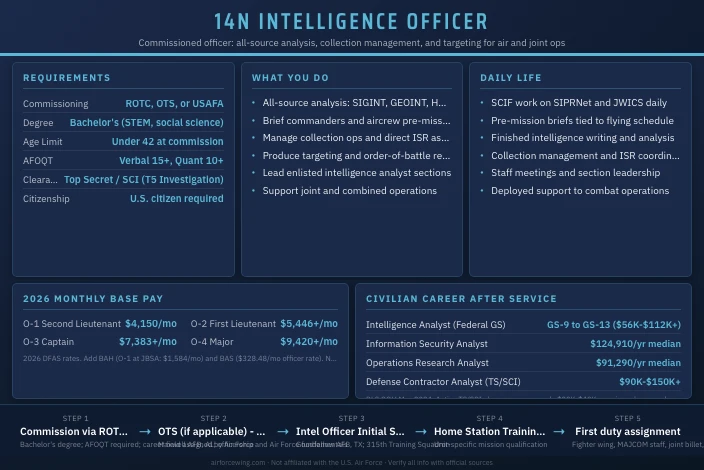
Job Role
The 14N Intelligence Officer directs all-source intelligence operations for Air Force flying and joint units. These officers collect, analyze, and present intelligence products that support targeting, mission planning, and force protection. They manage intelligence resources, direct collection efforts across multiple disciplines, brief senior leaders and aircrew, and lead intelligence flights and squadrons as they advance in rank.
Command and Leadership Scope
At the flight level, a new 14N manages a small team of enlisted intelligence analysts (primarily 1N0X1 All-Source Analysts) and owns the intelligence production cycle for a specific unit. A squadron-level 14N oversees the full intelligence section: personnel, systems, training, and operational output. Group and wing assignments carry broader responsibility for coordinating across multiple units and managing relationships with theater intelligence organizations.
Span of control grows significantly with rank. A first-tour captain might lead a flight of 8 to 15 Airmen. A lieutenant colonel serving as a squadron intelligence officer leads 20 to 40 personnel across multiple functional areas.
Specific Roles and Designations
| Designation | Title | Focus |
|---|---|---|
| 14N1 | Intelligence Officer (entry) | Initial skills, learning role |
| 14N3 | Intelligence Officer | Flight commander, unit intel officer |
| 14N4 | Intelligence Officer (senior) | Squadron-level leadership, staff |
| 14NX | Intelligence Officer (career field) | All designations, general reference |
Special Experience Identifiers (SEIs) are assigned to 14N officers who complete additional training in areas such as collection management, targeting, human intelligence, or special access programs. SEIs affect assignment competitiveness but do not appear in the basic AFSC code.
Mission Contribution
The 14N career field is how the Air Force knows what it doesn’t know. Intelligence officers identify gaps in situational awareness, direct collection assets to fill those gaps, and synthesize reporting from signals intelligence (SIGINT), imagery intelligence (GEOINT), human intelligence (HUMINT), measurement and signature intelligence (MASINT), and open-source intelligence (OSINT) into finished products. At the tactical level, that means pre-mission threat briefs for F-35 pilots and strike packages for bombers. At the operational and strategic level, it means targeting products, order-of-battle assessments, and indications-and-warning analysis that shapes campaign planning.
The field operates across joint and combined environments. 14N officers serve on combatant command staffs, joint intelligence support elements (JISEs), and national-level agencies including the Defense Intelligence Agency and National Geospatial-Intelligence Agency.
Technology, Equipment, and Systems
- SIPRNet and JWICS: classified networks carrying secret and top-secret traffic
- DCGS (Distributed Common Ground System): the Air Force’s primary ISR processing, exploitation, and dissemination architecture
- NSANet: National Security Agency network for signals intelligence
- Palantir and other all-source fusion tools: used at wing and theater levels
- Intelligence databases: classified repositories for targeting data, order of battle, and threat libraries
- Imagery exploitation tools: used to analyze satellite and airborne imagery products
All 14N work is conducted in Sensitive Compartmented Information Facilities (SCIFs), which are certified secure rooms isolated from unclassified systems.
Salary
Base Pay
Officer pay is set by DFAS and applies across all career fields. A new 14N commissions as an O-1 (Second Lieutenant) and advances automatically to O-3 (Captain) based on time in service. Promotion to O-4 (Major) and above is board-selected.
| Rank | Grade | Typical Time in Service | Monthly Base Pay |
|---|---|---|---|
| Second Lieutenant | O-1 | 0-2 years | $4,150 |
| First Lieutenant | O-2 | 2-4 years | $5,446 |
| Captain | O-3 | 4-10 years | $7,383-$9,004 |
| Major | O-4 | 10-16 years | $9,420-$10,402 |
Figures from DFAS 2026 military pay tables.
Special and Incentive Pay
The 14N career field does not carry aviation bonus pay. Officers in special access programs or assigned to certain joint billets may qualify for special duty assignment pay. Career Intermission Program participants and those accepting extended service commitments sometimes receive retention incentives, but no standing bonus exists specifically for 14N.
Additional Benefits
Basic Allowance for Housing (BAH) varies by installation, pay grade, and dependency status. At Joint Base San Antonio-Lackland, an O-1 without dependents receives $1,584 per month. BAH does not count as taxable income.
Basic Allowance for Subsistence (BAS) for officers is $328.48 per month (2026 rate).
Active-duty officers receive TRICARE Prime at no enrollment fee, no deductible, and no copays for covered services. Coverage includes medical, dental, vision, mental health, and prescriptions.
The Blended Retirement System (BRS) provides a 20-year pension at 40% of the average of the highest 36 months of basic pay, plus Thrift Savings Plan contributions. The government automatically contributes 1% of base pay to TSP and matches up to an additional 4% when the officer contributes.
Work-Life Balance
Intelligence officers work demanding schedules, particularly at flying units where the intel section must be staffed during all flying operations. A standard garrison week runs Monday through Friday with longer hours during exercises and surge periods. Deployed tempo is more variable. Some billets run 12-hour shifts six or seven days a week.
The Air Force provides 30 days of paid leave annually. Remote work options are limited because most 14N work occurs in SCIFs on classified networks, but CONUS assignments offer more schedule stability than most other career fields.
Qualifications
Commissioning Sources
There are three paths to commission as a 14N Intelligence Officer: Air Force ROTC, Officer Training School (OTS), and the Air Force Academy (USAFA). There is no direct commission into the 14N career field.
| Commissioning Source | Degree Requirement | GPA Minimum | Age Limit | Notes |
|---|---|---|---|---|
| AFROTC | Bachelor’s (any accredited school) | 3.0 preferred; no hard minimum published | Under 42 at commission | Rated board for career field assignment in final year |
| OTS | Bachelor’s degree in hand | 3.0 preferred | Under 42 at commission | Competitive; packet includes transcripts, LORs, fitness test |
| USAFA | Earned on graduation | N/A (USAFA GPA is earned there) | Enter academy under 23 | Career field assigned by USAFA process |
Degree preference: The Air Force lists science, humanities, social sciences, structured analysis, engineering, and mathematics as preferred fields for the 14N career field. No single major is required, but analytical degrees are competitive. STEM backgrounds and foreign language proficiency increase selection probability.
Test Requirements
All officer candidates must take the Air Force Officer Qualifying Test (AFOQT). The AFOQT is a standardized aptitude test covering verbal, quantitative, situational judgment, and aviation knowledge sections. Minimum published scores for non-rated officers are Verbal 15 and Quantitative 10, but competitive 14N candidates typically score well above those floors. The AFOQT can be taken twice. TBAS is not required for the 14N career field.
The AFOQT Verbal and Quantitative scores matter most for 14N competitiveness. Analytical reasoning and reading comprehension sections directly reflect the work intelligence officers do. Study early. Most OTS applicants report that AFOQT preparation takes 4-8 weeks of consistent effort.
Career Field Assignment and Classification
ROTC cadets compete for rated and non-rated career fields through the rated board and non-rated classification process during their final year. Academic performance, AFOQT scores, extracurricular leadership, and ROTC evaluations all factor into the field assignment. OTS applicants select a desired career field in their application package, and the Air Force assigns it based on needs and applicant competitiveness. Intelligence is consistently a popular field, making competitive scores more important.
Cross-training into 14N from another officer career field is possible but uncommon. Officers who want to cross-train apply through AFPC and must meet the same qualifications as initial-entry candidates.
Upon Commissioning
New officers enter at O-1 (Second Lieutenant). The standard Active Duty Service Commitment (ADSC) for initial commission is four years from the date of commissioning or one year from completion of Initial Skills Training, whichever is later. Officers accepting rated training (pilot, CSO) incur longer ADSCs, but 14N does not carry an aviation training commitment.
OTS candidates can find a focused study plan in our AFOQT study guide.
Work Environment
Setting and Schedule
14N officers work almost exclusively indoors in SCIFs. The physical setting is a classified operations room or office with access to secure workstations, classified printers, and communication systems. At a flying wing, the intel section is attached to the Operations Group and works on the flying schedule, which means early starts on flying days and shorter days when the aircraft are down.
Staff assignments at MAJCOMs, COCOM headquarters, or national agencies look different. Analytical work is more deliberate, products take longer to develop, and the schedule is closer to a standard business week. Joint billets at places like the Defense Intelligence Agency or NSA involve liaison work alongside officers and civilians from other services and agencies.
Leadership and Chain of Command
Early-career 14N officers work for a senior intelligence officer and closely with an experienced flight chief (typically a MSgt or SMSgt). The officer-NCO relationship in intelligence is particularly important because enlisted analysts carry deep technical expertise. A 14N lieutenant who ignores the senior NCO’s institutional knowledge wastes it. The best early-career officers treat that relationship as a resource.
As a Captain or Major, the 14N serves as the primary intelligence officer for a squadron or group, reporting to the operations officer or group commander. Senior 14Ns at the O-5 and O-6 level serve as wing intelligence officers, MAJCOM staff directors, or command positions at intelligence production centers.
Staff vs. Command Roles
The 14N promotion path requires a mix of command and staff assignments. Key Developmental (KD) positions include flight commander (O-3 level) and squadron commander (O-5 level). Between those positions, officers serve on MAJCOM staffs, joint staffs, or at national-level agencies. That broadening experience is evaluated by promotion boards.
An officer who spends their career only in unit billets will not be competitive for senior grades. The field rewards officers who demonstrate both operational unit performance and the ability to contribute at the strategic level.
Job Satisfaction and Retention
Retention in the 14N career field is generally higher than in rated fields, partly because the civilian market for cleared intelligence professionals is strong enough that officers who leave do well financially. The analytical challenge and operational stakes keep many people in. Officers who leave after their initial ADSC most often cite frequent PCS moves and the inflexibility of SCIF-based work, not dissatisfaction with the mission itself.
Training
Pre-Commissioning Training
ROTC cadets receive two to four years of leadership training, field exercises, and academic coursework leading to commissioning. OTS is 9.5 weeks at Maxwell AFB, AL, and focuses on officership, Air Force culture, and leadership fundamentals. It does not cover intelligence-specific content. USAFA graduates complete a four-year program with extensive leadership development and elective coursework in intelligence or national security fields.
Initial Skills Training
After commissioning, 14N officers attend the Intelligence Officer Initial Skills Course at Goodfellow Air Force Base, TX. The 315th Training Squadron at Goodfellow is the primary training organization for Air Force intelligence officers.
| Phase | Location | Length | Focus |
|---|---|---|---|
| OTS / Commissioning | Maxwell AFB, AL | 9.5 weeks | Officership, leadership, Air Force fundamentals |
| Intelligence Officer Initial Skills Course | Goodfellow AFB, TX | Approximately 8 weeks | All-source analysis, collection management, targeting, sensing grid operations |
| Home Station Training | Unit of assignment | 12 weeks | Mission-specific qualification and local procedures |
| Specialized Intelligence Course | Various | Approximately 3 weeks | Advanced discipline or platform-specific qualification |
The Initial Skills Course covers the six core intelligence disciplines, analysis tradecraft, collection management fundamentals, targeting methodology, and Air Force ISR systems. Officers receive both classroom instruction and applied exercises simulating real-world analytical problems. After completing the course, officers must perform intelligence functions for at least 12 months to receive full qualification.
Goodfellow AFB also trains enlisted intelligence specialists (1N0X1, 1N1X1, 1N2X1) and Navy, Marine Corps, and international partner students. The base is one of the few remaining installations dedicated primarily to intelligence training.
Professional Military Education
PME follows a predictable timeline tied to rank:
- Squadron Officer School (SOS): Completed as a Captain (O-3), typically in residence at Maxwell AFB for 8 weeks or via correspondence. Covers organizational leadership, joint operations, and Air Force doctrine.
- Air Command and Staff College (ACSC): A major prerequisite for O-5 promotion, completed as a Major either in residence at Maxwell AFB (one year) or by distance learning. Covers operational art, campaign planning, and joint doctrine.
- Air War College (AWC): For O-6 candidates and select O-5s. One-year in-residence program at Maxwell AFB focused on strategic leadership and national security policy.
Additional Schools and Training
14N officers with STEM backgrounds or interest in technical intelligence can pursue Air Force Institute of Technology (AFIT) programs, the Air Force’s fully funded graduate school at Wright-Patterson AFB, OH. Degrees in intelligence studies, operations research, systems engineering, and cybersecurity are all relevant to intelligence career development.
Joint duty assignments at the Defense Intelligence Agency, National Security Agency, or combatant command intelligence centers provide development opportunities that active-duty units cannot replicate. The Air Force Intelligence Weapons and Tactics course and other advanced skills programs are available to more senior officers.
Before OTS, you need qualifying scores. See our AFOQT study guide.
Career Progression
Career Path
| Rank | Grade | Typical Timeline | Key Developmental Positions |
|---|---|---|---|
| Second Lieutenant | O-1 | Commissioning to 2 years | Intelligence section officer, collection manager trainee |
| First Lieutenant | O-2 | 2-4 years | Flight officer, junior intelligence officer |
| Captain | O-3 | 4-10 years | Flight Commander (KD), operations intelligence officer |
| Major | O-4 | 10-16 years | Staff officer (MAJCOM, joint, COCOM), senior advisor |
| Lieutenant Colonel | O-5 | 16-22 years | Squadron Commander (KD), wing intelligence officer |
| Colonel | O-6 | 22+ years | Group commander, MAJCOM director, senior staff |
O-1 to O-3 promotions are essentially automatic with satisfactory performance. O-4 (Major) promotion is board-selected, with Air Force-wide selection rates historically around 80%. O-5 selection rates drop to 70-75%. O-6 is more competitive at approximately 50%.
Promotion System
Promotion boards evaluate the Officer Performance Report (OPR) record, stratification language from senior raters, PME completion, key developmental assignment completion, and joint duty credit. For 14N, board evaluators want to see flight commander and squadron commander positions completed at the right career phases, consistent top-block OPRs, and evidence of operational impact rather than just administrative competence.
Officers who complete joint billets at combatant commands, the Joint Staff, or national agencies receive joint duty credit. That credit is required for promotion to O-7 (Brigadier General) and increasingly expected for senior O-6 assignments.
Cross-Training and Broadening
Broadening assignments available to 14N officers include:
- ROTC instructor duty: teaches leadership while fulfilling an educational requirement
- Air Staff and MAJCOM staff positions: key for building relationships and understanding the larger Air Force
- National agency assignments: DIA, NGA, NSA, CIA analytic centers (through interagency rotations)
- Exchange officer programs: assignments to allied intelligence staffs in NATO, Five Eyes partners, or bilateral arrangements
- Congressional fellowships and think-tank programs: available to senior captains and majors through competitive selection
Physical Demands
Physical Requirements
All Air Force officers take the Air Force Fitness Assessment annually. Standards are age- and gender-normed. There are no career-field-specific fitness requirements for 14N beyond the standard assessment.
Air Force Fitness Assessment Standards
| Component | Max Points | Notes |
|---|---|---|
| 1.5-Mile Run | 60 | Primary aerobic component |
| Waist Circumference | 20 | Body composition measure |
| Push-Ups (1 min) | 10 | Muscular fitness |
| Sit-Ups (1 min) | 10 | Muscular fitness |
| Total | 100 | Minimum passing: 75 |
Standards are age- and gender-normed. Each component has a minimum passing threshold that must be met regardless of composite score. Verify current standards at af.mil.
Medical Requirements
The 14N career field requires no flight physical and carries no aviation medical standards. Officers must meet standard officer commissioning physical requirements, including vision correctable to 20/20, hearing within normal limits for military service, and general medical fitness for worldwide deployment.
The 14N AFSC requires a Tier 5 (T5) Investigation, the federal government’s most intensive background investigation level. Officers with significant foreign contacts, financial problems, or a history of substance misuse should consult with a recruiter before applying. The investigation process can take 12-24 months and is required before the AFSC can be formally awarded.
Deployment
Deployment Details
Intelligence officers deploy frequently, though the tempo varies significantly by assignment. At a fighter wing, 14Ns routinely deploy in support of the unit’s flying operations. Deployment lengths run 90 to 180 days for most theater assignments, though some joint billets and support to special operations can involve shorter, more frequent rotations.
Officers assigned to MAJCOM or national-level staffs deploy less frequently but may travel more on temporary duty (TDY) for exercises, conferences, and liaison work. The 14N field is considered an operational career field, so deployment experience is expected and valued on promotion records.
Duty Station Options
14N officers are assigned wherever the Air Force has intelligence requirements, which is essentially everywhere. Primary bases include:
- Langley-Eustis AFB, VA: ACC headquarters and fighter units
- Offutt AFB, NE: STRATCOM and global strike intelligence
- Hurlburt Field, FL: Air Force Special Operations Command
- Ramstein AB, Germany: USAFE headquarters and European theater
- Kadena AB, Japan: Pacific Air Forces theater intelligence
- Joint Base Pearl Harbor-Hickam, HI: PACAF headquarters
- National Capital Region (Bolling AFB, Pentagon): DIA, Air Staff, and COCOM billets
The Air Force Personnel Center (AFPC) manages officer assignment through a preference-based system. Officers submit a wish list of preferred assignments, and AFPC matches needs and preferences within the constraints of career field requirements. Join-spouse assignments are accommodated when operationally feasible but are not guaranteed.
Risk/Safety
Job Hazards
14N officers face minimal physical hazard compared to rated or special operations career fields. The primary risk is the psychological weight of operational intelligence work. Officers who support combat targeting operations see the results of those decisions in after-action imagery and reporting. This aspect of the job is real and should be considered by anyone evaluating the career field.
Officers in this field also carry significant personal legal risk related to classified information handling. Mishandling of classified material, even inadvertent disclosure, can result in career-ending consequences and potential criminal prosecution under federal law.
Safety Protocols
Intelligence operations use Operational Risk Management (ORM) frameworks to assess and mitigate risks in collection planning and targeting. Officers learn ORM as part of OTS and apply it throughout their careers.
Legal and Command Responsibility
14N officers at the flight-commander level and above carry command authority and all associated UCMJ responsibilities. Relief for cause (removal from a command or key position for disciplinary or performance reasons) is among the most damaging events in an officer’s career. Officers must maintain a command climate that meets equal opportunity standards, and they are personally accountable for the conduct of their sections.
Classified information management carries distinct legal responsibilities. Officers who handle Top Secret/SCI material are briefed on the legal consequences of unauthorized disclosure and sign binding nondisclosure agreements that survive separation from service.
Impact on Family
Family Considerations
The intelligence career field involves regular PCS moves, typically every two to three years. For dual-military couples or families with school-age children, this tempo is the most common source of stress cited by 14N officers. The Air Force Airman and Family Readiness Center (A&FRC) provides relocation support, spouse employment assistance, and transition counseling at most installations.
The Key Spouse Program provides peer-to-peer family support during deployments and high-tempo periods. Spouse employment is a real challenge at some intelligence bases because the work requires in-person SCIF access. Officers cannot be assigned to remote installations and commute; the family moves or the officer lives separately.
The SCIF Requirement and Family Life
The nature of intelligence work, performed in classified facilities on classified networks, means that remote work is not available in most billets. Officers cannot answer work emails from home or log in on a personal computer. When a deployment, exercise, or surge period extends hours, the family at home carries the domestic load without the officer being reachable. That boundary is clear, but it requires families to function independently during demanding periods.
This is a different dynamic than career fields where officers can occasionally work from home or take calls during off-hours. Partners who value consistent communication and the ability to reach the officer throughout the day often find the SCIF limitation frustrating, particularly during early career years when the volume of work is high and the hours are long.
Duty Station Considerations
14N officers serve at a wide range of installations, and each has a distinct character. Langley AFB (Virginia) is in the Hampton Roads region, a large military market with diverse spouse employment, multiple school districts, and reasonable cost of living. Offutt AFB (Nebraska) is in the Omaha metro area, which offers lower housing costs and stable employment options. Hurlburt Field (Florida) is in the Emerald Coast panhandle region with a high cost of living and limited large employer presence outside the base.
National Capital Region billets at the Pentagon or DIA headquarters put families in the highest-cost real estate market in the country, but BAH rates in that region are among the highest in the Air Force.
Dual-Military and Family Planning
When both spouses are active-duty officers, AFPC attempts to accommodate co-location through join-spouse assignment policy. Success depends on whether both officers’ career fields have billets at the same installation at the same time. Intelligence is present at most major Air Force bases, which helps. No guarantees exist, particularly during periods of high operational demand.
Parental leave policies follow Air Force-wide rules: up to 12 weeks of paid primary caregiver leave for new births or adoptions.
Reserve and Air National Guard
Component Availability
The 14N career field exists in both the Air Force Reserve and the Air National Guard. Air National Guard units with an intelligence mission have 14N officer billets at the group and wing level. Reserve intelligence officer positions are available at numbered air force and MAJCOM staff organizations, as well as at reserve intelligence units.
Commissioning Paths
Reserve and ANG commissioning follows the same three paths as active duty: ROTC with a Reserve component contract, OTS through an ANG officer accessions program, or transfer from active duty after completing the initial ADSC. Officers separating from active duty can affiliate with a Reserve unit or ANG wing that holds 14N billets, often without additional training if their qualifications are current.
Drill and Training Commitment
Standard Reserve and ANG commitment is one weekend per month (Unit Training Assembly, or UTA) plus 15 days of annual tour each year. Intelligence officer billets frequently require additional training days for certification, annual exercise participation, and clearance maintenance.
Part-Time Pay
An O-3 (Captain) with four years of service earns approximately $7,383 per month on active duty. The same officer drilling one weekend per month earns roughly four days of equivalent pay per drill weekend, or approximately $985 per month when drilling. Annual tour adds approximately 15 days of additional pay.
Benefits Differences
| Feature | Active Duty | Air Force Reserve | Air National Guard |
|---|---|---|---|
| Commitment | Full-time | 1 UTA/mo + 15 days/yr | 1 UTA/mo + 15 days/yr |
| Monthly Pay (O-3) | $7,383-$9,004 | ~$985/drill weekend | ~$985/drill weekend |
| Healthcare | TRICARE Prime (free) | TRICARE Reserve Select (premium-based) | TRICARE Reserve Select + state options |
| Education | TA up to $4,500/yr + GI Bill | Federal TA + GI Bill (pro-rated) | State tuition waivers vary + GI Bill |
| Retirement | 20-year pension (BRS) | Points-based at age 60 | Points-based at age 60 |
| Deployment Tempo | Frequent | Mobilization-based, less predictable | Mobilization-based, less predictable |
| Command Billets | Full range O-1 to O-6+ | O-3 to O-5 level | O-4 to O-6 level |
Command and Career Progression
ANG 14N officers can hold flight and squadron commander positions within their units. Promotion timelines in the Reserve and ANG are generally slower than active duty because competition pools are smaller and the number of billets at each grade is limited. Officers can attend SOS, ACSC, and other PME through both in-residence and distance-learning options, and doing so improves promotion competitiveness.
Civilian Career Integration
The 14N career field pairs well with civilian intelligence and national security careers. Many Reserve and ANG intelligence officers work as civilian analysts at the CIA, DIA, NSA, or in the defense contractor community, holding active clearances in both roles. USERRA protections guarantee job reemployment rights after mobilization. Employer support programs through the Employer Support of the Guard and Reserve (ESGR) help manage employer relationships during extended deployments.
Deployment and Mobilization
Reserve and ANG intelligence officers mobilize in support of combatant command requirements, usually for 6 to 12 months. Intelligence billets are in consistent demand, and 14N Reserve officers report higher-than-average mobilization rates compared to some other career fields. Voluntary active-duty operational support (ADOS) tours are also available for officers who want to increase their active-duty time without permanently converting.
Post-Service
Transition to Civilian Life
A 14N officer leaving active duty after one commitment carries a TS/SCI clearance, analytical tradecraft training, and leadership experience that the intelligence community and defense industry actively recruit. The transition is often straightforward compared to career fields where military skills don’t map directly to civilian jobs. Many officers move directly into positions at the CIA, DIA, NGA, NSA, or with major defense contractors without requiring additional training.
The Transition Assistance Program (TAP) runs at all Air Force installations and provides career counseling, resume workshops, and employer connections specifically for separating officers.
Civilian Career Prospects
| Job Title | Median Annual Salary | Outlook |
|---|---|---|
| Intelligence Analyst (federal GS) | GS-9 to GS-13 ($56,000-$112,000+) | Stable; ongoing hiring |
| Operations Research Analyst | $91,290 | +21% growth (2024-2034) |
| Information Security Analyst | $124,910 | +29% growth (2024-2034) |
| Management Analyst | $101,190 | +11% growth (2024-2034) |
| Defense Contractor Intelligence Analyst | $90,000-$150,000+ | Strong; clearance-dependent |
Salary data from BLS Occupational Outlook Handbook, May 2024. Federal GS salary varies by grade and location.
Officers with an active TS/SCI clearance command a market premium of $20,000 to $40,000 annually above uncleared counterparts in comparable analytical roles. That clearance, maintained through reserve service or a cleared contractor position, is one of the most valuable transferable assets from this career field.
Graduate Education and Credentials
The Post-9/11 GI Bill covers full in-state tuition at public universities, up to $29,920.95 annually at private institutions (2025-2026 cap), plus a monthly housing allowance and book stipend. Officers serving six or more years can transfer unused GI Bill benefits to dependents.
AFIT offers fully funded master’s and doctoral programs for officers who apply while on active duty. Intelligence-relevant degrees include operations research, cybersecurity, and systems engineering. Civilian certifications relevant to the career field include the Certified Intelligence Professional and various security management credentials through ASIS International.
Is This a Good Job
Ideal Candidate Profile
The 14N career field suits people who think analytically, communicate well in writing and briefing, and are comfortable working with uncertainty. Intelligence analysis requires tolerating ambiguity. You rarely have complete information, and you have to make assessments anyway. Candidates who did well in research-heavy coursework, who read widely, and who can organize complex information into clear arguments tend to thrive here.
Strong foreign language skills, regional expertise, or STEM backgrounds make candidates more competitive and expand assignment options throughout the career. Leadership drive matters too. This is an officer career, and the expectation is that you’ll manage people and eventually lead organizations.
Potential Challenges
Officers who prefer solitary technical work over managing people and briefing senior leaders will find the career increasingly frustrating as they advance. The higher you go, the less time you spend doing analysis yourself and the more time you spend reviewing others’ work, managing timelines, and communicating up the chain.
Frequent moves are the most common reason officers leave this career field. Families that value community stability or that have school-age children navigating specific educational needs find the two-to-three year PCS cycle genuinely difficult. Officers who want to stay in one place for more than three years should consider the ANG or Reserve components instead.
The SCIF environment limits flexibility. Remote work isn’t possible for most billets, and the security requirements of the job follow you permanently. Nondisclosure obligations remain after separation.
Career and Lifestyle Alignment
If your goal is a full military career to O-6 and retirement, the 14N field offers a clear path with genuine operational relevance at every grade. If you want a single commitment and a strong civilian career afterward, cleared intelligence experience transitions as well as almost any other officer specialty. The one-and-done officer who serves four to six years and then moves to a defense contractor or federal agency often earns more after separation than they did in uniform.
Reserve and ANG service is a genuine option for officers who want to maintain their clearance, stay connected to the intelligence community, and build a parallel civilian career simultaneously. That combination (reserve 14N plus civilian contractor or government analyst) is one of the more financially advantageous career paths available in the national security field.
More Information
If you’re serious about pursuing the 14N career field, contact your nearest Air Force recruiter or an AFROTC detachment at a university near you. Both can walk you through the application timeline, commissioning source options, and what’s competitive right now for intelligence classification. Requirements and class availability change frequently, so talking to someone with current information is the best next step.
The AFOQT is required for all commissioning paths. Strong Verbal and Quantitative scores improve your chances of being classified into a competitive non-rated field like intelligence. Start your AFOQT study guide early. Most applicants need at least a month of focused study to reach competitive scores.
When building your application package for an OTS or ROTC board, consider the elements that make a 14N candidate stand out. Academic performance in analytical coursework, economics, political science, history, foreign languages, mathematics, or any science discipline, signals the reasoning skills the career field demands. Prior experience with research, structured writing, or data analysis strengthens the picture.
Leadership experience matters as much as academic background. Competitive 14N candidates tend to have documented leadership in ROTC, student government, athletics, or employment that shows they can manage people and communicate clearly. The career field is an officer field first; analytical skills are the entry requirement, but leadership performance determines how far you go.
The TS/SCI clearance investigation begins before you arrive at Initial Skills Training. If you have foreign contacts, financial issues, or prior drug use in your history, bring those facts to your recruiter’s attention early rather than leaving them for the SF-86. Cleared careers built on honest disclosure are far more durable than ones built on hoping a reviewer misses something. A recruiter who understands the intelligence career field can help you work through the disclosure process.
For ROTC cadets, the rated board and non-rated classification process for 14N typically happens during your junior year. Build toward that window with a competitive AFOQT score, strong field training performance, and documented analytical or leadership experience that translates into a compelling application.
This site is not affiliated with the U.S. Air Force or any government agency. Verify all information with official Air Force sources before making enlistment or career decisions.
Explore more Air Force Intelligence officer careers to learn about related roles in this career field.