14F Information Operations Officer
When you purchase through links on our site, we may receive compensation at no extra cost to you.
Some officer jobs turn intelligence into reports. 14F turns information into effects. This is the officer field focused on shaping how adversaries think, what they see, and how they make decisions. The job sits at the edge of operations, intelligence, planning, and influence. It is analytical, but it is not passive. A strong 14F officer is building plans that combine information-related capabilities to create real operational advantage.
If you are pursuing OTS, start with the AFOQT study guide before your package window.
Job Role and Responsibilities
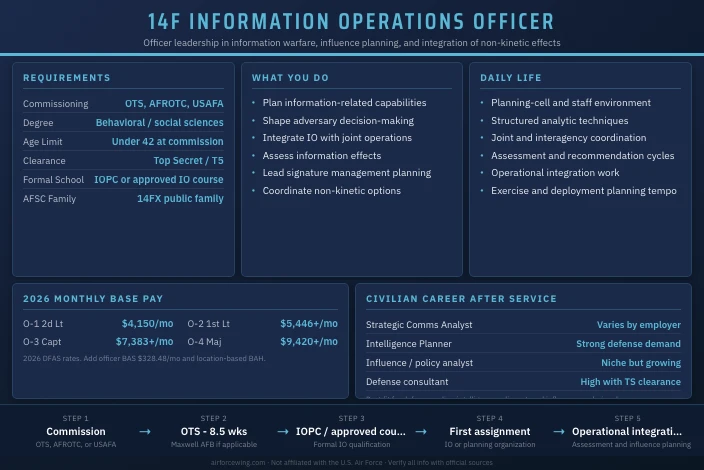
14F Information Operations Officers plan, integrate, and assess information-related capabilities that shape adversary decision-making and support Air Force and joint operations. They combine analysis, targeting of vulnerabilities, signature management, and synchronized non-kinetic effects to influence the operational environment.
Leadership Scope
This is a staff-intensive officer field. Even early in the career, 14F work often sits inside planning cells, joint staffs, or specialized teams where the officer leads smaller groups but influences much larger operational decisions. A junior 14F officer might work in an information operations cell developing influence-analysis products for a wing commander or a joint task force staff. They are contributing to operational planning at a level that junior officers in many other career fields do not reach until mid-career.
The officer’s value in those cells comes not from managing large formations but from synthesizing information from multiple intelligence and operational sources, identifying adversary decision-making vulnerabilities, and building coordinated plans that use information-related capabilities in concert with other joint effects. That analytical and planning credibility is what makes the field influential despite being staff heavy.
Family Code Context
The public recruiting site lists this field as 14FX Information Operations Officer. This guide shortens the code label to 14F while discussing the same career field.
| Designation | Meaning |
|---|---|
| 14F | Hub label used in this site |
| 14FX | Public recruiting family code |
Mission Contribution
14F officers help commanders create effects without relying only on kinetic action. That can mean planning signature-management efforts that protect friendly force identity and decision advantage, integrating psychological operations and military information support operations into a campaign, coordinating electronic warfare with influence objectives, or helping shape how an operation is perceived and responded to by adversary decision-makers. In modern great-power competition, information dominance is a prerequisite for operational success, and 14F officers are the Air Force’s specialists in building it.
Systems And Tools
The field relies on planning frameworks including Joint Publication 3-13 and Air Force doctrine for information operations, structured analytic techniques, assessment models for measuring influence effects, and coordination processes with joint, service, interagency, and coalition partners. Officers need to understand both the planning process and the specific information-related capabilities they are integrating, which include electronic warfare, military deception, operations security, and military information support operations. This is less about a single hardware system and more about integrating multiple capabilities into a coherent campaign.
Salary and Benefits
Officer Base Pay
2026 pay follows the DFAS military pay tables.
| Rank | Grade | Typical YOS | Monthly Base Pay |
|---|---|---|---|
| Second Lieutenant | O-1 | Under 2 | $4,150 |
| First Lieutenant | O-2 | 2-4 years | $5,446-$6,485 |
| Captain | O-3 | 4-10 years | $7,383-$8,376 |
| Major | O-4 | 10-16 years | $9,420-$10,402 |
Allowances
Officers in this career field receive the standard officer allowances package. Basic Allowance for Housing (BAH) is tax-free and calibrated to the duty-station location. Officers assigned to high-cost locations in the National Capital Region, the Pacific Northwest, or Hawaii can see BAH exceeding $2,500 per month tax-free, which substantially raises total compensation above base pay alone.
- BAH: location based, tax-free
- BAS: $328.48 monthly, tax-free
- TRICARE Prime: medical, dental, and vision coverage at low or no cost
- BRS and TSP matching: government contribution to the Blended Retirement System after 26 months
- Security clearance at the TS/SCI level is required for this field, which carries significant civilian market value for officers who separate
The TS/SCI clearance this field requires is expensive to obtain and maintain privately. Officers who serve in 14F for several years and then separate carry a current, adjudicated clearance that federal contractors, defense firms, and intelligence agencies will pay a significant premium for.
Civilian Value
The best civilian transitions tend to be in influence analysis, strategic communication, interagency planning, intelligence support, and policy-adjacent work rather than a clean one-to-one corporate equivalent. Defense and intelligence contractors, think tanks, and federal agencies with information-environment responsibilities recruit 14F veterans actively because the combination of cleared analyst status, operational planning experience, and information-influence expertise is genuinely rare outside military service.

Qualifications and Eligibility
Commissioning Requirements
The public Air Force Information Operations Officer page provides the strongest published baseline.
| Commissioning Source | Degree Requirement | Age Limit | Key Prerequisites |
|---|---|---|---|
| OTS | Bachelor’s degree | Must commission before 42 | Competitive officer selection |
| AFROTC | Bachelor’s degree | Must commission before 42 | Assignment at commissioning |
| USAFA | Degree on graduation | Standard academy limits | Assignment at graduation |
Competitive degree areas include behavioral sciences, social sciences, psychology, sociology, marketing, cultural studies, linguistics, communications, and public relations. The field specifically benefits from candidates who understand human decision-making, social influence, and how information environments shape behavior, since those are the intellectual foundations of effective information operations planning.
Screening
The public page specifically calls for:
- Completion of the Information Operations Professionals Course or approved equivalents as part of field qualification
- Completion of a Tier 5 Investigation for Top Secret clearance, which includes polygraph-level investigation for access to Sensitive Compartmented Information (SCI)
- Standard officer accession through OTS, USAFA, or AFROTC
The Tier 5 investigation is more intensive than the standard Tier 3 investigation that many Air Force officers complete at accession. Candidates should expect a thorough review of foreign contacts, financial history, and personal conduct. The process can take 6 to 18 months in competitive clearance environments, which affects when a commissioned officer can actually begin working in the field.
Use the AFOQT study guide if you are competing for the officer-accession side of the pipeline.
Upon Commissioning
New officers enter as O-1 and move into information operations training and operational integration roles after commissioning. The field rewards officers who can think across psychology, planning, and operations simultaneously, and who can explain complex influence-environment analysis clearly to commanders who may not share that background. Officers who arrive as generalists willing to develop deep functional expertise in IO doctrine and planning frameworks tend to advance fastest in this field.

Work Environment
Setting And Schedule
Most of the work happens in planning environments, staffs, operations centers, or secure collaborative spaces rather than on a flight line or in a conventional office. The physical environment for much of this work is classified, which means officers spend significant time in SCIFs and other restricted facilities coordinating with cleared partners. Exercise and operational tempo drive the rhythm of the work. During major exercises or actual operations, planning cells can sustain long hours and compressed timelines. Between those peaks, the work is more deliberate and analytical, reviewing assessments, refining plans, and coordinating with interagency or allied partners.
Remote or split-based work is common in some assignments, with officers supporting deployed headquarters from home-station SCIF environments. The field is not as geographically restricted to a single major installation as some more specialized officer fields.
Officer-NCO Dynamic
This field often works in mixed planning teams with intelligence, cyber, operations, and enlisted specialists. The officer’s value comes from synthesis and leadership across disciplines rather than owning a narrow technical lane. Senior NCOs in related fields, including 1N1 Geospatial Intelligence, 1N2 Signals Intelligence, and 6F0X1 Financial specialists embedded in planning, each bring expertise that complements the 14F officer’s integration role. Officers who invest in understanding what their enlisted counterparts know, and who build those relationships deliberately, produce stronger planning products.
Staff Balance
14F is staff heavy by design. That is not a weakness of the career field; it is where the mission lives. Information operations effects are generated through planning quality, organizational coordination, and sustained influence assessment, not through the execution of a single tactically decisive action. Officers who prefer visible, immediate operational effects over the slower, more diffuse impact of influence planning may find this career field frustrating.
Training and Skill Development
Training Pipeline
| Phase | Location | Length | Focus |
|---|---|---|---|
| Commissioning source or OTS | Maxwell AFB, AL or source dependent | OTS 8.5 weeks | Officership basics |
| Information Operations Professionals Course | Current Air Force / joint location | Verify current length | IO planning, integration, assessment |
| Follow-on approved IO courses | Mission dependent | Varies | IOIC, POQC, IIC-MISO, AFOC equivalents |
| First assignment OJT | IO or planning unit | 12-24 months | Operational integration |
After commissioning and Officer Training School, 14F officers complete the Information Operations Professionals Course (IOPC), which is the primary Air Force qualification course for this career field. The course covers IO doctrine, planning frameworks, the range of information-related capabilities, assessment methods, and coordination with joint and interagency partners. The Air Force public page is unusually specific about formal IO schooling being a hard requirement for this field, not just a developmental option.
Follow-on courses may include the Information Operations Integration Course (IOIC), Psychological Operations Qualification Course (POQC), and other service or joint courses that build specific capabilities. Officers who develop expertise across multiple information-related capabilities, rather than narrowly in one, build stronger records and are more valuable in joint planning environments.
Advanced professional military education, including Squadron Officer School and Air Command and Staff College, is expected at the appropriate career milestones. Joint assignments are particularly important for 14F officers because the information operations mission is inherently joint, and officers without joint-qualified credit may find senior-assignment competition more difficult.
The AFOQT study guide is still the right first prep step if you are entering through OTS.
Career Progression and Advancement
Timeline
| Rank | Grade | Typical Timeline | Development Focus |
|---|---|---|---|
| Second Lieutenant | O-1 | Entry to 2 years | Learn IO planning and assessment |
| First Lieutenant | O-2 | 2-4 years | Integrate with planning teams |
| Captain | O-3 | 4-10 years | Lead IO planning cells or sections |
| Major | O-4 | 10-16 years | Senior planner or staff integrator |
| Lieutenant Colonel | O-5 | 16-22 years | Senior IO leadership roles |
Promotion Drivers
Strong promotion records in this field come from joint credibility, clear and defensible assessment work, and the demonstrated ability to integrate information-related capabilities into real operations rather than treating IO as an add-on brief that commanders ignore. Officers who earn joint qualifications through joint assignments and JPME completion position themselves well for senior selection because 14F is a career field where joint integration is the mission, not a secondary development goal.
Officers who publish doctrine, develop IO training material, or build interagency relationships that produce real operational outcomes during their assignments build the kind of accomplishment records that stand out at promotion boards. The field rewards depth of impact over breadth of activity.
Physical Demands and Medical Evaluations
Fitness Standards
14F officers take the standard Air Force Fitness Assessment. No special career-field physical standard is required beyond standard officer accession medical requirements.
| Component | Max Points |
|---|---|
| 1.5-mile run | 60 |
| Push-ups | 10 |
| Sit-ups | 10 |
| Waist or body composition | 20 |
Because this field is not aviation, special operations, or a duty requiring a formal Special Duty Assignment physical examination, the fitness standard is the same as for all non-aviation Air Force officers. Officers must pass the fitness assessment twice annually throughout their career. Officers who deploy into forward-operating environments need the same baseline readiness as any other officer in that location, regardless of career field.
The TS/SCI clearance process does include a medical review component, and officers with certain medical histories may face additional scrutiny during the clearance adjudication process. This is not specific to 14F but applies broadly to high-clearance positions.
Deployment and Duty Stations
Deployment Tempo
This field can deploy with joint and operational staffs, and it often supports deployed planning operations even when the officer is not physically forward in a tactical unit. IO planning functions are increasingly conducted from home-station secure facilities in support of deployed commanders, which means deployment tempo can be lower than in some operational fields while still contributing directly to active operations. When 14F officers do deploy forward, they typically embed with command planning staffs or combined joint task force headquarters where their IO expertise directly supports the theater commander’s campaign.
Deployment length follows standard Air Force cycles, typically 90 to 179 days for Air Force rotations, though joint assignments in joint task force headquarters can run longer depending on theater demand.
Duty Stations
Assignments tend to cluster around operational staffs, intelligence-heavy organizations, and units where information planning is central to the mission. That includes numbered air forces, Air Operations Centers, joint task force headquarters, combatant command staffs, and headquarters assignments at the Pentagon and Air Staff. The National Capital Region, the Pacific, and European Command areas of responsibility are frequent assignment areas for senior 14F officers.
The base list is narrower than a broad support field but still includes multiple major installations. Officers who want a specific geographic area should discuss assignment preferences with a career field manager early and build records that make them competitive for those positions.
Risk, Safety, and Legal Considerations
Main Risks
The risk in this field is operational and strategic. Poor-quality information operations planning can produce influence effects that harm the mission rather than help it. Specific failure modes include:
- Inaccurate assessment of how adversary decision-makers actually process and respond to information
- Poor integration with kinetic operations, creating conflicting messages or unintended escalation
- Weak signature-management planning that inadvertently exposes friendly forces or decision processes
- Oversimplified assumptions about target audiences that produce ineffective or counterproductive influence efforts
- Classification violations that compromise sensitive methods or interagency relationships
The stakes are high because information operations plans can affect international perceptions, coalition relationships, and the overall success of a military campaign. Officers who produce poor plans without adequate review and coordination create strategic risk, not just tactical errors.
Control Measures
This field depends on disciplined doctrine-based planning, structured peer review of influence assessments, and constant coordination with legal advisors, intelligence analysts, and operational planners. Interagency and international law constraints on certain information operations activities are real and significant. 14F officers are expected to understand those legal boundaries, coordinate with legal advisors before executing operations in gray areas, and maintain the analytical honesty to acknowledge uncertainty in influence assessments rather than overstating predicted effects to satisfy commander expectations.
Impact on Family and Personal Life
The day-to-day physical risk is lower than in rated aviation or special operations fields, but the classified nature of the work creates a different kind of family-life challenge. Officers cannot discuss their work with family members who lack appropriate clearances, which limits the normal stress-processing conversation that most working adults have at home. Families who are uncomfortable with that opacity sometimes find the career field isolating in ways that affect the relationship.
Staff and planning tempo during exercises and real-world operations can be intense and sustained, even when the officer is not deployed. Exercises at numbered air forces or combatant commands can run for weeks at irregular hours. Assignment locations tend to cluster around major bases and headquarters cities rather than being spread evenly across the country, which limits geographic flexibility compared with broader support fields.
PCS moves follow the standard officer cycle, roughly every two to three years. Officers who build records that make them competitive for preferred assignments tend to have more geographic flexibility in mid-career, but early-career assignments are driven primarily by Air Force needs.
Reserve and Air National Guard
Component Availability
The public page lists Active Duty, Air Force Reserve, and Air National Guard for 14FX. That gives the field more component flexibility than some readers expect for a specialized information mission. Reserve and ANG 14F officers can support the mission in reserve-billet positions at numbered air forces, Air Operations Centers, and other IO organizations.
Reserve 14F officers who maintain active TS/SCI clearances and keep current with IO doctrine can fill high-value positions in reserve formations because the clearance base and functional expertise are scarce even within the military. Officers who separate from active duty and want to continue serving in a meaningful role often find the 14FX reserve path rewarding.
Civilian Integration
The strongest civilian overlap for 14F veterans is in intelligence-adjacent analysis, strategic communication consulting, policy support, and influence-environment research. Defense contractors supporting combatant commands, intelligence community agencies, and interagency organizations that work in the information environment all value the combination of IO planning experience, cleared status, and joint operational context. That combination is not easily replicable from civilian career paths alone.
Post-Service Opportunities
Civilian Career Paths
| Civilian Role | Median Pay | Outlook |
|---|---|---|
| Strategic Communications Analyst | Varies widely | Strong in government and defense consulting |
| Intelligence Planner | Sector dependent | Strong in defense and interagency |
| Policy and influence analyst | Varies by employer | Niche but growing demand |
| Information environment advisor | Strong in defense sector | Specialized demand at cleared firms |
The cleared contractor market for IO-experienced officers is strong. Major defense contractors, federally funded research and development centers (FFRDCs), and intelligence community support organizations actively recruit veterans who understand information operations, hold current TS/SCI clearances, and have operational planning experience in joint environments.
Think tanks and policy research organizations also recruit 14F veterans because the combination of analytical rigor, joint operational credibility, and information-environment expertise produces researchers who can bridge the gap between academic analysis and operational relevance, which is a rare and valuable combination in Washington D.C. and other policy centers.
Is This a Good Job for You? The Right (and Wrong) Fit
14F is a strong fit for officers who think well across psychology, planning, and operations simultaneously, who are comfortable working in ambiguous domains where effects are difficult to measure precisely, and who find intellectual satisfaction in building coordinated campaigns rather than executing decisive tactical actions. The field rewards people who read widely across disciplines and who can explain complex influence problems clearly to operational commanders.
It is a poor fit for officers who want a simple technical lane with clear performance metrics, who need immediate visible operational effects to stay motivated, or who find ambiguity in assessment and attribution frustrating rather than intellectually interesting. If you want to know exactly what you accomplished on Tuesday, this career field will often disappoint you.
Candidates who thrive here typically have strong academic backgrounds in behavioral or social science, a genuine interest in how information shapes human decision-making, and the patience to build expertise across multiple information-related capability areas over the course of a career.
Air Force officer candidates take the AFOQT for commissioning and career-field placement. See our AFOQT study guide for the 6-composite breakdown and a 30-day plan.
Or go straight to an AFOQT study course.

More Information
- Review the Air Force Information Operations Officer page
- Compare the adjacent field at 14N Intelligence Officer
- Build your OTS prep baseline with the AFOQT study guide
Explore more Air Force intelligence officer careers and compare this field with 14N Intelligence Officer and enlisted 1N0X1 All Source Intelligence Analyst.