14F Information Operations Officer
Some officer jobs turn intelligence into reports. 14F turns information into effects. This is the officer field focused on shaping how adversaries think, what they see, and how they make decisions. The job sits at the edge of operations, intelligence, planning, and influence. It is analytical, but it is not passive. A strong 14F officer is building plans that combine information-related capabilities to create real operational advantage.
If you are pursuing OTS, start with the AFOQT study guide before your package window.
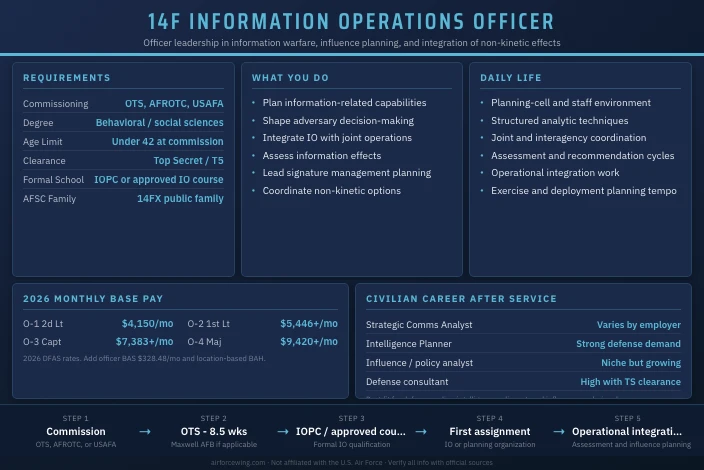
Job Role
14F Information Operations Officers plan, integrate, and assess information-related capabilities that shape adversary decision-making and support Air Force and joint operations. They combine analysis, targeting of vulnerabilities, signature management, and synchronized non-kinetic effects to influence the operational environment.
Leadership Scope
This is a staff-intensive officer field. Even early in the career, 14F work often sits inside planning cells, joint staffs, or specialized teams where the officer leads smaller groups but influences much larger operational decisions.
Family Code Context
The public recruiting site lists this field as 14FX Information Operations Officer. This page uses 14F to match the repo’s officer hub structure.
| Designation | Meaning |
|---|---|
| 14F | Hub label used in this site |
| 14FX | Public recruiting family code |
Mission Contribution
14F officers help commanders create effects without relying only on kinetic action. That can mean planning signature-management efforts, integrating psychological and information-related capabilities, or helping shape how an operation is perceived and responded to. In modern conflict, that matters more every year.
Systems And Tools
The field relies on planning frameworks, assessment models, structured analytic techniques, and coordination with joint, service, and interagency organizations. This is less about a single hardware system and more about integrating multiple capabilities into a coherent information campaign.
Salary
Officer Base Pay
2026 pay follows the DFAS military pay tables.
| Rank | Grade | Typical YOS | Monthly Base Pay |
|---|---|---|---|
| Second Lieutenant | O-1 | Under 2 | $4,150 |
| First Lieutenant | O-2 | 2-4 years | $5,446-$6,485 |
| Captain | O-3 | 4-10 years | $7,383-$8,376 |
| Major | O-4 | 10-16 years | $9,420-$10,402 |
Allowances
- BAH: location based
- BAS: $328.48 monthly
- TRICARE Prime
- BRS and TSP matching
Civilian Value
The best civilian transitions tend to be in influence analysis, strategic communication, interagency planning, intelligence support, and policy-adjacent work rather than a clean one-to-one corporate equivalent.
Qualifications
Commissioning Requirements
The public Air Force Information Operations Officer page provides the strongest published baseline.
| Commissioning Source | Degree Requirement | Age Limit | Key Prerequisites |
|---|---|---|---|
| OTS | Bachelor’s degree | Must commission before 42 | Competitive officer selection |
| AFROTC | Bachelor’s degree | Must commission before 42 | Assignment at commissioning |
| USAFA | Degree on graduation | Standard academy limits | Assignment at graduation |
Competitive degree areas include behavioral sciences, social sciences, psychology, sociology, marketing, cultural studies, and public relations.
Screening
The public page specifically calls for:
- Completion of the Information Operations Professionals Course or approved equivalents
- Completion of a Tier 5 Investigation for Top Secret clearance
- Standard officer accession through OTS, USAFA, or AFROTC
Use the AFOQT study guide if you are competing for the officer-accession side of the pipeline.
Upon Commissioning
New officers enter as O-1 and move into information operations training and operational integration roles after commissioning. The field rewards officers who can think across disciplines and explain complex influence problems clearly.
Work Environment
Setting And Schedule
Most of the work happens in planning environments, staffs, operations centers, or secure collaborative spaces rather than on a line or in a classic office-only routine. The rhythm depends heavily on exercise and operational tempo.
Officer-NCO Dynamic
This field often works in mixed planning teams with intelligence, cyber, operations, and enlisted specialists. The officer’s value comes from synthesis and leadership across disciplines rather than owning a narrow technical lane.
Staff Balance
14F is staff heavy by nature. That is not a weakness. It is where the mission lives.
Training
Training Pipeline
| Phase | Location | Length | Focus |
|---|---|---|---|
| Commissioning source or OTS | Maxwell AFB, AL or source dependent | OTS 8.5 weeks | Officership basics |
| Information Operations Professionals Course | Current Air Force / joint location | Verify current length | IO planning, integration, assessment |
| Follow-on approved IO courses | Mission dependent | Varies | IOIC, POQC, IIC-MISO, AFOC equivalents |
| First assignment OJT | IO or planning unit | 12-24 months | Operational integration |
The public page is unusually specific about course requirements and makes clear that formal IO schooling is part of accession credibility for this field.
The AFOQT study guide is still the right first prep step if you are entering through OTS.
Career Progression
Timeline
| Rank | Grade | Typical Timeline | Development Focus |
|---|---|---|---|
| Second Lieutenant | O-1 | Entry to 2 years | Learn IO planning and assessment |
| First Lieutenant | O-2 | 2-4 years | Integrate with planning teams |
| Captain | O-3 | 4-10 years | Lead IO planning cells or sections |
| Major | O-4 | 10-16 years | Senior planner or staff integrator |
| Lieutenant Colonel | O-5 | 16-22 years | Senior IO leadership roles |
Promotion Drivers
Strong records come from joint credibility, clear assessment work, and the ability to integrate information-related capabilities into real operations rather than treating IO as a side brief.
Physical Demands
Fitness Standards
14F officers take the standard Air Force Fitness Assessment.
| Component | Max Points |
|---|---|
| 1.5-mile run | 60 |
| Push-ups | 10 |
| Sit-ups | 10 |
| Waist or body composition | 20 |
No special field-specific physical standard is highlighted publicly beyond normal officer accession fitness.
Deployment
Deployment Tempo
This field can deploy with joint and operational staffs, and it often supports deployed planning even when the officer is not forward in a tactical unit. Tempo varies by assignment and mission.
Duty Stations
Assignments tend to cluster around operational staffs, intelligence-heavy organizations, and units where information planning is central. The base list is narrower than a broad support field but still diverse.
Risk/Safety
Main Risks
The risk is operational and strategic:
- Bad assessment of influence effects
- Poor integration with joint partners
- Weak signature management planning
- Oversimplified assumptions about adversary behavior
Control Measures
This field depends on disciplined analysis, structured planning, and constant coordination with other communities. Good 14F officers stay humble around complexity.
Impact on Family
The day-to-day physical risk is lower than in many operator fields, but staff and planning tempo can still be intense. Family impact depends more on assignment location and exercise cycle than on the field itself.
Reserve and Air National Guard
Component Availability
The public page lists Active Duty, Air Force Reserve, and Air National Guard for 14FX. That gives the field more component flexibility than some readers expect for a specialized information mission.
Civilian Integration
The strongest civilian overlap is in intelligence-adjacent analysis, strategic communication, policy support, and influence analysis rather than a generic private-sector job title.
Post-Service
Civilian Career Paths
| Civilian Role | Median Pay | Outlook |
|---|---|---|
| Strategic Communications Analyst | Varies widely | Strong in government/consulting |
| Intelligence Planner | Sector dependent | Strong in defense and interagency |
| Policy / influence analyst | Varies by employer | Niche but growing |
| Information environment advisor | Strong in defense sector | Specialized demand |
Is This a Good Job
14F is a strong fit if you think well across psychology, planning, and operations and you are comfortable working in the gray areas of influence. It is a poor fit if you want a simple technical lane or a job where outputs are easy to measure every day.
More Information
- Review the Air Force Information Operations Officer page
- Compare the adjacent field at 14N Intelligence Officer
- Build your OTS prep baseline with the AFOQT study guide
This site is not affiliated with the U.S. Air Force or any government agency. Verify all information with official Air Force sources before making enlistment or career decisions.
Explore more Air Force intelligence officer careers and compare this field with 14N Intelligence Officer and enlisted 1N0X1 All Source Intelligence Analyst.