38FXA Force Support Officer (Analyst)
The Air Force makes thousands of decisions about its people every year, how many officers a wing needs, whether a base is overmanned in one specialty and short in another, what the downstream effects of a force reduction will be. Someone has to run those numbers. In the 38F Force Support career field, the officers who specialize in that analytical work carry a specific designation: 38FXA.
Officers interested in the analytical side of force management should look closely at this shredout before building a commissioning package.
OTS candidates need competitive ASVAB scores. Our AFOQT study guide covers exactly how to prepare.
Job Role and Responsibilities
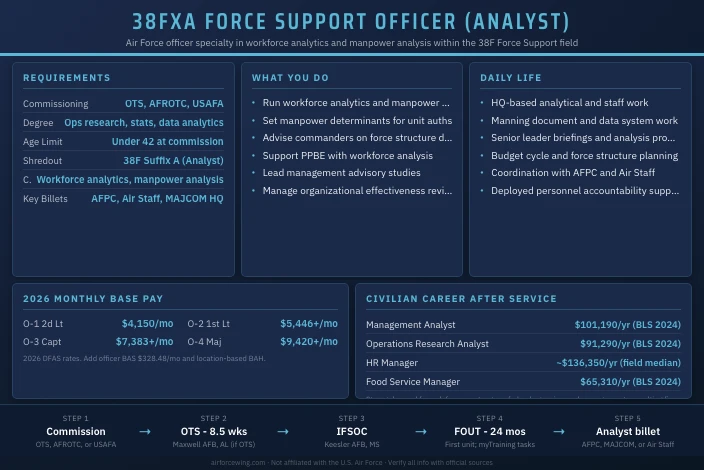
When a wing commander asks whether the base can absorb a 15% cut to its maintenance workforce without degrading sortie generation, the answer comes from a 38FXA officer. These officers specialize in workforce analytics, manpower determinants, and organizational analysis within the broader 38F Force Support career field. They apply management engineering and data methods to measure how many people the Air Force needs, where, and in what jobs, and their analysis directly informs budgets, force structure decisions, and personnel policy at every level of command.
Command and Leadership Scope
The 38FXA designation identifies officers assigned to billets that require proficiency in analytical tools and quantitative methods. At the company grade level, that typically means working inside a manpower and organization flight, a MAJCOM manpower division, or a headquarters staff function where workforce data drives recommendations to senior leaders.
Mid-career 38FXA officers often serve in policy-facing staff roles at Air Staff or AFPC. The analytical track within force support is one of the few paths in this career field that leads consistently to senior headquarters positions before the O-5 milestone. Officers who accumulate depth in data systems and manpower methodology become genuinely scarce, which matters when assignment officers build slates.
Specific Roles and Designations
The AFOCD documents two shredouts within the 38F career field. Both can appear at the entry (38F1) and qualified (38F3) skill levels.
| Shredout | Suffix | What It Means |
|---|---|---|
| Analyst | A | Positions requiring workforce analytics and manpower proficiency |
| Section Commander | Q | Section-level command billets (1- and 3-skill levels only) |
| Staff | (none, 38F4) | Senior staff positions above wing level |
An officer holding 38F3A has the qualified skill level with the analyst suffix. This suffix can also appear at the entry level as 38F1A when an officer is filling an analyst billet before completing the full qualification requirements.
Mission Contribution
The Air Force manages roughly 330,000 active-duty members. Keeping that force sized correctly across hundreds of specialties and dozens of installations is not a passive process. Manpower analysts set the determinants that drive authorizations, the numbers on unit manning documents that every commander checks when planning operations, requesting fill, or building unit type codes for deployment.
Poor manpower analysis wastes money and erodes readiness. Too many authorizations in one specialty starves another. 38FXA officers are the Air Force’s check on that math. Their work feeds the PPBE cycle (Planning, Programming, Budgeting, and Execution), where resource decisions with billion-dollar implications depend on credible workforce data.
Technology, Equipment, and Systems
Force support analyst officers work with Air Force manpower data systems including the Unit Manpower Document, personnel databases managed through AFPC, and analytical tools used for management advisory studies and organizational effectiveness assessments. Officers assigned to MAJCOM or Air Staff manpower roles also engage directly with the Defense Manpower Data Center systems that aggregate force-wide personnel data.
Salary and Benefits
Officer Base Pay
Pay follows the 2026 DFAS military pay tables and is identical across all 38F shredouts, the analyst suffix does not affect base pay.
| Rank | Grade | Typical YOS | Monthly Base Pay |
|---|---|---|---|
| Second Lieutenant | O-1 | Under 2 | $4,150 |
| First Lieutenant | O-2 | 2-4 | $5,446 - $6,485 |
| Captain | O-3 | 4-10 | $7,383 - $8,376 |
| Major | O-4 | 10-16 | $9,420 - $10,402 |
Allowances and Benefits
- BAS: $328.48 monthly (officer rate, 2026)
- BAH: varies by duty station and dependency status
- TRICARE Prime: zero-cost medical, dental at military treatment facilities, vision exams at no cost for active duty
- TSP matching: up to 5% of basic pay under the Blended Retirement System
- Tuition assistance: up to $4,500 per year, $250 per semester hour
The 38FXA path leads naturally to positions at AFPC in San Antonio, Air Staff in the Pentagon, and major command headquarters. Those locations carry higher BAH rates than many smaller installations. An O-3 at the Pentagon area or Joint Base San Antonio-Lackland will draw substantially more in total compensation than the base pay table alone suggests.
Work-Life Balance
Garrison assignments in manpower analyst roles tend to follow normal duty-hour patterns because the work is headquarters-based rather than operations-tempo-driven. Staff assignments at MAJCOM or Air Staff involve longer hours during budget cycles and major organizational reviews, but do not carry the sustained operational tempo of line units. Officers have 30 days of paid leave annually, accruing at 2.5 days per month.
Qualifications and Eligibility
Commissioning Sources
Candidates commission through the standard 38F paths. The analyst shredout is not a separate commissioning stream, it is a functional designation applied after commissioning and initial qualification.
| Commissioning Source | Degree Requirement | Age Limit | GPA Standard |
|---|---|---|---|
| OTS | Bachelor’s degree | Commission before 42 | Competitive; generally 3.0+ for competitive packages |
| AFROTC | Bachelor’s degree | Commission before 42 | Determined by detachment and accession year |
| USAFA | Conferred at graduation | Standard academy limits | N/A, academy graduates |
Degrees that position candidates well for analyst billets include operations research, mathematics, statistics, data analytics, economics, industrial engineering, public administration, and related quantitative fields. The AFOCD specifically notes that 38FXA positions require proficiency in analytical skills, and competitive degree areas on the airforce.com career page include operations research and data analytics.
Test Requirements
All officer candidates must pass the Air Force Officer Qualifying Test (AFOQT). The AFOQT is not rated-career-specific for 38F applicants, but competitive verbal and quantitative scores strengthen a commissioning package for a career field that emphasizes analytical work.
OTS candidates can use the AFOQT study guide to understand the full qualifying test suite and build a stronger application.
The TBAS (Test of Basic Aviation Skills) is not required for 38F or 38FXA candidates.
Career Field Assignment
At ROTC, cadets may receive a force support classification at commissioning. At OTS, career field selection is a competitive process. The 38F field is non-rated and considered a support career field, which typically means less competition for slots than rated or operations career fields, but selectees must still present strong packages including academic record, AFOQT scores, and leadership documentation.
Analyst billets within force support are identified by the A suffix on the unit manning document. Officers are not always assigned to analyst billets from day one. Many 38F officers rotate through a general force support assignment before moving into an analyst-coded position.
Upon Commissioning
New 38F officers enter as O-1 (2d Lt). The standard Active Duty Service Commitment for OTS is four years. Officers attending additional specialty schooling may incur additional ADSC.
Work Environment
Setting and Schedule
38FXA officers typically work in headquarters buildings, not on flight lines or in field environments. The pace varies: manpower reviews tied to the PPBE cycle have hard deadlines and sustained periods of intensive work, while steady-state periods allow more predictable hours.
Common analysis outputs include:
- Management advisory studies: recommendations on organizational structure and staffing
- Organizational effectiveness assessments: evaluation of unit mission performance vs. authorized manning
- Unit manning document (UMD) reviews: verification and adjustment of authorized position counts
- Manpower determinant studies: statistical models that define how many billets a mission requires
Officers assigned to AFPC in San Antonio operate in a large bureaucratic environment where the work directly affects assignment decisions for tens of thousands of Airmen. Pentagon and MAJCOM positions carry more senior-leader visibility and faster career development, but the environment is staff-heavy and politically complex.
Leadership and Chain of Command
At the company grade level, an 38FXA officer typically reports to a senior force support officer or a civilian GS manpower analyst, depending on the organization. As officers advance to field grade, they take on division or flight leadership roles. Senior 38F officers advise wing commanders and MAJCOM directors, a high-visibility role because manpower and personnel data are among the most politically sensitive topics in any headquarters.
The officer-NCO dynamic in force support manpower flights differs from general force support: manpower flights are often small and mix officers, civilians, and a handful of NCO analysts. Officers take ownership of analysis products quickly, even early in their careers.
Staff vs. Command Roles
The analyst track runs parallel to the command track in force support. Officers can pursue both, but the analyst track’s value proposition is depth. Officers who build genuine expertise in manpower determinants and workforce modeling become competitive for senior staff roles that generalist officers cannot fill. That said, Force Support Squadron command remains the primary key developmental position in this career field regardless of shredout.
Job Satisfaction and Retention
Force support officers who want to use quantitative skills in a military context often find the analyst track more satisfying than rotating through general services or personnel billets. The tradeoff is that the work is less visible to the wider Air Force than the readiness programs and installation operations that general 38F officers lead. Officers who prefer direct leadership over Airmen and installation operations sometimes find staff-heavy analyst roles isolating.
Training and Skill Development
Pre-Commissioning Training
ROTC cadets complete four years of leadership development coursework and field training. OTS is 8.5 weeks at Maxwell AFB, Alabama, covering officer fundamentals, leadership, and Air Force culture. USAFA provides four years of an integrated commissioning program.
Initial Skills Training
After commissioning, 38F officers complete the Initial Force Support Officer Course (IFSOC) at Keesler AFB, Mississippi. The course was established in 2008 when the Air Force merged the manpower, personnel, and services officer career fields into 38F. IFSOC is mandatory for company grade officers before award of the 38F3 (qualified) skill level; a Career Field Manager waiver is required if any portion cannot be completed.
| Phase | Location | Length | Focus |
|---|---|---|---|
| Commissioning source or OTS | ROTC detachment or Maxwell AFB, AL | Varies / 8.5 wks | Officership fundamentals |
| IFSOC | Keesler AFB, MS | Verify current length with AFPC | Personnel, manpower, services, education, and analytics |
| Follow-On Unit Training (FOUT) | First assignment unit | 24 months (CGOs) | Unit-specific competencies in myTraining |
After IFSOC, officers must complete Follow-On Unit Training within 24 months. This consists of competency tasks tracked in the myTraining system and certified by the Force Support Squadron commander or the senior career field leader in the unit.
Professional Military Education
- Squadron Officer School (SOS): Completed by most captains; can be completed in-residence at Maxwell AFB or through distance learning. Covers joint warfighting concepts and leadership development.
- Air Command and Staff College (ACSC): Eligible for selection as a major. In-residence at Maxwell AFB. Competitive selection. In-residence attendance strengthens promotion files.
- Air War College (AWC): Senior officer PME for lieutenant colonels and colonels.
Additional Training
Officers pursuing depth in the analyst track can pursue programs at the Air Force Institute of Technology (AFIT), which offers fully funded graduate degrees in operations research, statistics, data science, and related fields. AFIT selection is competitive and carries an ADSC. A graduate degree in a quantitative field, paired with manpower analyst experience, creates a strong profile for senior staff positions and makes an officer competitive for assignments at AFPC, Air Staff, and combatant command staffs.
Joint assignments, serving on a joint staff, are also part of career development for mid-grade and senior officers. Joint experience counts toward promotion at the O-5 and O-6 levels under joint officer management requirements.
Before OTS, you need qualifying scores. See our AFOQT study guide.
Career Progression and Advancement
Career Path
| Rank | Grade | Typical YOS | Key Developmental Focus |
|---|---|---|---|
| Second Lieutenant | O-1 | 0-2 | Initial qualification; IFSOC; first assignment |
| First Lieutenant | O-2 | 2-4 | Section leadership; FOUT completion |
| Captain | O-3 | 4-10 | Flight commander; management advisory studies; SOS |
| Major | O-4 | 10-16 | Squadron deputy or senior staff; ACSC |
| Lieutenant Colonel | O-5 | 16-22 | Force Support Squadron command or MAJCOM division chief |
| Colonel | O-6 | 22+ | Group/wing staff; Air Staff division; senior leadership |
Force Support Squadron command is the career field’s primary key developmental position. The analyst track does not exempt officers from needing command experience to promote competitively past O-4. Strong analyst officers build their career record by combining analytical staff assignments with flight and section leadership roles in the same career window.
Promotion System
O-1 through O-3 promotions are effectively time-based for officers meeting standards. O-4 (major) and above are board-selected. Air Force promotion boards evaluate officers on their overall officer performance reports, the quality and breadth of their assignments, PME completion, and senior rater endorsements. Officers in the analyst track who serve only in headquarters staff roles without operational leadership exposure may find promotion to O-5 more competitive.
Cross-training into 38F from other career fields is possible, with a minimum 12 months of experience required for field grade officer crossflows to earn the 38F3 skill level.
Broadening Assignments
- AFPC Directorate of Manpower and Personnel
- Air Staff (Pentagon), A1 Directorate
- Joint staff positions (required for joint officer management credit)
- Congressional fellowship
- AFIT graduate program (funded degree, additional ADSC)
- ROTC instructor duty
- Exchange programs with allied air forces
Physical Demands and Medical Evaluations
Fitness Standards
38FXA officers take the standard Air Force Fitness Assessment, the same test required of all Airmen. There are no career-field-specific physical screens or standards for force support analyst officers.
| Component | Maximum Points |
|---|---|
| 1.5-Mile Run | 60 |
| Push-Ups (1 minute) | 10 |
| Sit-Ups (1 minute) | 10 |
| Waist Circumference or Body Composition | 20 |
The composite minimum passing score is 75 out of 100. Standards are age- and gender-normed. Run time thresholds, push-up counts, and sit-up counts all adjust based on age bracket and gender. Officers must meet minimums on each individual component as well.
The assessment is conducted annually for most Airmen. Officers who fail any component enter a remedial fitness program with a mandatory retest within 90 days. Consecutive failures affect promotion eligibility, assignment opportunities, and in sustained cases can lead to administrative separation. The practical reality for 38FXA officers in staff assignments is that a desk-heavy work environment requires disciplined personal fitness habits. The job itself provides no physical conditioning.
Medical Requirements
There are no special flight physicals or career-field-specific medical requirements for 38FXA officers. Standard officer commissioning medical standards apply: the DoDMERB physical for commissioning sources and a periodic health assessment thereafter.
Officers must maintain fitness to perform deployed duties because the Force Support career field is designated expeditionary. Analysts may deploy in support of contingency operations. Deployed medical readiness standards require current immunizations, dental readiness class 1 or 2, and a valid PHA (Periodic Health Assessment). Officers with chronic conditions that limit deployment eligibility may be subject to Medical Evaluation Board review.
Deployment and Duty Stations
Deployment Tempo
Force support is an expeditionary career field. The AFOCD states explicitly that 38F officers establish, train, equip, and maintain ready status specialized mobility teams that deploy to support wartime and contingency operations. Officers in the analyst track are not exempt from deployment requirements, though analyst-coded positions are less likely to generate the high-frequency deployment tempo of some line units.
Deployed force support officers support personnel accountability, casualty reporting, and readiness functions. Analyst officers may support TPFDD planning and force accounting in deployed headquarters. Deployment length is typically 4-6 months for standard Air Expeditionary Force rotations, though contingency and extended deployments vary.
Duty Station Options
38F officers serve at virtually every major Air Force installation because every installation has a Force Support Squadron. Analyst and manpower billets are concentrated at:
- Air Force Personnel Center, Joint Base San Antonio-Lackland, TX
- Pentagon, Arlington, VA
- Major command headquarters (ACC, AMC, AETC, AFMC, AFSPC)
- Air Force Manpower Analysis Agency (AFMAA)
- Wing-level manpower and organization flights
Officers can submit preference worksheets through AFPC’s assignment process, but actual assignments depend on requisition fills and career development priorities. The breadth of installations gives force support officers more geographic flexibility than many career fields.
Risk, Safety, and Legal Considerations
Job Hazards
Professional accuracy: The primary risks for 38FXA officers are organizational rather than physical. Manpower analysis work that produces incorrect determinants, flawed studies, or misleading data briefed to senior leaders can result in poor resource decisions with real readiness consequences. Officers bear responsibility for the accuracy of their analysis products. A manpower study that underestimates staffing requirements can leave a unit unable to execute its mission; one that overstates requirements wastes resources the Air Force cannot afford to misallocate.
Deployed risk: Deployed environments add physical risk consistent with the threat environment at the deployed location. Force support officers in expeditionary roles operate inside the wire at established bases, but indirect fire and force protection threats apply.
Command Responsibility
UCMJ obligations: Force support officers hold standard officer responsibilities under the UCMJ regardless of shredout. Officers in section or flight leadership positions carry the full weight of command climate accountability, equal opportunity requirements, and supervisory authority over enlisted Airmen.
Professional credibility: Analysis products briefed to senior leaders carry the officer’s name and professional credibility. Errors in formal manpower studies or management advisory reports are a career matter, not just a data correction. Officers who sign manpower determinant studies are certifying the methodology and conclusions to the approving authority.
Privacy and data handling: Manpower analysts routinely handle personnel data including manning statistics, assignment projections, and organizational structure information. While most of this data is unclassified, it is controlled under the Privacy Act and must be handled according to Air Force records management policy. Unauthorized disclosure of personnel data can result in administrative or legal action.
Operational Risk Management (ORM) applies to officer decision-making across all settings. In the manpower context, this means validating data sources, applying proper statistical methodology, and flagging uncertainty in analysis products rather than presenting precision that doesn’t exist.
Impact on Family and Personal Life
Force support officers tend to PCS every 2-3 years, similar to other non-rated career fields. The analyst track concentrates assignments at AFPC in San Antonio and at headquarters locations, which can mean fewer total PCS moves for officers who build a reputation in the manpower analytical community. Sequential headquarters assignments are common for officers with strong analytical skills.
Key family-relevant factors for the 38FXA track:
- PCS frequency: Every 2-3 years, with potential for longer tours at AFPC or Pentagon
- Spousal employment: Strong civilian job markets at San Antonio and National Capital Region; smaller bases vary
- Childcare: On-base CDC (Child Development Center) at major installations; off-base waitlists common at high-demand locations
- Deployment notification: Typically 90-120 days advance notice for standard AEF rotations
- Join-spouse program: Available through AFPC; co-location not guaranteed but San Antonio’s large military footprint improves odds
The predictable garrison schedule of analyst roles generally supports family stability better than high-tempo operational fields. The tradeoff is that staff assignments in large headquarters can involve extended evening and weekend work during critical planning cycles. PPBE submission deadlines and manpower review milestones generate real surges that affect home life for weeks at a time.
Reserve and Air National Guard
Component Availability
The 38F career field is available across all three components. The airforce.com Force Support Officer page lists Active Duty, Air Force Reserve, and Air National Guard as available components. Reserve and Guard units maintain Force Support Squadrons at most flying wings and many support wings.
| Comparison Factor | Active Duty | Air Force Reserve | Air National Guard |
|---|---|---|---|
| Commitment | Full-time | One UTA weekend/mo + 15 days/yr | One UTA weekend/mo + 15 days/yr |
| Monthly Pay (O-3) | ~$7,383 - $8,376 full salary | Drill pay per UTA period | Drill pay per UTA period |
| Healthcare | TRICARE Prime (no cost) | TRICARE Reserve Select (premiums apply) | TRICARE Reserve Select or state plan |
| Education Benefits | Full TA + GI Bill transferability | Federal TA + GI Bill (with qualifying service) | State tuition waivers (varies by state) + Federal TA |
| Deployment Tempo | Moderate; AEF rotations | Mobilization-based; varies | Mobilization-based; varies |
| Command Opportunities | Force Support Squadron | Force Support Squadron | Force Support Squadron |
| Retirement System | BRS (20 yr pension) | Points-based reserve retirement | Points-based reserve retirement |
Commissioning and Transfer
ROTC cadets can commission into the Reserve component with a force support designation. Air National Guard officers typically commission through state-sponsored OTS or direct civilian accessions with a baccalaureate degree. Active-duty officers can separate and affiliate with a Reserve or Guard unit after completing their ADSC, this is a common path for officers who want to continue serving part-time while pursuing civilian careers that align directly with force support competencies.
Civilian Integration
The analyst track within 38F pairs naturally with civilian careers in human capital analytics, organizational effectiveness consulting, workforce planning, and operations research. Reserve and Guard officers who combine a 38FXA background with a civilian role in HR analytics, defense consulting, or data science maintain directly transferable skills between their military and civilian work. USERRA protections cover civilian employer obligations when officers are mobilized.
Post-Service Opportunities
Officers leaving the 38F analyst track bring a combination of leadership experience, quantitative analysis skills, and large-organization management credentials. Employers in defense consulting, federal government, HR analytics, and operations research actively recruit officers with this background.
| Civilian Role | Median Annual Pay | Outlook |
|---|---|---|
| Management Analyst | $101,190 | 9% growth, much faster than average |
| Operations Research Analyst | $91,290 | 21% growth, much faster than average |
| Human Resources Manager | ~$136,350 (field median) | Stable demand |
| Food Service Manager | $65,310 | 6% growth, faster than average |
Median salaries are from BLS May 2024 data. The operations research analyst category sees especially strong demand from defense contractors, federal agencies, and management consulting firms, all of which view Air Force manpower analyst experience as directly relevant.
Graduate Education and Credentials
The Post-9/11 GI Bill covers full in-state tuition at public universities and up to $29,920.95 per year at private institutions for the 2025-2026 academic year. Officers with significant active-duty service qualify for full benefits. AFIT-funded graduate degrees incur an additional ADSC but position officers for both senior military roles and high-value civilian transitions.
Professional certifications relevant to this field include the Project Management Professional (PMP), Certified Analytics Professional (CAP), and SHRM-SCP for officers transitioning into civilian HR leadership. Military training and experience count toward eligibility hours for several of these credentials.
The Transition Assistance Program (TAP) is available to separating officers. Programs like Hiring Our Heroes provide networking and fellowship opportunities specifically for transitioning military officers.
Is This a Good Job for You?
Ideal Candidate
The 38FXA path fits officers who genuinely enjoy quantitative work and want to apply it at an organizational scale. A college student who has taken statistics or operations research courses and found them interesting, not just manageable, will get more out of this track than someone pursuing it to avoid operational deployments.
Strong fits include:
- Officers with quantitative degree backgrounds who still want human impact
- People who find large-organization management and resource allocation interesting
- Candidates who want a clear path to senior staff positions
- Officers planning a civilian transition into consulting, analytics, or federal workforce planning
The analytical work is real, the impact is real, and officers who develop depth in it become genuinely difficult to replace.
Potential Challenges
Officers who prefer direct leadership of large teams and installation-level operations may find the analyst track’s staff-heavy assignments less satisfying than general force support billets. Analyst work is often invisible to the broader Air Force, even when the analysis is good. Headquarters environments can be politically complex and slower-paced than unit operations.
The 38F career field is broad by design. Officers who expect to specialize exclusively in analytics from day one may find themselves cycling through personnel, services, and manpower rotations before building true depth in the analyst function.
Career and Lifestyle Fit
For officers who want to commission, develop analytical skills in a military context, and exit into a well-compensated civilian analytics or consulting career, the 38FXA track is one of the better paths available in the Air Force officer corps. The field’s reach into PPBE, force structure, and personnel policy means the work matters, and the civilian demand for officers who can bridge quantitative methods and people-management experience is consistently strong.
The one-and-done path (commission, serve initial obligation, separate) is viable. The full career to O-5 or O-6 is also viable, particularly for officers who pursue PME, broadening assignments, and eventually Force Support Squadron command. Reserve and Guard affiliation after active duty extends the benefits and network without a full active-duty commitment.
More Information
Your local Air Force recruiter or ROTC detachment can answer current questions about career field selection, the classification process, and commissioning timelines. The AFPC Assignment page covers how officer duty assignments work once you’re in uniform. If you’re building an OTS package, the AFOQT study guide covers the qualifying exams and application requirements you’ll need to strengthen your candidacy.
This site is not affiliated with the U.S. Air Force or any government agency. Verify all information with official Air Force sources before making enlistment or career decisions.
Explore more Air Force force support officer careers and compare this field with the 38F Force Support Officer profile covering the full career field scope.