38F Force Support Officer
When you purchase through links on our site, we may receive compensation at no extra cost to you.
Few officer jobs touch more of daily Air Force life than 38F. Promotions, evaluations, manpower studies, education programs, dining facilities, lodging, fitness centers, readiness programs, and family-support services all live somewhere inside the force support mission. That means a 38F officer can influence almost every Airman on the installation, even without ever stepping into a cockpit or onto a flight line.
OTS applicants should start with the AFOQT study guide before building a package.
Job Role and Responsibilities
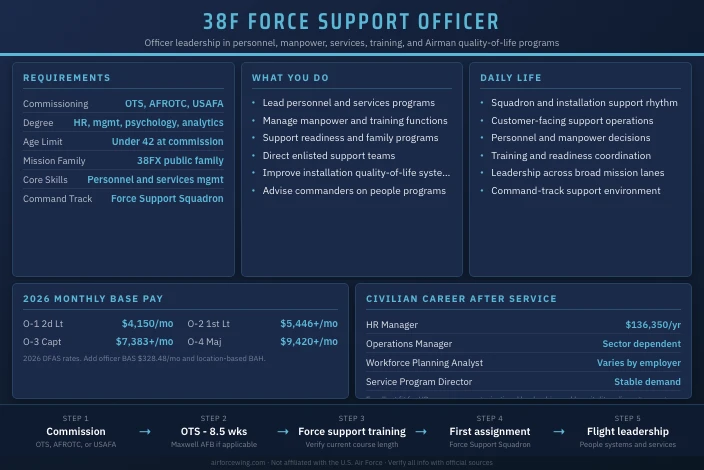
38F Force Support Officers lead the Air Force organizations responsible for personnel support, services, manpower, education and training, and quality-of-life programs. They manage both people systems and installation programs that affect readiness, morale, and daily life across the force.
Leadership Scope
This field is broad from the start. A junior 38F officer does not specialize in one narrow function. Depending on the assignment, the officer might supervise a personnel flight handling evaluations and records, a services flight running dining facilities and lodging, a manpower office analyzing unit requirements, or a training section tracking education programs. Each function has its own enlisted professionals, its own processes, and its own set of external Air Force regulations to stay current on. Learning that breadth fast is what separates early performers in this field.
Over time, 38F officers lead major flights within a Force Support Squadron (FSS), then move into deputy and commander roles. The FSS commander is one of the most visible wing positions because the squadron directly serves every Airman and family member on the installation.
Family Code Context
The public recruiting site presents this field as 38FX Force Support Officer. This guide shortens the label to 38F while discussing the same career field.
| Designation | Meaning |
|---|---|
| 38F | Hub label used in this site |
| 38FX | Public recruiting family code |
Mission Contribution
This is the officer field that keeps the people side of the Air Force functioning. Readiness still depends on records, assignments, education, manpower, lodging, recreation, feeding, and family support. 38F officers lead those systems. When a deployment occurs, the FSS manages the administrative processing that gets Airmen out the door. When retention is low, the FSS runs the programs that help keep people in. The mission is invisible when it works well and immediately obvious when it breaks.
Systems And Tools
The field spans personnel systems such as the Military Personnel Data System, manpower analysis frameworks, readiness reporting tools, training management platforms, and services-program oversight processes. Officers will work with both automated systems and manual processes across multiple functional areas. The ability to understand systems at the management level, not just the user level, is what makes 38F officers effective as leaders rather than just administrators.
Salary and Benefits
Officer Base Pay
2026 pay follows the DFAS military pay tables.
| Rank | Grade | Typical YOS | Monthly Base Pay |
|---|---|---|---|
| Second Lieutenant | O-1 | Under 2 | $4,150 |
| First Lieutenant | O-2 | 2-4 years | $5,446-$6,485 |
| Captain | O-3 | 4-10 years | $7,383-$8,376 |
| Major | O-4 | 10-16 years | $9,420-$10,402 |
Allowances
Officer total compensation extends well beyond base pay. Basic Allowance for Housing (BAH) is tax-free and set by duty station zip code and dependent status, so it varies substantially by location. Officers at high-cost-of-living installations like Joint Base Pearl Harbor-Hickam or Joint Base San Antonio can see BAH rates that effectively double the value of their base pay package.
- BAH: location based, tax-free
- BAS: $328.48 monthly, tax-free
- TRICARE Prime: medical, dental, and vision coverage
- BRS and TSP matching: government matches up to 5% of base pay after 26 months
- Legal assistance, commissary access, base housing eligibility: additional non-cash compensation worth thousands annually
Officers managing personnel programs will also counsel Airmen on these same benefits, so practical knowledge of the compensation system is professionally useful, not just personally relevant.
Civilian Value
The strongest civilian translation is into HR, operations management, workforce planning, hospitality leadership, and organizational development. Military HR experience at the leadership level maps well to civilian HR Manager, Director of People Operations, and Workforce Planning roles. The breadth of the 38F mission, spanning both the people systems and the services side, also creates a path into hospitality operations, food service management, and facilities leadership roles that civilian candidates without military backgrounds rarely hold by their mid-30s.

Qualifications and Eligibility
Commissioning Requirements
The Air Force Force Support Officer page provides the current public baseline.
| Commissioning Source | Degree Requirement | Age Limit | Notes |
|---|---|---|---|
| OTS | Bachelor’s degree | Must commission before 42 | Competitive officer selection |
| AFROTC | Bachelor’s degree | Must commission before 42 | Assignment at commissioning |
| USAFA | Degree on graduation | Standard academy limits | Assignment at graduation |
Competitive degree areas include economics, operations research, data analytics, organizational leadership, education, mathematics, statistics, psychology, behavioral science, public administration, business administration, management, hospitality, finance, and human resources.
Screening
The public page stresses knowledge of personnel management and other core competencies that sit inside the force support enterprise. Candidates do not need to arrive as subject-matter experts in all FSS functions; they need to demonstrate the management aptitude, leadership capacity, and systems thinking that make them effective across multiple functions as they develop. Officers who come in with narrow expertise in one area and no flexibility struggle more than those who arrive with broad organizational instincts and the discipline to learn each functional area as they lead it.
Use the AFOQT study guide if you are applying through OTS and want a stronger prep baseline.
Upon Commissioning
New 38F officers enter as O-1 and move into the force support enterprise after commissioning and initial officer training. The biggest adjustment early is learning just how broad the mission really is and building credibility with senior enlisted leaders who have spent entire careers in one or two FSS functional areas. Those NCOs are the institutional knowledge base for the squadron. A new officer who listens and learns from them develops faster than one who tries to lead from theory alone.

Work Environment
Setting And Schedule
Most assignments are installation based. A typical 38F workday covers office leadership, program management, customer-facing service oversight, and staff coordination with the wing and other installation agencies. The job mixes paperwork-heavy personnel administration with the more visible operational side of running dining facilities, fitness centers, lodging, and family programs. Schedules are generally steadier than in operational flying or special warfare units, but force support programs run outside normal duty hours. Fitness center operations, lodging check-ins, and dining operations do not stop at 1700, so subordinate sections require supervisory attention that sometimes extends beyond a standard Monday-through-Friday schedule.
Officer-NCO Dynamic
Senior enlisted force support leaders carry decades of functional expertise because the FSS spans so many distinct programs. An experienced First Sergeant in a Force Support Squadron has probably worked across personnel, services, and manpower at multiple installations. Officers who recognize that institutional depth and actively work alongside their senior enlisted leaders build stronger units faster. This field is one where enlisted credibility is hard-earned, visible, and worth developing early. Officers who try to outrank their way through functional decisions instead of earning trust tend to find themselves managing around, rather than through, their NCO corps.
Command And Staff Balance
This field offers a direct command track through the Force Support Squadron. The FSS commander is a primary lieutenant colonel position at most wings, and officers who develop strong reputations across multiple functional areas and multiple assignments compete well for it. Staff roles at MAJCOM and Air Staff also matter, especially for officers interested in manpower policy, personnel systems, or education and training programs at the Air Force level. Some officers build careers that alternate between FSS operational assignments and staff billets; others go deep on FSS command and senior leadership.
Training and Skill Development
Training Pipeline
| Phase | Location | Length | Focus |
|---|---|---|---|
| Commissioning source or OTS | Maxwell AFB, AL or source dependent | OTS 8.5 weeks | Officership basics |
| Force support officer qualification | Current Air Force course location | Verify current length | Personnel, services, manpower, training leadership |
| First assignment OJT | Force Support Squadron | 12-24 months | Unit programs and leadership |
After initial officer training, 38F officers complete Force Support specialty training that introduces the personnel, services, manpower, and education systems they will manage. The exact course names, locations, and lengths are less prominently published than in some other career fields and should be confirmed with a recruiter or current 38F officer. Specialty training does not make someone a fully competent FSS leader; it gives them the vocabulary and regulatory framework to start learning from their unit. Most of the real skill development happens in the first two assignments under strong supervisors and with deliberate mentorship from senior officers and NCOs in the field.
Advanced development opportunities include Air Command and Staff College (ACSC) at the O-4 level, joint billets, and functional management fellowships that place officers in civilian agency environments. Officers who pursue joint assignments build the joint professional military education (JPME) credit that matters for senior promotion.
The AFOQT study guide is still the right first prep step for OTS candidates.
Career Progression and Advancement
Timeline
| Rank | Grade | Typical Timeline | Development Focus |
|---|---|---|---|
| Second Lieutenant | O-1 | Entry to 2 years | Learn enterprise and lead small teams |
| First Lieutenant | O-2 | 2-4 years | Section leadership |
| Captain | O-3 | 4-10 years | Flight commander and broad program management |
| Major | O-4 | 10-16 years | Deputy and squadron-level leadership |
| Lieutenant Colonel | O-5 | 16-22 years | Force Support Squadron command or senior staff |
Promotion Drivers
This field rewards officers who can lead across very different functions without losing consistency. The FSS commander who holds standards in personnel, services, and manpower simultaneously shows the kind of versatile leadership that promotion boards notice. Strong records in this field typically include flight-commander experience at the O-3 level, a competitive joint or staff assignment at O-4, and clear evidence of organizational impact in each tour. Officers who stay in purely staff roles without building operational FSS credibility can struggle in senior competition, while those who alternate between FSS leadership and staff development put themselves in the strongest position.
Deployment performance also matters. 38F officers who deploy and run personnel or services operations in austere environments demonstrate the adaptability and resilience that promotion boards in all officer career fields look for.
Physical Demands and Medical Evaluations
Fitness Standards
38F officers take the standard Air Force Fitness Assessment. There is no special career-field physical screen beyond standard officer accession medical requirements.
| Component | Max Points |
|---|---|
| 1.5-mile run | 60 |
| Push-ups | 10 |
| Sit-ups | 10 |
| Waist or body composition | 20 |
The composite passing score threshold and age-adjusted grading apply to all officers. Because this field is not aviation or special warfare, there are no additional periodic flight physicals or specialized medical standards. That said, force support officers who deploy into austere environments need the same baseline physical readiness as any officer working in those conditions. Officers who maintain fitness well above the minimum standard are better prepared for the unexpected physical and operational demands that deployments can create, even in a support role.
The Air Force Fitness Assessment is taken twice annually. Officers who fail a component face a mandatory fitness improvement program and additional scrutiny on their record.
Deployment and Duty Stations
Deployment Tempo
Force support does deploy. Deployed units still need personnel services, fitness support, morale programs, lodging management, dining operations, and readiness reporting. The 38F officer may lead an expeditionary force support element at a deployed location, coordinate with joint partners on personnel tracking, or run the administrative systems that keep deployment records accurate for the home unit. Deployment tempo for this field is moderate compared with rated aviation or special operations, but it is real. Officers should expect periodic deployments across a career, with length and frequency depending on Air Force-wide demand and the officer’s assignment at the time.
Duty Stations
This field exists at virtually every major Air Force installation, which gives 38F one of the widest duty-station pools in the officer corps. Officers may serve at large CONUS wings like Travis AFB, Tinker AFB, or Scott AFB, or at overseas installations like Ramstein AB, Kadena AB, or Osan AB. The field also has billets at major headquarters locations such as the Pentagon, Air Force Personnel Center at JBSA-Randolph, and MAJCOM headquarters. Officers who want geographic flexibility will generally find this career field accommodating across a career, though final assignments depend on Air Force needs and officer preferences expressed through the assignment system.
Risk, Safety, and Legal Considerations
Main Risks
The risks in this field are leadership and organizational rather than physical. Force support officers manage high-volume administrative systems where errors compound quickly. A personnel system error in a promotion record, an assignment decision made without proper review, or a manpower study that uses bad baseline data can create downstream consequences that affect multiple Airmen. The field also involves command-climate responsibility because the FSS serves the entire installation population. Officers who let customer-service standards slip or allow morale programs to deteriorate do real harm to Airmen and families who depend on those services.
Specific risk areas include:
- Personnel records errors affecting promotions, assignments, or separations
- Poor oversight of programs that hold food, fitness, or financial accountability
- Manpower misrepresentations that skew resourcing decisions across the wing
- Command climate failures inside a large, diverse squadron
Control Measures
This field runs on management discipline, regulatory compliance, customer-service standards, and strong coordination with senior enlisted leaders and wing leadership. Officers who build structured processes, invest in their NCO corps, and maintain transparency with commanders manage these risks most effectively. The field’s breadth is its biggest challenge and its biggest control lever: officers who see all parts of the FSS clearly tend to catch problems before they escalate.
Impact on Family and Personal Life
Compared with deployment-heavy operational flying or special warfare communities, 38F typically offers more predictable home-station life. Most assignments are at major installations with full family support programs, schools, and base services. The assignment pool is wide enough that officers who need to prioritize certain geographic areas for family reasons can often express those preferences through the assignment system, though Air Force needs always take priority.
Deployment exists but is not as frequent or as extended as in some operational fields. Typical deployments for force support officers run three to six months, similar to most Air Force support officer fields. PCS frequency follows the standard Air Force officer pattern of roughly every two to three years, which means families will move. The FSS directly manages many of the programs that help families through PCS transitions, so 38F officers often have personal insight into those resources that other officers lack.
Officers who want to serve in a leadership role with broad organizational impact, while still having a sustainable family life across a 20-year career, often find 38F a strong fit compared with the alternatives.
Reserve and Air National Guard
Component Availability
The public page lists Active Duty, Air Force Reserve, and Air National Guard for 38FX. That makes this a flexible option for officers who want part-time service later or who prefer to start their careers in a reserve component and transition to active duty over time.
Reserve and ANG force support officers fulfill the same mission for their units, managing personnel records, manpower data, services programs, and readiness administrative requirements. The civilian workforce in force support also tends to have a strong overlap with what reservists already do in civilian human resources, workforce management, education, or hospitality careers. That alignment makes the drill weekend work feel immediately applicable rather than abstract.
Civilian Integration
This is one of the easiest officer fields to pair with civilian HR, workforce planning, education, hospitality, or organizational leadership work. An Air Force Reserve 38F officer who spends their civilian career in a corporate HR or workforce planning role is building directly on the same skills in both settings simultaneously. The two-career approach is more accessible in this field than in more specialized or technical officer communities.
Post-Service Opportunities
Civilian Career Paths
| Civilian Role | Median Pay | Outlook |
|---|---|---|
| Human Resources Manager | $136,350 median field | Strong |
| Operations Manager | Varies by sector | Strong |
| Workforce Planning Analyst | Varies by employer | Stable |
| Hospitality or service-program director | Sector dependent | Stable |
Beyond those broad categories, 38F veterans also find strong demand in federal civil service personnel roles with agencies like the Office of Personnel Management, Department of Defense civilian workforce programs, and veterans-service organizations. The Air Force Personnel Center, RAND Corporation, and defense consulting firms also value the combination of personnel-system expertise, management experience, and military organizational knowledge that a career 38F officer brings.
Officers who led large Force Support Squadrons, with hundreds of personnel and multi-million-dollar services budgets, can compete for senior civilian roles that most mid-career professionals cannot approach without decades of experience. The military career compresses that timeline significantly.
Is This a Good Job for You? The Right (and Wrong) Fit
38F is a strong fit for officers who want broad organizational leadership, care about people systems and quality of life, and can manage multiple very different functional areas without losing consistency. It rewards generalist instincts, strong people skills, and management discipline more than narrow technical mastery.
It is not a strong fit for officers who want a single defined technical specialty, an operational mission that creates tangible combat effects, or a field where outputs are easy to quantify. The FSS mission is about steady-state organizational health, which is hard to make dramatic on a performance report but critical to wing readiness.
Candidates who come in expecting HR paperwork and end up surprised by the breadth of running dining operations, managing fitness programs, and leading manpower studies simultaneously are not ready for this field. Candidates who look at that breadth and see a real leadership challenge are exactly what the field needs.
Air Force officer candidates take the AFOQT for commissioning and career-field placement. See our AFOQT study guide for the 6-composite breakdown and a 30-day plan.
Or go straight to an AFOQT study course.

More Information
- Review the Air Force Force Support Officer page
- Compare enlisted support fields like 3F0X1 Personnel and 3F1X1 Services
- Build your officer package with the AFOQT study guide
Explore more Air Force force support officer careers and compare this field with enlisted 3F3X1 Manpower or 3F2X1 Education and Training.