65W Cost Analysis Officer
Before the Air Force buys a new aircraft system, builds a runway, or changes its force structure, someone has to answer the hardest question: what is this actually going to cost? That someone is the 65W Cost Analysis Officer. These officers build the analytical models that shape billion-dollar decisions. They are not budget administrators or accountants. They are the people who tell senior leadership whether a program’s cost estimate is realistic, where the risk is hiding, and what a different course of action would actually run.
If you want an officer career that puts you at the table for major acquisition and resource decisions, this is the field that gets you there.
OTS candidates need competitive ASVAB scores. Our AFOQT study guide covers exactly how to prepare.
Job Role and Responsibilities
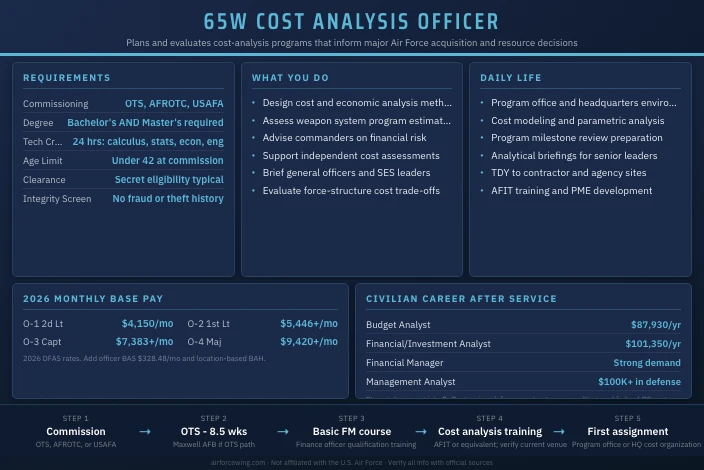
65W Cost Analysis Officers plan, organize, and evaluate cost-analysis programs that inform key Air Force leadership decisions. They design and develop cost and economic analysis methods, assess weapon system programs and force structures, and advise commanders on the financial and programmatic reality behind major resource choices.
Command and Leadership Scope
A new 65W officer typically enters a small, specialized analysis team inside a program office, major command staff, or Air Force headquarters element. The field is tighter than general financial management. You are not running a large comptroller flight with dozens of enlisted personnel under you. Instead, you are working alongside other analysts, engineers, and program managers, producing estimates and models that go directly to decision-makers.
At captain and major, the scope expands. Senior 65W officers lead analysis teams, brief general officers and senior executives, and direct the analytical work of both military and civilian cost analysts. The influence is significant even when the headcount is small, because the products carry real weight.
Specific Roles and Designations
| Designation | Scope |
|---|---|
| 65W | Cost Analysis Officer (base code) |
| 65WX | Cost Analysis Officer family (public recruiting code) |
| 65W3/65W4 | Grade-differentiated skill-level designators within the family |
The Air Force Officer Classification Directory also lists Special Experience Identifiers (SEIs) for specific cost-analysis disciplines such as software cost estimating, life-cycle cost analysis, and independent cost assessment work.
Mission Contribution
Cost analysis is where major program decisions either hold together or fall apart. When the Air Force submits a budget request to Congress or evaluates whether to continue developing a weapons system, 65W work forms part of the analytical foundation. These officers also support independent cost estimates that check the accuracy of contractor-provided estimates, a function that directly protects taxpayers and program managers alike.
Technology, Equipment, and Systems
65W officers work with cost-estimating software, statistical analysis tools, and parametric modeling programs used across the DoD cost community. Familiarity with tools like PRICE, SEER, ACEIT, and Crystal Ball is typical. The work demands quantitative rigor, database management, and briefing preparation. It is analytical and technical by nature, not administrative.
Salary and Benefits
Officer Base Pay
Pay follows the 2026 DFAS military pay tables.
| Rank | Grade | Typical Years of Service | Monthly Base Pay |
|---|---|---|---|
| Second Lieutenant | O-1 | Under 2 | $4,150 |
| First Lieutenant | O-2 | 2-4 years | $5,446 - $6,485 |
| Captain | O-3 | 4-10 years | $7,383 - $8,376 |
| Major | O-4 | 10-16 years | $9,420 - $10,402 |
Additional Compensation
65W does not carry aviation or hazardous-duty special pay. The compensation package is standard officer base pay plus tax-free allowances:
- BAH: varies by duty location and dependency status
- BAS: $328.48 per month (officer rate)
- TRICARE Prime: zero-cost medical coverage on active duty
- BRS pension: 40% of high-36 basic pay at 20 years
Work-Life Balance
Cost analysis is a staff-intensive specialty. Hours track the program calendar rather than a strict 8-to-5 schedule. Program milestone reviews, budget submissions, and independent cost estimate deadlines create peak-demand periods. Day-to-day stability is generally better than operational or maintenance officer jobs, though TDY to program offices and contractor facilities is common in this field.
The 30-day annual leave benefit applies across the board, and the officer schedule is predictable enough that pre-planned leave rarely gets cancelled outside of major reviews.
Qualifications and Eligibility
Commissioning Requirements
The Air Force Cost Analysis Officer career page is the authoritative source for current requirements.
| Commissioning Source | Degree Requirement | Academic Focus | Age Limit |
|---|---|---|---|
| OTS | Bachelor’s AND Master’s degree | Quantitative business or technical field | Must commission before 42 |
| AFROTC | Bachelor’s AND Master’s degree | Quantitative business or technical field | Must commission before 42 |
| USAFA | Degree earned at graduation | Strong quantitative foundation | Standard academy limits |
The degree requirement for 65W is stricter than most officer career fields. Both a bachelor’s and a master’s degree are required, and the academic coursework must include at least 24 credit hours of technical content drawn from calculus, statistics, engineering, finance, economics, or operations research. Of those 24 hours, at least 3 hours must be calculus and at least 3 hours must be statistics.
Strong degree combinations include operations research, economics, engineering, mathematics, finance, and quantitative business. A degree in one field paired with graduate work in a closely related analytical discipline typically satisfies the requirement.
Test Requirements
All officer commissioning candidates need competitive AFOQT scores. The 65W selection is not a rated career field, so TBAS is not required. AFOQT subscores in verbal and quantitative categories matter, but the field values academic credentials and the analytical depth of your coursework at least as much as test scores alone.
The AFOQT study guide is the practical starting point for building your test-prep foundation before the OTS package opens.
Career Field Assignment
65W is a small, specialized career field. Slots are limited, and competition reflects that. ROTC cadets compete through the classification process, while OTS candidates apply for the specific career field as part of their package. USAFA graduates receive career-field assignments at graduation based on academic standing and career preferences.
Upon Commissioning
New accessions enter as O-1 (2d Lt). The standard Active Duty Service Commitment for OTS is four years. Bonus programs and policy changes can adjust that length. The commitment in effect at the time you sign your commissioning contract is the one that applies.
The recruiting page also specifies a disqualifying integrity screen: no civilian conviction or nonjudicial punishment involving larceny, robbery, burglary, wrongful appropriation, or fraud. Given that cost analysis officers work directly with program financial data and sensitive acquisition information, this screen makes practical sense.
The 65W degree requirement is one of the most specific in the officer corps. Both a bachelor’s and master’s degree with at least 24 hours of qualifying technical coursework are required before commissioning. Start verifying your transcript early in the application process.
Work Environment
Setting and Schedule
65W officers work predominantly in offices, not in the field. Duty locations include Air Force program offices, major command headquarters, Air Staff positions in the Pentagon, and specialized cost-analysis centers. Wright-Patterson AFB, Ohio hosts several major acquisition and cost-analysis organizations and is one of the most common 65W assignment locations. Pentagon assignments, AFDW elements, and combatant command staffs are also part of the rotation.
Daily work involves building and reviewing cost models, writing analytical reports, attending program reviews, and preparing briefings. TDY to contractor sites, other bases, and DoD agencies is a routine part of the job.
Leadership and Chain of Command
Most 65W officers work in small, technically specialized units where the chain of command is flatter than a large squadron. At the flight or division level, you may supervise a handful of junior officers and civilian analysts. The senior NCO relationship is less central here than in large operational or maintenance units, though enlisted financial management personnel still support some cost organizations.
Staff vs. Command Roles
This career field skews heavily toward staff and functional leadership. Classic squadron command billets are not the norm for 65W officers. The career is built around analytical credibility, program influence, and increasingly senior staff roles rather than traditional command positions. Officers who want line commander tours typically need to be flexible about broadening assignments.
Job Satisfaction and Retention
The field retains officers who genuinely enjoy quantitative analysis and find meaning in influencing large program decisions. Officers who entered the career expecting more direct leadership of large teams or operational variety sometimes separate after their initial commitment. The analytical work is demanding and visible, which suits people who want their technical output to carry real weight.
Training and Skill Development
Pre-Commissioning Training
Commissioning training follows the standard path: ROTC curriculum and field training, OTS at Maxwell AFB, AL (approximately 8.5 weeks), or the USAFA four-year program. OTS covers military officership fundamentals, leadership, and Air Force culture. Technical cost-analysis training comes after commissioning.
Initial Skills Training
| Phase | Location | Approximate Length | Focus |
|---|---|---|---|
| Commissioning / OTS | Maxwell AFB, AL (OTS path) | 8.5 weeks | Officership, Air Force fundamentals |
| Basic Financial Management Officer course | Air Force finance training venue | Verify current length with recruiter | Core financial management and controls |
| Cost analysis initial qualification | AFIT, Wright-Patterson AFB, OH or other venue | Course-dependent; verify current schedule | Cost-estimating methods, parametric analysis, program tools |
| First-assignment OJT | Program office or HQ cost organization | 12-24 months | Supervised applied analysis, program support |
Course locations and lengths for specialty cost-analysis training change with curriculum updates and budget cycles. Always verify the current pipeline with your officer accessions manager or assignment team rather than relying on any static source.
The Air Force Institute of Technology at Wright-Patterson AFB plays a central role in cost-analysis professional development. AFIT offers both short-course professional development and degree programs that 65W officers pursue throughout their careers.
Professional Military Education
- Squadron Officer School (SOS): Typically attended in residence or by correspondence as a captain. Covers Air Force leadership doctrine, critical thinking, and joint operations concepts.
- Air Command and Staff College (ACSC): For field-grade officers, typically as a major. Focuses on joint warfare, strategy, and leadership at the operational level.
- Air War College (AWC): For senior field-grade officers. Strategic-level studies in national security, policy, and military leadership.
Additional Schools and Training
AFIT offers fully-funded graduate degree programs for selected active-duty officers, including programs in cost analysis, operations research, financial management, and engineering management. A 65W officer with a strong record can compete for an AFIT resident program, which provides a funded master’s or doctoral degree with an associated service commitment.
Civilian university fellowships and senior broadening programs also become available at the O-4 and O-5 level for officers with strong records.
Before OTS, you need qualifying scores. See our AFOQT study guide.
Career Progression and Advancement
Career Path
| Rank | Grade | Typical Timeline | Key Focus |
|---|---|---|---|
| Second Lieutenant | O-1 | Entry to 2 years | Learn cost-estimating tools, support senior analysts |
| First Lieutenant | O-2 | 2-4 years | Independent analysis tasks, program office integration |
| Captain | O-3 | 4-10 years | Lead analysis projects, brief O-6 and SES-level leaders |
| Major | O-4 | 10-16 years | Senior analysis leadership, headquarters or major program |
| Lieutenant Colonel | O-5 | 16-22 years | Division chief, senior staff, or specialized center lead |
Promotion System
O-1 through O-3 promotions are essentially time-based, provided performance reports are solid. O-4 and above require competitive selection by promotion board. Board selection depends on the quality and timing of assignments, the strength of Officer Performance Reports, and visible impact on major programs or organizations.
In a small specialty like 65W, the assignment record matters a great deal. Getting a key developmental position on a major weapons system or at a headquarters cost organization is the kind of assignment that distinguishes a competitive board file.
Cross-Training and Broadening
65W officers can pursue broadening assignments in joint cost organizations, Office of the Secretary of Defense staffs, and DoD-wide cost assessment groups. The DoD Cost Assessment and Program Evaluation (CAPE) office in the Pentagon is a high-profile destination for experienced cost analysts. Fellowships, AFIT programs, and Air Staff tours round out the broadening options available to experienced 65W officers.
Cross-training into other career fields is possible but not common. Officers who do leave the 65W field typically move into related financial management or acquisition roles.
Physical Demands and Medical Evaluations
Fitness Standards
65W officers take the same Air Force Fitness Assessment as every Airman in the force.
| Component | Max Points |
|---|---|
| 1.5-mile run | 60 |
| Push-ups (1 minute) | 10 |
| Sit-ups (1 minute) | 10 |
| Waist circumference or body composition | 20 |
The minimum passing composite score is 75. Standards are age- and gender-normed. There is no career-field-specific physical screen beyond standard commissioning and worldwide duty qualification requirements.
Flight Physicals and Career Field-Specific Medical
65W is a non-rated, non-special-operations career field. No flight physical or specialized medical screening applies beyond the standard commissioning physical. Officers must maintain worldwide deployability, which has its own medical standards, but there are no unique 65W medical requirements.
Deployment and Duty Stations
Deployment Details
65W officers deploy at a lower rate than operational or combat-support career fields. The work is mostly garrison-based. That said, major contingencies and expeditionary staff requirements can pull cost analysis expertise forward, particularly for major contracts or force-structure decisions tied to an ongoing operation.
Typical deployments are staff-based rather than combat-forward, and tempo is generally lower than intelligence, maintenance, or operations career fields.
Duty Station Options
The highest concentrations of 65W billets are at:
- Wright-Patterson AFB, OH: home to Air Force Materiel Command, AFIT, and multiple program office cost organizations
- Pentagon, Arlington, VA: Air Staff financial management and CAPE-adjacent positions
- Randolph/JBSA, TX and other major command headquarters
- Kirtland AFB, NM and other research and acquisition centers
Assignment decisions go through AFPC. Officers submit preference worksheets and work within the Air Force’s assignment cycle. The field is small enough that assignment officers generally know each 65W officer’s record, which means your relationship with your assignment team matters more than it does in larger career fields.
Risk, Safety, and Legal Considerations
Job Hazards
The risk profile for 65W officers is analytical and legal rather than physical. The main risks are:
- Analytical errors that influence major program decisions
- Providing misleading cost estimates to acquisition leadership
- Mishandling sensitive program data or contractor proprietary information
- Conflicts between independent analysis findings and program-office preferred numbers
Safety Protocols
Operational Risk Management applies to 65W work in the same way it does across the Air Force, though the daily application here is mostly about information security, data integrity, and sound methodology rather than physical safety.
Legal and Command Responsibility
Cost Analysis Officers operate in an environment with significant federal acquisition law exposure. Contractor proprietary data, source selection information, and pre-decisional budget data are all protected categories that 65W officers handle routinely. Understanding and following proper handling rules is not optional. Officers who mishandle protected acquisition data face serious professional and legal consequences.
Impact on Family and Personal Life
The day-to-day schedule is more predictable than flying, maintenance, or many operational officer jobs. Program milestone reviews and budget submission seasons create peak workload periods, but family planning is generally easier than in high-deployment or shift-work career fields.
PCS moves follow the standard Air Force assignment cycle, typically every two to three years at junior grades. Since duty locations concentrate around major acquisition centers and headquarters, officers in this field often find themselves returning to the same installations for different assignments over a career, which can help build family stability.
The Air Force Family Readiness Centers, Key Spouse Program, and base family support services are available at all major installations.
Reserve and Air National Guard
Component Availability
The Cost Analysis Officer recruiting page lists availability across Active Duty, Air Force Reserve, and Air National Guard. Reserve and Guard 65W billets are less numerous than active-duty positions, but they do exist at major command and headquarters elements.
Commissioning Paths
Reserve component candidates can commission through ROTC with a Reserve component contract, through a Guard OTS pipeline, or through direct commission in some cases. The same degree and coursework requirements apply. Candidates should work directly with Air Force Reserve or Air National Guard officer accessions teams to confirm current billet availability for 65W specifically.
Active-duty officers who complete their service commitment can transfer to the Reserve or Guard, which is a common path for experienced cost analysts who want to continue serving while moving into the civilian workforce.
Drill and Training Commitment
Standard Reserve and Guard commitment is one weekend per month (Unit Training Assembly) plus two weeks per year (Annual Tour). Some 65W positions require additional training days tied to program milestone reviews or specialized certification requirements. The unit’s participation agreement spells out the expected commitment beyond the standard drill schedule.
Part-Time Pay
An O-3 (Captain) in the Reserve or Guard earns drill pay based on four training assemblies per weekend. At approximately $7,383 to $8,376 monthly base pay for an O-3 (depending on years of service), a typical drill weekend yields roughly $950 to $1,050 in gross pay before taxes. Annual Tour adds two weeks of comparable daily pay.
Benefits Differences
| Category | Active Duty | Air Force Reserve | Air National Guard |
|---|---|---|---|
| Monthly pay (O-3) | $7,383 - $8,376 | Drill rate (4 UTA periods per weekend) | Same as Reserve |
| Healthcare | TRICARE Prime (no cost) | TRICARE Reserve Select (premium required) | TRICARE Reserve Select or state programs |
| Education | Tuition Assistance ($4,500/yr) + GI Bill | Federal TA + GI Bill eligibility | Federal TA + state tuition waivers vary |
| Retirement | BRS: 20-year active pension + TSP match | Points-based Reserve retirement | Points-based Reserve retirement |
| Deployment tempo | Moderate to low (staff field) | Periodic mobilization; less frequent | Periodic mobilization; varies by unit |
| Command opportunities | Program and staff leadership | Limited; varies by unit | Limited; varies by unit |
Civilian Career Integration
65W is one of the most naturally civilian-compatible officer specialties. A Reserve or Guard officer in this field can work simultaneously as a federal civilian cost analyst, a defense contractor pricing analyst, or a corporate finance professional. The methodologies and tools overlap directly. Many civilian employers with DoD contracts specifically value cost analysis experience paired with active clearances.
USERRA protections apply to Guard and Reserve members, requiring civilian employers to hold positions during military leave periods.
Post-Service Opportunities
Transition to Civilian Life
Cost analysis officers leave the service with a highly specific and marketable skill set. DoD agencies, defense contractors, consulting firms, and large corporations that manage complex capital programs all need people who can build credible cost estimates and evaluate financial risk. The experience is concrete and translates directly on a resume.
Transition programs including TAP (Transition Assistance Program), Hiring Our Heroes, and the American Corporate Partnership mentoring program support officers moving into the civilian workforce.
Civilian Career Prospects
| Civilian Role | Median Annual Pay | Outlook |
|---|---|---|
| Budget Analyst | $87,930 | 1% growth, ~3,100 openings/year |
| Financial and Investment Analyst | $101,350 | 6% growth, ~29,900 openings/year |
| Financial Manager | Strong demand; varies by sector | 15% growth projected through 2034 |
| Management Analyst | $100K+ in defense and consulting | 9% growth projected through 2034 |
Salary data from the BLS Occupational Outlook Handbook, May 2024.
The federal civilian pay scale (GS-12 through GS-14) also represents a direct path for 65W officers who want to stay in the government environment. Cost analyst positions in DoD agencies, CAPE, and the military services are frequently filled by former officers.
Graduate Education and Credentials
Officers who did not attend AFIT during their service can use the Post-9/11 GI Bill for graduate education after separation. The program covers full in-state tuition at public schools and up to $29,920 per academic year at private institutions, plus a monthly housing allowance. Active-duty Tuition Assistance covers up to $4,500 per year toward coursework while still serving.
Relevant civilian credentials for 65W alumni include the Certified Defense Financial Manager (CDFM) designation through ASMC, which many cost analysis and financial management officers pursue while still on active duty.
Is This a Good Job for You?
65W is a strong fit for people who genuinely enjoy quantitative modeling, think analytically about risk, and want their work products to land in front of general officers and senior executives. If you spent your undergraduate years in math, economics, or engineering and found yourself drawn to statistical analysis and modeling rather than field work, this career field will feel like a natural home.
It is a poor fit for people who want large team leadership early in their career, direct combat-support roles, or the operational variety of rated or special operations jobs. The work is analytical, office-based, and demands sustained technical depth. If you lose interest in spreadsheets and models after a year, you will struggle to stay motivated.
The civilian transfer value is exceptional. Few Air Force career fields leave officers this well-positioned for specific, high-paying civilian roles. But that value only compounds if you actually commit to developing the technical skills during your service. Officers who treat 65W as a safe choice rather than an intellectual calling tend to separate early and leave with less than they could have built.
More Information
Reach out to an Air Force officer recruiter or your nearest AFROTC detachment for current commissioning timelines and career field vacancy information. The Air Force Cost Analysis Officer career page is the official starting point for requirements.
For test prep, the AFOQT study guide covers what officer candidates need before submitting a commissioning package.
This site is not affiliated with the U.S. Air Force or any government agency. Verify all information with official Air Force sources before making enlistment or career decisions.
Explore more Air Force finance and contracting officer careers including the 65F Financial Management Officer.