65F Financial Management Officer
Every squadron commander wants to talk mission until the money runs short. Then the most important person in the room becomes the finance officer who can explain what funds are available, what risk the unit is carrying, and what has to change before the numbers break. That is the 65F Financial Management Officer mission. These officers do not just run a comptroller office. They translate strategy into funded plans, audit the health of a unit’s programs, and tell leadership where the financial truth actually sits.
OTS candidates should prep early with the AFOQT study guide before they build their package.
Job Role
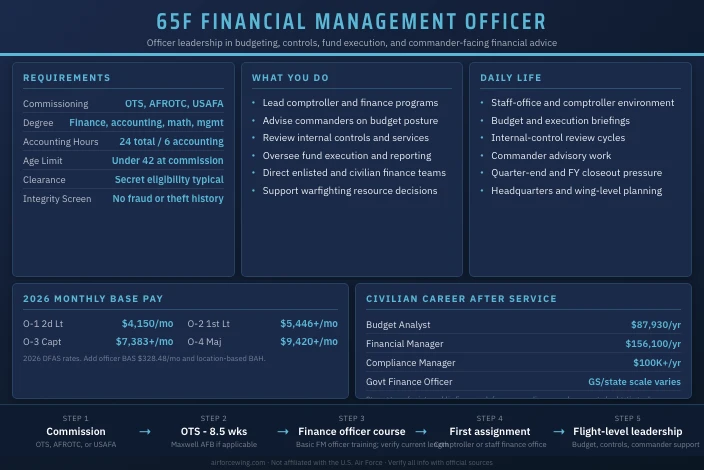
65F Financial Management Officers plan, direct, and assess Air Force financial programs that support daily operations and wartime mission execution. They oversee accounting controls, budget formulation, fund execution, internal controls, and commander-facing financial advice across installations and major commands.
Leadership Scope
A new 65F typically starts inside a comptroller flight or staff section, supervising enlisted finance personnel and civilian analysts while learning the unit’s execution rhythm. By captain and major, the job becomes more advisory. You are no longer just reviewing transactions. You are briefing commanders on funding posture, audit issues, staffing of the finance shop, and how a unit’s resources line up against its mission plan.
At the field-grade level, 65F officers can run a wing comptroller function, supervise multiple sections, and influence major program decisions at headquarters or combatant command staffs.
Specific Roles And Designations
The public Air Force recruiting site lists this family as 65FX Financial Management Officer. The 65F code used here is the narrower officer-field label inside that broader family.
| Designation | Focus |
|---|---|
| 65F | Financial Management Officer |
| 65FX | Financial Management family |
| Related 65-series work | Cost, program, and resource analysis |
Mission Contribution
Financial management officers make the rest of the Air Force executable. Aircraft maintenance, TDYs, contracts, training, construction, and deployments all depend on lawful, timely funding. A 65F officer helps leadership decide what can be funded now, what has to wait, and where an audit or internal control weakness could become a mission problem later.
Systems And Tools
The work is built around Air Force and DoD finance systems, budget reports, internal-control frameworks, spreadsheets, and staff briefings. You spend more time explaining money than moving it. That is the difference between the officer lane and the enlisted transaction-heavy side of the same field.
Salary
Officer Base Pay
Officer pay follows the 2026 DFAS military pay tables.
| Rank | Grade | Typical YOS | Monthly Base Pay |
|---|---|---|---|
| Second Lieutenant | O-1 | Under 2 | $4,150 |
| First Lieutenant | O-2 | 2-4 years | $5,446-$6,485 |
| Captain | O-3 | 4-10 years | $7,383-$8,376 |
| Major | O-4 | 10-16 years | $9,420-$10,402 |
Additional Compensation
65F does not normally carry aviation or hazardous-duty bonus pay. The compensation model is standard officer base pay plus allowances:
- BAH: location and dependency based
- BAS: $328.48 per month
- TRICARE Prime: active-duty medical coverage
- BRS retirement: pension plus TSP matching
Education And Long-Term Value
This career field has some of the strongest civilian transfer value in the officer corps. Government budget offices, defense contractors, consulting firms, and corporate finance teams all understand resource-management experience.
Qualifications
Commissioning Requirements
The Air Force public recruiting page for Financial Management Officer gives the clearest entry baseline.
| Commissioning Source | Degree Requirement | Age Limit | Key Prerequisites |
|---|---|---|---|
| OTS | Bachelor’s degree | Must commission before 42 | Competitive package, officer selection |
| AFROTC | Bachelor’s degree | Must commission before 42 | Cadet performance and field selection |
| USAFA | Degree earned on graduation | Standard academy limits | Career-field assignment at graduation |
The strongest degree paths are finance, accounting, economics, management, mathematics, engineering, law, and related quantitative fields. The current recruiting guidance also says at least 24 semester hours should come from economics, accounting, finance, management, and statistics, with six hours in accounting.
Test And Screening
Officer applicants typically need the AFOQT as part of commissioning. The recruiting page also calls out strict integrity screening: no civilian conviction or NJP involving larceny, robbery, burglary, wrongful appropriation, or fraud. That makes sense. A finance officer cannot lead internal controls if their own integrity record is compromised.
Use the AFOQT study guide to get your officer test-prep baseline in shape before your package window opens.
Upon Commissioning
New accessions enter as O-1 2d Lt unless prior commissioned service credit applies. The path then runs through OTS, ROTC, or USAFA commissioning followed by the finance officer qualification pipeline and on-the-job development in a comptroller organization.
Work Environment
Setting And Schedule
This is a staff-heavy officer field. Most daily work happens in comptroller offices, headquarters sections, and command staff environments. Hours are usually steadier than rated or maintenance officer jobs, but quarter close, fiscal-year close, and inspection cycles can create long days.
Officer-NCO Dynamic
65F officers rely heavily on experienced enlisted finance leaders. Senior NCOs know the systems, the local process traps, and the actual pace of the shop. Officers set direction, prioritize risk, and advise commanders. The field works best when both lanes stay strong.
Command vs Staff
Most of the career is staff and functional leadership rather than classic squadron command. But the leadership scope is still real. You may own a wing’s finance posture, internal control program, or a headquarters-level budget portfolio that affects multiple units.
Training
Training Pipeline
| Phase | Location | Length | Focus |
|---|---|---|---|
| Commissioning source or OTS | Maxwell AFB, AL or source dependent | OTS 8.5 weeks | Officership and Air Force fundamentals |
| Basic Financial Management Officer training | Finance training location per Air Force | Verify current course length | Finance leadership, controls, budget and accounting programs |
| First assignment OJT | Comptroller or staff office | 12-24 months | Commander support, internal controls, execution review |
The public recruiting page specifically calls out completion of the Basic Financial Management Officer course. Exact course length is not prominently published on the public site, so candidates should verify current details with a recruiter or officer accessions manager.
Before you reach that course, you still need a competitive officer package. The AFOQT study guide is the practical starting point for OTS applicants.
Professional Development
This field rewards advanced degrees and staff experience. Officers who pursue accounting, finance, public administration, or operations-research education stay competitive for larger resource-management jobs later.
Career Progression
Timeline
| Rank | Grade | Typical Timeline | Development Focus |
|---|---|---|---|
| Second Lieutenant | O-1 | Entry to 2 years | Learn finance programs and lead small teams |
| First Lieutenant | O-2 | 2-4 years | Independent section leadership |
| Captain | O-3 | 4-10 years | Commander advisor, flight-level responsibility |
| Major | O-4 | 10-16 years | Wing or staff resource-management leadership |
| Lieutenant Colonel | O-5 | 16-22 years | Senior comptroller or headquarters role |
Promotion Factors
Strong OPRs, clean internal-control performance, hard jobs at the right time, and clear commander impact matter. This is not a field where vague administrative success is enough. Leaders want proof that you improved decision quality and protected resources.
Broadening
A good 65F record can branch into MAJCOM staffs, Air Staff, joint resource positions, acquisition-adjacent roles, and later civilian finance leadership.
Physical Demands
Fitness Standards
65F officers take the same Air Force Fitness Assessment as every other officer.
| Component | Max Points |
|---|---|
| 1.5-mile run | 60 |
| Push-ups | 10 |
| Sit-ups | 10 |
| Waist or body composition | 20 |
There is no special career-field physical screen beyond normal commissioning and worldwide duty qualification.
Deployment
Deployment Tempo
This field does deploy, especially when expeditionary units need comptroller support or headquarters staffs stand up forward elements. Tempo is generally lower than combat or flight-related fields, but deployed finance support still matters when a base is moving people, contracts, and money under pressure.
Duty Stations
65F officers can serve at almost any major installation because every wing needs finance leadership. Staff-heavy assignments also make Pentagon, MAJCOM, and joint locations more common than in many other officer fields.
Risk/Safety
Main Risks
The risk profile is financial, legal, and leadership based:
- Weak internal controls
- Bad advice to commanders
- Poor fund execution oversight
- Integrity failures in a trust-heavy field
Accountability
This is one of the Air Force career fields where professional credibility is everything. If your judgment is weak, leadership will feel it quickly.
Impact on Family
Compared with flying or field-heavy officer jobs, the daily schedule is more stable. PCS moves still happen, and staff work can be demanding, but day-to-day family predictability is better than in many operational communities.
Reserve and Air National Guard
Component Availability
The public recruiting page lists Active Duty, Air Force Reserve, and Air National Guard availability for the 65FX family. That makes this one of the more flexible officer finance paths for candidates who want to serve part time.
Part-Time Value
A finance officer with civilian accounting, banking, corporate finance, or public-budget experience can pair this career field very well with Reserve or Guard service. The overlap is real and usually beneficial.
Post-Service
Civilian Career Paths
| Civilian Role | Median Pay | Outlook |
|---|---|---|
| Budget Analyst | $87,930 | Faster than average |
| Financial Manager | $156,100 median field | Strong |
| Government Finance Officer | Varies by GS/state scale | Stable public-sector demand |
| Internal Controls / Compliance Manager | $100K+ in many sectors | Strong in defense and healthcare |
65F officers leave the service with a language civilian employers understand immediately: controls, budgets, forecasting, audit response, and executive advising.
Is This a Good Job
65F is a strong fit if you like structure, numbers, and advising leaders from a position of technical credibility. It is not a good fit if you want tactical field work or hands-on mechanical problem solving. The job is about judgment, resource truth, and leadership under administrative pressure.
More Information
- Review the Air Force Financial Management Officer page
- Compare the enlisted side of the field at Financial Management and Comptroller
- Build your OTS prep baseline with the AFOQT study guide
This site is not affiliated with the U.S. Air Force or any government agency. Verify all information with official Air Force sources before making enlistment or career decisions.
Explore more Air Force finance and contracting officer careers including 64P Contracting Officer and adjacent enlisted 6F0X1 Financial Management.