17S Cyberspace Effects Operations Officer
Adversary networks are a battlefield. Air Force 17S officers operate on that battlefield every day, hunting vulnerabilities, executing cyberspace effects, and defending the digital infrastructure that modern air power depends on. This is one of the most technically demanding officer career fields in the service, and one of the few where your technical skills determine operational outcomes as directly as rank. If you’re drawn to computer science, exploitation research, or offensive security, and you want to do that work at a national security scale, the 17S Cyberspace Effects Operations Officer career field is worth understanding in detail.
OTS candidates need competitive ASVAB scores. Our AFOQT study guide covers exactly how to prepare.
Job Role
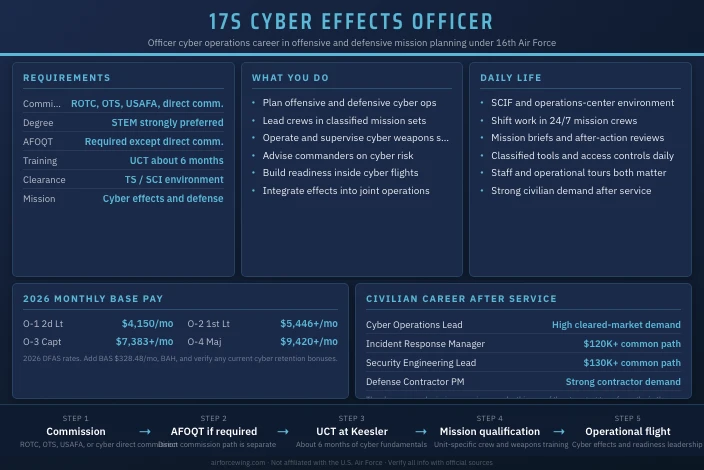
The 17S Cyberspace Effects Operations Officer plans, directs, and executes cyberspace operations against adversary systems, networks, and critical infrastructure. These officers review mission tasking and intelligence, operate cyberspace weapons systems, command crew operations, and advise commanders on cyber risks and mitigation. They lead cyberspace operations flights and squadrons, ensuring crew readiness and operational effectiveness across the full spectrum of offensive and defensive cyber missions.
Command and Leadership Scope
New 17S officers start as crew members and weapons system operators, building technical proficiency before taking on leadership responsibilities. At the O-3 (Capt) level, a 17S typically serves as a flight commander overseeing 10 to 20 Airmen executing daily cyber missions. Squadron command at the O-5 (Lt Col) level means owning the full operational program, personnel readiness, training currency, mission execution, and commander relationships.
The span of control is smaller in absolute numbers than a traditional flying squadron, but the operational stakes are comparable. A 17S flight commander is responsible for ensuring crew members are qualified to execute time-sensitive, complex operations that can affect adversary systems half a world away.
Specific Roles and Designations
The 17SX designation covers multiple mission sets across offensive cyberspace operations, defensive cyberspace operations, and Department of Defense information network operations.
| AFSC | Designation | Primary Mission Focus |
|---|---|---|
| 17S1 | Cyberspace Effects Officer (entry) | Crew qualification, initial operations |
| 17S3 | Cyberspace Effects Officer | Flight commander, mission commander |
| 17S4 | Cyberspace Effects Officer (senior) | Squadron staff, senior operational roles |
| 17SXA | Effects SEI | Offensive cyberspace effects operations |
| 17SXB | Defensive SEI | Defensive cyberspace operations, DODIN |
Special Experience Identifiers (SEIs) narrow the assignment focus and appear in the officer’s personnel record without changing the core 17S designator.
Mission Contribution
The 17S career field operates inside the 16th Air Force (Air Forces Cyber), the Air Force component of U.S. Cyber Command. 17S officers execute offensive cyberspace operations under Title 10 and Title 50 authority, meaning the work spans both traditional military operations and intelligence support to the nation’s most sensitive programs.
At the tactical level, 17S crews assess adversary systems, identify vulnerabilities, and execute effects that degrade or deny adversary capabilities without kinetic force. At the operational and strategic level, these officers integrate cyber effects into joint campaign planning, advising Joint Force Commanders on how cyberspace operations can enable or complicate kinetic operations. The career field plays directly in every major combatant command theater.
Technology, Equipment, and Systems
17S officers work with classified cyberspace weapons systems, exploitation tools, and command-and-control platforms. Specific systems are classified, but the technical environment spans:
- Offensive cyber platforms: specialized tools for network access, persistence, and effects delivery
- Defensive cyber systems: sensors, intrusion detection, and network monitoring architectures
- Intelligence fusion systems: platforms integrating SIGINT, HUMINT, and technical intelligence to support mission planning
- Command and control networks: SIPR, JWICS, and specially accredited networks carrying mission-critical traffic
All operations are conducted inside specially compartmented facilities with strict access controls. Officers work alongside NSA, CIA, and other interagency partners in some billets.
Salary
Officer Base Pay
Pay is uniform across all Air Force officer career fields and is set by DFAS. A new 17S commissions as an O-1 (2d Lt) and advances automatically to O-3 (Capt) with satisfactory performance. The table reflects 2026 DFAS pay tables.
| Rank | Grade | Typical Time in Service | Monthly Base Pay |
|---|---|---|---|
| Second Lieutenant | O-1 | 0-2 years | $4,150 |
| First Lieutenant | O-2 | 2-4 years | $5,446 |
| Captain | O-3 | 4-10 years | $7,383-$9,004 |
| Major | O-4 | 10-16 years | $9,420-$10,402 |
Special and Incentive Pay
The 17S career field does not carry aviation bonus pay. Officers in certain cyber billets may qualify for special duty assignment pay, and the Air Force has historically offered Cyber Officer Retention Bonuses for 17S officers who commit to extended service. Bonus availability and amounts change with each fiscal year. Verify current bonus status with an Air Force recruiter or at afpc.af.mil.
Additional Benefits
Basic Allowance for Housing (BAH) varies by installation, pay grade, and dependency status. It is not taxable income. At Joint Base San Antonio, an O-1 without dependents receives $1,584 per month; rates at high-cost locations like the National Capital Region run significantly higher.
Basic Allowance for Subsistence (BAS) for officers is $328.48 per month (2026 rate). This is separate from BAH and also not taxable.
Active-duty officers receive TRICARE Prime at no enrollment cost, no deductible, and no copays. Coverage includes medical, dental, vision, mental health, and prescriptions.
The Blended Retirement System (BRS) provides a 20-year pension at 40% of the average of your highest 36 months of base pay, plus government-funded TSP contributions. The Air Force automatically contributes 1% of base pay to TSP and matches up to an additional 4% when you contribute.
Work-Life Balance
Work hours in the 17S career field depend heavily on the mission. Cyber operations centers run 24/7. Junior officers in operational billets can expect shift work, rotating schedules, and surge periods tied to real-world operations. During exercises and actual mission execution, extended hours are common.
Garrison assignments at staff positions or program management offices run closer to standard business hours. The Air Force provides 30 days of paid leave annually, and officers in CONUS billets have more flexibility than those in forward-deployed locations. Classified mission environments mean remote work is not an option for most 17S billets.
Qualifications
Commissioning Sources
The 17S career field has four paths to commission: Air Force ROTC, Officer Training School (OTS), the Air Force Academy (USAFA), and the Cyber Direct Commission program. The last option is unique to the cyber career fields and allows qualified civilian cyber professionals to commission directly into officer grades.
| Commissioning Source | Degree Requirement | GPA Minimum | Age Limit | Notes |
|---|---|---|---|---|
| AFROTC | Bachelor’s (STEM strongly preferred) | 3.0 preferred | Under 42 at commission | Career field classified through rated/non-rated board |
| OTS | Bachelor’s degree | 3.0 preferred | Under 42 at commission | Competitive packet; AFOQT required |
| USAFA | Earned at graduation | N/A | Enter under 23 | Career field assigned through USAFA process |
| Cyber Direct Commission | Bachelor’s minimum; advanced degree preferred | N/A published | 17-42 | Requires documented cyber work experience; no OTS required |
The Cyber Direct Commission program accepts applicants with demonstrated professional experience in areas including cyber operations, software development, incident response, network security, cryptography, and malware analysis. Relevant certifications and specialized training strengthen an application. Officers may enter at ranks from Second Lieutenant through Colonel based on constructive service credit.
Degree preference for 17S: Computer and information sciences, computer science, mathematics, engineering, management information systems, and related technical disciplines are the stated preferences per official Air Force guidance. A non-technical degree does not automatically disqualify a candidate, but STEM backgrounds are strongly competitive.
Test Requirements
All commissioning paths except Cyber Direct Commission require the Air Force Officer Qualifying Test (AFOQT). Minimum published scores are Verbal 15 and Quantitative 10, but these floors reflect eligibility, not competitiveness. Candidates competing for a technical field like 17S benefit from strong Quantitative scores. The AFOQT can be taken twice.
TBAS is not required for the 17S career field. TBAS is specific to rated aviation positions (pilot, combat systems officer, RPA pilot).
The AFOQT Quantitative score reflects mathematical reasoning skills that are directly relevant to cyber operations work. Candidates with STEM backgrounds typically perform well on this subtest. Plan 4-8 weeks of focused preparation before testing. Most commissioning sources recommend having scores in hand well before application deadlines.
Career Field Assignment and Classification
ROTC cadets apply for 17S through the non-rated classification process during their final year, competing based on AFOQT scores, GPA, leadership evaluations, and Air Force needs. OTS candidates list a preferred career field in their application package, and AFPC assigns fields based on applicant competitiveness and current requirements.
Cyber is one of the more competitive non-rated fields because of strong demand from DoD and the high value of cleared cyber officers. A strong technical background, a competitive AFOQT Quantitative score, and documented cyber experience (even personal projects, internships, or certifications) help.
Cross-training into 17S from another career field is possible but uncommon. Officers interested in cross-training apply through AFPC and must meet the same qualification standards as initial-entry candidates.
Upon Commissioning
New officers enter at O-1 (Second Lieutenant). The standard Active Duty Service Commitment (ADSC) after commissioning is four years from the commissioning date or one year after completion of Initial Skills Training, whichever is later. Cyber officers who receive specialized training incur additional service commitments in some cases. Verify current ADSC policy with your commissioning source.
OTS candidates can find a focused study plan in our AFOQT study guide.
Work Environment
Setting and Schedule
17S officers work almost exclusively in Sensitive Compartmented Information Facilities (SCIFs) and specially accredited cyber operations centers. The physical environment is a secure facility with classified workstations, compartmented communications systems, and strict access controls. Some billets are at major command headquarters; others are at operational cyber units that run around-the-clock mission schedules.
Deployed environments vary. Cyber effects operations can be executed from CONUS locations with reach-back infrastructure, so some missions don’t require physical forward deployment. Other billets support forward-deployed joint forces in theater.
Leadership and Chain of Command
Early-career 17S officers work under a senior crew commander while qualifying in their weapons systems and mission sets. The NCO corps in cyber units carries deep technical expertise, experienced cyber NCOs often know the systems at a granular level that junior officers are still developing. The officer-NCO relationship in 17S works best when the officer respects and uses that technical depth while maintaining clear command authority on mission decisions.
At the Captain level, a 17S serves as a flight commander within a cyberspace operations squadron, typically reporting to a Major serving as operations officer or to the squadron commander. Staff assignments at numbered air force or combatant command headquarters require the officer to influence up and advise commanders who may have limited cyber background.
Staff vs. Command Roles
The 17S promotion path requires both operational command experience and staff broadening. Key Developmental (KD) positions include flight commander (O-3 level) and squadron commander (O-5 level). Between those positions, officers typically serve on MAJCOM staffs, combatant command cyber staffs, or in joint cyber billets at U.S. Cyber Command, NSA, or the Joint Staff.
Officers who spend their entire career in operational units without staff experience will not be competitive for senior grades. The field values officers who can connect tactical cyber effects to operational and strategic outcomes.
Job Satisfaction and Retention
Retention in the 17S career field has been a persistent Air Force challenge. The civilian market for cleared offensive cyber professionals pays substantially more than military base pay, and private defense contractors actively recruit 17S officers with operational experience. Officers who stay typically cite mission importance, access to capabilities and intelligence unavailable in the private sector, and leadership development as their reasons.
The Air Force has responded with retention incentives including cyber officer retention bonuses. Officers who leave after their initial commitment often move directly into senior positions at defense contractors, federal agencies, or the Intelligence Community.
Training
Pre-Commissioning Training
ROTC cadets complete two to four years of leadership training, physical fitness development, and military coursework before commissioning. OTS is approximately 8.5 to 9.5 weeks at Maxwell AFB, AL and focuses on officership fundamentals, Air Force culture, and leadership. Neither program provides 17S-specific technical training, that happens after commissioning.
Cyber Direct Commission candidates enter directly into the post-commissioning pipeline without attending a traditional OTS course, though they complete commissioning-related training tailored to their prior experience level.
Initial Skills Training
After commissioning, 17S officers complete Undergraduate Cyberspace Training (UCT), the Air Force’s core cyber officer qualification pipeline. UCT covers the foundational technical and operational content required before crew qualification.
| Phase | Location | Length | Focus |
|---|---|---|---|
| Commissioning (OTS/ROTC) | Maxwell AFB, AL / University | 8.5-9.5 weeks / 2-4 years | Officership, leadership, Air Force fundamentals |
| Undergraduate Cyberspace Training (UCT) | Keesler AFB, MS (329th Training Squadron) | Approximately 6 months | Cyber theory, network operations, offensive and defensive cyber, weapons system qualification |
| Mission Qualification Training | Unit of assignment | Varies | Mission-specific tactics, procedures, and crew certification |
UCT at Keesler covers electronics theory, information technology fundamentals, telecommunications, cryptography, network exploitation, and operational cyberspace concepts. Officers complete both classroom instruction and hands-on laboratory work before moving to mission qualification at their assigned unit.
The 329th Training Squadron at Keesler AFB, MS is the primary cyberspace officer training organization. Both 17S and 17D officer candidates attend UCT at Keesler before separating into their respective mission qualification pipelines.
Professional Military Education
PME follows the standard Air Force officer timeline:
- Squadron Officer School (SOS): Completed as a Captain, either in residence at Maxwell AFB for approximately 8 weeks or by distance learning. Covers organizational leadership, joint doctrine, and Air Force fundamentals.
- Air Command and Staff College (ACSC): Major-level requirement for O-5 promotion competitiveness, available in residence (one year) or by distance learning at Maxwell AFB.
- Air War College (AWC): Senior officer program at Maxwell AFB, focused on strategic leadership and national security policy. Available to select O-5s and O-6 candidates.
Additional Schools and Training
17S officers interested in advanced technical development can pursue Air Force Institute of Technology (AFIT) programs at Wright-Patterson AFB, OH. Fully funded graduate degrees in computer science, cybersecurity, electrical engineering, and systems engineering are directly applicable to the 17S career field.
Joint duty at U.S. Cyber Command, NSA, or combatant command cyber centers provides development that no operational squadron can replicate. Officers who complete joint cyber billets gain perspective on national-level operations and build relationships across the Intelligence Community that benefit the entire career. Advanced courses at the National Cryptologic School and Cyber Mission Force advanced qualification programs are available to more senior officers with appropriate clearances.
Before OTS, you need qualifying scores. See our AFOQT study guide.
Career Progression
Career Path
| Rank | Grade | Typical Timeline | Key Developmental Positions |
|---|---|---|---|
| Second Lieutenant | O-1 | Commissioning to ~2 years | UCT student, initial crew qualification |
| First Lieutenant | O-2 | 2-4 years | Crew member, cyber operator |
| Captain | O-3 | 4-10 years | Flight Commander (KD), crew commander, mission commander |
| Major | O-4 | 10-16 years | Staff officer (CYBERCOM, MAJCOM, joint), senior advisor |
| Lieutenant Colonel | O-5 | 16-22 years | Squadron Commander (KD), wing staff director |
| Colonel | O-6 | 22+ years | Group commander, numbered air force staff, MAJCOM director |
O-1 to O-3 promotions are essentially automatic with satisfactory performance. Board selection begins at O-4 (Maj). Air Force-wide O-4 selection rates have historically run around 80%, with O-5 closer to 70-75%. O-6 is more competitive at approximately 50%.
Promotion System
Promotion boards evaluate the Officer Performance Report record, stratification language from senior raters, PME completion, KD position completion, and joint duty credit. For 17S, boards want to see flight commander and squadron commander positions completed at the right career phases. Technical accomplishment matters at lower grades, but leadership impact and organizational outcomes drive board competitiveness at O-4 and above.
Joint duty credit is required for O-7 (Brigadier General) and increasingly expected for senior O-6 billets. 17S officers who complete a tour at U.S. Cyber Command, NSA, or a combatant command cyber center are well-positioned for senior assignments.
Cross-Training and Broadening
Broadening assignments available to 17S officers include:
- ROTC instructor duty: builds teaching skills and fulfills an educational service requirement
- Air Staff and MAJCOM staff positions: Pentagon cyber policy, acquisition support, and force development roles
- U.S. Cyber Command: joint operational headquarters integrating Service cyber components
- NSA and Intelligence Community agencies: national-level cyber operations and collection billets
- Congressional fellowships: competitive programs for senior captains and majors with policy interests
- Defense industry exchange programs: available to senior officers through AFIT and other programs
Physical Demands
Physical Requirements
All Air Force officers take the Air Force Fitness Assessment annually. Standards are age- and gender-normed. The 17S career field has no AFSC-specific physical requirements beyond the standard assessment. There is no flight physical requirement.
Air Force Fitness Assessment Standards
| Component | Max Points | Notes |
|---|---|---|
| 1.5-Mile Run | 60 | Primary aerobic component |
| Waist Circumference | 20 | Body composition measure |
| Push-Ups (1 min) | 10 | Muscular fitness |
| Sit-Ups (1 min) | 10 | Muscular fitness |
| Total | 100 | Minimum passing: 75 |
Standards are age- and gender-normed. Each component requires a minimum score regardless of composite total. Verify current standards at af.mil.
Medical Requirements and Security Clearance
The 17S AFSC requires a Single Scope Background Investigation (SSBI) for a Top Secret clearance before the AFSC can be formally awarded. This is among the most thorough federal background investigation processes available. The investigation examines financial history, foreign contacts, substance use history, employment record, and any criminal background.
The TS/SSBI investigation is mandatory and can take 12 to 24 months to complete. Candidates with significant foreign contacts, financial problems, or a history of substance misuse face elevated risk of clearance denial. Talk to a recruiter before applying if any of these apply to your background. An unresolved clearance denial can affect civilian career prospects in the national security field as well.
There are no aviation medical standards for the 17S career field. Officers must meet standard commissioning physical requirements, including vision correctable to 20/20 and general fitness for worldwide deployment.
Deployment
Deployment Details
The 17S deployment tempo is different from most other Air Force career fields because many cyber operations can be conducted remotely from CONUS reach-back locations. This doesn’t eliminate deployment, it changes its character. Some 17S billets support forward-deployed joint forces in theater. Others run sustained operations from home station with periodic TDY for exercises and joint coordination.
Deployment lengths at cyber operations units typically run 90 to 180 days for traditional combat support rotations. Officers in joint billets at U.S. Cyber Command or combatant command staffs may travel more frequently on shorter TDY trips. The field is operationally relevant across every geographic combatant command, so assignment diversity is genuine.
Duty Station Options
17S officers are assigned to installations where the Air Force’s cyber mission operates. Primary locations include:
- Joint Base San Antonio-Lackland, TX: 16th Air Force (Air Forces Cyber) headquarters
- Fort Meade, MD: U.S. Cyber Command and NSA, home to many joint cyber billets
- Offutt AFB, NE: STRATCOM support and cyber operations
- Hurlburt Field, FL: Air Force Special Operations Command cyber support
- Peterson SFB, CO: NORAD/NORTHCOM cyber elements
- Ramstein AB, Germany: European theater cyber support
- Hickam AFB, HI: Pacific Air Forces cyber and network operations
The Air Force Personnel Center manages officer assignments through a preference-based system. Officers submit assignment preferences, and AFPC balances needs and preferences within career field requirements. Join-spouse accommodation is attempted when operationally feasible.
Risk/Safety
Job Hazards
17S officers work in controlled facility environments, so physical hazard is minimal compared to rated or special operations career fields. The primary occupational risks are tied to the nature of the work itself: operating against adversary systems means operating in a legally complex environment where the rules of engagement and legal authorities govern every mission.
Officers also carry personal legal risk from classified information handling. The material 17S officers access is among the most sensitive in the federal government. Mishandling classified information carries consequences ranging from career termination to federal prosecution.
Safety Protocols
Cyber operations use the same Operational Risk Management (ORM) framework as other Air Force career fields, applied to mission planning for cyberspace effects. Legal review is integrated into mission planning at the operational level. JAG officers provide targeting law support to ensure operations comply with law of armed conflict requirements and applicable authorities.
Legal and Command Responsibility
17S flight and squadron commanders carry UCMJ authority over the Airmen in their charge. Command responsibility for command climate, equal opportunity, and Airman welfare is the same as in any other Air Force unit. Relief for cause is among the most damaging career events possible, and maintaining a professional command environment is a non-negotiable officer responsibility.
Officers in this career field also have permanent legal obligations related to classified information that survive separation from service. Nondisclosure agreements signed at access briefings remain enforceable. This is distinct from most civilian jobs and should be understood before commission.
Impact on Family
Family Considerations
PCS moves occur roughly every two to three years throughout a 17S career. Cyber units concentrate at fewer installations than some other career fields, which can limit geographic options during the assignment cycle. Families with school-age children or dual-career spouses feel this pressure most acutely.
The Air Force Airman and Family Readiness Center (A&FRC) provides relocation support, spouse employment assistance, financial counseling, and deployment preparation at all major installations. The Key Spouse Program offers peer-to-peer support during deployments and surge periods.
The SCIF-based nature of the work means there is no remote work option for most billets. Officers cannot do classified work from home. This matters for families who are weighing the flexibility of military vs. civilian cyber careers, the military work is almost entirely in-person at an accredited facility.
Dual-Military and Family Planning
AFPC applies join-spouse policy when both spouses are active-duty officers, attempting to co-locate both at the same installation or within reasonable distance. Cyber units are present at most major Air Force bases, which gives the 17S some assignment flexibility compared to career fields with narrower base footprints. Guarantees don’t exist, but co-location success rates are reasonable when both officers are in high-demand fields.
Parental leave follows Air Force-wide policy: up to 12 weeks of paid primary caregiver leave for new births or adoptions.
Reserve and Air National Guard
Component Availability
The 17S career field exists in both the Air Force Reserve and the Air National Guard. Air National Guard units in states with significant cyber infrastructure (Texas, Maryland, Hawaii, and others) have 17S billets. Reserve cyber units operate under 16th Air Force and can be found at installations that host Active Component cyber organizations.
Commissioning Paths
Reserve and ANG 17S officers commission through the same sources as their active-duty counterparts. ROTC with a Reserve component contract, OTS through a Guard officer accessions process, USAFA, or the Cyber Direct Commission program. Active-duty 17S officers who complete their ADSC can affiliate with a Reserve unit or ANG wing and often transition without repeating initial training if their qualifications are current.
Drill and Training Commitment
Standard commitment is one weekend per month (Unit Training Assembly) plus 15 days of annual tour. 17S billets frequently require additional training days for cyber certification maintenance, exercise participation, and currency requirements. The technical nature of the work means that skills degrade without regular practice, inactive officers who don’t maintain their qualifications lose mission certification.
Part-Time Pay
An O-3 (Capt) with four years of service earns approximately $7,383 per month on active duty. The same officer drilling one weekend per month earns approximately four days of equivalent pay per drill weekend, or roughly $985 per month during drill. Annual tour adds approximately 15 days of pay.
Component Comparison
| Feature | Active Duty | Air Force Reserve | Air National Guard |
|---|---|---|---|
| Commitment | Full-time | 1 UTA/mo + 15 days/yr | 1 UTA/mo + 15 days/yr |
| Monthly Pay (O-3) | $7,383-$9,004 | ~$985/drill weekend | ~$985/drill weekend |
| Healthcare | TRICARE Prime (no cost) | TRICARE Reserve Select (premium-based) | TRICARE Reserve Select + state options |
| Education | TA up to $4,500/yr + GI Bill | Federal TA + GI Bill (pro-rated) | State tuition waivers vary + GI Bill |
| Retirement | 20-year BRS pension | Points-based at age 60 | Points-based at age 60 |
| Deployment Tempo | Operational, frequent | Mobilization-based | Mobilization-based |
| Command Billets | Full range O-1 to O-6+ | O-3 to O-5 level | O-4 to O-6 level |
Civilian Career Integration
Reserve and ANG 17S service pairs exceptionally well with civilian cyber careers. Many reserve cyber officers hold concurrent positions at NSA, Cyber Command, defense contractors, or federal agencies, maintaining their clearances and operational currency in both roles simultaneously. USERRA protects job reemployment rights after mobilization.
The dual-career combination of reserve 17S officer and civilian cleared cyber professional is one of the most financially advantageous career paths in the national security field. Employers in the defense contractor space actively seek candidates with both military cyber operational experience and active clearances.
Post-Service
Transition to Civilian Life
17S officers leaving active duty typically carry a Top Secret clearance, documented offensive and defensive cyber operational experience, and leadership credentials that directly translate to senior civilian positions. The transition is often straightforward, cleared cyber professionals are in consistent, high demand.
The Transition Assistance Program (TAP) runs at all major installations and provides career counseling, resume support, and employer connection events specifically for separating officers.
Civilian Career Prospects
| Job Title | Median Annual Salary | Outlook |
|---|---|---|
| Information Security Analyst | $124,910 | Much faster than average (7%+) |
| Computer and Information Systems Manager | $171,200 | Much faster than average |
| Computer Network Architect | $130,390 | Much faster than average |
| Penetration Tester / Red Team Lead | $120,000-$180,000+ | Strong; clearance-dependent |
| Defense Contractor Cyber Operations | $130,000-$200,000+ | Consistent; clearance premium applies |
Salary data from ONET Online, May 2024. Defense contractor and cleared-market salaries reflect market rate, not BLS classification.*
Officers with an active TS/SCI clearance command a significant market premium in civilian cyber roles. Cleared offensive cyber experience from 17S operations is among the highest-value skill sets the defense industry and intelligence community recruit. Officers who maintain reserve service alongside a cleared civilian career maximize both earning potential and their long-term clearance posture.
Graduate Education and Credentials
The Post-9/11 GI Bill covers full in-state tuition at public universities, up to $29,920.95 annually at private institutions (2025-2026 academic year cap), plus a monthly housing allowance and book stipend. Officers serving six or more years can transfer unused benefits to dependents.
AFIT offers fully funded graduate programs in computer science, electrical engineering, cybersecurity, and related fields for officers who apply while on active duty. Civilian certifications that complement 17S experience include CISSP, GPEN, GREM, OSCP, and cloud security credentials. Many of these certifications map directly to skills developed during UCT and operational assignments.
Is This a Good Job
Ideal Candidate Profile
The 17S career field fits candidates who are genuinely technical, people who understand networking, operating systems, and security concepts at a level beyond casual familiarity. A computer science degree or hands-on experience with offensive security, vulnerability research, or network exploitation is the strongest background. Candidates who have done independent CTF (Capture the Flag) competitions, personal security research, or professional penetration testing understand the day-to-day mission better than candidates who haven’t.
Beyond technical ability, 17S is an officer career. The expectation is that you will eventually stop being primarily a technician and start being primarily a leader. Candidates who are drawn to the mission but resistant to people management and organizational responsibility will find the career increasingly uncomfortable as they advance past O-3.
Potential Challenges
The pay gap with the private sector is real and persistent. A 17S captain with four years of operational offensive cyber experience is worth significantly more in a cleared contractor role than their military base pay reflects. Officers who are purely financially motivated should understand this going in.
The SCIF environment eliminates the flexibility that many civilian tech workers value. No remote work, no flexible hours during operational periods, and a physical infrastructure requirement that follows you to every assignment. For officers with families who value geographic stability, the PCS cycle combined with the location constraints of cyber units adds significant stress.
The clearance investigation process is long and is not guaranteed. Candidates with financial problems, significant foreign contacts, or substance history should get an honest assessment of their clearance risk before committing to a commissioning timeline.
Career and Lifestyle Alignment
For the officer who wants a full career to O-6 and retirement, 17S offers operational relevance at every grade and a direct line to senior cyber leadership positions in the Air Force and joint force. For the one-commitment officer, the transition value of cleared offensive cyber experience is among the best in any military career field. Reserve service after the initial commitment extends both the mission access and the clearance, which the civilian market rewards directly.
If you’re weighing 17S against a civilian cybersecurity career, the honest comparison is this: the civilian career pays more immediately, but military experience and a clearance often open doors 5 to 10 years into a civilian career that you couldn’t reach otherwise.
More Information
Contact your nearest Air Force recruiter or AFROTC detachment to get current information on 17S classification timelines and what a competitive candidate profile looks like right now. The Cyber Direct Commission program is a separate point of contact, the same recruiter network can explain that pathway.
The AFOQT is required for OTS and ROTC commissioning. Strong performance on the Quantitative subtest is especially important for technical career fields. Start your AFOQT study guide well before your commissioning application deadline. Most applicants need 4 to 8 weeks of focused study to perform at their ceiling.
Official resources:
- U.S. Cyber Command (USCYBERCOM), joint command that 17S officers support and are sometimes assigned to at the O-4 level and above; mission overview is publicly available
- Air Force Cyberspace Command (AFCYBER/16th AF), operational command for Air Force offensive and defensive cyber missions; 17S officers serve within this command structure
- Cyber Direct Commissioning program, direct entry path for industry professionals; distinct from ROTC and OTS routes and has separate eligibility criteria
Related career profiles on this site:
- Air Force Cyber Operations careers hub, all cyber officer career field profiles including 17D, 17S, and intelligence roles that overlap with cyberspace missions
- 17D Cyberspace Warfare Operations Officer, the defensive and operations management track within the same 17X community; read both profiles to understand how the career fields differ before targeting one for classification
Practical preparation:
The 17S community is highly selective. Beyond AFOQT scores, classification panels look for academic STEM credentials, prior technical experience, and demonstrated interest in offensive cyber or vulnerability research. Candidates with internship or employment experience at NSA, Cyber Command, defense contractors, or in private-sector security operations are at an advantage.
AFOQT Quantitative and Verbal scores carry significant weight in commissioning packages for technical career fields. Begin your AFOQT study program at least two to three months before your commissioning application deadline. The test is only retakable once, so approaching it at your ceiling on the first attempt is worth the preparation investment.
If you are already in the Air Force as an enlisted member and want to pursue a commission into 17S, the Palace Chase or Stripes to Stars programs have their own eligibility requirements and timelines, discuss these paths with your career development NCO and local education office.
This site is not affiliated with the U.S. Air Force or any government agency. Verify all information with official Air Force sources before making enlistment or career decisions.
Explore more Air Force Cyber Operations officer careers to compare this role with other cyber officer career fields in the same community.