17D Cyberspace Warfare Operations Officer
Every Air Force aircraft, command center, and weapons system depends on a network. The 17D Cyberspace Warfare Operations Officer is the officer responsible for keeping that network running and keeping adversaries out of it. This is not a staff job or a soft technical role, 17D officers manage the secure communications infrastructure that enables air power, from tactical forward operating locations to strategic command nodes. If network engineering, IT infrastructure at scale, and defending critical systems under real-world pressure sound more like a calling than a job description, the 17D career field is worth a serious look.
OTS candidates need competitive ASVAB scores. Our AFOQT study guide covers exactly how to prepare.
Job Role
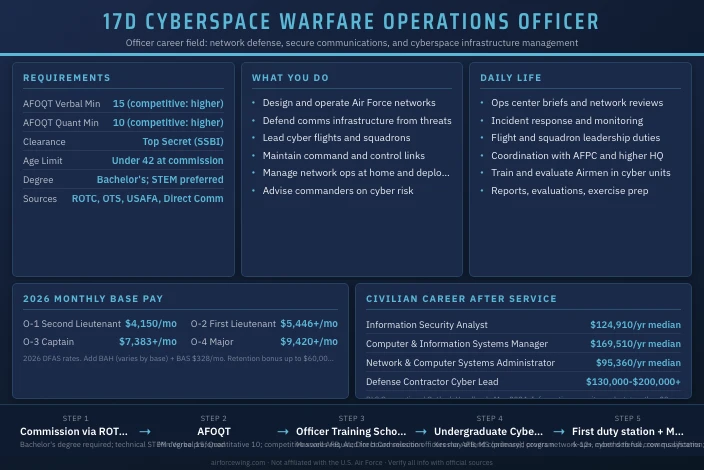
The 17D Cyberspace Warfare Operations Officer plans, designs, maintains, and operates the information networks and cyberspace systems that Air Force operations depend on. These officers provide a broad range of cyber-related expertise across warfighting operations in the air, space, and cyberspace domains, securing the communications backbone that connects aircraft, command centers, and weapons systems. They lead flights and squadrons responsible for network defense, communications architecture, and cyberspace infrastructure.
Command and Leadership Scope
At the flight commander level (Capt), a 17D officer typically leads a communications or cyber flight of 15 to 30 Airmen, supervising network administrators, systems operators, and communications specialists. At the squadron level (Maj to Lt Col), the scope expands to managing an entire wing’s cyberspace infrastructure, overseeing mission systems, command and control networks, and security operations. Senior 17D officers at the group and wing level direct multi-installation communications and cyber operations and advise wing commanders on network risk.
The 17D community also fills key billets at the Air Force Network (AFNET) level and in joint organizations where Air Force communications infrastructure intersects with combatant command requirements.
Specific Roles and Designations
| Shredout / SEI | Focus Area |
|---|---|
| 17DXA | Undergraduate Cyberspace Warfare Training (UCWT) graduate, base qualification |
| 17DXB | UCWT + Expeditionary Communications Training |
| 17D Capabilities Development | Software development, cyberspace tool and capability acquisition |
| 17D Network Operations | Enterprise network management, AFNET operations |
| 17D Expeditionary Comms | Forward deployed communications at deployed locations |
Mission Contribution
The Air Force’s ability to execute missions relies entirely on reliable, secure communications. A 17D officer’s work enables every other career field by maintaining the networks that carry targeting data, command and control instructions, logistics coordination, and intelligence feeds. In joint operations, 17D officers interface with Army, Navy, and coalition partners to ensure interoperability across theater communications architectures.
As cyber threats to military networks increase, 17D officers also contribute directly to defensive cyber operations, detecting intrusions, responding to incidents, and hardening infrastructure against adversary attacks.
Technology and Systems
17D officers work across a wide range of platforms and systems:
- Tactical communications networks (SIPR, NIPR, coalition networks)
- Command and control infrastructure supporting aircraft and weapons systems
- Satellite and ground-based communications systems
- Defensive cyber tools for monitoring and incident response
- Enterprise IT systems across Air Force installations
- Joint communications architectures in deployed environments
Salary
Officer Base Pay
Base pay is set by grade and years of service. All figures are 2026 DFAS rates.
| Rank | Grade | Years of Service | Monthly Base Pay |
|---|---|---|---|
| Second Lieutenant | O-1 | Less than 2 | $4,150 |
| First Lieutenant | O-2 | 2 years | $5,446 |
| Captain | O-3 | 4 years | $7,383 |
| Captain | O-3 | 8 years | $8,126 |
| Major | O-4 | 10 years | $9,420 |
Special Pays and Bonuses
Cyber is one of the few Air Force officer career fields that offers dedicated retention incentives because of strong competition from the private sector. The Air Force has offered 17D officers with four to twelve years of service a $60,000 retention bonus in exchange for a service extension, one of the most direct acknowledgments that the government competes with technology companies for the same talent. Verify current bonus availability and amounts with your Air Force recruiter or AFPC, as these programs open and close based on manning needs.
Cyber officers are eligible for special and incentive pays. Always check myairforcebenefits.us.af.mil for the latest bonus programs before making any commitment decision.
Additional Benefits
Officers receive Basic Allowance for Housing (BAH), which varies by duty location and dependency status. At a mid-CONUS installation, an O-3 without dependents typically receives $1,200 to $1,900 per month. Officers also receive Basic Allowance for Subsistence (BAS) of $328.48 per month (2026 rate). All active-duty officers are enrolled in TRICARE Prime at no premium, with zero deductibles and zero copays for most care.
The Blended Retirement System (BRS) provides a pension worth 40% of average high-36 basic pay at 20 years, plus Thrift Savings Plan (TSP) matching up to 5% of basic pay. Officers can also transfer GI Bill benefits to dependents after six years of service with a four-year service obligation.
Work-Life Balance
Garrison duty for 17D officers follows a standard duty week, though network operations and cyber security work can require off-hours response for incidents and outages. During deployments or contingency operations, hours are driven by mission tempo and can be demanding. Many installations have shift structures in the operations center, especially for units that maintain 24/7 network monitoring posture.
Qualifications
Commissioning Sources
There are four paths into the 17D career field.
| Source | GPA Requirement | Degree Preference | Age Limit | Notes |
|---|---|---|---|---|
| AFROTC | 2.0 minimum (competitive 3.0+) | Computer science, engineering, math, MIS | Under 42 at commission | Career field classification board selects cyber candidates |
| OTS | 2.0 minimum (competitive 3.0+) | Technical STEM degrees preferred | Under 42 at commission | Competitive board process |
| USAFA | Academy standards | Any field; technical degree advised | NA | Cyber track available through USAFA curriculum |
| Cyber Direct Commission | N/A | Cyber experience weighted heavily; STEM preferred | Under 42 at commission | No OTS required; grade determined by experience and credentials |
The Cyber Direct Commissioning program is a unique entry option not available in most career fields. Qualified civilians with established cyber careers can commission directly into the Air Force as officers without attending OTS. Entry grade ranges from Lieutenant through Colonel depending on work experience, advanced degrees, and professional certifications. Applicants must hold a bachelor’s degree and meet basic military eligibility, but the program prioritizes operational cyber experience and technical credentials over academic background alone.
Test Requirements
All officer candidates must pass the Air Force Officer Qualifying Test (AFOQT). For 17D selection through the Direct Commission program, the minimum scores are Verbal: 15 and Quantitative: 10. These are minimum thresholds, competitive candidates for the cyber field typically score significantly higher, especially on quantitative and verbal composites, given the technical nature of the work. Strong AFOQT preparation matters for making the cut on a competitive cyber selection board.
Direct commission applicants do not take the TBAS, which is only required for rated aviation career fields.
Career Field Assignment
For ROTC and OTS candidates, cyber career field assignment happens through a competitive board process. Candidates with technical degrees in computer science, mathematics, engineering, or management information systems have the strongest profiles. Prior enlisted experience in a cyber or communications AFSC is also a significant advantage and can substitute for a technical degree in some cases.
Officers who commission into the 17X community are assigned either 17S (cyberspace effects) or 17D (warfighter communications) based on mission requirements, academic background, and individual preferences expressed during the assignment process.
Upon Commissioning
New officers enter at O-1 (2d Lt). The standard Active Duty Service Commitment (ADSC) is four years from OTS or AFROTC commissioning. The Direct Commission program has its own ADSC terms that vary based on entry grade and any bonus accepted. Officers who accept a retention bonus incur an additional service obligation tied to that agreement.
Career field assignment for ROTC and OTS candidates is competitive and not guaranteed. A technical degree and strong AFOQT scores improve your chances significantly. Talk to your ROTC instructor or OTS cadre early about how to position for the 17X community.
OTS candidates can find a focused study plan in our AFOQT study guide.
Work Environment
Setting and Schedule
Most 17D officers work in operations centers, communications facilities, and network operations centers at Air Force installations. The work environment is primarily indoors, server rooms, network operations centers, mission systems facilities, and command post environments. Some officers spend significant time at classified facilities requiring badged access and cleared facilities.
Garrison work follows a regular duty week with typical office hours, though the nature of network operations means on-call requirements are common. Officers in command positions routinely work evenings and weekends during exercises and inspections. Deployed environments involve sustained operations center shifts with less predictability.
Leadership and Chain of Command
A junior 17D officer (2d Lt, 1st Lt) typically serves as an assistant flight commander or operations officer under a more senior officer. The direct relationship with the flight chief, usually a TSgt or MSgt, is one of the most important working relationships in this career field. Senior NCOs carry the technical depth and institutional knowledge that keeps complex network operations running. Officers who learn to lead through their NCOs rather than around them are far more effective in this community.
At the Capt level, the flight commander role brings full accountability for a unit’s mission performance, personnel, and standards. Staff positions between command assignments put 17D officers in requirements, acquisitions, operational planning, and policy roles at MAJCOM and Air Staff levels.
Staff vs. Command Roles
The 17D career path alternates between operational command and staff positions. Captains typically fill flight commander and assistant operations officer roles. Majors and Lt Cols move into squadron operations officer and squadron commander slots. Between these key developmental positions, officers fill staff assignments at numbered air forces, MAJCOMs, joint staffs, and the Pentagon. Staff time builds strategic and policy skills but takes officers away from the hands-on technical environment for years at a time, a reality that some officers find harder to adjust to than the operational work itself.
Retention and Job Satisfaction
Cyber officers face one of the highest exit rates of any Air Force career field. The private sector pays senior cybersecurity professionals significantly more than military compensation, and many officers leave after their initial commitment to take those positions. The Air Force has responded with dedicated retention bonuses, but competition from defense contractors and technology firms remains intense. Officers who stay typically cite mission significance, leadership opportunity, and access to classified work they cannot find in civilian careers.
Training
Pre-Commissioning Training
ROTC cadets complete a four-year program combining university coursework with military leadership training and summer field training. OTS candidates complete 9.5 weeks at Maxwell AFB, AL. Direct commission candidates may attend a condensed officer orientation program. All commissioning paths produce officers with foundational military skills and leadership training before career-field-specific instruction begins.
Initial Skills Training
| Phase | Location | Length | Focus |
|---|---|---|---|
| Commissioning (OTS) | Maxwell AFB, AL | 9.5 weeks | Officer foundation, leadership, military customs |
| Undergraduate Cyberspace Warfare Training (UCWT) | Various (Keesler AFB, MS is primary) | Varies by shredout | Network operations, cyber defense, communications systems |
| Mission Qualification Training | First duty station | 6-12+ months | Unit-specific systems, operational procedures, crew certification |
UCWT is the career field entry course for all 17D officers. It covers network architecture, communications systems, cyberspace operations doctrine, and the technical and tactical skills required to lead a communications or cyber flight. Officers who complete the additional Expeditionary Communications Training phase earn the 17DXB designation and are qualified to lead communications operations in deployed environments.
The Direct Commission path compresses or substitutes some training phases based on demonstrated experience. Officers entering via direct commission may receive credit for prior industry experience and certifications, shortening the training pipeline.
Professional Military Education
All Air Force officers progress through a PME path tied to career stage:
- Squadron Officer School (SOS): Completed around the Capt to Maj transition. In-residence at Maxwell AFB, AL. Focuses on leadership, communication, and strategic thinking.
- Air Command and Staff College (ACSC): For Majors selected for field grade development. In-residence at Maxwell AFB or distance learning. Builds operational and strategic competence.
- Air War College (AWC): For Lt Cols and Cols selected for senior leader development. The most selective PME in the Air Force.
Advanced Education and Specialized Schools
17D officers have access to fully funded graduate education through the Air Force Institute of Technology (AFIT) at Wright-Patterson AFB, OH. AFIT programs in computer science, electrical engineering, and cybersecurity are directly aligned with 17D mission requirements. Officers selected for AFIT graduate programs attend on full pay and benefits with no out-of-pocket cost.
The Air Force Weapons School at Nellis AFB, NV accepts cyber students and awards the IPME graduate distinction. While traditionally associated with aviation, the Weapons School cyber track develops the Air Force’s top cyber instructors and integrators. Selection is highly competitive and carries significant career weight.
Before OTS, you need qualifying scores. See our AFOQT study guide.
Career Progression
Career Path Timeline
| Rank | Grade | Typical Timeframe | Key Developmental Positions |
|---|---|---|---|
| Second Lieutenant | O-1 | 0-2 years | Initial qualification, UCWT, first assignment |
| First Lieutenant | O-2 | 2-4 years | Assistant flight commander, operations officer billets |
| Captain | O-3 | 4-10 years | Flight commander (KD), crew commander, Cyber Mission Force team lead |
| Major | O-4 | 10-14 years | Operations officer (KD), staff assignments, AFIT graduate school |
| Lieutenant Colonel | O-5 | 14-20 years | Squadron commander (KD), MAJCOM or joint staff |
| Colonel | O-6 | 20-26 years | Group commander, wing director of communications, senior staff |
O-1 through O-3 promotions are essentially automatic with time in service and satisfactory performance. O-4 (Major) is the first competitive board and marks the significant career transition point. Selection rates vary by year and Air Force-wide promotion authority, but cyber officers have generally seen favorable O-4 rates given the field’s high demand.
Building a Competitive Record
Officers who reach squadron command and are competitive for O-5 typically have:
- Completed all key developmental positions (flight commander, operations officer)
- At least one deployment or contingency operation on their record
- Distinguished or above ratings on officer performance reports
- Broadening assignments (ROTC instructor, Air Staff, joint staff, fellowship)
- Advanced degree, preferably in a technical field
- Active involvement in mentoring and unit development
Cross-Training and Broadening
Active-duty officers can cross-train to other career fields, though the process is competitive and depends on Air Force needs. Cyber officers are sometimes asked to cross-train into acquisitions or space operations later in their careers. Broadening assignments to joint staffs, the Pentagon, ROTC instructor duty, Congressional fellowships, and senior leader development programs are available and valued for promotion boards.
Physical Demands
Fitness Assessment
All Air Force officers, regardless of career field, take the Air Force Fitness Assessment annually. The FA uses a 100-point scoring system with a minimum passing composite of 75. Each component also has its own minimum that must be met independently.
| Component | Maximum Points | Notes |
|---|---|---|
| 1.5-Mile Run | 60 | Primary aerobic component |
| Waist Circumference | 20 | Body composition measure |
| Push-Ups (1 min) | 10 | Muscular endurance |
| Sit-Ups (1 min) | 10 | Core strength |
Standards are age- and gender-normed. Under-25 male officers need approximately 1:35 per mile pace or better on the run to score in the passing range. Under-25 female officers have adjusted standards for the same components. Verify current minimum scores for your age group with official Air Force sources at af.mil.
Career Field-Specific Medical
The 17D career field does not require a flight physical. Standard commissioning medical requirements apply: officers must meet Air Force accession medical standards, which cover vision, hearing, musculoskeletal fitness, and general health. There are no specific medical waivers unique to 17D that differ from baseline officer accession standards.
Officers who later move into cyber-related special operations or joint special operations command billets may face additional medical evaluation requirements tied to those specific assignments.
Deployment
Deployment Tempo
Most 17D officers deploy at least once during their career as company grade officers (CGO). Typical deployments support expeditionary communications requirements at forward operating locations, standing up tactical networks, maintaining communications links for deployed forces, and supporting contingency command and control. Deployment lengths typically run 60 to 180 days. Some officers with specialized skills may see more frequent deployments, particularly those assigned to expeditionary communications units.
The deployment tempo for 17D is generally lower than for rated aviation or special warfare career fields, but it is not zero. Officers assigned to certain units, particularly those supporting active combatant commands, can have higher operational tempos.
Duty Stations
17D officers are assigned across a wide range of Air Force installations because every major base has a communications squadron or cyber unit. Primary hubs for the career field include:
- Scott AFB, IL: Air Mobility Command headquarters; major communications presence
- Peterson SFB, CO: NORAD/USNORTHCOM; cyber and communications command billets
- Lackland AFB (JBSA), TX: 25th Air Force and cyber enterprise headquarters
- MacDill AFB, FL: CENTCOM and SOCOM; joint communications billets
- The Pentagon, VA: Air Staff and joint staff positions for senior officers
- Keesler AFB, MS: Training location; some officers are assigned as instructors
Assignments are managed by the Air Force Personnel Center (AFPC). Officers submit preference worksheets and AFPC matches them against available positions, mission requirements, and career development needs. Joint spouse coordination is available but can be more challenging in a field where some billets are location-specific.
Risk/Safety
Job Hazards
The 17D career field carries low physical hazard risk compared to aviation or special warfare. The primary risk is professional and reputational: officers who manage classified networks bear personal accountability for security incidents, data breaches, and network failures that occur on their watch. A significant security incident in a unit under a 17D officer’s command can be career-ending regardless of direct culpability.
Cyber work also carries the risk of insider threat exposure. Officers work with sensitive systems and data daily, and the scrutiny that comes with that access is ongoing throughout the career.
Safety Protocols and Risk Management
17D officers apply Operational Risk Management (ORM) frameworks to network change management, system upgrades, and new technology deployments. Every significant change to mission-critical infrastructure requires a formal risk review. Officers are also responsible for ensuring their units comply with cybersecurity frameworks, DISA STIGs, and Air Force network security requirements.
Legal and Command Responsibility
Officers hold command authority under the Uniform Code of Military Justice (UCMJ) and are personally responsible for the conduct, welfare, and performance of every Airman in their unit. Relief for cause, being removed from a command or leadership position for misconduct, poor performance, or a significant incident on your watch, is a career-ending event in nearly all cases. Officers who fail command climate surveys or face equal opportunity findings face formal investigation and potential separation.
The legal environment in cyber is also shaped by authorities specific to cyberspace operations, including Title 10 and Title 50 authorities governing what actions are permitted, who can authorize them, and what oversight is required.
Impact on Family
Family Considerations
The PCS (Permanent Change of Station) move cycle for 17D officers averages every two to three years, consistent with most Air Force career fields. Because 17D billets exist at installations across the country and overseas, families often face moves to locations without prior ties. The Air Force provides relocation support through the Airman and Family Readiness Center (A&FRC), which assists with housing, school enrollment, spouse employment, and community connection.
The Key Spouse Program at each installation provides peer support for spouses during deployments and exercises, when communication may be limited. Military OneSource offers free counseling and support services for family members regardless of location.
Dual-Military Couples
The Air Force makes a good-faith effort to assign dual-military couples to the same installation through the join spouse program, but success depends heavily on both officers’ career fields and billet availability. Cyber is one of the more distributed fields, which helps with co-location but doesn’t eliminate the challenge of finding matching billets at the same base. Dual-17D or 17D/17S couples may find the cyber concentration at certain bases (Scott, JBSA, Peterson) provides more assignment flexibility than more niche career fields.
During deployments, the non-deployed spouse typically remains at the home station with full access to all family support programs.
Reserve and Air National Guard
Component Availability
The 17D career field is available in both the Air Force Reserve and the Air National Guard. Guard and Reserve cyber units play an active role in defending state and federal networks alongside active-duty counterparts. Several states have dedicated cyber units with robust mission sets and frequent federal mobilization.
Commissioning Paths
Guard and Reserve 17D officers typically commission through the same ROTC, OTS, and USAFA pathways as active-duty officers, but with component-specific board processes. The Cyber Direct Commission program is also available to Guard and Reserve candidates. Active-duty 17D officers who separate after their ADSC often transfer directly into Guard or Reserve units, bringing operational experience and clearances that make them immediately valuable to those units.
Drill and Training Commitment
Standard Reserve commitment is one Unit Training Assembly (UTA) per month, typically a weekend, plus 15 days of Annual Tour per year. Many 17D Reserve and Guard units have additional training requirements beyond the standard schedule, including annual cyber defense exercises, certification maintenance, and federal mobilization support. Officers who hold specialized qualifications or command billets should expect above-average training commitments.
Part-Time Pay
An O-3 (Capt) with 4 years of service earns approximately $7,383 per month on active duty. For one UTA weekend (four drill periods), that same officer earns approximately $983 (4 × $7,383 / 30). Annual Tour pay is calculated at the daily rate for 15 days, or roughly $3,691.
Benefits Comparison
| Category | Active Duty | Air Force Reserve | Air National Guard |
|---|---|---|---|
| Commitment | Full-time | 1 UTA/month + 15 days/yr | 1 UTA/month + 15 days/yr |
| Monthly Pay (O-3, 4 yr) | $7,383/mo | ~$983/UTA weekend | ~$983/UTA weekend |
| Healthcare | TRICARE Prime (free) | TRICARE Reserve Select (premium) | TRICARE Reserve Select + state options |
| Education Benefits | Federal TA up to $4,500/yr; GI Bill transferable | Federal TA; GI Bill eligibility upon activation | State tuition waivers (varies); Federal TA; GI Bill |
| Retirement | 20-year pension (BRS) | Points-based Reserve retirement | Points-based Reserve retirement |
| Deployment Tempo | Regular; field-dependent | ADOS tours; periodic mobilization | Mobilization; state active duty missions |
| Command Opportunities | Squadron, group, wing | Squadron, group billets at Reserve wings | Squadron, group billets at ANG wings |
Civilian Career Integration
Guard and Reserve 17D officers often hold civilian cybersecurity positions that directly complement their military duties. A network security engineer at a federal contractor who drills one weekend a month as a 17D officer is a common profile in this community. The skills transfer nearly perfectly in both directions. USERRA (Uniformed Services Employment and Reemployment Rights Act) protects civilian job rights during mobilizations and deployments, and many defense contractors actively support and sometimes encourage Guard and Reserve service among their employees.
Post-Service
Transition to Civilian Life
Officers with 17D experience are competitive candidates for senior technical and leadership roles in industries that depend on network security and infrastructure. The transition process includes TAP (Transition Assistance Program), available at all major installations, and programs like Hiring Our Heroes, which connects veterans to corporate partners. The Air Force Credentialing Opportunities On-Line program can help 17D officers identify which civilian certifications their military experience maps to.
Civilian Career Prospects
| Job Title | Median Annual Salary | Outlook |
|---|---|---|
| Information Security Analyst | $124,910 | +29% (2024-2034) |
| Network and Computer Systems Administrator | $95,360 | +5% (2024-2034) |
| Computer and Information Systems Manager | $169,510 | +17% (2024-2034) |
Salary data from the U.S. Bureau of Labor Statistics Occupational Outlook Handbook. The information security analyst field is projected to add approximately 16,000 jobs per year through 2034, driven by escalating cyber threats across government and private sectors.
Defense contractors. Lockheed Martin, Raytheon, Booz Allen Hamilton, SAIC, Leidos, actively recruit former 17D officers for program management, systems engineering, and cybersecurity leadership roles. These positions often pay $130,000 to $200,000+ at the senior level, with security clearances (which 17D officers carry from day one) adding direct compensation value.
Certifications and Credentials
Military cyber training maps to several industry-recognized certifications. 17D officers with UCWT completion and operational experience are typically competitive for:
- CompTIA Security+ (often already required and funded by DoD)
- CISSP (Certified Information Systems Security Professional)
- Certified Information Security Manager (CISM)
- AWS/Azure cloud security certifications
The GI Bill covers tuition at public schools at full in-state cost and up to $29,920.95 per academic year at private institutions (2025-2026 cap). Officers who commission via direct commissioning may have different GI Bill accrual terms depending on prior military service.
Is This a Good Job
Ideal Candidate Profile
The officers who thrive in 17D share a few consistent traits. They genuinely like complex technical systems and want to understand how networks work at a level most people don’t reach. They’re comfortable with ambiguity, real network environments don’t behave like lab environments, and fielded systems rarely match their documentation. They also want to lead people, not just manage systems. The 17D job is ultimately a people-leadership role where the domain happens to be technical.
Strong candidates for this career field tend to have:
- Technical degree with good academic performance in CS, engineering, math, or MIS
- Prior experience with IT systems, networks, or cybersecurity (through internships, work, or enlisted service)
- Interest in operational missions rather than purely research or development work
- Ability to communicate complex technical concepts clearly to non-technical commanders
Potential Challenges
Officers who enter 17D expecting primarily hands-on technical work often find that leadership and administrative duties consume more time than anticipated, especially at Capt and above. The further an officer advances, the more time goes to managing people, writing evaluations, preparing for inspections, and attending meetings rather than working in the network itself. Officers who want to keep their technical skills sharp through active duty typically find they need deliberate effort to stay current alongside their leadership responsibilities.
The PCS cycle is also a real friction point. Moving every two to three years is hard on families, interrupts spouse careers, and requires Airmen to rebuild social and professional networks repeatedly. Officers who are geographically flexible will have more assignment options, but the moves don’t stop.
Career and Lifestyle Alignment
The 17D career field suits officers who want to serve a full military career to O-6 or who plan to do four to six years and transition to a well-paying civilian cyber role. Both paths are well-supported by the career field’s training and mission experience. Officers who want one focused assignment and a quick transition to industry will still come out with a Top Secret clearance, UCWT qualification, and operational leadership experience, all genuinely valuable in the civilian market.
Officers drawn to a purely hands-on technical role without management responsibility may find the 17D officer track frustrating. The enlisted 3D and 1B communities offer technically focused careers without the administrative and leadership overhead that comes with an officer commission.
More Information
Talk to an Air Force recruiter or your ROTC detachment early if you’re considering the 17D track. The career field classification process is competitive, and building a strong application, technical degree, solid AFOQT scores, relevant experience, takes time. If you’re coming from a civilian cyber background and want to explore direct commissioning, the Cyber Direct Commissioning program has its own application process and recruiters who specialize in it. All officer commissioning routes require the AFOQT, and preparation for that test is time well spent.
Official resources:
- Air Force Cyber Command (AFCYBER), the operational command for Air Force cyberspace operations; mission overview and news reflect current operational priorities for 17D officers
- National Security Agency/CSS, NSA is one of the most common assignment locations for senior 17D officers; understanding the NSA mission helps frame the career’s long-term potential
- DoD Cyber Workforce, DoD-wide cyber certification requirements and resources, including the 8570 framework that governs officer cyber credentialing
Related career profiles on this site:
- Air Force Cyber Operations careers hub, compare all cyber officer career tracks including 17D, 17S, and 14N intelligence roles that intersect with cyberspace
- 17S Cyberspace Effects Operations Officer, the offensive operations track within the same 17X community; compare scope and mission orientation before applying for classification
Practical preparation:
All commissioning routes require the AFOQT (Air Force Officer Qualifying Test). For cyber career field classification, technical aptitude demonstrated through AFOQT quantitative and verbal scores, plus academic background in computer science, electrical engineering, or a related STEM field, strengthens your classification application. Start AFOQT study guide early, the test covers quantitative skills, verbal reasoning, spatial awareness, and aviation knowledge, and strong scores across all areas support a competitive package.
If your background is non-technical but you have industry certifications (CISSP, Security+, CEH), include those in your commissioning package. The Cyber Direct Commission program specifically values working professionals with demonstrated industry experience.
This site is not affiliated with the U.S. Air Force or any government agency. Verify all information with official Air Force sources before making enlistment or career decisions.
Explore more Air Force Cyber Operations officer careers alongside the 17S Cyberspace Effects Operations Officer, which covers the offensive cyberspace operations track within the same 17X community.