16K Software Development Officer
Most military officer career fields put you in charge of people who operate systems someone else built. The 16K Software Development Officer is different. These officers build the systems. Working inside Air Force software factories like Kessel Run and Platform One, 16K officers lead agile development teams that write, ship, and maintain the software that warfighters depend on daily, targeting tools, logistics applications, command and control systems, and mission planning platforms. If you’re a developer, product manager, designer, or data scientist who wants to do that work at a scale and stakes that no startup can match, this is one of the most unusual officer career fields the Air Force has ever created.
Thinking about how to commission? The AFOQT is where all officer candidates start, the test is required for every commissioning route.
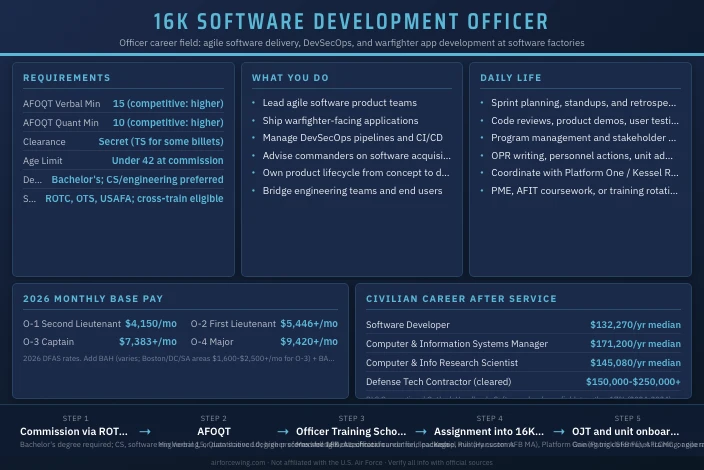
Job Role
The 16K Software Development Officer designs, develops, or manages the development of bespoke software or software-intensive weapon systems for the Air Force. These officers provide technical advice and leadership across both the acquisition and operational communities on deploying modern software capabilities. They work in software factories, at Air Force Material Command, on Air Staff, at MAJCOMs, and in operational units that use software-intensive weapons systems.
Command and Leadership Scope
At the entry level, a 16K officer joins a software product team and operates in a peer-engineering environment. The culture at most software factories is deliberately flat: a junior 16K officer pairs with engineers, participates in standups, and ships code alongside senior engineers and civilian contractors. Traditional Air Force rank hierarchy is present, but the day-to-day work dynamic looks more like a technology company than a typical military unit.
As officers advance, leadership responsibilities broaden to include managing product teams, owning full product roadmaps, and advising squadron and wing-level commanders on software acquisition and delivery. Senior 16K officers in staff billets help shape Air Force-wide software policy and acquisition strategy. They advise combatant commands on deploying software capabilities and managing technical programs that affect thousands of users across the joint force.
Specific Roles and Designations
The AFOCD defines four shredout tracks within 16K, each reflecting a specific software discipline. Officers are assigned to the shredout that matches their skills and billet.
| Shredout | Code | Focus |
|---|---|---|
| Product Manager | 16KXM | Product lifecycle, Agile/Lean delivery, stakeholder management |
| Product Designer | 16KXD | UX design, user research, visual and interaction design |
| Software Engineer | 16KXE | Application development, platform engineering, machine learning, security |
| Data Scientist | 16KXS | Data modeling, machine learning, dashboards, performance analytics |
The 16K1 entry level is awarded upon assignment into a designated 16K billet, no prior software-specific training is required before arrival. The 16K3 qualified designation requires a minimum of 12 months of experience in a software development assignment. The 16K4 staff level requires at least 12 months of prior experience as part of an operational software development team.
Mission Contribution
Warfighter software used to take years to develop and arrive obsolete. The 16K career field exists because the Air Force decided that was no longer acceptable. Kessel Run’s tanker planning application saved roughly $214,000 per day in logistics costs. Targeting tools developed at software factories reduced planning time by up to 85 percent. These outcomes came from applying commercial software development practices, continuous delivery, user-centered design, automated testing, to military problems.
16K officers contribute to joint operations by delivering software that connects air, ground, space, and cyber domains. When an operations center needs a new capability, a 16K product team can prototype, test, and deploy it in weeks rather than years. That speed is the mission contribution.
Technology, Equipment, and Systems
The technical environment for 16K officers includes:
- Cloud-native development platforms (AWS GovCloud, Azure Government)
- Platform One’s DevSecOps infrastructure and software factories’ CI/CD pipelines
- Container orchestration tools (Kubernetes, Docker) for deploying applications at scale
- Classified and unclassified networks spanning NIPR, SIPR, and JWICS
- Agile project management tools and product lifecycle platforms
- Machine learning and data analytics platforms for operational applications
- Mobile and web application frameworks for warfighter-facing products
Salary
Officer Base Pay
Base pay is set by grade and years of service. All figures are 2026 DFAS rates. Before these figures apply, you need to commission, and strong AFOQT scores are the first step in every commissioning package.
| Rank | Grade | Years of Service | Monthly Base Pay |
|---|---|---|---|
| Second Lieutenant | O-1 | Less than 2 | $4,150 |
| First Lieutenant | O-2 | 2 years | $5,446 |
| Captain | O-3 | 4 years | $7,383 |
| Captain | O-3 | 8 years | $8,126 |
| Major | O-4 | 10 years | $9,420 |
Special Pays and Bonuses
The 16K career field does not currently offer a dedicated aviation or hazardous duty bonus, but it competes with the private technology sector for the same talent pool. The Air Force has expanded its selective retention bonus program significantly, check Air Force officer bonus programs for current 16K eligibility, as these programs open and close based on manning requirements. Officers who hold in-demand technical skills (software engineering, data science, machine learning) are the most likely to see targeted retention incentives as the career field matures.
Additional Benefits
Officers receive Basic Allowance for Housing (BAH), which varies by duty location and dependency status. Many 16K billets are located in high cost-of-living areas. Boston, Northern Virginia, San Antonio, where BAH for an O-3 without dependents typically runs $1,600 to $2,500 per month or higher depending on the specific duty station. Officers also receive Basic Allowance for Subsistence (BAS) of $328.48 per month (2026 rate).
Active-duty officers receive TRICARE Prime healthcare at no premium, with zero deductibles and no copays for most care. The Blended Retirement System (BRS) pays a pension worth 40 percent of average high-36 basic pay at 20 years, with Thrift Savings Plan matching up to 5 percent of basic pay. Officers who serve at least six years can transfer GI Bill benefits to dependents with a four-year service obligation attached.
Work-Life Balance
Software factory environments typically operate on structured sprint cycles rather than continuous ops tempo. Garrison work follows a regular duty week at most assignments, though delivery deadlines and exercise support can extend hours. The culture at places like Kessel Run is closer to a technology company than a traditional Air Force unit, standups, retrospectives, and demo days replace some of the ceremony of a flying or operations squadron.
Deployment tempo for 16K is lower than aviation or special warfare career fields. Most 16K officers spend the bulk of their careers at CONUS installations, with periodic TDYs to user commands and operational sites.
Qualifications
Commissioning Sources
There are four paths into the 16K career field.
| Source | GPA Requirement | Degree Preference | Age Limit | Notes |
|---|---|---|---|---|
| AFROTC | 2.0 minimum (competitive 3.0+) | Computer science, software engineering, data science strongly preferred | Under 42 at commission | Career field classification is competitive; technical background required |
| OTS | 2.0 minimum (competitive 3.0+) | CS, software engineering, data science preferred; demonstrated industry experience valuable | Under 42 at commission | Strong AFOQT scores and prior tech work experience help classification |
| USAFA | Academy standards | Technical majors in CS, systems engineering, or math | N/A | Software development track available through USAFA curriculum |
| Direct Commission | N/A | Technical experience weighted heavily; CS/engineering background preferred | Under 42 at commission | No OTS required; grade based on experience and credentials |
The AFOCD does not list a separate direct commission pathway specifically for 16K the way cyber does for 17X, but officers from other career fields can cross-train into 16K billets with appropriate experience. A prior-service software engineer or data scientist with military experience is a strong candidate for 16K reclassification.
Test Requirements
All officer candidates must pass the Air Force Officer Qualifying Test (AFOQT). For non-rated (non-aviation) officer positions including 16K, the minimum scores are Verbal: 15 and Quantitative: 10. These are minimum thresholds, not competitive targets. Candidates aiming for classification into a technical career field like 16K should score well above the minimums, particularly on the quantitative and verbal composites given the analytical and communication demands of the role.
The TBAS (Test of Basic Aviation Skills) is not required for 16K, which is a non-rated career field. Strong AFOQT study guide improves your overall commissioning package regardless of target career field.
Career Field Assignment
The 16K AFSC is a special duty assignment, meaning officers enter it through an assignment into a 16K-designated billet rather than through a standard career field classification board. The AFOCD states that the 16K1 (entry) designation is awarded upon assignment into a 16K billet, no prior formal training is required. This means the path in is through billet availability and demonstrated technical skills, not a fixed accession pipeline.
For new officers seeking a 16K assignment out of commissioning, the most direct route is demonstrating strong software or data skills in the commissioning package, projects, internships, a GitHub portfolio, or prior civilian work. ROTC cadets can express preferences during field training and classification. OTS candidates can indicate interest during the assignment process. The career field is growing but still relatively small compared to traditional officer communities.
Upon Commissioning
New officers enter at O-1 (2d Lt). The standard Active Duty Service Commitment (ADSC) is four years from OTS or ROTC commissioning. Officers who accept a retention bonus incur an additional service obligation tied to that agreement.
The 16K career field is classified as a Special Duty Assignment (SDA). Commissioning as a 16K is possible directly from OTS or ROTC if a designated billet is available, but most officers will hold a primary AFSC first and cross-train into 16K through an assignment into a software factory or software-intensive operational unit.
Work Environment
Setting and Schedule
Most 16K officers work in software factory environments located at or near Air Force installations in urban areas. The work setting varies by assignment type:
| Assignment Type | Environment | Daily Rhythm |
|---|---|---|
| Software factory (Kessel Run, Platform One) | Open floor plan, collaboration spaces, multiple monitors, standing desks | Sprint ceremonies, stand-ups, code reviews, user testing |
| AFLCMC acquisition program | Traditional government office at Wright-Patt or Hanscom | Requirements meetings, acquisition milestone reviews, contractor oversight |
| Air Staff / Pentagon | Office environment in Arlington, VA | Policy development, programming and budgeting, strategic planning |
| Operational unit support | Varies by unit; may include SCIF access | Integration testing, deployment support, direct warfighter engagement |
Some positions require access to classified facilities, but much development work happens on unclassified or low-side systems first. Kessel Run operates at Hanscom AFB, MA (near Boston), Platform One at Patrick SFB, FL, with additional billets at AFLCMC, Air Staff, and operational units across the CONUS.
Leadership and Chain of Command
Junior 16K officers (2d Lt, 1st Lt) work as individual contributors on product teams. The relationship with senior engineers, whether government civilian or contractor, is collaborative rather than hierarchical. The flight chief and senior NCO dynamic that dominates other Air Force career fields is less pronounced in software factories, where technical depth often matters more than grade.
At the Capt level, flight commander and product manager roles bring people leadership responsibilities alongside technical work. Officers who advance to Major and above move into program management, MAJCOM staff, and cross-functional leadership that requires bridging software teams and traditional acquisition bureaucracy.
Staff vs. Command Roles
The 16K career field is primarily assignment-driven rather than command-centric. There are no traditional flying squadron commands in 16K, and the key developmental positions look different than in rated or operational support career fields. Product manager billets, software factory leadership, and senior program management at AFLCMC are the KD positions that shape career trajectories. Staff assignments at SAF/AQ, AFMC headquarters, and the Pentagon fill the space between operational product team assignments.
Retention and Job Satisfaction
The Air Force created the 16K AFSC partly because it recognized that technical talent was leaving, or never joining, because the military had no dedicated pathway for software professionals. Officers in this career field generally report high job satisfaction tied to the direct mission impact of their work and the quality-of-life advantages of a non-deployable or low-deployment assignment. The main driver of attrition is compensation: a senior software engineer with a Top Secret clearance and Air Force experience can earn $180,000 to $250,000 at a defense contractor or major technology firm after their initial commitment ends.
Training
Pre-Commissioning Training
ROTC cadets complete a four-year program combining university coursework with military leadership training. OTS candidates complete 9.5 weeks at Maxwell AFB, AL covering officer foundation, leadership, and military customs. There is no AFSC-specific classroom pipeline before arrival at the first assignment, technical training is hands-on, organization-specific, and driven by the gaining unit.
Initial Skills Training
| Phase | Location | Length | Focus |
|---|---|---|---|
| Commissioning (OTS) | Maxwell AFB, AL | 9.5 weeks | Officer foundation, leadership, military customs |
| Assignment Onboarding | Gaining unit (software factory or operational unit) | 2-8 weeks | Unit-specific processes, tools, product team integration |
| On-the-Job Training (OJT) | Duty station | 6-12 months | Mission qualification, product delivery, team leadership |
The AFOCD is explicit on this: specific training for 16K “will be determined by the gaining organization and can include on-the-job training or specialized training through commercial programs.” There is no centralized technical school equivalent for 16K. Before commissioning, candidates benefit from reviewing AFOQT test preparation to build a competitive score on the quantitative composite, a strong number on that section signals technical aptitude to career field classification boards. Kessel Run, for example, runs internal training programs that cover agile practices, DevSecOps pipelines, and product delivery frameworks specific to their environment. Platform One runs its own onboarding for engineers and product managers on its DevSecOps infrastructure.
Professional Military Education
All Air Force officers progress through PME tied to career stage:
- Squadron Officer School (SOS): Completed around the Capt-to-Maj transition. In-residence at Maxwell AFB, AL. Covers leadership, communication, and strategic thinking.
- Air Command and Staff College (ACSC): For Majors selected for field grade development. In-residence or distance learning. Builds operational and strategic competency.
- Air War College (AWC): For Lt Cols and Cols in senior leader development tracks.
PME is required for promotion and is separate from technical training. A 16K officer needs to complete both tracks, the technical depth to lead product teams and the PME to be competitive for promotion boards.
Advanced Education and Specialized Training
The Air Force Institute of Technology (AFIT) at Wright-Patterson AFB, OH offers fully funded graduate programs in computer science, computer engineering, data science, and systems engineering. A 16K officer selected for an AFIT program attends on full pay and benefits. These programs directly align with the 16K technical mission and are a strong career differentiator.
Commercial training through AWS, Azure, Google Cloud, and technical certifications (Certified Scrum Product Owner, AWS Solutions Architect, Google Professional Data Engineer) are available through unit training funds. The Air Force has also partnered with civilian technical programs to maintain currency in rapidly evolving software practices.
Career Progression
Career Path Timeline
| Rank | Grade | Typical Timeframe | Key Developmental Positions |
|---|---|---|---|
| Second Lieutenant | O-1 | 0-2 years | Assignment into 16K billet, OJT, team contributor |
| First Lieutenant | O-2 | 2-4 years | Individual contributor, assistant product lead |
| Captain | O-3 | 4-10 years | Product manager or team lead (KD), software factory flight commander |
| Major | O-4 | 10-14 years | Program manager (KD), MAJCOM or Air Staff staff billet, AFIT |
| Lieutenant Colonel | O-5 | 14-20 years | Software factory director or deputy (KD), senior acquisition lead |
| Colonel | O-6 | 20-26 years | AFLCMC division chief, senior software strategist, Air Staff |
O-1 through O-3 promotions are essentially automatic with satisfactory performance and time in service. O-4 (Major) is the first competitive board. Cyber and technical career fields have generally seen favorable promotion rates given their high demand, but the 16K community is young enough that long-term promotion data is still limited.
Building a Competitive Record
A 16K officer competitive for O-5 and above typically has:
- Demonstrated product or engineering leadership with measurable mission outcomes
- At least one staff assignment (MAJCOM, AFLCMC, or Air Staff) that broadened strategic perspective
- Completion of all PME requirements on time
- Advanced degree in a technical field (AFIT graduate or funded external program)
- OPR bullets that quantify software delivery impact in warfighter terms (not just process compliance)
Cross-Training and Broadening
Officers from other career fields who hold technical degrees or industry software experience can cross-train into 16K through the assignment process. 16K officers can also cross-train into the 62E (Development Engineer) or 64P (Contracting Officer) communities, where their software delivery experience translates well into acquisition leadership. Broadening assignments to joint staffs, ROTC instructor duty, Congressional fellowships, and Silicon Valley innovation offices (AFWERX, DIU) are available and valued.
Physical Demands
Fitness Assessment
All Air Force officers take the Air Force Fitness Assessment (FA) annually. The FA uses a 100-point scoring system with a minimum passing composite of 75. Each component has its own minimum that must be met independently.
| Component | Maximum Points |
|---|---|
| 1.5-Mile Run | 60 |
| Waist Circumference | 20 |
| Push-Ups (1 minute) | 10 |
| Sit-Ups (1 minute) | 10 |
Standards are age- and gender-normed. Verify current minimum scores for your age group with official Air Force sources at af.mil.
Career Field-Specific Physical and Medical
The 16K career field does not require a flight physical. Standard commissioning medical requirements apply:
- Vision: Correctable to 20/20; no specific uncorrected standard for non-rated officers
- Hearing: Must meet standard audiometric screening thresholds
- General health: Musculoskeletal fitness and overall health per Air Force accession medical standards (DoDI 6130.03)
- No 16K-specific waivers: No additional medical requirements beyond baseline officer accession standards
The work is sedentary by nature, long hours at a computer, in meetings, or in front of a whiteboard. Physical fitness is a professional requirement and a personal responsibility; the FA keeps officers accountable, but there is no operational physical demand specific to this career field. Officers in software factory environments report that ergonomic setup, regular movement breaks, and maintaining consistent fitness habits during high-tempo sprint cycles are the practical wellness considerations that matter most in this career field.
Deployment
Deployment Tempo
The 16K career field has one of the lowest deployment tempos in the officer corps. Most billets are at CONUS installations with no regular deployment requirement. Officers may travel to forward operating locations or deployed environments on TDY to support software delivery or integration of applications with operational systems, but extended deployments are uncommon. The career field is shaped by the garrison work of building and maintaining software, not by rotational combat deployments.
Some 16K officers assigned to units with active operational software programs may support exercises or contingency operations remotely or via short TDYs. This is assignment-dependent and not a career field-wide pattern.
Duty Stations
16K billets are concentrated at Air Force installations with major software development activity:
- Hanscom AFB, MA (near Boston). Kessel Run headquarters; Air Force Life Cycle Management Center East
- Wright-Patterson AFB, OH: AFLCMC headquarters; AFIT; major acquisition programs
- Joint Base San Antonio (JBSA), TX: 16th Air Force; cyber and digital transformation programs
- Patrick SFB, FL: Platform One primary location
- Pentagon / Arlington, VA: Air Staff and SAF/AQ software policy billets
- Scott AFB, IL: Air Mobility Command digital programs; Magellan application development
Assignments are managed by AFPC. Officers submit preference worksheets and AFPC matches them against available billets. The 16K community is small enough that personal advocacy and networking within software factory communities can meaningfully influence assignment outcomes.
Risk/Safety
Job Hazards
Physical hazard risk is minimal in the 16K career field. The primary risks are programmatic, professional, and legal:
- Product accountability: An officer responsible for a software product that fails in an operational environment bears command accountability for that failure. Software defects in mission-critical systems can have operational consequences, and 16K officers who own those products own the risk.
- Program-level exposure: Software acquisition programs have a high failure rate across government and industry alike. Officers who manage programs that are cancelled, descoped, or restructured face career exposure even when the problems originate from institutional constraints outside their control.
- Mixed-team leadership liability: Officers often lead teams of military, civilian, and contractor personnel governed by different legal frameworks, which creates accountability complexity not found in traditional military units.
Safety Protocols and Risk Management
16K officers apply software quality practices, automated testing, staged rollout, user acceptance testing, and security scanning, as risk management tools. DevSecOps pipelines include security gates before any code reaches production environments. Air Force software factories use the Risk Management Framework (RMF) for system authorization, which is the DoD-standard security compliance process for all information systems.
Legal and Command Responsibility
Officers hold command authority under the Uniform Code of Military Justice (UCMJ) and are responsible for the conduct and performance of their Airmen. In software factory environments, the command relationship can be complex: officers often lead mixed teams of military members, government civilians, and contractors, each governed by different legal frameworks. Understanding the boundaries of command authority over each category is a practical leadership challenge unique to this environment.
Impact on Family
Family Considerations
The 16K career field offers some of the best quality-of-life conditions in the Air Force officer corps for families. Low deployment tempo means more time at home. Duty station locations in or near major metropolitan areas offer civilian employment opportunities for spouses and access to good schools and established communities.
| Duty Station | Metro Area | BAH Consideration | Spouse Employment |
|---|---|---|---|
| Hanscom AFB, MA | Greater Boston | High-cost area; BAH reflects metro rates | Strong tech and healthcare job market |
| Wright-Patterson AFB, OH | Dayton | Moderate cost; BAH covers most housing options | Defense contractor and university employment |
| JBSA, TX | San Antonio | Moderate cost; strong BAH-to-housing ratio | Large military community; growing tech sector |
| Patrick SFB, FL | Melbourne/Space Coast | Moderate cost | Aerospace and defense contractor corridor |
PCS moves occur on the standard Air Force cycle of roughly every two to three years. The Airman and Family Readiness Center (A&FRC) assists with housing, school enrollment, and spouse employment resources at each installation. Military OneSource offers free counseling and support services regardless of duty location.
Dual-Military Couples
The Air Force’s join spouse program attempts to co-locate dual-military couples, but success depends on billet availability. A dual-16K couple faces a particularly narrow overlap of available billets given the small community size, though the geographic concentration of software billets at a few major bases improves odds compared to more dispersed career fields. Couples where one officer is 16K and the other is in a larger career field (17D, acquisitions, logistics) will have more flexibility.
Reserve and Air National Guard
Component Availability
The 16K AFSC is available in the Air Force Reserve and Air National Guard, though the number of Reserve and Guard billets is smaller than on active duty. Guard and Reserve 16K officers typically support software development programs at units affiliated with active-duty software factories or at Guard organizations with established cyber and software missions.
Commissioning Paths
Guard and Reserve 16K officers commission through the same ROTC, OTS, and USAFA pathways as active-duty officers, with component-specific board processes. Active-duty officers who separate after their ADSC often transfer directly into Guard or Reserve billets, bringing product team experience and technical skills that are immediately useful. The cross-training pathway also applies in the Reserve component, experienced civilian developers or engineers can commission into Guard or Reserve 16K billets if positions exist.
Drill and Training Commitment
Standard Reserve commitment is one Unit Training Assembly (UTA) per month (a weekend) plus 15 days of Annual Tour per year. Many 16K Reserve and Guard units supplement the standard schedule with additional training or exercises tied to software program support. Officers in product manager or technical lead roles should expect above-average training commitments during active program phases.
Part-Time Pay
An O-3 (Capt) with 4 years of service earns approximately $7,383 per month on active duty. For one UTA weekend (four drill periods), that same officer earns approximately $984 (4 x $7,383 / 30). Annual Tour pay runs roughly $3,691 for 15 days at the daily rate.
Benefits Comparison
| Category | Active Duty | Air Force Reserve | Air National Guard |
|---|---|---|---|
| Commitment | Full-time | 1 UTA/month + 15 days/yr | 1 UTA/month + 15 days/yr |
| Monthly Pay (O-3, 4 yr) | $7,383/mo | ~$984/UTA weekend | ~$984/UTA weekend |
| Healthcare | TRICARE Prime (free) | TRICARE Reserve Select (premium) | TRICARE Reserve Select + state options |
| Education Benefits | Federal TA up to $4,500/yr; GI Bill transferable | Federal TA; GI Bill eligibility on activation | State tuition waivers (varies); Federal TA; GI Bill |
| Retirement | 20-year pension (BRS) | Points-based Reserve retirement | Points-based Reserve retirement |
| Deployment Tempo | Low; assignment-dependent | ADOS tours; periodic mobilization | Mobilization; state active duty missions |
| Command Opportunities | Product lead, factory director billets | Software program support billets | Software/cyber unit billets at ANG wings |
Civilian Career Integration
This is one of the strongest civilian-military career integrations in any officer community. A 16K Reserve or Guard officer who works as a software engineer or product manager at a defense contractor, federal agency, or tech company during the week and drills one weekend a month is doing essentially the same work in both roles. The skills transfer in both directions with minimal friction. USERRA protects civilian job rights during mobilizations, and many defense contractors actively support and encourage Reserve service among technical employees.
Post-Service
Transition to Civilian Life
Officers with 16K experience transition into some of the most competitive civilian technology jobs available. The combination of a security clearance, software delivery experience in classified environments, and officer leadership background is a rare package that defense contractors and government technology firms compete aggressively to hire. The Transition Assistance Program (TAP) at all major installations helps officers translate military experience into civilian resume language, and programs like Hiring Our Heroes connect veterans with corporate technology partners.
Civilian Career Prospects
| Job Title | Median Annual Salary | Outlook (2024-2034) |
|---|---|---|
| Software Developer | $132,270 | +17% |
| Computer and Information Systems Manager | $171,200 | +15% |
| Computer and Information Research Scientist | $145,080 | +26% |
Salary data from the U.S. Bureau of Labor Statistics Occupational Outlook Handbook. The software developer field is projected to add roughly 153,000 jobs per year through 2034. Defense contractors. Booz Allen Hamilton, Leidos, SAIC, Palantir, Anduril, recruit former 16K officers for senior engineering and program management roles that carry significant compensation premiums over median figures above, particularly when a TS/SCI clearance is attached.
Certifications and Credentials
Military 16K experience maps well to civilian certifications that employers recognize:
- AWS Certified Solutions Architect or Azure Solutions Architect Expert
- Certified Scrum Product Owner (CSPO) or Professional Scrum Product Owner (PSPO)
- Project Management Professional (PMP)
- Certified Information Systems Security Professional (CISSP) for security-focused officers
- Google Professional Data Engineer for the S-suffix data science track
The GI Bill covers full in-state tuition at public schools and up to $29,920.95 per academic year at private institutions (2025-2026 cap). Officers who want advanced degrees in computer science, data science, or systems engineering after service can use this benefit, though many will have already earned a graduate degree through AFIT during active duty.
Is This a Good Job
Ideal Candidate Profile
The officers who thrive in 16K share a few traits that cut across shredout tracks. They build things. They are genuinely energized by writing code, designing systems, or analyzing data, not just comfortable with the concepts, but actively drawn to the work. They can communicate technical decisions to non-technical commanders without condescension or confusion. And they want the mission weight that comes with knowing the tools they build will be used in combat.
Strong candidates tend to have:
- A technical degree in computer science, software engineering, data science, or a closely related field
- Personal projects, open-source contributions, internships, or civilian work history in software development
- Comfort with ambiguity and iterative approaches rather than fixed-spec waterfall projects
- Interest in leadership without abandoning technical depth entirely
Potential Challenges
Officers who enter 16K expecting a purely individual-contributor technical role often find that leadership and administrative responsibilities grow faster than they anticipated. By the time an officer reaches O-3 and O-4, a significant portion of each week goes to performance reports, personnel management, meetings with program stakeholders, and navigating acquisition bureaucracy, time that does not produce code.
The career field is also young and the promotion data is thin. Officers who enter 16K are, to some degree, betting on a career field that the Air Force created in 2019 and is still defining. The rules about key developmental positions, promotion competitiveness, and career viability at O-5 and O-6 are still being written. That’s an opportunity for officers who want to shape a career field from the ground up. It’s a risk for those who want a clear, well-established path.
Career and Lifestyle Alignment
The 16K career field suits officers who want to make a full military career through O-6, and equally suits officers who plan to commission, serve four to six years, and transition into well-compensated technology jobs. Both paths are viable and well-supported by the skills and clearance the career field develops.
Officers drawn to a traditional military experience, tactical operations, deployments, direct leadership of large formations, will find 16K a poor fit. The culture is intentionally different from line units, and that difference is a feature for the right person and a frustration for the wrong one.
More Information
Talk to an Air Force recruiter or your ROTC detachment early if you’re considering the 16K track. Because the career field assigns officers through a billet process rather than a standard classification pipeline, building your case starts before commissioning, a strong technical background, real software projects, and clarity about which shredout (engineer, product manager, designer, data scientist) fits your skills will all matter. All officer commissioning routes require the AFOQT, and strong scores on the quantitative composite strengthen your package for any technical career field. Start AFOQT study guide well ahead of your test date.
Official resources:
- Department of the Air Force Office of the Chief Software Officer, the enterprise home for Air Force software strategy, factory listings, and DevSecOps guidance
- Air Force Personnel Center (AFPC), officer assignment management, billet listings, and career management resources
- Air Force Institute of Technology (AFIT), fully funded graduate education programs in CS, data science, and engineering for active-duty officers
This site is not affiliated with the U.S. Air Force or any government agency. Verify all information with official Air Force sources before making enlistment or career decisions.
Explore more Air Force Cyber Operations officer careers alongside the 17D Cyberspace Warfare Operations Officer, which covers the network defense and secure communications track, and the 17S Cyberspace Effects Operations Officer, the offensive cyberspace operations track within the 17X community.