17S Cyberspace Effects Operations Officer
The Air Force does not win wars with only aircraft and missiles. It wins them by controlling information, and denying adversaries the same. The 17S Cyberspace Effects Operations Officer is the career field that executes offensive and defensive operations in the digital domain, commanding crews that operate cyberspace weapons systems against real targets. This is not an IT management role. It is an operational weapons career, and the Air Force recruits for it specifically.
If you are preparing an officer package, the ASVAB for OTS guide covers the qualification process and what competitive applicants look like.
OTS candidates need competitive ASVAB scores. Our AFOQT study guide covers exactly how to prepare.
Job Role and Responsibilities
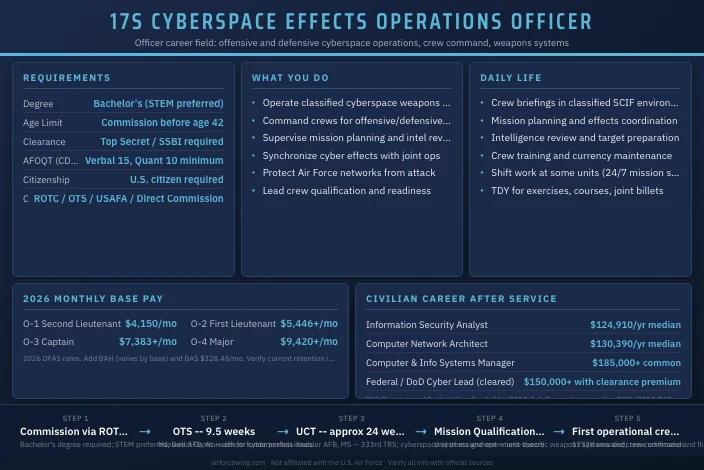
A 17S officer’s day starts with a classified intelligence brief and ends with mission execution against real adversary networks. These officers operate cyberspace weapons systems and command crews to accomplish offensive and defensive cyberspace missions. They supervise mission planning, review intelligence products, direct operations against adversary infrastructure, and maintain crew readiness to execute on short notice.
Command and Leadership Scope
At the lieutenant level, 17S officers typically serve as crew members under supervision, building the technical and operational depth required to lead. The span of control at this stage is narrow, a crew of a few specialists, but the operational stakes are high. These are classified environments where mistakes have real consequences.
By captain, officers take on crew command, flight leadership, and operations planning roles. A 17S captain might run a combat mission crew, lead a flight of multiple crews, or serve as a staff officer at a cyber operations center. Major-level officers move into operations officer billets, squadron-level staff, or joint cyber commands.
Roles and Designations
| Designation | Description |
|---|---|
| 17S1X | Entry-level officer, pre-qualification (Undergraduate Cyberspace Training not yet complete) |
| 17S2X | Qualified crew member, post-UCT |
| 17S3X | Primary AFSC awarded at first duty station after UCT completion |
| 17S4X | Senior designation, applied as Duty AFSC based on position |
The 17S career field sits within the broader Air Force cyber and electromagnetic activities enterprise. It is the offensive and effects-focused lane, as distinct from 17C, which manages base communications infrastructure.
Mission Contribution
The 17S mission directly supports joint warfighters. Cyberspace effects operations can degrade adversary command-and-control, protect Air Force networks from attack, and synchronize cyber operations with kinetic strikes and electronic warfare. In joint operations, 17S officers work alongside NSA, CYBERCOM, and allied cyber units.
Technology, Equipment, and Systems
17S officers work with classified cyberspace weapons systems, operational planning tools, intelligence feeds, and command-and-control platforms. The systems are classified; what is publicly confirmed is that officers must demonstrate knowledge of electronics theory, computer networking, telecommunications, cryptography, and vulnerability assessment.
Salary and Benefits
Officer Base Pay
2026 pay reflects the DFAS military pay tables.
| Rank | Grade | Typical Years of Service | Monthly Base Pay |
|---|---|---|---|
| Second Lieutenant | O-1 | Under 2 years | $4,150 |
| First Lieutenant | O-2 | 2-4 years | $5,446-$6,485 |
| Captain | O-3 | 4-10 years | $7,383-$8,376 |
| Major | O-4 | 10-16 years | $9,420-$10,402 |
Allowances and Benefits
17S does not carry aviation bonus pay. Compensation includes standard officer base pay plus:
- BAH: varies by duty location and dependency status
- BAS: $328.48 per month
- TRICARE Prime: zero-cost healthcare for active-duty members
- Blended Retirement System (BRS): 40% of high-36 pay at 20 years plus TSP matching up to 5%
No confirmed accession bonus is publicly attached to 17S on active duty as of early 2026. Reserve and Guard bonuses for 17S do exist, Air Force Reserve bonus guidance lists incentives by fiscal year for specific billets. Verify current active duty incentives with a recruiter.
Work-Life Balance
The work tempo depends heavily on the unit and operational tasking. Some 17S units operate around the clock in shift-based crew environments. Others run more standard work schedules between exercises and operations. Expect TDY travel, classified-environment requirements, and a work rhythm that can shift with little notice when operations are active.
The 30 days of annual paid leave apply the same way they do across the Air Force. What changes is whether you can actually use them, which depends on unit operations tempo.
Qualifications and Eligibility
Commissioning Paths
| Commissioning Source | Degree Requirement | Age Limit | Notes |
|---|---|---|---|
| OTS (Officer Training School) | Bachelor’s degree | Must commission before age 42 | Competitive package; AFOQT required |
| AFROTC | Bachelor’s degree | Must commission before age 42 | Career field assigned post-commission |
| USAFA | Degree upon graduation | Standard academy limits | Field assignment at graduation |
| Cyber Direct Commission | Bachelor’s degree or higher | Age 17-42 | For professionals with cyber work experience; constructive credit for senior entry grade |
The Cyber Direct Commissioning Program is a separate pathway specifically for civilian cyber professionals entering as 17S or 17D. Applicants need a bachelor’s degree in a qualifying field (computer science, cybersecurity, software engineering, data science, or related disciplines), meet minimum AFOQT verbal (15) and quantitative (10) scores, and have demonstrated professional experience in cyber-related work. Constructive service credit can allow direct commissions at O-2, O-3, or higher based on education and experience.
Test Requirements
All officer candidates apply to commission through the Air Force Officer Qualifying Test (AFOQT). For the Cyber Direct Commission path specifically, the minimum AFOQT scores are verbal 15 and quantitative 10. Traditional ROTC and OTS applicants should target scores well above the minimums, competitive packages typically reflect strong quantitative results given the technical demands of the field.
The AFOQT study guide is a useful foundation for officers building a package through traditional commissioning.
Career Field Assignment
The 17S career field is competitive. Officers commissioning through ROTC or OTS do not automatically enter 17S, career field classification and assignment happen through the rated and non-rated board process. USAFA graduates receive assignments at graduation. Demonstrated technical aptitude, degree relevance, and overall officer package strength affect selection.
Preferred degree fields are computer science, computer engineering, cybersecurity, information technology, and related STEM disciplines. Non-STEM degrees are not automatically disqualifying, but a strong technical background makes the difference in competitive selection.
Upon Commissioning
New officers enter at O-1 (2d Lt). They carry the 17S1X designation until completing Undergraduate Cyberspace Training (UCT), at which point they become 17S3X upon arrival at their first duty station.
The standard Active Duty Service Commitment (ADSC) for non-rated officer training is typically four years from commissioning. Career field-specific ADSCs may apply based on training costs and assignment. Verify current ADSC requirements with an Air Force recruiter or accession source.
Work Environment
Setting and Schedule
17S officers work in classified, controlled environments. Depending on the assignment, that may mean a Sensitive Compartmented Information Facility (SCIF) on a domestic installation, a joint cyber operations center, or a forward-deployed position. The physical setting is computers, monitors, and controlled access, not a flight line.
Shifts exist at units that operate continuously. During steady-state periods, work hours can resemble a normal military work day. That changes fast during exercises, real-world operations, or crisis response.
Leadership and Chain of Command
At the lieutenant level, 17S officers report to experienced captains and majors while completing crew qualification. Senior enlisted cyber specialists bring deep operational knowledge, and the officer-NCO dynamic here closely mirrors what you see in other Air Force operations career fields. The officer provides mission leadership and command authority; the senior NCO provides technical depth and continuity.
Staff vs. Command Roles
The field supports both command and staff tracks. Some officers build careers almost entirely in operational crew and command roles. Others spend significant time at joint commands, cyber headquarters, or Air Staff, shaping policy and programming for the broader cyber enterprise.
Job Satisfaction and Retention
Retention in cyber career fields is an ongoing Air Force challenge. The private sector pays very well for officers with active TS/SCI clearances and cyber operations experience. The Air Force has used bonus programs and special duty incentives to improve retention. Officers who stay often cite mission significance, early responsibility, and the irreproducibility of the work in civilian life as reasons to continue serving.
Training and Skill Development
Pre-Commissioning Training
Training before commissioning follows the standard path for the commissioning source: ROTC curriculum, OTS (9.5 weeks at Maxwell AFB, AL), or USAFA’s four-year program. The Cyber Direct Commission path has its own entry-training pipeline.
Initial Skills Training
| Phase | Location | Length | Focus |
|---|---|---|---|
| Commissioning (OTS) | Maxwell AFB, AL | 9.5 weeks | Officership, leadership fundamentals |
| Undergraduate Cyberspace Training (UCT) | Keesler AFB, MS | Approximately 24 weeks | Cyberspace operations theory, systems, technical skills |
| Mission Qualification Training (MQT) | Unit of assignment | Varies by unit and system | Unit-specific weapons systems, procedures, and crew readiness |
The UCT course is the career field’s initial skills training, taught by the 333rd Training Squadron at Keesler AFB. Graduates receive the 17S2 qualification. After UCT, officers proceed to their first duty station and complete MQT on unit-specific systems before being certified as mission-ready.
Because exact course durations and pipeline details change with curriculum updates, candidates should confirm current UCT length with a recruiter.
Professional Military Education
PME follows the standard Air Force officer track:
- Squadron Officer School (SOS): Typically attended by captains, in-residence at Maxwell AFB or by correspondence
- Air Command and Staff College (ACSC): Available to majors; develops joint operational and strategic perspective
- Air War College (AWC): Senior officers selected for the most senior PME
Additional Schools and Training
AFIT (Air Force Institute of Technology) funded graduate programs are a realistic option for 17S officers. Computer science, cybersecurity, and electrical engineering master’s degrees at AFIT support both career advancement and technical depth. Joint duty assignments at NSA, CYBERCOM, or DIA are available for mid-career officers and are valued for promotion boards.
Before OTS, you need qualifying scores. See our AFOQT study guide.
Career Progression and Advancement
Career Timeline
| Rank | Grade | Typical Timeline | Key Developmental Focus |
|---|---|---|---|
| Second Lieutenant | O-1 | 0-2 years | Crew qualification, UCT, arrive at first unit |
| First Lieutenant | O-2 | 2-4 years | Crew mission qualification, flight-level duties |
| Captain | O-3 | 4-10 years | Crew command, flight commander, operations planning |
| Major | O-4 | 10-16 years | Operations officer, staff billets, joint assignments |
| Lieutenant Colonel | O-5 | 16-22 years | Squadron command, senior staff |
| Colonel | O-6 | 22+ years | Group command, senior joint or Air Staff roles |
Promotion System
Promotions from O-1 to O-3 are largely automatic with satisfactory performance and time in service. O-4 (Major) and above require selection by a promotion board. Board selection depends on Officer Performance Reports (OPRs), key developmental positions completed, advanced education, joint service, and stratification by senior raters. The career field’s strong demand and smaller size can affect board rates, but published historical rates fluctuate.
Cross-Training and Broadening
Officers can pursue broadening assignments through ROTC instructor tours, Air Staff or MAJCOM staff positions, fellowship programs, and joint billets at combatant commands or national agencies. The technical background of 17S officers also makes them competitive for AFIT-funded academic programs.
Physical Demands and Medical Evaluations
Fitness Standards
17S officers take the standard Air Force Fitness Assessment, the same as all Airmen.
| Component | Max Points |
|---|---|
| 1.5-mile run | 60 |
| Push-ups (1 minute) | 10 |
| Sit-ups (1 minute) | 10 |
| Waist circumference or body composition | 20 |
The minimum composite passing score is 75 out of 100. Each component also has a minimum that must be met separately. Standards are age- and gender-normed.
Flight Physicals and Career Field-Specific Medical
17S is not a rated career field. No flight physical is required. There are no documented special physical requirements beyond standard commissioning medical standards and the fitness assessment.
The security clearance process includes a thorough background investigation. Any history that creates suitability concerns, foreign contacts, financial issues, legal history, can affect clearance eligibility and therefore the ability to serve in this career field.
Deployment and Duty Stations
Deployment Details
Deployment tempo for 17S is moderate to high depending on the unit and current operational demand. Cyber operations units can support contingency operations without leaving CONUS, but expeditionary deployments also exist in support of joint and combined commands. Officers should expect both extended TDY for training and exercises and operational deployments.
Duty Station Options
17S officers serve at installations with Air Force cyber operations units. Confirmed active locations include:
- Lackland AFB / JBSA, TX: home of major Air Force cyber and intelligence operations units
- Fort Meade, MD: proximity to NSA and CYBERCOM for joint assignments
- Peterson SFB, CO: space and cyber operations presence
- Offutt AFB, NE: STRATCOM support roles
- Various CONUS and OCONUS installations: based on unit requirements and mission
Assignment management for officers works through AFPC’s assignment process. Officers submit preference worksheets, and AFPC balances needs of the Air Force with individual preferences. Join-spouse programs exist to help dual-military couples manage assignments.
Risk, Safety, and Legal Considerations
Job Hazards
The hazards in this career field are operational and legal rather than physical. Officers operate within classified environments where compartmentalization is strictly enforced and mistakes can have strategic consequences. The main risks are:
- Operational security failures
- Errors in target selection or effects assessment during active operations
- Handling classified material incorrectly
- Legal exposure from operations outside approved authorities
Safety Protocols
17S officers apply Operational Risk Management (ORM) frameworks and operate strictly within approved rules of engagement. Cyberspace operations are subject to legal review and command authority at multiple levels. Officers do not act unilaterally, every mission is planned, reviewed, and authorized through a command chain.
Legal and Command Responsibility
Officers in this field carry standard UCMJ authority and accountability. Command responsibility is significant: a crew commander is accountable for the actions of their crew during an operation. Equal opportunity compliance, command climate obligations, and the consequences of relief for cause all apply the same way they do in any other Air Force career field.
Impact on Family and Personal Life
The lifestyle is more stable than flying careers in terms of physical risk, but less predictable than a standard garrison posting. The classified nature of the work limits how much officers can share with family about what they do day to day. Some spouses find that adjustment harder than others.
Families benefit from the standard Air Force support infrastructure: Airman and Family Readiness Centers (A&FRC), Key Spouse Programs, military legal assistance, and spouse employment programs on most installations. The field’s concentration at a limited number of major installations means fewer PCS moves than some other career fields.
Dual-military couples in the cyber community can use join-spouse programs, though the specialized nature of 17S assignments and the limited number of units means join-spouse requests are not always approvable. AFPC manages these requests on a case-by-case basis.
Reserve and Air National Guard
Component Availability
The 17S career field exists across Active Duty, Air Force Reserve, and Air National Guard. Guard and Reserve units have 17S billets, and some Guard units are particularly well-resourced for cyber given their mission to support both federal and state cyber defense requirements.
Commissioning Paths
Reserve and Guard officers can commission through ROTC with a Reserve-component contract, OTS through the Air National Guard, or direct commission for qualified cyber professionals. The Reserve Component also launched a direct commission program for cyber officers with experience and qualifying degrees, which mirrors the active-duty Cyber Direct Commission program.
Active-duty officers who complete their ADSC can transfer to Reserve or Guard in the same career field. Exactly which billets are available depends on current unit vacancies.
Drill and Training Commitment
The standard commitment is one weekend per month (Unit Training Assembly) plus two weeks per year (Annual Tour). 17S officers should expect additional requirements on top of that: classified read-on training, currency maintenance, exercise participation, and unit-specific certifications that don’t always fit within the standard schedule.
Part-Time Pay
A Reserve or Guard O-3 (Captain) earns approximately $7,383 per month on active duty. Drill weekend pay for an O-3 is calculated as 4 days of active-duty base pay, which works out to roughly $985 for a standard two-day UTA weekend. Annual Tour adds 14 days of active-duty pay.
Component Comparison
| Category | Active Duty | Air Force Reserve | Air National Guard |
|---|---|---|---|
| Commitment model | Full-time | 1 wknd/mo + 2 wks/yr | 1 wknd/mo + 2 wks/yr |
| Monthly base pay (O-3) | $7,383+ | Drill pay only (approx $985/UTA) | Drill pay only (approx $985/UTA) |
| Healthcare | TRICARE Prime (free) | TRICARE Reserve Select (premiums apply) | TRICARE Reserve Select (premiums apply) |
| Education benefits | Full TA + GI Bill | Federal TA + GI Bill | State tuition waivers may apply (varies by state) |
| Deployment tempo | Moderate-high | Mobilization dependent | Mobilization dependent |
| Command opportunities | Yes | Yes, in assigned unit | Yes, in assigned unit |
| Retirement | 20-year active pension | Points-based Reserve retirement | Points-based Reserve retirement |
Civilian Career Integration
The Guard/Reserve cyber career pairs exceptionally well with civilian careers in cybersecurity, federal IT, and defense contracting. Many 17S Guard and Reserve officers work full-time in cleared civilian positions, federal agency IT, defense contractor cyber teams, or financial sector security operations, and bring real-world technical depth back to their military units. USERRA protects civilian employment during mobilizations, and most employers in the national security community actively support employees with military service.
Post-Service Opportunities
Civilian Career Paths
Officers leaving 17S with an active TS/SCI clearance and documented cyber operations experience are in high demand. The private sector pays a significant premium for cleared professionals, and former 17S officers arrive with operational credibility that civilian training cannot replicate.
| Civilian Role | Median Annual Pay | Outlook |
|---|---|---|
| Information Security Analyst | $124,910 | +29% growth 2024-2034 |
| Computer Network Architect | $130,390 | +12% growth 2024-2034 |
| Computer and Information Systems Manager | $185,000+ | Strong |
| Federal/Government IT Security Lead | Often $150,000+ with clearance premium | Very strong in defense sector |
Transition programs available include the Transition Assistance Program (TAP), Hiring Our Heroes, and American Corporate Partners (ACP). Defense contractors, federal agencies (NSA, DHS CISA, CYBERCOM), and financial sector security teams all actively recruit from this community.
Graduate Education and Credentials
The GI Bill benefit transfers to post-service education, covering full in-state tuition at public schools or up to $29,920 per year at private institutions. Officers who spent active time in funded AFIT programs may already hold a master’s degree before leaving service.
Civilian certifications that overlap with 17S experience include CISSP (Certified Information Systems Security Professional), CEH (Certified Ethical Hacker), and CompTIA Security+. Active-duty time alone does not confer these certifications, but the knowledge base and operational background accelerate preparation significantly.
Is This a Good Job for You? The Right and Wrong Fit
Ideal Candidate
This field fits people who are technically strong, comfortable with strict operational discipline, and willing to work in classified environments for an entire career. The best 17S candidates combine genuine curiosity about adversary systems with the patience to operate within legal and command constraints.
College students who have studied computer science, cybersecurity, or engineering and want an operational leadership career rather than a purely technical individual-contributor path tend to do well here. The field rewards intellectual drive, adaptability, and the ability to brief non-technical commanders on complex operations.
Potential Challenges
The classified nature of the work is genuinely limiting in some ways. You cannot discuss your work with most people. Career networking outside the cleared community is harder. And the operational tempo at some units means that the 30 days of leave on the books and the leave you can actually take are different numbers.
Officers who want frequent physical adventure, outdoor work environments, or visible public recognition of their mission may find this career frustrating. The mission is real, but it is almost entirely invisible.
Career and Lifestyle Alignment
For a full military career to O-5 or O-6, 17S is a strong path. The field has command opportunities, broadening options, and visible relevance in national security strategy. For a one-and-done officer who plans to exit after the initial commitment, the TS/SCI clearance and operational experience translate into some of the best post-military job prospects available anywhere in the officer corps.
The one weak fit: someone who wants to stay close to family long-term and avoid classified-environment concentration. The 17S basing footprint is smaller than some career fields, which means fewer assignment options and less control over where you live.
More Information
The best starting point is the official Air Force Cyberspace Effects Operations Officer career page and the Cyber Direct Commissioning program page for officers considering the direct commission path. For officer promotions and assignment management, AFPC’s career management resources are the authoritative source.
Start your OTS package preparation with the AFOQT study guide.
This site is not affiliated with the U.S. Air Force or any government agency. Verify all information with official Air Force sources before making enlistment or career decisions.
Explore more Air Force communications officer careers and compare the base-communications leadership lane at 17C Communications Officer.