17C Communications Officer
When a base loses comms, everything else slows down with it. Aircraft still need data, commanders still need networks, and deployed teams still need secure links back to higher headquarters. The officer who owns that problem is the communications officer. In this site’s officer structure, that role is tracked under 17C. Public recruiting materials often place the same mission inside the broader cyber and warfighter communications officer family. Either way, the job is the same at its core: lead technical people, keep critical systems online, and make sure Air Force operations can still talk, move, and decide.
Officer applicants should start with the AFOQT study guide before they build a package.
Job Role
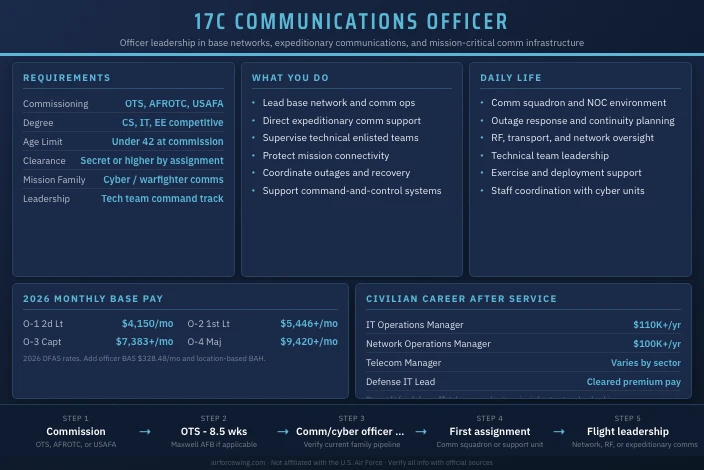
17C Communications Officers lead Air Force communications and network operations for installations and deployed units. They direct the teams that operate base networks, communications infrastructure, radio and satellite links, and expeditionary communications systems that keep commanders and operators connected.
Leadership Scope
At the lieutenant level, the job is usually flight leadership inside a communications squadron or cyber support organization. You supervise enlisted technicians, civilian specialists, or mixed teams responsible for help-desk support, transport systems, RF links, or command-and-control infrastructure.
By captain and major, the role becomes more operational and broader in scope. Officers move from owning a section to owning service reliability for a large part of the base or deployed network picture. That means more responsibility for readiness, security, continuity, and resource prioritization.
Code And Family Context
The current public recruiting site shows the communications mission in the broader cyber family and, in some places, under Warfighter Communications Operations Officer. The hub in this repo uses 17C Communications Officer to label the base communications-leadership lane rather than the offensive cyber lane. That narrower naming is useful for readers comparing communications against 17D/17S cyber jobs.
| Label | Meaning |
|---|---|
| 17C | Communications Officer label used in this site’s officer structure |
| 17D / 17DX family | Broader public cyber and communications officer family on recruiting pages |
| Warfighter Communications Operations Officer | Public-facing mission label for expeditionary comm leadership |
Mission Contribution
This field keeps the Air Force connected. That includes daily base IT, operational comm links, expeditionary communications packages, and the network reliability that supports command decisions. The mission is less visible than flying, but when communications fails the operational impact is immediate.
Systems And Tools
Communications officers work around enterprise networks, satellite and RF systems, secure voice and data systems, transport infrastructure, base cyber-defense tools, and expeditionary communications equipment. The officer role is leadership first, but technical credibility still matters.
Salary
Officer Base Pay
2026 pay follows the DFAS military pay tables.
| Rank | Grade | Typical YOS | Monthly Base Pay |
|---|---|---|---|
| Second Lieutenant | O-1 | Under 2 | $4,150 |
| First Lieutenant | O-2 | 2-4 years | $5,446-$6,485 |
| Captain | O-3 | 4-10 years | $7,383-$8,376 |
| Major | O-4 | 10-16 years | $9,420-$10,402 |
Allowances And Benefits
17C does not carry standard aviation bonus pay. Compensation is standard officer pay plus:
- BAH: location based
- BAS: $328.48 monthly
- TRICARE Prime
- BRS retirement and TSP matching
Civilian Value
The after-service upside is strong. Network leadership, IT operations management, and communications-infrastructure experience transfer well into government IT, defense contracting, telecom, and enterprise operations roles.
Qualifications
Commissioning Paths
| Commissioning Source | Degree Requirement | Age Limit | Notes |
|---|---|---|---|
| OTS | Bachelor’s degree | Must commission before 42 | Competitive officer selection |
| AFROTC | Bachelor’s degree | Must commission before 42 | Career-field assignment after commissioning |
| USAFA | Degree on graduation | Standard academy limits | Assignment at graduation |
Technical degrees such as computer science, information technology, electrical engineering, and related fields are especially competitive for this community.
Screening And Competitive Factors
Public recruiting materials do not present 17C as a fully separate civilian-facing landing page the way they do for some other officer fields. The practical screening picture still matches the hub’s summary: officer commissioning, technical aptitude, and security-clearance eligibility. Expect at least Secret-level access and, for some assignments, higher classified access.
Use the AFOQT study guide if you are applying through OTS and want a stronger officer-test baseline.
Upon Commissioning
New officers enter as O-1 2d Lt and move into communications or cyber-support organizations after commissioning. The early career focus is learning the operational environment well enough to lead technically skilled enlisted teams without slowing them down.
Work Environment
Setting And Schedule
This field lives in communications squadrons, network operations centers, base comm facilities, and deployed communications units. The schedule can look like normal staff hours during steady-state periods, but outages, exercises, and deployments quickly change that.
Officer-NCO Dynamic
This career field depends heavily on senior enlisted expertise. Communications NCOs know the network, the gear, and the trouble spots. Officers prioritize mission, resources, and risk. The best lieutenants here learn quickly and listen early.
Command And Staff Balance
The field offers a credible command track at squadron level, but staff assignments also matter. Later jobs can include headquarters communications planning, joint communications billets, and expeditionary communications leadership.
Training
Training Pipeline
| Phase | Location | Length | Focus |
|---|---|---|---|
| Commissioning source or OTS | Maxwell AFB, AL or source dependent | OTS 8.5 weeks | Officership fundamentals |
| Communications or cyber officer qualification | Current course location varies | Verify current pipeline | Network, comm, and systems leadership fundamentals |
| First assignment OJT | Unit of assignment | 12-24 months | Local systems, readiness, team leadership |
Because the public recruiting site presents this mission inside the broader cyber and warfighter communications family, exact pipeline labels can move. Candidates should verify the current officer qualification course with a recruiter or accession source.
Before any of that, you still need a competitive officer package. The AFOQT study guide is the starting point for that prep.
Additional Development
This field rewards certifications, advanced IT education, and operational credibility. Later-career officers often accumulate experience in network operations, expeditionary communications, cyber-defense coordination, or large enterprise service management.
Career Progression
Timeline
| Rank | Grade | Typical Timeline | Development Focus |
|---|---|---|---|
| Second Lieutenant | O-1 | Entry to 2 years | Learn local systems and supervise small teams |
| First Lieutenant | O-2 | 2-4 years | Flight-level technical leadership |
| Captain | O-3 | 4-10 years | Flight commander or section lead |
| Major | O-4 | 10-16 years | Squadron operations, staff, or program leadership |
| Lieutenant Colonel | O-5 | 16-22 years | Squadron command or senior staff roles |
Promotion Drivers
Network reliability, leadership under outage or exercise pressure, and strong OPRs matter more here than flashy narratives. Commanders remember the officer who kept the network stable during stress.
Broadening
The field can open doors to cyber support, joint communications planning, enterprise IT, and major-program communications management later in the career.
Physical Demands
Fitness Standards
17C officers take the standard Air Force Fitness Assessment.
| Component | Max Points |
|---|---|
| 1.5-mile run | 60 |
| Push-ups | 10 |
| Sit-ups | 10 |
| Waist or body composition | 20 |
No special field-specific physical screen is publicized for the communications lane beyond normal officer commissioning standards.
Deployment
Deployment Tempo
Communications officers deploy when units need expeditionary communications, network continuity, or command-and-control infrastructure in theater. Tempo is moderate but can become intense during exercises or contingency operations.
Duty Stations
Any large installation with a communications squadron can host this field. Deployed and expeditionary opportunities add variety that civilian IT jobs usually do not.
Risk/Safety
Main Risks
The hazards are operational and leadership based rather than physical:
- Network outages affecting mission execution
- Security failures in communications infrastructure
- Poor contingency planning
- Weak prioritization during degraded operations
Risk Control
The field relies on disciplined procedures, change control, cyber hygiene, and technical-team leadership. The officer’s job is making sure the team stays ready before the system breaks.
Impact on Family
This field usually offers steadier home-station life than flying communities, but outage response and deployments can still disrupt schedules quickly. Families benefit from the strong civilian transfer value of the work, especially if long-term plans include IT or telecom jobs after service.
Reserve and Air National Guard
Component Availability
Communications and cyber-support missions exist across Active Duty, Reserve, and Guard components. Exact billet titles vary more here than in some other officer fields because units may group communications under broader cyber families.
Civilian Integration
This is one of the better officer fields for civilian overlap. Network operations, telecom support, systems management, and IT leadership all line up well with the military mission.
Post-Service
Civilian Career Paths
| Civilian Role | Median Pay | Outlook |
|---|---|---|
| IT Operations Manager | Often $110K+ | Strong |
| Network Operations Manager | $100K+ in many markets | Strong |
| Telecommunications Manager | Varies by industry | Stable |
| Government / defense IT lead | Often cleared premium pay | Strong in defense sector |
Is This a Good Job
17C is a good fit if you want to lead technical teams without living inside offensive cyber all day. It is a bad fit if you dislike infrastructure, troubleshooting culture, or being responsible for systems other people only notice when they fail. The reward is impact. When comms work, the mission works.
More Information
- Review the Air Force Cyber and Intelligence careers page for the current communications and cyber family context
- Compare the related officer cyber lane at Cyber Direct Commissioning
- Build your OTS package foundation with the AFOQT study guide
This site is not affiliated with the U.S. Air Force or any government agency. Verify all information with official Air Force sources before making enlistment or career decisions.
Explore more Air Force communications officer careers including the offensive cyber lane at 17S Cyberspace Effects Operations Officer.