Air Force Readiness and Emergency Management Engineer: The 32E B Shredout
An Air Force readiness and emergency management engineer prepares a base for disasters, major accidents, and chemical, biological, radiological, and nuclear (CBRN) events. Suffix B identifies this work within the 32E civil engineer field.
The officer advises the commander and coordinates with other response teams. The Air Force calls the role Readiness and Emergency Management Engineer, and the code is 32E with suffix B.
The work is not building and not bomb disposal. It is the plan, the drill, and the call that follows.
This page covers what the job does, how the Air Force hands it out, and why the path looks nothing like the other civil engineer jobs.
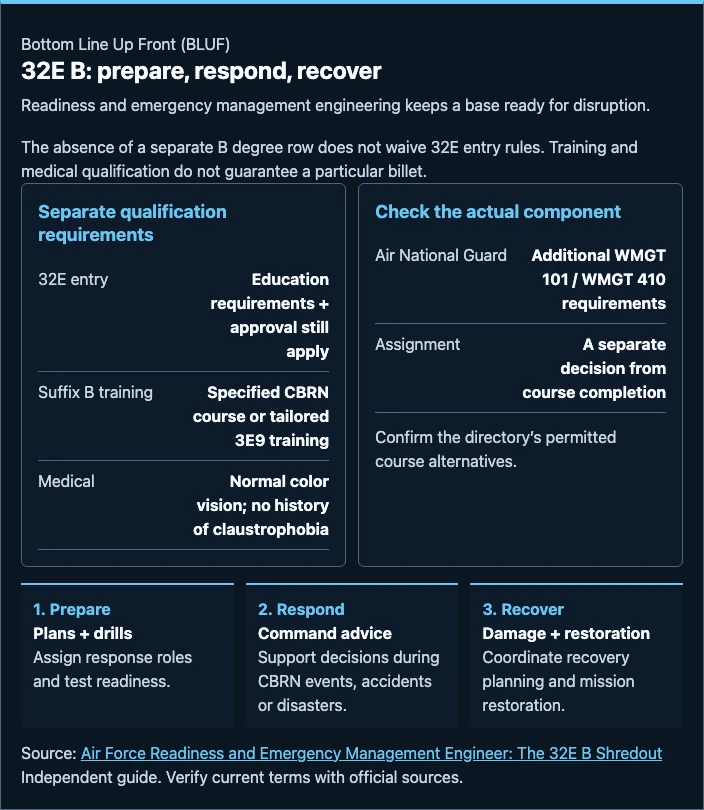
The absence of a separate B degree row does not waive 32E entry rules. Training and medical qualification do not guarantee a particular billet.
Separate qualification requirements
- 32E entry
- Education requirements + approval still apply
- Suffix B training
- Specified CBRN course or tailored 3E9 training
- Medical
- Normal color vision; no history of claustrophobia
Check the actual component
- Air National Guard
- Additional WMGT 101 / WMGT 410 requirements
- Assignment
- A separate decision from course completion
Confirm the directory’s permitted course alternatives.
- PreparePlans + drillsAssign response roles and test readiness.
- RespondCommand adviceSupport decisions during CBRN events, accidents or disasters.
- RecoverDamage + restorationCoordinate recovery planning and mission restoration.
Source: Air Force Readiness and Emergency Management Engineer: The 32E B Shredout
Independent guide. Verify current terms with official sources.
On this page
Wing Duty is supported by purchases through our links, which may earn us a commission.
Job Role and Responsibilities
A 32E B officer plans, trains, and leads a base response to chemical, biological, radiological, and nuclear events, major accidents, and natural disasters. The officer writes the response plan, runs the drills that test it, advises the commander during an event, and directs the clean-up and repair that follows.
Command and Leadership Scope
The flight is small, perhaps a dozen enlisted planners and trainers, and the officer leads them. Their work reaches every unit on base, so leading that flight is how the officer leads the base.
Despite the flight’s small size, a young lieutenant writes a plan that every unit on base follows when something breaks. That plan assigns jobs to fire, security forces, medical and civil engineers, and sets the order for warning, shelter and recovery. Senior leaders depend on the junior officer’s work.
The officer helps the commander weigh decisions such as:
- Should people shelter or evacuate?
- Which building needs attention first?
- When can the runway reopen?
The officer frames those choices and gives the commander a recommendation with the facts behind it.
Specific Roles and Designations
One code holds skill level and job. The letter marks the work.
| Code | Meaning |
|---|---|
| 32E1 | Entry level and student |
| 32E3 | Qualified civil engineer officer |
| 32E4 | Staff |
| 32E3B | Readiness and Emergency Management Engineer |
| 32E3A | Architect and Architectural Engineer |
| 32E3H | Explosive Ordnance Disposal Engineer |
| 32E3J | Environmental Engineer |
The letters are not ranks. They mark a split in the work, and one base may hold several of them at once, with each suffix carrying its own share of the base mission. The B suffix carries the plan.
Mission Contribution
Civil engineers make a base work, and this shredout keeps it working when the day goes wrong. The officer keeps a trained team ready, finds and fixes weak spots before an event tests them, and writes the steps for limiting damage and restoring the base after an attack.
The reach goes past accidents. The job also covers forces readied for attack by conventional, nuclear, biological, or chemical means, and it includes briefings to the commander on how a base might survive a strike and how it recovers, which is war planning as much as it is safety work.
One duty stands out. The officer can run the weapons recovery cell inside a first response team after a nuclear accident. That is a narrow job with heavy stakes.
The directory separately specifies the medical screen; do not infer its rationale or a nuclear assignment from the suffix alone.
Technology, Equipment, and Systems
The tools are plans, alarms, and drills. Officers work the base warning system and the shelter and exit plans, and they set the drill schedule. They work with detection gear through the enlisted team.
They use damage checks, bed-down plans for inbound forces, and fast repair steps after an attack.
Salary and Benefits
Officer Base Pay
| Rank | Pay Grade | Years of Service | Monthly Base Pay | Annual Base Pay |
|---|---|---|---|---|
| Second Lieutenant (2d Lt) | O-1 | 2 or less | $4,150 | $49,802 |
| First Lieutenant (1st Lt) | O-2 | Over 2 | $5,446 | $65,354 |
| Captain (Capt) | O-3 | Over 4 | $7,383 | $88,592 |
| Major (Maj) | O-4 | Over 10 | $9,420 | $113,040 |
Source: DFAS 2026 pay tables. Figures reflect the 2026 pay raise.
Special Pays
Base pay is the same as any other line officer at the same grade and years. Civil engineers do not get flight pay or a career field bonus. Hazard pay is not routine here, though it can apply in some posts and the rules shift.
Check the current rule instead of planning on it.
Additional Benefits
Officers get the standard set. Housing pay follows the area, and there is a food allowance. Health cover runs through TRICARE.
For new accessions under the Blended Retirement System, automatic TSP contributions start after 60 days and matching starts after two years, subject to the plan rules.
Graduate education support depends on program eligibility and approval; it is not an automatic funding promise.
Work-Life Balance
Most weeks are steady, and this is not a shift job. The plan, the training dates, and the drill schedule fill the days. That pace breaks when an event hits or a base inspection lands.
Drills can run late, and a real event runs as long as it runs.
Qualifications and Eligibility
Commissioning Sources
You cannot ask for this shredout at a recruiting office. You earn a commission as a civil engineer first. Then the Air Force gives out a shredout based on your degree and what the field needs.
The April 2026 officer classification directory separates entry into 32E from award of suffix B. The absence of a separate B degree row does not waive the career field’s education requirements or approval process.
| Commissioning Source | Degree | Age Limit | Notes |
|---|---|---|---|
| OTS | Bachelor’s | Must commission before 42 | Board pick, then job match |
| AFROTC | Bachelor’s | Must commission before 42 | Job match in the cadet years |
| USAFA | Degree at graduation | Academy rules | Job match at graduation |
| Direct commission | Not used here | Not applicable | Civil engineer accessions take the standard route |
Test Requirements
The AFOQT is the entry test for OTS and ROTC, and scores count. Technical fields weigh the math part hard. There is no flight test here and no trade exam.
If you are assembling an application, an AFOQT course and the AFOQT study guide walk through the test. Both are affiliate links, and this site earns a fee if you buy.
The free AFOQT guide on this site covers the same ground at no cost.

Assignment Process
Here the B shredout splits from its siblings. The field hands out most shredouts by degree. An architect becomes the architect shredout, an environmental engineer becomes the environmental shredout, and a general engineer covers degrees that fit no named slot.
The B shredout does not work that way. The job directory lists no entry degree for it, and it also leaves B out of the upgrade rule that moves officers in the A, C, E, F, G, I, and J shredouts up after two years in the shredout that fits their degree.
The directory adds specific requirements for the 32E3B award:
- CBRN training: Complete the Marine Corps CBRN Basic Warrant Officer Course or a tailored version of 3E9 initial skills training.
- Air National Guard: The directory additionally specifies WMGT 101 and WMGT 410 flight leadership, with its stated course alternatives.
- Medical: Meet the normal color-vision and claustrophobia requirements described below.
Training, medical qualification and assignment are separate decisions; completing a course does not guarantee a particular billet.
What that means for you is simple. A civil engineer with a construction management degree can land this job, and so can an environmental engineer. The thing that splits them is whether the Air Force sends them to the CBRN course and puts them in a readiness flight.
Upon Commissioning
New civil engineer officers start as O-1 second lieutenants. The active duty commitment for a standard commission is four years. The first post is a civil engineer squadron, where a new lieutenant learns one section at a time.
Work Environment
Daily Setting
The work sits in an office, an emergency operations center, and a drill site. Planning happens at a desk with a laptop and a base map, and drills run across the base, sometimes at night. A real event puts the officer in the operations center with the commander and the squadron leads.
The week is mostly day shift, though inspections, drills, and real events set their own hours. The squadron also runs an on-call list, and the readiness flight often holds part of it.
Officer-NCO Dynamic
Emergency management is an enlisted field, and the NCOs know the gear and the plans in detail. A new lieutenant with a fresh degree and no base knowledge will get corrected fast, and should be.
The officer owns the plan and the advice to the commander. The senior NCO owns the training record and the hands-on work.
The pair works when the officer asks real questions. A flight that trusts its officer runs better drills and finds more gaps.
Staff vs. Command Roles
The first tour is at flight level. A captain may then move to squadron operations or to a base readiness office. Majors move to wing, command, or headquarters staff on readiness policy, drill programs, or inspection rules.
Command comes later, and it is usually a civil engineer squadron rather than a readiness-only unit.
Job Satisfaction and Retention
This job suits officers who like plans and stakes. It grates on officers who want to build. A readiness officer spends more time on papers, dates, and briefings than a construction officer does.
The payoff is that the plan gets tested, and the test shows whether the work was real.
The Air Force does not print retention rates by shredout. Treat any exact number you hear about this field as unproven.
Training and Skill Development
Pre-Commissioning Training
Officers come in through OTS, ROTC, or the Academy. None of those teach emergency management. They teach officership and leadership, and the trade work starts after that.
Initial Skills and Pipeline
| Phase | Location | Length | Focus |
|---|---|---|---|
| Commissioning source | Maxwell AFB or source dependent | OTS about 8.5 weeks | Officership and leadership |
| Civil engineer basic course | AFIT, course WMGT 101 | About 6 weeks | Base engineering, readiness, flight work |
| CBRN course | Course dependent | Course dependent | CBRN response and emergency management |
| Flight leadership course | Required for Guard officers | Course dependent | Leading a readiness flight |
| First post | Your unit | 12 to 24 months | Base plans, drills, and response duty |
The directory lists WMGT 101 for A, C, E, F, G, I, and J qualification. Its separate B rule specifies CBRN training and additional ANG course requirements; confirm the courses allocated to the actual component and assignment.
Professional Military Education
Officers go to Squadron Officer School as captains, Air Command and Staff College as majors, and Air War College near the top.
The schools teach leadership and strategy, not engineering. They also build the contacts an officer needs for staff work.
Additional Schools and Training
The field backs grad school through the Air Force Institute of Technology and through civilian schools. Emergency management, homeland security, and public administration degrees fit the work, and federal emergency courses and base drill certificates are common extras. None of that takes the place of the CBRN course, which is the one that earns the mark.
Career Progression and Advancement
Timeline
| Rank | Career context, not promotion dates | Focus |
|---|---|---|
| O-1 | Assignment-dependent | Learn the flight, learn the plan, run small drills |
| O-2 | Assignment-dependent | Own a program, lead drills |
| O-3 | Assignment-dependent | Flight lead, base readiness lead |
| O-4 | Assignment-dependent | Squadron operations, wing readiness staff |
| O-5 | Assignment-dependent | Squadron command or senior staff |
Promotion System
Promotion eligibility and performance requirements apply at every grade; time alone does not guarantee advancement. Major and above go to a board. The board reads the file: reports, awards, school, and the breadth of posts.
In this field, a strong file shows the officer ran something real. An officer who rebuilt a base response plan, ran a large drill, and fixed what it found has a story a board can read.
An officer who only sat in meetings does not.
Broadening
The field opens staff work at wing, command, and joint level. Teaching at the civil engineer school is a common move for captains and majors. This work also opens posts with civil agencies, where an officer works beside civilian responders.
Early experience may focus on planning and taking part in readiness exercises. A senior officer must also judge whether units can carry out those plans, identify gaps and organize training or corrective work. Coordination and assessment therefore become central to the career.
Applicants should ask how often a position involves direct field activity versus reviewing plans, building exercises and leading teams.
Physical Demands and Medical Evaluations
Fitness Standards
Civil engineer officers take the standard fitness test. There is no field-specific physical test.
| General test, under age 25 | Male | Female |
|---|---|---|
| Minimum satisfactory total | 75 points | 75 points |
| Event minimums | Meet each chosen event’s chart minimum | Meet each chosen event’s chart minimum |
| Failure despite 75 total | A missed event minimum can make the result unsatisfactory | A missed event minimum can make the result unsatisfactory |
The Air Force fitness page and DAFMAN 36-2905 own the current charts.
Career Field-Specific Medical
The B shredout has a specific medical rule: the directory requires normal color vision and no history of claustrophobia for the 32E3B award. The reason is plain. Detection gear uses color-coded tags, and response work can put a person in a suit and a tight space.
That screen is narrow. It does not make this a special operations job. It does mean a person with a color vision fault should ask about B before assuming the door is open.
Deployment and Duty Stations
Deployment Tempo
Readiness officers deploy as civil engineers, often inside a Prime BEEF team or a headquarters readiness cell. Tour length and tempo depend on the unit and tasking; no universal length for this shredout is established here.
There is a second kind of tasking. An emergency management officer can be sent to help with a response elsewhere, including aid work at home or abroad. Those calls are less easy to predict than a normal rotation.
Duty Stations
Almost every base has a civil engineer squadron, so postings are available almost everywhere. Large bases with heavy infrastructure and a full drill schedule offer more growth. The personnel center runs the match, and officers send in a wish list.
Family and medical needs can shape the result, but the needs of the Air Force come first.
Risk, Safety, and Legal Considerations
Job Hazards
The hazards are the hazards of the event. An officer may work near a damaged building, a dead utility line, a chemical release, or a dirty area. Drills carry their own risk, since they use trucks, suits, and fake casualties.
Safety Protocols
The work runs on checklists and risk calls. Every drill gets a risk review before it starts, and a response runs under one command structure with set roles. The officer has a duty to stop work that has become unsafe, and that duty is written down rather than optional.
Legal and Command Responsibility
A readiness officer writes plans that other people carry out, so a wrong plan lands the cost on the base and on the officer’s file. Officers also answer under the Uniform Code of Military Justice like any leader.
Relief from a post is rare, but a failed drill or a botched response can end a command path.
Impact on Family and Personal Life
The home base week is calmer than aviation or special warfare, though storms are not. A storm or an event can pull an officer out of a family evening with no warning. Families who plan around an on-call list do better than families who expect a fixed week.
Move timing and available billets depend on the assignment cycle and component, rather than a fixed two-to-three-year promise. Deployments are the bigger break in the year, and they are usually known far enough ahead to plan.
Emergency-management duties can be quiet during routine planning and demanding when an exercise or response requires quick action. A fixed duty location does not necessarily mean fixed hours. Families should ask about exercise frequency, short-notice work and the support available during extended operations rather than relying on a general description of engineering office life.
Reserve and Air National Guard
Component Availability
The civil engineer field lives in the active force, the Reserve, and the Guard. The B shredout shows up in the Guard and Reserve too. The directory names a Guard-only course for the mark, which tells you the shredout is expected there.
Commissioning and Transfer
Guard and Reserve civil engineer officers commission the same way, then compete for a slot in a unit. An active duty officer can move over after the commitment, provided the gaining unit must have a vacancy in the right slot.
Drill Commitment and Part-Time Pay
The standard deal is one weekend a month plus two weeks a year. Readiness work can add drill weekends and inspection prep. Drill pay for an O-3 is a share of the full month, based on the days worked.
Benefits Differences
Reserve and Guard members can buy TRICARE Reserve Select, which costs a monthly premium that active duty does not. School aid differs by state for Guard members, and retirement runs on points rather than a twenty-year pension.
| Item | Active Duty | Air Force Reserve | Air National Guard |
|---|---|---|---|
| Commitment | Full time | One weekend a month, two weeks a year | One weekend a month, two weeks a year |
| Pay basis | Monthly base pay | Drill days plus annual tour | Drill days plus annual tour |
| Health cover | TRICARE Prime, no premium | TRICARE Reserve Select, premium | TRICARE Reserve Select, premium |
| School aid | Tuition aid, GI Bill | Tuition aid, GI Bill | Federal aid, state waivers in some states |
| Retirement | Blended system, 20-year pension | Points based | Points based |
| Command | Squadron and above | Where slots exist | Where slots exist |
| Deployment | Rotations and contingencies | Mobilization | State and federal mobilization |
Civilian Integration
This field pairs well with a civilian job. Emergency management, continuity planning, and risk work exist in every large firm, and a Guard or Reserve officer here often works in safety, compliance, or emergency planning on the civilian side.
Post-Service Opportunities
Transition to Civilian Life
The skills carry over. An officer who has written base response plans, run drills, and led a response has a record that cities, hospitals, schools, and large firms hire for. The standard programs help, and those include the transition class, veteran hiring events, and the programs that map military training to civilian credentials.
Civilian Career Prospects
| Civilian role | May 2025 median annual pay | Growth, 2025–2035 |
|---|---|---|
| Emergency management director | $93,330 | 4 percent |
This occupation-wide median is not a promised salary or a guaranteed transition. The BLS describes a role that typically requires a bachelor’s degree and substantial related experience; employers assess the actual qualifications of each applicant.
Graduate Education and Credentials
The GI Bill covers officer and enlisted service alike. Civil engineer officers can chase a grad degree while serving through tuition aid and, for a chosen few, a fully paid program. Federal emergency courses and state papers are cheap adds that show commitment.
Is This a Good Job for You? The Right (and Wrong) Fit
Ideal Candidate Profile
This field suits a person who likes plans and pressure. You should enjoy thinking about what could go wrong and building the steps that handle it. You should be at ease briefing senior officers and telling a commander that a base is not ready.
An engineering or science degree helps, and so does a past in emergency services, safety, or planning. Suffix B adds training and medical requirements to entry into the civil engineer field; have an accessions recruiter assess the actual degree and route.
Potential Challenges
Most of the work is prep, and prep is invisible until it is tested. Officers who need a visible result each week find that hard. The paper load also surprises people who expected a build job.
The other snag is doubt. A drill that never meets a real event can look like wasted funds to a tight commander. Making the case for readiness is part of the job.
Career and Lifestyle Alignment
If you want a full career, this field leads to squadron command and senior readiness posts. If you want one tour, the mark and the record move well to civilian emergency work. If you want a Guard or Reserve career, the field fits: the work looks like the civilian job.
It is a poor fit if you want to draw buildings, run heavy construction work, or spend your days on a site. Those are the A, C, and G shredouts, not this one.
Where This Job Stops and Another Begins
Three jobs on a base touch a bad day, and they are not the same job. This part matters most before you pick a path.
| Question | 32E B Readiness and Emergency Management | 32E H EOD Engineer | 43E Bioenvironmental Engineer |
|---|---|---|---|
| What does it own? | The plan, the drill, and the response | The render-safe work on a device | The health risk from a hazard |
| Who leads the event? | The officer advises the commander and runs the cell | The officer leads a team on the device | The officer samples and advises on health |
| What training marks it? | A CBRN course and a medical screen | The EOD pipeline at Eglin | A health science route |
| What is the main output? | A plan and a recovery | A safe device or a cleared site | A risk finding and a limit |
The EOD officer does the hands-on work on a device, while this officer plans the response around it. The bioenvironmental engineer studies what a hazard does to people. This officer studies what the base needs to do next.
On a real event the three work side by side.
They are not interchangeable.
More Information
Talk to a local Air Force recruiter or an ROTC unit about civil engineer accessions before you assume this job is open to you. The B mark comes after you commission, and the medical screen is tight.
If OTS is your path, the AFOQT study guide covers the test, and an AFOQT course is the paid option this site puts first for score work.
Start with the 32E Civil Engineer profile for the shared career view. Then read the environmental engineer shredout and the architect shredout, which follow a degree instead of a course. The Civil Engineering community lists the whole field, including the EOD officer who does the bomb work this job helps to run.