Air Force Environmental Engineer: The 32E J Shredout
An Air Force environmental engineer manages a base’s environmental compliance and stewardship programs, including permits, waste handling, and spill planning. Suffix J identifies this work within the 32E civil engineer field.
The Air Force calls that officer an Environmental Engineer, and the code is 32E with suffix J. The job is one of the few civil engineer slots with a named degree in the rule book. It is also the slot most often confused with a medical job that has a similar name, so this page sorts the two out.
You will find the work, the degree rule, and the path in. You will also find the honest limits, and the compare that matters most.
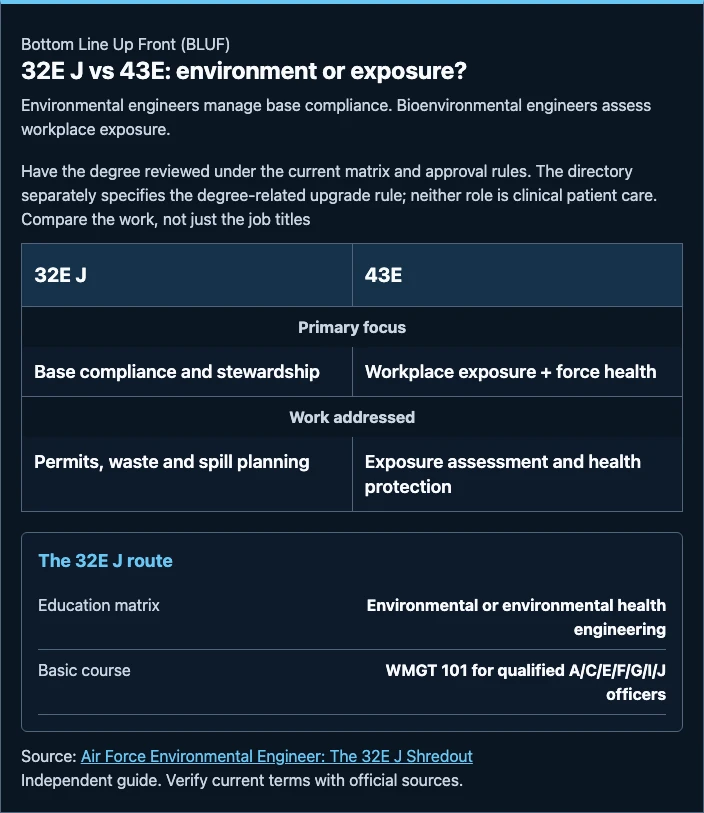
Have the degree reviewed under the current matrix and approval rules. The directory separately specifies the degree-related upgrade rule; neither role is clinical patient care.
| 32E J | 43E |
|---|---|
| Primary focus | |
| Base compliance and stewardship | Workplace exposure + force health |
| Work addressed | |
| Permits, waste and spill planning | Exposure assessment and health protection |
The 32E J route
- Education matrix
- Environmental or environmental health engineering
- Basic course
- WMGT 101 for qualified A/C/E/F/G/I/J officers
Source: Air Force Environmental Engineer: The 32E J Shredout
Independent guide. Verify current terms with official sources.
On this page
Wing Duty is supported by purchases through our links, which may earn us a commission.
Job Role and Responsibilities
A 32E J officer manages environmental compliance and stewardship for an Air Force base. The officer runs the permits, the waste programs, the spill plans, and the reviews that keep a base inside federal, state, and local law. The job is engineering judgment applied to rules.
It is not clinical patient care.
Command and Leadership Scope
A new officer lands in a civil engineer squadron. The first post is often a program area inside the environmental flight, and the officer may own air permits, water permits, waste, or the spill plan. Each of those is a base-wide program with a legal deadline.
By captain, the officer may lead the flight. That means setting the check calendar and responding to an inspection. It also means telling a commander that a project cannot go ahead until an issue is fixed.
The same officer sits in the reviews where a wing decides what to build.
The officer must resolve practical compliance questions:
- Does the new hangar require a permit?
- Is the soil suitable for construction?
- Can the squadron store the chemical under the applicable rules?
A wrong answer brings a fine, a stop-work order, or a clean-up bill.
Specific Roles and Designations
The code carries both the skill level and the job. The letter marks the field.
| Code | Meaning |
|---|---|
| 32E1 | Entry level and student |
| 32E3 | Qualified civil engineer officer |
| 32E4 | Staff |
| 32E3A | Architect and Architectural Engineer |
| 32E3B | Readiness and Emergency Management Engineer |
| 32E3C | Civil Engineer |
| 32E3G | General Engineer |
| 32E3H | Explosive Ordnance Disposal Engineer |
| 32E3J | Environmental Engineer |
The J mark is the law and stewardship slot. It is not a medical code, and it is not a general civil engineering code either. It names a body of work with its own degree rule.
Mission Contribution
Civil engineers make a base usable, and the environmental shredout keeps that base legal while protecting the ground and water. That includes air permits for boilers and paint booths, plus water permits for storm drains and wastewater. Waste handling, fuel system oversight and old spill clean-up are also part of the job.
The work also shapes what the Air Force can do. A base that loses a permit loses a mission. An officer who plans a permit early protects the mission, while an officer who misses one stops it.
That is why the job sits close to command decisions rather than off in a corner.
Technology, Equipment, and Systems
The work relies on permits, sampling plans, records, air and water monitoring data, waste tracking systems and base maps. Officers work with spill gear through the enlisted and civilian team, but they do not run a clinic or treat people.
Salary and Benefits
Officer Base Pay
| Rank | Pay Grade | Years of Service | Monthly Base Pay | Annual Base Pay |
|---|---|---|---|---|
| Second Lieutenant (2d Lt) | O-1 | 2 or less | $4,150 | $49,802 |
| First Lieutenant (1st Lt) | O-2 | Over 2 | $5,446 | $65,354 |
| Captain (Capt) | O-3 | Over 4 | $7,383 | $88,592 |
| Major (Maj) | O-4 | Over 10 | $9,420 | $113,040 |
Source: DFAS 2026 pay tables. Figures reflect the 2026 pay raise.
Special Pays
Pay is the same as any other line officer at the same grade and years. Environmental engineers get no field bonus and no flight pay. Hazard pay does not apply here in the normal case.
Check current rules for unusual posts rather than planning around an extra.
Additional Benefits
Officers get the standard set. Housing pay follows the area, and there is a food allowance. Health cover runs through TRICARE.
For new accessions under the Blended Retirement System, automatic TSP contributions start after 60 days and matching starts after two years, subject to the plan rules.
Graduate education support depends on program eligibility and approval; it is not an automatic funding promise.
Work-Life Balance
Most weeks run on a normal day shift. Permits, checks, and reviews fill the calendar. That rhythm breaks at a deadline or a spill, when an inspector visit or a fuel release can pull an officer out at short notice.
A reporting deadline does not move for a weekend.
Qualifications and Eligibility
Commissioning Sources
You cannot sign for this shredout at a recruiting office. You commission as a civil engineer officer first. The Air Force then matches you to a shredout.
For the J mark, that match follows your degree.
The 32E education matrix in the April 2026 classification directory owns the degree rule. The field keeps a table that lists the degree program for each shredout, and that table marks the rule as mandatory. For the J shredout the listed program is environmental engineering or environmental health engineering.
A general civil engineering degree does not fill that slot.
| Commissioning Source | Degree | Age Limit | Notes |
|---|---|---|---|
| OTS | Bachelor’s | Must commission before 42 | Board pick, then job match |
| AFROTC | Bachelor’s | Must commission before 42 | Job match in the cadet years |
| USAFA | Degree at graduation | Academy rules | Job match at graduation |
| Direct commission | Not used here | Not applicable | Civil engineer accessions take the standard route |
Test Requirements
The AFOQT is the entry test for OTS and ROTC, and scores count. Technical fields weigh the math part hard. There is no flight test and no trade exam for this field.
If you are assembling an application, an AFOQT course and the AFOQT study guide walk through the test. Both are affiliate links. This site earns a fee if you buy.
The free AFOQT guide on this site covers the same ground at no cost.

Assignment Process
The field hands out most marks by degree, and this one sits at the front of that line. An environmental engineering graduate who commissions into civil engineering is the natural fit for 32E J.
The rule goes one step further. After two years, officers in the A, C, E, F, G, I, and J shredouts move up to the next skill level. They do it in the shredout that matches their degree.
The general engineer slot is the exception. So the degree keeps shaping the code through the early career.
That cuts both ways. If you hold an environmental engineering degree, the J mark is the likely home. If you hold a civil engineering degree, the C mark is the likely home, and the environmental work goes to someone else.
Neither path is better. They are different jobs with a shared parent.
Upon Commissioning
New civil engineer officers start as O-1 second lieutenants. The active duty commitment for a standard commission is four years. The first post is a civil engineer squadron, where a new lieutenant learns one section at a time.
Work Environment
Daily Setting
The week is a mix of office and field. Permit work happens at a desk with rules and a base map, while field work puts the officer at a fuel farm or a storm drain. It can put the officer at a waste yard or a building site with soil in a jar.
Inspector meetings put the officer across the table from a state or federal official.
The schedule is close to a normal day shift, though deadlines move it. So does a release. The squadron also runs an on-call list for utility and building trouble, and officers take turns.
Officer-NCO Dynamic
Civil engineer squadrons run on experienced NCOs and civilians. An environmental NCO may know a permit file better than any new officer will, and that holds true through a whole first tour. The officer sets the priority and signs the decision.
The technical staff carries the detail.
The pair works when the officer reads the file and asks real questions. An officer who signs a report without reading it is a liability, and the squadron knows it.
Staff vs. Command Roles
The first tour is at flight level. A captain may then move to a program office or to a base planning cell. Majors move to wing, command, or headquarters staff, where the subject is environmental policy, check standards, or building programs.
Command comes later, and it is a civil engineer squadron rather than an environmental office.
Job Satisfaction and Retention
This job suits officers who like rules and engineering at the same time. It frustrates officers who want pure design or pure field science. The higher you go, the more the work is money, people, and priority.
The less of it is sampling.
The Air Force does not print retention rates by shredout. Treat any exact number about this field as unproven.
Training and Skill Development
Pre-Commissioning Training
Officers come in through OTS, ROTC, or the Academy. None of those teach environmental law or permit work. They teach officership and leadership, and the trade work starts after that.
Initial Skills and Pipeline
| Phase | Location | Length | Focus |
|---|---|---|---|
| Commissioning source | Maxwell AFB or source dependent | OTS about 8.5 weeks | Officership and leadership |
| Civil engineer basic course | AFIT, course WMGT 101 | About 6 weeks | Base engineering, readiness, flight work |
| First post | Your unit | 12 to 24 months | Permits, waste programs, spill plans |
| Later schooling | AFIT or a civilian school | Varies | Environmental law, management, public health |
The basic course is the shared ground. Every officer in the A, C, E, F, G, I, and J shredouts takes it before the qualified mark. It covers base engineering and how a squadron is built.
It also covers how a project moves from need to build.
Professional Military Education
Officers go to Squadron Officer School as captains. They attend Air Command and Staff College as majors. Air War College comes near the top.
The schools teach leadership and strategy, not environmental law. They also build the contacts an officer needs for staff work.
Additional Schools and Training
The field backs grad school through the Air Force Institute of Technology and through civilian schools. A master’s in environmental engineering, environmental law, or public health fits. Federal and state certificate programs in waste and clean air are common adds, and they cost little.
Career Progression and Advancement
Timeline
| Rank | Career context, not promotion dates | Focus |
|---|---|---|
| O-1 | Assignment-dependent | Learn the flight, run one program |
| O-2 | Assignment-dependent | Own a program set, lead a review |
| O-3 | Assignment-dependent | Flight lead, base law lead |
| O-4 | Assignment-dependent | Squadron operations, wing staff |
| O-5 | Assignment-dependent | Squadron command or senior staff |
Promotion System
Promotion eligibility and performance requirements apply at every grade; time alone does not guarantee advancement. Major and above go to a board. The board reads the file: reports, awards, school, and the breadth of posts.
In this field, a strong file shows the officer kept a base out of trouble. An officer who fixed a permit gap and closed an old spill has a story a board can read. That officer also passed an inspector check.
An officer who only attended meetings does not.
Broadening
The field opens staff work at wing, command, and joint level. Teaching at the civil engineer school is a common move. Policy posts at a major command also fit.
So do posts at the installation agency, which put an officer close to the rules that shape every base.
An environmental engineering officer may start by investigating a defined problem and later oversee several projects or compliance responsibilities at once. The broader role involves setting priorities, reviewing work performed by specialists and explaining risks to installation leaders. A strong career record shows how an officer evaluated options and coordinated a response, rather than merely recording that a project produced a report.
Physical Demands and Medical Evaluations
Fitness Standards
Civil engineer officers take the standard fitness test. There is no field-specific physical test.
| General test, under age 25 | Male | Female |
|---|---|---|
| Minimum satisfactory total | 75 points | 75 points |
| Event minimums | Meet each chosen event’s chart minimum | Meet each chosen event’s chart minimum |
| Failure despite 75 total | A missed event minimum can make the result unsatisfactory | A missed event minimum can make the result unsatisfactory |
The Air Force fitness page and DAFMAN 36-2905 own the current charts.
Career Field-Specific Medical
The J shredout adds no medical rule of its own, and the general officer health standard for commissioning still applies. Field work may call for a respirator fit test and a hazard brief at a site, though that is a task condition rather than a condition of the job code.
Deployment and Duty Stations
Deployment Tempo
Environmental officers deploy as civil engineers, often inside a Prime BEEF team. A deployed post may put the officer on waste handling, spill response, or bed-down planning. Tour length depends on the tasking; no universal deployment length for this shredout is established here.
The tempo moves with the unit. A base with a heavy construction program keeps its officers busy at home too, and a full exercise schedule adds to that.
Duty Stations
Almost every base has a civil engineer squadron, so postings are available almost everywhere. Large bases with fuel farms and industrial shops offer more law work. The personnel center runs the match, and officers send in a wish list.
Family and medical needs can shape the result. The needs of the Air Force still come first.
Risk, Safety, and Legal Considerations
Job Hazards
The hazards are the hazards of a site. An officer may work near a fuel release or a chemical store. A waste yard or soil that needs testing adds another.
Field gear and a respirator cut the risk but do not remove it. The risk is low compared with aviation, but a site is still not a desk.
Safety Protocols
The work runs on checklists and risk calls. A site visit gets a safety brief, and a sampling plan gets a review before anyone takes a sample. The officer has a duty to stop work that has become unsafe, and that duty is written down rather than optional.
Legal and Command Responsibility
An officer who signs a law report carries the weight of that signature. A missed rule can bring a fine or a stop-work order, and it can also bring a personal record entry. Officers also answer under the Uniform Code of Military Justice like any leader.
Relief from a post is rare, but a serious failure can end a command path.
Impact on Family and Personal Life
The home base week is calmer than aviation or special warfare, though deadlines are not. An inspector visit or a spill can mean late hours, and a reporting deadline does not move for a family evening. Families who plan for a deadline season do better.
A fixed week is a poor bet.
Move timing and available billets depend on the assignment cycle and component, rather than a fixed two-to-three-year promise. Deployments are the bigger break in the year, though they are usually known far enough ahead to plan.
Environmental work involves field inspections, office analysis and discussions with installation staff. Those duties may be predictable in some billets, while urgent problems, training and deployment preparation change the calendar in others.
Applicants should ask which programs the unit manages and how often the officer must travel or work outside normal hours.
Reserve and Air National Guard
Component Availability
The civil engineer field lives in the active force, the Reserve, and the Guard. The J shredout shows up in the Guard and Reserve, where a state or unit environmental program needs an officer who knows the rules.
Commissioning and Transfer
Guard and Reserve civil engineer officers commission the same way. Then they compete for a slot in a unit. An active duty officer can move over after the commitment, provided the gaining unit must have a vacancy in the right slot.
Drill Commitment and Part-Time Pay
The standard deal is one weekend a month plus two weeks a year. A law program can add drill weekends and preparation for inspections. Drill pay for an O-3 is a share of the full month, and the share follows the days worked.
Benefits Differences
Reserve and Guard members can buy TRICARE Reserve Select. That plan costs a monthly premium that active duty does not. School aid differs by state for Guard members, and retirement runs on points rather than a twenty-year pension.
| Item | Active Duty | Air Force Reserve | Air National Guard |
|---|---|---|---|
| Commitment | Full time | One weekend a month, two weeks a year | One weekend a month, two weeks a year |
| Pay basis | Monthly base pay | Drill days plus annual tour | Drill days plus annual tour |
| Health cover | TRICARE Prime, no premium | TRICARE Reserve Select, premium | TRICARE Reserve Select, premium |
| School aid | Tuition aid, GI Bill | Tuition aid, GI Bill | Federal aid, state waivers in some states |
| Retirement | Blended system, 20-year pension | Points based | Points based |
| Command | Squadron and above | Where slots exist | Where slots exist |
| Deployment | Rotations and contingencies | Mobilization | State and federal mobilization |
Civilian Integration
This field pairs well with a civilian job. Environmental law, permitting, and site work exist in every large firm and every public agency, and a Guard or Reserve officer here often works in a consulting firm or a state agency.
Post-Service Opportunities
Transition to Civilian Life
The skills carry over. An officer who has run permits, closed spills, and passed checks has a record that firms and agencies hire for. The standard programs help, and those include the transition class and veteran hiring events.
There are also programs that map military training to civilian credentials.
Civilian Career Prospects
| Role | 2025 Median Pay | Outlook |
|---|---|---|
| Environmental engineer | $107,110 per year | 6 percent growth, 2025–2035 |
The figure comes from the Bureau of Labor Statistics and is an occupation-wide median, not a promised offer. Environmental engineering is tracked as its own job, and the field held about 39,100 posts in 2025. The growth rate runs above the average for all jobs.
The law and permit side of this field is a steady hiring area, since the rules do not go away.
Graduate Education and Credentials
The GI Bill covers officer and enlisted service alike. Civil engineer officers can chase a grad degree while serving, and tuition aid pays for it. A chosen few get a fully paid program.
A license as an engineer is a long-term asset, and the field treats it that way.
Is This a Good Job for You? The Right (and Wrong) Fit
Ideal Candidate Profile
This field suits a person who likes rules and engineering at once. You should enjoy reading a rule and finding the path that keeps a mission moving. You should be at ease telling a commander that a project has to wait.
An environmental or environmental health engineering degree is the entry ticket. A past in consulting, a utility, or a state agency helps you read the work fast.
Potential Challenges
The job carries a legal edge that many engineers do not expect: a missed rule is a personal record entry rather than just a project delay. That weight is the reason some officers love the field. It is also the reason others leave it.
The other snag is the pace. Permits move slowly, and a fix can take years. You have to be content with a long game.
Career and Lifestyle Alignment
If you want a full career, this field leads to squadron command and senior policy posts. If you want one tour, the experience transfers well to a civilian consulting or agency job. If you want a Guard or Reserve career, the field fits: the work looks like the civilian job.
If the main interest is occupational exposure assessment and force health protection, compare the 43E Bioenvironmental Engineer route. That role is distinct from both civil engineering and clinical patient care.
Where This Job Stops and Another Begins
Two jobs in the Air Force carry the word environmental, and they are not the same. This is the part that matters most before you pick a path.
| Question | 32E J Environmental Engineer | 43E Bioenvironmental Engineer | 32E C or G General and Civil Engineer |
|---|---|---|---|
| What does it protect? | The ground, air, water, and the base permit | The health of the people who work there | The buildings, roads, and utilities |
| Who sets the rule? | Federal, state, and local environmental law | Health and exposure standards | Building codes and mission needs |
| What is the main output? | A permit, a plan, a clean-up | A health risk finding and a limit | A built or repaired building |
| What degree fits? | Environmental or environmental health engineering | A science or engineering degree in the health field | Civil, mechanical, or general engineering |
| What is the health role? | Environmental compliance and stewardship | Occupational and environmental health hazard assessment | Infrastructure engineering |
The bioenvironmental engineer sits in the biomedical sciences corps, so that officer is not in civil engineering. That officer studies exposure and health risk, while this officer studies law and the base itself. The two work together on a spill or a chemical review.
They are not interchangeable.
More Information
Talk to a local Air Force recruiter or an ROTC unit about civil engineer accessions. Do that before you assume this job is open to you. The J mark follows your degree, and the transcript matters more here than in most officer jobs.
If OTS is your path, the AFOQT study guide covers the test, and an AFOQT course is the paid option this site puts first for score work.
Start with the 32E Civil Engineer profile for the shared career view. Then read the architect shredout, which follows a degree the same way.
Also read the readiness and emergency management shredout, which follows a course instead. The Civil Engineering community lists the whole field.