Air Force Architect and Architectural Engineer: The 32E A Shredout
A base is a small city. It has dorms, hangars, a clinic, a fire station, and a runway, so someone has to decide where each building goes and what it looks like. An Air Force officer with a design background also has to judge whether the plan will still work in twenty years, rather than leaving that decision to a contractor.
The Air Force calls the role Architect and Architectural Engineer, and the code is 32E with suffix A. It is one of the few civil engineer jobs that names a degree in the rule book. If you hold an architecture degree and want to serve, this is the slot built for you.
This page covers the work, the degree rule, and the path in. It also shows the honest limits, and where this job stops and another begins.
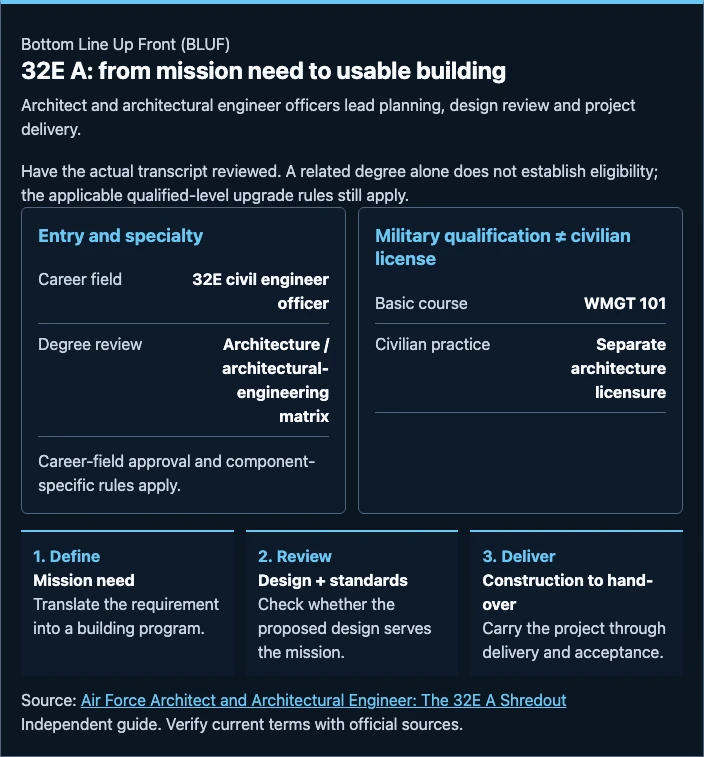
Have the actual transcript reviewed. A related degree alone does not establish eligibility; the applicable qualified-level upgrade rules still apply.
Entry and specialty
- Career field
- 32E civil engineer officer
- Degree review
- Architecture / architectural-engineering matrix
Career-field approval and component-specific rules apply.
Military qualification ≠ civilian license
- Basic course
- WMGT 101
- Civilian practice
- Separate architecture licensure
- DefineMission needTranslate the requirement into a building program.
- ReviewDesign + standardsCheck whether the proposed design serves the mission.
- DeliverConstruction to hand-overCarry the project through delivery and acceptance.
Source: Air Force Architect and Architectural Engineer: The 32E A Shredout
Independent guide. Verify current terms with official sources.
On this page
Wing Duty is supported by purchases through our links, which may earn us a commission.
Job Role and Responsibilities
A 32E A officer leads building planning, design review, and project delivery for an Air Force base. That work starts when the officer turns a mission need into a building program, then checks that the design serves the mission and carries the project through construction to hand-over. It is leadership over design work rather than a drafting desk.
Command and Leadership Scope
A new officer lands in a civil engineer squadron. The first post is often a flight or a project cell, where the officer may own a set of projects rather than people. That changes fast.
By captain, the officer may lead a flight. That flight holds engineers, drafters, and program managers. The officer sets the project list and defends it to the squadron commander.
The same officer also sits in meetings where a wing decides what to build next year, and those meetings decide what waits.
A 32E A officer makes decisions about money and mission, using design judgment and a budget:
- Should the new dorm go up before the hangar repair?
- Is the design ready to build, or does it need another review?
- Can the base accept a delay?
Specific Roles and Designations
The code carries both the skill level and the job. The letter marks the field.
| Code | Meaning |
|---|---|
| 32E1 | Entry level and student |
| 32E3 | Qualified civil engineer officer |
| 32E4 | Staff |
| 32E3A | Architect and Architectural Engineer |
| 32E3B | Readiness and Emergency Management Engineer |
| 32E3C | Civil Engineer |
| 32E3G | General Engineer |
| 32E3J | Environmental Engineer |
The A mark is the design and planning slot. It is not a higher grade than C or G. It names a different body of work inside the same career field.
Mission Contribution
Civil engineers make a base usable, and the architect shredout decides what gets built and how well each building fits the surrounding base. That work covers planning studies, space use, the look of a campus and the long view.
The work also carries a legal edge. Federal building work runs under codes, standards, and a review chain, and the officer is often the person who reads a design against that code before saying yes or no. A base that skips that step builds a problem it lives with for decades.
Technology, Equipment, and Systems
The tools are drawings, models, cost data, and planning records. Officers use building models and space planning tools, read the base property records, and work inside the civil engineer program that funds Air Force construction. They do not fly, drive, or shoot anything; the output is a decision and a document.
Salary and Benefits
Officer Base Pay
| Rank | Pay Grade | Years of Service | Monthly Base Pay | Annual Base Pay |
|---|---|---|---|---|
| Second Lieutenant (2d Lt) | O-1 | 2 or less | $4,150 | $49,802 |
| First Lieutenant (1st Lt) | O-2 | Over 2 | $5,446 | $65,354 |
| Captain (Capt) | O-3 | Over 4 | $7,383 | $88,592 |
| Major (Maj) | O-4 | Over 10 | $9,420 | $113,040 |
Source: DFAS 2026 pay tables. Figures reflect the 2026 pay raise.
Special Pays
Pay is the same as any other line officer at the same grade and years, so architects get no field bonus and no flight pay, and hazard pay does not apply here in the normal case. Check current rules for unusual posts rather than planning around an extra.
Additional Benefits
The official BRS overview distinguishes automatic contributions from matching and explains the applicable pension formula.
Officers get the standard set. Housing pay follows the area, and there is a food allowance. Health cover runs through TRICARE.
For new Blended Retirement System accessions, automatic TSP contributions begin after 60 days and matching begins after two years, subject to the plan rules. Education support depends on the program, eligibility, and approval; it is not an automatic promise to fund a graduate degree.
Work-Life Balance
Most weeks run on a normal day shift. Design review, project meetings, and site visits fill the calendar. That rhythm breaks at a deadline, when a design package due to a higher office can mean long days.
A construction problem can pull an officer to a site at short notice.
Qualifications and Eligibility
Commissioning Sources
You cannot sign for this shredout at a recruiting office. You commission as a civil engineer officer first. The Air Force then matches you to a shredout.
For the A mark, that match follows your degree.
The 32E education matrix in the classification directory is the reference for the degree decision. Use the listed architecture and architectural-engineering programs as the starting point, then have the career field review the actual transcript. The directory retains career-field-manager approval authority and component-specific education-waiver processes; a related degree alone does not establish eligibility for the A shredout.
| Commissioning Source | Degree | Age Limit | Notes |
|---|---|---|---|
| OTS | Bachelor’s | Must commission before 42 | Board pick, then job match |
| AFROTC | Bachelor’s | Must commission before 42 | Job match in the cadet years |
| USAFA | Degree at graduation | Academy rules | Job match at graduation |
| Direct commission | Not used here | Not applicable | Civil engineer accessions take the standard route |
Test Requirements
The AFOQT is the entry test for OTS and ROTC, and scores count. Technical fields weigh the math part hard. There is no flight test and no trade exam for this field.
If you are assembling an application, an AFOQT course and the AFOQT study guide walk through the test. Both are affiliate links. This site earns a fee if you buy.
The free AFOQT guide on this site covers the same ground at no cost.

Assignment Process
Here is the part that separates the shredouts. The field hands out most marks by degree, and this one sits at the front of that line. An architecture graduate who commissions into civil engineering is the natural fit for 32E A.
The rule goes one step further. After two years, officers in the A, C, E, F, G, I, and J shredouts move up to the next skill level. They do it in the shredout that matches their degree.
The general engineer slot is the exception. So the degree does not just open the door. It keeps shaping the code through the early career.
That cuts both ways. If you hold an architecture degree, the A mark is the likely home. If you hold a civil engineering degree, the C mark is the likely home, and the A work goes to someone else.
Neither path is better. They are different jobs with a shared parent.
Upon Commissioning
New civil engineer officers start as O-1 second lieutenants. The active duty commitment for a standard commission is four years. The first post is a civil engineer squadron, where a new lieutenant learns one section at a time.
Work Environment
Daily Setting
The week is a mix of office and site. Design review happens at a desk with drawings and a code book. Site visits put the officer in a hard hat on a building lot.
Planning work puts the officer in a room with a base map and a list of needs.
The schedule is close to a normal day shift, though deadlines move it. A construction problem or an inspection can do the same. The squadron also runs an on-call list for utility and building trouble, and officers take turns.
Officer-NCO Dynamic
Civil engineer squadrons run on experienced NCOs and civilians. A senior designer may know more about a system than any new officer will, and that holds true through a whole first tour. The officer sets the priority and signs the decision.
The technical staff carries the detail.
The pair works when the officer asks real questions and reads the design. An officer who signs a package without reading it is a liability, and the squadron knows it.
Staff vs. Command Roles
The first tour is at flight level. A captain may then move to a program office or to a base planning cell. Majors move to wing, command, or headquarters staff, where the subject is construction programs, planning standards, or building policy.
Command comes later, and it is a civil engineer squadron rather than a design office.
Job Satisfaction and Retention
This job suits officers who like the design side and still want to lead, and it frustrates officers who expected to draw all day. The higher you go, the more the work turns to money, people, and priority, and the less of it is design.
The Air Force does not print retention rates by shredout. Treat any exact number about this field as unproven.
Training and Skill Development
Pre-Commissioning Training
Officers come in through OTS, ROTC, or the Academy. None of those teach building design. They teach officership and leadership, and the trade work starts after that.
Initial Skills and Pipeline
| Phase | Location | Length | Focus |
|---|---|---|---|
| Commissioning source | Maxwell AFB or source dependent | OTS about 8.5 weeks | Officership and leadership |
| Civil engineer basic course | AFIT, course WMGT 101 | About 6 weeks | Base engineering, readiness, flight work |
| First post | Assigned unit | 12 to 24 months | Projects, design review, base planning |
| Later schooling | AFIT or a civilian school | Varies | Design, planning, or management |
The basic course is the shared ground. Every officer in the A, C, E, F, G, I, and J shredouts takes it before the qualified mark. It covers base engineering and how a squadron is built.
It also covers how a project moves from a stated need to construction.
Professional Military Education
Officers go to Squadron Officer School as captains. They attend Air Command and Staff College as majors. Air War College comes near the top.
The schools teach leadership and strategy, not design. They also build the contacts an officer needs for staff work.
Additional Schools and Training
The field backs grad school through the Air Force Institute of Technology and through civilian schools. A master’s in architecture, planning, or management fits. Some officers earn an engineer license while serving.
The field treats that as a long-term asset rather than an entry rule.
Career Progression and Advancement
Timeline
| Rank | Responsibility examples, not promotion dates | Focus |
|---|---|---|
| O-1 | Early commissioned service | Learn the squadron, run small projects |
| O-2 | Early assignments | Own a project set, lead a design review |
| O-3 | Assignment-dependent | Flight lead, program lead |
| O-4 | Assignment-dependent | Squadron operations, wing planning staff |
| O-5 | Assignment-dependent | Squadron command or senior staff |
Promotion System
Promotion eligibility and performance requirements still apply to first lieutenant and captain; time in service alone is not a guarantee. Major and above go to a board. The board reads the file: reports, awards, school, and the breadth of posts.
In this field, a strong file shows the officer delivered something. An officer who carried a major construction project from need to hand-over has a story a board can read. That officer also kept it on cost.
An officer who only attended reviews does not.
Broadening
The field opens staff work at wing, command, and joint level. Teaching at the civil engineer school is a common move. Planning posts at a major command also fit.
So do posts at the installation agency, which put an officer close to the decisions that shape a base for years.
A project drawing is only one part of an architectural officer’s responsibility. As assignments broaden, officers may review designs prepared by others, manage competing requirements and explain why a proposal needs revision before construction begins. Advancement can therefore depend on project judgment and leadership as well as technical knowledge.
Prospective officers should ask how much of an assignment involves direct design compared with oversight.
Physical Demands and Medical Evaluations
Fitness Standards
Civil engineer officers take the standard fitness test. There is no field-specific physical test.
| General test, under age 25 | Male | Female |
|---|---|---|
| Minimum satisfactory total | 75 points | 75 points |
| Event minimums | Meet each chosen event’s chart minimum | Meet each chosen event’s chart minimum |
| Failure despite 75 total | A missed event minimum can make the result unsatisfactory | A missed event minimum can make the result unsatisfactory |
The Air Force fitness page and DAFMAN 36-2905 own the current charts.
Career Field-Specific Medical
The A shredout adds no medical rule of its own. Normal color vision helps on site and in review work. The directory does not make it a condition for this mark.
The general officer health standard for commissioning still applies.
Deployment and Duty Stations
Deployment Tempo
Architect officers deploy as civil engineers, often inside a Prime BEEF team. A deployed post may put the officer on bed-down planning or building damage checks. Fast construction work also comes up.
Tour length depends on the tasking; no standard deployment length for this shredout is established here.
The tempo moves with the unit. A base with a heavy construction program keeps its officers busy at home too, and a full exercise schedule adds to that.
Duty Stations
Almost every base has a civil engineer squadron, so postings are available almost everywhere. Large bases with a full construction program offer more design and planning work. The personnel center runs the match, and officers send in a wish list.
Family and medical needs can shape the result. The needs of the Air Force still come first.
Risk, Safety, and Legal Considerations
Job Hazards
The hazards are the hazards of a build site. An officer may walk an active construction lot, climb to a roof, or enter a utility plant. Drills and deployments add field conditions.
The risk is low compared with aviation, but a site is still not a desk.
Safety Protocols
The work runs on checklists and risk calls. A site visit gets a safety brief. A design gets a review against fire, structural, and life-safety codes.
The officer has a duty to stop work that has become unsafe, and that duty is written down rather than optional.
Legal and Command Responsibility
An officer who signs a design review carries the weight of that signature. Code errors can cost money and, in the worst case, lives. Officers also answer under the Uniform Code of Military Justice like any leader.
Relief from a post is rare, but a botched project or a safety failure can end a command path.
Impact on Family and Personal Life
The home base week is calmer than aviation or special warfare, though the hours are not. A design package due to a higher office can mean late nights, and a construction problem can pull an officer to a site on a weekend. Families who plan for a deadline season do better.
A fixed week is a poor bet.
Move timing and available architect billets depend on the assignment cycle and component, rather than a fixed two-to-three-year promise. Deployments are the bigger break in the year, though they are usually known far enough ahead to plan.
A base architect may have a structured office schedule, but construction deadlines, site visits and field exercises can change it. A new posting may also shift the balance between design review and installation management. Before choosing the field for its perceived stability, ask what work the actual billet performs and whether travel, exercises or major projects will affect time at home.
Reserve and Air National Guard
Component Availability
The civil engineer field lives in the active force, the Reserve, and the Guard. The A shredout shows up in the Guard and Reserve, where a state or unit construction program needs a design lead.
Commissioning and Transfer
Guard and Reserve civil engineer officers commission the same way. Their accession or transfer must also match an available unit position. An active duty officer can move over after the commitment, provided the gaining unit has a suitable vacancy and the transfer is approved.
Drill Commitment and Part-Time Pay
The standard deal is one weekend a month plus two weeks a year. A construction program can add drill weekends and preparation for inspections. Drill pay depends on grade, years of service, and paid training periods; annual training and active orders follow separate pay rules.
Benefits Differences
Reserve and Guard members can buy TRICARE Reserve Select. That plan costs a monthly premium that active duty does not. School aid differs by state for Guard members, and reserve retirement eligibility and retired-pay timing depend on qualifying service and retirement points, rather than the active-duty retirement timeline.
| Item | Active Duty | Air Force Reserve | Air National Guard |
|---|---|---|---|
| Commitment | Full time | One weekend a month, two weeks a year | One weekend a month, two weeks a year |
| Pay basis | Monthly base pay | Drill days plus annual tour | Drill days plus annual tour |
| Health cover | TRICARE Prime, no premium | TRICARE Reserve Select, premium | TRICARE Reserve Select, premium |
| School aid | Tuition aid, GI Bill | Tuition aid, GI Bill | Federal aid, state waivers in some states |
| Retirement | Blended system, 20-year pension | Points based | Points based |
| Command | Squadron and above | Where slots exist | Where slots exist |
| Deployment | Rotations and contingencies | Mobilization | State and federal mobilization |
Civilian Integration
This field pairs well with a civilian job. Architecture, planning, and building work exist in every large firm and every public agency, and a Guard or Reserve officer here often works in a design office or a planning department.
Post-Service Opportunities
Transition to Civilian Life
The skills carry over. An officer who has run base planning, reviewed designs, and carried construction projects has a record that firms and agencies hire for. The standard programs help, and those include the transition class and veteran hiring events.
There are also programs that map military training to civilian papers.
Civilian Career Prospects
| Role | 2025 Median Pay | Outlook |
|---|---|---|
| Architect | $99,280 per year | 4 percent growth, as fast as average |
The BLS architect profile explains pay, employment, and civilian licensing. Military project experience does not replace a state license; check the education, experience, and examination requirements where you intend to practice. Architect work is tracked as its own job, and the field held about 124,600 posts in 2025.
A civilian architect role and an engineering-management role have different requirements; compare the actual vacancy rather than treating one occupation’s median as a guaranteed next salary.
Graduate Education and Credentials
Officers may qualify for GI Bill benefits and other education programs under their respective eligibility rules. Tuition assistance and funded graduate study have separate approval, funding, and service-obligation requirements; neither is guaranteed by this shredout.
A license as a planner or an engineer is a long-term asset, and the field treats it that way.
Is This a Good Job for You? The Right (and Wrong) Fit
Ideal Candidate Profile
This field suits a person who likes design and still wants to lead. You should enjoy reading a drawing and finding the flaw. You should be at ease telling a contractor that the work does not meet the spec.
An architecture or architectural engineering degree is the usual educational starting point, subject to the current matrix and career-field approval. A past in a design office or a planning department helps you read the work fast. So does time on a build site.
Potential Challenges
The design share of the job shrinks as you rise, which officers who want to draw for a career find hard. The paper load also surprises people who expected a studio.
The other snag is distance. A base project takes years, and an officer may move before the building opens. You have to be content with a good hand-off rather than a finished photo.
Career and Lifestyle Alignment
If you want a full career, this field leads to squadron command and senior planning posts. If you want one tour, the experience transfers well to a civilian design or planning job. If you want a Guard or Reserve career, the field fits: the work looks like the civilian job.
It is a poor fit if you want to build with your hands or run heavy gear. No 32E shredout should be treated as a promise of daily hands-on construction. Ask what the actual billet requires; officer duties include planning, oversight, and leadership across the field.
More Information
Talk to a local Air Force recruiter or an ROTC unit about civil engineer accessions. Do that before you assume this job is open to you. Have the current education matrix and your transcript reviewed for the A shredout before treating a degree title as an eligibility decision.
If OTS is your path, the AFOQT study guide covers the test, and an AFOQT course is the paid option this site recommends first for score work.
Start with the 32E Civil Engineer profile for the shared career view. Then read the environmental engineer shredout, which follows a degree the same way. Also read the readiness and emergency management shredout, which follows a course instead.
The Civil Engineering community lists the whole field.