32EX EOD Officer
When you purchase through links on our site, we may receive compensation at no extra cost to you.
Some officer jobs manage risk from a conference room. This one manages risk when the object on the ground can still explode. In this site’s civil-engineering structure, 32EX is used for the EOD-focused officer lane: the leader who understands the explosive-hazard mission well enough to command the people handling it. Current public recruiting pages do not break this officer path out cleanly on their own, so readers should treat the public Air Force EOD technician pipeline as the clearest baseline for the underlying mission and verify current officer specifics with accession sources.
If you are pursuing OTS before this kind of high-screening field, start with the AFOQT study guide.
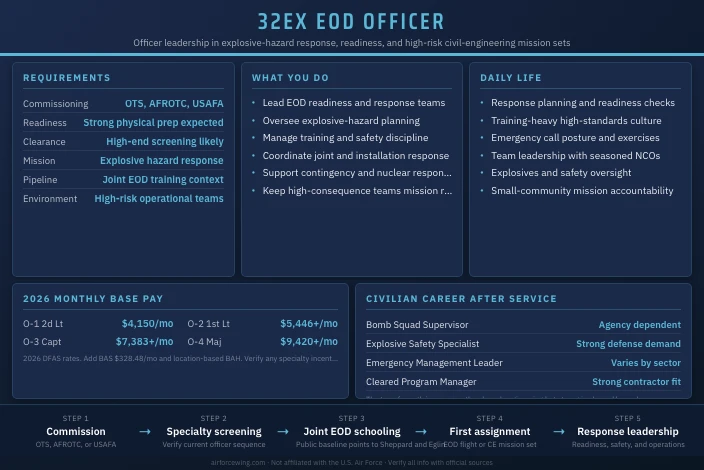
Job Role and Responsibilities
32EX EOD Officers lead explosive-ordnance-disposal teams and related civil-engineering response elements that identify, render safe, recover, and manage explosive hazards. The officer role is command, planning, readiness, and mission integration rather than personally performing every hands-on render-safe task.
Leadership Scope
This is a small community with high stakes. A junior officer in the lane is responsible for readiness, equipment accountability, training discipline, and the judgment climate inside an EOD flight. That flight may respond to conventional unexploded ordnance found on or near an installation, improvised explosive devices on deployed missions, range clearance operations, or nuclear-weapons-accident response tasks under special programs such as NEST coordination.
The officer establishes the training standards, reviews the risk assessments, and signs off on readiness certifications that determine whether the team can execute the mission. When a real call comes in, the officer is responsible for the decision to commit the team, the risk management during the operation, and the accounting for what happens after. There is no second EOD flight to pass the problem to if the decision goes wrong.
As officers progress, the work broadens into program leadership, installation explosive-safety relationships, and joint coordination. The unit size may be smaller than some other officer specialties, but the consequence of weak leadership is far higher.
Mission Contribution
Explosive-hazard response protects people, aircraft, infrastructure, and operations. When munitions are unsafe, a suspicious package shuts down an installation, or a contingency mission involves explosive threats, EOD keeps the Air Force moving instead of freezing. A range with unexploded ordnance cannot be used for training. An installation under a credible threat cannot operate normally. An EOD flight that is ready, well-led, and trusted by base leadership gives the installation commander options that do not exist without them.
Public-Source Reality
The public Air Force site currently documents the enlisted EOD mission in much more detail than the officer side. That is why this page describes the officer lane carefully:
| Public Source | What It Confirms |
|---|---|
| Air Force EOD technician page | Core mission, training stages, fitness expectations, and hazard profile |
| Civil-engineering field context | EOD sits inside the broader CE readiness world |
| Joint EOD schooling references | Training is specialized and interservice by design |
Salary and Benefits
Officer Base Pay
2026 compensation follows the DFAS military pay tables.
| Rank | Grade | Typical YOS | Monthly Base Pay |
|---|---|---|---|
| Second Lieutenant | O-1 | Under 2 | $4,150 |
| First Lieutenant | O-2 | 2-4 years | $5,446-$6,485 |
| Captain | O-3 | 4-10 years | $7,383-$8,376 |
| Major | O-4 | 10-16 years | $9,420-$10,402 |
Allowances And Benefits
- BAH: location based, paid in addition to base pay
- BAS: $328.48 monthly
- TRICARE Prime: medical, dental, and vision coverage for the service member with family coverage available
- BRS retirement and TSP matching: government TSP matching from day one under the Blended Retirement System
- Hazardous duty pay: EOD-related duties may qualify for special pay or hazardous duty incentives; verify current entitlements with military pay resources
Civilian Value
The civilian crossover is narrower than standard engineering, but it is strong in bomb-squad leadership, emergency management, explosive-safety programs, and cleared government or contractor roles. Federal agencies and defense contractors value the combination of technical EOD knowledge, security clearance, and officer leadership experience that this career produces. Law enforcement agencies with bomb-squad units also recognize Air Force EOD credentials as a meaningful differentiator.

Qualifications and Eligibility
Commissioning Paths
| Commissioning Source | Degree Requirement | Age Limit | Notes |
|---|---|---|---|
| OTS | Bachelor’s degree | Must commission before 42 | Competitive officer selection |
| AFROTC | Bachelor’s degree | Must commission before 42 | Assignment by Air Force needs |
| USAFA | Degree on graduation | Standard academy limits | Assignment at graduation |
Technical or physical-science degrees fit naturally with the analytical and methodical nature of EOD work, but the Air Force does not mandate a single major for officer accession into this specialty. The bigger differentiator is demonstrated discipline, composure under pressure, and the physical and psychological profile that high-screening programs look for.
Screening And Competitive Factors
The public Air Force EOD page publishes demanding enlisted entry standards, including strong fitness benchmarks, psychological suitability evaluation, color vision requirements, and high-tier clearance screening that includes a Single Scope Background Investigation. The officer path is not broken out publicly with the same detail, but candidates should approach the process with the assumption that similar standards apply. Leading a team in explosive-hazard operations requires the same psychological steadiness and physical readiness that the enlisted EOD standards measure.
Factors that matter for officer screening:
- Officer commissioning eligibility and competitive package
- Strong physical fitness above the Air Force minimum
- Clearance eligibility for Top Secret level access
- Demonstrated composure and decision-making under pressure
- Academic performance showing technical competency
- Comfort with inherently hazardous operations and the personal accountability that comes with them
Build your OTS baseline with the AFOQT study guide before you get deeper into specialty screening.
Upon Commissioning
A new officer does not walk in as a finished EOD flight commander. Early development is about learning the technical mission from the people who have been doing it. Senior EOD NCOs have render-safe procedures, equipment knowledge, and mission experience that a new lieutenant cannot quickly replicate from a training course. The officer’s first credibility challenge is demonstrating that the rank does not substitute for knowledge and that command decisions will be made with the team’s expertise in the room, not over it.

Work Environment
Setting And Schedule
This field works from EOD flights within civil engineer squadrons, explosive-storage and response areas, training ranges, emergency response staging areas, and deployed environments. The day-to-day during steady-state periods can look routine: maintenance checks on equipment, training qualifications, readiness reporting, and administrative work. But the nature of the job means that routine can end instantly.
A call for a suspicious package, a range sweep, an aircraft accident with munitions, or a nuclear-response task can compress everything else in the schedule. Officers who are not mentally ready to shift from administrative work to hazardous-operations command immediately are in the wrong field. The schedule is calm until it demands everything.
Officer-NCO Dynamic
This is one of the officer lanes where enlisted expertise matters most. An EOD flight sergeant with multiple deployments and dozens of real calls has knowledge that classroom training and officer authority cannot replace. An officer who ignores the experience of senior EOD NCOs will lose trust immediately in a community that cannot afford to have its standards questioned during a live operation. The officer’s job is to set the standards, make command decisions, and provide top-cover for the team, not to substitute rank for technical judgment.
Good EOD officers build trust by showing up to every training event, staying physically prepared, asking smart questions, and being honest about what they do not know. In this field, intellectual honesty is a safety requirement.
Command And Staff Balance
The field is operationally small but strategically important. EOD flights at most bases have a limited number of officers. That means early career exposure to command responsibility is higher than in many other career fields. Later-career assignments can include program management, readiness oversight, explosive-safety roles at headquarters, and broader civil-engineering leadership positions.
Training and Skill Development
Training Pipeline
| Phase | Location | Length | Focus |
|---|---|---|---|
| Commissioning source or OTS | Maxwell AFB, AL or source dependent | OTS 8.5 weeks | Officership fundamentals |
| EOD screening and preparatory training | Verify current sequence | Verify current length | Specialty screening and technical fundamentals |
| EOD Preliminary Course | Sheppard AFB, TX | Approximately 26 days | Explosive theory, safety, and initial render-safe procedures |
| Naval School Explosive Ordnance Disposal | Eglin AFB, FL | Approximately 143 days | Full EOD curriculum including IEDs, UXO, nuclear weapons, render-safe procedures |
| First assignment OJT | EOD flight or CE unit | 12-24 months | Team readiness, response leadership, and local mission set |
The public Air Force EOD technician page currently shows this two-school pipeline as the enlisted qualification path. Because the public site does not separately map the officer pipeline, this page uses that enlisted baseline as the clearest official indicator of training intensity. Candidates should verify the current officer sequencing with an accession source, as the officer pipeline may differ in structure or sequence from the enlisted one.
The NAVSCOLEOD curriculum at Eglin covers conventional munitions, improvised explosive devices, nuclear weapons response, chemical and biological hazards in explosive contexts, and render-safe procedures across multiple device types. The course is demanding academically and physically. Attrition is real. Officers who arrive without the technical aptitude or physical preparation to absorb a high-density technical curriculum under stress will not complete it.
Before you ever reach that stage, get the commissioning fundamentals right with the AFOQT study guide.
Additional Development
This lane rewards physical resilience, technical discipline, and calm decision-making under significant pressure. Officers who continue developing their leadership credentials through advanced education, joint assignments, or broadening tours in explosive-safety and emergency management build the kind of record that positions them for senior CE and joint roles. Later development opportunities include nuclear surety programs, joint IED defeat organizations, and interagency coordination roles that value EOD-qualified officers with clearances and operational experience.
Career Progression and Advancement
Timeline
| Rank | Grade | Typical Timeline | Development Focus |
|---|---|---|---|
| Second Lieutenant | O-1 | Entry to 2 years | Learn EOD mission and team standards |
| First Lieutenant | O-2 | 2-4 years | Team leadership and response readiness |
| Captain | O-3 | 4-10 years | Flight command or mission-program leadership |
| Major | O-4 | 10-16 years | Higher-level readiness and staff oversight |
| Lieutenant Colonel | O-5 | 16-22 years | Senior CE or explosive-safety leadership |
Promotion Drivers
The field values judgment, readiness, and trust in ways that are harder to fake than in administrative career fields. Promotion boards look at real operational performance, deployed records, and whether the officer built and maintained a team that met standards under pressure. An officer who kept the flight training-ready, deployed without incident, and handled real calls professionally builds a record that evaluation bullets can actually capture.
Weak standards in training, poor deployment performance, or safety failures are career-damaging in a community where the record of what actually happened is specific and documented. There is limited room to spin poor performance in a field this operationally concrete.
Broadening
EOD leadership can open doors into emergency management, installation safety programs, civil-engineering readiness at squadron and group levels, joint IED defeat roles, nuclear-response coordination, and specialized cleared assignments later in the career. Officers who perform well in operational EOD roles are competitive for joint and interagency positions that value both technical expertise and demonstrated leadership under hazardous conditions.
Physical Demands and Medical Evaluations
Fitness Standards
32EX officers take the standard Air Force Fitness Assessment, but this is not a low-physicality desk job.
| Component | Max Points |
|---|---|
| 1.5-mile run | 60 |
| Push-ups | 10 |
| Sit-ups | 10 |
| Waist or body composition | 20 |
Passing is 75 points, but officers in this field should treat the standard fitness assessment as the floor, not the target. The public EOD technician page shows a much higher specialty fitness bar that includes pull-ups, a 1.5-mile run under 10:20, and the ability to perform work under physical stress. Even where the officer standard is not published separately, candidates should prepare to perform at the enlisted EOD fitness level, because commanding a team that trains at that level while being personally unfit creates an immediate credibility problem.
The physical demands of the mission include working in protective bomb suits that add significant heat and weight, operating in confined spaces, conducting long range-clearance operations on foot, and maintaining composure under the physical stress of a hazardous-device response. These demands do not go away during deployments to hot climates or high-elevation environments.
Officers should also expect that the medical screening process looks beyond the standard commission physical. Color vision, psychological evaluation, and any history of conditions that would impair judgment under stress are all relevant to the screening process.
Deployment and Duty Stations
Deployment Tempo
Deployment and contingency response are normal parts of this career. EOD flights support joint task forces, overseas contingency operations, range clearance missions, and humanitarian explosive-hazard removal programs. The community’s small size relative to mission demand means that experienced officers may deploy multiple times across a career, with individual deployments ranging from 90 days to six months or more.
Officers should enter this career expecting deployment as a recurring reality rather than an occasional exception. The mission attracts officers who are motivated by real operational stakes, and the deployment history of the community reflects that.
Duty Stations
EOD flights exist at a narrower set of installations than general civil engineering. Major installations with active EOD programs include Air Force bases in the continental United States, Alaska, Hawaii, and overseas locations with significant munitions and operational explosive-hazard requirements. The smaller basing footprint means officers have fewer geographic assignment choices over a career than colleagues in broader career fields.
The tradeoff is a mission set with unusually strong operational relevance and a community culture built on shared commitment to high standards. Officers who join for the mission tend to find the narrower basing picture acceptable. Those who prioritize geographic flexibility should consider whether this field is the right fit.
Risk, Safety, and Legal Considerations
Main Risks
The physical risk in this career is direct and well-understood within the community:
- Explosive-device response carries the possibility of detonation during render-safe procedures if errors occur
- Blast and fragmentation exposure over a career, including from training events, creates cumulative health considerations
- Traumatic brain injury risk from blast proximity, even during incidents that do not cause visible physical injury
- Clearance and security failures that remove the officer from mission-critical access
- Command decision errors in time-critical situations where poor judgment has immediate consequences for team safety
Control Measures
The field lives on checklists, disciplined training, peer review of procedures, and a culture where calling a stop to a render-safe operation because something is wrong is always the right decision. Weak standards in EOD are not a quality-control issue. They are a survival issue.
Legal accountability is also real. Officers who fail to follow established safety protocols, inadequately supervise rendered-safe operations, or mismanage explosive storage and accountability face consequences that go beyond standard officer misconduct procedures. Explosive-ordnance regulations carry specific legal weight, and officers are responsible for knowing them.
Medical monitoring programs track blast exposure over time for EOD personnel. Officers should participate fully in those programs rather than treating occupational health monitoring as administrative overhead.
Impact on Family and Personal Life
This is one of the harder officer fields for family predictability. Real-world calls, exercises, deployments, and the emotional weight of leading a hazardous-operations team can all affect family life in ways that are difficult to schedule around.
Families who thrive in this community generally share a few characteristics: they understand the mission and its risks honestly rather than minimizing them, they have strong personal support networks, and they communicate proactively about how the schedule and deployment cycle will affect family decisions. Officers who try to shield families from the reality of the work often create more anxiety than transparency would.
PCS cycles follow standard officer timelines, but the narrower basing footprint of the EOD community can limit assignment choices in ways that affect family employment and school stability. Partners who need geographic flexibility for their own careers should factor the limited duty-station options into long-term planning. Families who have lived the EOD culture often describe the community as unusually tight-knit because shared high-stakes experience creates bonds that other officer communities do not always develop to the same degree.
Reserve and Air National Guard
Component Availability
The public EOD mission appears across Active Duty, Air National Guard, and Air Force Reserve components. EOD capability at Guard units supports both state emergency response and federal mission requirements. Officer billet structure in reserve components is smaller and less publicly documented than the enlisted side, so availability should be verified with the specific unit.
Reserve and Guard EOD officers often maintain civilian careers in law enforcement, emergency management, or engineering fields that complement the military mission. The dual-track professional identity is one of the reasons some officers transition to reserve status rather than separating entirely after active-duty service.
Civilian Integration
The civilian overlap is more specialized than broad engineering, but it is strong in bomb-squad command, explosives-safety management, emergency response leadership, and cleared technical programs. Law enforcement agencies operating bomb squads actively recruit from the Air Force EOD community. Defense contractors and federal agencies with explosive-safety or nuclear-safety programs value the security clearance, technical credentials, and leadership background that 32EX officers bring.
Post-Service Opportunities
Civilian Career Paths
| Civilian Role | Typical Direction |
|---|---|
| Bomb Squad Supervisor | Law enforcement or federal response teams |
| Explosive Safety Specialist | Defense ranges, munitions programs, or federal compliance |
| Emergency Management Director | Municipal, county, federal, or contractor emergency programs |
| Cleared Program Manager | Defense-industrial and national-security environments |
| Federal Agent / Inspector | ATF, FBI, or other agencies with explosive or weapons programs |
Post-service options are narrower than general engineering in volume, but the competition for those roles tends to be limited. An Air Force EOD officer with a current Top Secret clearance, multiple deployments, and flight command experience enters a civilian job market where very few other candidates have a comparable background. Federal law enforcement, defense contracting, and government explosive-safety programs recruit directly from this community.
Officers who invest in advanced education during service, particularly in emergency management, homeland security, or project management, expand their post-service reach into senior program and policy roles.
Is This a Good Job for You? The Right (and Wrong) Fit
32EX is a good fit if you want a small, hazardous, standards-heavy mission where calm leadership matters every day and where the consequences of poor judgment are direct and immediate. Officers who thrive in this lane tend to be internally driven, methodical, physically prepared, and genuinely comfortable with the responsibility that comes from leading people in dangerous work. The community’s size means your performance is visible and your contributions matter at every level.
It is a poor fit if you want comfort, loose process, or geographic flexibility over a career. It is also a poor fit if you are drawn to the identity of the mission rather than the actual work of building and leading a team that stays ready, stays safe, and responds well when it matters. EOD culture can identify the difference quickly, and a candidate who is performing rather than committed will stand out in training before they ever reach a real call.
Officers who last and perform well in this career generally describe it as one of the most meaningful things they have done, not because it was dramatic, but because the standards were real, the team trust was earned, and the mission had actual stakes.
Air Force officer candidates take the AFOQT for commissioning and career-field placement. See our AFOQT study guide for the 6-composite breakdown and a 30-day plan.
Or go straight to an AFOQT study course.

More Information
- Review the Air Force Explosive Ordnance Disposal page for the clearest current public mission baseline
- Review the Air Force Special Warfare and Combat Support careers page for broader mission context
- Build your commissioning prep plan with the AFOQT study guide
Explore more Air Force civil-engineering officer careers and compare the enlisted technical mission at 3E8X1 Explosive Ordnance Disposal or the broader officer engineering lane at 32E Civil Engineer.