32EX EOD Officer
Some officer jobs manage risk from a conference room. This one manages risk when the object on the ground can still explode. In this site’s civil-engineering structure, 32EX is used for the EOD-focused officer lane: the leader who understands the explosive-hazard mission well enough to command the people handling it. Current public recruiting pages do not break this officer path out cleanly on their own, so readers should treat the public Air Force EOD technician pipeline as the clearest baseline for the underlying mission and verify current officer specifics with accession sources.
If you are pursuing OTS before this kind of high-screening field, start with the AFOQT study guide.
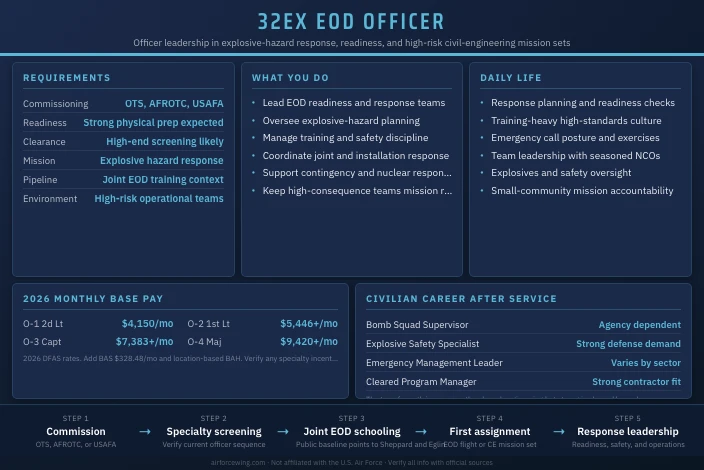
Job Role
32EX EOD Officers lead explosive-ordnance-disposal teams and related civil-engineering response elements that identify, render safe, recover, and manage explosive hazards. The officer role is command, planning, readiness, and mission integration rather than personally performing every hands-on render-safe task.
Leadership Scope
This is a small community with high stakes. A junior officer in the lane is responsible for readiness, equipment accountability, training discipline, and the judgment climate inside an EOD team. That team may be responding to conventional unexploded ordnance, improvised devices, range clears, or nuclear-response tasks.
As officers progress, the work broadens into program leadership, installation explosive-safety relationships, and joint coordination. The unit size may be smaller than some other officer specialties, but the consequence of weak leadership is far higher.
Mission Contribution
Explosive-hazard response protects people, aircraft, infrastructure, and operations. When munitions are unsafe, a suspicious package shuts down an installation, or a contingency mission involves explosive threats, EOD keeps the Air Force moving instead of freezing.
Public-Source Reality
The public Air Force site currently documents the enlisted EOD mission in much more detail than the officer side. That is why this page describes the officer lane carefully:
| Public Source | What It Confirms |
|---|---|
| Air Force EOD technician page | Core mission, training stages, fitness expectations, and hazard profile |
| Civil-engineering field context | EOD sits inside the broader CE readiness world |
| Joint EOD schooling references | Training is specialized and interservice by design |
Salary
Officer Base Pay
2026 compensation follows the DFAS military pay tables.
| Rank | Grade | Typical YOS | Monthly Base Pay |
|---|---|---|---|
| Second Lieutenant | O-1 | Under 2 | $4,150 |
| First Lieutenant | O-2 | 2-4 years | $5,446-$6,485 |
| Captain | O-3 | 4-10 years | $7,383-$8,376 |
| Major | O-4 | 10-16 years | $9,420-$10,402 |
Allowances And Benefits
- BAH: location based
- BAS: $328.48 monthly
- TRICARE Prime
- BRS retirement and TSP matching
Civilian Value
The civilian crossover is narrower than standard engineering, but it is strong in bomb-squad leadership, emergency management, explosive-safety programs, and cleared government or contractor roles.
Qualifications
Commissioning Paths
| Commissioning Source | Degree Requirement | Age Limit | Notes |
|---|---|---|---|
| OTS | Bachelor’s degree | Must commission before 42 | Competitive officer selection |
| AFROTC | Bachelor’s degree | Must commission before 42 | Assignment by Air Force needs |
| USAFA | Degree on graduation | Standard academy limits | Assignment at graduation |
Technical or physical-science degrees fit naturally, but the bigger differentiator is whether you can handle a screening-heavy field without losing composure or discipline.
Screening And Competitive Factors
The public Air Force EOD page publishes demanding enlisted entry standards, including strong fitness, psychological suitability, color vision, and high-end clearance screening. The officer path is not publicly broken out with the same level of detail, so the safest assumption is that candidates should expect similarly serious screening tied to explosive operations and access requirements.
- Officer commissioning eligibility
- Strong physical readiness
- Clearance eligibility for sensitive mission work
- Ability to lead under pressure
- Comfort with inherently hazardous operations
Build your OTS baseline with the AFOQT study guide before you get deeper into specialty screening.
Upon Commissioning
A new officer does not walk in as a finished EOD commander. Early development is about learning the technical mission, absorbing safety culture, and building credibility with seasoned EOD technicians whose experience is critical to unit survival.
Work Environment
Setting And Schedule
This field works from EOD flights, explosive-storage and response areas, training ranges, emergency scenes, and deployed environments. The schedule can look quiet until it does not. Real-world calls, exercises, and suspicious-package responses can reshape the day immediately.
Officer-NCO Dynamic
This is one of the officer lanes where enlisted expertise matters most. An officer who ignores the experience base of senior EOD NCOs will lose trust fast. The officer’s job is to set standards, make command decisions, and keep the team ready without pretending rank substitutes for technical judgment.
Command And Staff Balance
The field is operationally small but strategically important. Later-career assignments can include program management, readiness oversight, and broader civil-engineering or explosive-safety roles.
Training
Training Pipeline
| Phase | Location | Length | Focus |
|---|---|---|---|
| Commissioning source or OTS | Maxwell AFB, AL or source dependent | OTS 8.5 weeks | Officership fundamentals |
| EOD screening and preparatory training | Verify current sequence | Verify current length | Specialty screening and fundamentals |
| Joint EOD schooling | Sheppard AFB / Eglin AFB pipeline context | Public enlisted baseline is 26 days + 143 days | Explosive tools, render-safe procedures, nuclear response |
| First assignment OJT | EOD flight or CE unit | 12-24 months | Team readiness, response leadership, local mission set |
The public Air Force EOD technician page currently shows an EOD Preliminary Course at Sheppard AFB followed by Naval School Explosive Ordnance Disposal at Eglin AFB. Because the public site does not separately map the officer pipeline, this page uses that enlisted baseline as the clearest official indicator of the mission’s training intensity while telling candidates to verify current officer sequencing directly.
Before you ever reach that stage, get the commissioning fundamentals right with the AFOQT study guide.
Additional Development
This lane rewards physical resilience, calm decision-making, and disciplined training culture. Later growth often includes explosive-safety leadership, joint integration, and higher-readiness oversight.
Career Progression
Timeline
| Rank | Grade | Typical Timeline | Development Focus |
|---|---|---|---|
| Second Lieutenant | O-1 | Entry to 2 years | Learn EOD mission and team standards |
| First Lieutenant | O-2 | 2-4 years | Team leadership and response readiness |
| Captain | O-3 | 4-10 years | Flight command or mission-program leadership |
| Major | O-4 | 10-16 years | Higher-level readiness and staff oversight |
| Lieutenant Colonel | O-5 | 16-22 years | Senior CE or explosive-safety leadership |
Promotion Drivers
The field values judgment, readiness, and trust. Units remember whether you kept standards high when the pressure was real.
Broadening
EOD leadership can open doors into emergency management, installation safety, civil-engineering readiness, joint response planning, and specialized cleared assignments later in the career.
Physical Demands
Fitness Standards
32EX officers still take the standard Air Force Fitness Assessment, but this is not a low-physicality desk job.
| Component | Max Points |
|---|---|
| 1.5-mile run | 60 |
| Push-ups | 10 |
| Sit-ups | 10 |
| Waist or body composition | 20 |
The public EOD technician page also shows a much stronger specialty fitness bar tied to pull-ups, running, and work under pressure. Even where the officer standard is not published separately, candidates should train above the basic Air Force minimum.
Deployment
Deployment Tempo
Deployment and contingency response are normal parts of the mission. Any field centered on explosive hazards can move quickly from training to real-world response.
Duty Stations
This community is narrower than general civil engineering, so the basing picture is more selective. The tradeoff is a mission set with unusually strong operational relevance.
Risk/Safety
Main Risks
The obvious risk is physical, but the leadership risk matters too:
- Explosive hazards and blast exposure
- Training failures inside a high-risk community
- Clearance or security failures
- Bad judgment in time-critical response situations
Control Measures
The field lives on checklists, discipline, repetition, and trust. Weak standards in EOD are not a paperwork issue. They are a survival issue.
Impact on Family
This is one of the harder officer fields for predictability. Real-world calls, exercises, deployments, and the emotional load of hazardous operations can all hit family life. The mission attracts people who are comfortable with that tradeoff and who can communicate well at home when the schedule changes suddenly.
Reserve and Air National Guard
Component Availability
The public EOD mission appears across Active Duty, Air National Guard, and Air Force Reserve on the Air Force recruiting site. Officer billet structure is smaller and less public, so component opportunities should be verified case by case.
Civilian Integration
The civilian overlap is more specialized than broad engineering, but it is strong in bomb-squad, explosives, emergency-response, and cleared technical-leadership work.
Post-Service
Civilian Career Paths
| Civilian Role | Typical Direction |
|---|---|
| Bomb Squad Supervisor | Law enforcement or federal response teams |
| Explosive Safety Specialist | Defense, range, or munitions programs |
| Emergency Management Leader | Municipal, federal, or contractor response work |
| Cleared Program Manager | Defense-industrial and security environments |
Is This a Good Job
32EX is a good fit if you want a small, hazardous, standards-heavy mission where calm leadership matters every day. It is a poor fit if you want comfort, loose process, or the ability to mentally coast through training and readiness checks.
More Information
- Review the Air Force Explosive Ordnance Disposal page for the clearest current public mission baseline
- Review the Air Force Special Warfare and Combat Support careers page for broader mission context
- Build your commissioning prep plan with the AFOQT study guide
This site is not affiliated with the U.S. Air Force or any government agency. Verify all information with official Air Force sources before making enlistment or career decisions.
Explore more Air Force civil-engineering officer careers and compare the enlisted technical mission at 3E8X1 Explosive Ordnance Disposal or the broader officer engineering lane at 32E Civil Engineer.