32E Civil Engineer
When you purchase through links on our site, we may receive compensation at no extra cost to you.
Aircraft do not launch because the runway exists on a map. Someone has to build it, inspect it, repair it, power the base around it, and keep water, utilities, housing, and contracts moving when the environment turns ugly. That officer is the civil engineer. Current public recruiting pages often present the broader civil-engineering lane under 32EX, but this site keeps the operational 32E Civil Engineer label because that is still how many applicants and career-field references discuss the job.
If you are coming through OTS, start with the AFOQT study guide before you build the rest of your package.
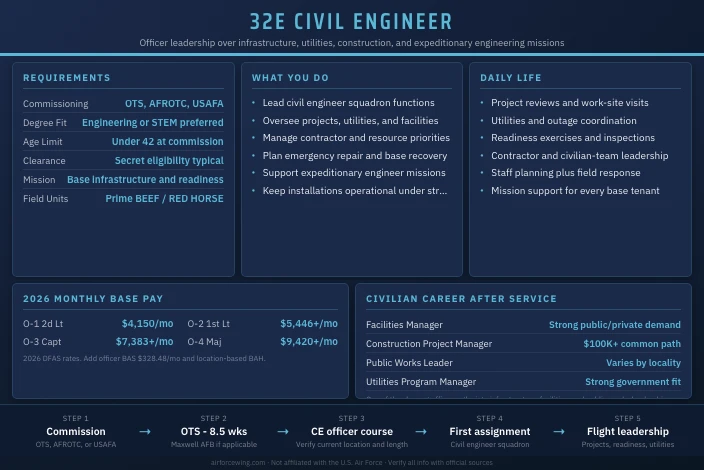
Job Role and Responsibilities
32E Civil Engineers lead Air Force infrastructure, facilities, utilities, environmental, and expeditionary engineering missions. They supervise the officers, NCOs, civilians, and contractors who keep bases functional and who deploy engineering capability with Prime BEEF and RED HORSE units when the mission requires it.
Leadership Scope
A new 32E officer usually starts inside a civil engineer squadron, learning one flight at a time: operations, engineering, emergency services, or readiness. Even early on, the job is leadership heavy. You are not personally wiring buildings or pouring concrete every day. You are setting priorities, allocating manpower, and making sure the people who do that work can keep the installation operating.
Day-to-day responsibilities vary by assignment but typically include supervising maintenance work orders, reviewing contractor submittals, managing utility outage coordination, leading safety inspections, and tracking readiness training for the section. Lieutenants in operations or readiness flights often own more direct supervision of enlisted and civilian workers than officers in many other career fields at the same rank.
By captain and major, the scope expands into project oversight, readiness planning, and installation-level infrastructure decisions. That can mean overseeing large military construction projects worth tens of millions of dollars, managing utility outages that affect flight operations, or leading deployed engineer teams in austere environments where normal contractor support is not available.
Mission Contribution
Civil engineering is the Air Force field that makes the rest of the base usable. The runway, dorms, hangars, water system, fire protection, environmental compliance, and emergency repair capability all run through this squadron. When a base loses power or storm damage threatens operations, 32E officers are central to the response.
Expeditionary Side
Prime BEEF and RED HORSE give the field its expeditionary identity. Prime Base Engineer Emergency Force teams deploy to restore utility and facility capability at contingency locations. RED HORSE is a heavy construction unit that operates in austere environments without contractor support. Officers assigned to these missions take on more operational risk and a faster decision pace than home-station infrastructure management, but they also build leadership credibility that tracks through the rest of the career.
Salary and Benefits
Officer Base Pay
2026 compensation follows the DFAS military pay tables.
| Rank | Grade | Typical YOS | Monthly Base Pay |
|---|---|---|---|
| Second Lieutenant | O-1 | Under 2 | $4,150 |
| First Lieutenant | O-2 | 2-4 years | $5,446-$6,485 |
| Captain | O-3 | 4-10 years | $7,383-$8,376 |
| Major | O-4 | 10-16 years | $9,420-$10,402 |
Allowances And Benefits
- BAH: location based, and can be significant at high-cost installations near major metro areas
- BAS: $328.48 monthly
- TRICARE Prime: medical, dental, and vision coverage for the service member with family coverage available
- BRS retirement and TSP matching: government TSP matching from day one under the Blended Retirement System
- Tuition assistance: the Air Force funds graduate coursework and supports advanced engineering degrees relevant to career development
Civilian Value
The civilian transfer value of this career is among the strongest of any Air Force officer field. Project management at scale, infrastructure oversight, contractor management, utility operations, environmental compliance, and emergency planning are all skills that civilian employers in construction, federal government, utilities, and facilities management pay well for. Officers who separate at captain or major often qualify for positions that civilian engineers without leadership experience cannot access.

Qualifications and Eligibility
Commissioning Paths
| Commissioning Source | Degree Requirement | Age Limit | Notes |
|---|---|---|---|
| OTS | Bachelor’s degree | Must commission before 42 | Competitive officer selection |
| AFROTC | Bachelor’s degree | Must commission before 42 | Career-field assignment after commissioning |
| USAFA | Degree on graduation | Standard academy limits | Assignment at graduation |
Engineering, architecture, environmental science, construction management, and related STEM degrees are especially natural fits, even when the Air Force does not list a single mandatory major for every billet. Civil, structural, mechanical, electrical, and environmental engineering degrees all translate directly into the work a 32E officer does from the first assignment forward.
Screening And Competitive Factors
Public Air Force career pages place civil engineering inside the larger facilities and engineering mission set rather than a narrow one-page officer specialty. The practical screening picture is straightforward:
- Officer commissioning eligibility
- U.S. citizenship
- Security-clearance eligibility
- Strong academic performance in engineering or technical fields
- Ability to lead in both office and field conditions
- Demonstrated project or team leadership experience
A Professional Engineer (PE) license is not required to commission but is a long-term career asset. Some officers pursue their PE while in service, particularly those in engineering flight roles where the technical work supports that credential path.
Use the AFOQT study guide if OTS is your accession path and you want a stronger test-prep baseline.
Upon Commissioning
New 32E officers enter as O-1 2d Lt and begin learning civil engineer squadron operations immediately. Early credibility comes from understanding the mission fast enough to make sound decisions around infrastructure, safety, and readiness without getting in the way of experienced NCOs and civilians. The fastest way to damage your standing as a new lieutenant is to issue guidance on a technical matter you do not understand yet. The fastest way to build it is to ask good questions, learn the systems, and back your NCOs when they are right.

Work Environment
Setting And Schedule
This field lives in civil engineer squadrons, project sites, utility plants, emergency operations centers, and deployed construction environments. A lot of the work is staff and coordination, but it is not purely a desk job. Site walks, inspections, utility plant checks, contractor meetings, outages, exercises, and emergency response all pull 32E officers out into the field on a regular basis.
Working hours track normal duty hours during steady-state periods, but the infrastructure mission does not stop at 1700. Utility failures, weather damage, and safety emergencies create after-hours response requirements. Officers in operations and emergency-services flights experience this most often.
Officer-NCO Dynamic
Civil engineering works because seasoned NCOs and civilian specialists know the systems in detail. A plumbing system that has been running for 30 years has history that a new lieutenant cannot quickly absorb from a drawing set. Officers set priorities, manage resources, and own the command relationship. Good lieutenants in this field ask sharp questions, make decisions when needed, and let technical experts do technical work. The relationship between a 32E officer and a senior NCO in the operations flight is a professional partnership, not a supervision chain where rank overrides experience.
Command And Staff Balance
There is a real command track here. Civil engineer squadrons are prominent base organizations because they touch almost every installation function. Senior officers can move into Base Civil Engineer roles, major program oversight at AFCEC, installation planning, and higher-headquarters infrastructure work. The path from flight-level leadership to installation-level command is clearly visible in this career field.
Training and Skill Development
Training Pipeline
| Phase | Location | Length | Focus |
|---|---|---|---|
| Commissioning source or OTS | Maxwell AFB, AL or source dependent | OTS 8.5 weeks | Officership fundamentals |
| Civil Engineer Officer Initial Skills Training | Tyndall AFB, FL | Approximately 6 weeks | Base engineering, readiness, CE leadership, and flight operations |
| First assignment OJT | Unit of assignment | 12-24 months | Utilities, projects, readiness, squadron operations |
The Civil Engineer Officer Initial Skills Training course at Tyndall AFB is where new officers first learn how Air Force civil engineer squadrons are organized, what each flight owns, how Prime BEEF readiness works, and what the legal and safety frameworks look like. The course covers construction project management, utilities basics, environmental compliance, and emergency management fundamentals. Candidates should arrive with engineering or technical academic backgrounds that help them absorb the material quickly.
After the formal course, first-assignment OJT is where the real learning happens. The unit is the training environment. Officers who engage seriously with their NCOs, ask about the history of the systems they are managing, and seek out additional project exposure during their first tour arrive at their second assignment with a credibility advantage.
Before any of that, build a competitive commissioning package with the AFOQT study guide.
Additional Development
The field rewards project-management skill, expeditionary readiness, construction-program literacy, and the ability to keep a base operating during disruptions. Officers who pursue professional development through engineering certification, project management credentials, or graduate degrees in engineering management or public administration strengthen their long-term competitiveness. Later assignments often deepen environmental, emergency management, or major-construction expertise, depending on career-field needs and personal performance record.
Career Progression and Advancement
Timeline
| Rank | Grade | Typical Timeline | Development Focus |
|---|---|---|---|
| Second Lieutenant | O-1 | Entry to 2 years | Learn squadron functions and lead small sections |
| First Lieutenant | O-2 | 2-4 years | Flight-level project and readiness leadership |
| Captain | O-3 | 4-10 years | Flight commander or major program oversight |
| Major | O-4 | 10-16 years | Deputy BCE, squadron operations, or staff work |
| Lieutenant Colonel | O-5 | 16-22 years | Squadron command or senior installation engineering roles |
Promotion Drivers
Strong officers in this field earn trust by handling outages, projects, exercises, and deployed tasks without losing control of safety or resources. The field values steady execution more than dramatic problem-solving. Promotion boards look for officers who built credible operational records and who also contributed at the staff level, whether through readiness program improvements, major construction oversight, or technical policy development.
Deployed performance is a meaningful promotion input. An officer who led a Prime BEEF or RED HORSE mission successfully and kept standards high under field conditions builds the kind of record that stands out at major and lieutenant colonel promotion boards.
Broadening
32E opens doors to RED HORSE, Prime BEEF readiness leadership, installation planning, environmental programs, headquarters engineering, and joint infrastructure roles later in the career. Officers who demonstrate program management depth early often compete well for senior staff and enterprise-level assignments that carry more strategic impact than installation-level work.
Physical Demands and Medical Evaluations
Fitness Standards
32E officers take the standard Air Force Fitness Assessment.
| Component | Max Points |
|---|---|
| 1.5-mile run | 60 |
| Push-ups | 10 |
| Sit-ups | 10 |
| Waist or body composition | 20 |
Passing is 75 points, and officers are expected to maintain scores well above the minimum. A 32E officer who consistently scores near the floor raises questions about personal standards in a field that demands physical readiness for field conditions and deployments.
The field is not special warfare, but it does expect officers who can move around work sites for hours, tolerate outdoor field conditions in varying climates, and stay effective during long recovery or construction days. Deployed assignments with Prime BEEF and RED HORSE can involve extended physical work in hot or remote environments. Officers who arrive at those assignments physically unprepared create problems for their teams.
Deployment and Duty Stations
Deployment Tempo
Deployment tempo varies by unit, but expeditionary engineering is a real part of the career. Officers assigned to Prime BEEF units train specifically for rapid deployment to contingency locations. RED HORSE assignments carry a heavier operational tempo and expect officers to lead construction in locations where normal contract and facility support is limited or absent. Even officers at standard CE squadrons may deploy in support of joint task forces, humanitarian missions, or theater infrastructure missions.
A 32E officer who completes a full career without deploying at least once is the exception rather than the rule. Most officers deploy multiple times, with durations typically ranging from 90 days to 6 months depending on mission type and unit.
Duty Stations
Nearly every major installation needs civil-engineering leadership. That gives the field wide basing options across the continental United States, Alaska, Hawaii, Europe, and the Pacific. Large installations with significant military construction programs and utility infrastructure, such as Joint Base San Antonio, Ramstein Air Base, and Kadena Air Base, carry heavier workloads and often generate stronger career-development opportunities. Officers should expect to PCS approximately every two to three years.
Risk, Safety, and Legal Considerations
Main Risks
The risk profile is environmental, industrial, and operational:
- Construction and work-site hazards including fall protection, electrical, and confined-space risks
- Utility failures affecting mission execution, particularly high-voltage electrical and natural gas systems
- Environmental compliance liability from fuel, chemical, and hazardous-material management on large installations
- Emergency response under time pressure during weather events, utility outages, or damage-assessment situations
- Expeditionary operations in austere conditions without the safety infrastructure of a developed installation
Control Measures
The field depends on technical discipline, safety programs, contractor oversight, and calm decision-making during outages or emergencies. Civil engineering can absorb a lot of complexity, but not sloppy leadership. Officers who cut corners on safety programs or contractor oversight create liability for themselves and their chain of command. The Air Force’s Occupational Safety and Health program, environmental compliance standards, and construction quality-assurance requirements all impose real accountability on 32E officers.
Impact on Family and Personal Life
Home-station life is often steadier than aviation or special-warfare communities, but emergencies, storm response, and deployments still disrupt the schedule. The CE squadron is an installation-essential organization, which means that when things break on a Saturday night, the on-call officer responds. Families who understand the rotational duty and occasional after-hours response requirements adapt more easily than those who expect a predictable 8-to-5 schedule.
PCS cycles follow standard officer timelines of roughly two to three years. The wide basing footprint of the CE field gives some flexibility in requesting geographically desirable assignments over a career, though the Air Force’s needs take priority. Officers with school-age children or spouses in professional careers should factor the relocation frequency into long-term family planning.
The tradeoff is that the civilian career overlap is strong and broad, which simplifies post-service transitions and supports family financial stability after military retirement or separation.
Reserve and Air National Guard
Component Availability
Civil-engineering missions exist across Active Duty, Air National Guard, and Air Force Reserve installations. Nearly every ANG base and many Reserve installations have civil engineer units that mirror the active-duty mission. That makes 32E one of the officer fields with credible long-term component flexibility.
Guard and Reserve CE officers often work in civilian engineering, construction, or facilities roles and activate for readiness training, deployments, and contingency missions. The professional overlap between military CE work and civilian engineering careers makes the reserve component path particularly practical in this specialty.
Civilian Integration
This field pairs especially well with civilian engineering, utilities, environmental, and construction careers because the military work already sits in that same professional space. A 32E officer who separates after 10 years has managed infrastructure at scale, led multi-million-dollar construction programs, and supervised diverse workforces. Those credentials translate directly into senior roles in facilities management, construction management, federal engineering, and public works leadership.
Post-Service Opportunities
Civilian Career Paths
| Civilian Role | Typical Direction |
|---|---|
| Facilities Manager | Base or campus infrastructure leadership |
| Civil / Construction Project Manager | Commercial, federal, or government projects |
| Public Works Director | Municipal or federal infrastructure oversight |
| Utilities / Emergency Management Leader | Operational continuity and resilience work |
| Government Contractor Program Manager | Defense-related infrastructure and installation support |
The civilian job market for officers with Air Force civil engineering backgrounds is consistently strong. Federal agencies including the Army Corps of Engineers, General Services Administration, and Department of Energy actively recruit veterans with military construction and infrastructure management experience. The combination of technical training, leadership experience, and clearance eligibility positions 32E officers well for senior federal roles that civilian engineers without military service often cannot access.
Is This a Good Job for You? The Right (and Wrong) Fit
32E is a strong fit if you want engineering-adjacent leadership rather than a narrow lab or design role. It works well for people who like variety, who can manage technical problems alongside personnel and budget pressures, and who want to see tangible results from their work. The runway you repaired or the utility system you kept running is a visible outcome that many staff jobs cannot match.
It is a weaker fit if you dislike field conditions, contractor oversight, or owning messy real-world infrastructure problems that refuse to stay on a clean schedule. Officers who want to focus exclusively on design or analysis without the leadership and management weight will find this career heavier than they expected. It is also a poor fit if you are unwilling to deploy or if you expect engineering work to be a clean, controlled environment.
Air Force officer candidates take the AFOQT for commissioning and career-field placement. See our AFOQT study guide for the 6-composite breakdown and a 30-day plan.
Or go straight to an AFOQT study course.

More Information
- Review the Air Force Maintenance and Repair careers page for the current public civil-engineering family context
- Review the AFPC officer developmental category overview showing
32Einside Combat Support - Build your commissioning prep plan with the AFOQT study guide
Explore more Air Force civil-engineering officer careers and compare the enlisted engineering side at 3E5X1 Engineering or 3E0X1 Electrical Systems.