32E Civil Engineer
Aircraft do not launch because the runway exists on a map. Someone has to build it, inspect it, repair it, power the base around it, and keep water, utilities, housing, and contracts moving when the environment turns ugly. That officer is the civil engineer. Current public recruiting pages often present the broader civil-engineering lane under 32EX, but this site keeps the operational 32E Civil Engineer label because that is still how many applicants and career-field references discuss the job.
If you are coming through OTS, start with the AFOQT study guide before you build the rest of your package.
Job Role
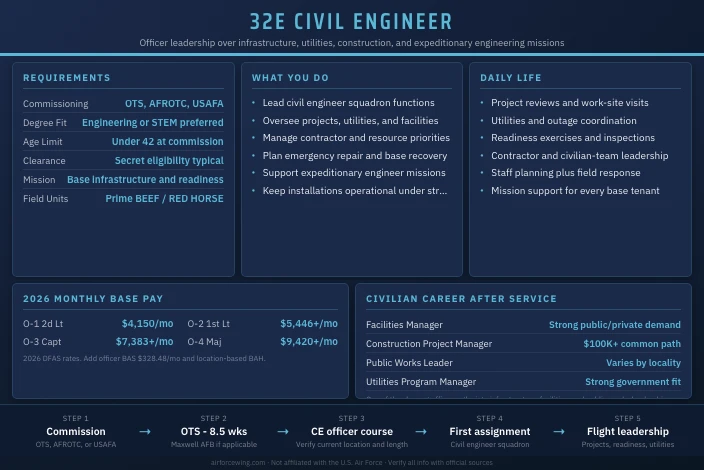
32E Civil Engineers lead Air Force infrastructure, facilities, utilities, environmental, and expeditionary engineering missions. They supervise the officers, NCOs, civilians, and contractors who keep bases functional and who deploy engineering capability with Prime BEEF and RED HORSE units when the mission requires it.
Leadership Scope
A new 32E officer usually starts inside a civil engineer squadron, learning one flight at a time: operations, engineering, emergency services, or readiness. Even early on, the job is leadership heavy. You are not personally wiring buildings or pouring concrete every day. You are setting priorities, allocating manpower, and making sure the people who do that work can keep the installation operating.
By captain and major, the scope expands into project oversight, readiness planning, and installation-level infrastructure decisions. That can mean overseeing large military construction projects, managing utility outages, or running deployed engineer teams in austere environments.
Mission Contribution
Civil engineering is the Air Force field that makes the rest of the base usable. The runway, dorms, hangars, water system, fire protection, environmental compliance, and emergency repair capability all run through this squadron. When a base loses power or storm damage threatens operations, 32E officers are central to the response.
Expeditionary Side
Prime BEEF and RED HORSE give the field its expeditionary identity. Those teams repair damage, build operating locations, restore utilities, and keep airfields usable in contingency environments where civilian support is limited or absent.
Salary
Officer Base Pay
2026 compensation follows the DFAS military pay tables.
| Rank | Grade | Typical YOS | Monthly Base Pay |
|---|---|---|---|
| Second Lieutenant | O-1 | Under 2 | $4,150 |
| First Lieutenant | O-2 | 2-4 years | $5,446-$6,485 |
| Captain | O-3 | 4-10 years | $7,383-$8,376 |
| Major | O-4 | 10-16 years | $9,420-$10,402 |
Allowances And Benefits
- BAH: location based
- BAS: $328.48 monthly
- TRICARE Prime
- BRS retirement and TSP matching
Civilian Value
This field translates well into facilities management, construction management, utilities leadership, public works, and civil-project oversight after service.
Qualifications
Commissioning Paths
| Commissioning Source | Degree Requirement | Age Limit | Notes |
|---|---|---|---|
| OTS | Bachelor’s degree | Must commission before 42 | Competitive officer selection |
| AFROTC | Bachelor’s degree | Must commission before 42 | Career-field assignment after commissioning |
| USAFA | Degree on graduation | Standard academy limits | Assignment at graduation |
Engineering, architecture, environmental science, construction management, and related STEM degrees are especially natural fits, even when the Air Force does not list a single mandatory major for every billet.
Screening And Competitive Factors
Public Air Force career pages place civil engineering inside the larger facilities and engineering mission set rather than a narrow one-page officer specialty. The practical screening picture is straightforward:
- Officer commissioning eligibility
- U.S. citizenship
- Security-clearance eligibility
- Ability to lead in both office and field conditions
- Strong performance in technical or project-heavy environments
Use the AFOQT study guide if OTS is your accession path and you want a stronger test-prep baseline.
Upon Commissioning
New 32E officers enter as O-1 2d Lt and begin learning civil engineer squadron operations immediately. Early credibility comes from understanding the mission fast enough to make sound decisions around infrastructure, safety, and readiness without getting in the way of experienced NCOs and civilians.
Work Environment
Setting And Schedule
This field lives in civil engineer squadrons, project sites, utility plants, emergency operations centers, and deployed construction environments. A lot of the work is staff and coordination, but it is not purely a desk job. Site walks, inspections, outages, exercises, and emergency response all pull 32E officers out into the field.
Officer-NCO Dynamic
Civil engineering works because seasoned NCOs and civilian specialists know the systems in detail. Officers set priorities, manage resources, and own the command relationship. Good lieutenants in this field ask sharp questions, make decisions when needed, and let technical experts do technical work.
Command And Staff Balance
There is a real command track here. Civil engineer squadrons are prominent base organizations because they touch almost every installation function. Later-career officers can move into major-program management, base civil engineer roles, AFCEC-related assignments, and higher-headquarters infrastructure planning.
Training
Training Pipeline
| Phase | Location | Length | Focus |
|---|---|---|---|
| Commissioning source or OTS | Maxwell AFB, AL or source dependent | OTS 8.5 weeks | Officership fundamentals |
| Civil engineer officer initial course | Verify current location | Verify current length | Base engineering, readiness, CE leadership |
| First assignment OJT | Unit of assignment | 12-24 months | Utilities, projects, readiness, squadron operations |
The public recruiting site currently surfaces the civil-engineering mission under a broader family label. That means course names and labels can drift, but the core reality does not: new officers learn how an Air Force civil engineer squadron operates, then build experience by leading pieces of that mission at home station and in the field.
Before any of that, build a competitive commissioning package with the AFOQT study guide.
Additional Development
The field rewards project-management skill, expeditionary readiness, construction-program literacy, and the ability to keep a base operating during disruptions. Later assignments often deepen environmental, emergency management, or major-construction expertise.
Career Progression
Timeline
| Rank | Grade | Typical Timeline | Development Focus |
|---|---|---|---|
| Second Lieutenant | O-1 | Entry to 2 years | Learn squadron functions and lead small sections |
| First Lieutenant | O-2 | 2-4 years | Flight-level project and readiness leadership |
| Captain | O-3 | 4-10 years | Flight commander or major program oversight |
| Major | O-4 | 10-16 years | Deputy BCE, squadron operations, or staff work |
| Lieutenant Colonel | O-5 | 16-22 years | Squadron command or senior installation engineering roles |
Promotion Drivers
Strong officers in this field earn trust by handling outages, projects, exercises, and deployed tasks without losing control of safety or resources. The field values steady execution more than drama.
Broadening
32E opens doors to RED HORSE, Prime BEEF readiness leadership, installation planning, environmental programs, headquarters engineering, and joint infrastructure roles later in the career.
Physical Demands
Fitness Standards
32E officers take the standard Air Force Fitness Assessment.
| Component | Max Points |
|---|---|
| 1.5-mile run | 60 |
| Push-ups | 10 |
| Sit-ups | 10 |
| Waist or body composition | 20 |
The field is not special warfare, but it does expect officers who can move around work sites, tolerate field conditions, and stay effective during long recovery or construction days.
Deployment
Deployment Tempo
Deployment tempo varies by unit, but expeditionary engineering is a real part of the career. Prime BEEF and RED HORSE missions can push 32E officers into austere conditions, contingency construction, and infrastructure recovery tasks.
Duty Stations
Nearly every major installation needs civil-engineering leadership. That gives the field wide basing options, plus additional opportunities tied to engineer-heavy units and readiness organizations.
Risk/Safety
Main Risks
The risk profile is mostly environmental, industrial, and operational:
- Construction and work-site hazards
- Utility failures affecting mission execution
- Emergency response under time pressure
- Expeditionary operations in austere conditions
Control Measures
The field depends on technical discipline, safety programs, contractor oversight, and calm decision-making during outages or emergencies. Civil engineering can absorb a lot of complexity, but not sloppy leadership.
Impact on Family
Home-station life is often steadier than aviation or special warfare communities, but emergencies, storm response, and deployments still disrupt the schedule. The tradeoff is that the career also has strong civilian transfer value if long-term family planning includes engineering or public-works work after service.
Reserve and Air National Guard
Component Availability
Civil-engineering missions exist across Active Duty, Air National Guard, and Air Force Reserve installations. That makes 32E one of the officer fields with credible long-term component flexibility.
Civilian Integration
This field pairs especially well with civilian engineering, utilities, environmental, and construction careers because the military work already sits in that same professional space.
Post-Service
Civilian Career Paths
| Civilian Role | Typical Direction |
|---|---|
| Facilities Manager | Base or campus infrastructure leadership |
| Civil / Construction Project Manager | Commercial or government projects |
| Public Works Director | Municipal or federal infrastructure oversight |
| Utilities / Emergency Management Leader | Operational continuity and resilience work |
Is This a Good Job
32E is a strong fit if you want engineering-adjacent leadership rather than a narrow lab or design role. It is a weaker fit if you dislike field conditions, contractor oversight, or owning messy real-world infrastructure problems that refuse to stay on a clean schedule.
More Information
- Review the Air Force Maintenance and Repair careers page for the current public civil-engineering family context
- Review the AFPC officer developmental category overview showing
32Einside Combat Support - Build your commissioning prep plan with the AFOQT study guide
This site is not affiliated with the U.S. Air Force or any government agency. Verify all information with official Air Force sources before making enlistment or career decisions.
Explore more Air Force civil-engineering officer careers and compare the enlisted engineering side at 3E5X1 Engineering or 3E0X1 Electrical Systems.