52R Chaplain
The Air Force Chaplain is one of the few officer roles where the credential comes before the uniform. The service is not training you to become clergy. It is commissioning someone who already is one, then asking that person to minister in the most demanding environments the military creates. A 52R officer leads worship, counsels Airmen and families, advises commanders on religious accommodation and moral climate, and deploys as a noncombatant with units under stress.
OTS is not the normal front door here, but officer candidates still benefit from understanding Air Force accession expectations. The AFOQT study guide is useful background if you are comparing chaplaincy with other officer paths.
Job Role
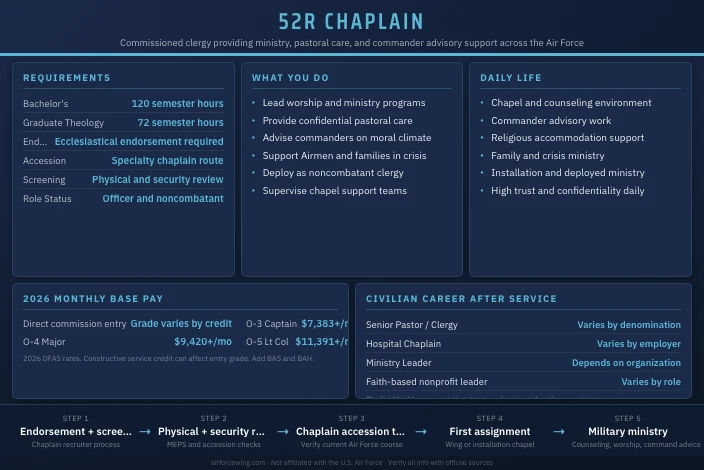
52R Chaplains provide religious ministry, confidential pastoral care, and commander advisory support across the Air Force. They protect the free exercise of religion for Airmen of all faiths while also serving their own endorsing faith group with integrity.
Leadership Scope
A chaplain is an officer, but not a line commander. The leadership is moral, pastoral, advisory, and organizational. Chaplains lead chapel teams, supervise religious affairs Airmen, and advise commanders on issues of conscience, religious accommodation, grief, trauma, and morale.
Mission Contribution
The chaplain corps exists to protect the constitutional right of religious exercise while supporting readiness. That means worship services, counseling, crisis response, and command advice all sit inside the same mission.
Noncombatant Status
This field is unique in the officer corps because chaplains are noncombatants. They do deploy, but their role is ministry and support rather than combat action.
Salary
Officer Base Pay
52R officers receive standard officer pay under the 2026 DFAS military pay tables.
| Rank | Grade | Typical YOS | Monthly Base Pay |
|---|---|---|---|
| Second Lieutenant / First Lieutenant equivalent | O-1/O-2 entry credit varies | Entry dependent | $4,150-$6,485 |
| Captain | O-3 | Common early career officer grade | $7,383-$8,376 |
| Major | O-4 | Mid-career | $9,420-$10,402 |
Direct-commission clergy may receive constructive service credit that affects entry grade. Exact grade depends on experience and current accession policy.
Allowances
- BAH: location based
- BAS: $328.48 monthly
- TRICARE Prime
- BRS and TSP matching
Civilian Value
The field does not translate into a new civilian profession because candidates already arrive as clergy. The value is leadership, counseling, and military ministry experience.
Qualifications
Education And Endorsement
The Air Force Chaplain FAQ gives the clearest published baseline.
| Requirement | Current Public Standard |
|---|---|
| Bachelor’s degree | At least 120 semester hours |
| Graduate theology degree | At least 72 semester hours post-baccalaureate |
| Ecclesiastical endorsement | Required from recognized religious body |
| Ministry experience | Expected and reviewed in screening |
| Physical / security screening | Required before commission |
Accession Path
This is a specialty accession path, not the normal ROTC or USAFA pipeline. The chaplain page emphasizes:
- Ecclesiastical endorsement
- Chaplain recruiter screening
- Resume of religious leadership experience
- MEPS physical
- Security and credit check screening
Upon Commissioning
52R officers commission as clergy already qualified to minister. The military piece is learning how to do that inside the Air Force environment and under military law and policy.
If you are weighing chaplaincy against a standard officer accession lane, the AFOQT study guide helps frame what the broader commissioning process looks like outside this specialty path.
Work Environment
Setting And Schedule
Chaplains work in chapel settings, offices, hospitals, dorms, deployment sites, and crisis-response environments. The job can look quiet on one day and deeply intense on the next.
Relationship With Command
The chaplain serves as a confidential pastoral counselor and also as a commander advisor. That dual role makes trust central to the field.
Team Structure
Chaplains typically work alongside Religious Affairs Airmen and other support staff. The effectiveness of that team matters, especially during deployments and emergencies.
Training
Training Pipeline
| Phase | Location | Length | Focus |
|---|---|---|---|
| Chaplain accession screening | Recruiter and MEPS process | Varies | Endorsement, records, physical |
| Chaplain officer training | Air Force chaplain accession training path | Verify current length | Military ministry and officer integration |
| First assignment OJT | Wing or installation chapel | 12-24 months | Base ministry, command advisory work |
The public chaplain page focuses more on accession requirements than on a single simple training timeline. That reflects reality. The hard gate is becoming endorsement-eligible clergy first.
Candidates comparing officer paths can still use the AFOQT study guide as background on broader Air Force accession expectations, even though chaplaincy is a specialty route.
Career Progression
Timeline
| Rank | Grade | Typical Timeline | Development Focus |
|---|---|---|---|
| Entry-grade chaplain | O-1 to O-3 depending on credit | Entry | Learn Air Force ministry environment |
| Captain / Major | O-3 / O-4 | Early to mid-career | Chapel leadership and commander advisory work |
| Lieutenant Colonel | O-5 | Senior field grade | Wing-level chaplain leadership |
| Colonel | O-6 | Senior career stage | Senior chaplain roles and headquarters advisory work |
Promotion Drivers
The field rewards ministry credibility, deployment performance, advisory effectiveness, and leadership across pluralistic environments. Chaplains must be trusted both by commanders and by the people they serve.
Physical Demands
Fitness Standards
Chaplains are officers and take the standard Air Force Fitness Assessment.
| Component | Max Points |
|---|---|
| 1.5-mile run | 60 |
| Push-ups | 10 |
| Sit-ups | 10 |
| Waist or body composition | 20 |
There is no aviation or special warfare physical requirement attached to 52R.
Deployment
Deployment Tempo
Yes, chaplains deploy. The public FAQ states that clearly. Deployment is a normal part of the field because units need ministry and pastoral care in conflict zones and high-stress environments.
Duty Stations
Chaplain billets exist across the force, from major CONUS installations to overseas wings and deployed settings. The duty-station picture is broad because every base community needs religious support.
Risk/Safety
Main Risks
The risks are emotional, moral, and operational rather than mechanical:
- Ministry during trauma and loss
- High-confidentiality counseling
- Advising leaders during crisis
- Deploying into stressful environments as a noncombatant
Safeguards
The field relies on endorsement, professional conduct, confidentiality, and strong coordination with commanders and religious affairs teams.
Impact on Family
Chaplain life can be meaningful for families, but the emotional load is real. This is a field where you carry other people’s crises home if you do not manage boundaries well. Deployments and PCS cycles still apply like any other Air Force career.
Reserve and Air National Guard
Component Availability
The Air Force chaplain pages and FAQs support active-duty and reserve-component pathways. Availability depends on endorsed faith-group demand and unit needs, but the career is not limited to active duty.
Civilian Integration
This is one of the few officer jobs explicitly designed to pair with an existing civilian profession. Many chaplains move between military and civilian ministry over time.
Post-Service
Civilian Career Paths
| Civilian Role | Typical Path |
|---|---|
| Senior pastor / clergy leader | Continue ministry with added military experience |
| Hospital or institutional chaplain | Strong fit after military pastoral experience |
| Counseling / care ministry leader | Depends on denomination and credentials |
| Nonprofit faith-based leader | Leadership and crisis-ministry overlap |
Is This a Good Job
52R is a strong fit only if you already know ministry is your calling and you want to practice it inside the Air Force. It is not a field for someone casually exploring religion, counseling, or officer life. The credential and commitment requirements are too serious for that.
More Information
- Review the Air Force Chaplain page
- Review the Chaplain FAQ
- If you are still comparing accession routes, the AFOQT study guide helps frame the broader officer picture
This site is not affiliated with the U.S. Air Force or any government agency. Verify all information with official Air Force sources before making enlistment or career decisions.
Explore more Air Force chaplain officer careers and compare the enlisted support lane at 5R0X1 Religious Affairs.