52R Chaplain
The Air Force Chaplain is one of the few officer roles where the credential comes before the uniform. The service is not training you to become clergy. It is commissioning someone who already is one, then asking that person to minister in the most demanding environments the military creates. A 52R officer leads worship, counsels Airmen and families, advises commanders on religious accommodation and moral climate, and deploys as a noncombatant with units under stress.
Chaplains commission through OTS at Maxwell AFB, Alabama, like other Air Force officers. The ROTC and USAFA pipelines are not typical entry points for this specialty. Officer candidates benefit from understanding broader Air Force accession expectations, and the AFOQT study guide is useful background if you are comparing chaplaincy with other officer paths.
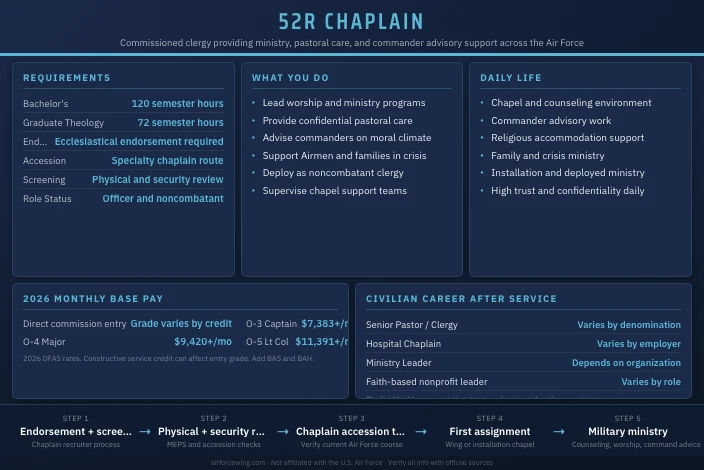
Job Role and Responsibilities
52R Chaplains provide religious ministry, confidential pastoral care, and commander advisory support across the Air Force. They protect the free exercise of religion for Airmen of all faiths while also serving their own endorsing faith group with integrity.
Leadership Scope
A chaplain is an officer, but not a line commander. The leadership is moral, pastoral, advisory, and organizational. On any given week, a 52R officer might lead a worship service for 50 people, sit in a one-on-one counseling session with a suicidal junior enlisted Airman, brief a commander on religious accommodation requests from the unit, coordinate with a civilian hospital chaplain for an Airman family member in crisis, and prepare a religious support plan for an upcoming deployment. None of those activities look like conventional military leadership, and all of them are essential to it.
Chaplains lead chapel teams that include Religious Affairs Airmen (5R0X1), who handle administrative, logistical, and operational support for the chapel program. Managing that team effectively while also fulfilling pastoral duties requires strong organizational and people skills alongside ministry credentials.
Mission Contribution
The chaplain corps exists to protect the constitutional right of free religious exercise while directly supporting unit readiness. Those two purposes reinforce each other. A unit with unresolved moral injury, unaddressed spiritual crisis, or unmet religious accommodation needs does not perform as well in training or combat. Chaplains address the root of those problems in ways no other military professional can. The commander advisory role makes chaplains force multipliers: the insights a chaplain carries from confidential counseling relationships, shared without breaking confidence, can prevent command failures that destroy units.
Noncombatant Status
This field is unique in the officer corps because chaplains are noncombatants under the Geneva Conventions. They do deploy, but they do not carry weapons and do not participate in combat operations. Their role is ministry, counseling, and command advisory support in every environment the Air Force operates in, including combat zones.
Salary and Benefits
Officer Base Pay
52R officers receive standard officer pay under the 2026 DFAS military pay tables.
| Rank | Grade | Typical YOS | Monthly Base Pay |
|---|---|---|---|
| Second Lieutenant / First Lieutenant equivalent | O-1/O-2 entry credit varies | Entry dependent | $4,150-$6,485 |
| Captain | O-3 | Common early career officer grade | $7,383-$8,376 |
| Major | O-4 | Mid-career | $9,420-$10,402 |
Direct-commission clergy may receive constructive service credit that affects entry grade. A candidate with significant ministry experience may enter at O-2 or O-3 rather than O-1, depending on accession policy at the time of application. Exact grade should be confirmed with a chaplain recruiter during the accession process.
Allowances
Officers of all specialties receive the same allowances structure. Basic Allowance for Housing (BAH) is set by duty-station location and dependent status and is tax-free. At high-cost installations, BAH can add $2,000 or more per month to effective compensation beyond base pay.
- BAH: location based, tax-free
- BAS: $328.48 monthly, tax-free
- TRICARE Prime: medical, dental, and vision coverage at low or no cost
- BRS and TSP matching: retirement system with government contributions after 26 months
- Commissary, MWR access, and base services round out the non-cash compensation package
Chaplains who are also ordained clergy do not receive a separate clergy housing allowance (parsonage) on top of military BAH while on active duty. That distinction matters for tax planning during service and after.
Civilian Value
The field does not create a new civilian profession after service because candidates already arrive as clergy. The value is in leadership depth, counseling credential reinforcement, crisis-management experience, and military ministry credibility. A veteran chaplain returns to civilian ministry having counseled Airmen through combat trauma, suicide, divorce, grief, and institutional injustice in ways most civilian clergy will never encounter. That experience, while hard to quantify, makes those individuals exceptional pastoral leaders.
Qualifications and Eligibility
Education And Endorsement
The Air Force Chaplain FAQ gives the clearest published baseline.
| Requirement | Current Public Standard |
|---|---|
| Bachelor’s degree | At least 120 semester hours |
| Graduate theology degree | At least 72 semester hours post-baccalaureate |
| Ecclesiastical endorsement | Required from recognized religious body |
| Ministry experience | Expected and reviewed in screening |
| Physical / security screening | Required before commission |
The ecclesiastical endorsement is the single most important gate in this accession path. It must come from a religious organization that the Armed Forces Chaplains Board (AFCB) recognizes. Not all faith communities have endorsing agents, and some have specific requirements for their chaplain candidates that go beyond the Air Force minimums. Candidates should contact their endorsing agent before beginning the Air Force accession process to ensure they can meet both sets of requirements simultaneously.
Accession Path
Chaplains commission through OTS at Maxwell AFB, Alabama. OTS is the standard commissioning source for this specialty. What makes the chaplain path distinct from the ROTC and USAFA pipelines is the credential gate, not a bypass of OTS. The process requires:
- Ecclesiastical endorsement from a recognized faith-group endorsing agent
- Chaplain recruiter initial screening and application package
- Resume of religious leadership and ministry experience
- MEPS physical examination
- Security background and financial check screening
Candidates who do not hold an endorsement and a qualifying graduate theology degree cannot enter this career field, regardless of other qualifications. Applicants must commission before their 42nd birthday. The process from initial recruiter contact to commission can take 12 to 24 months for a well-qualified candidate, depending on endorsement processing, accession competition, and Air Force accession timelines.
Upon Commissioning
52R officers commission as clergy already qualified to minister in their faith tradition. The military piece is learning how to exercise that ministry inside the Air Force environment and under military law, policy, and operational structure. That transition takes real time and intentional effort in the first assignment. The Air Force chaplaincy expects officers to be both competent military officers and credible spiritual leaders simultaneously.
If you are weighing chaplaincy against a standard officer accession lane, the AFOQT study guide helps frame what the broader commissioning process looks like outside this specialty path.
Work Environment
Setting And Schedule
Chaplains work in chapel sanctuaries, counseling offices, hospital rooms, dormitory common areas, deployment camps, and crisis-response environments. The physical setting shifts more than in almost any other officer career field. One day looks like preparing and leading a Sunday worship service with full attendance. The next might be a midnight call from a duty officer about an Airman in crisis, followed by several hours in a hospital waiting room with a family. The rhythm is not predictable by design, and candidates who need a structured, bounded schedule find this career field difficult. Those who thrive in relational, crisis-responsive work tend to find it exceptionally meaningful.
Chapel programs on large installations run multiple worship services weekly across multiple faith traditions, religious education programs, marriage preparation courses, and community events. The chaplain’s administrative load is real, and officers who do not manage it through their Religious Affairs team will find themselves buried in paperwork instead of in ministry.
Relationship With Command
The chaplain serves simultaneously as a confidential pastoral counselor and as a commander advisor on religious accommodation, morale, and unit climate. That dual role is the defining tension of the career field. Commanders value chaplains who provide honest advisory input on unit health without violating pastoral confidentiality. Building that trust takes time and requires consistent, reliable judgment across many interactions. Chaplains who cannot hold that line credibly in both directions are less effective in both roles.
Team Structure
Chaplains typically work alongside Religious Affairs Airmen who handle logistics, scheduling, facility coordination, and administrative support. On larger installations, a wing chaplain may oversee multiple chaplains and a team of Religious Affairs Airmen. The effectiveness of that team, how well it runs the chapel program and responds to unit needs, directly reflects on the chaplain’s leadership. Officers who invest in their team develop far more ministry capacity than those who treat Religious Affairs Airmen as administrative support only.
Training and Skill Development
Training Pipeline
| Phase | Location | Length | Focus |
|---|---|---|---|
| Chaplain accession screening | Recruiter and MEPS process | Varies | Endorsement, records, physical |
| OTS | Maxwell AFB, AL | ~8.5 weeks | Officer fundamentals and commissioning |
| Chaplain accession training | Air Force chaplain training course | Verify current length | Military ministry, policy, and officer integration |
| First assignment OJT | Wing or installation chapel | 12-24 months | Base ministry, command advisory work |
After OTS, new 52R officers complete chaplain-specific accession training that bridges their ministry background with Air Force policy, military law affecting religious practice, and the operational structure of a wing chapel program. The course introduces the legal framework around religious accommodation under Department of Defense instruction, the command-advisor role, and the administrative requirements of running a multi-faith installation chapel program.
The public chaplain page focuses more on accession requirements than on a detailed training timeline, which reflects how the field actually works. The hard gate is becoming endorsement-eligible clergy first. The military training, while important, teaches Air Force context to someone who already knows ministry. Beyond initial training, chaplains attend advanced professional military education (PME) like Squadron Officer School and Air Command and Staff College alongside officers from all career fields.
Candidates comparing officer paths can still use the AFOQT study guide as background on broader Air Force accession expectations, even though chaplaincy is a specialty route.
Career Progression and Advancement
Timeline
| Rank | Grade | Typical Timeline | Development Focus |
|---|---|---|---|
| Entry-grade chaplain | O-1 to O-3 depending on credit | Entry | Learn Air Force ministry environment |
| Captain / Major | O-3 / O-4 | Early to mid-career | Chapel leadership and commander advisory work |
| Lieutenant Colonel | O-5 | Senior field grade | Wing-level chaplain leadership |
| Colonel | O-6 | Senior career stage | Senior chaplain roles and headquarters advisory work |
Promotion Drivers
The field rewards ministry credibility, deployment performance, advisory effectiveness, and leadership across pluralistic environments. A chaplain at O-3 who has effectively run a wing chapel program, deployed in support of a combat wing, and earned the trust of both commanders and Airmen across the installation is well positioned for promotion. Chaplains who stay narrowly focused on their faith tradition’s internal community without investing in the pluralistic ministry that Air Force chaplaincy requires will have thinner promotion records.
Senior chaplain roles at O-5 and O-6 carry significant organizational responsibility. Wing chaplains often lead teams of two to five chaplains and their Religious Affairs Airmen, manage chapel facilities and budgets, and serve as the senior religious advisor to the wing commander. That role is less about personal ministry and more about organizational leadership and command advisory credibility.
Physical Demands and Medical Evaluations
Fitness Standards
Chaplains are officers and take the standard Air Force Fitness Assessment. Physical standards are the same as for all Air Force officers in non-aviation, non-special-duty positions.
| Component | Max Points |
|---|---|
| 1.5-mile run | 60 |
| Push-ups | 10 |
| Sit-ups | 10 |
| Waist or body composition | 20 |
There is no aviation or special warfare physical requirement attached to 52R. Standard officer accession medical requirements apply at commissioning, including a MEPS physical examination. Ongoing annual officer fitness assessments apply throughout the career.
Deployment environments can be physically demanding regardless of occupational specialty. Chaplains in austere forward-deployed locations may experience limited access to climate control, sleep disruption, and the physical strain of sustained operational pace. Maintaining solid physical fitness is not just a compliance requirement; it affects the chaplain’s ability to be present and effective in those environments.
Deployment and Duty Stations
Deployment Tempo
Yes, chaplains deploy. The public FAQ states that clearly. Deployment is a normal part of the 52R career because units need ministry, pastoral care, and command advisory support in conflict zones and high-stress environments, not just at home station. Deployed chaplains often serve Airmen from multiple units and services simultaneously, providing religious support to any service member in the area who needs it, regardless of faith tradition.
Deployment length varies but typically follows Air Force standard rotation cycles of 90 to 179 days for most deployed positions. Some chaplains deploy into joint environments supporting Army, Navy, or Marine units where Air Force personnel are present. The pace of ministry in a deployed environment tends to be higher than at home station because the stressors driving Airmen to seek counseling are more immediate and intense.
Duty Stations
Chaplain billets exist across the force, from major CONUS installations to overseas wings, deployed locations, and headquarters assignments. Large Air Force bases typically have multiple chaplains. Smaller bases may have one or two. Officers can serve at installations across the United States, in Europe, Asia, and the Middle East, and at joint bases shared with other service branches. The duty-station picture is broad because every base community needs religious support, and the Air Force is a global force.
Risk, Safety, and Legal Considerations
Main Risks
The risks in this career field are emotional, moral, and operational rather than mechanical or physical. Chaplains carry other people’s crises professionally. Cumulative secondary trauma from sustained exposure to grief, suicide, combat loss, sexual assault cases, and family dissolution is a real occupational risk in this field. Chaplains who do not maintain their own spiritual and psychological health over the course of a career can develop compassion fatigue that impairs their ability to minister effectively.
Specific risk areas include:
- Compassion fatigue from sustained crisis ministry without adequate self-care
- Confidentiality violations, which can destroy trust and end a chaplaincy career
- Boundary violations in pastoral counseling relationships
- Advising commanders in ways that inadvertently expose privileged counseling information
- Deploying into stressful environments as a noncombatant without adequate psychological preparation
Safeguards
The field relies on endorsement accountability, professional ethics training, regular supervisory consultation with the wing chaplain, and formal peer support structures. Air Force chaplains are expected to maintain active relationships with their endorsing faith organizations throughout their career, which provides an external professional accountability structure. Chaplains are not licensed mental health providers, and they know the boundaries between pastoral care and clinical mental health treatment. Referral relationships with military mental health providers are a core part of doing the job responsibly.
Impact on Family and Personal Life
Chaplain life can be deeply meaningful for families who understand and support the calling. The mission is visible and purposeful in ways that are easy to explain to children and spouses: this person helps people through the hardest moments of their lives. But the emotional load is real, and it does not always stay at the office. Chaplains who minister through a week of suicides, combat deaths, and family trauma carry something home even when they do not carry specific information. Families who are not prepared for that reality, and who see the chaplain as having a 9-to-5 officer job, often find the lived experience of the career harder than expected.
PCS moves happen on the standard Air Force officer cycle, roughly every two to three years. Deployments follow unit and Air Force needs. Unlike some operational fields, chaplain deployments are rarely announced far in advance; they respond to unit requirements. That unpredictability adds family stress that candidates should discuss directly before entering the field. The Air Force maintains strong family support programs, including Family Support Centers and chapel-based programs, that families of 52R officers can access on every installation.
Reserve and Air National Guard
Component Availability
The Air Force chaplain pages and FAQs support active-duty and reserve-component pathways. Reserve and ANG chaplains fulfill the same mission for their units during drill weekends, annual training, and deployments. Availability of billets depends on endorsed faith-group demand and unit needs, but the career field is not limited to active duty.
Reserve-component chaplains are often actively serving in civilian ministry while maintaining their military chaplaincy commitment. That dual role is the most natural version of a chaplain career because the civilian ministry credential remains active and in use throughout. Reserve chaplains who are senior pastors, hospital chaplains, or institutional ministers during the week bring directly relevant current experience to their drill weekend ministry.
Civilian Integration
This is one of the few officer jobs explicitly designed to pair with an existing civilian profession. Many chaplains move between active-duty and reserve ministry over the course of a career, maintaining continuity in both. The combination of active-duty military experience and ongoing civilian ministry creates a ministry leader who is unusually well prepared for senior institutional or hospital chaplaincy roles.
Post-Service Opportunities
Civilian Career Paths
| Civilian Role | Typical Path |
|---|---|
| Senior pastor / clergy leader | Continue ministry with added military and crisis-ministry experience |
| Hospital or institutional chaplain | Strong fit after military pastoral and crisis-response experience |
| Veterans’ service chaplain | Highly valued; military experience directly relevant |
| Counseling or care ministry leader | Depends on denomination, credentials, and clinical training pursued |
| Nonprofit faith-based leader | Leadership and crisis-ministry experience map well |
Veterans of 52R careers return to civilian life with ministry experience that most civilian clergy cannot match. Managing a pluralistic, multi-faith community under operational pressure, counseling in combat and crisis environments, and advising senior military leaders on religious and moral matters gives veteran chaplains a depth that opens doors in hospital chaplaincy, hospice ministry, veterans’ ministry organizations, and senior pastoral roles at institutions with diverse congregations or clinical populations.
Some veteran chaplains pursue additional clinical credentials such as Clinical Pastoral Education (CPE) certification to expand their scope in hospital or counseling settings. The military pastoral experience often shortens the CPE process because so much of the required competency has already been demonstrated in uniform.
Is This a Good Job for You? The Right (and Wrong) Fit
52R is a strong fit only if you already know ministry is your calling and you want to practice it inside the Air Force. The credential and commitment requirements are too serious for a casual exploration of officer life, religious counseling, or military culture. Candidates who are not already ordained, endorsed clergy with a qualifying graduate theology degree cannot enter this field, and those who enter without genuine pastoral conviction tend to find the sustained emotional and spiritual demands unsustainable.
The field is also a poor fit for officers who need a structured, predictable schedule; who are uncomfortable sitting with suffering and grief without offering a solution; or who want a visible operational mission that creates measurable tactical effects. Ministry, including military ministry, is not that kind of job.
The right fit is an ordained minister, priest, rabbi, imam, or other endorsed clergy person who wants to serve those in uniform, who can hold confidence and command trust simultaneously, and who has the resilience to minister through repeated human tragedy without losing their own faith or their own health.
More Information
- Review the Air Force Chaplain page
- Review the Chaplain FAQ
- If you are still comparing accession routes, the AFOQT study guide helps frame the broader officer picture
Explore more Air Force officer career paths to compare this field with other options.