Air Force Flight Test Engineer: The 62E Flight-Test Path
A flight test engineer works out what a new aircraft must prove. The engineer plans the test, watches the data, and reports what it means. The pilot flies the profile. The engineer owns the plan and the analysis.
Here is the part people miss. You do not join the Air Force as a flight test engineer. You commission as an engineer first. Then you compete for the test school. The flight test code comes after the course, not before it.
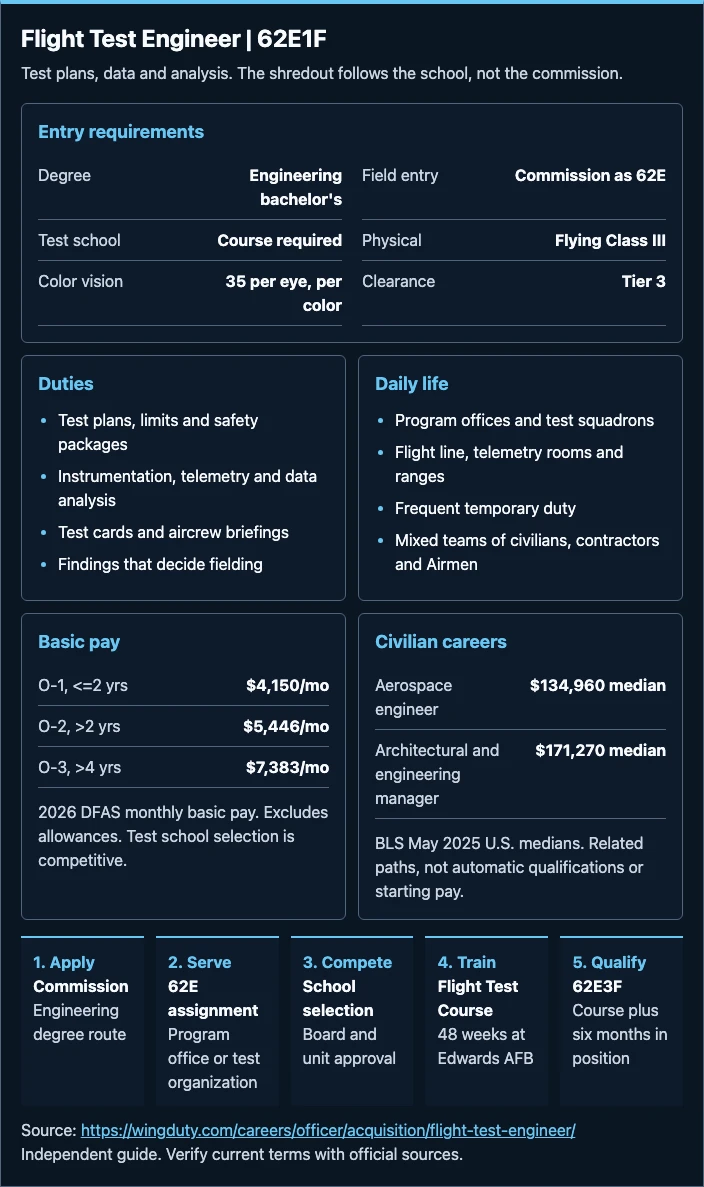
Entry requirements
- Degree
- Engineering bachelor's
- Field entry
- Commission as 62E
- Test school
- Course required
- Physical
- Flying Class III
- Color vision
- 35 per eye, per color
- Clearance
- Tier 3
Duties
- Test plans, limits and safety packages
- Instrumentation, telemetry and data analysis
- Test cards and aircrew briefings
- Findings that decide fielding
Daily life
- Program offices and test squadrons
- Flight line, telemetry rooms and ranges
- Frequent temporary duty
- Mixed teams of civilians, contractors and Airmen
Basic pay
- O-1, <=2 yrs
- $4,150/mo
- O-2, >2 yrs
- $5,446/mo
- O-3, >4 yrs
- $7,383/mo
2026 DFAS monthly basic pay. Excludes allowances. Test school selection is competitive.
Civilian careers
- Aerospace engineer
- $134,960 median
- Architectural and engineering manager
- $171,270 median
BLS May 2025 U.S. medians. Related paths, not automatic qualifications or starting pay.
- ApplyCommissionEngineering degree route
- Serve62E assignmentProgram office or test organization
- CompeteSchool selectionBoard and unit approval
- TrainFlight Test Course48 weeks at Edwards AFB
- Qualify62E3FCourse plus six months in position
Source: Air Force Flight Test Engineer: The 62E Flight-Test Path
Independent guide. Verify current terms with official sources.
On this page
Wing Duty is supported by purchases through our links, which may earn us a commission.
Job Role and Responsibilities
62E1F flight test engineers plan and lead tests of Air Force aircraft, systems and software. They turn a requirement into a test plan, decide what data will prove or disprove it, run the test with aircrew and maintainers, and report findings that decide whether a system is safe to field. The flight test shredout sits inside the 62E developmental engineering field, and it is awarded only after an officer finishes a flight test engineer course.
The April 2026 officer classification directory lists the wider 62E job. That work covers systems engineering across a system’s life. It runs from requirements and design to manufacturing, quality and test. Support engineering, spares and technical orders sit in the same span. The flight test branch takes the test part. It then adds a flying program around that part.
Command and Leadership Scope
A new 62E1F joins a test team of government civilians, contractors and enlisted maintainers. Only a few members are officers, so the junior engineer starts with technical work. That means building the test plan and test card, briefing the aircrew, watching the data and writing up what happened.
Responsibility grows with the program rather than the size of the team. A captain may direct a test project and sign the safety package that lets it fly. A major or lieutenant colonel may lead a test division, oversee a group of projects or serve as the technical authority for a system. Test teams are small but highly skilled, so officers lead through judgment rather than headcount.
Specific Roles and Designations
The field uses an entry level, a qualified level and a staff level. The flight test suffix is the letter F.
| Code | Level | What earns it |
|---|---|---|
| 62E1F | Entry, flight test | Completion of the Air Force Flight Test Engineer Course, the Space Test Course, or a comparable US Navy or foreign flight test engineer course |
| 62E3F | Qualified, flight test | The acquisition fundamentals course, the flight test engineer course, and at least six months of experience in a 62E3F position |
| 62E4 | Staff | The senior level of the field |
Other suffixes cover aeronautical (A), astronautical (B), computer systems (C), electrical and electronic (E), project (G) and mechanical (H). A further suffix covers systems, industrial and human factors (I). Most branches want an engineering degree in that discipline. Flight test and project are the two exceptions. Flight test is defined by its course. Project takes any engineering major.
Special Experience Identifiers record extra qualifications. They sit apart from the AFSC code on an officer’s record.
The 62E parent profile covers the shared engineering career. The 11X Pilot profile covers the flying career that supplies test pilots for the same programs.
Mission Contribution
Test and evaluation sits between a design and a fielded system. A test program answers narrow questions. Does the radar hold track at the edge of its range? Does the software recover from a fault? Does the new rack release safely at the limits of the envelope? Each answer is evidence. Program offices, requirements owners and safety boards use it to decide.
Flight test engineers work beside test pilots, combat systems officers, air battle managers and remotely piloted aircraft pilots. The Test Pilot School lists its student groups. They are experimental test pilots, experimental RPA pilots, experimental combat systems officers, experimental air battle managers, and experimental flight test engineers. One program can include several at once. Each has a different job in the air and on the ground.
Technology, Equipment, and Systems
The tools are test instruments, telemetry, data systems and analysis software. Before a flight, the engineer writes the test card, the limits and the safety package. After it, the engineer reads the recorded data, the video and the telemetry. Model based systems engineering, test planning software and data tools support that work. The wider 62E field uses standard acquisition reviews and readiness levels.
Systems under test range from fighters, bombers and tankers to remotely piloted aircraft and space systems. Electronic warfare gear and command software sit in the same list. The aircraft type matters less than the method. Define the question, set the limits, and measure the answer.
Salary and Benefits
Flight test engineers receive base pay by rank and years of service on the same scale as other line officers. There is no separate flight test scale. The rows below use shared 2026 DFAS data to show pay at selected ranks and service lengths, not to predict when an officer will reach each rank.
| Rank | Pay Grade | Years of Service | Monthly Base Pay | Annual Base Pay |
|---|---|---|---|---|
| Second Lieutenant (2d Lt) | O-1 | 2 or less | $4,150 | $49,802 |
| First Lieutenant (1st Lt) | O-2 | Over 2 | $5,446 | $65,354 |
| Captain (Capt) | O-3 | Over 4 | $7,383 | $88,592 |
| Major (Maj) | O-4 | Over 10 | $9,420 | $113,040 |
Source: DFAS 2026 pay tables. Figures reflect the 2026 pay raise.
Allowances sit on top of base pay. The officer food allowance is $328.48 a month. Housing allowance depends on rank, location and dependents. So there is no single figure for the field.
Other pay follows its own rules.
- Healthcare follows active duty TRICARE rules. The member pays no enrollment fee or copay.
- A flying crew job can carry the right incentive pay. That needs the right rating and orders. It is not paid across the field.
- No standing 62E bonus was verified for this page. Acquisition retention bonuses appear when the field needs people. Ask a recruiter or career field manager for the current position.
- Active duty members earn 30 days of paid leave a year. Test schedules and travel can shape when it is used.
The Blended Retirement System pairs a pension with a savings plan. Members who meet the rules get 40% of the highest 36 month average base pay at 20 years, with allowances excluded from that base. The Thrift Savings Plan adds 1% of base pay plus matching contributions of up to 4% when a member puts in 5%, though some money must vest first.
Work life here is steadier than in a flying squadron. Program offices keep normal hours most weeks, and deployment is light. The trade is travel. Test programs send engineers to ranges, contractor plants and other test centers. A big test campaign can mean long days until the data is in.
Qualifications and Eligibility
Find the right entry route
You need a bachelor’s degree to commission. For this field, it should be in engineering. The recruiting page for developmental engineers lists aerospace, aeronautical, astronautical, computer, electrical, electronics, communication and mechanical. There is no direct commission path for 62E. Every officer enters through ROTC, the Air Force Academy or Officer Training School.
| Route | Degree | Age | How the field is assigned |
|---|---|---|---|
| Air Force ROTC | Accredited bachelor’s, engineering related to the field | Under 31 at commissioning; confirm the current standard | Career field assigned before commissioning through the cadet classification process |
| Officer Training School | Bachelor’s degree; engineering related to the field | Must be at least 18 and not yet 42 | Applied for as part of the OTS selection process |
| Air Force Academy | Academy degree with an engineering major available in the curriculum | Academy entry rules apply | Assigned during the senior year |
The recruiting page lists no field grade point average. ROTC and OTS each set their own academic bar. Confirm the current numbers with a detachment or recruiter. An engineering degree helps your odds for a 62E job. It does not guarantee one. It does not put you in flight test either.
Study for the AFOQT
Every officer route needs the Air Force Officer Qualifying Test. The published minimums for officer accessions are verbal 15 and quantitative 10. Those are floors, not targets. A technical field rewards strong quantitative scores. Boards compare candidates. They do not just check boxes.
The TBAS is for pilot and combat systems officer candidates. This field does not need it.
A study plan should show where marks are lost.
- Take a timed sample test and keep the score.
- Sort the errors by topic and by cause.
- Review the method behind each missed answer.
- Try fresh questions to see if the skill improved.
If you want lessons and practice in a set order, an AFOQT study course is one paid option. This is an affiliate link. No course can promise a career field or a test school seat. A study guide costs less if you study on your own. Check what each format includes before you buy.

Security Clearance
The 62E field needs routine access to Tier 3 information and systems. A current Tier 3 investigation is mandatory to hold the AFSC. The entry level can be awarded before it finishes. That needs an interim Secret clearance. Some programs need more, based on the systems involved. So the assignment, not the career field alone, sets the level of access.
Career Field Assignment and Classification
Cadets are classified into career fields by the Air Force Personnel Center. It weighs the academic record, test scores, field training and the needs of the Air Force. OTS candidates apply to a field, and selection is part of the board. Cross training into 62E later is possible but rare. It takes a waiver and approval from the career field manager.
Flight test is not part of that first decision. The flight test shredout cannot be awarded at commissioning because the entry code requires the flight test engineer course. Applicants first commission into 62E or another technical field, do well in an engineering or test job and then compete for the school when a board opens.
Upon Commissioning
New officers enter at O-1, a second lieutenant. Your commissioning route sets its own service commitment, so read that term with a recruiter before you sign. The test school adds its own obligation. The Test Pilot School states that the current active duty service commitment for its course is five years. That clock starts after the course, not after your commission.
Work Environment
Setting and Schedule
The job moves between an office, a flight line, a telemetry room and a test range. In a program office, a normal week means test plans, contractor questions and prep for the next test. During test weeks, early briefs give way to aircraft or systems work that drives the schedule. The team collects data through the day and uses the debrief to prepare for the next attempt.
Travel is normal here, not rare. Engineers go to ranges, contractor plants and other test centers. A program in a heavy test phase can keep a team away for weeks. Deployment is lighter than in operational flying fields.
Leadership and Chain of Command
A flight test engineer works in a test squadron or a program office. The team may include government civilians who have known the aircraft for decades. Contractors built the system. Enlisted maintainers keep it flying. Rank gives authority. Technical credibility decides how much weight an argument carries.
The NCO relationship differs from a flying squadron. A test project may have few enlisted members. So leadership shows up as clear priorities, sound test plans and fair treatment of a mixed team.
Staff vs. Command Roles
Careers here alternate between technical jobs and staff work. Technical tours build depth on a system or a test method. Staff tours at a major command, the Pentagon or a joint headquarters build the wider view. Boards look for that above O-4. Some officers return to the schoolhouse. They teach at the Test Pilot School, the Air Force Institute of Technology or the Academy.
Command jobs exist too. They include test squadron command and program leadership. Those roles carry command equivalent duty for people and resources.
Job Satisfaction and Retention
Officers who stay talk about the technical depth and the small teams. They also point to the fact that a test result changes a program. Officers who leave point to the slow pace, the paperwork and the pay available to engineers with clearances.
No current retention rate for this field was verified for this page. Treat any general acquisition figure as a broad picture, not this field’s number. Ask about manning if retention matters to your decision.
Training and Skill Development
Pre-Commissioning Training
ROTC cadets finish a four year program. It includes field training, leadership labs and the Air Force curriculum. Those courses run beside the engineering courses. Academy cadets finish the military and academic program. They also hold leadership jobs in the Cadet Wing. Officer Training School serves graduates of neither program. The official OTS page describes an 8.5 week course at Maxwell Air Force Base in Alabama.
Initial Skills Training
Every 62E officer starts with the acquisition fundamentals course. The classification directory names two options. One is the Air Force Institute of Technology course, Fundamentals of Acquisition Management. The other is the Defense Acquisition University course, Fundamentals of Systems Acquisition Management. For reserve officers, that rule applies to the grades O-1 through O-4.
| Stage | Where | Length | Focus |
|---|---|---|---|
| Officer Training School, if needed | Maxwell AFB, Alabama | 8.5 weeks | Officership and leadership |
| Acquisition fundamentals course | Air Force Institute of Technology or Defense Acquisition University | Course dependent | The defense acquisition system |
| First assignment | Program office, laboratory or test organization | Ongoing | Engineering practice and program work |
| Flight test engineer course | Test Pilot School at Edwards AFB, California, or a comparable course | 48 weeks for the Test Pilot School course | Test planning, execution, analysis and reporting |
The flight test engineer course is the gate to the shredout. The Air Force sends officers to the Test Pilot School Flight Test Course. It also sends them to the Space Test Course for space systems. A comparable Navy or foreign course counts too. The entry code comes on completion. The directory also lists a physical and a color vision standard for the qualified level. This page covers both under medical evaluations.
Professional Military Education
Squadron Officer School comes around the captain years. It runs at Maxwell Air Force Base or by distance learning. It is required for promotion to major. Air Command and Staff College serves majors who compete for lieutenant colonel. Air War College serves senior lieutenant colonels and colonels. Class dates and formats change, so confirm them before you plan around a school.
Additional Schools and Training
The Test Pilot School runs more than one course. Its Space Test Course graduates receive graduate certificates in Space Test Engineering, which matters for space programs. Graduates of the 48 week Flight Test Course earn the Master of Flight Test Engineering. That course carries the five year service commitment noted earlier.
The Air Force Institute of Technology offers funded graduate degrees. The Air Force rarely pays for advanced technical education as part of a career. This is one of the few places it does. On the acquisition side, the Materiel Leader specialty makes a Defense Acquisition Workforce Improvement Act certificate mandatory. It must be at the practitioner level in test and evaluation or engineering. So certification courses run beside the day job.
Career Progression and Advancement
Career Path
The field moves from doing technical work to leading it. Early jobs build test discipline and system knowledge. Middle jobs add program duty. Senior jobs carry technical authority for a group of programs.
| Rank | Time in grade | Possible development and duties |
|---|---|---|
| O-1, second lieutenant | Initial grade; school timing varies | Learn the system, support test planning and data analysis |
| O-2, first lieutenant | Selected active duty officers normally reach captain after two years in grade, subject to approval rules | Run parts of a test project and brief aircrew |
| O-3, captain | No verified flight test tour length | Direct a test project, sign test plans, attend Squadron Officer School |
| O-4, major | Board selected; no verified flight test timeline | Lead a test division or a program engineering team |
| O-5, lieutenant colonel | Board selected; command has a separate selection | Senior test leadership, program office leadership or staff |
| O-6, colonel | Board selected; limited senior posts | Group or wing level leadership, senior acquisition roles |
The two year active duty rule for selected first lieutenants still needs approval, and date of rank rules apply. No flight test promotion rate was verified for this page. A broad Air Force rate would not describe this field.
Promotion System
Promotion to O-2 and O-3 is mostly time and a clean record. O-4 and above are board selections. Boards weigh performance reports, education, awards and the breadth of a career. They reward officers who led technical work and finished professional military education. They also reward officers who took jobs outside one program office.
Cross-Training and Broadening
A 62E officer can compete for operational experience tours. Those place acquisition officers in flying units or command staffs. Officers who want program management as their main job can move to the 63A Acquisition Manager field. That needs career field manager approval. Teaching, joint staff and fellowship tours are the usual broadening moves. Each one takes an application and a release from the current job.
To build a competitive record, keep the technical work strong and make results visible. A test program that finished early says more than a list of courses. So does a design fix that ended a repeated failure.
As flight-test engineers advance, the job can move from analyzing a particular test to planning a wider campaign and deciding whether the evidence supports the next step. Coordinating pilots, engineers and program staff requires a clear explanation of what a result establishes and what remains uncertain. A leadership role may involve more review and risk discussion than hands-on analysis, so applicants should consider which part of that progression appeals to them.
Physical Demands and Medical Evaluations
Physical Requirements
Flight test engineers still take the general fitness test. The current assessment uses a two mile run or an approved shuttle run. It adds strength and core events plus a waist to height measure. The pass mark is 75 points, with an event minimum in each chosen event. The Air Force fitness page and DAFMAN 36-2905 own the rules and the charts.
| General assessment, under age 25 | Male | Female |
|---|---|---|
| Minimum satisfactory total | 75 points | 75 points |
| Event minimums | Meet each chosen event’s chart minimum | Meet each chosen event’s chart minimum |
| Failure despite 75 total | A missed event minimum can make the result unsatisfactory | A missed event minimum can make the result unsatisfactory |
The current age and sex score sheets were not checked for this page. So no run times or repetition counts appear here. Use the official charts.
Flight Physicals and Career Field-Specific Medical
The flight test level has its own medical gate. The classification directory requires a Flying Class III physical under AFI 48-123. That applies at the qualified level. It also sets a color vision score of at least 35 in each eye for each color. It states that no scanning duties are required. Officers who fly as crew should expect the unit’s own flying medical and physiological training too.
Nothing here grants a waiver. Medical staff review past surgery, eye conditions and injuries against the current standard. A school or a unit can add screening of its own. Start the medical work early, because a slow review can move a school date.
Deployment and Duty Stations
Deployment Details
This is a low deployment field. Acquisition and test work sits mostly in the continental United States. Deployments tend to be short. They follow a system being fielded or a request for technical help. The travel burden comes from temporary duty instead. That means trips to ranges, contractor plants, test centers and program reviews.
Duty Station Options
Flight test work sits at a small number of bases. Edwards Air Force Base in California hosts the Air Force Test Center and the Test Pilot School. Eglin Air Force Base in Florida supports armament and test work. Arnold Air Force Base in Tennessee runs propulsion and ground test facilities. Wright Patterson Air Force Base in Ohio hosts Air Force Materiel Command and the Air Force Institute of Technology. Other acquisition work sits at Hanscom, Kirtland, Hill and Los Angeles Air Force Base.
Officers state preferences through the Air Force Personnel Center. Assignments follow the needs of the Air Force and the officer’s record. Join spouse rules exist, but they cannot create a job at every base. Flight test locations are few. That is a real limit for a couple who both need a set place.
Risk, Safety, and Legal Considerations
Job Hazards
Flight test carries the risk of testing something past its known behavior. The field manages that with planning, not optimism. Limits are set before the flight. The test card is briefed and flown as written. Data is checked before the next event. An engineer who signs a test plan or a safety package shares the duty for what happens next.
The other hazard is professional. Developmental engineers answer for engineering decisions, especially on safety critical systems. A misstated finding or a hidden conflict of interest can end a career.
Safety Protocols
Operational risk management applies to test work as it does across the Air Force. Test organizations use hazard analysis, test readiness reviews and independent safety review. They stop a test when its assumptions no longer hold. Engineers are expected to raise a concern in the review, not in a memo after the fact.
Legal and Command Responsibility
Officers work under the Uniform Code of Military Justice. Federal acquisition law and regulation also apply. Rules on procurement integrity and on certified cost or pricing data govern how an officer deals with contractors. They also govern how program costs are documented. Relief from a job for cause goes in an officer’s file. It ends most promotion prospects above O-4. That is one reason acquisition officers treat signature authority with care.
Impact on Family and Personal Life
Family Considerations
The field is steadier than a flying squadron. Acquisition and test tours usually run three to four years, and the bases do not change often. So a family can settle and hold a school year. Wright Patterson, Edwards, Eglin and the other hubs have established communities and base services.
The cost is travel. Temporary duty can take an engineer away during a heavy test phase. A program that slips moves the schedule at home too. Airman and Family Readiness Centers help with moves, spouse jobs and money. The Key Spouse Program links families during absences.
Dual-Military and Family Planning
Join spouse requests are considered, not guaranteed. This work sits at a handful of bases. That makes co-location harder than in a large career field. Couples should compare likely assignments before choosing this field. Plan for one member to take a less wanted posting if both want technical work.
Test schedules depend on aircraft availability, conditions and the need to investigate unexpected results. Planned work can change without much notice even when the engineer is assigned to one location. Families evaluating the field should ask about travel, unusual test hours and the difference between routine office periods and active campaigns rather than assuming all engineering roles follow the same schedule.
Reserve and Air National Guard
Component Availability
The 62E field exists in the Air Force Reserve and the Air National Guard. Both have fewer jobs than active duty. Reserve and Guard engineers tend to serve near the major acquisition and test bases. Some work beside active duty counterparts on the same programs.
Commissioning Paths
Reserve and Guard officers commission through ROTC with a reserve contract, or through unit sponsored OTS. A transfer from active duty is the third route. A transfer needs a release and an open job. A strong engineer is a fair candidate for a unit job. The unit still has to have the opening.
Drill and Training Commitment
The standard commitment is one unit training assembly weekend a month. It adds a two week annual tour. Acquisition certification and program work can add days. A flight test job in a part time unit may take more time than a monthly drill suggests.
Part-Time Pay
A drill period pays one thirtieth of monthly basic pay. So four periods pay about four thirtieths of a month. An O-3 with more than four years of service earns $246.09 for one paid drill period in 2026. Four periods pay $984.36 before tax and deductions. Annual training and active orders pay under their own rules. A drill check does not include the full set of active duty allowances.
Benefits Differences
Members who meet the rules can buy TRICARE Reserve Select for $57.88 a month alone or $286.66 with family coverage in 2026. Those are premiums, and care can carry extra costs. Federal tuition assistance is open to drilling members. Guard education benefits vary by state. Post 9/11 GI Bill eligibility depends on qualifying service, so the benefit differs from member to member.
Command and Career Progression
Reserve and Guard units have their own command and leadership jobs. Officers can attend professional military education when a seat and schedule allow. Promotion timing and board rates differ from active duty. No current field figures were verified for this page.
Reserve and Guard engineering positions are fewer than active-duty positions, and the available duties may lean toward acquisition or program support rather than hands-on flight testing. Ask whether the specific billet has a test organization, which technical qualifications it requires, and what assignments can follow it. Promotion and school seats are not guaranteed by prior engineering experience.
Deployment and Mobilization
Part time members can be mobilized for contingencies or operational support. Acquisition skills are sometimes needed on active orders for a program. No fixed mobilization interval was verified, so ask a unit what its recent cycle looked like.
A lower routine deployment tempo does not mean there is no travel. An engineer may need temporary duty at a test range, contractor site, or program review, and part-time officers can receive active orders when their skills are needed. Ask the unit for its recent schedule and distinguish regular drills, short technical trips, and mobilizations when assessing the time commitment.
Civilian Career Integration
This field pairs well with civilian work. Many Reserve and Guard 62E officers work for defense contractors, federal agencies or aerospace firms during the week. Their program experience and clearance support that work. USERRA protects job and reemployment rights for covered service, within its rules. It does not promise full civilian pay during a mobilization.
| Factor | Active duty | Air Force Reserve | Air National Guard |
|---|---|---|---|
| Commitment | Full time | Part time, roughly 39 days a year plus mobilization | Part time, roughly 39 days a year plus mobilization |
| 2026 O-3 pay example, over four years | $7,382.70 monthly base pay | $984.36 for four paid drill periods | $984.36 for four paid drill periods |
| Healthcare | Active duty TRICARE rules | Eligible members may buy Reserve Select | Eligible members may buy Reserve Select |
| Education | Federal programs with service conditions | Component programs; GI Bill depends on service | Federal and eligible state programs |
| Deployment | Program tasking, low tempo | Mobilization and operational support | Federal and state duty as applicable |
| Command | Test and program leadership | Unit level billets | Unit level billets |
| Retirement | Qualifying active service under the Blended Retirement System | Points based, payable from age 60 with qualifying years | Points based, payable from age 60 with qualifying years |
Post-Service Opportunities
Transition to Civilian Life
A flight test engineer leaves with a rare mix. That mix is test design experience and data analysis discipline. It also means program office knowledge and often a clearance. Flight test organizations, defense contractors and aerospace makers hire people who have run a test program. The skill is learned on the job, not in a classroom.
Keep mission details out of a resume. Describe the test problem, the method and the result in general terms. Let the clearance and the program experience speak. The Transition Assistance Program can help plan the move.
Civilian Career Prospects
| Civilian field | US median annual pay, May 2025 | Job growth, 2025 to 2035 |
|---|---|---|
| Aerospace engineer | $134,960 | 8% |
| Architectural and engineering manager | $171,270 | 6% |
These are medians for everyone in the occupation, not starting pay for a former officer. They are related paths, not automatic matches. A test background fits an aerospace firm, a flight test organization or a systems engineering job. A clearance adds value with defense employers.
For an actual vacancy, compare the required engineering degree, security eligibility, and technical tools with work done during service. Test planning, telemetry analysis, safety review, and program leadership may lead to different jobs even within the same aerospace company. Keep unclassified examples of methods and results that a civilian hiring team can verify without exposing restricted information.
Graduate Education and Credentials
A Test Pilot School graduate holds a Master of Flight Test Engineering. Air Force Institute of Technology degrees carry civilian recognition. The Post 9/11 GI Bill can fund further study for members who have not used it. An accredited engineering degree plus qualifying work experience is also the usual route to a Professional Engineer license. State boards decide how military experience counts. Check the board where you plan to practice.
Is This a Good Job for You? The Right (and Wrong) Fit
Ideal Candidate Profile
This path suits an engineer who wants to own a technical question from plan to answer. The work rewards people who write clearly and defend a method in a review. It also takes patience for a long data review and calm when a test goes wrong. Curiosity matters more than bravado. The job is to find out what is true, not to prove a design right.
Potential Challenges
Most 62E work is not flight test. Officers spend years in program offices before a test school seat opens. Some never go. The acquisition system moves slowly by design. It adds layers of review, paperwork and coordination. An engineer who needs fast feedback can find that hard.
Flight test has a cost too. Travel is frequent, and test schedules slip. The work sits at a few locations. That can strain a family which needs a set place to live.
Career and Lifestyle Alignment
Compare the three routes before you commit. A test pilot flies the profile, which needs a pilot rating and the test pilot course. A flight test engineer plans and analyzes the test, and reaches it through an engineering commission. A civilian flight test engineer does similar analysis for a contractor or a test organization. That route skips the commission, which matters if you want the technical work without the military career.
If program management is the real interest, the 63A Acquisition Manager field is the direct route. It does not need an engineering degree. If the pull is flying rather than testing, start with the 11X Pilot profile.
More Information
Ask a recruiter or an ROTC detachment which engineering majors the current boards favor. Ask a test organization what a new engineer does in the first year. Then plan the parts you control. Those are the degree, the AFOQT score, the fitness standard and the medical review.
For test preparation, the AFOQT study course is the first paid option on this page. This is an affiliate link. A study guide costs less if it fits your budget and study habits. The free AFOQT guide on this site explains the composites. It also says what each one measures.
Compare the Acquisition officer group to see how this field fits the wider community. The 63A Acquisition Manager and 64P Contracting Officer pages explain the program management and contracting roles. Those roles work beside developmental engineers. The 62E parent profile covers the shared pay, commissioning and career details in full.