64P Contracting Officer
Every F-35, satellite, and communications network the Air Force operates got there through a contract. The 64P Contracting Officer is the officer who writes it, negotiates it, and makes sure the other side delivers.
This career field sits at the center of the defense acquisition system. Contracting officers hold legal authority to commit the U.S. government to billions of dollars in spending. They negotiate with major defense primes, administer complex multi-year agreements, and ensure every dollar spent follows the Federal Acquisition Regulation. If the program manager decides what gets built and the engineer decides how it works, the contracting officer decides on what legal and financial terms the government actually pays for it. That’s real authority, and real accountability.
OTS candidates need competitive ASVAB scores. Our AFOQT study guide covers exactly how to prepare.
Job Role
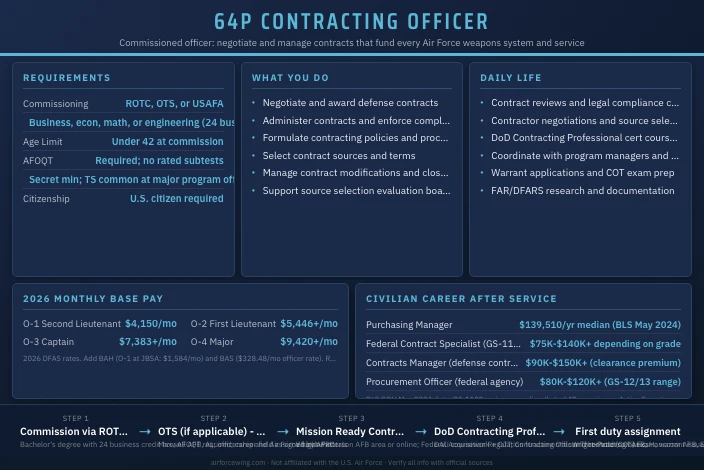
64P Contracting Officers are Air Force commissioned officers responsible for planning, organizing, and managing all contracting functions that provide essential supplies and services to Air Force missions. They select contract sources, negotiate terms, administer contract performance, and ensure compliance with federal acquisition law throughout the contract lifecycle, from pre-award strategy through close-out. These officers make binding legal commitments on behalf of the U.S. government and are a critical link between Air Force program offices and the defense industrial base.
Command and Leadership Scope
A new 64P officer typically enters a contracting squadron as a junior contracting officer, supporting senior officers on contract actions and working toward their first warrant. By O-3 (Captain), most officers hold an independent warrant and are executing contract awards and modifications with limited supervision. At O-4 (Major) and above, officers lead contracting flights or divisions, managing teams of government civilians and junior officers.
In a large contracting unit, such as those supporting a major program executive office, a senior 64P might oversee a contracting division handling billions in annual obligation authority. In a smaller deployed or operational contracting element, a single officer may be the sole contracting authority for an entire installation’s purchasing requirements.
Specific Roles and Designations
| Designation | Focus Area | Where They Serve |
|---|---|---|
| 64PX (Systems Acquisition Contracting) | Weapons systems, aircraft, satellites, major programs | Program executive offices, AFMC, Space Systems Command |
| 64PX (Base Contracting) | Installation services, construction, commodities, professional services | Installation contracting squadrons, AFICA detachments |
| 64PX (Deployed/Contingency) | Operational contract support, theater business clearance | Deployed locations, combined air operations centers |
Most officers cycle between systems acquisition and base contracting assignments across a career, building competency across both environments. The Air Force Installation Contracting Center (AFICC) manages the base contracting enterprise; the various program executive offices under Air Force Materiel Command manage systems acquisition assignments.
Mission Contribution
The Air Force cannot operate without contracts. Fuel, maintenance support, communications services, cloud computing, spare parts, professional services, and construction, every one of these requires a contracting officer to put a legal agreement in place. A 64P officer in a systems acquisition role might manage the production contract for a major weapons system. One in an operational contracting element might be the only person authorized to award an urgent contract at a deployed location.
This work connects directly to joint and combined operations. Contracting officers support contingency contracting during combat and humanitarian missions, theater security cooperation programs, and foreign military sales. When a combatant command needs a capability fielded urgently, it’s often a contracting officer who makes the emergency acquisition happen.
Technology and Systems
64P officers work within the federal acquisition regulatory framework every day. Key systems include:
- Procurement Integrated Enterprise Environment (PIEE): DoD-wide system for contract award, administration, and payment documentation
- Standard Procurement System (SPS) / Electronic Document Access (EDA): Contract writing and storage systems
- System for Award Management (SAM.gov): Contractor registration, exclusions, and federal award data
- Defense Contract Audit Agency (DCAA) interfaces: Incurred cost auditing and forward pricing rate negotiations
- Wide Area WorkFlow (WAWF): Electronic invoicing and acceptance system
Officers also engage with classified program databases and program office management tools when supporting major weapons system programs.
Salary
Officer Base Pay
Pay follows the standard DFAS military pay scale. The table below reflects 2026 rates for 64P officers at representative career milestones.
| Rank | Grade | Typical Years of Service | Monthly Base Pay |
|---|---|---|---|
| Second Lieutenant | O-1 | 0-2 years | $4,150/mo |
| First Lieutenant | O-2 | 2-4 years | $5,446-$6,618/mo |
| Captain | O-3 | 4-12 years | $6,770-$8,788/mo |
| Major | O-4 | 12-16 years | $9,420-$10,402/mo |
These are 2026 DFAS pay rates. Officers entering with prior enlisted service receive years-of-service credit that raises base pay from day one.
Special Pays and Bonuses
The 64P career field does not carry aviation bonus pay or hazardous duty incentive pay. AFPC has offered retention bonuses to contracting officers in past years to address critical manning shortfalls. Bonus availability and amounts vary annually; check with your recruiter or AFPC for current program year offerings. The bonus structure, when active, typically requires a multi-year service extension in exchange for a lump-sum payment.
Allowances and Benefits
Total compensation goes well beyond base pay.
- Basic Allowance for Housing (BAH): Varies by duty location and dependency status. An O-1 at Joint Base San Antonio receives approximately $1,584/month without dependents. Officers at higher-cost locations like Hanscom AFB, MA, or the Pentagon area receive substantially more.
- Basic Allowance for Subsistence (BAS): $328.48/month for officers (2026 rate).
- TRICARE Prime: Full health, dental, vision, and mental health coverage at no cost. No enrollment fee, deductible, or copay for active-duty members or their dependents.
- Thrift Savings Plan (TSP): Under the Blended Retirement System, the Air Force contributes 1% of basic pay automatically and matches up to 4% of member contributions after 60 days of service.
- Annual leave: 30 days per year, accruing at 2.5 days per month.
Retirement
Officers who serve 20 years receive a monthly pension under the Blended Retirement System equal to 40% of their average high-36 base pay, for life. An O-5 retiring after 20 years with approximately $11,000/month in base pay would receive roughly $4,400/month as a retirement annuity, in addition to whatever TSP savings they’ve accumulated.
Qualifications
Commissioning Sources
All three commissioning paths lead into 64P: ROTC, OTS, and the Air Force Academy. The 64P career field has specific education requirements that set it apart from most other officer AFSCs.
| Commissioning Source | GPA Minimum | Degree Requirement | Age Limit | Additional Prerequisite |
|---|---|---|---|---|
| Air Force ROTC | 2.0 (competitive 3.0+) | Business, econ, math, or engineering (see credit hour requirement) | Under 31 at commission | 4-year scholarship or enrollment |
| Officer Training School (OTS) | 2.5 (competitive 3.0+) | Bachelor’s with qualifying credit hours | Under 42 at commission | Degree in hand at application |
| Air Force Academy (USAFA) | Competitive (class rank) | USAFA degree with business electives | Under 23 at entry | Congressional nomination |
The degree requirement for 64P is more specific than most career fields. Candidates must hold a bachelor’s degree in business, economics, math, or engineering AND have completed at least 24 semester credit hours in one or more of these subjects: accounting, business, law, contracts, purchasing, economics, industrial management, marketing, quantitative methods, or organizational management. If your undergraduate major doesn’t cover those 24 hours, you can add coursework before applying.
The 24-credit-hour requirement is verified during accessions processing. Review your transcripts before applying and count qualifying courses carefully. Community college credits that transferred to your bachelor’s program typically count.
Test Requirements
All officer candidates must take the Air Force Officer Qualifying Test (AFOQT). The AFOQT has multiple subtests; the 64P career field is not rated (no flying requirement), so the Pilot and Combat Systems Officer subtests are informational only and not used for 64P selection. Strong scores on the Verbal and Quantitative subtests support career field selection board competitiveness and ROTC ranking.
The TBAS (Test of Basic Aviation Skills) is not required for 64P.
Career Field Assignment and Classification
ROTC cadets rank career field preferences before commissioning; AFPC assigns fields based on Air Force needs, cadet ranking, and quota availability. For OTS, career field assignment happens during the accessions process. Contracting is generally accessible for qualified candidates, though assignment is never guaranteed. The 24-credit-hour requirement means some candidates need to plan ahead if their undergraduate coursework doesn’t align.
Cross-training into 64P later in a career is possible through formal AFPC processes, and the Air Force has used in-service conversion programs to bring officers from other career fields into contracting when shortfalls exist.
Upon Commissioning
All new officers commission at O-1 (Second Lieutenant). The standard Active Duty Service Commitment (ADSC) for most commissioning programs is four years. There is no extended aviation ADSC for 64P. Officers who receive funded graduate education at AFIT or through other programs incur additional service commitments tied to that training.
The 24-credit-hour degree requirement is enforced at accessions. Officers who don’t meet this standard at commissioning may be assigned to a different career field. Verify your transcripts before submitting an OTS application or declaring your ROTC career field preference.
OTS candidates can find a focused study plan in our AFOQT study guide.
Work Environment
Daily Setting and Schedule
Contracting officers work in office environments almost exclusively. At a large program executive office, say, the F-35 program at Wright-Patterson AFB, the office setting means reviewing contract deliverables, drafting contract modifications, attending program status reviews, and coordinating with defense contractor representatives. At a base contracting squadron, the pace involves a high volume of smaller actions: commercial services contracts, construction task orders, and support agreements for the installation.
Work hours are structured but variable. Contract awards have hard deadlines. Source selections, the formal process for picking a contractor on a competitive bid, can require surge periods with extended hours as the evaluation team works through proposals. Outside of those peak periods, garrison work is generally predictable.
TDY travel is common, particularly for officers in systems acquisition roles who visit contractor facilities for progress reviews, plant visits, and program status briefings. Officers in deployed contracting roles work in austere environments and must be prepared to award contracts quickly under operational time pressure.
Leadership and Chain of Command
Junior 64P officers report to experienced contracting officers and civilian supervisors within contracting squadrons and program offices. The chain of command in acquisition contracting is more civilian-heavy than at an operational flying wing. Program executive officers may be general officers or Senior Executive Service civilians, and policy authority over contracting flows through the Assistant Secretary of the Air Force for Acquisition, Technology and Logistics.
The officer-NCO dynamic is less pronounced in contracting than in other career fields. Most contracting offices have few enlisted personnel. Junior 64P officers work primarily alongside GS civilian employees and other officers rather than leading an enlisted team on day one.
Staff vs. Command Roles
Most 64P billets are functional positions, not command billets. Officers lead contracting flights and divisions at the O-4 and O-5 level, which carries supervisory authority but differs from command in the operational sense. Some contracting squadrons do have formal command positions, and officers can serve as contracting squadron commanders at the O-5 level. Between functional assignments, officers fill staff positions at AFMC, SAF/AQ, the Air Staff, and joint organizations.
Job Satisfaction and Retention
The Air Force has historically faced contracting officer retention challenges, which is part of why retention bonuses have been offered. Officers who stay often cite the early responsibility, clear skill transferability to civilian careers, and the variety of the work as reasons to remain. Those who leave early frequently cite frustration with regulatory complexity and the limited connection to traditional Air Force operational culture compared to flying or special warfare career fields.
Training
Commissioning Training
Officers reach 64P through the same paths as all Air Force officers. OTS at Maxwell AFB, AL, runs 9.5 weeks and focuses on officership, Air Force doctrine, and physical conditioning. ROTC programs run four years with progressive leadership development. USAFA offers a four-year commissioning program with academic breadth requirements. None of these programs include contracting-specific content; that training begins at the first duty assignment.
Initial Skills Training
| Phase | Location | Length | Focus |
|---|---|---|---|
| Commissioning (OTS) | Maxwell AFB, AL | 9.5 weeks | Officership, Air Force fundamentals |
| Mission Ready Contracting Officer Course | Wright-Patterson AFB area / online | ~4-6 weeks | FAR basics, contract types, pricing, source selection |
| DoD Contracting Professional Certification | Defense Acquisition University | Multiple courses (online + resident) | Contracting warrant prerequisites, COT exam prep |
| Unit OJT | Home station | 6-18 months | Live contract actions, warrant upgrade |
The warrant system is central to the career. A contracting officer warrant is the legal authority to commit the government to a contract. Warrants come in tiers: initial warrants cover smaller dollar thresholds, while unlimited warrants require two years of experience, a baccalaureate degree, the DoD Contracting Professional Certification, and passing the Contracting Officer Threshold (COT) examination at a minimum score of 80%. All warrant appointments are tracked through the AF CO Warrant Tracking Tool (AFCOWTT) and are transferable between assignments.
Professional Military Education
All Air Force officers complete the same PME progression:
- Squadron Officer School (SOS): Attended as a Captain (O-3), typically at Maxwell AFB or by correspondence. Covers leadership, doctrine, and Air Force fundamentals.
- Air Command and Staff College (ACSC): For Majors (O-4), either in-residence at Maxwell AFB or via distance learning. Competitive in-residence selection; focuses on joint operations and strategy.
- Air War College (AWC): For Lieutenant Colonels and Colonels at Maxwell AFB. National security strategy and senior leader development.
Advanced Education and Specialized Schools
The Air Force Institute of Technology (AFIT) at Wright-Patterson AFB offers fully funded graduate degrees in systems acquisition management, cost analysis, and logistics management. Acceptance is competitive and comes with a service commitment.
Additional opportunities include:
- Congressional and industry fellowships: Available for senior Captains and Majors with competitive records.
- Joint duty assignments: Pentagon and combatant command tours build joint qualification required for flag officer consideration.
- Defense Acquisition University instructors and intern programs: Some officers rotate through DAU to develop curriculum or teach acquisition fundamentals.
Before OTS, you need qualifying scores. See our AFOQT study guide.
Career Progression
Typical Career Timeline
| Rank | Grade | Typical Timeline | Key Positions |
|---|---|---|---|
| Second Lieutenant | O-1 | 0-2 years | Contracting officer (trainee), functional area support |
| First Lieutenant | O-2 | 2-4 years | Contracting officer with limited warrant, contract action officer |
| Captain | O-3 | 4-12 years | Contracting officer with unlimited warrant, flight lead, staff officer |
| Major | O-4 | 12-16 years | Contracting division chief, deputy contracting squadron commander, Air Staff |
| Lieutenant Colonel | O-5 | 16-22 years | Contracting squadron commander, program executive office chief of contracts, senior staff |
| Colonel | O-6 | 22+ years | Contracting directorate chief, AFICA senior leader, SAF/AQ staff |
Promotion from O-1 to O-3 is largely automatic with satisfactory performance and time in grade. O-4 and above requires selection by a central promotion board. Contracting officers compete within their career field community, and boards weigh job performance, PME completion, joint duty experience, and competitive key developmental positions.
Key Developmental Positions
Key developmental (KD) positions for 64P officers typically include serving as a contracting officer of record on a significant program or installation mission, a contracting flight or division chief role, or a high-visibility staff position at SAF/AQ or a major command. Checking these boxes before each board window directly affects promotion competitiveness.
Cross-Training and Broadening
Cross-training from 64P into other career fields is possible but uncommon mid-career. Officers with strong analytical backgrounds sometimes move into program management (63A) or logistics career fields on broadening assignments. Pentagon tours at SAF/AQ, the Office of the Secretary of Defense, and combatant commands count toward joint qualification and broaden career records. Legislative liaison and international affairs positions are available to senior officers with strong communication skills.
Building a competitive 64P record means earning the unlimited warrant early, completing AFIT or a joint PME course in-residence, taking a high-visibility staff tour at SAF/AQ or an AFMC directorate, and ensuring all KD boxes are checked before each promotion board window.
Physical Demands
Fitness Requirements
All Air Force officers, including 64P Contracting Officers, take the Air Force Fitness Assessment annually. The FA is identical for all Airmen regardless of career field.
| Component | Max Points | Notes |
|---|---|---|
| 1.5-Mile Run | 60 | Primary aerobic component |
| Push-Ups (1 minute) | 10 | Muscular endurance |
| Sit-Ups (1 minute) | 10 | Core endurance |
| Waist Circumference / Body Composition | 20 | Body composition component |
The composite score must reach at least 75 out of 100 to pass. Each component has its own minimum threshold as well. Standards are age- and gender-normed. Contracting officers spend most of their duty day behind a desk, which makes deliberate physical training essential rather than incidental.
Medical and Clearance Requirements
64P officers do not require a flight physical or any career field-specific medical evaluation beyond the standard commissioning physical (DoDMERB for ROTC and USAFA, MEPS for OTS candidates). The standard commissioning physical screens for conditions that would affect an officer’s ability to serve.
Most contracting positions require a Secret security clearance at minimum. Officers supporting classified major acquisition programs, space systems, advanced weapons development, or intelligence community programs, often require Top Secret or Top Secret/SCI access. The investigation process for a Top Secret clearance can take six months to over a year. Candidates should avoid financial delinquencies, foreign contacts, and other clearance-sensitive issues before and during the application process.
Deployment
Deployment Tempo
Contracting officers deploy less frequently than combat arms or operational support career fields, but deployments happen. Operational contract support is a formal mission area within the Air Force: contracting officers deploy to support contingency operations, theater security cooperation programs, and humanitarian relief efforts. Typical deployment lengths run 90 to 180 days.
Officers assigned to systems acquisition roles at major program executive offices typically deploy rarely. Those with contingency contracting backgrounds or assignments to combat support wings may deploy more regularly.
Primary Duty Stations
Major 64P billet concentrations follow the Air Force acquisition enterprise.
- Wright-Patterson AFB, OH: Headquarters of Air Force Materiel Command (AFMC) and the Air Force Installation Contracting Center (AFICC); the largest single concentration of contracting billets.
- Hanscom AFB, MA: Electronic Systems Center; C2, communications, and information technology contracting.
- Eglin AFB, FL: Armament Directorate contracting; munitions and weapons systems programs.
- Kirtland AFB, NM: Nuclear weapons and directed energy programs.
- Pentagon, Arlington, VA: SAF/AQ policy staff and OSD contracting oversight roles.
- Los Angeles AFB, CA: Space Systems Command contracting for launch and satellite programs.
- Various installation contracting squadrons worldwide: Base contracting supports every major Air Force installation.
Officers submit preference worksheets through AFPC. Join-spouse programs exist for dual-military couples but cannot guarantee collocated assignments on every PCS cycle.
Risk/Safety
Job Hazards
The primary risks in this career field are legal and professional. Contracting officers hold authority to commit government funds, and that authority comes with accountability. A procurement decision that violates the FAR, DFARS, or DoD policy can trigger Inspector General investigations, Government Accountability Office (GAO) protests from competing contractors, and congressional scrutiny. Errors in source selection documentation can invalidate contract awards and set programs back months.
Physical risk is minimal for most assignments. Deployed contracting officers operating in active contingency environments face the same force protection considerations as any officer deployed to a hostile area.
Legal and Command Responsibility
Every contract action a 64P officer signs is a binding legal obligation of the United States government. Officers who exceed their warrant authority, signing contracts for amounts above their warranted threshold, can face personal liability and UCMJ action. Knowingly misrepresenting a contractor’s performance or a program’s contract status can constitute fraud under federal law.
The FAR and DFARS set explicit ethical requirements for contracting officers, including rules on contractor gifts, conflicts of interest, and post-employment restrictions. Officers must complete ethics training and comply with financial disclosure requirements. Violations of procurement integrity law are career-ending events.
Impact on Family
PCS Tempo and Stability
64P officers move roughly every three to four years, consistent with the Air Force average. Assignment concentration at a handful of major installations. Wright-Patterson, Hanscom, Eglin, and the Pentagon area, means families can cycle back to familiar locations. A family that settles near Wright-Patterson, for instance, has a reasonable chance of returning there over the course of a 20-year career.
The Air Force Airman and Family Readiness Center (A&FRC) operates at every major installation with relocation support, spouse employment resources, and financial planning assistance. The Key Spouse Program connects families within units for mutual support during deployments and extended TDYs.
Dual-Military Families
Dual-military couples in acquisition careers have a more predictable assignment picture than those in operational career fields, given the stable base pool. AFPC manages join-spouse requests but cannot guarantee collocated assignments. Couples should plan assignment cycles together and use AFPC’s join-spouse program proactively at each PCS window.
Work-Life Balance
Garrison work in contracting is demanding but relatively predictable compared to operational flying units. Source selections, contract award deadlines, and program milestone events create surge periods. Outside of those windows, a structured 8-10 hour workday is the norm at most contracting organizations. Deployments are less frequent than in combat career fields, and extended unplanned absences are uncommon at garrison assignments.
Reserve and Air National Guard
Component Availability
The 64P career field is available in both the Air Force Reserve and the Air National Guard. Reserve and ANG contracting officers typically serve in units that augment active-duty contracting squadrons and provide deployable contracting capability during contingency and humanitarian operations.
Commissioning Paths
Reserve and ANG officer candidates commission through the same paths as active duty. ROTC with a Reserve component contract, OTS through a Reserve or Guard-sponsored application, or USAFA followed by a Reserve assignment. The same 24-credit-hour degree requirement applies. Active-duty officers who complete their ADSC can transfer to Reserve or ANG contracting billets, carrying their warrant and certifications with them.
Drill Commitment and Pay
The standard Reserve and ANG obligation is one weekend per month (Unit Training Assembly, or UTA) plus two weeks annually (Annual Tour). Some contracting units require additional training days for exercise support or certification maintenance. A Reserve O-3 (Capt) with 4-6 years of service earns approximately $7,383-$7,737/month when on active orders, prorated for drill days. A standard drill weekend (four training assemblies) produces roughly $985-$1,032 in drill pay.
Benefits Comparison
| Category | Active Duty | Air Force Reserve | Air National Guard |
|---|---|---|---|
| Monthly pay (O-3, 6 YOS) | $7,737/mo (active) | ~$1,000/drill weekend (4 UTA) | ~$1,000/drill weekend (4 UTA) |
| Healthcare | TRICARE Prime (free) | TRICARE Reserve Select (premium-based) | TRICARE Reserve Select or state plan |
| Education | Tuition Assistance ($4,500/yr) | Federal Tuition Assistance (same rate) | State tuition waivers (vary by state) |
| Retirement | 20-year pension (high-36) | Points-based system at age 60 | Points-based system at age 60 |
| Deployment tempo | Low-moderate (varies by assignment) | Periodic mobilization, 90-180 day tours | Periodic mobilization, state activation possible |
| Command opportunities | Flight, division, squadron command | Limited; unit augmentation billets | Limited; varies by state unit |
TRICARE Reserve Select requires member-paid premiums but provides coverage comparable to active-duty TRICARE for inpatient and outpatient care. State tuition waivers for ANG members vary substantially, some states offer full in-state tuition at public universities, others provide partial benefits or none.
Reserve retirement uses an accumulated points system. Officers earn points for drill weekends, active-duty periods, and other qualifying service. At age 60 (or earlier with recent active-duty service), the pension amount is calculated based on total points divided by 360, multiplied by 2.5%, multiplied by the high-36 average pay.
Civilian-Military Career Integration
The 64P skill set pairs exceptionally well with civilian careers in federal contracting, defense industry, and the broader government contractor community. Reserve and ANG service lets officers maintain their warrant status, security clearance, and acquisition certifications while working in related civilian roles. The overlap between military and civilian procurement law (FAR, DFARS, GS-1102 series) is substantial, contracting officers often work on the same programs in both their military and civilian capacities.
USERRA protections require civilian employers to grant leave for military service and restore returning members to equivalent positions.
Post-Service
Civilian Career Transition
Few military career fields translate as cleanly to civilian employment as 64P. Federal contracting is a regulated profession: the GS-1102 Contracting Specialist series at federal agencies maps directly to 64P experience. The Defense Contract Management Agency, Defense Logistics Agency, General Services Administration, and virtually every civilian federal agency with a procurement office hire former contracting officers. Defense primes. Lockheed Martin, Raytheon Technologies, Northrop Grumman, Boeing, and SAIC, also recruit heavily from the 64P community for contracts management, supply chain, and program control positions.
The Transition Assistance Program (TAP) runs workshops at every major installation. Hiring Our Heroes offers fellowship programs and employment events for transitioning officers. The American Corporate Partners (ACP) mentorship program connects transitioning officers with civilian mentors in relevant industries.
Civilian Career Prospects
| Civilian Job Title | BLS Median Salary | Job Outlook (2024-2034) |
|---|---|---|
| Purchasing Manager | $139,510/yr | 5% growth (faster than average) |
| Buyer or Purchasing Agent | $75,650/yr | 5% growth (faster than average) |
| Federal Contract Specialist (GS-1102, GS-12/13) | $85,000-$120,000+/yr | Steady federal demand |
| Contracts Manager (defense contractor) | $90,000-$150,000+/yr | Strong demand with clearance |
Salary data is from BLS May 2024 data. Officers with active Secret or Top Secret clearances command a measurable premium above the uncleared median figures. GS-1102 positions at agencies like DCMA or DLA routinely bring former 64P officers in at GS-12 or GS-13 equivalents, reflecting the direct applicability of their military experience.
Certifications and Graduate Education
The DoD Contracting Professional Certification does not have a one-to-one civilian equivalent, but it is recognized within the federal acquisition community and often cited in federal job announcements. The Certified Federal Contracts Manager (CFCM) credential from the National Contract Management Association (NCMA) is a widely accepted civilian analog and pairs well with military contracting experience.
Officers who completed AFIT graduate programs exit with a full master’s degree. Those using the Post-9/11 GI Bill after service can cover up to $29,920.95 per academic year at private schools (2025-2026 cap) or full in-state tuition at public universities, plus a monthly housing allowance and book stipend.
Is This a Good Job
Ideal Candidate Profile
Contracting suits officers who think analytically, write clearly, and can work through complex regulatory requirements without getting lost in the weeds. The job is fundamentally about negotiation, legal compliance, and protecting the government’s interests on every agreement, that takes precision and patience.
Strong 64P candidates typically have:
- Background in business, economics, law, or quantitative fields
- Comfort with regulatory frameworks and attention to procedural detail
- Interest in negotiation and the mechanics of how large organizations buy things
- Tolerance for documentation-heavy workflows and compliance requirements
- Ability to balance competing priorities across multiple active contract actions
Potential Challenges
Contracting is not a good fit for officers who want constant visible operational impact. A pilot knows the mission succeeded. A contracting officer might spend months on a single source selection and never see the hardware it delivers. The career involves significant documentation, regulatory research, and process compliance, and the consequences of getting it wrong (GAO protests, IG investigations, program delays) can be severe and career-affecting.
Officers who prefer technical hands-on work over legal and administrative management often find the 62E Developmental Engineer path more satisfying. Those who want closer proximity to operational Air Force culture sometimes find contracting’s office-centric environment isolating.
Long-Term Fit
64P is one of the strongest career fields for officers who plan a full 20-year commitment followed by civilian employment in federal contracting or the defense industry. The skills are directly transferable, clearances maintain value, and the GS-1102 civilian pathway provides a structured entry point. Officers who leave after one four-year commitment can still enter federal contracting at entry-level GS-7 to GS-9 positions, though the full value of experience and warrant history takes longer to build.
Compared to a private-sector supply chain or corporate procurement career, the military path delivers broader acquisition experience faster, with more regulatory depth and larger program exposure. The tradeoff is lower early-career pay and geographic constraints tied to major acquisition installations. For anyone comfortable with those constraints and interested in defense procurement, it’s a competitive foundation that takes years to replicate in the civilian sector.
More Information
Talk to an Air Force recruiter or your nearest ROTC detachment about 64P eligibility, the 24-credit-hour requirement, and current career field availability. Recruiters can walk you through the AFOQT registration timeline, OTS application requirements, and what AFPC looks for in contracting officer candidates. The AFOQT is a required part of every officer application, the OTS test prep guide covers the exam format, scoring, and how to prepare.
This site is not affiliated with the U.S. Air Force or any government agency. Verify all information with official Air Force sources before making enlistment or career decisions.
Explore more Air Force Acquisition officer careers including the 63A Acquisition Manager and 62E Developmental Engineer to compare the three paths within the acquisition career field.