63A Acquisition Manager
The Air Force spends over $60 billion a year on weapons systems, aircraft, satellites, and technology. Someone has to make sure that money actually produces capability. That’s the 63A Acquisition Manager.
Most officer career fields put you in a cockpit or a command post. This one puts you in a program office, where your decisions determine whether a next-generation fighter comes in on budget, whether a new satellite hits its launch date, and whether the contract with a defense prime protects the taxpayer’s interests. Acquisition officers work on some of the most expensive and technically complex programs in the federal government. The career rewards people who are comfortable with ambiguity, bureaucratic endurance, and the kind of long-horizon thinking that makes a 10-year program schedule feel urgent today.
OTS candidates need competitive ASVAB scores. Our AFOQT study guide covers exactly how to prepare.
Job Role
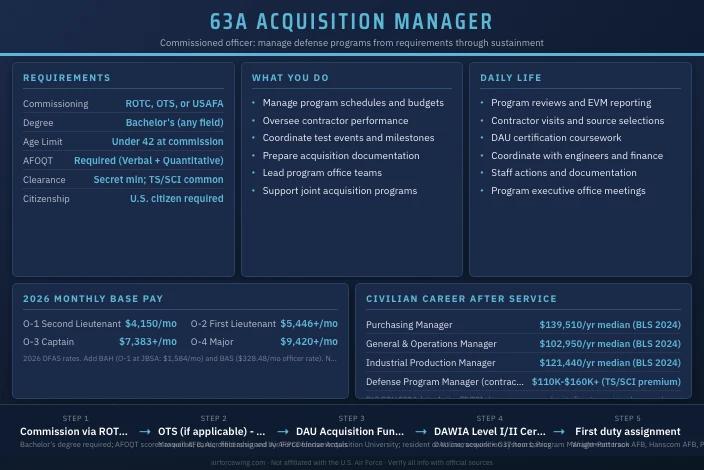
63A Acquisition Managers are Air Force commissioned officers who plan, direct, and oversee the acquisition of weapons systems, aircraft, satellites, and defense technology across the full program lifecycle, from initial requirements through development, production, and sustainment. They manage schedules, budgets, and contractor performance for some of the Department of Defense’s most complex and costly programs, working at program executive offices, major commands, and the Pentagon.
Command and Leadership Scope
A new 63A officer typically enters as a program manager within a program office, managing a specific work package or functional area rather than a full program. By the O-4 (Major) level, officers are often serving as deputy program managers or functional leads for programs worth hundreds of millions to billions of dollars. At O-5 and O-6, officers may lead entire programs or serve as directors within a program executive office.
Span of control varies widely by assignment. A junior 63A might lead a team of two or three government civilians and a handful of contractors. A senior program director may be responsible for dozens of government employees and oversight of contractor workforces numbering in the thousands.
Specific Roles and Designations
The 63A AFSC includes shredouts that reflect specific functional expertise within the acquisition career field.
| Designation | Title | Focus Area |
|---|---|---|
| 63AX | Acquisition Manager (generalist) | Full lifecycle program management |
| 63A with SEI | Special Experience Identifier variants | Defense acquisition, major program, rapid acquisition |
Most officers enter as 63AX and earn SEIs over time as they gain experience in specific program types or acquisition domains. The Defense Acquisition Workforce Improvement Act (DAWIA) certification system assigns Level I, II, or III credentials based on training and experience.
Mission Contribution
Acquisition managers are the connective tissue between Air Force operational requirements and the defense industrial base. A pilot describes what a new aircraft needs to do. An acquisition manager turns that requirement into a contract, manages the development program, and gets the aircraft delivered to the flight line.
This work extends into joint and combined operations. Many Air Force acquisition programs are joint efforts with the Navy, Army, or allied nations. An officer might manage the Air Force’s share of a joint satellite program, coordinate with international partners on an aircraft sale, or oversee a rapidly acquired capability being fielded to combatant commands. The programs managed by 63A officers directly determine what operational commanders can do in a conflict.
Technology, Equipment, and Systems
Acquisition managers work across every major Air Force system category: aircraft (fighters, bombers, tankers, transports), space systems (satellites, launch vehicles, ground systems), missiles and munitions, and information systems. They use program management tools including the Defense Acquisition Management Information Retrieval (DAMIR) system, Earned Value Management (EVM) reporting software, and DoD contracting databases. Officers with information technology program backgrounds will also work within the DoD’s software acquisition pathway, a streamlined process for rapidly acquiring IT and software capabilities.
Salary
Officer Base Pay
All officer pay follows the standard DFAS military pay scale for the current year. The table below shows base pay at representative years of service for 63A officers.
| Rank | Grade | Typical YOS | Monthly Base Pay |
|---|---|---|---|
| Second Lieutenant | O-1 | 0-2 years | $4,150/mo |
| First Lieutenant | O-2 | 2-4 years | $5,446-$6,618/mo |
| Captain | O-3 | 4-10 years | $6,770-$8,788/mo |
| Major | O-4 | 10-16 years | $9,420-$10,402/mo |
Pay figures are 2026 DFAS rates. Officers with prior enlisted service enter with higher years-of-service credit, which raises starting pay.
Special Pays and Bonuses
The 63A career field does not carry aviation bonus pay or hazardous duty incentive pay. Some acquisition billets may qualify for special duty assignment pay, but most 63A officers are compensated through base pay plus allowances. Retention bonuses for acquisition officers have been offered in the past but vary by year and are managed through AFPC.
Allowances and Benefits
Base pay is only part of total compensation. Officers receive:
- Basic Allowance for Housing (BAH): Varies by duty location and dependency status. An O-1 at JBSA without dependents receives approximately $1,584/month. Rates climb significantly at O-3 and O-4 at higher-cost locations like Wright-Patterson AFB, OH, or the Pentagon.
- Basic Allowance for Subsistence (BAS): $328.48/month for officers (2026 rate).
- TRICARE Prime: Free comprehensive health, dental, vision, and mental health coverage for active-duty members and their dependents. No enrollment fee, no deductible, no copay for in-network care.
- Thrift Savings Plan (TSP): Under the Blended Retirement System, the Air Force contributes 1% of basic pay automatically and matches up to 4% of member contributions.
- Annual leave: 30 days per year.
Retirement
Officers who serve 20 years earn a pension under the Blended Retirement System equal to 40% of their high-36 average base pay, paid monthly for life. An O-5 retiring after 20 years with roughly $11,000-$12,000/month in base pay would receive approximately $4,400-$4,800/month as a retirement annuity, in addition to TSP savings.
Qualifications
Commissioning Sources
There are three paths into the Air Force as a commissioned officer: ROTC, OTS, and the Air Force Academy (USAFA). All three are valid routes into the 63A career field.
| Commissioning Source | GPA Minimum | Degree Requirement | Age Limit | Key Prerequisite |
|---|---|---|---|---|
| Air Force ROTC | 2.0 (competitive 3.0+) | Bachelor’s in any field | Under 31 at commission | 4-year scholarship or enrollment |
| Officer Training School (OTS) | 2.5 (competitive 3.0+) | Bachelor’s in any field | Under 42 at commission | Degree in hand at application |
| Air Force Academy (USAFA) | Competitive (class rank) | USAFA degree (any major) | Under 23 at entry | Congressional nomination |
Acquisition does not require a STEM degree, though quantitative or business backgrounds (finance, economics, systems engineering, operations research) are common and well-suited to the program management work. Officers with engineering degrees may find the 62E Developmental Engineer path a better fit if they want hands-on technical work.
Test Requirements
All officer candidates must take the Air Force Officer Qualifying Test (AFOQT). The AFOQT has multiple subtests; minimum scores are set by career field and commissioning source. There are no published AFOQT subtest minimums specific to 63A, the career field is not rated (no flying), so the Pilot and Combat Systems Officer subtests are not required. Competitive AFOQT Verbal and Quantitative scores matter for selection boards and ROTC field training ranking. The TBAS (Test of Basic Aviation Skills) is not required for 63A.
Strong analytical and verbal skills directly support acquisition work, so preparing for the Quantitative and Verbal subtests is worthwhile regardless of the minimum threshold.
Career Field Assignment and Classification
ROTC cadets rank their career field preferences before commissioning; Air Force AFPC assigns fields based on needs, cadet performance, and field quotas. OTS selectees go through a similar assignment process. Acquisition is not among the most competitive career fields (unlike rated slots or special warfare), but demand for qualified acquisition officers is consistently high given the breadth of programs being managed. Cross-training into or out of 63A mid-career is possible through formal processes managed by AFPC, and some officers with other backgrounds apply for acquisition positions through special assignment opportunities.
Upon Commissioning
All new officers commission at O-1 (Second Lieutenant). The standard Active Duty Service Commitment (ADSC) for most commissioning programs is four years. Officers who attend specific funded graduate education programs or receive other funded training may incur additional service commitments. There is no aviation ADSC for acquisition officers.
OTS candidates can find a focused study plan in our AFOQT study guide.
Work Environment
Daily Setting and Schedule
Acquisition managers typically work in program offices at Air Force installations with major acquisition missions. The work is predominantly office-based: reviewing contractor deliverables, attending program reviews, writing acquisition documentation, and coordinating with engineers, contracting officers, and financial managers on the same program. Significant time goes into earned value management reports, risk registers, and test event planning.
Work hours at major program offices are structured but demanding. A program entering a critical design review or a milestone decision might pull 50- to 60-hour weeks for a stretch. Day-to-day garrison work is more predictable, typically running 8-10 hours on most days.
TDY travel is a regular part of the job. Officers visit contractor facilities to conduct program reviews, attend conferences, and support testing events at test ranges and operational bases. Travel frequency varies by program phase, a program in active development involves more contractor visits than one in steady-state sustainment.
Leadership and Chain of Command
Junior 63A officers report to senior acquisition officers and civilian senior executive service (SES) members within program offices. The chain of command in acquisition is more civilian-heavy than in most Air Force career fields; the Assistant Secretary of the Air Force for Acquisition, Technology and Logistics (SAF/AQ) sits above the uniformed acquisition workforce and wields significant authority over program decisions.
The officer-NCO relationship looks different in acquisition than it does at a flying wing. Most program offices have few or no enlisted personnel. Senior NCOs do serve in acquisition functions, but the day-to-day working relationship is more often officer-to-civilian-government-employee or officer-to-contractor rather than officer-to-NCO.
Staff vs. Command Roles
Most acquisition billets are staff positions, not command positions in the traditional Air Force sense. Officers do not command squadrons the way operations officers do. “Command” in acquisition typically means program directorship, formal authority over a program office with an assigned budget and workforce. These positions exist at the O-5 and O-6 level and are competitive.
Between program assignments, officers fill staff roles at major commands, the Air Staff, or joint organizations like the Office of the Secretary of Defense. Pentagon tours are common for O-4 and O-5 officers, and they count as broadening assignments for promotion boards.
Training
Commissioning Training
The path into 63A starts with commissioning, either a 4-year ROTC program, 9.5 weeks of OTS at Maxwell AFB, AL, or 4 years at USAFA. OTS covers military customs, officership, Air Force doctrine, and physical conditioning. It does not cover acquisition-specific content; that comes later.
Initial Skills Training
| Phase | Location | Length | Focus |
|---|---|---|---|
| Commissioning (OTS) | Maxwell AFB, AL | 9.5 weeks | Officership, Air Force fundamentals |
| Acquisition Fundamentals Course | DAU campus or online | ~3-4 weeks | Defense acquisition system, FAR, program management basics |
| DAWIA Level I / ACQ 101 | Defense Acquisition University (DAU) | Online + resident courses | Acquisition certification: contracts, cost, program management |
| Formal Training Unit (unit-specific) | Home station | Varies by program | Program-specific systems, processes, and relationships |
The Defense Acquisition University (DAU) is the primary provider of formal training for acquisition officers. DAU courses are a mix of resident instruction and online modules. Officers are expected to complete DAWIA Program Management Level II certification within a few years of their first acquisition assignment, this typically requires a combination of DAU coursework, on-the-job experience hours, and a continuous learning requirement.
Resident DAU courses are located at Fort Belvoir, VA; Huntsville, AL; and other satellite campuses. Some courses are offered at major acquisition installations like Wright-Patterson AFB.
Professional Military Education
All Air Force officers progress through the same PME ladder:
- Squadron Officer School (SOS): Attended as a Captain (O-3), usually in-residence at Maxwell AFB or by correspondence. Covers leadership, Air Force doctrine, and officer development fundamentals.
- Air Command and Staff College (ACSC): For Majors (O-4), either in-residence at Maxwell AFB or via distance learning. Competitive in-residence selection; covers joint operations, strategy, and leadership at the operational level.
- Air War College (AWC): For Lieutenant Colonels and Colonels (O-5 and O-6), at Maxwell AFB. Focuses on national security strategy and senior leader decision-making.
Advanced Education and Specialized Schools
Acquisition officers have access to graduate education through the Air Force Institute of Technology (AFIT) at Wright-Patterson AFB, OH. AFIT offers fully funded master’s degrees in systems acquisition management, cost analysis, logistics management, and related fields. Acceptance is competitive, and officers incur an ADSC for attendance.
Other advanced opportunities include:
- Fellows programs: Congressional, White House, and industry fellowship programs are available for senior captains and majors.
- Joint duty assignments: Pentagon and combatant command billets count toward joint qualification, which is required for promotion to O-7 and above.
- Defense Acquisition University faculty or intern programs: Some officers serve rotations at DAU as instructors or curriculum developers.
Before OTS, you need qualifying scores. See our AFOQT study guide.
Career Progression
Typical Career Timeline
| Rank | Grade | Typical Timeline | Key Positions |
|---|---|---|---|
| Second Lieutenant | O-1 | 0-2 years | Program analyst, functional area lead |
| First Lieutenant | O-2 | 2-4 years | Program manager (junior), staff action officer |
| Captain | O-3 | 4-12 years | Deputy program manager, program integrator, staff officer |
| Major | O-4 | 12-16 years | Deputy director, program director, Air Staff action officer |
| Lieutenant Colonel | O-5 | 16-22 years | Program director, division chief, senior Pentagon staff |
| Colonel | O-6 | 22+ years | Program executive officer deputy, wing staff director |
Promotion from O-1 to O-3 is largely automatic with time in grade and satisfactory performance. O-4 and above requires selection by a central board. Acquisition officers compete within a career field-specific board, and records are judged on job performance, developmental education completion, and joint assignment experience.
Key Developmental Positions
Officers need certain “key developmental” (KD) billets on their records to be competitive for promotion. For 63A officers, KD positions typically include serving as a program manager or deputy program manager of record, or a significant staff position at a program executive office or major headquarters. These are competitive and assigned through AFPC.
Cross-Training and Broadening
Cross-training from 63A into other career fields is possible but not common mid-career. Some officers transition into the contracting (64P) or logistics (21A/21M) functional areas, or move into legislative liaison or public affairs positions on broadening tours. Officers who want to move toward joint or interagency work pursue Pentagon assignments, defense agency billets, and attachments to combatant commands.
Building a competitive record in acquisition means completing DAWIA Level III certification, attending a joint PME course in-residence, taking a Pentagon or combatant command staff tour, and checking all required KD boxes before each promotion board. Program offices at Wright-Patterson (AFMC) and the Pentagon (SAF/AQ) are the highest-visibility assignments for career advancement.
Physical Demands
Fitness Requirements
All Air Force officers, including acquisition officers, take the Air Force Fitness Assessment (FA) annually. The FA is the same for all Airmen regardless of career field. There are no 63A-specific physical standards beyond the standard FA.
| Component | Max Points | Notes |
|---|---|---|
| 1.5-Mile Run | 60 | Primary cardiovascular component |
| Push-Ups (1 min) | 10 | Muscular endurance |
| Sit-Ups (1 min) | 10 | Core endurance |
| Waist Circumference / Body Composition | 20 | Scored separately from muscular components |
The composite score must be at least 75 out of 100 to pass. Each component also has its own minimum threshold. Standards are age- and gender-normed. Acquisition officers working in office environments need to maintain deliberate physical training habits; the sedentary nature of program office work makes fitness discipline harder than at an operational unit.
Medical and Clearance Requirements
63A officers do not require a flight physical. The standard commissioning physical (DoDMERB for ROTC and USAFA, MEPS for OTS) applies. Most acquisition program offices require at minimum a Secret security clearance; many require Top Secret or Top Secret/SCI access given the classified nature of advanced weapons systems programs.
The investigation process for a Top Secret clearance takes six months to over a year in some cases. Officers should avoid financial issues, foreign contacts, and other factors that could delay or deny the investigation.
Deployment
Deployment Tempo
Acquisition officers deploy less frequently than operational career fields, but deployments are not absent. Officers may deploy in support of rapid acquisition efforts, operational contract support, theater business clearance responsibilities, or contingency program management. Typical deployment lengths run 90 to 180 days. Some officers spend entire careers with minimal deployments; others support urgent operational needs and deploy more regularly.
Acquisition officers who manage programs tied to active operational requirements, intelligence systems, communications, or cyber capabilities, tend to see more deployment and TDY opportunities than those in long-horizon development programs.
Duty Station Options
Most 63A billets are concentrated at installations with major acquisition missions.
- Wright-Patterson AFB, OH: Home of Air Force Materiel Command (AFMC) and the largest concentration of acquisition billets in the Air Force.
- Hanscom AFB, MA: Electronic Systems Center; C2, communications, and cyber systems.
- Eglin AFB, FL: Armament Directorate; munitions and weapons programs.
- Kirtland AFB, NM: Nuclear weapons programs and directed energy.
- Pentagon, Arlington, VA: Air Staff acquisition policy and program oversight.
- Redstone Arsenal, AL: Missile and rocket programs; joint programs with the Army.
- Los Angeles AFB, CA: Space and launch systems programs (Space Force integration).
Assignments are managed through AFPC. Officers submit preference worksheets and are matched against available billets. Join-spouse programs exist for dual-military couples, though the geographic concentration of acquisition bases limits how often joint assignments can be accommodated.
Risk/Safety
Job Hazards
The primary risks for acquisition officers are professional and legal, not physical. Officers who make poor contracting decisions, mismanage program funds, or fail to report program problems accurately can face Inspector General investigations, congressional scrutiny, or professional consequences including relief for cause.
Acquisition officers work in a heavily regulated environment governed by the Federal Acquisition Regulation (FAR), the Defense Federal Acquisition Regulation Supplement (DFARS), and DoD acquisition policy directives. Mistakes in this environment can cost taxpayers millions and set programs back years.
Legal and Command Responsibility
63A officers hold government contracting authority within defined limits. They are responsible for accurate reporting to program executive officers, the comptroller, and Congress through the Selected Acquisition Report (SAR) process. Knowingly misrepresenting program status, a practice sometimes called “painting programs green”, is a serious ethics violation and can result in UCMJ action or civilian prosecution under the False Claims Act.
The UCMJ applies to all military officers. Acquisition officers are subject to the same standards of conduct, equal opportunity requirements, and command climate expectations as any other officer. Officers who are relieved for cause in an acquisition assignment face a difficult path to further promotion.
Impact on Family
PCS Tempo and Family Stability
Acquisition officers typically move every three to four years, which is comparable to the Air Force average but somewhat more predictable than operational career fields. Assignments are concentrated at a handful of installations, which means a family might relocate between Wright-Patterson, the Pentagon, Hanscom, and back. Families who settle near one of these bases can often cycle back to the same installation more than once over a career.
The Air Force Airman and Family Readiness Center (A&FRC) operates at every major installation and offers resources for relocation, spouse employment, and financial planning. The Key Spouse Program connects families within units for mutual support during deployments and TDYs.
Dual-Military Families
Dual-military couples in acquisition have a somewhat easier path than those in operational career fields because the duty station pool, while smaller, is concentrated and stable. AFPC manages join-spouse requests but cannot guarantee collocated assignments in every career. Officers should plan for periods where one partner may be on a remote or unaccompanied tour.
Work-Life Balance
In garrison, acquisition work is demanding but generally predictable. Program milestones drive workload spikes, source selection events, milestone decision reviews, and test windows create surge periods. Outside of those events, the pace allows for consistent family time. Deployments are less frequent than in operational career fields, and the office-based nature of the work means extended unplanned absences are less common.
Reserve and Air National Guard
Component Availability
The 63A career field is available in both the Air Force Reserve and the Air National Guard, though billet availability is narrower than on active duty. Reserve and ANG acquisition officers typically work within program support units that augment active-duty program offices during exercises, mobilizations, and surge periods.
Commissioning Paths
Reserve and ANG candidates commission through the same sources as active duty. ROTC with a Reserve component contract, OTS through a Reserve or ANG-sponsored application, or USAFA followed by a Reserve assignment. Direct commission into the acquisition career field is rare but possible for candidates with significant defense industry or government acquisition experience.
Active-duty officers who complete their ADSC can transfer to the Reserve or ANG in 63A billets, retaining their DAWIA certification and acquisition experience.
Drill Commitment and Pay
The standard Reserve and ANG commitment is one weekend per month (Unit Training Assembly) plus two weeks annually (Annual Tour). Some acquisition units require additional training days for program-specific exercises or DAU certification maintenance. Acquisition billets in the Reserve often align with ongoing program office support, so some officers work alongside their active-duty counterparts on the same programs they managed in uniform.
A Reserve O-3 (Capt) with 4-6 years of service earns approximately $7,383-$7,737 per month in base pay when on active orders, prorated for drill days during standard UTA weekends. On a standard drill weekend (four training assemblies), this equates to roughly $988-$1,032 in drill pay.
Reserve and Guard Benefits
| Category | Active Duty | Air Force Reserve | Air National Guard |
|---|---|---|---|
| Monthly pay (O-3, 6 YOS) | $7,737/mo (active) | ~$1,000/drill weekend (4 UTA) | ~$1,000/drill weekend (4 UTA) |
| Healthcare | TRICARE Prime (free) | TRICARE Reserve Select (premium-based) | TRICARE Reserve Select or state plan |
| Education | Tuition Assistance ($4,500/yr) | Federal Tuition Assistance (same rate) | State tuition waivers vary by state |
| Retirement | 20-year pension (high-36) | Reserve points-based system at age 60 | Reserve points-based system at age 60 |
| Deployment tempo | Moderate (varies by assignment) | Periodic mobilization, 90-180 day tours | Periodic mobilization, state activation possible |
| Command opportunities | Program director, staff director | Limited; some program support billets | Limited; varies by state unit |
TRICARE Reserve Select requires a premium payment from the member; coverage is comparable to active-duty TRICARE for inpatient and outpatient care. State tuition waivers for Air National Guard members vary significantly, some states offer full in-state tuition waivers at public universities, others offer partial or no benefit.
Reserve component retirement uses a points system. Officers earn points for drill periods, active duty, and other qualifying service. At age 60 (or earlier with recent active service), they draw a pension based on accumulated points divided by 360, multiplied by 2.5%, multiplied by high-36 pay.
Civilian-Military Career Integration
Defense industry, federal agencies, and government contracting firms actively recruit Reserve and ANG acquisition officers for their DAWIA certification, clearances, and program management experience. Companies like Lockheed Martin, Northrop Grumman, Raytheon, Boeing, and SAIC regularly hire prior acquisition officers. Civilian DoD program analyst and contracting roles map directly onto 63A experience.
Reserve service can accelerate civilian defense careers by maintaining clearances, building ongoing relationships with active programs, and demonstrating continued commitment to defense work. USERRA protections require employers to grant leave for military service and restore returning members to equivalent civilian positions.
Post-Service
Civilian Career Transition
Former acquisition officers hold qualifications that are directly bankable in the civilian job market. DAWIA Level II and III certification, active security clearances, and program management experience on billion-dollar defense programs are credentials that defense contractors, federal agencies, and consulting firms pay significant premiums for.
The Transition Assistance Program (TAP) runs workshops at every installation to help officers translate military experience into civilian resumes, interview skills, and federal application packages. Hiring Our Heroes and the American Corporate Partners (ACP) mentorship program offer additional resources for connecting with civilian employers.
Civilian Career Prospects
| Civilian Job Title | BLS Median Salary | Job Outlook (2024-2034) |
|---|---|---|
| Purchasing Manager | $139,510/yr | Average (3-4%) |
| General and Operations Manager | $102,950/yr | Average (3-4%) |
| Industrial Production Manager | $121,440/yr | Slower than average (1-2%) |
| Program Manager (defense contractor, mid-career) | $110,000-$160,000+/yr | Strong demand |
| Federal Civilian (GS-13 to GS-15, DoD) | $90,000-$140,000+/yr | Steady government demand |
Defense contractors and federal agencies typically bring former acquisition officers in at mid-grade equivalent levels, reflecting their experience managing government contracts from the government side. Officers with active Top Secret clearances command a measurable salary premium above the BLS medians listed.
Certifications and Graduate Education
DAWIA Program Management Level II and III certifications do not have direct civilian equivalents, but they are recognized credentials within the defense acquisition community. The Project Management Professional (PMP) certification from PMI is a widely accepted civilian analog; many former acquisition officers pursue PMP certification post-service to pair with their DAU credentials.
Officers who attended AFIT for a funded master’s degree leave with a full graduate credential that transfers to any civilian employer. The Post-9/11 GI Bill covers up to $29,920.95 per academic year at private schools (2025-2026 cap) and full in-state tuition at public institutions for veterans using education benefits after service.
Is This a Good Job
Ideal Candidate Profile
Acquisition suits people who are analytically oriented, comfortable managing complexity, and willing to see long projects through without immediate gratification. You’ll spend years on programs that won’t deliver hardware until after you’ve moved to your next assignment. You need to be okay with that.
Strong candidates for 63A typically have:
- Undergraduate degree in business, engineering, economics, systems management, or a related analytical field
- Interest in how large organizations buy and manage technology
- Comfort working with both technical engineers and financial managers
- Tolerance for regulatory complexity and documentation requirements
- Patience for multi-year timelines and bureaucratic processes
Potential Challenges
Acquisition is not for officers who want immediate, visible impact. A pilot knows if a sortie succeeded. A 63A officer may spend three years managing a program review cycle and never see the aircraft fly. The career involves a lot of paperwork, meetings, and process compliance, and the consequences of process failures (Inspector General investigations, congressional testimony, program cancellations) can be career-defining in a bad way.
The pace of defense acquisition frustrates many officers who came in expecting to move faster than the system allows. Officers who prefer hands-on technical work over people management and program oversight tend to find 62E (Developmental Engineer) or cyber career fields more satisfying.
Long-Term Fit
Acquisition is one of the better Air Force career fields for officers who want a full 20-year career followed by a high-paying civilian job in the defense industry. The skills transfer directly, the clearances maintain value, and the network of program offices and contractors means post-retirement employment often follows naturally from career relationships. Officers who leave after one obligation (four years) can still enter defense contracting or federal civil service, though the full value of DAWIA certification and senior program experience takes more time to build.
If you’re choosing between acquisition and a private-sector program management career, the military path delivers broader program experience faster, but at lower early-career pay and with significant geographic constraints. The equation typically favors military service for anyone willing to serve at least 6-10 years and who values the clearance and defense-specific experience that follows.
More Information
Talk to an Air Force recruiter or your nearest ROTC detachment about 63A career field opportunities and the officer application process. Recruiters can walk you through the AFOQT registration timeline, the OTS application package, and what AFPC looks for in acquisition officer candidates. Preparing for the AFOQT early gives you the most flexibility in career field selection, the officer test prep guide covers the exam format, scoring, and study approach in detail.
This site is not affiliated with the U.S. Air Force or any government agency. Verify all information with official Air Force sources before making enlistment or career decisions.
Explore more Air Force Acquisition officer careers to compare the 63A Acquisition Manager with other career options in the acquisition field.