62E Developmental Engineer
The F-35 didn’t build itself. Someone had to review the aerodynamics, assess the radar performance, manage the ground test program, and tell the program manager when the software wasn’t ready. That someone was a 62E Developmental Engineer.
If you have an engineering degree and want to put it to use inside the world’s most capable air force, this career field offers something civilian engineering rarely does at the same career stage: technical authority over programs worth hundreds of millions of dollars, direct access to the defense contractors building them, and a leadership track that can take you from flight commander to program director. The 62E is not a lab technician role. It’s a commissioned officer position with real engineering depth and real command weight behind it.
OTS candidates need competitive ASVAB scores. Our AFOQT study guide covers exactly how to prepare.
Job Role
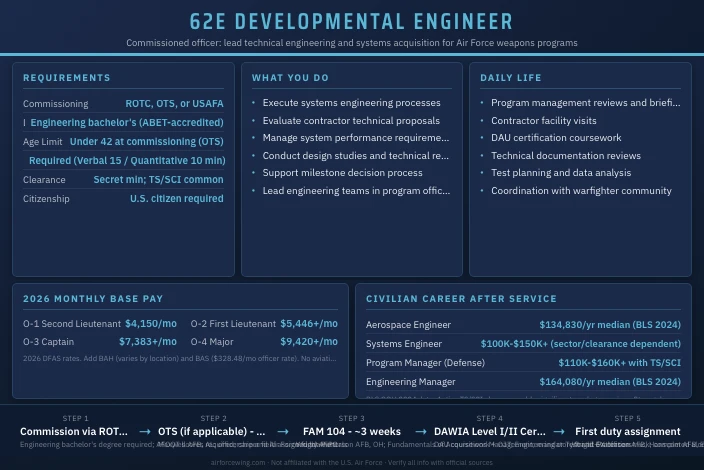
62E Developmental Engineers are Air Force commissioned officers who plan, organize, and execute systems engineering processes across the full lifecycle of Air Force weapons systems, aircraft, satellites, and software platforms. They evaluate designs, assess contractor technical proposals, manage system performance against requirements, conduct design studies, and coordinate engineering activities across program offices, test centers, and laboratories. At senior levels, they formulate engineering policy and lead acquisition organizations.
Command and Leadership Scope
A new 62E typically enters a program office or test organization as a junior systems engineer, working within an established technical team. By the O-3 (Capt) level, most are serving as engineering leads for a specific system or subsystem, responsible for technical performance within a larger program. At O-4 (Maj) and above, officers often take on roles as chief engineers, engineering directors, or lead program managers within their career area.
Span of control grows steadily. Early assignments may involve supervising a small team of government civilians and contractor engineers. Senior 62E positions can carry responsibility for engineering organizations of 20 to 50 people and technical oversight of contractor teams many times that size. At the O-6 (Col) level, some officers serve as science and technology directorate chiefs or program executive office deputies.
Specific Roles and Designations
The 62E career field includes multiple shredouts, specialty designations that narrow an officer’s technical focus while keeping broader career mobility intact.
| Shredout | Code | Focus Area |
|---|---|---|
| Aeronautical | 62E1A | Aircraft structures, aerodynamics, propulsion systems |
| Astronautical | 62E1B | Satellites, space launch vehicles, orbital systems |
| Computer Systems | 62E1C | Software-intensive systems, embedded computing, cybersecurity for systems |
| Electrical/Electronic | 62E1E | Avionics, radar, electronic warfare systems |
| Flight Test | 62E1F | Test planning, data analysis, aircraft and system evaluation |
| Mechanical | 62E1H | Structural mechanics, thermal systems, manufacturing processes |
Special Experience Identifiers (SEIs) document additional qualifications, such as Test Pilot School graduate status or specific acquisition certification levels, and appear separately from the AFSC code on officer records.
Mission Contribution
The Air Force operates and sustains thousands of aircraft, missiles, satellites, and ground systems, all of which were fielded through a formal acquisition process. Developmental Engineers are the technical backbone of that process. They translate warfighter requirements into engineering specifications, track contractor design compliance, and validate that a system actually performs what the contract says it will.
In joint operations, 62E officers frequently support multi-service or coalition programs where engineering standards must bridge different technical communities. Some serve on exchange programs with NASA, defense agencies, and international partner air forces, extending the career field’s reach well beyond Air Force acquisition offices.
Technology, Equipment, and Systems
Depending on shredout and assignment, a 62E officer may work across fighter aircraft, bombers, tankers, unmanned systems, space systems, directed energy weapons, electronic warfare systems, and command and control software. The systems engineering discipline itself relies on model-based systems engineering (MBSE) tools, integrated master schedules, earned value management (EVM) systems, and Defense Acquisition University (DAU) certification training. Program offices use standard DoD acquisition frameworks, milestone decision processes, technical readiness levels, and systems engineering management plans, as the organizational structure around which engineers do their daily work.
Salary
Base Pay
62E officers receive the same base pay as all other active-duty Air Force officers. Pay is determined by grade and years of service, per the 2026 DFAS pay tables.
| Grade | Title | Entry Pay (less than 2 years) | Mid-Career Pay (6-8 years) |
|---|---|---|---|
| O-1 | Second Lieutenant | $4,150/mo | , |
| O-2 | First Lieutenant | $4,782/mo | $6,618/mo |
| O-3 | Captain | $5,534/mo | $8,126/mo |
| O-4 | Major | $6,295/mo | $8,816/mo |
Base pay is only part of the picture. Officers who live off base receive Basic Allowance for Housing (BAH), which varies by duty station and dependency status. An O-1 at Wright-Patterson AFB or Hanscom AFB will receive different BAH than one at Edwards AFB, check the DFAS BAH rate lookup for current figures at your assignment location. All officers also receive Basic Allowance for Subsistence (BAS) at $328.48 per month (2026 rate).
Special Pays and Bonuses
The 62E career field does not carry an aviation bonus or flight pay. Some 62E officers with flight test assignments or aeronautical ratings may qualify for aviation career incentive pay, but this is specific to those assignments rather than the career field overall. Retention bonuses for acquisition officers are offered periodically based on manning requirements, check with your recruiting officer or career field manager for current availability.
Additional Benefits
Active-duty 62E officers receive full TRICARE Prime coverage with no enrollment fee, no deductibles, and no copays for medical, dental, vision, and mental health services. The Blended Retirement System (BRS) provides a pension equal to 40% of your high-36 average basic pay at 20 years, plus TSP matching up to 5% of basic pay. Officers also receive 30 days of paid leave per year and Tuition Assistance up to $4,500 annually for off-duty education.
After 36 months of qualifying active duty, the Post-9/11 GI Bill covers full in-state tuition at public universities or up to $29,920.95 per year at private schools (2025-2026 cap), plus a monthly housing allowance and up to $1,000 per year for books.
Qualifications
Commissioning Sources
All 62E officers are commissioned through one of three paths. Each leads to the same career field, though the selection timing and academic requirements differ.
| Commissioning Source | GPA Minimum | Degree Requirement | Age Limit | Career Field Selection |
|---|---|---|---|---|
| AFROTC | 2.5 cumulative | Accredited engineering bachelor’s degree | Under 31 at commissioning | Assigned by AFPC prior to commissioning |
| OTS (Officer Training School) | 3.0 preferred | Accredited engineering bachelor’s degree | Under 42 | Selected during OTS application process |
| USAFA | N/A (academic performance tracked) | Engineering major available within Academy curriculum | N/A | Assigned during senior year |
AFROTC is the most common path. Cadets are classified into career fields during their senior year based on GPA, AFOQT scores, field training performance, and career field needs. Engineering majors gain a direct advantage for 62E classification, but the competition for rated slots (pilot, CSO) is separate, cadets who want 62E specifically should communicate that preference clearly and maintain strong academic standing.
OTS candidates apply with a completed degree. Selection boards evaluate the full application package including GPA, AFOQT scores, letters of recommendation, and work experience. Officers commissioning through OTS may have prior military, government, or industry experience that strengthens their engineering credentials.
Direct Commission is not available for 62E. Officers must commission through one of the three standard paths.
Test Requirements
All officer commissioning sources require the Air Force Officer Qualifying Test (AFOQT). For non-rated career fields including 62E, the minimum required scores are Verbal 15 and Quantitative 10. These are minimum thresholds, not competitive targets. Strong candidates for a technical career field like developmental engineering typically score well above minimums on the Quantitative and Academic Aptitude composites.
The TBAS (Test of Basic Aviation Skills) is not required for 62E, as this is a non-rated career field. Preparing well for the AFOQT gives you a stronger application, the AFOQT study guide covers test structure, time management, and the quantitative sections that matter most for engineering career candidates.
Security Clearance
All 62E officers require at minimum a Secret security clearance. Many acquisition programs carry Top Secret requirements, and some positions require TS/SCI access given the sensitivity of advanced weapons system designs and foreign disclosure obligations. A Single Scope Background Investigation (SSBI) is standard for most program office assignments. Officers with foreign contacts, foreign travel history, or dual citizenship should expect scrutiny in the investigation process and consult with their recruiter before applying.
Career Field Assignment
ROTC cadets are assigned career fields by the Air Force Personnel Center (AFPC) using a merit-based process. Factors include academic GPA, AFOQT scores, field training performance, and the Air Force’s needs at the time of classification. A declared engineering major in electrical, aerospace, computer, or mechanical disciplines improves 62E classification odds but does not guarantee it.
OTS candidates apply to 62E specifically; career field selection is part of the OTS board process. Cross-training into 62E from other career fields after commissioning is possible but uncommon, typically requiring a waiver and career field manager approval.
Upon Commissioning
All new officers enter at O-1 (2d Lt). The standard Active Duty Service Commitment (ADSC) for a non-rated officer commission through OTS is three years. Officers who complete advanced acquisition education programs through the Air Force Institute of Technology (AFIT) incur an additional service commitment tied to the length of the funded education, typically one year of ADSC for each year of school.
Engineering degree fields most likely to support 62E classification: aerospace/aeronautical engineering, electrical/computer engineering, mechanical engineering, systems engineering, computer science. The AFOCD lists specific degree requirements by shredout, verify current criteria with your ROTC detachment or OTS recruiter.
Work Environment
Setting and Schedule
Most 62E officers spend their working hours in program offices, which are office environments located on or near major acquisition installations. A typical day involves reviewing contractor-delivered documentation, attending program management reviews, coordinating with test personnel, and responding to technical questions from program leadership. The work is office-based but not sedentary, travel to contractor facilities, test ranges, and other government labs is routine.
TDY (temporary duty) travel is frequent in the 62E career field. Flight test assignments at Edwards AFB or Eglin AFB require time on the flight line and at test facilities in addition to office work. Lab-based assignments at Wright-Patterson AFB or Kirtland AFB may involve more hands-on hardware evaluation.
Garrison schedules typically run standard duty hours, though major test events, acquisition milestones, and source selections can require sustained extra effort. Deployment tempo is low compared to operational career fields.
Leadership and Chain of Command
Junior 62E officers report to a program manager or chief engineer within a program office. As technical expertise grows, officers transition from being managed engineers to directing technical work across teams. The officer-NCO dynamic differs significantly from operational career fields, most direct reports in acquisition billets are government civilians or contractors rather than enlisted Airmen.
Senior NCOs and civilian engineers who have spent decades in a program area carry deep institutional knowledge. Effective 62E officers learn quickly that rank doesn’t equal expertise, and the best acquisition officers build working relationships with their experienced civilian counterparts rather than managing around them.
Staff vs. Command Roles
Career development for 62E officers alternates between technical assignments (program offices, test organizations, labs) and staff roles (AFPC, Air Staff, OSD, joint commands). Staff tours, particularly at the Pentagon or in major command headquarters, are career-broadening requirements for competitive promotion above O-4. Some officers also serve as instructors at the Air Force Institute of Technology or the Air Force Academy.
Command opportunities exist at the squadron level for 62E officers, though the path is different from operational career fields. Science and technology directorate commands and program management positions carry command-equivalent authority over significant resources and personnel.
Job Satisfaction and Retention
Acquisition career fields see notable mid-career attrition as officers with engineering expertise and security clearances find strong demand in the defense industry. Officers who stay tend to cite the scope and complexity of the programs, the intellectual challenge of technical problem-solving at scale, and the opportunity to lead programs that directly affect operational readiness. Officers who leave often point to bureaucratic friction, slow program timelines, and the compensation gap relative to defense industry peers.
Training
Pre-Commissioning Training
ROTC cadets complete a four-year program including two field training sessions, leadership labs, and the Air Force curriculum alongside their engineering coursework. OTS candidates complete a 9.5-week commissioned officer program at Maxwell AFB, AL, covering officership, Air Force culture, and military leadership fundamentals. USAFA graduates complete a four-year military and academic program that includes leadership positions within the Cadet Wing.
Initial Skills Training
All new 62E officers complete Fundamentals of Acquisitions Management (FAM 104), a mandatory initial skills course for acquisition career fields. This three-week course at Wright-Patterson AFB, OH, introduces new officers to the defense acquisition system, program lifecycle management, and the regulatory framework governing how the Air Force buys things.
| Phase | Location | Length | Focus |
|---|---|---|---|
| OTS (if applicable) | Maxwell AFB, AL | 9.5 weeks | Officership, Air Force fundamentals |
| FAM 104 (Fundamentals of Acquisitions Management) | Wright-Patterson AFB, OH | ~3 weeks | Defense acquisition system, program lifecycle |
| DAU Certification Coursework | Online / resident | Varies | Level I/II acquisition certification tracks |
| First Duty Assignment | Program office or test organization | Ongoing | OJT-based engineering and acquisition qualification |
Defense Acquisition Workforce Improvement Act (DAWIA) certification is a career-long requirement. Most 62E officers pursue certification in Engineering or Test and Evaluation, reaching Level II by the O-3 level and Level III as they take on senior engineering roles. DAU coursework is available both resident and online, and officers complete it in parallel with their regular duties.
Professional Military Education
Squadron Officer School (SOS) is completed in residence at Maxwell AFB or via distance learning around the O-3 level. It covers strategic communication, leadership theory, and joint warfighting concepts, mandatory for promotion to O-4. Air Command and Staff College (ACSC) is for O-4s competing for O-5 selection. Air War College (AWC) at Maxwell AFB serves senior O-5s and O-6s preparing for strategic leadership assignments.
Additional Schools and Opportunities
The Air Force Institute of Technology (AFIT) at Wright-Patterson AFB offers fully funded graduate degrees in engineering, technology management, and systems engineering. Selection is competitive and requires service commitment, but it’s one of the few officer career tracks where the Air Force actively funds advanced technical education as part of career development rather than as a bonus.
Test Pilot School (TPS) at Edwards AFB is available to 62E officers pursuing the flight test shredout. Graduates earn the Flight Test Engineer (FTE) designation and are among the most technically specialized officers in the acquisition community. The curriculum is intensive, typically 48 weeks, and selection is highly competitive.
Some 62E officers pursue Education With Industry (EWI) fellowships, spending a year embedded at major defense contractors or technology companies to build industry perspective. The Advanced Academic Degree (AAD) program funds degrees at civilian universities for officers whose technical specialty requires graduate-level credentials.
Before OTS, you need qualifying scores. See our AFOQT study guide.
Career Progression
Career Path
The 62E career ladder moves through increasingly complex technical and program management roles. Key developmental positions shape the record that promotion boards evaluate.
| Grade | Title | Typical Time in Grade | Key Positions |
|---|---|---|---|
| O-1 | Second Lieutenant | ~18 months | Systems engineer, program analyst, lab engineer |
| O-2 | First Lieutenant | ~2 years | Engineering lead, test engineer |
| O-3 | Captain | ~4 years | Chief engineer (subsystem), program engineer, SOS attendance |
| O-4 | Major | ~4 years | Program engineer lead, deputy chief engineer, ACSC |
| O-5 | Lieutenant Colonel | ~4 years | Chief engineer (system), program director, squadron command |
| O-6 | Colonel | Variable | S&T directorate chief, PEO deputy, senior acquisition leader |
Key developmental positions at the O-3 and O-4 level, chief engineer billets with technical oversight responsibility, are the standard markers of a competitive acquisition engineering officer. Officers who avoid staff tours or who stay only in technical roles without broadening assignments tend to plateau below O-5.
Promotion System
O-1 through O-3 promotions happen essentially by time and performance with standard records. O-4 and above require board selection by promotion boards that evaluate the Officer Performance Report (OPR) record, decorations, education, and broadening assignments. Current O-4 selection rates across acquisition career fields are in the 80% range, but O-5 rates are more selective. Boards reward demonstrated technical leadership, PME completion, and diverse assignment history.
Cross-Training and Broadening
62E officers with strong records can be considered for Operational Experience (OpEx) programs that place acquisition officers in operational units, flying units, combat support wings, or MAJCOM staffs, to develop a broader understanding of the warfighter community they support. This deliberate broadening is viewed favorably by promotion boards and builds the operational context that makes senior acquisition engineers more effective.
Cross-training out of 62E is possible but uncommon. Officers interested in transitioning to program management may formally move into the 63A Acquisition Manager career field with career field manager approval, typically around the O-4 level. Many 62E officers also develop significant 63A-style program management expertise organically through their assignments.
Physical Demands
Physical Requirements
62E is a non-flying, non-combat officer career field with no AFSC-specific physical demands beyond standard fitness standards. All Air Force officers take the Air Force Fitness Assessment annually, scored on a 100-point scale with a minimum passing composite of 75.
| Component | Max Points | Minimum Required |
|---|---|---|
| 1.5-Mile Run | 60 | Must meet minimum per component |
| Waist Circumference / Body Composition | 20 | Must meet minimum per component |
| Push-Ups (1 minute) | 10 | Must meet minimum per component |
| Sit-Ups (1 minute) | 10 | Must meet minimum per component |
Standards are age- and gender-normed. Officers who fail the composite or any individual component are placed on a remediation program, which can affect promotions and assignments.
Flight Physicals and Medical
Most 62E officers do not require a flight physical. Officers pursuing the Flight Test (62E1F) shredout or those assigned to flight test organizations at Edwards AFB or Eglin AFB may require medical evaluations if they fly as test observers or conduct airborne test duties. Officers with flight test assignments should coordinate early with their installation flight surgeon to understand applicable medical standards.
No unique medical disqualifiers apply to the standard 62E career field beyond the baseline commissioning physical and security clearance investigation requirements.
Deployment
Deployment Details
The 62E career field has a lower deployment tempo than most operational Air Force career fields. Acquisitions work is primarily CONUS-based, tied to the program offices and test centers where programs are managed. That said, some 62E officers deploy in support of contingency operations, particularly when systems they manage are being fielded or when operational feedback requires direct technical support downrange.
TDY travel to contractor facilities, partner nation sites, and test ranges is common and can be frequent depending on the program phase. A 62E supporting a major milestone decision may spend several weeks per year traveling to contractor sites, test locations, and Washington D.C. before returning to their home installation.
Duty Station Options
The largest concentrations of 62E officers are at the major acquisition and test installations:
- Wright-Patterson AFB, OH: headquarters of AFMC and the Air Force’s largest acquisition center; the most common assignment for new 62E officers
- Hanscom AFB, MA: C2 and electronic systems programs
- Eglin AFB, FL: armament and munitions programs; Air Force Test Center
- Edwards AFB, CA: Air Force Test Center; Flight Test shredout primary location
- Kirtland AFB, NM: directed energy and space programs
- Hill AFB, UT: sustainment programs, F-35 program support
- Arnold AFB (Arnold Engineering Development Complex), TN: test and evaluation
- Los Angeles AFB, CA: space acquisition (Space Systems Command)
Officers state duty station preferences through AFPC, but assignment is based on Air Force needs and competitive record. Join-spouse provisions apply, officers with military spouses can request co-location consideration, though it’s not guaranteed.
Risk/Safety
Job Hazards
The 62E career field carries the physical risk profile of an office-based professional position for most assignments. Officers in flight test roles accept the additional risks associated with flight test operations, test flights involve known and unknown system behaviors, and the test environment manages that risk through disciplined test planning and safety review processes.
The more significant risk category for 62E officers is command accountability. As technical authorities on programs, developmental engineers can be held professionally responsible for engineering decisions, especially those related to safety-critical systems. Officers who approve designs, release test plans, or sign off on system performance documentation carry legal and professional weight behind those signatures.
Safety Protocols
Operational Risk Management (ORM) applies across Air Force operations, including test and acquisition activities. Flight test organizations operate under detailed safety review processes that involve hazard analysis, test readiness reviews, and independent safety oversight. Systems engineers working on safety-critical systems must understand and apply relevant engineering standards, including MIL-STD documentation, software reliability requirements, and mishap investigation procedures.
Legal and Command Responsibility
62E officers exercise their authority under the Uniform Code of Military Justice (UCMJ) and applicable DoD acquisition law and regulation. This includes the Truth in Negotiations Act, Federal Acquisition Regulations, and procurement integrity requirements. Officers who misrepresent technical findings, improperly influence contractor relationships, or fail to disclose conflicts of interest face career-ending and potentially criminal consequences. Relief for cause, being removed from a position by a superior, is documented in the OPR and effectively ends promotion eligibility above O-4.
Impact on Family
Family Considerations
The 62E career field is more family-stable than most operational Air Force paths. Acquisition tours are typically 3-4 years at installations that don’t change frequently, reducing the disruption of constant moves. Wright-Patterson AFB, Hanscom AFB, and the other major acquisition hubs are permanent installations with established communities, schools, and family support infrastructure.
The Airman and Family Readiness Center (A&FRC) at each installation provides financial counseling, spouse employment resources, deployment support, and transition assistance. The Key Spouse Program connects spouses of deployed or TDY Airmen with installation support networks.
PCS (permanent change of station) moves occur roughly every 3-4 years on average for acquisition officers, which is less frequent than the 2-3 year cycle common in operational career fields. For families with school-age children or spouses with careers, this is a meaningful lifestyle advantage.
Dual-Military and Family Planning
The Air Force’s join-spouse program allows dual-military couples to request co-location. Given the concentration of acquisition billets in a relatively small number of installations, joining-spouse with a partner in a different career field can be challenging, especially if that partner is in a rated or special operations career field stationed elsewhere. Couples should plan career field selections and timing with this dynamic in mind.
Reserve and Air National Guard
Component Availability
The 62E career field is available in both the Air Force Reserve and the Air National Guard, though the number of acquisition billets in reserve components is smaller than on active duty. Reserve 62E officers typically serve at units co-located with or near the major CONUS acquisition installations, and some perform acquisition duties directly alongside their active-duty counterparts through Integrated Prime Associate Unit (IPAU) arrangements.
Commissioning Paths
Reserve component commissioning for 62E follows the same paths as active duty: AFROTC with a Reserve contract, OTS through Air Force Reserve or Air National Guard, or direct lateral transfer from active duty. Officers completing active-duty service commitments and transitioning to the Reserve or Guard can often continue in 62E billets if a position exists at their unit.
Drill and Training Commitment
Standard Reserve commitment is one Unit Training Assembly (UTA) weekend per month plus a two-week Annual Tour per year. 62E officers may be required to attend periodic DAU certification updates or acquisition community exercises beyond the standard schedule. Some acquisition-focused Reserve units support active programs more intensively than a typical monthly drill structure would suggest.
Part-Time Pay
An O-3 (Capt) in the Air Force Reserve earns approximately $836 per drill weekend (based on 2026 DFAS drill pay rates for 4 drills at O-3 with 4+ years). This compares to $5,534 per month in active-duty base pay for the same grade at entry.
Benefits Differences
Reserve and Guard officers have access to TRICARE Reserve Select, a premium-based health plan covering medical and pharmacy. It differs from active-duty TRICARE Prime in that members pay monthly premiums (approximately $50-$250 per month depending on coverage tier). Active-duty TRICARE Prime has no premiums or copays.
Federal Tuition Assistance is available to drilling reservists. Air National Guard members may also qualify for state tuition waivers depending on their state’s Guard education benefits program.
The Reserve retirement system is points-based rather than the 20-year pension model. Reservists accumulate retirement points for drills, annual tours, and active duty periods. Retirement pay is calculated at age 60 (or earlier with qualifying service) based on total points divided by 360, multiplied by 2.5% of the pay for the equivalent years of service.
Component Comparison
| Feature | Active Duty | Air Force Reserve | Air National Guard |
|---|---|---|---|
| Commitment | Full-time | ~39 days/yr + mobilization | ~39 days/yr + mobilization |
| O-3 Monthly Pay | ~$5,534 base | ~$418/drill day | ~$418/drill day |
| Healthcare | TRICARE Prime (no cost) | TRICARE Reserve Select (premium) | TRICARE Reserve Select (premium) |
| Education | Full GI Bill + TA | GI Bill (prorated) + TA | GI Bill + state waivers (vary) |
| Deployment Tempo | Low (acquisition) | Periodic mobilization | Periodic mobilization |
| Command Opportunities | Squadron to PEO level | Unit-level acquisition billets | Unit-level acquisition billets |
| Retirement | 20-year pension (40% of high-36) | Points-based at age 60 | Points-based at age 60 |
Civilian Career Integration
The 62E skillset, systems engineering, program management, security clearance, and DoD acquisition experience, pairs naturally with civilian defense industry careers. Reserve and Guard officers in this field often work for defense contractors, DoD civilian agencies, or technology companies during the week and maintain their commission on weekends. The overlap between military acquisition duties and civilian defense roles makes this one of the more natural reserve-civilian pairings in the officer corps.
Post-Service
Transition to Civilian Life
62E officers leave the Air Force with credentials that the defense industry and federal government actively recruit. Systems engineering leadership experience, program management background, and an active security clearance are a strong package. Transition programs including the Transition Assistance Program (TAP), Hiring Our Heroes fellowships, and the Army Career Program (ACP) all support veterans moving into civilian roles.
Officers with AFIT graduate degrees and senior acquisition experience are particularly well-positioned for senior defense contractor roles, GS-13 to SES federal civilian positions, and executive programs at aerospace companies.
Civilian Career Prospects
| Civilian Job Title | Median Salary | Job Outlook |
|---|---|---|
| Aerospace Engineer | $134,830/yr | +6% (2024-2034) |
| Systems Engineer | $100,000-$150,000/yr (varies by sector) | Strong demand |
| Program/Project Manager (Defense) | $110,000-$160,000+ with clearance | Strong demand |
| Engineering Manager | $164,080/yr median | +4% (2024-2034) |
Salary data from Bureau of Labor Statistics Occupational Outlook Handbook, 2024.
An active Top Secret clearance adds significant market value above uncleared peers, particularly at Lockheed Martin, Raytheon, Northrop Grumman, SAIC, and Booz Allen Hamilton. Federal civilian positions (GS/NSPS equivalent) at AFMC, AFRL, and DoD agencies also heavily recruit former 62E officers.
Graduate Education and Credentials
Officers who completed AFIT degrees carry an accredited graduate credential with full civilian recognition. The Post-9/11 GI Bill funds additional graduate education after separation for officers who haven’t used it. No direct civilian license (like a PE license) is automatically awarded for military engineering service, but 62E officers who meet education and work experience criteria can sit for the Professional Engineer (PE) exam. The Fundamentals of Engineering (FE) exam is a common first step, consult your state board’s requirements.
Is This a Good Job
Ideal Candidate Profile
The strongest 62E candidates are engineering graduates who want to do more than sit at a workstation running simulations or reviewing specs. You’ll get the most out of this career field if you’re technically sharp, comfortable presenting your analysis to senior leaders and defense contractors, and motivated by the idea of your work affecting real operational systems.
This is also a career for people who can hold long time horizons. An acquisition program can run 15 to 20 years from inception to full deployment. If you need to see the end result within a two-year assignment, you’ll find the pace frustrating. But if you’re drawn to the idea of working at the cutting edge of military technology and you can build institutional knowledge across a long career, the 62E offers both depth and scope that’s hard to match in the civilian engineering market at the same career stage.
Potential Challenges
The bureaucratic reality of DoD acquisition is a common source of officer frustration. Programs move slowly, decisions require extensive coordination, and technical concerns can be overridden by schedule or budget pressure. Officers who need direct control over outcomes or who dislike working in a matrix organization with multiple stakeholders may find the environment draining.
TDY travel is frequent. Officers in active program phases may spend weeks per year away from their home installation. For officers with young families or dual-career households, the travel cadence is a real lifestyle consideration.
Career and Lifestyle Alignment
62E fits officers who want a commission without committing to a flying career, who have engineering credentials they want to use professionally, and who see themselves potentially staying through 20 years into a senior program leadership role. The CONUS-heavy assignment base and lower deployment tempo also suit officers for whom stability matters more than operational intensity.
For officers primarily drawn to leadership and management over technical engineering work, the 63A Acquisition Manager track may be a better fit and doesn’t require an engineering degree. Officers who lean toward technical computing and cyber systems might also find Air Force Cyber (17X) career fields worth comparing before committing.
More Information
Talk to a local Air Force recruiter or your nearest AFROTC detachment to learn about current career field openings, AFOQT preparation, and the classification process. The AFOQT is a required step in every officer commissioning path, and strong quantitative scores help in a competitive technical career field, the AFOQT study guide for OTS candidates is a practical starting point for test preparation.
This site is not affiliated with the U.S. Air Force or any government agency. Verify all information with official Air Force sources before making enlistment or career decisions.
Explore more Air Force Acquisition officer careers such as the 63A Acquisition Manager for a broader look at how Developmental Engineers, Acquisition Managers, and Contracting Officers work together within the same program offices.