15A Operations Research Analyst
The Air Force has about 550 operations research analysts. They are among the least visible officers in the service and among the most consequential.
A 15A officer doesn’t fly the jet. But they do the analysis that determines whether the Air Force buys the jet, how many squadrons to field, and whether the logistics chain can sustain it in combat. These officers apply mathematical modeling, simulation, and data science to decisions worth billions of dollars and, in some cases, thousands of lives. The career field was formally redesignated from 61A to 15A in April 2020, reflecting a broader shift in how the Air Force treats analytical capability, no longer a subset of acquisition, but a standalone discipline. If you have a quantitative background and want to work on national security problems that most civilians never see, this is a direct path in.
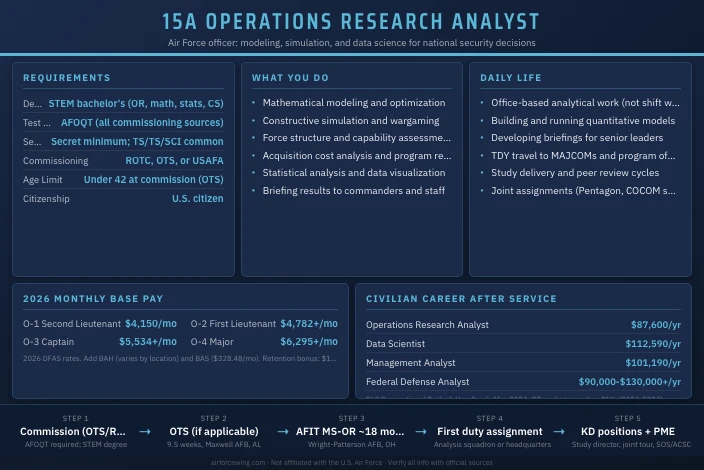
Job Role
15A Operations Research Analysts are Air Force commissioned officers who conduct studies, models, simulations, and assessments to inform military decisions across the full range of Air Force operations, acquisitions, and strategy. They apply structured quantitative methods, including optimization, probability modeling, statistical analysis, and constructive simulation, to answer questions that commanders and acquisition executives cannot answer with experience alone.
Command and Leadership Scope
At the O-1 through O-3 (Second Lieutenant to Captain) level, 15A officers function largely as analysts. They build models, run studies, develop briefing products, and support larger analytical efforts led by more senior officers or civilian analysts. The work is hands-on and technical. Individual study ownership typically arrives at the O-3 level, when a Captain leads a complete analytical effort from problem framing through final recommendation.
Field-grade officers (O-4 and above) shift toward managing analytical teams and owning entire programs. A Major might lead a division of analysts or serve as a senior staff advisor at a major command headquarters. Lieutenant Colonels and Colonels run analysis squadrons, direct Air Staff programs, or lead high-visibility analytical efforts at OSD-level organizations. Span of control ranges from a small team of three or four analysts at the Captain level to a full squadron of 40 or more people at the Lieutenant Colonel level.
Specific Roles and Designations
| Designation | Title | Focus Area |
|---|---|---|
| 15AX | Operations Research Analyst (generalist) | Military analysis, modeling, simulation, force structure |
| 15AX with SEI | Specialized experience variant | Wargaming, cost analysis, test and evaluation, logistics modeling, data science |
Special Experience Identifiers reflect domain expertise developed through sustained assignment in a particular area. Officers earn them over time; they are not awarded at initial assignment.
Mission Contribution
The Air Force makes decisions at institutional scale, force structure, weapon system acquisitions, operational planning, logistics posture. 15A officers provide the quantitative backbone behind those decisions. When a combatant command needs to know whether a force mix can accomplish a campaign objective, a 15A study delivers the answer. When an acquisition program office needs to know whether a new aircraft justifies its lifecycle cost, a 15A cost analysis shapes the decision.
The work is joint by nature. Many studies touch Army logistics, Navy force structure, or Marine Corps operational data. Officers frequently serve at joint organizations including the Joint Staff J8, OSD Cost Assessment and Program Evaluation (CAPE), and combatant command analytical shops. This joint exposure is not incidental, it is a deliberate part of how 15A officers build the breadth needed for senior advisory roles.
Technology, Equipment, and Systems
15A officers work across a wide range of analytical tools. Statistical and programming environments include R, Python, MATLAB, and SAS. Simulation platforms include JSAF, EADSIM, and OneSAF for combat modeling, along with proprietary DoD simulation environments not available in the civilian sector. Cost analysis tools, earned value management systems, and database analysis platforms are common at acquisition program offices. Data visualization matters as much as technical rigor, a study that commanders cannot understand does not change decisions.
Salary
Officer Base Pay
All officer compensation follows the DFAS military pay scale. Base pay figures below reflect 2026 rates from DFAS.
| Rank | Grade | Typical YOS | Monthly Base Pay |
|---|---|---|---|
| Second Lieutenant | O-1 | 0-2 years | $4,150/mo |
| First Lieutenant | O-2 | 2-4 years | $4,782-$6,618/mo |
| Captain | O-3 | 4-10 years | $5,534-$8,788/mo |
| Major | O-4 | 10-16 years | $6,295-$10,402/mo |
Officers entering with prior enlisted service receive years-of-service credit, which increases starting base pay above the entry figures shown.
Retention Bonus
The Air Force offers a retention bonus of $15,000 per year for a four-year contract to eligible 15A officers. That is $60,000 in total bonus pay over the contract period. Eligibility requirements and contract windows are managed by AFPC; officers should confirm current availability with their career field manager before making retention decisions.
Allowances and Benefits
Base pay is a floor, not a ceiling. Officers also receive:
- Basic Allowance for Housing (BAH): Varies by duty location and dependency status. At high-cost installations like the Pentagon area or Wright-Patterson AFB, monthly BAH for an O-3 without dependents can reach $2,000 or more. Use the DoD BAH rate lookup for current figures at specific installations.
- Basic Allowance for Subsistence (BAS): $328.48/month for officers (2026 rate).
- TRICARE Prime: Free medical, dental, mental health, and prescription coverage on active duty. Zero enrollment fee, zero deductible, zero copay for in-network care.
- Thrift Savings Plan (TSP): Under the Blended Retirement System, the Air Force automatically contributes 1% of basic pay and matches member contributions up to 4%, for a maximum government contribution of 5% of basic pay.
- Annual leave: 30 days per year.
- Tuition Assistance: Up to $4,500 per year, $250 per semester hour, for off-duty education.
Retirement
Officers who serve 20 years qualify for a Blended Retirement System pension equal to 40% of their high-36 average basic pay, paid monthly for life. An O-5 retiring after 20 years with a final base pay in the $11,000-$12,000 per month range would receive approximately $4,400-$4,800 per month as a lifetime annuity, separate from TSP savings.
Qualifications
The 15A AFSC requires a quantitative STEM bachelor’s degree. Candidates without a strong math or statistics foundation are unlikely to receive this career field assignment even with a competitive overall officer package.
Commissioning Sources
Three paths lead to a commission as a 15A officer: Air Force ROTC, Officer Training School (OTS), and the Air Force Academy (USAFA). All three are valid routes. Direct commission into 15A is not offered.
| Commissioning Source | GPA Minimum | Degree Requirement | Age Limit | Key Prerequisites |
|---|---|---|---|---|
| Air Force ROTC | 2.0 (competitive 3.0+) | STEM bachelor’s strongly preferred | Under 31 at commission | Scholarship or enrollment; AFOQT required |
| Officer Training School (OTS) | 2.5 (competitive 3.0+) | Degree in hand at application | Under 42 at commission | AFOQT required; degree must be complete |
| Air Force Academy (USAFA) | Competitive (class rank) | USAFA degree | Under 23 at entry | Congressional nomination |
The 15A field expects officers to enter with a degree in operations research, mathematics, statistics, data science, computer science, or a closely related quantitative discipline. Candidates from other majors need sufficient coursework in calculus, probability, and statistics to demonstrate analytical competence. ROTC cadets targeting 15A should select a quantitative STEM major from the start of their academic program. The officer test prep guide covers the AFOQT in detail, including which subtests matter most for non-rated career fields.
Test Requirements
All officer candidates must pass the Air Force Officer Qualifying Test (AFOQT). The AFOQT covers verbal ability, quantitative aptitude, situational judgment, and aviation aptitude subtests. For 15A, the quantitative and verbal sections carry the most weight, given the analytical nature of the career field. No published AFOQT subtest minimums exist specifically for 15A beyond general officer selection minimums, but competitive quantitative scores strengthen a career field application.
The TBAS (Test of Basic Aviation Skills) is not required for 15A. This is a non-rated, non-aviation career field. The officer test prep guide covers the AFOQT’s quantitative sections in detail and explains the full OTS application process for non-rated candidates.
Career Field Assignment Process
ROTC cadets rank career field preferences before commissioning; AFPC assigns fields based on Air Force needs, cadet performance, and available quotas. OTS selectees go through the same process after their class assignment. The 15A field is not the most numerically competitive in terms of quotas, but it is selective on academic background, candidates without a quantitative STEM foundation are screened out regardless of overall officer package strength.
Cross-training into 15A mid-career is possible through AFPC formal processes, most commonly for officers with adjacent analytical backgrounds in intelligence (14N), acquisition (63A), or logistics readiness.
Upon Commissioning
New officers commission at O-1 (Second Lieutenant). The standard Active Duty Service Commitment for most commissioning programs is four years. Officers who receive a funded AFIT master’s degree as an initial assignment incur an additional service commitment based on program length, typically two to three years for a 15-18 month graduate program.
Work Environment
Daily Setting and Schedule
Most 15A officers work in offices, analysis squadrons, headquarters directorate shops, program office analytical teams, or joint planning organizations. The daily rhythm is data-heavy: building models, reviewing methodology, interpreting outputs, writing study reports, and developing briefings for commanders and senior staff.
Unlike rated or special operations career fields, 15A officers do not work rotating shifts. The garrison schedule is largely predictable, running 9-10 hours on normal days with surge periods around major study deliveries, exercises, or program reviews.
TDY travel is a consistent part of the job. Officers brief results at major commands, attend analytical conferences, support wargaming events, and visit program offices across the country. Some assignments involve extended TDY to combatant commands. Junior officers at AFIT effectively spend 18 months in a full-time graduate school environment before their first operational assignment.
Leadership and Chain of Command
Junior 15A officers typically report to more senior analysts and, at many headquarters billets, to civilian Senior Executive Service leaders or equivalent. The chain of command in analytical organizations is often civilian-heavy above the O-5 level, directors, assistant secretaries, and OSD staff routinely sit above military analysts in the decision hierarchy.
Enlisted personnel are less common in analysis units than at operational squadrons. When present, senior NCOs manage administrative functions or bring subject-matter expertise from specific analytical domains. The day-to-day dynamic is often officer-to-civilian rather than officer-to-NCO in most 15A assignments.
Staff vs. Command Roles
The majority of 15A billets are staff positions. Officers lead analysis teams and study programs rather than command combat squadrons. Formal squadron command is available at the O-5 level for officers assigned to operations analysis squadrons; it is a key developmental milestone. Between command cycles, officers fill staff roles at major commands, the Air Staff, or joint organizations. The career path is fundamentally staff-oriented, and officers who want line command should evaluate other career fields.
Job Satisfaction and Retention
Retention in 15A reflects a persistent competition with the private sector. The analytical skills 15A officers develop, quantitative modeling, simulation, data analysis applied to high-stakes decisions, transfer directly to defense contracting, consulting, and technology industries that pay significantly more. Officers who stay typically do so because of mission weight, access to classified problems at national-security scale, and rapid movement into senior advisory roles. The retention bonus exists because the Air Force has to compete harder for this talent than for career fields with fewer civilian market parallels.
Training
Pre-Commissioning Training
The path to 15A begins with commissioning. ROTC cadets complete a 3-4 year program combining Air Force leadership education with their academic degree. OTS delivers 9.5 weeks of training at Maxwell AFB, AL, covering officer fundamentals, Air Force doctrine, and leadership basics. USAFA provides a four-year commissioning program. None of these sources deliver 15A-specific technical content, that training comes after the commission. If you’re preparing the AFOQT as part of your OTS or ROTC application, the officer test prep guide covers the quantitative sections in detail.
Initial Skills Training
| Phase | Location | Length | Focus |
|---|---|---|---|
| Commissioning (OTS path) | Maxwell AFB, AL | 9.5 weeks | Officership, Air Force fundamentals |
| Initial Skills Training (AFIT MS-OR) | Wright-Patterson AFB, OH | ~18 months | Graduate-level operations research, modeling, simulation, statistics |
| Initial Skills Training (AFIT certification) | Distance / Wright-Patterson AFB | Varies | Quantitative methods certification for prior-degree holders |
| First duty assignment | Varies by AFPC assignment | Ongoing | AFSC qualification on the job |
Most new 15A officers attend the Air Force Institute of Technology (AFIT) at Wright-Patterson AFB, OH for their initial skills training. The preferred track is the Master of Science in Operations Research (MS-OR), a full 18-month in-residence graduate program. Officers who already hold a qualifying graduate degree may complete a shorter AFIT certification track instead. AFIT admission for the MS-OR requires a 3.0 overall GPA and 3.0 math GPA.
The MS-OR curriculum covers mathematical programming, probability theory, simulation design, applied statistics, decision analysis, and combat modeling. Officers leave AFIT with a funded graduate degree and direct proficiency in Air Force analytical methods, a path to senior-level competence that civilian graduate programs do not replicate. The 15A field requires completion of initial skills training within 24 months of entry into the career field (or 36 months for first-assignment AFIT students).
Professional Military Education
All Air Force officers progress through the same PME sequence:
- Squadron Officer School (SOS): Completed as a Captain (O-3), in-residence at Maxwell AFB or by correspondence. Covers Air Force doctrine, leadership, and officer development.
- Air Command and Staff College (ACSC): For Majors (O-4), either in-residence at Maxwell AFB or via distance learning. Covers joint operations and operational-level leadership.
- Air War College (AWC): For Lieutenant Colonels and Colonels (O-5/O-6) at Maxwell AFB. Focuses on national security strategy and senior leader decision-making.
In-residence attendance at SOS and ACSC is competitive and preferred over correspondence completion by promotion boards.
Advanced Education and Specialized Schools
Beyond the AFIT MS-OR, 15A officers can pursue additional advanced education and specialized assignments:
- AFIT doctoral programs: PhD in Operations Research or related disciplines for officers selected for academic roles or advanced research
- OSD CAPE rotations: High-visibility broadening assignment at the Office of the Secretary of Defense’s Cost Assessment and Program Evaluation directorate
- Fellowships: Congressional, White House, and RAND defense fellowships available for senior Captains and Majors with strong analytical records
- Wargaming courses: Several joint centers offer courses in military simulation design, combat gaming, and red team analysis
- Joint duty: Pentagon and combatant command billets count toward joint qualification, which is required for consideration for general officer rank
Career Progression
Typical Career Timeline
| Rank | Grade | Typical Timeline | Key Positions |
|---|---|---|---|
| Second Lieutenant | O-1 | 0-2 years | Junior analyst, study team member |
| First Lieutenant | O-2 | 2-4 years | Study team lead, staff action officer |
| Captain | O-3 | 4-12 years | Study director, analysis flight lead, staff officer |
| Major | O-4 | 12-16 years | Division chief, branch chief, senior staff analyst |
| Lieutenant Colonel | O-5 | 16-22 years | Squadron commander, directorate deputy, Air Staff division chief |
| Colonel | O-6 | 22+ years | Program director, Air Staff director, senior headquarters advisor |
Promotion from O-1 to O-3 is largely automatic with time in grade and satisfactory performance. O-4 and above requires selection by a central promotion board. Boards evaluate job performance, PME completion, joint assignment experience, and key developmental billet history.
Key Developmental Positions
Key developmental billets for 15A officers include serving as a study director or analysis flight commander, a major headquarters staff position at the Air Staff or a combatant command analytical shop, and at least one joint assignment during a career. Pentagon tours are high-visibility and strongly support O-5 and O-6 board selection. AFIT faculty tours and CAPE rotational assignments carry significant weight for analytically focused promotion boards.
Cross-Training and Broadening
Cross-training out of 15A mid-career is possible, most often into acquisition (63A) or intelligence (14N) given skill overlap. Broadening assignments include ROTC instructor tours, legislative liaison billets, defense agency rotations, and fellowships at think tanks or civilian analytics organizations.
Building a competitive 15A promotion record means completing the AFIT degree early, attending in-residence PME, finishing at least one joint assignment, and checking key developmental billets before each promotion board cycle.
Physical Demands
Fitness Requirements
All Air Force officers, including 15A officers, take the annual Air Force Fitness Assessment. The FA is identical for all Airmen regardless of career field.
| Component | Max Points | Notes |
|---|---|---|
| 1.5-Mile Run | 60 | Primary cardiovascular component |
| Push-Ups (1 minute) | 10 | Muscular endurance |
| Sit-Ups (1 minute) | 10 | Core endurance |
| Waist Circumference / Body Composition | 20 | Scored separately |
The composite must reach at least 75 out of 100 to pass, with minimum thresholds on each individual component. Standards are age- and gender-normed. Current scoring tables are maintained on af.mil.
Officers who fall below minimum on any single component fail the assessment regardless of composite score. Regular physical training is an officer responsibility, there is no assigned PT formation in most headquarters and analytical units, which means 15A officers need personal discipline to stay fit. Most analytical assignments do not include physical labor, shift work, or operational tempo that keeps fitness levels naturally elevated.
Medical and Clearance Requirements
15A officers do not require a flight physical. The standard commissioning physical applies. DoDMERB for ROTC and USAFA, MEPS for OTS. Neither 15A duties nor the analytical environment impose physical demands beyond ordinary office work, so medical disqualifiers are limited to general officer commissioning standards rather than career-field-specific requirements.
Most 15A assignments require at minimum a Secret security clearance. Many program office, headquarters, and wargaming assignments require Top Secret or TS/SCI access, given the classified nature of operational analysis, force structure studies, and weapon system acquisition data. Officers assigned to CAPE, certain wargaming centers, or nuclear program analysis shops may require Sensitive Compartmented Information (SCI) access tied to specific programs.
Clearance investigations for Top Secret can take six months to over a year. Candidates should avoid financial problems, extensive foreign contacts, and other factors that complicate adjudication. The clearance is an asset, maintaining it throughout a career, and passing it to Reserve or post-service employment, adds direct economic value to the 15A credential.
Deployment
Deployment Tempo
15A officers deploy at a lower rate than operational career fields, but deployments occur. Officers support contingency analytical requirements, theater operations analysis, deployed wargaming, and rapid acquisition support. Typical deployment lengths run 90-180 days. Officers assigned to analytical units directly supporting active contingency operations tend to see more deployment and TDY than those in long-range planning roles.
Compared to rated, special operations, or remotely piloted aircraft career fields, 15A deployment tempo is moderate and largely predictable. Officers planning family schedules around deployment patterns will find this career field significantly more stable than most.
TDY is a separate consideration from deployment and happens more frequently. Officers may travel multiple times per year to brief results at major commands, attend analytical conferences, or support exercise events. A busy TDY year might involve 60-90 days of travel spread across short trips, which is manageable but worth factoring into family scheduling. Deployment and TDY together represent the primary work-life tradeoff for 15A officers rather than the extended combat rotations that define operational career fields.
Duty Station Options
15A billets are distributed across the Air Force’s analytical and acquisition infrastructure rather than concentrated at a single installation.
- Wright-Patterson AFB, OH: Air Force Materiel Command headquarters; AFIT campus; major acquisition program offices; primary 15A hub
- Pentagon, Arlington, VA: Air Staff A9 (Studies, Analyses, and Assessments); OSD CAPE
- Hanscom AFB, MA: Electronic Systems Center; C2 and communications system analysis
- Langley-Eustis AFB, VA: Air Combat Command; operational analysis support
- Kirtland AFB, NM: Air Force Nuclear Weapons Center; directed energy and nuclear program analysis
- Maxwell AFB, AL: Air University analytical organizations; doctrine and wargaming centers
- Joint bases and combatant commands: Joint Staff J8, USINDOPACOM, USCENTCOM analytical shops
AFPC manages officer assignments. Officers submit preference worksheets and are matched against available billets. The geographic spread of 15A positions gives somewhat more flexibility than career fields concentrated at a single installation, though Wright-Patterson AFB is the career field’s center of gravity.
Risk/Safety
Job Hazards
The primary risks for 15A officers are professional, not physical. Analytical products that misrepresent capability, understate program risk, or selectively present data to support a preferred outcome carry serious professional consequences. Operations research credibility rests entirely on methodological integrity. Studies challenged in congressional hearings or OSD reviews can be career-ending.
Acquisition-adjacent analysis carries financial accountability risk. Officers who certify cost estimates or force structure studies used in budget justification documents are responsible for the accuracy of those products under DoD and congressional reporting requirements.
Legal and Command Responsibility
All military officers are subject to the Uniform Code of Military Justice (UCMJ). 15A officers in positions with program analysis responsibility may face Inspector General scrutiny if their products are found to be inaccurate, incomplete, or shaped by external pressure rather than evidence. Equal opportunity requirements and command climate responsibilities apply across all officer assignments. Officers relieved for cause in analytical or staff positions face a difficult path to further promotion and post-service government employment.
Safety Protocols
15A officers apply Operational Risk Management (ORM) principles in study design, particularly when analysis informs decisions about weapon system effectiveness, force structure sizing, or system reliability under combat conditions. Peer review of analytical models, sensitivity analysis on key assumptions, and independent validation of simulation results are standard professional safeguards in the field.
The culture of analytical peer review within the 15A community is a genuine professional protection. Officers who produce sloppy or pressure-shaped analysis face reputational consequences within a relatively small career field. With only about 550 military operations research analysts in the force, the community is tight enough that methodological reputation travels. Officers who build credibility for rigorous, honest analysis earn assignments and leadership opportunities that officers who compromise on methodology do not.
Classified information handling is a daily responsibility for most 15A officers. Work product at program offices and headquarters analytical shops routinely touches acquisition-sensitive and operationally classified data. Mishandling classified materials, whether through negligence or deliberate disclosure, carries criminal liability under federal law and UCMJ. Officers should treat data security as non-negotiable professional practice, not a compliance exercise.
Impact on Family
PCS Tempo and Family Stability
15A officers move every 2-4 years, consistent with the Air Force average. A career spanning 20 years may involve moves between Wright-Patterson, the Pentagon, Langley, Hanscom, and joint assignments at various locations. Unlike rated career fields, there are no location extremes tied to specific aircraft beddown bases.
The Air Force Airman and Family Readiness Center (A&FRC) operates at every major installation and provides relocation support, spouse employment resources, and financial counseling. The Key Spouse Program connects families within units for mutual support during TDYs and deployments.
Dual-Military Families
Dual-military couples with one or both partners in analytical career fields benefit from a relatively dispersed duty station footprint compared to rated career fields. AFPC manages join-spouse requests but cannot guarantee collocated assignments in every cycle. Officers with a spouse in a geographically constrained career field should plan for potential separation during mid-career assignment cycles.
Work-Life Balance
Garrison work in analysis units is demanding but largely predictable. Major study deliveries, command briefings, and exercise support create workload surges; outside those events, the pace is manageable relative to operational squadrons. The absence of rotating shift work, combined with a lower deployment tempo than most career fields, makes this one of the more family-friendly paths in the officer corps.
The AFIT assignment in particular deserves mention for families. The 18-month graduate program at Wright-Patterson AFB, OH puts officers in a stable, school-like environment with regular hours and no operational demands. Families who join the officer at Wright-Patterson typically find the AFIT period one of the more settled stretches of a military career. Spouse employment options in the Dayton, OH area and on-base school infrastructure make the assignment workable for families with children.
PCS moves happen roughly every two to three years in a typical career. That is consistent with other officer career fields and manageable with planning. The A&FRC at each installation offers free relocation counseling, spouse employment support, and connection to community resources. Officers approaching a PCS move should engage A&FRC services early, as the support provided by these centers is substantially underutilized by junior officers who don’t know the services exist.
Reserve and Air National Guard
Component Availability
The 15A career field is available in both the Air Force Reserve and the Air National Guard. Billet availability is narrower than on active duty, with most Reserve and ANG 15A positions tied to analysis units that augment active component organizations during exercises, mobilizations, and study support requirements.
Commissioning Paths
Reserve and ANG candidates commission through the same sources as active duty: ROTC with a Reserve component contract, OTS through a Reserve or ANG-sponsored application, or USAFA followed by a Reserve assignment. Active-duty 15A officers who complete their ADSC can transfer to Reserve or ANG billets while retaining analytical skills and clearances built on active duty.
Drill Commitment and Pay
The standard Reserve and ANG commitment is one weekend per month (Unit Training Assembly) plus two weeks per year (Annual Tour). Some analytical billets require additional days for exercise support or study deliverables. An O-3 (Capt) with 4-6 years of service earns approximately $7,383-$7,737 per month in base pay while on active orders; on a standard drill weekend (four training assemblies), that prorates to roughly $988-$1,032 in drill pay for the weekend.
Component Comparison
| Category | Active Duty | Air Force Reserve | Air National Guard |
|---|---|---|---|
| Commitment model | Full-time | 1 weekend/mo + 2 wks/yr | 1 weekend/mo + 2 wks/yr |
| Monthly pay (O-3, 6 YOS) | $7,737/mo | ~$1,000/drill weekend | ~$1,000/drill weekend |
| Healthcare | TRICARE Prime (free) | TRICARE Reserve Select (premium-based) | TRICARE Reserve Select or state plan |
| Education benefits | TA $4,500/yr + GI Bill | Federal TA (same rate) | State tuition waivers vary |
| Retirement | 20-yr pension (high-36) | Points-based at age 60 | Points-based at age 60 |
| Deployment tempo | Low-moderate | Periodic mobilization | Periodic mobilization + state activations |
| Command opportunities | Analysis squadron at O-5 | Limited; study support billets | Limited; varies by state unit |
TRICARE Reserve Select requires member-paid premiums but provides coverage comparable to active-duty TRICARE for most care. State tuition waivers for Air National Guard members vary considerably, some states cover full in-state tuition at public universities; others offer partial or no benefit.
Civilian-Military Career Integration
The Reserve and ANG path pairs exceptionally well with civilian careers in data science, defense consulting, and federal analytics. Employers in defense contracting, technology, and financial services actively seek cleared analysts with experience in military modeling tools and simulation environments. Reserve service maintains clearances and keeps 15A officers current on DoD methods. USERRA protections require employers to grant military leave and restore returning members to equivalent civilian positions.
Post-Service
Civilian Career Transition
Few Air Force officer career fields produce a more direct civilian translation than 15A. Officers leave with quantitative skills, security clearances, and experience applying analysis to billion-dollar decisions, a combination that defense contractors, consulting firms, federal agencies, and technology companies pay measurable premiums to hire.
The Transition Assistance Program (TAP) provides workshops at every installation to convert military experience into civilian resumes and interview strategies. Hiring Our Heroes and the American Corporate Partners mentorship program offer additional pathways to civilian employers.
Civilian Career Prospects
| Civilian Job Title | BLS Median Salary | Job Outlook (2024-2034) |
|---|---|---|
| Operations Research Analyst | $87,600/yr | +21% (much faster than average) |
| Data Scientist | $112,590/yr | +34% (much faster than average) |
| Management Analyst / Consultant | $101,190/yr | +9% (faster than average) |
| Defense / Program Analyst (federal) | $90,000-$130,000+/yr | Steady government demand |
Salary data from the BLS Occupational Outlook Handbook. Officers with active Top Secret or TS/SCI clearances typically command salaries above these medians in the defense contracting and government consulting sectors.
Certifications and Graduate Education
AFIT MS-OR graduates leave with a transferable master’s degree recognized by civilian employers in defense, consulting, and technology. Common post-service certifications include the Project Management Professional (PMP) from PMI for officers moving into program management, and data science or statistics certifications for those pivoting toward technology or finance.
For officers using education benefits after service, the Post-9/11 GI Bill covers full in-state tuition at public universities and up to $29,920.95 per academic year at private schools (2025-2026 cap), plus a monthly housing allowance based on the E-5 with dependents BAH rate at the school location.
Officers with an AFIT master’s degree already have the graduate credential that most post-service education transitions target. Their GI Bill benefits are therefore available for doctoral programs, additional certifications, or other purposes rather than a first graduate degree. That is a distinct financial advantage compared to officers who leave service without advanced education and must fund a master’s degree before reaching senior civilian roles. The AFIT-funded MS-OR is part of what makes the 15A lifetime value proposition strong relative to comparable civilian career paths.
Is This a Good Job
Ideal Candidate Profile
This career field suits candidates who reach for a dataset before they reach for an opinion, and who are comfortable telling a two-star general that the data does not support what they want to do. The work rewards analytical rigor and patience, studies take months, results get revised, and the impact of a single analysis may not be visible for years.
Strong 15A candidates typically bring:
- An undergraduate degree in operations research, mathematics, statistics, data science, computer science, or engineering
- Comfort building and interpreting quantitative models under time pressure
- Ability to explain complex analytical results to non-technical decision-makers
- Genuine interest in military strategy and national security problems, not just the math
- Tolerance for large-organization timelines and bureaucratic review cycles
Potential Challenges
This is not a career for officers who want visible, immediate operational impact. Studies get shelved. Results get overtaken by decisions made before the analysis was complete. The best analytical work sometimes never reaches a decision-maker. Officers need a tolerance for that reality.
The pay gap relative to private-sector data science is real and grows as civilian salaries rise. Officers who stay past their initial obligation tend to do so because of the mission weight, access to classified problems at national-security scale, and the AFIT-funded graduate degree, not because military pay matches what a senior data scientist earns in industry.
Long-Term Fit
15A is a strong full-career choice for officers who want a 20-year path followed by defense industry, federal government, or consulting roles. The analytical skills compound over time. An O-5 with 18 years in Air Force wargaming and cost analysis is a differentiated hire in the defense sector in a way that a four-year officer is not.
Compared to starting a civilian data science or consulting career at the same age, the 15A path offers earlier access to senior advisory roles, classified high-stakes problems, and a funded graduate degree, at the cost of lower early compensation and geographic constraints. The tradeoff favors military service for anyone with strong national security motivation and the quantitative background to thrive in this field.
More Information
Talk to an Air Force recruiter or your nearest ROTC detachment about 15A career field eligibility and the officer application timeline. Recruiters can advise on AFOQT scheduling, AFIT degree prerequisites, and how to build a competitive package for this career field assignment. The commissioning process takes real preparation, the AFOQT and officer test prep guide covers the quantitative sections of the exam and walks through the full OTS application process.
This site is not affiliated with the U.S. Air Force or any government agency. Verify all information with official Air Force sources before making enlistment or career decisions.
Explore more Air Force Acquisition officer careers alongside other analytical and technical options such as the 62E Developmental Engineer and the 63A Acquisition Manager.