1W0X2 Special Operations Weather
Few Air Force jobs exist that require you to skydive into a blizzard, dive underwater with a rebreather, and then produce a precision weather forecast for a SEAL Team before sunrise. Special Operations Weather Technicians do exactly that. This AFSC started as 1W0X2, built its reputation over a decade of combat deployments in Afghanistan and Iraq, and officially transitioned to the 1Z4X1 Special Reconnaissance designation in 2019. The mission didn’t shrink, it expanded. Whether you’re eyeing this career field by its original code or its current one, the job demands the same thing: someone who can perform elite physical tasks and rigorous meteorological analysis in the same 24 hours.
AFSC transition note: The 1W0X2 Special Operations Weather code was retired on April 30, 2019. The career field now operates under 1Z4X1 Special Reconnaissance. All current enlistment, training, and qualification information below reflects the 1Z4X1 designation. Contact an Air Force Special Warfare recruiter to enlist into this career field today.
Qualifying requires specific ASVAB line scores, our ASVAB study guide covers what to target and how to prepare.
Qualifying requires specific ASVAB line scores. Our ASVAB study guide covers what to target and how to prepare.
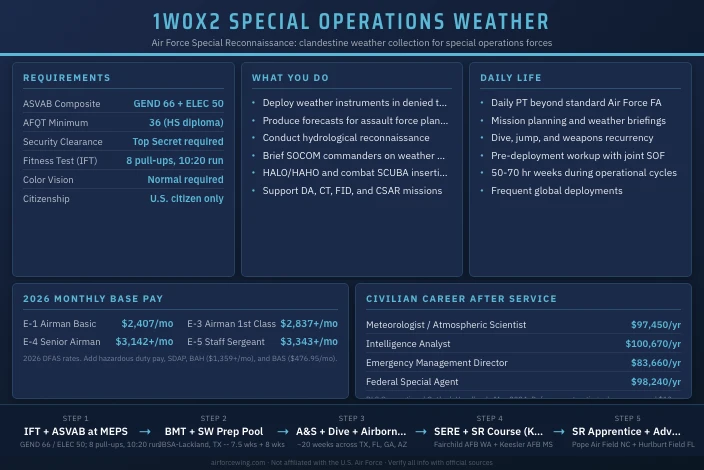
Job Role
Special Reconnaissance Airmen (formerly Special Operations Weather Technicians) are ground-based operators who collect meteorological, hydrological, and environmental data in denied or contested areas, then translate that data into precision forecasts for special operations mission planners. They deploy in small clandestine elements, often ahead of assault forces, to provide the ground truth that satellite imagery can’t deliver.
What You Actually Do
The mission sounds straightforward: collect weather data, produce forecasts. The execution is anything but. SR Airmen operate where accurate environmental data is impossible to get any other way, deep in a mountain range, on a contested coastline, or in a city where no standard weather station exists.
Day-to-day responsibilities include:
- Deploying surface weather observation instruments in remote terrain
- Collecting atmospheric profile data (temperature, humidity, wind, precipitation)
- Producing target-area and route forecasts for rotary and fixed-wing aircraft
- Briefing special operations commanders on environmental windows for insertion and extraction
- Conducting hydrological reconnaissance (tide, surf, sea state, river crossings)
- Supporting direct action, counter-terrorism, foreign internal defense, and combat search and rescue missions
Specializations and Designations
The 1Z4X1 career field uses skill levels and additional duty identifiers rather than formal shredouts.
| Designation | Description |
|---|---|
| 1Z4X1 (Apprentice) | Awarded after completion of the SR Apprentice Course |
| 1Z431 | Entry-level, 3-skill level |
| 1Z451 | Journeyman, 5-skill level |
| 1Z471 | Craftsman, 7-skill level |
| 1Z491 | Superintendent, 9-skill level |
Mission Contribution
Special operations missions live and die on environmental conditions. A helicopter assault that launches into unexpected fog, or a HALO jump into wind shear the planners didn’t account for, can end in catastrophe. SR Airmen eliminate those unknowns. Their forecasts don’t just inform decisions, they determine whether a mission launches at all.
The role sits under the 720th Special Tactics Group, 24th Special Operations Wing, Air Force Special Operations Command (AFSOC). SR Airmen routinely operate alongside Army Special Forces, Ranger units, Navy SEALs, and foreign partner forces.
Technology and Equipment
SR Airmen work with a mix of meteorological instruments and standard special operations gear. On the weather side, that includes rawinsonde balloon systems, portable surface weather stations, dropsonde systems, and upper-air profiling equipment. On the operator side, they carry the same kit as other special warfare Airmen, individual weapons, night vision, communication systems, and specialized infiltration equipment for HALO, HAHO, and combat dive operations.
Salary
Special Reconnaissance Airmen receive standard Air Force enlisted pay plus any applicable special pay for hazardous duty and special operations assignment. The table below reflects 2026 DFAS rates.
Base Pay
| Rank | Pay Grade | Monthly Base Pay (entry) |
|---|---|---|
| Airman Basic | E-1 | $2,407 |
| Airman | E-2 | $2,698 |
| Airman First Class | E-3 | $2,837 |
| Senior Airman | E-4 | $3,142 |
| Staff Sergeant | E-5 | $3,343 |
| Technical Sergeant | E-6 | $3,401 |
| Master Sergeant | E-7 | $3,932 |
Most Airmen complete the SR pipeline and arrive at their first duty station as an E-3 or E-4. Given the length of the pipeline (roughly 12 to 18 months after BMT), pay advances several steps before the first operational assignment.
Special pays and allowances: Hazardous duty incentive pay applies for jumps and dive operations. Assignment to AFSOC special tactics units frequently carries Special Duty Assignment Pay (SDAP). The Basic Allowance for Housing (BAH) varies by duty location and dependency status, a single E-4 at Fort Liberty or Hurlburt Field earns a significant housing allowance on top of base pay. Basic Allowance for Subsistence (BAS) adds $476.95 per month for all enlisted Airmen regardless of rank.
Additional Benefits
TRICARE Prime covers active-duty Airmen with no enrollment fees, no deductibles, and no copays. Coverage includes medical, dental, vision, mental health, and prescriptions. The Post-9/11 GI Bill covers full in-state tuition at public universities, or up to $29,920.95 per academic year at private schools, plus a monthly housing allowance and $1,000 annual book stipend. Tuition Assistance allows up to $4,500 per year toward college courses while on active duty.
Retirement under the Blended Retirement System (BRS) combines a 20-year pension at 40% of your high-36 average basic pay with automatic Thrift Savings Plan contributions. The government contributes 1% automatically and matches up to 4% of your contributions.
Work-Life Balance
SR Airmen operate on an irregular schedule driven by mission requirements and training cycles. Expect 50 to 70 hours per week on average. Leave accrues at 2.5 days per month (30 days annually). Deployment tempo is high, this career field deploys frequently and for extended periods.
Qualifications
Entry requirements for this AFSC are among the most demanding in the enlisted force. The ASVAB and fitness standards are gates, not goals, candidates who barely clear them rarely finish the pipeline.
Qualification Table
| Requirement | Standard |
|---|---|
| Citizenship | U.S. citizen |
| Age | 17 to 39 (waiverable) |
| Education | High school diploma or GED |
| AFQT Minimum | 36 (HS diploma); 65 (GED) |
| ASVAB Composite | GEND 66 AND ELEC 50 |
| Security Clearance | Top Secret (eligible at accession) |
| Vision | Correctable to 20/20; normal color vision |
| Depth Perception | Required |
| Swim Qualification | Must pass combat water survival |
| Physical | Must pass the IFT before contracting |
The GEND 66 AND ELEC 50 requirement is significantly higher than the minimum for most Air Force jobs. Study deliberately for the arithmetic reasoning, general science, word knowledge, and electronics subtests. A higher score gives you stronger standing in ASVAB negotiations and shows recruiters you have the aptitude to survive the technical portions of training.
The Initial Fitness Test (IFT)
Before a recruiter can contract you for this AFSC, you must pass the Air Force Special Warfare Initial Fitness Test. The IFT replaced the older PAST test. Minimum standards include:
- Pull-ups: 8 (within 2 minutes)
- Sit-ups: 50 (within 2 minutes)
- Push-ups: 40 (within 2 minutes)
- 1.5-mile run: 10:20
- 500-meter surface swim: Under 15 minutes
- Two 25-meter underwater swims: Pass/fail
Clearing minimums is not enough. Assessment and Selection eliminates roughly 30% of candidates who passed the IFT. Recruiters recommend exceeding the minimums by a significant margin before reporting.
Application Process
- Contact an Air Force Special Warfare recruiter (not a standard Air Force recruiter)
- Complete the ASVAB at MEPS and achieve GEND 66 / ELEC 50
- Pass the IFT administered by the recruiter or at a Special Warfare pre-screening event
- Complete medical screening at MEPS, including depth perception and color vision checks
- Obtain a Top Secret security clearance investigation initiation
- Receive a guaranteed 1Z4X1 contract before shipping to BMT
Service Obligation
Enlistment contracts for special warfare AFSCs are typically four to six years. All candidates enlist as Airman Basic (E-1) and begin drawing E-1 pay on the day they ship to BMT.
See our ASVAB study guide for strategies to hit these line scores, or take the PiCAT from home if you are a first-time tester.
Work Environment
SR Airmen don’t work in a single environment, that’s the point. A given week can involve a morning briefing in a tactical operations center, an afternoon underwater dive rehearsal, and a night parachute operation. The operational schedule is dictated by mission cycles, training requirements, and unit readiness posture.
Within the 720th Special Tactics Group, SR Airmen serve in Special Tactics Squadrons alongside Pararescue, Combat Control, and TACP personnel. The team culture is tight. Units are small, and everyone knows what everyone else can do. Decision-making autonomy is high relative to most enlisted jobs, operators in the field are trusted to adjust plans based on conditions that commanders can’t see from the operations center.
Chain of Command and Feedback
Performance evaluations follow the Air Force Enlisted Performance Report (EPR) system. At the 5-skill level (journeyman) and above, Airmen begin supervising junior members and taking on mission planning responsibilities. The EPR uses a 5-tier rating scale, and scores in special warfare units are highly competitive, high-performing Airmen receive stratification bullets that are essential for promotion board selection.
Retention
Special warfare careers carry strong retention incentives. The Air Force has historically offered selective reenlistment bonuses for 1Z4X1 to maintain staffing. Contact a recruiter for current bonus availability, as amounts change by fiscal year.
Training
The SR training pipeline is one of the longest in the enlisted force. From BMT ship date to first operational assignment, plan on 12 to 18 months or more depending on course scheduling.
Training Pipeline
| Phase | Location | Duration | Focus |
|---|---|---|---|
| Basic Military Training (BMT) | JBSA-Lackland, TX | 7.5 weeks | Military fundamentals; SW candidates do extra PT with cadre |
| Special Warfare Prep Pool | JBSA-Lackland, TX | 8 weeks | Swimming, running, rucking, strength conditioning |
| Assessment & Selection (A&S) | JBSA-Lackland, TX | 4 weeks | Physical and mental evaluation; ~30% attrition |
| Pre-Dive Course | JBSA-Lackland, TX | 4 weeks | Water confidence, underwater tasks |
| Combat Dive School | NDSTC, Panama City, FL | 5 to 6 weeks | Open-circuit and closed-circuit SCUBA, night diving |
| Airborne School | Fort Benning, GA | 3 weeks | Static-line parachute qualification |
| Military Free-Fall (MFF) School | YPG, AZ | 4 weeks | HALO and HAHO operations |
| SERE Training | Fairchild AFB, WA | 2.5 to 3 weeks | Survival, evasion, resistance, escape |
| SR Course (Technical) | Keesler AFB, MS | 8 weeks | Meteorology, environmental reconnaissance, forecasting |
| SR Apprentice Course | Pope Air Field, NC | Approx. 6 months | Integrated special operations skills; AFSC award |
| Special Tactics Advanced Skills | Hurlburt Field, FL | 6 to 12 months | Weapons, demolitions, surveillance, maritime, drones |
The SR pipeline mirrors the PJ (Pararescue) pipeline in terms of combat dive and military freefall requirements. It is longer and physically harder than the Combat Control pipeline. Candidates who enter with swimming and running already at competition level have a significantly better chance of finishing.
Advanced Training
After earning the AFSC, operators continue building skills throughout their career. Qualification schools include combat weather officer support integration, advanced surveillance techniques, electronic warfare applications, drone operations, and joint integration with partner special operations forces. Language training is available and encouraged. Airmen who deploy repeatedly to specific regions often pursue Defense Language Institute coursework.
The Air Force funds degree completion through Tuition Assistance during stateside assignments. Many SR Airmen pursue degrees in meteorology, atmospheric science, or intelligence analysis, which directly strengthen their operational effectiveness.
Everything starts with qualifying ASVAB scores, our study guide covers what to study first.
Career Progression
Rank Progression
| Rank | Grade | Typical Time-in-Service |
|---|---|---|
| Airman Basic | E-1 | Entry |
| Airman | E-2 | 6 months |
| Airman First Class | E-3 | 1 year |
| Senior Airman | E-4 | 3 years |
| Staff Sergeant | E-5 | 5 to 7 years |
| Technical Sergeant | E-6 | 11 to 12 years |
| Master Sergeant | E-7 | 17 to 18 years |
| Senior Master Sergeant | E-8 | 20+ years |
| Chief Master Sergeant | E-9 | 24+ years |
Most candidates complete the pipeline and arrive at their first unit as A1C or SrA. Promotion to SSgt is highly competitive across the Air Force, but SR Airmen who perform well in their units tend to accumulate strong EPR packages that set them up well for the E-5 and E-6 boards.
Career Growth and Specialization
At the 5-skill level, SR Airmen take on mission planning roles and begin mentoring junior operators. At the 7-skill level, they manage unit training programs and lead team deployments. Senior NCOs at the 9-skill level serve as superintendents within Special Tactics Squadrons or in positions at AFSOC headquarters and major command staff.
Within the 1Z careers broadly, SR Airmen can cross-train into related roles or pursue officer commissioning through the Airman Scholarship and Commissioning Program (ASCP) or Officer Training School. Some pursue warrant officer or warrant officer-like functional career paths in specialized reconnaissance programs.
Performance Evaluation
The Air Force EPR system rates Airmen on a 1 to 5 scale across six performance factors. In special warfare units, a score below a 5 is considered underperformance. Stratification language in the EPR (e.g., “top 1 of 8 SrA”) carries enormous weight at promotion boards. Airmen who contribute to real-world missions and take on additional duties outside their primary job accumulate the strongest records.
Physical Demands
Daily Physical Demands
SR Airmen train to a different standard than the rest of the Air Force. Unit physical training typically occurs daily and goes well beyond the minimum Fitness Assessment requirements. A typical training day might include a 5-mile run, a swim session, rucking with a loaded pack, and strength work, before the workday begins. During pre-deployment workup cycles, training volume increases further.
The job’s physical demands in the field include parachuting with full kit (often 70+ lbs), combat diving in cold water or low-visibility conditions, long-range foot movement in mountainous terrain, and sustained operations over multiple days with limited sleep and resupply.
Air Force Fitness Assessment Standards
All Airmen take the annual Air Force Fitness Assessment (FA). The table below shows minimum passing scores for the under-25 age bracket.
| Component | Male (Under 25) | Female (Under 25) |
|---|---|---|
| 1.5-Mile Run | 9:12 min (max) | 10:51 min (max) |
| Push-Ups (1 min) | 33 min reps | 18 min reps |
| Sit-Ups (1 min) | 42 min reps | 38 min reps |
| Waist Circumference | 35.0 in (max) | 31.5 in (max) |
| Composite Passing Score | 75 / 100 | 75 / 100 |
SR Airmen routinely score in the “Excellent” range. Failing the Fitness Assessment in a special warfare unit is treated as a significant performance issue.
Medical Standards
Candidates must meet Air Force accession medical standards before shipping to BMT, plus any AFSC-specific requirements determined at MEPS. Depth perception and normal color vision are required. Applicants must pass a physical exam confirming fitness for dive and parachute operations. An annual Fitness for Duty review supports continued qualification in dive and freefall skills. Top Secret clearance eligibility requires a thorough background investigation; any foreign contacts, financial issues, or prior drug use can complicate this process.
Deployment
Deployment Tempo
This is a high-deployment career field. SR Airmen can expect to deploy multiple times per enlistment, with individual deployments running from 90 days to six months or longer. Deployments are global, counterterrorism operations in the Middle East and Africa, special reconnaissance missions in the Pacific, and NATO-aligned operations in Europe. The exact deployment schedule depends on unit cycle, operational demand, and personnel availability.
Special Tactics units operate on a different deployment model than conventional Air Force units. Rather than deploying as a full squadron, SR Airmen typically deploy in small teams, often two to four personnel, attached to joint special operations task forces. That means a unit may have several teams deployed simultaneously to different theaters, with individual operators cycling in and out on staggered rotations rather than a single collective deployment schedule.
Between deployments, units cycle through workup periods that involve joint training events with Army Special Forces, Ranger units, and Naval Special Warfare teams. These training deployments, to ranges, live-fire facilities, or partner nation exercise locations, add to the overall time away from home even when they don’t count as formal deployments. An SR Airman with four years of service may spend more than half of that time away from their primary duty station when training rotations are factored in.
Duty Stations
SR Airmen are assigned to Special Tactics Squadrons. Key duty stations include:
- Hurlburt Field, FL: 720th Special Tactics Group, 23rd Special Tactics Squadron
- Pope Air Field (Fort Liberty), NC: 21st Special Tactics Squadron
- Joint Base Lewis-McChord, WA: 22nd Special Tactics Squadron
- Kadena AB, Japan: Pacific-assigned Special Tactics elements
- Air National Guard units including the 125th Special Tactics Squadron, Portland, OR
Assignments are based on unit needs and individual preference where possible. Most operators spend the majority of their career cycling between two or three of these locations.
Risk/Safety
Hazards
Parachuting, combat diving, and ground combat operations carry inherent risks. Mishaps during training are rare but do occur. The Air Force tracks safety data and adjusts training standards accordingly. Operational deployments introduce combat risk. SR Airmen operate in non-permissive environments where hostile contact is a realistic possibility.
The physical demands of the career field produce cumulative wear on the body. Parachuting with heavy kit, frequently 60 to 80 pounds for operational jumps, stresses ankles, knees, and the lower back repeatedly over a career. Combat diving in cold or low-visibility water requires precise air management and situational awareness under conditions where minor mistakes can become fatal. Long-range foot movement in mountainous terrain, carried out with limited sleep and limited resupply, produces injuries ranging from stress fractures to hypothermia and altitude sickness. SR Airmen should understand this is not a career that ends without physical cost, the question is whether the mission and the lifestyle are worth it.
Training pipeline attrition is itself a risk category. Candidates who enter Assessment and Selection and do not complete it are reassigned to a different AFSC. That reassignment is not a failure in the Air Force sense, it happens to a significant percentage of every A&S class, but candidates should be prepared for the possibility and should understand what reassignment means for their military career trajectory before committing to the special warfare pipeline.
Safety Protocols
Every qualification school has strict safety procedures administered by trained cadre and safety officers. Combat dive operations require buddy checks, redundant air supply systems, and dive medical officer oversight. Parachute operations require multiple gear checks before every jump. Units maintain rigorous training safety cultures because the operational consequences of unsafe habits are severe.
Closed-circuit rebreather diving introduces specific hazards not present in open-circuit operations, including oxygen toxicity at depth and carbon dioxide scrubber failures. SR Airmen are trained to recognize and respond to these conditions, and dive profiles are carefully managed to minimize exposure. Unit dive safety officers maintain oversight of all dive operations.
Security and Legal Requirements
Top Secret clearance is required, initiated at accession and renewed periodically. Airmen must self-report any changes in personal circumstances that could affect clearance eligibility, new foreign contacts, financial changes, or legal issues. Deployments in conflict zones are governed by Rules of Engagement (ROE) specific to each theater, and SR Airmen receive thorough pre-deployment legal and ROE briefings. Enlistment contracts include service commitments that extend beyond the initial term if specialized training is completed. Personnel who voluntarily separate before completing their training obligation may be required to repay training costs.
Impact on Family
This is a demanding lifestyle. High deployment tempo means extended time away from family, sometimes with limited communication during sensitive operations. Spouses and partners of SR Airmen describe the schedule as similar to, or harder than, that of Army Special Forces families.
Communication during operational deployments can be restricted or completely cut off for periods ranging from days to weeks. Families should prepare for windows where no contact is possible and build their daily routines around that expectation. Many Special Operations family support groups at units like Hurlburt Field provide structured programs specifically for this reality, including peer mentorship between families of experienced operators and those new to the community.
The concentration of Special Tactics units at a small number of installations creates a tighter geographic community than most Air Force career fields experience. Families stationed at Hurlburt Field or Pope Air Field are surrounded by other special operations families with shared experiences. That community can be a significant source of support during the long periods when the Airman is away. At the same time, repeated PCS moves to the same small set of installations mean that personal and professional relationships stay largely within the same community throughout a career.
The Air Force provides several support systems for Special Operations families. The Airman and Family Readiness Center (AFRC) at each installation offers deployment support, financial counseling, childcare resources, and spousal employment assistance. TRICARE covers the entire family at no cost. SpousePath and other DOD programs help spouses find employment that can survive frequent moves.
Relocation
SR Airmen rotate through Permanent Change of Station (PCS) moves every two to four years on average. Most assignments are to a small number of installations where Special Tactics units are based, so relocation patterns are somewhat predictable. The military pays for household goods moves and provides Dislocation Allowance (DLA) to offset moving costs.
Reserve and Air National Guard
Component Availability
The 1Z4X1 career field is available in both the Air Force Reserve and the Air National Guard, but positions are limited compared to active duty. Reserve and ANG operators serve in special tactics squadrons at select locations, the 125th Special Tactics Squadron (Oregon ANG) is one well-known Reserve Component unit.
Drill Schedule and Commitment
| Component | Standard Commitment | Additional Requirements |
|---|---|---|
| Active Duty | Full-time | Full deployment cycle, continuous training |
| Air Force Reserve | 1 weekend/month + 15 days/year | Additional training days for skill currency; dive/jump recurrency required |
| Air National Guard | 1 weekend/month + 15 days/year | State-specific activations; federal mobilizations; recurrency training |
Reserve and ANG SR operators must maintain the same qualifications as their active-duty counterparts, dive and freefall recurrency, weapons quals, and medical clearances don’t pause because you’re part-time. Expect significantly more than a standard drill weekend commitment.
Component Comparison
| Factor | Active Duty | Air Force Reserve | Air National Guard |
|---|---|---|---|
| Monthly Pay (E-4) | $3,142/mo | ~$1,256/drill weekend (4 drills) | ~$1,256/drill weekend (4 drills) |
| Healthcare | TRICARE Prime (free) | TRICARE Reserve Select (premium required) | TRICARE Reserve Select (premium required) |
| Education Benefits | Full Tuition Assistance + GI Bill | Federal TA + GI Bill (partial eligibility based on service) | State tuition waivers vary; GI Bill available after mobilization |
| Deployment Tempo | High (multiple deployments per enlistment) | Moderate to high (mobilizations available) | Moderate (state + federal activations) |
| Retirement | BRS 20-year pension | Points-based Reserve retirement | Points-based Reserve retirement |
Civilian Career Integration
Reserve and ANG service in this AFSC pairs well with civilian careers in emergency management, intelligence analysis, federal law enforcement, or atmospheric science. Most civilian employers accommodate military training schedules, and USERRA protections prevent job loss due to military duty.
Part-Time Pay
An E-4 earns approximately $209.47 per drill period (one per drill weekend, four drill periods per weekend), putting a drill weekend total around $838. Compare that to $3,142 monthly base pay on active duty. Part-time service at this level requires significant personal commitment for compensation that doesn’t reflect the operational intensity.
Post-Service
Civilian Career Paths
The skills SR Airmen develop translate directly into high-demand civilian roles. Weather forecasting, reconnaissance analysis, federal law enforcement, defense contractor positions, and emergency management all offer clear pathways. BLS data for comparable civilian occupations:
| Civilian Title | Median Annual Salary | Job Outlook (2024-2034) |
|---|---|---|
| Atmospheric Scientist / Meteorologist | $97,450 | +1% (slower than average) |
| Intelligence Analyst | $100,670 | +4% |
| Emergency Management Director | $83,660 | +3% |
| Special Agent (Federal Law Enforcement) | $98,240 | +6% |
| Defense Contractor / ISR Analyst | $85,000 to $130,000+ | Strong demand |
Defense contracting is the fastest path for many veterans, companies that support SOCOM operations actively recruit former special tactics operators. Active TS/SCI clearances carry real value and translate directly into salary negotiating power.
Transition Support
The Air Force Transition Assistance Program (TAP) provides pre-separation workshops, resume assistance, and job placement resources. Hiring Our Heroes connects veterans with corporate partners. SR veterans also benefit from the community networks built through AFSOC and the Grey Beret Association, which supports former Special Operations Weather Technicians.
Education
The Post-9/11 GI Bill covers up to 36 months of college. Many SR veterans use this toward meteorology, atmospheric science, intelligence studies, or engineering degrees that complement their operational experience. The American Meteorological Society and National Weather Service actively recruit veterans with field weather experience.
Is This a Good Job
Who Thrives Here
This career attracts a specific personality. The right candidate doesn’t separate “physical” from “technical”, they see both as the same problem. You’ll need to be genuinely interested in atmospheric science, not just tolerant of it. The forecasting work is technically demanding, and the operators you support are counting on accuracy. If you find weather science boring, you’ll have a hard time maintaining the edge this job demands.
Strong candidates tend to be methodical thinkers who perform well under stress. Comfort with discomfort is non-negotiable. The training pipeline selects for people who don’t quit when conditions deteriorate, because the operational job puts you in deteriorating conditions on purpose.
Other traits that predict success:
- Comfortable swimming in open water and confined spaces
- Can run and ruck at pace with minimal preparation
- Reads well and retains technical information under fatigue
- Draws satisfaction from team outcomes, not individual recognition
- Handles ambiguity without needing constant direction
Who Won’t Last
If you need predictable hours, a steady home base, or a work environment that doesn’t physically punish you, this isn’t a fit. The pipeline attrition is real, many candidates who pass the IFT don’t finish Assessment and Selection, and some who finish A&S don’t complete dive school. The job on the back end is as demanding as the training.
Candidates who depend on constant supervision or who struggle with analytical work in technical subjects also tend to wash out in the technical portions of the pipeline at Keesler.
Career and Lifestyle Fit
This job fits someone who wants a career that changes frequently, sends them to varied locations, and provides tangible proof of their contribution. The tradeoff is family impact and physical wear. SR Airmen who make it to 12 to 15 years of service describe a career with high personal satisfaction and significant personal cost. Both are real, and both should factor into the decision.
More Information
Talk to an Air Force Special Warfare recruiter before committing to this path. Standard Air Force recruiters may not have current pipeline details or be able to administer the IFT, find a dedicated Special Warfare recruiter at afspecialwarfare.com or ask at your local recruiting office to be connected with someone who specializes in this career field. They can confirm current bonus availability, walk you through the contracting process, and get you scheduled for a pre-screening event.
When you contact a Special Warfare recruiter, come prepared to discuss your current physical benchmarks relative to the IFT standards. Recruiters are more likely to invest time in candidates who are already close to competitive IFT performance, not the minimums, but numbers that indicate you’ll survive the attrition pipeline. If your 1.5-mile run is already under 9:30 and you can manage the pull-up and swim minimums, you’re in a position to have a productive conversation. If you’re still several months from those marks, use that time to train and recontact when your numbers are stronger.
Additional official resources:
- Air Force Special Warfare official site, IFT standards, recruiting information, pre-screening events
- 720th Special Tactics Group overview, unit structure and mission context
- American Meteorological Society, for background on the meteorological science underpinning this career field
- AFSOC public affairs, current operational context for Special Operations Command missions
The Grey Beret Association, the alumni organization for former Special Operations Weather Technicians, maintains a network of veterans who can speak to the career from firsthand experience. For candidates who want an honest picture of what the job looks like at the 8-year mark or the 15-year mark, connecting with a veteran through that network provides information no recruiter or official source can offer.
- Prepare for the ASVAB with our study guide to make sure your line scores qualify
This site is not affiliated with the U.S. Air Force or any government agency. Verify all information with official Air Force sources before making enlistment or career decisions.
Explore more Air Force special warfare careers such as 1C2X1 Combat Control and 1C4X1 Tactical Air Control Party.