1T2X1 Pararescue
Pararescuemen (PJs) are the only U.S. military personnel whose primary mission is to go into combat to recover and treat the wounded. Every branch sends medics forward. Only Pararescue sends operators trained to HALO jump, combat dive, and climb into a crashing helicopter, and then perform surgical-level emergency medicine when they arrive. Their motto, “That Others May Live,” describes the job exactly.
The 1T2X1 pipeline runs over 18 months. The dropout rate exceeds 80%. Those who earn the maroon beret hold the Air Force’s most advanced combat medical credential and one of the most physically demanding jobs in any military on earth.
Qualifying requires specific ASVAB line scores, our ASVAB study guide covers what to target and how to prepare.
Qualifying requires specific ASVAB line scores. Our ASVAB study guide covers what to target and how to prepare.
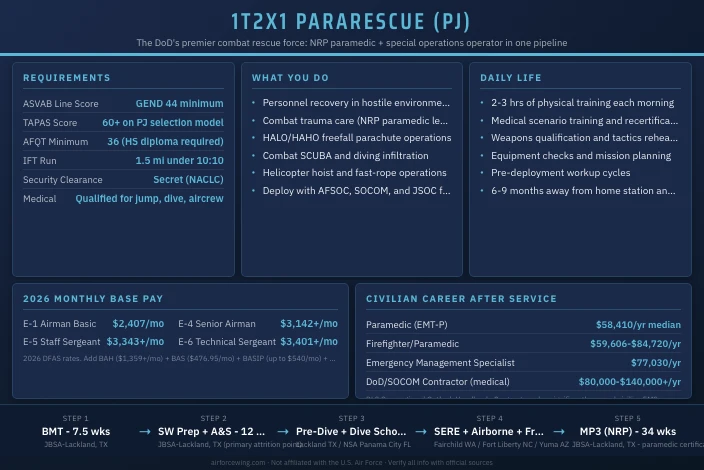
Job Role
Pararescuemen (AFSC 1T2X1) are Air Force special operations forces trained in personnel recovery, combat search and rescue, and advanced trauma care. They locate, reach, and treat isolated or downed personnel in hostile environments, air, land, and sea, using parachute, SCUBA, and ground infiltration techniques. Every PJ is a nationally registered paramedic with additional combat trauma qualifications beyond standard civilian scope.
Day-to-Day Responsibilities
At an operational rescue squadron, a PJ’s day is built around physical training, medical currency, and mission readiness. Physical training typically runs two to three hours each morning. The rest of the duty day involves scenario-based medical training, equipment checks, weapons qualification, and mission rehearsals.
Core mission tasks include:
- Conducting personnel recovery in denied, degraded, or contested environments
- Providing emergency trauma care (surgical airways, needle decompression, hemorrhage control) under fire
- Infiltrating by HALO/HAHO freefall, combat dive, or ground movement
- Operating from fixed-wing, rotary-wing, and tilt-rotor aircraft
- Conducting helicopter hoist and rope descent operations
- Coordinating with Combat Search and Rescue (CSAR) aircrews during recovery operations
Specialized Roles and Identifiers
| Code | Description |
|---|---|
| 1T231 | Apprentice (3-skill level, training pipeline) |
| 1T251 | Journeyman (5-skill level, first duty assignment) |
| 1T271 | Craftsman (7-skill level, team leader / supervisor) |
| 1T291 | Superintendent (9-skill level, senior NCO) |
| SEI 270 | Pararescue Team Leader |
Mission Contribution
PJs are AFSOC’s primary personnel recovery asset and the Department of Defense’s premier combat rescue force. When a pilot goes down in hostile territory or a special operations team takes casualties with no medevac available, Pararescuemen are the answer. They operate across every geographic combatant command and deploy in direct support of conventional and special operations forces. No other enlisted specialty in any branch combines that level of combat operator training with National Registry Paramedic certification.
Equipment
PJs carry a load-out built for both fighting and medicine. Standard kit includes a combat medical bag stocked for trauma surgery, individual weapons, night-vision devices, laser designators, and communications equipment. They’re qualified on SCUBA closed-circuit systems, tandem and solo military freefall parachutes, and fast-rope and hoist rigging. At the squadron level, they train with MH-60 Pave Hawk, HC-130J Combat King II, and CV-22 Osprey crews.
Salary
PJs earn Air Force base pay plus a stack of special pays that add several hundred dollars per month to total compensation, more if they deploy.
Base Pay Table
| Rank | Grade | Monthly Base Pay (2026) |
|---|---|---|
| Airman Basic | E-1 | $2,407 |
| Airman | E-2 | $2,698 |
| Airman First Class | E-3 | $2,837 - $3,198 |
| Senior Airman | E-4 | $3,142 - $3,816 |
| Staff Sergeant | E-5 | $3,343 - $4,422 |
| Technical Sergeant | E-6 | $3,401 - $5,044 |
Special and Incentive Pays
Because PJs qualify for parachute, diving, and special duty assignment, they receive pays on top of base:
| Pay Type | Monthly Amount |
|---|---|
| Battlefield Airman Incentive Pay (BASIP) | Up to $540/mo (combines jump, dive, demo pay) |
| Special Duty Assignment Pay (SDAP) | $225 - $450/mo depending on grade and time in AFSC |
| Hazardous Duty Incentive Pay (HALO) | $225/mo (HALO-qualified) |
| Imminent Danger Pay | $225/mo (deployed to designated areas) |
| Hardship Duty Pay | Up to $150/mo (austere locations) |
| Family Separation Allowance | $250/mo (during qualifying deployments) |
A new PJ at E-3 with no dependents at Davis-Monthan AFB takes home approximately $4,400 per month when base pay, BAS ($476.95), BAH, and BASIP are combined, before any deployment pays.
Benefits
Beyond pay, all active-duty Airmen receive:
- TRICARE Prime: zero-cost health, dental, and vision coverage for the member; low-cost family enrollment
- BAH: varies by duty station and dependency status; at JBSA-Lackland an E-4 without dependents receives $1,359 monthly
- Tuition Assistance: up to $4,500 per year for college courses while serving
- Post-9/11 GI Bill: full in-state tuition at public schools; up to $29,920.95 per year at private institutions after separation
- Blended Retirement System (BRS): 1% automatic TSP contribution after 60 days, government matching up to 4% on member contributions, plus a 40% pension at 20 years
Work-Life Balance
PJs average 30 days of paid leave per year. Deployment cycles vary by unit and current operational demand, but expect to spend significant periods away from home, often more than half the year when pre-deployment workups and actual deployments are combined. Units rotate through high-readiness cycles that limit personal travel during certain windows. The trade-off is a tight team culture with high unit cohesion.
Qualifications
Pararescue has some of the most selective entry standards in the enlisted Air Force. Meeting the minimum qualifications only gets an applicant to the starting line.
Minimum Qualifications Table
| Requirement | Standard |
|---|---|
| ASVAB Line Score | GEND 44 minimum |
| TAPAS Score | 60 or higher on the PJ selection model |
| AFQT Minimum | 36 (high school diploma required; no GEDs) |
| Age | 17-39 (prior to BMT start) |
| Citizenship | U.S. citizen only |
| Security Clearance | Secret (NACLC + background investigation) |
| Vision | Correctable to 20/20; color vision required |
| Swim Qualification | Must be able to pass water screening |
| Medical | Physically qualified for parachute, dive, and aircrew duty |
Verify current requirements at af.mil and through an Air Force Special Warfare recruiter.
The GEND 44 line score is the absolute minimum. Most candidates who successfully complete the pipeline score well above it. Competitive ASVAB prep matters, a stronger score keeps more options open if you need to reclass later.
Pre-Enlistment Physical Fitness Test (AFSPECWAR IFT)
Before shipping to BMT, PJ candidates take the Individualized Fitness Test (IFT), formerly known as the PAST. All events must be passed in a single session.
| Event | Minimum Standard |
|---|---|
| 500m Surface Swim | Under 15:00 |
| Underwater Swim (25m x 2) | Pass/fail (no fins) |
| Pull-Ups | 10 minimum |
| Push-Ups (1 minute) | 52 minimum |
| Sit-Ups (1 minute) | 54 minimum |
| 1.5-Mile Run | Under 10:10 |
These are minimum standards. Candidates who score at the floor rarely survive Assessment and Selection. Most training programs recommend targeting 20+ pull-ups, sub-9:00 run times, and 500m swim under 10:00 before attempting the IFT.
Application Process
Service Obligation
New recruits enlist for a minimum of 4 years active duty. Most PJ contracts are 6 years given the investment in training. Enlistment bonuses (which have reached $75,000 for qualifying specialties in recent Air Force bonus cycles) typically require a 6-year contract and are paid after successful completion of training and 30 days at the first duty station.
Trainees who fail to complete the pipeline are typically reclassified to another AFSC rather than discharged.
See our ASVAB study guide for strategies to hit these line scores, or take the PiCAT from home if you are a first-time tester.
Work Environment
PJs work inside Air Force Special Operations Command (AFSOC) rescue squadrons, organized under Rescue Wings. The environment is demanding, high-trust, and deliberately small in unit size. Most duty sections are staffed by 10 to 30 PJs who know each other’s capabilities intimately.
Setting and Schedule
The physical environment ranges from desert training at Davis-Monthan to jungle exercises in PACOM and Arctic operations in Alaska. PJs work from helicopters, fixed-wing aircraft, and small boats. On garrison days, the schedule follows a team-based cycle of PT, skills maintenance, and mission planning.
Shift work is uncommon on garrison; alert rotations are common. When a rescue mission activates, the team responds regardless of time. Pre-deployment workup periods involve extended training away from the home station, often at ranges or training areas.
Team Dynamics
Decision-making at the team level is decentralized once in the field. A PJ team leader may be a Staff Sergeant running a four-person element responsible for a recovery mission with no officer on site. That level of autonomy is by design. PJs are expected to exercise judgment under pressure from the earliest assignments.
Performance feedback comes through the Air Force EPR (Enlisted Performance Report) system, supplemented by the tight peer accountability that comes with small-team special operations culture.
Job Satisfaction and Retention
PJ retention rates are high relative to most AFSCs. The job demands are extreme, but the mission clarity is also extreme, it’s hard to find a more direct answer to “what did you do today?” than “recovered a downed pilot.” Operators who thrive tend to stay because the mission is worth the cost. Those who struggle with the physical or deployment demands usually identify that early in the pipeline rather than after assignment.
Training
The 1T2X1 pipeline is one of the longest and most demanding in the enlisted Air Force. From BMT entry to the maroon beret, expect at least 18 months of continuous training.
Training Pipeline Table
| Phase | Location | Duration | Focus |
|---|---|---|---|
| Basic Military Training (BMT) | JBSA-Lackland, TX | 7.5 weeks | Military fundamentals |
| Special Warfare Prep | JBSA-Lackland, TX | 8 weeks | Conditioning, swim, ruck |
| Assessment & Selection (A&S) | JBSA-Lackland, TX | 4 weeks | Mental/physical screening |
| Special Warfare Pre-Dive | JBSA-Lackland, TX | 4 weeks | Underwater confidence, swim |
| Air Force Dive School | NSA Panama City, FL | 8 weeks | SCUBA and combat diving |
| Underwater Egress Training | Fairchild AFB, WA | 1 day | Helicopter ditching procedures |
| Air Force Survival School (SERE) | Fairchild AFB, WA | 2.5 weeks | Survival, evasion, resistance, escape |
| Army Airborne School | Fort Liberty, NC | 3 weeks | Static-line parachute qualification |
| Military Freefall School | Yuma Proving Ground, AZ | 4 weeks | HALO/HAHO freefall parachuting |
| Modernized Pararescue Provider Program (MP3) | JBSA-Lackland, TX | 34 weeks | Combat medicine, National Registry Paramedic |
| Pararescue Apprentice Course | Kirtland AFB, NM | Variable | Tactical integration, unit qualification |
Assessment and Selection is the primary attrition point. Candidates who pass A&S move through the rest of the pipeline as a cohort. Washbacks (failures at a phase who are recycled) can extend the total timeline.
The Modernized Pararescue Provider Program (MP3) is the 34-week medical phase where candidates earn their National Registry Emergency Medical Technician-Paramedic (NRP) certification. This alone exceeds the training required to practice as a civilian paramedic.
Advanced Training
After initial qualification, PJs pursue additional training throughout their careers:
- Combat Dive Master / Dive Supervisor certification for experienced operators
- Tactical Combat Casualty Care (TCCC) recurrent training and certification
- Advanced Tactical Practitioner (ATP) courses for senior PJs
- Joint Terminal Attack Controller (JTAC) qualification (selected PJs)
- Officer Accession Programs: Highly qualified enlisted PJs can apply for Combat Rescue Officer (CRO) positions through AFSPECWAR officer programs
The Air Force funds medical recertification and continuing education hours required to maintain National Registry Paramedic status throughout a PJ’s career.
Everything starts with qualifying ASVAB scores, our study guide covers what to study first.
Career Progression
Rank Progression Table
| Skill Level | Rank Typical at Award | Years of Service (Typical) | Role |
|---|---|---|---|
| 3 (Apprentice) | E-3 / E-4 | 0-3 | Pipeline trainee |
| 5 (Journeyman) | E-4 / E-5 | 3-6 | Operator, first duty station |
| 7 (Craftsman) | E-5 / E-6 | 6-12 | Team leader, mission commander |
| 9 (Superintendent) | E-7 / E-8 | 12+ | Flight chief, senior NCO leadership |
| CCM (Career Field Manager) | E-9 | 20+ | Career field oversight |
Promotion in AFSOC rescue units is competitive. PJs who distinguish themselves through deployments, advanced qualifications, and EPR ratings advance faster than the base rate. E-5 to E-6 is a meaningful gate, those who make TSgt take on supervisory roles and begin mentoring junior operators.
Specialization and Career Diversity
Beyond the core PJ skill set, senior operators can branch into:
- Pararescue Instructor at JBSA-Lackland (training the next generation)
- Special Tactics Team Sergeant (leading mixed CCT/PJ teams)
- Medical Liaison roles with JSOC units
- Government contractor roles post-service (discussed in Post-Service section)
Lateral moves out of the 1T2X1 career field are available but rare. PJs invest so heavily in their qualification set that most stay in the AFSC until retirement or transition to a related contractor or civilian position.
Performance Evaluation
PJs are evaluated through the Air Force Enlisted Performance Report system. EPRs are rendered annually and require a rater (immediate supervisor) and additional rater. For special operations Airmen, the EPR narrative reflects mission performance, leadership potential, and additional qualifications earned during the rating period.
Stratification (ranking an Airman against peers) is the primary driver of promotion board outcomes. PJs who earn strong stratifications and multiple advanced qualifications, particularly at the E-5 and E-6 gates, are well-positioned for promotion.
Physical Demands
Pararescue is among the most physically demanding jobs in the Air Force by any measure. The IFT standards are entry-level; operational demands exceed them.
A deployed PJ may carry a medical bag, weapons, water, and ancillary equipment totaling 80+ pounds over uneven terrain, followed immediately by providing complex medical care to a casualty. Physical failure in that moment is not an option.
Air Force Fitness Assessment Standards
All Airmen, including PJs, take the Air Force Fitness Assessment annually. The assessment is scored on a 100-point scale with a minimum passing composite of 75.
| Component | Maximum Points |
|---|---|
| 1.5-Mile Run | 60 |
| Waist Circumference / Body Composition | 20 |
| Push-Ups (1 minute) | 10 |
| Sit-Ups (1 minute) | 10 |
Standards are age- and gender-normed. The formal FA is the floor for PJs, unit physical training standards run significantly higher in practice.
Medical Standards and Ongoing Evaluations
PJs hold parachute, diving, and aircrew medical qualifications simultaneously. Each requires periodic medical recertification:
- Annual flight physical for aircrew qualification
- Periodic dive physical for continued diving duty
- Standard DOD medical readiness requirements (immunizations, dental, vision)
Any medical disqualification from parachute or dive duty triggers a review that can result in reclassification. PJs who sustain injuries that permanently limit their ability to perform all three infiltration methods may be unable to continue in the 1T2X1 AFSC.
Deployment
Duty Station Assignments
PJs are concentrated at a small number of installations with active rescue squadrons:
| Installation | Location | Unit |
|---|---|---|
| Moody AFB | Valdosta, GA | 38th Rescue Squadron |
| Davis-Monthan AFB | Tucson, AZ | 48th Rescue Squadron |
| Patrick Space Force Base | Cocoa Beach, FL | 308th Rescue Squadron |
| Kadena Air Base | Okinawa, Japan | 31st Rescue Squadron |
Reserve and Air National Guard units at additional locations round out the total force. First assignments are based on service needs, though recruiters can communicate preferred locations. Most junior PJs receive Moody or Davis-Monthan as a first assignment.
Deployment Patterns
PJs deploy regularly. Rescue squadrons maintain alert postures at home station and cycle personnel through forward-deployed locations in support of combatant commands. Rotational deployments typically run 3 to 6 months, and operational tempo has remained elevated. Expect to spend 6 to 9 months away from home station in a given year when training rotations and deployments are counted together.
Deployments are predominantly overseas but can include domestic disaster response and search and rescue missions.
The deployment model for PJ units differs from conventional Air Force deployments in several important ways. Rescue squadrons deploy as packages that include PJs, HH-60 Pave Hawk crews, and HC-130J Combat King II aircraft. Individual PJs may also deploy as attachments to other SOF task forces or theater medical support units when the personnel recovery mission requires a forward-positioned rescue asset.
Pre-deployment workup periods involve intensive rehearsal of specific mission scenarios, medical currency training, and high-altitude airborne and dive events. These workups can last 60 to 90 days before a formal deployment begins, adding to the total time away from home. Families should plan for workup periods as part of the deployment cycle, not as separate home-station time.
Theater assignments vary. PJs have deployed to support operations in CENTCOM, AFRICOM, INDOPACOM, and SOUTHCOM. Domestic activations for hurricane response, wildfire rescues, and other major disasters call on Guard and Reserve PJ units and can involve active-duty personnel on temporary duty. The nature of the personnel recovery mission means no two deployments look the same, the theater, the supported unit, and the threat environment change, which keeps the work demanding but also keeps it from becoming routine.
Kadena-based PJs in the 31st Rescue Squadron operate in the Indo-Pacific theater, with access to South Korea, Japan, and Western Pacific contingency areas. That assignment comes with overseas cost-of-living allowance and the experience of operating in a strategically active region.
Risk/Safety
Pararescue carries direct, quantifiable risk. PJs insert into active threat environments to reach casualties who cannot be reached any other way. The probability of contact with enemy personnel or improvised explosive devices is real, not theoretical.
Job Hazards
Primary hazards include:
- Combat exposure during personnel recovery operations in hostile territory
- High-altitude freefall parachuting (HALO/HAHO) and static-line operations
- Combat diving and underwater egress in degraded visibility
- Helicopter operations including fast rope and hoist work
- Extreme physical stress and potential for musculoskeletal injury over a career
The cumulative physical toll of a full PJ career, thousands of jumps, dive operations, and heavy carries, results in a higher rate of chronic injuries than general-purpose AFSCs.
Safety Protocols
AFSOC maintains rigorous operational risk management protocols. Dive operations follow Navy-standard dive tables with dive supervisors present. Airborne operations use verified equipment and jump masters. Medical training is scenario-based and validated against TCCC standards. Despite the risk environment, modern safety protocols have significantly reduced training fatalities compared to earlier eras.
Security and Legal Requirements
A Secret clearance is required from day one and must be maintained throughout the career. Background investigation covers financial history, foreign contacts, and any criminal record. Loss of clearance eligibility effectively ends a PJ’s career in the AFSC.
PJs operating in combat zones fall under the Law of Armed Conflict (LOAC) and Rules of Engagement established for the specific theater. Medical operations follow the Geneva Conventions with respect to treatment of wounded personnel regardless of affiliation.
Impact on Family
The Pararescue lifestyle has a pronounced impact on family life. High deployment tempo means extended absences, multiple times per year in some operational periods. Pre-deployment training cycles restrict local leave and keep members away from home before formal deployment even begins.
The Air Force provides family support through Military OneSource, Airmen and Family Readiness Centers, and installation-based childcare. AFSOC units typically have strong Family Readiness Organizations given the above-average deployment tempo.
Permanent Change of Station (PCS) moves occur every two to four years. Duty stations for PJs are limited to a small number of locations, which can simplify long-term planning but also limits geographic flexibility. Kadena AB in Japan is the only consistently overseas assignment for junior PJs, and it carries overseas cost-of-living allowances to offset expenses.
Spouses and family members who research the assignment locations early. Tucson, Valdosta, the Cocoa Beach area, Okinawa, tend to adapt better than those who arrive without expectations set.
Specific Installation Considerations
Moody AFB, Georgia: Valdosta is a mid-sized Southern city with affordable housing, a military-heavy economy, and good access to outdoor activities. Spouse employment options are modest compared to larger markets. Schools in the area are average for the region.
Davis-Monthan AFB, Arizona: Tucson is the most significant metro area on the PJ base list. The University of Arizona provides educational and employer diversity, and the cost of living is reasonable by Western standards. Summer heat is extreme, families coming from temperate climates should plan for that adjustment.
Patrick Space Force Base, Florida: The Space Coast corridor from Titusville to Melbourne is a growing technology employment market, with aerospace and defense contractors active in the region. Housing costs have risen sharply with Space Force expansion, so BAH may not fully cover off-base rent at mid-career grades.
Kadena Air Base, Japan: Okinawa is a three-year overseas assignment that comes with overseas housing allowances, the exceptional discount network, and a tight-knit military community. Schooling for military dependents is available on base through the Department of Defense Education Activity (DODEA). Many families describe it as one of the best assignments of a career, the experience is distinctive, and the financial benefits reduce the cost premium of living overseas.
Family Readiness and Support Networks
Unit family readiness groups (FRGs) for PJ rescue squadrons are typically active because the deployment tempo makes them necessary. Connecting with the FRG before the first deployment, rather than during it, helps families build the support network early. Military OneSource provides confidential counseling, financial consultation, and local resource referrals at no cost to service members and dependents.
Reserve and Air National Guard
Pararescue exists in all three components: Active Duty, Air Force Reserve, and Air National Guard. The mission is the same. The schedule is not.
Component Availability
| Component | AFSC Available | Primary Locations |
|---|---|---|
| Active Duty | Yes | Moody, Davis-Monthan, Patrick SFB, Kadena |
| Air Force Reserve | Yes | 920th Rescue Wing (Patrick SFB, FL) |
| Air National Guard | Yes | Multiple states (CA, NY, AK, HI, PA, others) |
Air National Guard PJ units exist in states with their own rescue missions, often tied to Air Rescue coordination centers. California and Alaska have historically maintained strong ANG PJ presence due to terrain and maritime search and rescue requirements.
Drill Schedule and Training Commitment
Reserve and ANG members follow the standard one weekend per month, two weeks per year baseline, but PJs in these components face additional training requirements to maintain parachute, dive, and medical currency. Expect more than the minimum drill commitment in practice.
Medical recertification (NRP), jump currency (minimum number of jumps per quarter), and dive refreshers all require dedicated training time beyond Unit Training Assembly weekends.
Part-Time Pay
An E-4 SrA PJ in the Reserve or ANG earns base pay for each drill day at the daily equivalent of the active-duty monthly rate:
- E-4 monthly base pay: $3,142 (less than 2 years of service)
- A standard 4-drill-period weekend equals approximately 4 days of pay: $419
- Annual two-week tour (14 days): approximately $1,465
Active duty monthly base pay for the same E-4: $3,142. Part-time service pays roughly 15-17% of the active-duty monthly figure per typical drill weekend.
Special pays (BASIP, SDAP) typically do not apply on drill weekends unless activated on orders.
Benefits Comparison
| Benefit | Active Duty | Air Force Reserve | Air National Guard |
|---|---|---|---|
| Healthcare | TRICARE Prime (free) | TRICARE Reserve Select (premium required) | TRICARE Reserve Select (premium required) |
| Tuition Assistance | $4,500/yr federal TA | Federal TA available on qualifying orders | State tuition waiver programs (varies by state) |
| GI Bill | Post-9/11 GI Bill (full) | Montgomery GI Bill Selected Reserve | Montgomery GI Bill Selected Reserve |
| Retirement | BRS pension + TSP at 20 yrs active | Points-based (good year = 50+ points) | Points-based (good year = 50+ points) |
| Deployment Rate | High (6-9 months away annually) | Moderate (unit mobilizations + volunteers) | Moderate (state and federal activations) |
The ANG tuition benefit varies significantly by state. Some states offer near-full tuition waivers at state universities; others offer nothing beyond the federal program. Verify with the specific state’s adjutant general office.
Civilian Career Integration
Reserve and ANG PJs routinely work as civilian paramedics, firefighters, search and rescue technicians, or emergency management professionals. The overlap is high. A civilian fire department values NRP certification and the calm-under-pressure conditioning that comes with PJ training. USERRA protections require most civilian employers to hold positions during military activations and prohibit discrimination based on reserve service.
Post-Service
The PJ qualification set translates directly into high-demand civilian careers. National Registry Paramedic certification is a standalone credential that never expires as long as continuing education requirements are met.
Civilian Career Prospects
| Civilian Role | Median Annual Salary | Job Outlook |
|---|---|---|
| Paramedic (EMT-P) | $58,410 | +5% (2022-2032, BLS) |
| Firefighter/Paramedic (dual-role) | $59,606 - $84,720 | +4% |
| Emergency Management Specialist | $77,030 | +3% |
| Search and Rescue Technician | $47,000 - $70,000 | Varies by sector |
| Federal Law Enforcement (USMS, FBI, CBP) | $60,000 - $100,000+ | Competitive |
| DoD/JSOC Contractor (medical) | $80,000 - $140,000+ | Strong demand |
Bureau of Labor Statistics, Occupational Outlook Handbook
The DoD contractor track is particularly lucrative for former PJs. Government contractors supporting AFSOC, SOCOM, and theater-level combat rescue operations actively recruit former PJs for medical advisor, training, and direct support positions. Pay significantly exceeds civilian EMS roles.
State and local firefighting departments frequently recruit PJ veterans for senior positions, sometimes bypassing entry-level pathways entirely. A former PJ with a paramedic license and documented rescue experience is not an entry-level candidate.
Transition Programs
Active-duty PJs separating after 6 or more years qualify for the Post-9/11 GI Bill, which covers full in-state tuition at public universities. Many use this to pursue RN or PA programs, building on the medical foundation already established during service.
The Transition Assistance Program (TAP) is mandatory for separating Airmen and includes resume workshops, job fairs, and VA benefits enrollment support. Helmets to Hardhats connects veterans to construction and infrastructure careers, relevant for PJs interested in technical rescue or emergency management roles.
Is This a Good Job
This is the hardest enlisted job to qualify for in the Air Force. Most people who attempt the pipeline fail. That’s worth saying plainly before anything else.
The Right Fit
PJ is an excellent match for someone who:
- Has a strong athletic foundation (swimming background is a particular asset)
- Can tolerate prolonged physical and mental stress without quitting
- Wants to practice emergency medicine in the most austere environments on earth
- Genuinely finds meaning in the mission of recovering the wounded
- Is prepared to spend a substantial portion of their career away from home
- Can maintain elite fitness for 10 to 20 years, not just for selection
The medical component distinguishes PJ from other special warfare roles. Candidates who are drawn to medicine, not just combat, tend to thrive. The pipeline rewards those who want both.
The Wrong Fit
This AFSC is likely a poor match for someone who:
- Has any significant orthopedic, cardiac, or respiratory condition
- Cannot sustain the swim training required to pass the underwater phases
- Has dependents who cannot cope with extended separations and frequent relocation
- Wants predictable hours and stable duty locations
- Is primarily motivated by the “cool factor” without genuine investment in the medical mission
The dropout rate is not a statistic, it’s a daily reality throughout the pipeline. Candidates who survive on motivation alone, without the physical base and mission clarity, typically wash out in Assessment and Selection or during the dive phase.
Career and Lifestyle Alignment
PJs who finish a full career typically describe the experience as difficult to replicate anywhere else. The combination of physical challenge, medical purpose, and team belonging creates strong retention. Post-service, the credential set is genuinely valued by employers in emergency services, federal agencies, and defense contracting.
If the lifestyle fits, and that’s a significant if, the 1T2X1 AFSC offers one of the more complete combinations of training, compensation, and mission purpose available in the enlisted force.
More Information
Talk to an Air Force Special Warfare recruiter to confirm current 1T2X1 availability, IFT scheduling, and any updated pipeline prerequisites before you commit to the process. Official career information is also available at airforce.com and through AFSPECWAR recruiting resources.
- Prepare for the ASVAB with our study guide to make sure your line scores qualify
This site is not affiliated with the U.S. Air Force or any government agency. Verify all information with official Air Force sources before making enlistment or career decisions.
Explore more Air Force special warfare careers such as 1C2X1 Combat Control and 1C4X1 Tactical Air Control Party.