1T0X1 SERE Specialist
Most Airmen never prepare someone to be taken prisoner. SERE Specialists do exactly that, and far more. They train the pilots, aircrew members, and other high-risk personnel who might one day find themselves isolated behind enemy lines with no support and no easy way home. They run the Air Force’s survival and resistance schools, conduct combat survival instruction across every terrain type on earth, and deploy in support of personnel recovery missions. It is one of the most physically and intellectually demanding instructor roles in any military branch, and the pipeline to get there is longer and harder than most recruits expect.
If you want a career that combines outdoor expertise, combat skills, and genuine teaching responsibility, and you’re willing to earn it through a selection process designed to push you out, the ASVAB is your first gate.
Qualifying requires specific ASVAB line scores. Our ASVAB study guide covers what to target and how to prepare.
Job Role and Responsibilities
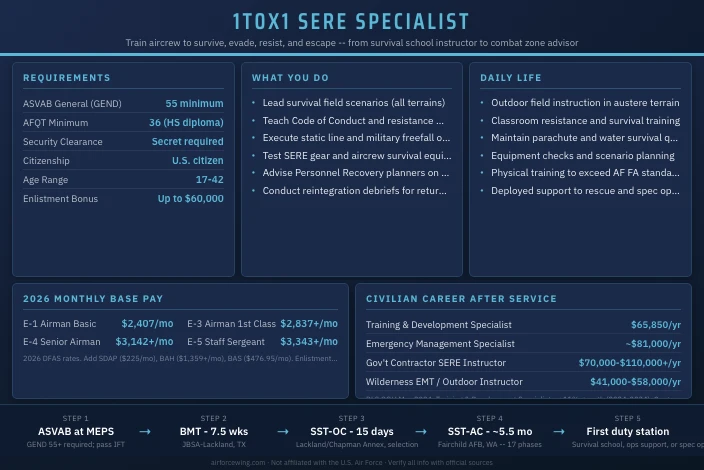
SERE Specialists (AFSC 1T0X1) train U.S. military personnel in Survival, Evasion, Resistance, and Escape techniques so they can survive hostile environments, evade capture, resist interrogation, and return home. They operate Air Force survival schools, support Personnel Recovery planning, and deploy with special operations forces to advise on isolated personnel situations. The role sits at the intersection of combat instruction, outdoor survival science, and psychological resilience training.
What SERE Specialists Do Daily
On a typical training day, a SERE Specialist is running a field exercise, not sitting behind a desk. They lead students through land navigation, emergency signaling, improvised shelter construction, and water procurement in actual wilderness terrain. When a field phase ends, they shift to classroom instruction on the Code of Conduct, resistance techniques, and the legal framework governing prisoner-of-war status under the Geneva Conventions.
Day-to-day tasks include:
- Planning and executing survival training scenarios in forest, desert, coastal, and arctic environments
- Teaching resistance to interrogation and exploitation techniques in controlled environments
- Running parachute operations (static line and military free fall) to insert students into training scenarios
- Testing and evaluating SERE equipment, survival radios, and aircrew gear
- Advising personnel recovery planners on isolated personnel scenarios
- Providing reintegration support and debriefs for returned personnel
Shredouts and Specializations
The 1T0X1 AFSC does not have formal published shredout codes in the same way as some medical AFSCs, but SERE Specialists earn Special Experience Identifiers (SEIs) based on qualification in parachuting, SCUBA, and combat water survival. Senior Specialists frequently branch into Personnel Recovery staff positions, operational support squadron assignments, or special tactics group advisor roles.
Mission Contribution
The Air Force’s greatest asset is its aircrew. Losing a trained pilot to enemy capture is costly in every sense, operationally, financially, and in human terms. SERE Specialists exist to reduce the probability of that outcome. Every aircrew member who deploys goes through SERE training before their first high-risk assignment. The quality of that training has a direct effect on how personnel perform if they are isolated, captured, or compromised. When a pilot returns from captivity, or evades it, some part of that success belongs to a SERE Specialist who prepared them.
Salary and Benefits
Base Pay
SERE Specialists enter service as an E-1 Airman Basic (AB) and progress through the enlisted ranks. The table below reflects 2026 DFAS monthly base pay rates.
| Rank | Pay Grade | Monthly Base Pay (Entry) |
|---|---|---|
| Airman Basic | E-1 | $2,407 |
| Airman First Class | E-3 | $2,837+ |
| Senior Airman | E-4 | $3,142+ |
| Staff Sergeant | E-5 | $3,343+ |
| Technical Sergeant | E-6 | $3,401+ |
| Master Sergeant | E-7 | $3,932+ |
Base pay increases with time in service at every grade. An E-5 with 6 years of service earns $4,109 per month before allowances.
Special Pay and Enlistment Bonus
SERE Specialists receive Special Duty Assignment Pay (SDAP) of $225 per month. Qualified Specialists also earn parachute pay and may qualify for dive pay depending on their assignment.
New enlistees who complete the full training pipeline and sign a six-year contract are eligible for an enlistment bonus of up to $60,000, paid upon pipeline completion. Bonus eligibility should be confirmed with a recruiter at time of contracting.
Allowances and Benefits
Beyond base pay, Airmen receive:
- BAS (Basic Allowance for Subsistence): $476.95/month (2026 rate, all enlisted)
- BAH (Basic Allowance for Housing): Varies by duty station and dependency status. A single E-4 at JBSA-Lackland receives approximately $1,359/month; an E-4 with dependents receives approximately $1,728/month.
- TRICARE Prime: Full medical, mental health, dental (at military treatment facilities), and prescription coverage at zero cost for active duty Airmen.
- Tuition Assistance: Up to $4,500/year for college coursework while on active duty.
- Post-9/11 GI Bill: Full in-state tuition at public universities (or up to $29,920.95/year at private institutions for the 2025-2026 academic year) after qualifying service.
Retirement
The Blended Retirement System (BRS) applies to all Airmen who entered service after January 1, 2018. It combines a 20-year pension paying 40% of high-36 average basic pay with a Thrift Savings Plan (TSP) match of up to 4% of basic pay. Airmen who serve 20 years receive both the pension and any accumulated TSP balance.
Work-Life Balance
SERE Specialists on active duty typically work a predictable schedule once they complete the training pipeline, with voluntary deployments encouraged during the first four years. Field exercise weeks are intensive and irregular. Standard leave is 30 days per year, accruing at 2.5 days per month with a 60-day carryover ceiling.
Qualifications and Eligibility
The 1T0X1 career field has one of the more demanding entry requirements among enlisted Air Force careers. Every candidate must meet all criteria before contracting.
Minimum Requirements Table
| Requirement | Minimum Standard |
|---|---|
| ASVAB General (GEND) score | 55 |
| TAPAS assessment | 55 |
| AFQT minimum | 36 |
| Age at enlistment | 17-42 |
| Citizenship | U.S. citizen |
| Reading level | 11th grade (Air Force Reading Abilities Test) |
| Security clearance | Secret |
| Speech | No impediment that interferes with clear instruction |
SERE Initial Fitness Test (IFT)
The IFT is a pass/fail assessment. Every candidate must meet all minimums to qualify:
- Pull-ups: 8 (in 2 minutes)
- Sit-ups: 48 (in 2 minutes)
- Push-ups: 40 (in 2 minutes)
- 1.5-mile run: Under 11:00
- Swimming: Basic proficiency required
These are minimum entry standards. Candidates who barely pass the IFT rarely succeed through the full training pipeline. Most successful candidates significantly exceed these numbers.
Application Process
The path to contracting begins with the ASVAB at a Military Entrance Processing Station (MEPS). You’ll need a General composite score of at least 55, the PiCAT and ASVAB study resources can help you hit that number. From there, a recruiter verifies your eligibility, you complete the TAPAS assessment, pass a physical examination at MEPS, and then attempt the IFT. Total time from initial contact to contract varies, but most candidates take several months to prepare for the IFT.
Competitiveness
The SERE pipeline has historically seen attrition rates above 50%, though changes to training sequencing have improved completion rates in recent years. Candidates with prior outdoor skills (rock climbing, hunting, wilderness survival), swimming ability, and above-minimum fitness levels complete the pipeline at higher rates. No civilian certification is required, but documented experience in austere environments helps.
Service Obligation
The standard service obligation is a six-year enlistment contract. This matches the bonus eligibility window. Trainees who fail the pipeline are reassigned to another AFSC based on Air Force needs.
Work Environment
Setting and Schedule
No two weeks look the same for a SERE Specialist, and that’s largely the point. During training cycles, they spend extensive time outdoors, in forests, deserts, mountains, and cold-water environments, executing field survival scenarios. Back on base, they conduct classroom instruction, prepare training materials, maintain equipment, and coordinate with aircrews scheduled for training.
Duty stations span multiple installation types:
- Survival schools (primary instructor assignments at Fairchild AFB, WA)
- Operational support squadrons at major bases hosting combat aircraft
- Special operations groups and rescue squadrons
- Training detachments at smaller installations
Scheduling varies by assignment type. Survival school cadre typically follow a training-cycle schedule tied to student class start dates. Operational assignments can involve more irregular hours, especially around deployments.
Leadership and Autonomy
SERE Specialists generally work under a Non-Commissioned Officer (NCO) chain in their unit, but field instructors operate with significant autonomy when running student exercises. Senior Specialists regularly serve as the subject matter expert in their assigned unit, often briefing commanders and planning staffs on isolated personnel issues. Performance is evaluated through the Enlisted Performance Report (EPR) system annually, with feedback from immediate supervisors.
Team Dynamics
Training at survival schools is a team endeavor. SERE Specialists typically work in small instructor teams, sharing workload across field phases, classroom sessions, and administrative requirements. On operational assignments, they may be the only SERE Specialist in the unit, which demands both self-sufficiency and the ability to build relationships with aircrew, rescue personnel, and special tactics operators who aren’t in the same career field.
Job Satisfaction
The role attracts people who find desk work intolerable. Teaching someone to stay alive and return with honor, and then watching them successfully complete an exercise that pushed them to their limit, is the kind of work that keeps SERE Specialists re-enlisting. The physical nature of the job is also reported as a positive for most Specialists, they stay in peak condition because their work requires it.
Training and Skill Development
The path from civilian to qualified SERE Specialist spans approximately eight to nine months from the end of BMT, not counting BMT itself.
Training Pipeline Table
| Phase | Name | Location | Duration | Focus |
|---|---|---|---|---|
| 1 | Basic Military Training (BMT) | JBSA-Lackland, TX | 7.5 weeks | Military fundamentals |
| 2 | SERE Specialist Training Orientation Course (SST-OC) | JBSA-Lackland/Chapman Annex | 15 days | Selection assessment |
| 3 | SERE Specialist Training Apprentice Course (SST-AC) | Fairchild AFB, WA | ~5.5 months (17 phases) | Full SERE instructor qualification |
Phase 1: Basic Military Training
All enlisted Airmen complete BMT at Joint Base San Antonio-Lackland, TX. The 7.5-week course covers Air Force customs, core values, physical conditioning, and weapons qualification. SERE candidates enter BMT knowing they are already contracted for the follow-on pipeline, which provides motivation but also means there is no transition delay between BMT and the SST-OC.
Phase 2: SST-OC (Orientation Course)
The 15-day Orientation Course at the Chapman Annex assesses whether candidates have what it takes before the Air Force invests months of training. Evaluators observe physical performance, speaking ability (essential for a future instructor role), leadership under stress, and commitment to the career field. Candidates who do not meet standards are reclassified.
Phase 3: SST-AC (Apprentice Course)
The Apprentice Course at Fairchild AFB in eastern Washington is the heart of the pipeline. Its 17 phases cover:
- Wilderness survival: Forest, desert, coastal, tropical, and arctic environments
- Survival medicine: Wilderness first aid, field evacuation, and medical improvisation
- Evasion and navigation: Land navigation, tracking avoidance, and movement planning
- Resistance training: Principles of resistance and exploitation under duress
- Water survival: Open-ocean survival, combat water survival, and life raft operations
- Parachute operations: Static line and military free fall qualification
- Instructor methods: Teaching techniques, scenario design, and student evaluation
Candidates who complete all 17 phases receive their 3-skill level (Apprentice) and proceed to their first operational assignment.
Advanced Training
After assignment, Specialists pursue upgrade training toward the 5-skill level (Journeyman) and 7-skill level (Craftsman) through on-the-job training and formal upgrade courses. Instructor certification at the survival school requires additional evaluator qualification. Senior Specialists attend Professional Military Education (PME) and may pursue Personnel Recovery staff courses. Before you reach any of that, a strong ASVAB score is the first requirement, the ASVAB study guide covers every composite you’ll need to know. Parachute and SCUBA qualifications are available at appropriate duty stations.
Career Progression and Advancement
Rank and Time-in-Grade Table
| Rank | Pay Grade | Typical Time to Achieve |
|---|---|---|
| Airman Basic | E-1 | Entry |
| Airman | E-2 | 6 months |
| Airman First Class | E-3 | 16 months |
| Senior Airman | E-4 | ~36 months |
| Staff Sergeant | E-5 | ~5-8 years (competitive board) |
| Technical Sergeant | E-6 | ~7-12 years (competitive board) |
| Master Sergeant | E-7 | ~14-16 years |
| Senior Master Sergeant | E-8 | ~18-20 years |
| Chief Master Sergeant | E-9 | Senior leadership |
Promotion from E-4 to E-5 and above requires competitive board action. Airmen with strong EPR scores, decorations, education credits, and demonstrated technical mastery advance faster.
Specialization and SEI Codes
Senior SERE Specialists often hold Special Experience Identifiers tied to specific qualifications:
- Parachute operations (static line and military free fall)
- Combat dive qualifications
- Personnel Recovery staff positions
- Survival school evaluator certification
These qualifications open doors to assignments with rescue squadrons, special tactics groups, and joint special operations commands where SERE expertise is in high demand.
Career Flexibility
After completing the first enlistment, SERE Specialists with strong records may apply for retraining into related career fields or pursue direct commissioning. The Officer Training School (OTS) path at Maxwell AFB, AL is available to enlisted Airmen who complete a bachelor’s degree. Many SERE Specialists pursue degrees in emergency management, kinesiology, or environmental science while serving.
Performance Evaluation
The Air Force Enlisted Performance Report (EPR) is completed annually by the immediate rater and senior rater. EPRs drive promotion board scores. For SERE Specialists, demonstrated instructional competence, physical readiness, and willingness to take on challenging assignments all feed into a strong EPR narrative.
Physical Demands and Medical Evaluations
Daily Physical Demands
SERE Specialists are physically active every working day. Field phases involve carrying heavy survival equipment over rough terrain, conducting long-distance land navigation with a loaded ruck, performing water survival drills, and completing parachute operations. Even classroom-focused assignment days include physical training requirements and readiness for unscheduled field taskings.
This is not a desk job that occasionally gets physical. The physical demands are the job.
Air Force Fitness Assessment Standards
All Airmen, including SERE Specialists, take the Air Force Fitness Assessment at least annually. The table below shows current minimum passing scores for the under-25 age bracket on each component. Standards are age- and gender-normed.
| Component | Maximum Points | Male Under 25 (Minimum) | Female Under 25 (Minimum) |
|---|---|---|---|
| 1.5-Mile Run | 60 | Must meet min time | Must meet min time |
| Push-Ups (1 min) | 10 | Must meet min reps | Must meet min reps |
| Sit-Ups (1 min) | 10 | Must meet min reps | Must meet min reps |
| Waist Circumference | 20 | Must meet measurement | Must meet measurement |
| Composite | 100 | 75 minimum | 75 minimum |
SERE Specialists routinely score well above the 75-point minimum. The pipeline and the job demands naturally maintain fitness levels that exceed the test floor.
Medical Requirements
SERE Specialists must meet the standard Air Force medical accession requirements at MEPS, plus specific medical standards for parachute and water survival operations. Visual acuity, cardiovascular fitness, and orthopedic health are closely evaluated. Ongoing medical evaluations include periodic physicals and any aviation or parachute-specific examinations required by their unit’s mission.
Deployment and Duty Stations
Deployment Patterns
SERE Specialists assigned to survival schools deploy less frequently than those in operational units, but deployments still occur. The Air Force encourages voluntary deployments within the first four years, and many Specialists volunteer for overseas assignments early in their career to build operational experience. Operational support squadron and special operations assignments carry higher deployment rates, sometimes one to two deployments per year, each typically lasting 90 to 180 days.
Deployments can be domestic (supporting exercises) or overseas, including combat support zones where Personnel Recovery planning is active.
Duty Station Options
Most SERE Specialists spend at least one tour at Fairchild AFB, WA, either as a student or a cadre instructor. After initial assignment, Specialists can serve at:
- Operational support squadrons at major flying bases
- Rescue squadrons (with access to HH-60 and HC-130 platforms)
- Special operations groups, including assignments at Hurlburt Field, FL
- Training detachments supporting joint exercises
- Staff positions at major commands
Assignment preferences are submitted through the Air Force assignment system, but needs of the Air Force drive final assignments.
Risk, Safety, and Legal Considerations
Job Hazards
SERE Specialist training and operations carry real physical risk. Primary hazard areas include:
- Parachute operations (static line and freefall)
- Open-water survival exercises
- Cold-weather and arctic field phases
- Resistance training scenarios under controlled stress
- Deployed operations in hostile or austere environments
Students pushed to their physical and mental limits in field exercises present unpredictable risks that instructors must actively manage.
When deployed, SERE Specialists may find themselves in hostile or austere environments supporting personnel recovery operations. The risk level depends heavily on the assignment.
Safety Protocols
The Air Force maintains strict safety protocols for all training involving parachutes, water survival, and controlled stress exercises. Every field phase has a safety officer and established abort criteria. Medical personnel are on standby for high-risk training events. Specialists are trained to recognize and respond to hypothermia, heat casualties, drowning, and trauma injuries that can occur during field scenarios.
Security and Legal Requirements
The Secret clearance required for this AFSC involves a background investigation covering financial history, foreign contacts, criminal record, and character references. Clearance processing typically takes several months and must complete before a trainee can access certain classified survival and resistance curriculum materials.
SERE Specialists are subject to standard Uniform Code of Military Justice (UCMJ) obligations and Air Force Instructions governing their career field. They are also bound by strict rules regarding the conduct of resistance training, no actual harm to students is permitted, and all scenarios must comply with established guidelines.
Impact on Family and Personal Life
Family Considerations
The training pipeline itself, roughly a year from enlistment to first assignment, is the most disruptive phase for relationships. Trainees are geographically separated from family for most of that period, first at BMT, then at Lackland for the orientation course, then at Fairchild for the apprentice course.
After completing the pipeline and arriving at a permanent duty station, the schedule becomes more predictable for those at survival schools. Operational assignments with special operations or rescue units involve more irregular hours, frequent field work, and higher deployment rates that demand significant family flexibility.
The Air Force provides family support resources for SERE Specialist families:
- Military OneSource: 24/7 counseling and referral services
- Air Force Aid Society: emergency financial assistance
- Family Readiness Programs: deployment preparation and support groups
- Installation Family Support Centers: childcare referrals, spouse employment help
- EFMP (Exceptional Family Member Program): assistance for families with special medical or educational needs during PCS moves
Relocation and Time Away
Permanent Change of Station (PCS) moves typically occur every two to four years. SERE Specialists can expect at least one move to Fairchild during their career, plus moves tied to operational assignments. The EFMP (Exceptional Family Member Program) assists families with special medical or educational needs during relocations.
Time away from home varies by assignment type. Survival school tours often mean consistent hours with predictable field rotation schedules. Special operations or rescue assignments mean more time in the field, on alert, or deployed.
Reserve and Air National Guard
Component Availability
The 1T0X1 AFSC is available in both the Air Force Reserve and the Air National Guard, primarily at units that have a Personnel Recovery or survival training mission. Positions are limited compared to active duty, and not every state’s National Guard has a SERE unit.
Drill Schedule and Training Commitment
Reserve and Guard SERE Specialists follow the standard one-weekend-per-month, two-weeks-per-year commitment framework, but the nature of the AFSC often requires additional training days to maintain parachute currency, water survival qualifications, and instructor certifications. Operational Guard or Reserve units with active Personnel Recovery missions may have higher training tempo than standard support units.
Component Comparison Table
| Active Duty | Air Force Reserve | Air National Guard | |
|---|---|---|---|
| Commitment | Full time | 1 wknd/mo + 2 wks/yr (plus training) | 1 wknd/mo + 2 wks/yr (plus training) |
| Monthly Base Pay (E-4) | $3,142+ | ~$788/drill weekend | ~$788/drill weekend |
| Healthcare | TRICARE Prime (free) | TRICARE Reserve Select (premiums apply) | TRICARE Reserve Select (premiums apply) |
| Education | TA ($4,500/yr) + GI Bill | Federal TA; GI Bill after mobilization | State tuition waivers vary; Federal TA |
| Deployment Tempo | Moderate to high | Varies; mobilization possible | Varies; state/federal activation |
| Retirement | 20-yr pension (BRS) | Points-based Reserve retirement | Points-based Reserve retirement |
Civilian Career Integration
SERE Specialists in the Reserve or Guard often work in emergency management, law enforcement, fire service, outdoor education, or training and development roles between drill weekends. The skills overlap is strong. Employers covered by USERRA (Uniformed Services Employment and Reemployment Rights Act) must protect your job and benefits when you are called up for training or deployment.
Post-Service Opportunities
SERE training creates a versatile civilian skill set that applies across multiple industries. The combination of instructional expertise, wilderness medicine, and stress management experience transfers well.
Civilian Career Options
| Civilian Role | Median Annual Salary | Job Outlook (2024-2034) |
|---|---|---|
| Training and Development Specialist | $65,850 | +11% (much faster than avg) |
| Emergency Management Specialist | ~$81,000 | +4% |
| Wilderness EMT / Outdoor Instructor | $41,000-$58,000 | Varies |
| Government Contractor (SERE/PR Instructor) | $70,000-$110,000+ | Strong demand |
| Recreation Worker (Outdoor Program) | $35,380 | +5% |
Salary data for Training and Development Specialists from BLS Occupational Outlook Handbook, May 2024. Government contractor SERE instructor positions are not tracked by BLS; figures reflect reported ranges in defense contracting.
Certifications and Licensing
Many SERE Specialists pursue civilian credentials while still serving. Wilderness First Responder (WFR) and Wilderness EMT certifications align directly with survival medicine training. Parachute rigger ratings and FAA certificates are available to those with parachute qualifications. Instructors with teaching experience can pursue state teaching certifications or roles at outdoor leadership programs such as NOLS or Outward Bound.
Transition Support
The Air Force Transition Assistance Program (TAP) provides pre-separation counseling, resume workshops, and connection to Hiring Our Heroes fellowship programs. Veterans with a SERE background also qualify for federal hiring preference, which opens doors at FEMA, CBP, DoD contractors, and other agencies where survival and emergency expertise is valued.
Is This a Good Job for You? The Right (and Wrong) Fit
Who Thrives in This Career
The candidates who succeed in the SERE pipeline and build long careers in this career field share a few consistent characteristics. They are comfortable in discomfort, not just tolerant of it, but genuinely at home in austere conditions. They communicate clearly under pressure. They can teach, not just perform. Many who wash out of the pipeline have the physical ability but struggle with the instructional and communication demands; SERE Specialists must eventually stand in front of a room and teach a pilot how to stay alive, and that requires both confidence and clarity.
The ideal candidate:
- Has above-average swimming ability before enlisting
- Runs regularly and can exceed the IFT minimums without a training peak
- Scores well on the ASVAB General composite, the ASVAB study guide covers the subtests that feed this score
- Has some outdoor experience (camping, hiking, hunting, climbing, any combination)
- Reads well and can absorb complex material quickly
- Doesn’t need a predictable schedule to function
- Wants work where the stakes are real
Who Struggles
Candidates who prefer stable hours, permanent office environments, or work that is primarily technical rather than physically active will find this career field misaligned with their strengths. People who struggle with public speaking or instructor roles will hit a hard ceiling early, the 7-skill level and most senior positions require effective teaching.
Frequent relocation, irregular schedules during operational assignments, and periods away from family during field exercises and deployments also make this a poor fit for people who need geographic stability or consistent home presence.
The Bottom Line
This is a career for people who want to be genuinely hard to kill and want to make others hard to kill too. The pay is competitive, the enlistment bonus is substantial, and the post-service options are strong. But the pipeline is long, the washout rate is significant, and the demands don’t reduce much after qualification. Those who stay in the career field typically say they can’t imagine doing anything else.
More Information
Contact an Air Force recruiter or the SERE Recruiting Liaison Office at gosere.af.mil for current pipeline dates, IFT scheduling, and bonus eligibility confirmation. Recruiter information is available at airforce.com. Verify all requirements before signing a contract, bonus amounts, IFT standards, and training pipeline details can change.
Before meeting a recruiter, make sure your ASVAB score is ready. The ASVAB preparation guide covers the General composite and pre-screening options that give you the best shot at contracting for this career field.
This site is not affiliated with the U.S. Air Force or any government agency. Verify all information with official Air Force sources before making enlistment or career decisions.
Explore more Air Force Special Warfare careers such as 1T2X1 Pararescue and 1C2X1 Combat Control.