1C4X1 Tactical Air Control Party
Every airstrike that a ground unit calls in on a battlefield starts with one person holding a radio, managing frequencies, and talking an aircraft onto a target. That person is a Tactical Air Control Party specialist. AFSC 1C4X1. You’ll be the only Air Force presence assigned to an Army brigade or battalion, often downrange for months at a time, responsible for the link between the troops on the ground and the aircraft overhead. The training pipeline runs about 60 weeks and washes out a significant portion of candidates. But the Airmen who earn the beret work at the tip of the spear and carry one of the most consequential skill sets in the U.S. military.
Qualifying requires specific ASVAB line scores. Our ASVAB study guide covers what to target and how to prepare.
Job Role
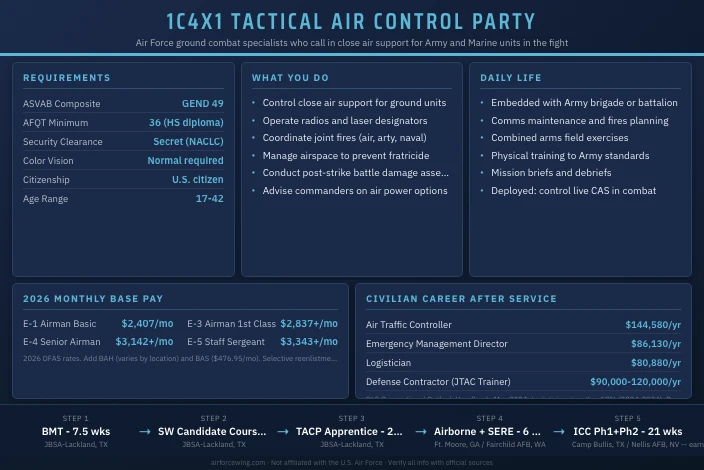
1C4X1 Tactical Air Control Party (TACP) specialists are Air Force enlisted personnel embedded with Army and Marine Corps ground combat units to plan and execute close air support (CAS), coordinate joint fires, and serve as certified Joint Terminal Attack Controllers (JTACs). They are the ground-level link between air assets and maneuver forces, directing aircraft to strike enemy targets, coordinate air movements, and manage airspace in complex combat environments. TACPs are among the most forward-deployed Airmen in the Air Force.
Daily Tasks
On a typical workday at a conventional unit, a TACP maintains radio proficiency, plans fires support, briefs pilots, participates in unit training, and integrates with Army staff on mission planning. When deployed, the intensity increases sharply.
Core responsibilities include:
- Calling in and controlling close air support, coordinating with strike aircraft in real time
- Managing tactical airspace to prevent fratricide and deconflict fires
- Planning and coordinating joint fires, air, artillery, and naval gunfire
- Operating and troubleshooting advanced communications gear in austere conditions
- Conducting battle damage assessment after strikes
- Advising ground commanders on air power employment
Specialization and Codes
TACPs carry the base designator 1C4X1. Skill level progression follows standard Air Force numbering (3-skill through 9-skill). The most significant career designation is the SEI 914 (Joint Terminal Attack Controller), which certifies the Airman as a qualified JTAC under AFI 13-112. This certification is required before a TACP can advance to the 7-skill level and is the operational credential that authorizes controlling live aircraft onto targets.
Special Operations TACPs who are selected to support Ranger Regiments, Special Forces Groups, or other SOF units serve with units like the 17th Special Tactics Squadron and may pursue a Top Secret clearance. Conventional TACPs are assigned to Army brigades and divisions across the force.
Mission Contribution
The Air Force brings enormous firepower to any fight, attack aircraft, bombers, and gunships. But that firepower is useless without someone on the ground who can talk to the crew, clear the target, and make sure the bomb lands on the right building. TACPs are that link. When a ground unit gets pinned down or needs to suppress a threat from the air, the TACP is the one who makes the call. Without them, joint air-ground operations break down.
Technology and Equipment
TACPs work with a dense array of communications and targeting equipment. Standard gear includes:
- AN/PRC-152 and AN/PRC-117 multiband radios for air-to-ground communications
- Laser designators for terminal guidance of precision munitions
- Rangefinders and GPS devices for accurate target coordinates
- JTT (Joint Tactical Terminal) and other link systems for situational awareness data
- Tablet-based fire support apps for digital coordination
You’ll maintain and operate this gear in environments ranging from desert heat to alpine cold, always with limited resupply and no tech support down the street.
Salary
Base Pay and Special Pay
All enlisted pay is determined by pay grade and years of service, per DFAS 2026 pay tables. TACPs enter service as Airman Basic (E-1) and progress through the enlisted structure. Most Airmen earn their JTAC certification and reach E-4 or E-5 in their first enlistment.
| Rank | Grade | Monthly Base Pay (entry) |
|---|---|---|
| Airman Basic | E-1 | $2,407 |
| Airman | E-2 | $2,698 |
| Airman First Class | E-3 | $2,837 |
| Senior Airman | E-4 | $3,142 |
| Staff Sergeant | E-5 | $3,343 |
| Technical Sergeant | E-6 | $3,401 |
Base pay alone doesn’t tell the full story. A Staff Sergeant at a CONUS installation receives Basic Allowance for Housing (BAH), which varies by duty location and dependent status, plus Basic Allowance for Subsistence (BAS) of $476.95 per month (2026 rate). Combined, these allowances can add $1,500 to $2,500 or more to monthly compensation depending on location.
TACPs who remain in the career field are eligible for selective reenlistment bonuses. The Air Force has listed 1C4X1 among career fields eligible for career-span bonuses ranging up to $360,000 across multiple reenlistment contracts. Verify current bonus amounts with a recruiter, as figures change each fiscal year.
Additional Benefits
Active-duty Airmen and their dependents receive TRICARE Prime health coverage with no enrollment fees, no deductibles, and no copays. Dental and vision are included. There is no civilian equivalent to this coverage at comparable cost.
Education benefits include Tuition Assistance of up to $4,500 per year while on active duty, and eligibility for the Post-9/11 GI Bill after service, covering full in-state tuition at public schools or up to $29,920.95 per year at private institutions (2025-2026 cap), plus a monthly housing allowance.
Retirement under the Blended Retirement System (BRS) combines a 20-year pension (40% of high-36 average basic pay) with Thrift Savings Plan matching of up to 4% of basic pay from the government.
Work-Life Balance
TACPs earn 30 days of paid leave per year, the same as all active-duty Airmen. The reality is that leave usage depends heavily on the unit’s operational tempo. During workup cycles and pre-deployment training, taking consecutive leave blocks is difficult. Between deployments, units typically have more flexibility. The Army-embedded nature of this AFSC means your schedule often mirrors the Army unit you’re assigned to, not the Air Force wing.
Qualifications
Qualification Table
| Requirement | Standard |
|---|---|
| Age | 17-42 at enlistment |
| Citizenship | U.S. citizen |
| Education | High school diploma or equivalent |
| ASVAB Composite | General (GEND) 49 minimum |
| AFQT Minimum | 36 |
| Security Clearance | Secret (NACLC) |
| Physical | Initial Fitness Test (IFT) required |
| Vision | Normal color vision and depth perception |
| Medical | No medical conditions that restrict airborne ops |
The GEND composite combines Word Knowledge, Paragraph Comprehension, Arithmetic Reasoning, and Mathematics Knowledge subtests. A score of 49 is moderately competitive, most candidates scoring this well on the ASVAB have solid reading comprehension and basic math skills.
The ASVAB score is only the first gate. Before you can contract for 1C4X1, you must pass the Special Warfare Operator Enlistment Initial Fitness Test (IFT): a physical screening that includes a 25-meter underwater swim, 500-meter surface swim, a 1.5-mile run, and timed push-ups, sit-ups, and pull-ups. Many applicants with qualifying ASVAB scores fail the IFT. Start training for the swim and run before you visit a recruiter.
Application Process
The path to a TACP contract runs through the following steps:
- Take the ASVAB at a Military Entrance Processing Station (MEPS) and confirm a GEND 49 or higher
- Complete the TACP selection model personality assessment (minimum score of 30 required)
- Pass the Initial Fitness Test
- Clear a medical exam at MEPS confirming no conditions that would preclude airborne qualification
- Receive a TACP enlistment contract and ship to BMT
The full application process from initial visit to a signed contract typically takes two to four months. MEPS medical clearances and recruiter processing times vary by location.
Selection Competitiveness
TACP is one of the more competitive enlisted Air Force careers. Physical screening eliminates a portion of applicants before training even starts, and the training pipeline itself carries meaningful attrition. Candidates who start prep well before their MEPS date, especially on swimming, running, and upper body strength, have a materially better chance of completing selection and the pipeline.
Prior experience in athletics, especially swimming or endurance sports, correlates with pipeline success. No prior military experience is required.
Service Obligation
Graduating from the TACP Initial Certification Course (ICC) triggers a 6-year active-duty service commitment. This runs from graduation day, not from enlistment. Factor this into planning when you look at initial enlistment contract lengths.
See our ASVAB study guide for strategies to hit these line scores, or take the PiCAT from home if you are a first-time tester.
Work Environment
Setting and Schedule
TACPs don’t work in a typical Air Force environment. Most are assigned to Army units at installations like Fort Cavazos (TX), Fort Stewart (GA), Fort Campbell (KY), Fort Drum (NY), and Fort Wainwright (AK). You’ll live and train alongside soldiers, eat in Army chow halls, and operate on an Army battle rhythm, which runs hard and rarely slows down for Air Force wing activities.
A standard day at a home station unit might involve physical training at 0600, followed by communications maintenance, fires planning, and participation in combined arms exercises. Overnight field training exercises happen regularly. There’s no predictable Monday-through-Friday schedule.
At the TACP squadron level, you’ll have an Air Force chain of command in the form of a TACP officer and senior enlisted leadership. But day-to-day, you’re integrated with the Army unit you’re assigned to support.
Leadership and Communication
The Air Force evaluates TACPs through the standard Enlisted Performance Report (EPR) system, with ratings flowing through TACP squadron leadership. But your reputation on the ground is built with the Army unit. Ground commanders who trust their TACP give them more responsibility and more latitude. That trust is earned by being proficient, reliable, and present.
Communication management is central to the job itself. You’ll brief before missions, debrief after, and write detailed fire support plans. Written and verbal communication skills matter in this career more than most people expect going in.
Team Dynamics and Autonomy
You operate as a small element, often a single TACP or a two-person team assigned to a battalion or brigade. There’s no supervisor standing next to you when a radio call needs to go out. The job demands independent judgment in high-stakes situations. That said, you work within a structured fires network, you don’t freelance, you coordinate.
At more senior levels, you’ll lead a TACP team, mentor junior Airmen embedded in other units, and eventually take on planning roles at the brigade or division level.
Job Satisfaction and Retention
TACPs tend to separate at relatively high rates after their first commitment, often transitioning to defense contractor roles as JTAC trainers or fires consultants, civilian positions that pay well precisely because the certification is difficult to earn. Those who stay are genuinely engaged in the mission. Retention incentives, including the selective reenlistment bonus program, reflect how the Air Force values keeping experienced JTACs in the force.
Training
Training Pipeline
The TACP training pipeline is roughly 60 weeks from BMT to JTAC certification. Every phase builds on the last, and there is no skipping forward.
| Phase | Location | Duration | Focus |
|---|---|---|---|
| Basic Military Training (BMT) | JBSA-Lackland, TX | 7.5 weeks | Air Force fundamentals, physical conditioning |
| Special Warfare Candidate Course | JBSA-Lackland, TX | 7 weeks | Swim qualification, physical screening, mental toughness |
| TACP Apprentice Course | JBSA-Lackland, TX | 21 weeks | Fire support fundamentals, radio operations, tactics |
| Airborne School | Fort Moore, GA | 3 weeks | Static-line parachuting qualification |
| SERE Training | Fairchild AFB, WA | 3 weeks | Survival, Evasion, Resistance, Escape |
| ICC Phase 1 | Camp Bullis, TX | 16 weeks | Advanced CAS, live-fire exercises, battlefield integration |
| ICC Phase 2 (Air Phase) | Nellis AFB, NV | 5 weeks | JTAC qualification, simulated and live CAS scenarios |
The Special Warfare Candidate Course at Lackland is the first major attrition point. Students who don’t meet physical standards here do not advance. The TACP Apprentice Course covers the technical core: radios, target grids, fire support planning, and the doctrinal framework for controlling aircraft. Airborne and SERE are standard qualifications for anyone operating in a special warfare pipeline.
ICC Phase 1 at Camp Bullis is where classroom knowledge gets tested in the field. Students run live-fire exercises, conduct combat scenario integration with Army and SOF units, and build the tactical judgment required for operational JTAC work. Phase 2 at Nellis AFB is the air phase, controlled airspace scenarios where students talk actual aircraft onto targets and demonstrate JTAC proficiency. Completing Phase 2 earns the SEI 914 JTAC designation.
JTAC certification under AFI 13-112 is a joint DoD credential, it’s recognized across all services and with allied forces. Earning SEI 914 as an Air Force TACP puts you in the same qualification tier as Army, Marine, and Navy JTACs. This matters for interoperability and for your civilian resume.
Advanced Training
After earning JTAC certification, experienced TACPs can pursue several advanced paths:
- Special Operations TACP selection: competitive process to join squadrons supporting Ranger Regiment, Special Forces, or other SOF units
- Air Support Operations Squadron (ASOS) assignments: brigade and division-level fires planning roles
- Instructor billets: JTAC instructors at Phase 2 or Apprentice Course level
- Joint fires integration courses: advanced training with multinational partners
The Air Force also supports Tuition Assistance for off-duty education. Many TACPs pursue degrees in emergency management, criminal justice, or logistics during their service. The Airman Development section of AF.mil outlines available programs.
Everything starts with qualifying ASVAB scores, our study guide covers what to study first.
Career Progression
Rank Progression
Promotion in the Air Force follows a structured timeline based on time-in-service and performance. TACPs compete for promotion within the 1C4 career field population.
| Rank | Grade | Typical Time-in-Service |
|---|---|---|
| Airman Basic | E-1 | Entry |
| Airman | E-2 | 6 months |
| Airman First Class | E-3 | 16 months |
| Senior Airman | E-4 | 3 years |
| Staff Sergeant | E-5 | 4.5-6 years |
| Technical Sergeant | E-6 | 8-12 years |
| Master Sergeant | E-7 | 14-16 years |
| Senior Master Sergeant | E-8 | 18-20 years |
| Chief Master Sergeant | E-9 | 20+ years |
Most TACPs complete their initial pipeline and JTAC certification somewhere in the E-3 to E-4 window, then hit their E-5 promotion with operational experience. The career field is small, which means competition for senior enlisted positions is real, but so is the opportunity to take on meaningful leadership roles at earlier ranks than you’d see in a larger AFSC.
The 7-skill level (craftsman) requires JTAC certification (SEI 914) to be awarded. This is non-negotiable, no SEI 914 means no 7-level. The 9-skill level (superintendent) carries supervisory responsibility for a TACP section or squadron.
Role Flexibility and Transfers
TACPs who want to rebalance their career can request retraining through the Air Force Personnel Center (AFPC). Common destinations include other special warfare support roles, intelligence, or operations career fields. Retraining is approved based on Air Force needs and timing, not on demand. Most experienced TACPs who do leave the AFSC do so via ETS, not retraining.
Performance Evaluation
Air Force EPRs rate Airmen from 1 to 5, with a 5 representing “Truly Among the Best.” TACP performance is evaluated against the unit’s firing standards, radio proficiency, integration effectiveness with the ground force, and the assessment of Army commanders. A TACP who earns consistent praise from Army unit commanders writes EPR bullets that are hard to ignore during promotion boards.
Success in this career comes down to two things: technical proficiency and ground-force trust. Master the radio, know the doctrine, and show up consistently ready to work.
Physical Demands
Physical Requirements
This is one of the most physically demanding enlisted AFSCs in the Air Force. Standard working conditions include road marches with full combat load, extended field exercises, and sustained operations without adequate rest or nutrition. TACPs must stay in shape year-round, not just before fitness tests.
Daily physical demands include:
- Extended road marches carrying 50 to 80 pounds of equipment
- Running to and from positions during tactical exercises
- Climbing, jumping, and moving through urban and wilderness terrain
- Static-line and military freefall jumps (for airborne-qualified Airmen)
- Swimming for units supporting riverine or littoral operations
Air Force Fitness Assessment
All Airmen take the Air Force Fitness Assessment, scored on a 100-point scale with a minimum passing composite of 75. Standards are age- and gender-normed. TACPs who stay near 90 or above are better positioned for special operations selection and are generally expected to outperform the baseline.
| Component | Max Points |
|---|---|
| 1.5-Mile Run | 60 |
| Waist Circumference / Body Composition | 20 |
| Push-Ups (1 minute) | 10 |
| Sit-Ups (1 minute) | 10 |
The fitness assessment covers baseline conditioning. The IFT, required before contracting, and ongoing unit training standards go significantly beyond what the formal test requires.
Medical Evaluations
All TACP candidates undergo a standard MEPS physical before enlistment. Specific disqualifying conditions include anything that restricts airborne qualification, since Airborne School is a required pipeline element. Periodic flight physicals are not required for TACPs, but annual medical exams are standard for all active-duty Airmen. Any condition that develops during service that would prevent airborne qualification or weapons handling can trigger a medical review board.
Normal color vision and depth perception are required because TACPs use laser designators and must accurately identify targets for aircraft crews.
Deployment
Deployment Patterns
TACP is a high-deployment career field. Conventional TACPs assigned to Army brigade combat teams typically deploy at the Army unit’s rotation tempo, often one deployment every 18 to 36 months, with some units cycling more frequently. SOF-assigned TACPs with Ranger Regiment or Special Forces units deploy at higher frequency and shorter intervals.
Deployments range from 6 to 12 months for conventional units, and may be shorter but more frequent for SOF units. Combat deployments are the norm, not the exception, for this AFSC. TACPs attached to maneuver units are among the most downrange Air Force enlisted personnel in any given conflict.
During deployment, TACPs operate at the lowest tactical level, often assigned to a company or battalion, moving with that unit through whatever the operational environment requires. This can mean weeks in the field without returning to a forward operating base, conducting operations in environments that range from desert heat to mountain altitudes. The TACP is responsible for all communications and fires coordination within that element, with limited ability to call for backup or consult with senior fires staff when contact happens.
Between deployments, workup cycles keep units in near-constant training preparation. Live-fire ranges, joint exercises with Air Force aviation units, and pre-deployment combat readiness inspections fill the calendar. There are relatively few quiet periods in a conventional TACP assignment.
Duty Station Assignments
Because TACPs are assigned to Army units rather than Air Force wings, duty stations skew Army-heavy. Common locations include:
- Fort Cavazos (formerly Fort Hood), TX
- Fort Stewart, GA
- Fort Campbell, KY
- Fort Drum, NY
- Fort Wainwright, AK
- Fort Bragg (Fort Liberty), NC (SOF-aligned units)
TACP squadrons request preferences through normal Air Force assignment processes, but the final assignment is driven by where the Army unit is located. Overseas postings (Germany, South Korea, Hawaii) are possible depending on where supported Army units are stationed.
Airmen assigned to Fort Wainwright, Alaska, and Fort Drum, New York, operate in cold-weather environments that add physical demands beyond what most other duty station assignments involve. Cold-weather training qualifications are available and frequently required for those assignments. Germany-based TACPs support 7th Army units and deploy to European theater exercises, which provides a different operational context than Middle East-focused units, both are valuable career experiences. The Army unit’s mission set directly shapes what the TACP’s career looks like, so asking about supported unit types and recent deployment history during the assignment process is worth doing.
Risk/Safety
Job Hazards
This is a combat-coded role. TACPs deploy to the most dangerous locations a ground unit occupies. Risks include enemy direct fire, indirect fire, IEDs, and all other hazards of close combat. The TACP’s position at the forward edge of the unit means exposure to threat contact is frequent, not incidental.
Safety Protocols
The Air Force and Army both enforce rigorous procedures for airspace deconfliction and fires coordination. Calling in ordnance follows strict checklists to prevent fratricide, friendly fire is the worst outcome, and the rules exist to prevent it. TACPs train extensively on “9-line” and “15-line” request procedures, abort criteria, and authentication protocols. Safety is embedded in the technical doctrine, not treated as separate from operations.
JTAC authority to clear a weapon release onto a target carries legal weight. Errors in target identification or authorization can result in civilian casualties, triggering investigations under the Laws of Armed Conflict. The SEI 914 certification process specifically trains for these legal obligations.
Security Clearance
The 1C4X1 AFSC requires a Secret security clearance via National Agency Check, Local Agency Checks and Credit (NACLC). The NACLC covers criminal history, foreign contacts, financial records, and character references. An interim Secret clearance can be granted to begin training while the full investigation completes.
TACPs selected for SOF assignments may be required to upgrade to Top Secret, which involves a Single Scope Background Investigation (SSBI) and polygraph. Clean financial history and limited foreign contacts accelerate the clearance process.
Impact on Family
Family Considerations
A TACP career is hard on families. The deployment rate is high, the schedule is Army-driven and rarely predictable, and home station training can pull Airmen to the field for weeks at a time. Families who thrive in this environment tend to build strong local support networks, get connected with the Family Readiness Group (FRG), and plan financially for the periods when the TACP is unavailable.
Military OneSource, the Air Force Airman and Family Readiness Center, and unit-level chaplains all provide support services. Counseling, childcare resources, and financial planning assistance are available at no cost to active-duty families.
The FRG at Army installations is one of the most important resources for TACP families. Because TACPs live and work on Army posts, they plug into Army family support infrastructure. Family Readiness Groups, Army Community Service centers, and installation school liaison programs, in addition to Air Force support channels. Families who connect with both networks generally handle deployments and PCS moves better than those who rely on only one system.
Honest financial planning before deployments is essential. Combat Zone Tax Exclusion applies when TACPs are deployed in combat zones, which can significantly increase take-home pay during those months. Banking deployment income, eliminating consumer debt, and building an emergency fund during deployment periods gives families more stability during the reintegration and workup periods when expenses may spike. The Air Force and Army both offer free financial counseling through their respective family service programs.
Children of TACP Airmen experience frequent school changes and extended periods of a parent’s absence from home. The Interstate Compact on Educational Opportunity for Military Children helps manage enrollment, credit transfer, and special education continuity across state lines. Schools near major Army installations. Fort Cavazos, Fort Campbell, Fort Stewart, are experienced with military family enrollment cycles and typically have support staff specifically for transition-related challenges.
Relocation and Flexibility
TACP assignments are driven by where Army units are stationed. Requests for specific locations exist, but the assignment system is constrained by operational requirements. Families who own homes should plan on a permanent change of station (PCS) move every two to four years. BAH covers housing costs, and PCS moves include government-funded household goods shipping.
TACP careers are not compatible with a preference for geographic stability. The combination of frequent deployments and PCS moves means several years of significant disruption before the career stabilizes.
Reserve and Air National Guard
Component Availability
The 1C4X1 AFSC is available in both the Air Force Reserve and Air National Guard. TACP units in the Reserve Component support both conventional and SOF missions, and some Air National Guard TACP squadrons have operational histories as active as their active-duty counterparts.
The Reserve Component generally does not offer every shredout or SEI path at the same rate as active duty. SOF TACP assignments are more concentrated in active-duty units, but the JTAC certification is fully achievable in Reserve and Guard billets.
Drill Schedule and Training Commitment
Reserve and Guard TACPs commit to the standard one weekend per month and two weeks per year, but this AFSC frequently requires additional training days beyond that baseline. JTAC currency requires regular controlled CAS events, annual recertifications, and exercises that can add 15 to 30 days per year beyond the standard schedule. Prospective Guard and Reserve TACPs should discuss the realistic annual commitment with their recruiter before signing.
Part-Time Pay
A Reserve or Guard E-4 performing standard drill weekend duties earns four drill periods (two per day) at the daily rate. At the 2026 E-4 entry base pay rate, one drill period is approximately $105 (one day’s pay divided by 30). Four periods over a weekend equals roughly $420 per drill weekend, compared to the full monthly base pay of $3,142 on active duty.
Reserve vs. Active Duty Comparison
| Factor | Active Duty | Air Force Reserve | Air National Guard |
|---|---|---|---|
| Commitment | Full-time | ~1 weekend/month + 2 weeks/yr + additional JTAC training days | Same as Reserve |
| Monthly Pay (E-4) | $3,142 base | ~$420/drill weekend | ~$420/drill weekend |
| Healthcare | TRICARE Prime (no cost) | TRICARE Reserve Select (premiums apply) | TRICARE Reserve Select or state options |
| Education | Full TA + GI Bill earned by service length | Federal TA; limited GI Bill; state waivers vary | Federal TA; many states offer tuition waivers for in-state public schools |
| Deployment | High tempo, frequent | Mobilized per unit needs; can approach active-duty tempo | Same as Reserve; some ANG TACP units deploy regularly |
| Retirement | 20-year pension (BRS) | Points-based (requires 20 qualifying years) | Points-based (same as Reserve) |
The ANG advantage over Reserve is primarily in state tuition benefits, many states offer free or reduced in-state tuition for Guard members. TRICARE Reserve Select requires monthly premiums for the member and family but provides substantial coverage compared to civilian plans.
Civilian Career Integration
Reserve and Guard TACPs often work in public safety, federal law enforcement, emergency management, or defense contracting. The JTAC credential and fire support planning background are genuinely valuable in those fields. Civilian employers in security-sensitive roles frequently view an active clearance as a direct benefit. USERRA protections give Reserve and Guard members the right to return to civilian jobs after deployment without penalty.
Post-Service
Civilian Career Transition
The technical skills built in a TACP career translate into a specific set of well-paying civilian paths. The most direct is defense contracting, firms supporting DoD training ranges, simulation programs, and foreign military sales contracts actively recruit former JTACs. Contractor JTAC trainer positions frequently pay six figures and require the exact certification earned during service.
Beyond defense contracting, former TACPs transition into roles that draw on communications, operational planning, and emergency management experience.
| Civilian Career | Median Annual Salary | Job Outlook (2024-2034) |
|---|---|---|
| Air Traffic Controller | $144,580 | +1% (slower than avg) |
| Emergency Management Director | $86,130 | +3% (avg) |
| Logistician | $80,880 | +17% (much faster than avg) |
Salary data from the BLS Occupational Outlook Handbook, May 2024.
Air traffic control is the most direct technical translation of CAS coordination skills, and the FAA controller pipeline has a structured pathway for veterans. Emergency management and logistics draw on the planning and operational management skills built across a TACP career.
The Transition Assistance Program (TAP) provides resume writing, federal hiring guidance, and job placement support for separating Airmen. Hiring Our Heroes runs a fellowship program specifically designed to connect veterans with civilian employers.
Separation and Discharge
Normal separation after a completed enlistment is an honorable discharge. After the 6-year ICC obligation is fulfilled, TACPs who choose not to reenlist process out through a standard separation timeline. The GI Bill clock starts after separation from active duty.
Is This a Good Job
Ideal Candidate
This AFSC suits people who want to be in the fight, not supporting it from a base. The right person is physically tough, detail-oriented under stress, and comfortable operating alone within an Army unit where they represent the entire Air Force. Good candidates have strong spatial awareness, can think clearly when fatigued, and don’t need external validation to stay motivated.
If you’re drawn to the idea of controlling aircraft onto targets in real combat, working with special operations forces, and earning one of the most recognized certifications in joint warfare, TACP delivers. The lifestyle is genuinely intense, but the sense of purpose is correspondingly high.
Potential Challenges
The physical and operational demands are non-negotiable. TACPs who struggle with long field exercises, Army culture, or the pace of high-deployment units tend to burn out before reaching the senior NCO levels where the career stabilizes. Family stress is real and should be discussed openly with any partner before signing.
The career also demands continuous technical currency. JTAC re-certification isn’t a one-time event. You’ll spend meaningful time every year maintaining proficiency. Airmen who want a more predictable schedule, a single duty location for years at a time, or a primarily technical (non-combat) role should look elsewhere.
Career and Lifestyle Fit
TACP is a strong match if you want:
- Direct combat experience and close integration with the Army
- A recognized joint warfare credential (SEI 914) that pays dividends on both sides of the fence
- High-deployment tempo and complex missions
- A career that demands and rewards physical excellence
It’s a poor fit if you want:
- Stability and predictability in schedule or location
- A primarily technical or administrative role
- Limited exposure to combat deployments
- Standard Air Force wing life
More Information
Contact an Air Force recruiter to find out whether your ASVAB score, physical fitness, and background meet current TACP requirements. Recruiters can walk you through the IFT preparation standards and connect you with prior TACPs who can give a realistic picture of the career. The official Air Force careers page for 1C4X1 has current enlistment requirements and an online application to get started.
Start training for the Initial Fitness Test well before your MEPS date. The swim component eliminates a significant number of otherwise-qualified candidates, if you haven’t been in a pool recently, start there first. The 25-meter underwater swim and 500-meter surface swim require specific technique, not just general fitness. Taking swim lessons or joining a Masters swim program before your IFT date is a common preparation strategy among successful candidates.
Useful resources for further research:
- Air Force Special Warfare, the Air Force’s official special warfare recruiting page with IFT standards and preparation resources
- AFI 13-112 (JTAC Program), the Air Force instruction governing JTAC certification and currency requirements
- Joint Fires Network, Army fires school resources that provide context for the joint fires environment TACPs work in
- Bureau of Labor Statistics: Air Traffic Controllers, the most direct civilian career translation for JTAC communications skills
- Transition Assistance Program (TAP), pre-separation resources including the SkillBridge program that can bridge you to a defense contractor role while still on active duty
An ASVAB study guide targeting the General composite will help you clear the GEND 49 threshold. The reading comprehension and arithmetic portions of the GEND directly reflect the communications and targeting math you’ll use in the TACP mission.
This site is not affiliated with the U.S. Air Force or any government agency. Verify all information with official Air Force sources before making enlistment or career decisions.
Explore more Air Force special warfare careers to compare TACP against the other combat-focused AFSCs in this group.