1C2X1 Combat Control
Combat Controllers are one of the rarest combinations in the U.S. military: elite special operators who are also FAA-certified air traffic controllers. They parachute into denied territory, conduct underwater infiltration, and direct airstrikes, all while managing the airspace above the fight. Less than 1% of Air Force applicants make it through the full pipeline. The ones who do hold credentials that no other enlisted role in any branch can match.
If you’re considering 1C2X1, you need to understand what you’re actually signing up for before you talk to a recruiter.
Qualifying requires specific ASVAB line scores. Our ASVAB study guide covers what to target and how to prepare.
Job Role
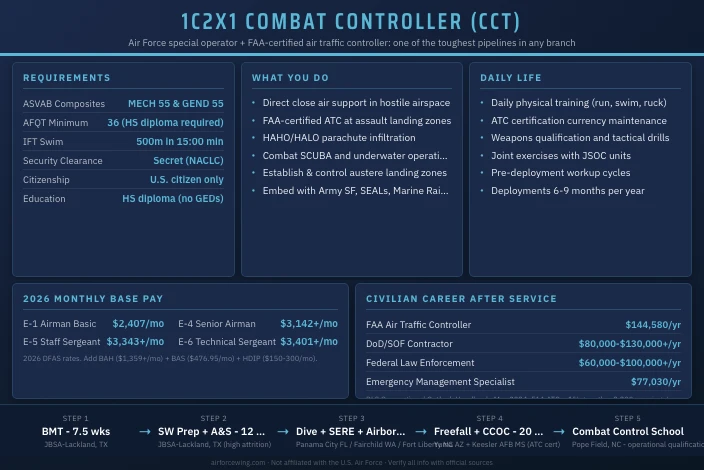
Combat Controllers (AFSC 1C2X1) are Air Force special operators trained to establish air traffic control in denied or contested environments. They deploy with special operations forces. Army Special Forces, Navy SEALs, and Marine Raiders, to manage airspace, call in close air support, direct airdrops, and seize or establish assault landing zones. Every CCT holds an FAA air traffic controller certification, making them both a trained warfighter and a credentialed aviation professional.
Day-to-Day Responsibilities
On a typical assignment to a Special Tactics Squadron, a Combat Controller’s day involves a mix of physical training, operational planning, and technical currency work. The physical demands don’t stop at selection, maintaining the fitness required to deploy at a moment’s notice is a permanent part of the job.
Technical responsibilities include:
- Controlling aircraft in non-radar and radar environments
- Setting up and operating portable communications equipment in austere locations
- Conducting terminal attack control of fixed-wing and rotary-wing close air support
- Managing airhead operations during airborne and air assault missions
- Planning and executing infiltration by HAHO/HALO parachute, SCUBA, or land movement
Specialized Roles and Identifiers
The 1C2X1 AFSC includes skill-level shredouts and Special Experience Identifiers (SEIs) that reflect additional qualifications earned during a CCT’s career.
| Code | Description |
|---|---|
| 1C231 | Apprentice (3-skill level, initial training pipeline) |
| 1C251 | Journeyman (5-skill level, first duty station) |
| 1C271 | Craftsman (7-skill level, supervisor) |
| 1C291 | Superintendent (9-skill level, senior NCO) |
| SEI 210 | Special Tactics Team Leader |
| SEI 215 | Joint Terminal Attack Controller (JTAC) |
Mission Contribution
CCTs are the Air Force’s primary tool for integrating airpower with ground special operations. When Army Special Forces teams need air support in a location with no established airspace control, a CCT builds that infrastructure from the ground up. They identify usable landing zones, establish communication frequencies, and clear aircraft into the fight. Without that link, airstrikes get delayed, medevacs lose time, and resupply drops miss the objective. CCTs exist to close that gap under the most adverse conditions possible.
Equipment
Combat Controllers work with a combination of aviation and special operations gear. That includes portable ATC radar systems, laser designators, satellite communications terminals, night-vision equipment, and standard special operations individual weapons. They’re also trained on static-line and military freefall parachute systems and closed-circuit diving equipment.
Salary
Combat Controllers earn standard Air Force base pay, but the role also qualifies for several additional pays that add meaningfully to total compensation.
Base Pay Table
| Rank | Grade | Pay (Entry) | Pay (4 Yrs) | Pay (8 Yrs) |
|---|---|---|---|---|
| Airman Basic | E-1 | $2,407/mo | , | , |
| Airman First Class | E-3 | $2,837/mo | $3,198/mo | , |
| Senior Airman | E-4 | $3,142/mo | $3,659/mo | $3,816/mo |
| Staff Sergeant | E-5 | $3,343/mo | $3,947/mo | $4,299/mo |
| Technical Sergeant | E-6 | $3,401/mo | $4,069/mo | $4,613/mo |
| Master Sergeant | E-7 | $3,932/mo | $4,663/mo | $5,105/mo |
2026 DFAS rates.
Special and Incentive Pays
CCTs qualify for several pays on top of base:
- Hazardous Duty Incentive Pay (HDIP): $150/mo for parachuting; $150/mo for diving
- Special Duty Assignment Pay (SDAP): varies by assignment, typically $75-$375/mo
- Combat Zone Tax Exclusion (CZTE): base pay becomes tax-exempt during qualifying deployments
- Selective Reenlistment Bonus (SRB): 1C2X1 has historically received SRBs due to high attrition and retention needs; verify current availability with your recruiter
Total monthly compensation for an E-4 with 4 years of service includes base pay, BAH (varies by duty station, an E-4 at Pope Field, NC receives approximately $1,359-$1,728/mo depending on dependent status), and BAS ($476.95/mo flat). Combined, total monthly take-home for a mid-career SrA can exceed $5,000 before special pays.
Additional Benefits
All active-duty Airmen receive TRICARE Prime at no cost, zero enrollment fee, zero deductible, zero copays for medical, dental, vision, and prescriptions. Education benefits include up to $4,500/year in Tuition Assistance while serving, and the Post-9/11 GI Bill covers full in-state tuition at public schools (or up to $29,920.95/year at private schools) after separation.
The Blended Retirement System (BRS) provides a pension at 20 years equal to 40% of your high-36 average basic pay, plus automatic TSP contributions starting at 1% and government matching up to 4% on your contributions.
Airmen earn 30 days of paid leave per year, accruing at 2.5 days per month.
Qualifications
The Combat Controller pipeline has one of the longest and most demanding entry processes in the Air Force. The qualifications below are entry requirements, not a guarantee of selection. Both MECH and GEND composites require a 55, so targeted preparation with an ASVAB study guide with practice tests is worth the time before you test at MEPS.
Requirements Table
| Requirement | Standard |
|---|---|
| Citizenship | U.S. citizen |
| Age | 17-39 (must ship before 40th birthday) |
| Education | High school diploma (GED not accepted) |
| AFQT Minimum | 36 |
| ASVAB Composites | MECH 55 and GEND 55 |
| Security Clearance | Secret (NACLC required) |
| Vision | 20/200 correctable to 20/20; normal color vision |
| Swimming | Must be able to pass the IFT swim events |
| Medical | No history of claustrophobia; hearing within standards |
| Service Obligation | 4 years (active duty, 8-year military service obligation total) |
A high school diploma is required. GEDs are not accepted for Combat Control. This is a hard cutoff, not a waiviable standard.
Initial Fitness Test (IFT)
Before you can contract for 1C2X1, you must pass the Special Warfare Operator Enlistment Initial Fitness Test (IFT). This is administered at MEPS or a recruiting event. The IFT is a pass/fail test with six events:
- Pull-ups (minimum 8 reps)
- Sit-ups for 2 minutes (minimum 50 reps)
- Push-ups for 2 minutes (minimum 40 reps)
- 1.5-mile run (maximum 10:20)
- Two 25-meter underwater swims (pass/fail)
- 500-meter surface swim (maximum 15:00)
Failing any single event fails the entire IFT. Most candidates who come in unprepared fail the underwater swim events, not the run. Start swim training early.
The IFT is a minimum standard. Candidates who score near the cutoff on any event typically wash out during pipeline training. Aim to exceed every standard by at least 20% before testing.
Application Process
The process from first contact with a recruiter to shipping to BMT typically takes 3-9 months depending on clearance processing and available training seats.
Waivers
Some medical and moral waivers are available but not guaranteed. Minor past drug use (marijuana in a state where it is legal) has been waived in some cases. Eyesight that is correctable to 20/20 is acceptable. Laser eye surgery (PRK or LASIK) may be approved after a waiting period. Contact your recruiter for current waiver guidance, the standards evolve.
Work Environment
Combat Controllers work in Special Tactics Squadrons (STS) organized under Air Force Special Operations Command (AFSOC). The work environment is fundamentally different from a standard Air Force unit.
Setting and Schedule
There is no standard schedule in an STS. Training rotations, pre-deployment workups, and actual deployments create a cycle where 60-80 hour weeks are routine. Physical training happens every duty day, usually in the early morning before operational tasks begin. CCTs frequently conduct off-base training events with Army and Joint Special Operations Command (JSOC) units, meaning travel is constant even when not deployed.
Time on a home installation looks like long days of individual tactical training, small-unit exercises, currency maintenance for ATC certifications, and weapons qualification. Evenings and weekends are technically personal time, but the culture in most STSs expects additional self-directed physical preparation.
Team Dynamics
Special Tactics Squadrons are small by Air Force standards, typically 20-50 operators. The command structure is flat compared to a conventional unit. Junior Airmen with 3-4 years of experience operate with significant autonomy during missions because the environment demands it. Your NCO chain is present for training and supervision, but on a mission in denied territory, a SrA or SSgt Combat Controller may be the sole Air Force representative on the ground.
Performance and Retention
The CCT community has a high retention rate among those who complete the pipeline, the investment in training and the nature of the work creates strong career satisfaction. But the washout rate during training is estimated at 60-80%, meaning the majority of people who contract for 1C2X1 never reach an operational squadron. Among those who do, reenlistment rates are high.
Training
The 1C2X1 training pipeline is one of the longest in the enlisted Air Force. From BMT through Combat Control School graduation, the full pipeline runs approximately 12-13 months. If the ASVAB is the next step before you can even contract, a PICAT practice test lets you prepare at home before the proctored version at MEPS.
Training Pipeline Table
| Phase | Location | Duration | Focus |
|---|---|---|---|
| Basic Military Training (BMT) | JBSA-Lackland, TX | 7.5 weeks | Core military skills |
| Special Warfare Preparatory Course | JBSA-Lackland, TX | 8 weeks | Physical conditioning, swimming |
| Assessment & Selection (A&S) | JBSA-Lackland, TX | 4 weeks | Selection event; high attrition |
| Special Warfare Pre-Dive | JBSA-Lackland, TX | 4 weeks | Dive preparation |
| Air Force Dive School | Naval Support Activity, Panama City, FL | 8 weeks | SCUBA, combat diving |
| Underwater Egress Training | Fairchild AFB, WA | 1 day | Aircraft egress |
| Air Force Survival School (SERE) | Fairchild AFB, WA | 2.5 weeks | Survival, evasion, resistance, escape |
| Airborne School | Fort Liberty, NC | 3 weeks | Static-line parachuting |
| Military Freefall School | Yuma Proving Ground, AZ | 4 weeks | HAHO/HALO parachuting |
| Combat Control Operator Course (CCOC) | Keesler AFB, MS | 15.5 weeks | FAA air traffic control certification |
| Combat Control School (CCS) | Pope Field, NC | Variable | Tactics, JTAC, culminating exercise |
Assessment & Selection (A&S) is a deliberate elimination event. The Air Force does not publish pass rates, but historical attrition at A&S alone is reported at 50% or higher. Candidates who fail A&S are reclassified to another AFSC.
What Each Phase Develops
The Preparatory Course and A&S are pure physical and mental assessment. You will operate sleep-deprived, under-fueled, and under constant stress while performing the same calisthenics and water events you already passed on the IFT, but with added load, time pressure, and attrition pressure.
Dive School at Panama City produces military combat divers. You will complete open-circuit and closed-circuit SCUBA qualifications. The pool work is precise and technical, improper buoyancy control or equipment mishandling results in training hold or disenrollment.
CCOC at Keesler AFB is where the air traffic control certification happens. The 15.5-week course covers ATC fundamentals, non-radar and radar approach control, control tower operations, and the practical skills required for FAA certification. This is an academic course, not a physical one. Failing academics here ends your CCT career.
Combat Control School at Pope Field integrates everything: ATC skills from Keesler, physical capability from A&S, and tactical skills from airborne and SERE training. Graduates leave with a Special Tactics qualification and report to an operational STS.
Advanced Training
After reaching an operational unit, CCTs pursue additional qualifications throughout their career. These include JTAC certification, advanced mobility air forces integration courses, and higher-level ATC endorsements. Senior CCTs often attend the Special Tactics Advanced Skills Course or pursue other SOF-specific advanced training through AFSOC’s training pipeline.
Career Progression
Rank Progression Table
| Rank | Grade | Typical TIG | Notes |
|---|---|---|---|
| Airman First Class | E-3 | First year | During pipeline training |
| Senior Airman | E-4 | ~2-3 years | First operational assignment |
| Staff Sergeant | E-5 | ~4-6 years | Board-selected; supervisory responsibilities begin |
| Technical Sergeant | E-6 | ~8-10 years | Element lead, senior operator |
| Master Sergeant | E-7 | ~12-15 years | Flight chief or senior tactical leadership |
| Senior Master Sergeant | E-8 | ~16-19 years | Squadron-level senior NCO |
| Chief Master Sergeant | E-9 | 20+ years | Command Chief or senior advisor roles |
Promotion to SSgt and above is competitive and board-selected. Enlisted Performance Reports (EPRs) are the primary promotion document. In the special warfare community, documented operational experience, additional qualifications, and leadership roles in deployed environments carry significant weight on EPRs.
Role Flexibility
Lateral retraining from 1C2X1 is possible but uncommon. The investment in pipeline training creates strong institutional pressure to retain qualified CCTs in the career field. CCTs who transition away typically move into special operations support roles, instructor billets, or officer commissioning programs.
Performance Evaluation
The Air Force uses the Enlisted Performance Report (EPR) to evaluate Airmen annually. EPRs are 5-tier rated and feed directly into promotion board scoring. In the CCT community, documented deployments, operational accomplishments, and leadership in training pipelines are the strongest EPR bullets. An EPR with specific mission impact statements from a deployed environment outperforms a generic garrison EPR every time.
Physical Demands
Daily Physical Demands
The physical load in an operational STS is sustained and significant. Most units conduct structured physical training 5 days per week, including long-distance running (6-10 miles), ruck marching with 45-65 lb loads, swimming, and strength work. This isn’t elective, it’s part of the duty day and is tracked by leadership.
On a deployment, CCTs carry a full special operations combat load that commonly exceeds 100 lbs, traverse terrain by foot, and operate in extreme environmental conditions (high altitude, extreme heat, or cold) for extended periods without resupply.
Air Force Fitness Assessment
All Airmen, including CCTs, take the standard Air Force Fitness Assessment (FA) annually. The FA is a 100-point composite score with a minimum passing score of 75. CCTs in operational units typically score well above the minimum.
| Component | Max Points | Notes |
|---|---|---|
| 1.5-Mile Run | 60 | Age- and gender-normed |
| Waist Circumference / Body Composition | 20 | Age- and gender-normed |
| Push-Ups (1 min) | 10 | Age- and gender-normed |
| Sit-Ups (1 min) | 10 | Age- and gender-normed |
Minimum passing composite: 75 points. Each component has its own minimum threshold. Standards are age- and gender-normed per AFI 36-2905.
Operator Fitness Test (OFT)
Beyond the standard FA, CCTs in operational units are subject to the Special Warfare Operator Fitness Test (OFT): a higher physical standard that is tested periodically to maintain assignment eligibility in a Special Tactics unit. The OFT is more demanding than the standard FA and reflects what the mission actually requires.
Medical Evaluations
CCTs receive annual flight physicals in addition to routine medical care, because FAA ATC certification requires documented medical fitness. Any condition that could affect hearing, cognition, or cardiovascular performance requires prompt reporting and medical evaluation. Hearing loss from sustained noise exposure is an occupational risk. CCTs working around aircraft and weapons systems are issued and expected to use hearing protection consistently.
Deployment
Duty Station Assignments
CCT assignments are concentrated at a small number of installations that host Special Tactics Squadrons. These are not negotiable in the same way as conventional Air Force assignments, you go where an STS billet is available.
Active duty STS locations include:
- Pope Field, NC (21st and 724th Special Tactics Squadrons)
- Joint Base Lewis-McChord, WA (22nd Special Tactics Squadron)
- Hurlburt Field, FL (23rd Special Tactics Squadron)
- Cannon AFB, NM (26th Special Tactics Squadron)
- Kadena Air Base, Okinawa (320th Special Tactics Squadron)
- RAF Mildenhall, England (321st Special Tactics Squadron)
All of these are high-cost-of-living areas relative to the average Air Force base, which is relevant for BAH calculations when budgeting.
Deployment Frequency
Combat Controllers deploy frequently. Annual deployments of 6-9 months are common for Airmen assigned to operational squadrons, and some years include multiple rotations. Deployment cycles depend on the global special operations posture and the specific squadron’s tasking, not the individual Airman’s preference.
Deployments are typically to USCENTCOM or USAFRICOM areas of responsibility, but CCTs have deployed globally wherever JSOC missions have occurred.
The deployment model for Special Tactics Squadrons differs from conventional Air Force deployments. CCTs typically do not deploy as a full unit. Instead, small teams or individuals attach to supported special operations task forces, which means a CCT’s daily deployed environment might include Army Special Forces, Navy SEALs, or allied SOF partners rather than other Air Force Airmen. That context shapes everything from the chain of command to the day-to-day living conditions.
Pre-deployment workups are the period immediately before a rotation where teams train to mission-specific standards for the theater they’re entering. These workups can last several weeks to a few months and involve TDY travel to ranges and training areas that count as time away from home station even before the deployment begins. Combined with the deployment itself, the actual number of days away from home in a given year often exceeds the formal deployment length.
Dwell time, the period at home station between deployments, is supposed to meet Department of Defense minimums (one day at home for every day deployed for Guard and Reserve; active duty minimums are enforced at command level), but operational demand in SOF has historically compressed dwell below those targets during sustained contingency operations.
Overseas OCONUS assignments, including the 320th Special Tactics Squadron at Kadena, Japan, and the 321st at RAF Mildenhall, England, offer an alternative to the continental U.S. STS basing while maintaining the same mission focus.
Risk/Safety
Job Hazards
1C2X1 is among the highest-risk enlisted AFSCs in the U.S. military. Direct combat exposure is not theoretical, it is an expected part of the operational assignment. CCTs work in environments that are, by definition, not under friendly control. Hazards include:
- Direct enemy fire in combat operations
- Diving accidents (pressure injuries, equipment failure)
- Parachuting injuries (high-altitude freefall and static-line operations)
- Aircraft hazards during ATC operations at austere airfields
- Blast and noise exposure from close air support operations
Safety Protocols
Every hazardous training activity is governed by Air Force and DOD safety standards. Dive operations follow Navy Diving Manual standards. Parachute operations are conducted under strict weather minimums and equipment inspection protocols. The Air Force tracks class A mishaps (fatalities and major equipment losses) and continuously updates training procedures.
Security Clearance
The 1C2X1 AFSC requires a Secret clearance, obtained through a National Agency Check with Local Agency Checks and Credit (NACLC). Factors that complicate NACLC adjudication include significant debt, foreign national contacts, criminal history, and prior drug use. The investigation begins at MEPS, delays in clearance processing can delay or prevent entry into the pipeline.
The Secret clearance requirement for 1C2X1 is a baseline. Specific assignment types or higher-level programs within the CCT community may require access at the Top Secret/SCI level. That investigation begins after you reach an operational unit.
Service Obligation
Enlistment for 1C2X1 carries a 4-year active-duty obligation with an 8-year total military service obligation (MSO). If you fail out of the pipeline, you will be reassigned to another Air Force AFSC and will serve out your contracted obligation in that role.
Impact on Family
What Military Life Actually Looks Like
CCTs deploy often and for extended periods. A family living near Pope Field or Hurlburt Field should plan for one parent being absent 6-9 months per year during operational assignment cycles. That’s not an outlier event, it’s the baseline tempo for an active STS.
On top of deployment, pre-deployment workups, joint exercises, and TDY travel create additional time away from home even between rotations. Partners who prefer predictability and regular schedules typically find the CCT lifestyle difficult to manage. Partners who build strong independent routines and connect with the military community on-base often adapt well.
Support Systems
Air Force installations with STSs all have full family support infrastructure: Military Family Life Counselors, Air Force Family Readiness Centers, on-base childcare, commissary, and exchange access. The Special Tactics community specifically has active family readiness groups (FRGs) that provide practical support during deployments. The Military OneSource program provides confidential counseling and referrals at no cost to service members and their dependents.
BAH and Housing
The duty station list for CCTs skews toward areas with higher housing costs. BAH rates reflect local market conditions, so compensation adjusts accordingly. Families near Pope Field or JBLM typically find military installation housing competitive with local rents, but waitlists for on-base housing can run 6-12 months.
Reserve and Air National Guard
Component Availability
The 1C2X1 AFSC is available in both the Air Force Reserve Command (AFRC) and the Air National Guard (ANG). Reserve and Guard CCTs serve in their own Combat Control Squadrons or Special Tactics Squadrons, these are operational billets, not training cadre positions.
ANG units with CCT billets include:
- 123rd Special Tactics Squadron, Louisville International Airport, KY
- 125th Special Tactics Squadron, Portland International Airport, OR
Component Comparison
| Factor | Active Duty | Air Force Reserve | Air National Guard |
|---|---|---|---|
| Commitment | Full-time | 1 weekend/mo + 2 weeks/yr (+ deployments) | 1 weekend/mo + 2 weeks/yr (+ deployments) |
| Monthly Base Pay (E-4 drill) | $3,659/mo (4 yrs) | ~$732/weekend (2 UTAs) | ~$732/weekend (2 UTAs) |
| Healthcare | TRICARE Prime (free) | TRICARE Reserve Select (premiums apply) | TRICARE Reserve Select (premiums apply) |
| Education | Full TA + Post-9/11 GI Bill | TA available; GI Bill eligibility depends on activation | State tuition waivers often available; TA available |
| Deployment Frequency | High (6-9 mo/yr typical) | Moderate; mobilized for real-world missions | Moderate; state activation possible in addition to federal |
| Retirement | 20-yr pension (40% high-36) | Points-based reserve retirement (age 60 draw) | Points-based reserve retirement (age 60 draw) |
Part-Time Training Commitment
Guard and Reserve CCTs do not simply show up one weekend a month. The physical and operational currency requirements for 1C2X1 mean these Airmen must conduct additional training events, maintain JTAC certifications, and participate in joint exercises beyond the standard Unit Training Assembly (UTA) schedule. Employers hiring Guard or Reserve CCTs should expect more than two weeks of annual absence.
Civilian Career Integration
The CCT qualification pairs well with federal law enforcement, FAA ATC, and private-sector security roles. Many Guard CCTs work as FAA controllers or in aviation operations during the week. USERRA protects civilian employment rights during activations. The Employer Support of the Guard and Reserve (ESGR) program provides resources for both Airmen and employers navigating reserve service requirements.
Post-Service
The combination of ATC certification, special operations experience, and leadership background makes 1C2X1 one of the strongest résumé-building AFSCs in the Air Force.
FAA Air Traffic Controller
The most direct transition is to a FAA air traffic controller position. The FAA prioritizes veterans, and CCT experience directly maps to ATC certification requirements. The median annual wage for air traffic controllers was $144,580 as of May 2024 (BLS). Top earners at major facilities exceed $210,000 annually. Projected annual openings average 2,200 per year through 2034.
Civilian Career Transition Table
| Civilian Career | Median Annual Salary | Growth Outlook (2024-2034) | Notes |
|---|---|---|---|
| FAA Air Traffic Controller | $144,580 | +1% (stable, high demand) | CCT ATC cert applies directly |
| DoD/Government Contractor (SOF) | $80,000-$130,000+ | Varies | TS/SCI clearance adds value |
| Law Enforcement / Federal Agent | $60,000-$100,000+ | Varies by agency | Physical fitness + clearance valued |
| Emergency Management Specialist | $77,030 | +3% | OEM.gov roles; FEMA positions |
| Aviation Operations Specialist | $50,000-$80,000 | Varies | Airport ops, military liaison roles |
Salary figures from BLS Occupational Outlook Handbook (May 2024) and industry ranges. Civilian pay varies significantly by location and employer.
Transition Assistance
The Air Force’s Transition Assistance Program (TAP) begins 12 months before separation and provides resume writing, interview coaching, and connections to hiring events through programs like Hiring Our Heroes. Veterans with CCT backgrounds are also competitive for special operations contracting roles through private military companies and government agencies, where a TS/SCI clearance and JTAC certification can command premium pay.
The Post-9/11 GI Bill’s housing allowance (paid at the E-5 with dependents BAH rate at the school’s ZIP code) provides meaningful financial support during full-time education after separation.
Is This a Good Job
Who Thrives in 1C2X1
Combat Control is not a job for someone who wants structured hours, geographic stability, or a clear boundary between work and personal time. The people who last, and more importantly, who want to last, share a few traits:
- Comfortable being physically exhausted and still having to perform technical tasks
- Drawn to environments with high stakes and ambiguous rules of engagement
- Willing to be the Air Force’s lone representative on a joint SOF mission
- Patient enough to spend 12-13 months in training before reaching an operational unit
- Competitive, but team-oriented, the individual matters less than the team’s capability
The FAA certification component also means academic work is part of the package. The CCOC at Keesler is a serious ATC training program. Candidates who struggled with technical academic work in high school or who dislike sitting in a classroom will find this phase harder than the physical components.
CCTs who commission as officers can pursue the Special Tactics Officer (13C) career field, which places Special Tactics team leaders in command roles over CCT, PJ, TACP, and SR Airmen.
Who Should Look Elsewhere
Avoid 1C2X1 if:
- You want predictable deployments with clear return dates
- Sustained separation from family is a dealbreaker
- You need early career assignment flexibility (CCT billets are geographically concentrated)
- You’re not confident in the water, the IFT’s swim requirements eliminate a significant number of applicants before the pipeline even starts
The pipeline attrition rate is honest feedback about how demanding this career field is. Many motivated, physically fit people fail Assessment & Selection. Failing A&S does not mean you failed the Air Force, it means you’re assigned to a different career. But if your plan hinges on 1C2X1 specifically, build a backup plan.
Career and Lifestyle Fit
CCTs who spend 20 years in the career field describe work that is consistently meaningful and physically demanding in a way that keeps them engaged. The FAA certification creates a clear, high-value path after separation. The downside is the personal cost: marriages in SOF communities experience above-average stress, and the physical toll of sustained high-intensity operations accumulates over a career.
If you want military service that stretches you and leaves you with credentials that translate directly to a high-paying civilian career, 1C2X1 is one of the few enlisted roles that delivers both. The question is whether you’re willing to pay the price of admission.
More Information
Talk to an Air Force Special Warfare recruiter, not a general recruiter, to get accurate and current information about the 1C2X1 pipeline, current bonus availability, and open training seats. General Air Force recruiters process paperwork for special warfare applications, but a recruiter who works specifically with special operations candidates understands the IFT standards, pipeline structure, and contract options in a way that a general recruiter typically does not.
Before any recruiter conversation, confirm your ASVAB scores meet the MECH 55 and GEND 55 composites. An ASVAB study guide covers both composites and helps you prioritize which subtests to focus on. If you have already tested and need to retest, you may do so after a 30-day waiting period following your first attempt, but only one retake is typically permitted within a 6-month window at MEPS.
Physical preparation is the other critical pre-application step. Most candidates who fail the IFT fail the swim events, not the run. If you are not currently training in water, start immediately. Specific preparation steps before your IFT:
- Build a 500m swim time under 12 minutes (well below the 15-minute cutoff) before testing
- Practice the 25-meter underwater swim repeatedly until it is comfortable and consistent
- Run at least 30 miles per week at a comfortable pace to build aerobic base
- Add pull-up volume, most candidates find this the limiting factor after swimming
Current IFT standards and the official Air Force Special Warfare pre-accession training program are published through the Air Force Special Operations Command. Contact your local Air Force recruiter through airforce.com to start the process and be connected with a Special Warfare-familiar recruiter in your area.
This site is not affiliated with the U.S. Air Force or any government agency. Verify all information with official Air Force sources before making enlistment or career decisions.
Explore more Air Force special warfare careers such as 1C4X1 Tactical Air Control Party and 1W0X2 Special Operations Weather.