2M0X3 Missile and Space Facilities
The Minuteman III missile sits 60 feet underground in a reinforced concrete silo somewhere in Wyoming, Montana, or North Dakota. For that weapon to be operational, every power system, environmental control, and support structure around it has to work, not most of the time, but all of the time. Missile and Space Facilities Airmen are the people responsible for that. They keep the electrical systems running, the climate control functioning, and the launch infrastructure in a constant state of readiness.
This is not a glamorous job in the way pilots or special operations draw attention. It is a foundational one. The United States’ intercontinental ballistic missile force depends entirely on the facilities specialists who maintain the physical infrastructure that supports it. If a power distribution system fails at a launch facility, the operational consequences reach all the way to national command authority. That is the weight this career field carries, and the Airmen in it understand it.
The 2M0X3 AFSC also supports space launch facilities at Vandenberg Space Force Base, expanding the work beyond just missile sites into the support infrastructure for military and national security launches. If you want a hands-on technical role that keeps some of the most sensitive systems in the U.S. military running, this career field is worth a serious look.
Qualifying requires specific ASVAB line scores. Our ASVAB study guide covers what to target and how to prepare.
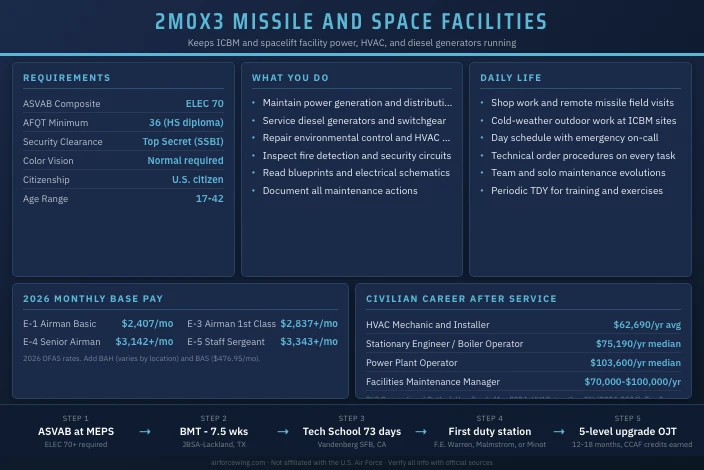
Job Role
2M0X3 Missile and Space Facilities specialists install, operate, maintain, and repair power generation and distribution systems, environmental control equipment, and associated support infrastructure at intercontinental ballistic missile launch facilities and space launch sites. They service weapons systems, troubleshoot equipment malfunctions, analyze operational readiness, supervise launch processing activities, and operate specialized support vehicles.
What You Do Every Day
The work is technical and physical. Unlike ops center AFSCs where most of the job happens at a computer screen, 2M0X3 Airmen regularly travel off-base to remote missile facilities to perform hands-on maintenance. A typical workday might look like this:
- Drive a convoy to a launch facility complex 30 to 50 miles from the main base
- Perform scheduled preventive maintenance on power generation equipment
- Troubleshoot an environmental control malfunction and repair it on-site
- Document work in the maintenance information system and close out technical order steps
- Inspect backup power systems and verify operational status before leaving the site
- Return to base and coordinate follow-up maintenance with the next crew
Not every day involves a site trip. Some days are spent in shop areas performing bench maintenance, attending training, or supporting administrative tasks. The ratio shifts depending on the unit’s schedule and mission tempo.
Specializations Within 2M0X3
The 2M0X3 career field does not use formal shredouts at accession. Specialization develops through assignment history and unit mission.
| Mission Area | Description |
|---|---|
| ICBM Launch Facilities | Power, HVAC, and electrical maintenance at hardened underground complexes |
| Launch Control Centers | Facility support systems for the command posts that control missile wings |
| Space Launch Facilities | Pad and facility support infrastructure at Vandenberg SFB for spacelift missions |
| Research and Development Support | Facility maintenance for R&D sites tied to missile and space programs |
Mission Contribution
The Air Force’s nuclear deterrence mission runs 24 hours a day, every day of the year. That deterrence only functions if the physical systems housing the weapons are operational. Every generator that fails, every HVAC unit that goes down, and every power distribution problem that goes uncorrected degrades the readiness of the force. Missile and Space Facilities Airmen are the direct line of defense against that degradation. Their work is why the missile force can report operational readiness to national command authority.
Technology and Equipment
The equipment ranges from industrial-grade power generators and switchgear to commercial HVAC systems adapted for hardened underground environments. Airmen read technical orders, blueprints, schematic diagrams, and workflow documentation to perform maintenance tasks. At space launch facilities, the work extends to pad support systems that service rockets before they leave the ground. Some systems are decades old and well-understood; others are being modernized as part of the ongoing Sentinel ICBM replacement program, which is rebuilding much of the ground infrastructure the current force runs on.
Salary
2M0X3 is an active-duty AFSC at installations with fixed missions and consistent manning needs. Pay follows standard DFAS military pay tables, with allowances that vary by duty location.
Base Pay Table
| Rank | Grade | Monthly Base Pay (entry) |
|---|---|---|
| Airman Basic | E-1 | $2,407 |
| Airman | E-2 | $2,698 |
| Airman First Class | E-3 | $2,837 |
| Senior Airman | E-4 | $3,142 |
| Staff Sergeant | E-5 | $3,343 |
| Technical Sergeant | E-6 | $3,401 |
Pay figures are 2026 DFAS rates, reflecting the 3.8% raise effective January 1, 2026.
Allowances and Additional Pay
Base pay is the foundation, but total compensation is larger. BAS (Basic Allowance for Subsistence) adds $476.95 per month for all enlisted Airmen regardless of location. BAH varies by installation and dependency status, duty stations like F.E. Warren (Cheyenne, WY) and Minot AFB (ND) typically carry lower BAH rates than coastal installations, which is worth factoring into cost-of-living planning.
Reenlistment bonuses vary by fiscal year and Air Force retention needs. Contact a recruiter for current figures, as bonus programs change annually based on career field manning data.
Benefits Package
- Healthcare: TRICARE Prime at zero cost, no enrollment fees, no deductibles, no copays for active-duty Airmen
- Housing: Government quarters on base or BAH for off-base housing
- Education: Tuition Assistance covers up to $4,500 per year; Post-9/11 GI Bill covers full in-state tuition after separation
- Retirement: Blended Retirement System (BRS), 20-year pension at 40% of high-36 average base pay plus TSP matching up to 5% of basic pay
- Leave: 30 days paid vacation per year
Work-Life Balance
Missile wing assignments run on rotating shifts because the mission never stops. At most wings, the maintenance schedule is driven by weapon system status, exercise cycles, and inspection calendars. Long-term planning is possible, you typically know your schedule weeks ahead, but there are periods, particularly around nuclear surety inspections or higher headquarters visits, when the pace intensifies. When you’re off shift, you’re genuinely off, which is a meaningful quality-of-life factor.
Qualifications
The qualification threshold for 2M0X3 reflects the technical nature of the work and the sensitivity of the facilities where you’ll work.
Qualification Table
| Requirement | Minimum Standard |
|---|---|
| ASVAB Composite | ELEC 70 |
| AFQT Score | 36 (with HS diploma) |
| Citizenship | U.S. citizen |
| Age | 17-42 at enlistment |
| Color Vision | Normal required |
| Security Clearance | Secret (T3 Investigation) |
| Physical, Heights | Must be free of fear of heights |
| Physical, Confined Spaces | Must be free of claustrophobia |
Requirements sourced from airforce.com.
The ELEC composite draws from General Science, Arithmetic Reasoning, Mathematics Knowledge, and Electronics Information subtests. An ELEC of 70 is a meaningful bar, it filters out applicants who lack the electronics reasoning foundation the job requires. Plan your ASVAB prep around those four subtests specifically.
Application Process
The path to 2M0X3 runs through your recruiter and MEPS, same as any enlisted AFSC.
Selection and Competitiveness
The ELEC 70 requirement is the primary filter. Applicants with strong math and basic electronics knowledge tend to score in the qualifying range without intensive study, but don’t assume prior knowledge is enough, the ASVAB rewards deliberate preparation. A clean financial and legal history speeds the clearance process considerably. There is no physical pre-screening beyond standard MEPS requirements, though the job’s physical demands are significant compared to desk-based AFSCs.
Service Obligation
Standard enlisted contract is four years of active-duty service. The Air Force’s investment in clearance adjudication and specialized training for 2M0X3 is reflected in the standard obligation. New accessions enter service at E-1 (Airman Basic).
Before you test, make sure your electronics and math scores are competitive. The PiCAT is available for first-time testers and can be taken from home.
Work Environment
2M0X3 Airmen work in a mix of environments that differ significantly from most Air Force technical jobs. Part of the work happens in shops and maintenance bays on the installation. A substantial part happens off-base, in the field, at launch facility complexes scattered across the missile wing’s geographic footprint.
Setting and Schedule
The missile wings at Malmstrom, Minot, and F.E. Warren all operate in remote or semi-rural areas with harsh winters. Field work at launch facilities means working in cold weather, sometimes in confined spaces, and sometimes at elevation on facility structures. This is not an office job. The physical environment is the job.
Shift work is standard. Most wings use rotating schedules:
- Days: Primary shift for launch facility field trips and scheduled maintenance
- Swings: Afternoon/evening coverage, standby and support duties
- Nights: Overnight shift, emergency response and facility monitoring
Expect to work weekends and to rotate through night shifts. Launch facility trips are typically day-shift activities, but support duties and standby requirements can extend into evenings.
Team Dynamics
Field maintenance at missile sites is crew-based work. You do not go to a launch facility alone, convoys require multiple personnel and specific vehicle configurations. Within the shop, work is coordinated through production schedules and work order systems. Experienced Technical Sergeants and Staff Sergeants lead maintenance crews; junior Airmen work under direct supervision during the 3-skill level upgrade period.
Decision-making authority scales with skill level. A 7-level Missile and Space Facilities craftsman can operate with significant autonomy. At the 3 level, you follow technical orders step by step with supervision. That progression is deliberate and tied directly to safety, the systems you’re maintaining are mission-critical.
Job Satisfaction
Airmen in this field who report high job satisfaction tend to be the ones who like working with their hands, are comfortable in challenging physical environments, and find satisfaction in visible, concrete results. When a power system you repaired keeps a launch facility fully operational through a brutal Montana winter, that’s a tangible outcome. The tradeoff is the remote duty stations and rotating shifts, which some Airmen find isolating. The small, tight-knit nature of missile wing communities can offset that, or amplify it, depending on personality.
Training
Training Pipeline
| Phase | Location | Duration | Focus |
|---|---|---|---|
| Basic Military Training (BMT) | JBSA-Lackland, TX | 7.5 weeks | Military foundations, fitness, discipline |
| Technical School | Vandenberg Space Force Base, CA | 73 days | Power systems, HVAC, schematics, missile facility operations |
| On-the-Job Training (OJT) | First duty station | Varies | Skill upgrade tasks, TO certification, 5-level progression |
Tech School at Vandenberg
Technical training for 2M0X3 runs 73 days at Vandenberg Space Force Base on the California central coast. The curriculum covers the skills you’ll need in the field: reading technical orders, interpreting blueprints and schematic diagrams, understanding electrical and mechanical principles, and applying them to the specific systems found at missile and space launch facilities. You’ll also learn HVAC fundamentals, power distribution concepts, and the safety protocols that govern work at nuclear-related facilities.
Vandenberg is also an active launch facility, so you’ll train in proximity to the real infrastructure you’ll eventually support. The 73-day course includes classroom instruction and hands-on lab work. Completion earns credits toward a Mechanical and Electrical Technology degree through the Community College of the Air Force (CCAF).
On-the-Job Training and Skill Levels
After Tech School, you arrive at your first duty station as a 3-skill level (journeyman in training). The 3-to-5-level upgrade requires completing a set of core tasks documented in the Career Field Education and Training Plan (CFETP), plus a specified number of months in upgrade training. The 5-skill level certifies you to perform most maintenance tasks independently. Progression to the 7-skill level adds supervisory and instructor responsibilities.
Advanced Training
Experienced Airmen can pursue nuclear surety qualifications, equipment-specific certifications, and instructor roles at the technical school. The Sentinel ICBM modernization program is introducing new facility systems that will require retraining across the missile wing enterprise, creating ongoing technical development opportunities for career Airmen who stay in the field long enough to work on the new hardware.
Your recruiter can walk you through training class availability, confirm your ASVAB scores are ready with our study guide before that conversation.
Career Progression
Rank Progression
| Rank | Grade | Typical Milestone | Time in Service |
|---|---|---|---|
| Airman Basic | E-1 | BMT entry | 0 |
| Airman | E-2 | Auto promotion | 6 months |
| Airman First Class | E-3 | Auto promotion | 16 months |
| Senior Airman | E-4 | BTZ or time-in-grade | ~3 years |
| Staff Sergeant | E-5 | Enlisted Promotions Board | ~4-6 years |
| Technical Sergeant | E-6 | Board + EPR record | ~8-10 years |
| Master Sergeant | E-7 | Board + record | ~12+ years |
Promotion to E-4 can come early through a Below-the-Zone (BTZ) board that selects outstanding Airmen six months ahead of the standard timeline. Promotions to Staff Sergeant and above require competitive board scores based on EPR ratings, professional military education (PME), and documented duty performance.
Specialization and Growth
The career field’s progression is largely linear, you develop depth in the same systems as you advance through skill levels rather than branching into subspecialties at accession. The meaningful career branch points are supervisor and instructor roles at the 7-skill level, and the possibility of becoming a nuclear surety evaluator or unit trainer. Senior NCOs in 2M0X3 often accumulate enough breadth across power, HVAC, and electrical systems to compete for roles in broader civil engineering or base operations functions if they pursue retraining later in their careers.
The Sentinel ICBM modernization program will demand experienced facility maintainers who understand both the old systems and the new ones being fielded. Career Airmen who stay through that transition will be in high demand.
Performance Evaluation
The Air Force Enlisted Performance Report (EPR) system rates Airmen on a five-tier scale. Your EPR is the primary driver of promotion competitiveness above E-4. In 2M0X3, strong EPR bullet points come from mission accomplishment data, maintenance completion rates, zero-defect inspection results, upgrade training milestones, and contributions to unit readiness metrics. Airmen who complete CCAF coursework, volunteer for additional duties, and finish PME early tend to perform better on promotion boards than those who limit themselves to minimum requirements.
Physical Demands
Daily Physical Requirements
2M0X3 is a physically demanding AFSC by Air Force standards. A typical field workday involves:
- Driving to remote sites, often on rough roads in adverse weather
- Carrying tools and equipment into facility access points
- Working in confined mechanical spaces and equipment rooms
- Climbing facility structures and working at heights
- Performing repairs that require moderate to heavy lifting
- Sustained outdoor exposure in cold-weather environments at northern missile wings
The strength and endurance requirements are genuine, not incidental. Airmen who are physically fit beyond the minimum FA standards find the job more manageable, particularly during high-tempo maintenance periods.
The Air Force Fitness Assessment (FA) applies to all Airmen regardless of AFSC.
Air Force Fitness Assessment Standards (Under 25, 2026)
| Component | Male Minimum | Female Minimum | Max Points |
|---|---|---|---|
| 1.5-Mile Run | 9:12 (satisfactory) | 10:47 (satisfactory) | 60 |
| Push-Ups (1 min) | 42 reps (satisfactory) | 18 reps (satisfactory) | 10 |
| Sit-Ups (1 min) | 42 reps (satisfactory) | 32 reps (satisfactory) | 10 |
| Waist Circumference | 35 inches or less | 31.5 inches or less | 20 |
| Composite Passing Score | 75 out of 100 | 75 out of 100 | 100 |
Standards are age- and gender-normed. Verify current standards at af.mil before your assessment.
Medical Standards
Standard MEPS medical evaluation applies at accession, including color vision testing. Normal color vision is a non-negotiable requirement for this AFSC, the ability to distinguish wire colors and indicator lights is part of routine electrical work. After entering service, periodic preventive care is provided through TRICARE. No AFSC-specific medical waivers are commonly associated with 2M0X3 beyond the color vision requirement, though the physical nature of the work means musculoskeletal fitness matters throughout your career.
Deployment
Where You Can Serve
The 2M0X3 AFSC is concentrated at missile wings and space launch facilities. Major duty stations include:
- Malmstrom AFB, MT: 341st Missile Wing, Minuteman III operations
- Minot AFB, ND: 91st Missile Wing, Minuteman III operations
- F.E. Warren AFB, WY: 90th Missile Wing, Minuteman III operations
- Vandenberg Space Force Base, CA: spacelift facility support and Tech School
- Hill AFB, UT: logistics and support functions
- Ramstein AB, Germany: overseas assignment opportunity
The three missile wings account for the bulk of 2M0X3 billets. Geographic diversity in this career field is more limited than in AFSCs with broad mission presence across multiple installation types.
Deployment Tempo
Deployment tempo for 2M0X3 is relatively low compared to combat-support AFSCs. The missile wing mission is fixed-facility and does not lend itself to forward deployment in the same way that logistics, security forces, or maintenance AFSCs do. Short deployments to support exercises or contingency requirements occur, but extended combat-zone deployments are rare for this specialty. Most of a career in 2M0X3 is spent at or near the home installation.
Assignment Process
Assignments are managed through the Air Force Personnel Center (AFPC) using the Assignment Management System (AMS) and MyVector Talent Marketplace. Individual preferences can be submitted, but AFPC balances those against mission requirements. Given that most 2M0X3 billets sit at the three missile wings, a first assignment at one of those installations is the most likely outcome. Subsequent assignments can include Vandenberg or overseas locations for qualified mid-career Airmen.
Risk/Safety
Job Hazards
2M0X3 carries a higher physical risk profile than most Air Force technical AFSCs. Relevant hazards include:
- Electrical systems: Working with high-voltage power distribution equipment requires strict lockout/tagout procedures and trained awareness
- Confined spaces: Some facility access points and equipment rooms qualify as permit-required confined spaces with specific entry controls
- Heights: Facility structure maintenance requires working at elevation with fall protection equipment
- Cold-weather operations: Northern missile wing locations expose Airmen to extreme winter conditions during field work
- Nuclear-adjacent environment: Work is performed in close proximity to nuclear weapons systems, though direct weapons maintenance is a separate AFSC (2M0X2)
Safety Protocols
Technical orders govern every maintenance task. There is no improvisation in this career field, procedures are documented, verified, and signed off. Lockout/tagout procedures, confined space entry controls, fall protection requirements, and vehicle safety standards are all actively enforced. The nuclear environment adds a layer of security and safety oversight beyond standard occupational safety requirements.
Security Clearance Requirements
A Secret clearance is required for award and retention of 2M0X3. The Tier 3 (T3) Investigation covers your background, finances, foreign contacts, and personal history. The SF-86 security questionnaire must be completed honestly and completely. Omissions discovered later carry significantly more weight than disclosed issues.
Maintaining the clearance requires ongoing reporting of foreign travel, foreign contacts, significant financial changes, and any circumstances that could affect your adjudicative status. Periodic Reinvestigation cycles keep the clearance current through your career.
Legal Obligations
Standard enlistment contract terms apply. The Air Force’s investment in clearance processing and technical training may be reflected in service commitments tied to specialty training costs. Your recruiter will explain any additional obligations at the time of contracting.
Impact on Family
Remote Duty Stations and Community Life
The three primary missile wings are all located in states with harsh winters and small civilian communities. Cheyenne, WY (F.E. Warren); Minot, ND; and Great Falls, MT (Malmstrom) are distinctly different from the large metro areas near coastal Air Force bases. Military families who thrive in those environments generally embrace the outdoor recreation opportunities, low cost of living, and tight-knit community that small-city bases provide. Families accustomed to urban amenities can find the adjustment significant.
On-base infrastructure at the missile wings is mature and well-funded:
- K-12 schools (local public with school liaison support for military families)
- On-base childcare and youth programs
- Fitness center and recreation facilities
- Military Family Support Center and Military OneSource counseling
School liaison officers assist with student transitions. All resources are available at no cost to active-duty families.
Shift Work and Family Coordination
Rotating shifts at the missile wing mean that not every weekend is a weekend and not every weekday is a workday. The schedule is predictable, you will know your rotation weeks in advance, but it takes household coordination to manage meals, childcare pickups, and shared responsibilities around a schedule that isn’t Monday through Friday. Families who establish routines based on the posted schedule tend to adapt well. Those who expect a conventional work week tend to find it frustrating.
Field trip days, which can run 10 to 12 hours including travel, add another wrinkle. On days when you convoy to a remote site, the day is effectively gone. That is normal for this career field, and families who understand it from the start are better positioned to plan around it.
Relocation
PCS moves typically occur every two to four years. The limited number of 2M0X3 duty stations means reassignment often means moving between missile wings or to Vandenberg. Back-to-back assignments in the same region are possible given the geographic clustering of missile wing installations.
Reserve and Air National Guard
Component Availability
The 2M0X3 AFSC is principally an active-duty career field. The Career Field Education and Training Plan (CFETP) for 2M0X3 does not apply to Air National Guard or Air Force Reserve members, and the missile wing mission is operated almost exclusively by active-duty personnel. Reserve and ANG billets in this specific specialty are sparse. Confirm current component availability with a recruiter or AFPC before assuming a part-time path exists in this career field.
If a Guard or Reserve component is important to your long-term service plan, 1C6X1 Space Systems Operations is a space-adjacent AFSC with documented Reserve and ANG availability.
Drill Schedule and Commitment
The standard Reserve and ANG commitment is one Unit Training Assembly (UTA) weekend per month plus a two-week Annual Tour (AT). Missile facility maintenance requires equipment currency, so any part-time billets that do exist in this specialty may require additional training days for task recertification beyond the standard UTA schedule.
Part-Time Pay
An E-4 Senior Airman earns $3,142/month on active duty. An E-4 drilling one UTA weekend per month earns approximately $418 per drill weekend based on current daily pay calculations. Annual Tour adds two weeks of base pay on top of that.
Component Comparison
| Feature | Active Duty | Air Force Reserve | Air National Guard |
|---|---|---|---|
| 2M0X3 availability | Yes, primary component | Very limited | Very limited |
| Monthly base pay (E-4) | $3,142 | ~$418/drill weekend | ~$418/drill weekend |
| Healthcare | TRICARE Prime (free) | TRICARE Reserve Select (premiums) | TRICARE Reserve Select (premiums) |
| Education benefits | Active TA + full GI Bill | Reserve TA + partial GI Bill | State tuition waivers (varies) + GI Bill |
| Deployment tempo | Low | Low to moderate (when mobilized) | Low to moderate (when mobilized) |
| Retirement | BRS 20-year pension + TSP | Points-based (at age 60) | Points-based (at age 60) |
Civilian Career Integration
The electrical, HVAC, and power systems skills from 2M0X3 transfer well to civilian maintenance and facilities management careers regardless of whether you pursue a Reserve component afterward. Defense contractor and federal civil service positions at missile installations are a natural next step. USERRA protections apply to any reservists who do serve in a related capacity.
Post-Service
Civilian Career Transition
The skills built in 2M0X3 are directly marketable in the civilian workforce. Power systems maintenance, HVAC troubleshooting, reading electrical schematics, and working in controlled-environment facilities are all in demand outside the military. The Secret clearance adds a premium on top of the technical skills, particularly for defense contractor roles at missile installations or space launch facilities.
Federal government positions through USAJobs are a common transition path for 2M0X3 veterans. Civil service maintenance and facilities management positions at missile wing installations are regularly posted, and veterans’ preference gives departing Airmen a meaningful advantage in the application process.
Defense contractors supporting the Sentinel ICBM modernization program are actively recruiting experienced missile facilities personnel. The scale of the Sentinel program, essentially rebuilding the entire ICBM ground infrastructure over the next decade, means sustained demand for people who understand what is being replaced.
Civilian Career Prospects
| Civilian Career | Median Annual Salary | Job Outlook |
|---|---|---|
| Electrician | $62,350 | +9% (2024-2034) |
| Electrical and Electronics Installer/Repairer | $71,270 | Stable, ~9,600 openings/yr |
| HVAC and Refrigeration Mechanic/Installer | $59,810 | +8% (2024-2034) |
| Facilities Maintenance Technician (Federal GS) | Varies by GS grade | Consistent federal demand |
Salary figures from the BLS Occupational Outlook Handbook (May 2024 data). Federal GS salary varies by grade, step, and locality pay.
Education and Certifications
The CCAF degree in Mechanical and Electrical Technology provides a foundation for continued education after service. Veterans frequently pursue HVAC certifications, electrical journeyman licenses, or facility management credentials. The CFPE (Certified Facility Management Professional) and certifications from organizations like the Association of Facilities Engineering are attainable and valued in the private sector. The Secret clearance opens defense contractor and federal civilian doors that are inaccessible to uncleared candidates, and it remains adjudicated for a period after separation that gives you time to find the right civilian role before it requires reinvestigation.
Is This a Good Job
Who Thrives in 2M0X3
This AFSC suits a specific type of person. The ideal candidate:
- Likes working with their hands and solving concrete mechanical and electrical problems
- Is comfortable in physically demanding environments, including cold weather and confined spaces
- Has no fear of heights and can work on facility structures without issue
- Scores well on electronics and math portions of the ASVAB (ELEC 70 is the baseline)
- Can operate independently in remote environments far from direct supervision
- Is prepared to live in smaller, rural communities far from major metro areas
The job rewards people who are detail-oriented about procedures, physically fit enough to perform sustained field work, and comfortable with the reality that the work happens in isolated locations on systems that must function perfectly.
Potential Challenges
Remote duty stations are the most common source of dissatisfaction. Minot and Malmstrom are not for everyone. The weather is severe, the surrounding communities are small, and the cultural adjustment from a major metro area can be abrupt. Airmen who arrive unprepared for that reality often struggle in ways that have nothing to do with the job itself.
Rotating shifts and regular field trips also make a standard family schedule impossible to maintain. Partners and families who aren’t prepared for an irregular household rhythm tend to find missile wing assignments harder than they expected. The deployment rate is low, which is a genuine benefit, but it doesn’t compensate for shift work and remote location challenges if those weren’t understood going in.
The ELEC 70 requirement means you can’t coast into this career field on a below-average ASVAB score. Prepare specifically for the electronics and math subtests.
Career and Lifestyle Alignment
If you want a technically demanding, hands-on career with direct connection to a visible and critical national security mission, 2M0X3 delivers. The post-service career options in electrical and facilities maintenance are solid, clearance-enhanced, and transferable to both federal civilian and private sector paths. If you want geographic variety, urban duty stations, or a primarily indoor office environment, this is not the right fit. The combination of remote locations, physically demanding field work, and rotating shifts is the defining characteristic of this career field, not an occasional inconvenience.
More Information
Talk to an Air Force recruiter about 2M0X3 availability, current training class schedules, and whether open seats exist. Bring practice ASVAB scores and ask specifically about the ELEC composite, the published minimum of 70 is the floor, and knowing where you stand against the competitive range is useful information before you commit.
Ask your recruiter about the Sentinel ICBM modernization timeline and what it means for career Airmen in this specialty over the next decade. The program will reshape much of the infrastructure these Airmen maintain and is expected to drive sustained demand for experienced facilities personnel across the missile wing enterprise.
The security clearance process is the longest variable in your onboarding timeline. Pull your credit report before sitting down with a recruiter and address any open collections or delinquencies. Start the SF-86 process honestly and completely, the T3 investigation covers the past seven to ten years of your life and will surface anything you don’t disclose. Clearances are routinely granted to applicants with disclosed past issues that were handled honestly. Omissions are a different matter entirely.
If you’re still preparing for the ASVAB, our study guide covers the electronics, arithmetic, mathematics, and general science subtests that drive the ELEC composite. An Air Force recruiter can confirm current training seat availability and walk you through the full application timeline.
This site is not affiliated with the U.S. Air Force or any government agency. Verify all information with official Air Force sources before making enlistment or career decisions.
Explore more Air Force space careers and compare specialties like 1C6X1 Space Systems Operations to find the best fit for your technical background and career goals.