1C6X1 Space Systems Operations
The assets that make modern warfare work. GPS, missile warning, satellite communications, orbit 22,000 feet above the battlefield. Someone has to watch them. Space Systems Operations Airmen run the consoles that track those satellites, monitor for ballistic missile launches, and keep space-based assets functioning through every phase of their operational lives. It is one of the most consequential technical jobs in the Air Force, and almost nobody outside the community knows it exists.
The 1C6X1 AFSC sits at the intersection of national security and space technology. You do not fly aircraft or carry a weapon in this role. You operate ground systems that give commanders visibility they cannot get any other way. Get it wrong and the effects cascade far beyond your operations center. Get it right and you are invisible, which is exactly how it should work.
One factor that shapes every conversation about this career field: the ongoing transfer program between the Air Force and the U.S. Space Force. Many 1C6X1 Airmen serve their full enlistment under the Air Force; others have transferred to the Space Force’s growing enlisted ranks. Both paths are legitimate outcomes worth knowing before you sign.
Qualifying requires specific ASVAB line scores. Our ASVAB study guide covers what to target and how to prepare.
Job Role
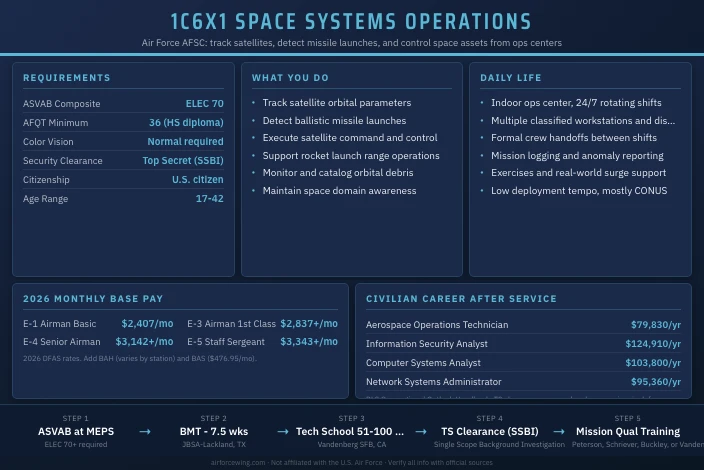
Space Systems Operations specialists operate ground-based systems that detect, track, and control military satellites and monitor for ballistic missile launches. They manage satellite orbital parameters, execute command and control for space assets, support rocket launch operations, and assess space system effectiveness across all mission phases from launch through end-of-life disposal.
What You Do Every Day
The work is console-based and mission-continuous. An ops center running missile warning or satellite command and control does not shut down, so you work rotating shifts. Your day-to-day work includes:
- Monitoring radar and optical sensors that track satellite orbital paths
- Detecting and identifying ballistic missile launches using ground and space-based sensors
- Executing satellite command and control sequences during critical operational windows
- Supporting range safety and coordination during rocket launches
- Logging system anomalies and escalating to mission controllers
- Maintaining situational awareness of the space environment, including orbital debris
Specializations Within 1C6X1
The 1C6X1 career field covers several mission areas. Specific assignments depend on the unit’s mission and available billets rather than a formal shredout system at entry.
| Mission Area | Description |
|---|---|
| Missile Warning | Detect and characterize ballistic missile launches using dedicated sensor networks |
| Satellite Command and Control | Operate and manage military satellites through command uplinks and telemetry |
| Space Surveillance | Track and catalog objects in Earth orbit using optical and radar sensor networks |
| Launch Support | Provide range operations and safety monitoring during rocket launches |
Mission Contribution
Satellite command and control is a force multiplier mission. Without the Airmen operating these systems, GPS becomes unreliable, communications satellites drift, and missile warning goes silent. Space Systems Operations specialists provide the persistent ground-side human element that keeps space-based capabilities available to every combatant command. The work directly enables joint operations across every domain.
Technology and Equipment
The equipment is purpose-built for space domain awareness. You will work with dedicated command and control workstations, classified communication networks, and sensor processing software tied to space surveillance networks. Some assignments use systems that track hundreds of objects simultaneously. The technology changes as older systems are modernized, and the Space Force is actively fielding new ground architectures, so the learning curve does not flatten after Tech School.
Salary
Space Systems Operations is a competitive specialty with a demanding security clearance requirement. Pay follows the standard DFAS military pay scale, with additional allowances on top of base pay.
Base Pay Table
| Rank | Grade | Monthly Base Pay (entry) |
|---|---|---|
| Airman Basic | E-1 | $2,407 |
| Airman | E-2 | $2,698 |
| Airman First Class | E-3 | $2,837 |
| Senior Airman | E-4 | $3,142 |
| Staff Sergeant | E-5 | $3,343 |
| Technical Sergeant | E-6 | $3,401 |
Pay figures are 2026 DFAS rates, reflecting the 3.8% raise effective January 1, 2026.
Allowances and Additional Pay
Base pay is only part of your total compensation. Most Airmen living off-base also receive Basic Allowance for Housing (BAH), which varies by duty station and dependency status. A single E-4 at Peterson Space Force Base, Colorado, for example, draws significantly more BAH than the JBSA baseline figures. BAS (Basic Allowance for Subsistence) adds $476.95 per month for all enlisted Airmen regardless of location.
Specialty pay and reenlistment bonuses are available but vary by fiscal year and career field needs. Contact a recruiter for current bonus figures, as the Air Force adjusts these based on retention data. Space-related specialties have seen periodic critical skills bonuses tied to the Space Force’s expansion.
Benefits Package
- Healthcare: TRICARE Prime at no cost, zero enrollment fees, zero deductibles, zero copays for active-duty Airmen
- Housing: Government quarters on base or BAH for off-base housing
- Education: Tuition Assistance covers up to $4,500 per year while serving; Post-9/11 GI Bill covers full in-state tuition after separation
- Retirement: Blended Retirement System (BRS), 20-year pension at 40% of high-36 average base pay, plus TSP matching up to 5% of basic pay
- Leave: 30 days paid vacation per year
Work-Life Balance
Ops center work runs on rotating shifts, which means some weeks you work nights or weekends. That trade-off comes with consistent schedule predictability: you know your shift weeks in advance, and the duty hours are typically 8-12 hours with clear handoffs. When you are off, you are off. This is not a field where Airmen routinely get called back mid-leave for short-notice taskings, though surge periods during exercises or real-world events can compress time off temporarily.
Qualifications
The qualification bar for 1C6X1 is set high. The ASVAB requirement is above average for enlisted AFSCs, and the security clearance requirement means your background gets scrutinized before you ever sit behind a console.
Qualification Table
| Requirement | Minimum Standard |
|---|---|
| ASVAB Composite | ELEC 70 |
| AFQT Score | 36 (with HS diploma) |
| Citizenship | U.S. citizen |
| Age | 17-42 at enlistment |
| Color Vision | Normal required |
| Security Clearance | Top Secret (SSBI) |
| Physical Profile | PULHES, no significant restrictions |
Requirements verified via airforce.com and military.com ASVAB and Air Force Jobs.
The ELEC composite includes General Science, Arithmetic Reasoning, Mathematics Knowledge, and Electronics Information subtests. An ELEC score of 70 is competitive, plan your ASVAB study accordingly and prioritize math and electronics prep.
Application Process
The path to 1C6X1 runs through your Air Force recruiter and a Military Entrance Processing Station (MEPS). Steps in order:
Selection and Competitiveness
The ELEC 70 requirement eliminates a significant portion of applicants, and the Top Secret clearance requirement adds a further filter. Applicants with strong math backgrounds, clean financial histories, and no foreign entanglements tend to move through the clearance process faster. Prior exposure to electronics, astronomy, or computer systems is not required but can help during Tech School. There is no physical fitness pre-screening beyond standard MEPS requirements for this AFSC.
Service Obligation
Standard enlisted contract is four years of active-duty service. The Air Force invests heavily in training and clearance adjudication for 1C6X1, so expect a standard active-duty obligation. Reserve and Air National Guard options exist and are covered below.
New accessions enter service at E-1 (Airman Basic).
See our ASVAB study guide for strategies to hit these line scores, or take the PiCAT from home if you are a first-time tester.
Work Environment
1C6X1 Airmen work indoors, almost exclusively. The ops center environment is climate-controlled, computer-intensive, and 24/7 operational. Expect fluorescent lighting, multiple monitors, classified networks, and a shift schedule that rotates across days, evenings, and nights.
Setting and Schedule
Most duty assignments place you in a dedicated space operations center or missile warning facility. These facilities operate around the clock, so the unit’s manning is structured around rotating shifts. Common schedules include 12-hour shifts with a Panama schedule (alternating 2-day and 3-day blocks) or traditional 8-hour shift rotations. The specific schedule depends on unit manning and mission tempo.
Physical demands are low by Air Force standards. You sit at a workstation for the majority of your shift, manage sensor data, and communicate with other operators and mission controllers. The mental load, however, is high. You are responsible for tracking real assets with real operational consequences, and anomalies require fast, accurate responses.
Team Dynamics
Ops center work is inherently team-based. You operate as part of a crew with a designated crew commander or senior controller. Decisions are shared and documented, and the handoff between shifts is a formal process with accountability built in. Individual operators carry specific console responsibilities, but nothing gets executed in isolation.
Airmen who thrive in this environment tend to have high attention to detail, comfort with repetitive vigilance tasks, and the ability to stay sharp during long quiet periods when activity suddenly spikes.
Job Satisfaction
Retention rates in 1C6X1 tend to run higher than many other enlisted AFSCs. The combination of a meaningful mission, consistent schedule, indoor environment, and strong post-service job prospects keeps many Airmen through a first reenlistment. The clearance also creates a financial incentive to stay, the longer you hold it, the more it’s worth on the civilian market.
Training
Training Pipeline
| Phase | Location | Duration | Focus |
|---|---|---|---|
| Basic Military Training (BMT) | JBSA-Lackland, TX | 7.5 weeks | Military foundations, fitness, discipline |
| Technical School | Vandenberg Space Force Base, CA | 51-100 days | Space surveillance, missile warning, satellite C2 |
| Mission Qualification Training | First duty station | Varies | System-specific and mission-specific certification |
After Tech School at Vandenberg Space Force Base, you complete unit-level qualification training at your first assignment before standing your first solo watch. The time from Tech School graduation to fully qualified console operator varies by mission area and unit, typically several additional weeks to a few months.
Tech School at Vandenberg
Technical training for 1C6X1 runs 51 to 100 days, placing it in the mid-range for Air Force technical specialties. The curriculum covers the physics of orbital mechanics, missile warning system operations, satellite command and control procedures, and space domain awareness fundamentals. Vandenberg SFB sits on the Central California coast and is one of the primary launch sites for military and commercial space missions, you will train adjacent to the very infrastructure you will later operate.
Upon Tech School completion, you earn credits toward a Community College of the Air Force (CCAF) degree in Air and Space Operations Technology.
Advanced Training and Development
Experienced 1C6X1 Airmen can pursue additional mission qualifications, crew commander positions, and assignments to joint commands or national-level agencies. The Space Force’s accelerating modernization effort means that new ground system platforms are being introduced regularly, creating ongoing technical training opportunities. Cross-training into cyber operations or other space-adjacent fields is possible after completing a first enlistment.
Everything starts with qualifying ASVAB scores, our study guide covers what to study first.
Career Progression
Rank Progression
| Rank | Grade | Typical Milestone | Time in Service |
|---|---|---|---|
| Airman Basic | E-1 | BMT entry | 0 |
| Airman | E-2 | Auto promotion | 6 months |
| Airman First Class | E-3 | Auto promotion | 16 months |
| Senior Airman | E-4 | Below-the-zone or time-in-grade | ~3 years |
| Staff Sergeant | E-5 | Enlisted Promotions Board | ~4-6 years |
| Technical Sergeant | E-6 | Board + record | ~8-10 years |
| Master Sergeant | E-7 | Board + record | ~12+ years |
Promotion to E-4 can come early through a Below-the-Zone (BTZ) board, which selects outstanding Airmen 6 months ahead of schedule. Promotions to E-5 and above require competitive board scores that factor in EPR ratings, professional military education (PME), and duty performance.
Specialization and Growth
There is no formal shredout system within 1C6X1 at accession. Mission specialization happens through unit assignment and subsequent mission qualification training. Career Airmen in this field accumulate expertise in one or more mission areas, missile warning, satellite C2, space surveillance, or launch operations, which makes them competitive for instructor positions, staff billets, and leadership roles in space operations units.
The Space Force transfer pathway represents a significant career branch point. Airmen who transfer become Guardians and serve in a separate chain of command while doing largely parallel work to their Air Force counterparts.
Performance Evaluation
The Air Force Enlisted Performance Report (EPR) system rates Airmen on a 5-tier scale. Your EPR is the primary driver of promotion competitiveness above E-4. Ops center work is quantifiable, mission completion rates, qualification achievements, and supervisory endorsements translate directly into EPR bullet points. Airmen who volunteer for additional duties, pursue CCAF coursework, and complete PME early tend to outperform peers on promotion boards.
Physical Demands
Daily Physical Requirements
Day-to-day physical demand is low. Console work is sedentary. You carry equipment during occasional exercises or deployments, but the regular duty day does not involve heavy lifting, extended standing, or outdoor exposure. The 40-pound strength requirement listed in official sources reflects the occasional need to move equipment rather than a sustained physical labor component.
The Air Force Fitness Assessment (FA) applies to all Airmen regardless of AFSC.
Air Force Fitness Assessment Standards (Under 25, 2026)
| Component | Male Minimum | Female Minimum | Max Points |
|---|---|---|---|
| 1.5-Mile Run | 9:12 (satisfactory) | 10:47 (satisfactory) | 60 |
| Push-Ups (1 min) | 42 reps (satisfactory) | 18 reps (satisfactory) | 10 |
| Sit-Ups (1 min) | 42 reps (satisfactory) | 32 reps (satisfactory) | 10 |
| Waist Circumference | 35 inches or less | 31.5 inches or less | 20 |
| Composite Passing Score | 75 out of 100 | 75 out of 100 | 100 |
Standards are age- and gender-normed. Verify current standards with af.mil before your assessment.
Medical Standards
Standard MEPS medical screening applies at accession. Normal color vision is required and tested at MEPS. After entering service, you receive periodic preventive care through TRICARE. No AFSC-specific medical waiver issues are commonly associated with 1C6X1 beyond the color vision requirement.
Deployment
Where You Can Serve
Space Systems Operations billets are concentrated at installations with dedicated space operations infrastructure. Major duty stations include:
- Peterson Space Force Base, CO: headquarters of Space Operations Command
- Vandenberg Space Force Base, CA: primary launch and training site
- Buckley Space Force Base, CO: missile warning and space surveillance missions
- Schriever Space Force Base, CO: satellite operations and GPS control
- Cavalier Space Force Station, ND: space surveillance radar operations
- Kaena Point, HI: satellite tracking station
Most duty locations are CONUS-based, which is a practical quality-of-life advantage compared to AFSCs with heavy overseas rotation. Some assignments involve overseas or remote detachments tied to global sensor networks.
Deployment Tempo
Deployment tempo for 1C6X1 is lower than most combat-support AFSCs. Space operations are primarily conducted from fixed facilities, and the mission does not require forward-deployed personnel in the same way that logistics, security forces, or maintenance AFSCs do. Short-duration deployments to austere locations do occur, particularly for sensor maintenance support or joint exercise participation, but they are the exception rather than the rule.
Assignment Process
Assignments are managed through the Air Force Personnel Center (AFPC). Preferences are submitted through the Assignment Management System, and AFPC balances individual requests against mission requirements. Colorado Springs, home to Peterson, Buckley, and Schriever, accounts for a large share of 1C6X1 billets, making it one of the more likely first-assignment locations.
Risk/Safety
Job Hazards
Ops center work carries minimal physical hazard. The primary occupational health considerations are associated with shift work: disrupted sleep cycles, irregular meal timing, and the sustained attention demands of console operations. These are manageable with deliberate sleep hygiene and unit wellness programs.
Some duty locations involve access to controlled areas with classified equipment and materials. Standard facility safety protocols govern movement and equipment handling in those environments.
Security Clearance Requirements
The Top Secret clearance is the most significant legal and administrative commitment in this career field. The Single Scope Background Investigation (SSBI) covers your entire background: finances, foreign contacts, prior drug use, and criminal history. Intentional omissions or misrepresentations on the SF-86 security questionnaire carry serious legal consequences.
Maintaining the clearance requires ongoing compliance with security reporting requirements. You must report foreign travel, foreign contacts, financial changes, and any circumstances that could affect your adjudicative status. Periodic Reinvestigation (PR) cycles keep the clearance current throughout your career.
The clearance investigation begins before you ship to BMT. Answer all SF-86 questions completely and honestly. Omissions discovered later carry more weight than disclosed issues that were already part of your history.
Legal Obligations
Standard enlistment contract terms apply. Specific obligations tied to the clearance investment may include service commitments linked to specialty training costs. Your recruiter will explain any additional service requirements at the time of contracting.
Impact on Family
Stability and Quality of Life
The duty station concentration in Colorado Springs and California’s Central Coast makes long-term housing planning more predictable than most AFSCs. These are stable, established military communities with good schools, support services, and infrastructure built around the military population. The shift schedule is predictable enough to plan family life around, though nights and weekends in the rotation require household coordination.
Permanent Change of Station (PCS) moves typically occur every 2-4 years. The concentration of 1C6X1 billets in the Colorado Springs area means that back-to-back assignments in the same region are not unusual, which significantly reduces the family disruption associated with frequent moves.
The shift schedule itself is worth preparing families for. On a Panama schedule (common in ops centers), you alternate between 2-day and 3-day work blocks, which means some weekends are workdays and some weekdays are off. That’s different from a standard Monday-Friday household rhythm, and it takes deliberate coordination to manage childcare, school pickups, and shared household responsibilities. Families who establish routines based on the posted schedule, rather than expecting a 9-to-5 pattern, tend to adapt well.
Shift Work and Family Coordination
Families new to ops center career fields are sometimes caught off guard by how shift work affects daily life. When one parent works nights or evenings, coordination over meals, childcare, and sleep becomes an active planning task. Online tools and apps for shared scheduling help. Military Family Life Counselors (MFLCs), available at no cost through the installation, are useful early-on for families adjusting to the rhythm.
Colorado Springs Community
Colorado Springs has a large, well-established military population because of the four Space Force installations in the area. The school districts near Peterson and Schriever are experienced with military families and offer school liaison officer support to help students transition between districts. The civilian job market includes a significant concentration of aerospace and defense employers, which is relevant for military spouses looking for employment options that can survive a PCS.
Family Support
Military installations provide the full support infrastructure: Military Family Support Centers, Military OneSource counseling, school liaison officers, and access to on-base childcare. Spouses of 1C6X1 Airmen stationed at Peterson or Schriever can access the Colorado Springs economy, which has a substantial civilian defense and technology sector.
The low deployment tempo is a meaningful quality-of-life factor. Families can plan around a home-station schedule in a way that is harder with high-deployment-tempo AFSCs.
Reserve and Air National Guard
Component Availability
1C6X1 is available in both the Air Force Reserve and the Air National Guard. The ANG has been particularly active in space operations as states with significant aerospace industry presence have stood up space-focused units. Reserve and ANG billets in this career field are concentrated at or near active-duty space operations installations.
Air Force Reservists interested in transferring to the Space Force Reserve component should contact their unit commander. Application windows have been opening as Space Force policies and processes mature.
Drill Schedule and Commitment
Standard Reserve/ANG commitment is one Unit Training Assembly (UTA) weekend per month plus a two-week Annual Tour (AT). Space operations units may require additional training days for mission certification maintenance and equipment recurrency. The mission qualification requirements do not disappear in a part-time component, you must stay current on console procedures.
Part-Time Pay Comparison
An E-4 Senior Airman earns $3,142/month on active duty. The same E-4 drilling one weekend per month earns approximately four days’ base pay for the UTA weekend, roughly $416 per drill weekend based on daily pay rate calculations. Annual Tour pay adds another two weeks of base pay.
Component Comparison
| Feature | Active Duty | Air Force Reserve | Air National Guard |
|---|---|---|---|
| Monthly commitment | Full time | 1 weekend/mo + 2 wks/yr | 1 weekend/mo + 2 wks/yr |
| Monthly base pay (E-4) | $3,142 | ~$416/drill weekend | ~$416/drill weekend |
| Healthcare | TRICARE Prime (free) | TRICARE Reserve Select (premiums) | TRICARE Reserve Select (premiums) |
| Education benefits | Active TA + full GI Bill | Reserve TA + partial GI Bill | State tuition waivers (varies) + GI Bill |
| Deployment tempo | Low | Low to moderate (when mobilized) | Low to moderate (when mobilized) |
| Retirement | BRS 20-year pension + TSP | Points-based (at age 60) | Points-based (at age 60) |
Civilian Career Integration
Space operations experience pairs extremely well with the defense and commercial space sectors, which are heavily concentrated in the same regions as the active-duty installations. Part-time Guard and Reserve service in 1C6X1 can run simultaneously with a civilian career at a defense contractor, national lab, or space company in the Colorado Springs or Santa Barbara/Vandenberg area without conflict of interest issues in most cases. USERRA protections apply to drilling reservists.
Post-Service
Civilian Career Transition
The Top Secret clearance and space domain expertise built in 1C6X1 translate directly into a civilian job market that is actively short on qualified candidates. Defense contractors, national agencies, and commercial space companies all need people who have operated space surveillance and satellite control systems. The clearance alone commands a meaningful salary premium compared to uncleared peers.
Federal government positions through USAJobs are a common transition path. Space operations veterans frequently qualify for GS-7 through GS-11 positions depending on time in service and education level.
Civilian Career Prospects
| Civilian Career | Median Annual Salary | Job Outlook |
|---|---|---|
| Aerospace Engineering and Operations Technician | $79,830 | +8% (2024-2034) |
| Information Security Analyst | $124,910 | +33% (2023-2033) |
| Network and Computer Systems Administrator | $95,360 | +6% (2023-2033) |
| Computer Systems Analyst | $103,800 | +11% (2023-2033) |
Aerospace technician median wage from the BLS Occupational Outlook Handbook (May 2024 data). IT occupation figures from BLS OOH.
Education and Certifications
The CCAF degree in Air and Space Operations Technology provides a foundation for continued education. Veterans frequently pursue bachelor’s degrees in aerospace operations, systems engineering, or computer science. Security certifications. CompTIA Security+, CISSP, complement the clearance background for roles in cyber-adjacent space operations. The clearance makes both government and contractor roles accessible immediately after separation without the waiting period that uncleared applicants face.
Transition Programs
The Transition Assistance Program (TAP) begins 12-18 months before your end of active service date (EAS). SkillBridge internships during your final 180 days allow you to gain civilian work experience with government or contractor organizations while still drawing military pay. Many space operations veterans use SkillBridge placements at defense contractors in the Colorado Springs area.
Is This a Good Job
Who Thrives in 1C6X1
This AFSC rewards a specific combination of traits. You need to be comfortable with sustained vigilance, long periods of routine monitoring punctuated by moments that require fast, accurate decisions. Strong candidates typically share these characteristics:
- High math and electronics aptitude (the ELEC 70 bar is a natural filter)
- Comfort with shift work and rotating schedules
- Detail-oriented and methodical in documentation
- Calm under pressure without needing constant physical activity
- Interested in space, orbital mechanics, or aerospace technology
- Clean financial and legal history (a clearance reality, not a preference)
Potential Challenges
Shift work is the most common adjustment difficulty. Working nights and rotating through different shift patterns disrupts sleep, social rhythms, and family schedules. Airmen who struggle with irregular sleep schedules tend to find this harder than anticipated. The work environment is also geographically constrained, if you want diverse duty station options across the globe, the concentration of 1C6X1 billets in Colorado and California limits that variety.
The clearance process can be stressful for applicants who have financial history complications, foreign contacts, or prior drug use. These issues can be mitigated with honesty and documentation, but they require proactive handling.
Career and Lifestyle Alignment
If you want a military career that flows directly into a high-paying civilian technology career, 1C6X1 is one of the most direct paths available from the enlisted ranks. The clearance and space operations background are genuinely rare combinations that large employers compete for. If you want a physically active, combat-adjacent, or geographically varied career, this is not the right fit. But if mission depth, technical mastery, and long-term career payoff matter more than diversity of location or duty, this field delivers.
More Information
Talk to an Air Force recruiter about 1C6X1 availability and current bonus offers. Bring your practice ASVAB scores and ask specifically about open training seats, 1C6X1 class sizes are smaller than many other AFSCs and seats fill quickly.
When you contact a recruiter, come prepared with specific questions. Ask about the current ELEC composite cutoff in practice (not just the published minimum of 70), whether any Space Force transfer incentives apply to new enlistees, and whether a Schriever or Vandenberg first assignment is possible. Recruiters familiar with the space operations career field will have current information on bonus availability and training class schedules that general recruiters may not.
The clearance process is the longest variable in your timeline. The SF-86 form covers the past 10 years of your life, addresses, employers, foreign contacts, finances, and criminal history. Get ahead of it by pulling your credit report and identifying any issues before you sit down with a recruiter. Disclosed problems that are honestly reported and documented are almost always less damaging than omissions discovered later. The Single Scope Background Investigation (SSBI) for a Top Secret can take 6 to 12 months, and in some cases longer. Starting the process early, before you even ship to BMT, is the best way to avoid delays between Tech School graduation and your first operational assignment.
If you are still preparing for the ASVAB, focus your study time on the subtests that feed the ELEC composite: Electronics Information, Arithmetic Reasoning, Mathematics Knowledge, and General Science. An Air Force recruiter can confirm the current composite formula and benchmark your practice scores against the competitive range for 1C6X1 training seats.
- Prepare for the ASVAB with our study guide to make sure your line scores qualify
This site is not affiliated with the U.S. Air Force or any government agency. Verify all information with official Air Force sources before making enlistment or career decisions.
Explore more Air Force space careers to understand the full scope of the space operations career group.