7S0X1 Special Investigations
The Air Force Office of Special Investigations doesn’t post guards at gates. AFOSI runs criminal investigations, hunts foreign intelligence threats, and works fraud cases that touch every level of the Air Force. The enlisted Airmen who become special agents get federal law enforcement credentials, a Top Secret clearance, and training alongside other federal agents at the same facility where the FBI, DEA, and Secret Service send their recruits.
This is not an entry-level job. You cannot enlist directly into 7S0X1. AFOSI only takes Airmen who have already served in another career field, earned a proven performance record, and can pass one of the most thorough background investigations the military conducts. If you get selected, you trade your current AFSC for a plainclothes investigative role that looks nothing like a conventional military assignment.
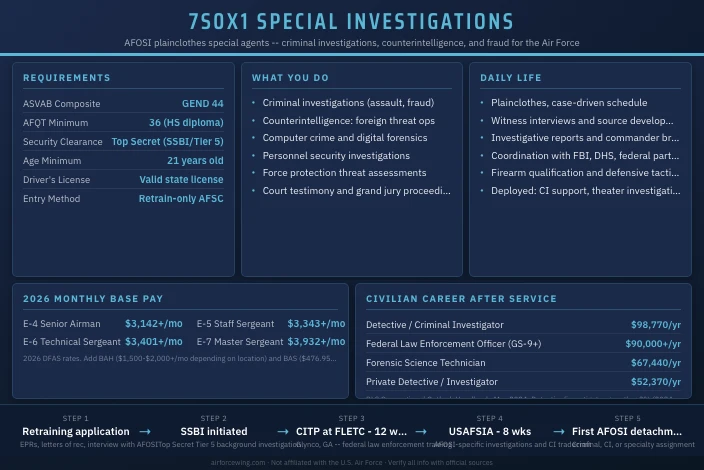
Job Role and Responsibilities
AFOSI special agents (7S0X1) conduct criminal, counterintelligence, and fraud investigations on behalf of the U.S. Air Force and Space Force. They identify and neutralize foreign intelligence threats, investigate crimes ranging from violent offenses to computer intrusions, support force protection programs, and brief senior commanders on investigative findings. Agents operate in plainclothes and work cases that span bases, jurisdictions, and sometimes international boundaries.
Day-to-Day Duties
An AFOSI agent’s day is rarely the same twice. On a given week, an agent might open a new fraud case in the morning, conduct a witness interview that afternoon, and write a threat assessment brief for a wing commander the next day. Counterintelligence work involves identifying personnel who may have been approached or compromised by foreign intelligence services, a mission that requires careful source development, analytical thinking, and coordination with other federal agencies.
Criminal investigations cover the full range of felony offenses: sexual assault, homicide, robbery, drug trafficking, and financial crimes. Computer crime investigations have become a growing part of the workload as cyber threats targeting Air Force systems and personnel increase. Agents also conduct personnel security investigations, which determine whether individuals should retain access to classified information.
Force protection is another core mission. AFOSI agents identify and assess threats to Air Force installations from terrorism, sabotage, and insider threats. They work closely with local law enforcement and federal partners to develop threat pictures for installation commanders. When AFOSI agents testify, it’s typically in military courts-martial or federal grand jury proceedings, not traffic court.
Specialized Roles
| Code | Skill Level | Title |
|---|---|---|
| 7S031 | Journeyman | Special Investigator (entry, post-FLETC/USAFSIA) |
| 7S071 | Craftsman | Special Investigator (supervisory/senior agent) |
| 7S091 | Superintendent | Special Investigator (management/SAIC) |
Beyond the standard skill levels, AFOSI agents can pursue specialized assignments in counterintelligence, computer crimes, economic crime (fraud), technical services (surveillance and polygraph), and the Anti-Terrorism Specialty Team (AST). AST agents receive additional training for high-risk threat response and work the most operationally intense cases AFOSI handles. Polygraph examiners complete additional training through the Defense Intelligence Agency’s credentialing program.
Mission Contribution
AFOSI is the Air Force’s primary criminal investigative and counterintelligence organization. Its agents protect billions in Air Force contracts from fraud, identify foreign operatives targeting Air Force personnel and systems, and support prosecution of crimes that undermine good order and discipline. Every Air Force installation is covered by an AFOSI detachment. When a commander needs an investigation that goes beyond what Security Forces can handle, or when the case involves classified programs, foreign threats, or high-profile personnel, AFOSI takes it.
Technology and Equipment
AFOSI agents work with law enforcement databases, forensic tools, and classified systems for threat analysis. Computer crime investigators use digital forensics platforms to recover evidence from electronic devices. Technical services personnel operate surveillance equipment and conduct polygraph examinations. Agents carry firearms and must qualify periodically, but the job is investigation-first, the weapon is there when needed, not the center of the work.
Salary and Benefits
Since 7S0X1 is a retrain-only AFSC, you’ll enter with the rank and base pay you already hold. A Staff Sergeant (E-5) retraining into AFOSI earns the same base pay as any other E-5, the AFSC change doesn’t reset your grade or time in service. If you haven’t enlisted yet and AFOSI is your long-term goal, a study guide targeting the General composite helps you hit the ASVAB scores that qualify for the feeder AFSCs that lead here.
2026 Base Pay: Typical AFOSI Agent Career Ranks
| Rank | Grade | Monthly Base Pay |
|---|---|---|
| Senior Airman | E-4 | $3,142 - $3,816 |
| Staff Sergeant | E-5 | $3,343 - $4,422 |
| Technical Sergeant | E-6 | $3,401 - $5,044 |
| Master Sergeant | E-7 | $3,932 - $5,537 |
| Senior Master Sergeant | E-8 | $5,867 - $7,042 |
| Chief Master Sergeant | E-9 | $7,182 - $8,248 |
Ranges reflect years of service from entry to 20+ years per DFAS 2026 military pay tables. Most Airmen enter 7S0X1 as E-4 or E-5, so the realistic starting point is mid-table.
All Airmen receive Basic Allowance for Subsistence (BAS) of $476.95/month. Agents living off-base receive Basic Allowance for Housing (BAH) based on duty location and dependency status. A single E-5 at a metropolitan AFOSI detachment can expect BAH in the range of $1,500 to $2,000+ monthly depending on the city.
Special Pay
AFOSI agents may qualify for Hazardous Duty Incentive Pay when assigned to duties involving physical hazard, and Law Enforcement Availability Pay (LEAP) is authorized for federal law enforcement officers under specific conditions. Verify current special pay eligibility with your AFOSI detachment or finance office.
Additional Benefits
Active-duty Airmen receive full TRICARE Prime healthcare at no cost, covering medical, mental health, prescriptions, dental, and vision. The Air Force contributes up to $4,500 per year in Tuition Assistance toward college courses you can take while on active duty. After six years of service, you can transfer Post-9/11 GI Bill benefits to dependents (requires a four-year service commitment).
Retirement
The Blended Retirement System (BRS) combines a 20-year pension worth 40% of your high-36 average basic pay with a government-matched Thrift Savings Plan (TSP). The government automatically contributes 1% of your basic pay to TSP and matches up to an additional 4% when you contribute.
Work-Life Balance
AFOSI agents work irregular hours. Active cases don’t stop at 1700 on a Friday, and agents on-call respond when needed. Most detachments operate on a flex schedule rather than standard military shift work. The tempo varies significantly by detachment location, a busy installation in a high-crime metro area runs differently than a small overseas detachment. Annual leave accrues at 2.5 days per month (30 days per year), but case workload can affect when you actually take it.
Qualifications and Eligibility
7S0X1 is a retrain-only AFSC. You cannot enlist directly into this career field. Before submitting a retraining package, confirm you meet all time-in-service and performance requirements with your current unit’s career development section.
Since qualifying for 7S0X1 requires prior service, reviewing your ASVAB scores now is smart, a strong General composite leaves you well-positioned. An ASVAB prep course can help you build those scores before your retraining window opens. Airmen who haven’t yet enlisted but are interested in the AFOSI path can take the PiCat pre-screening test before MEPS to lock in a qualifying score early.
Requirements Table
| Requirement | Minimum Standard |
|---|---|
| ASVAB Composite | GEND 44 (General) |
| Minimum AFQT | 36 |
| Security Clearance | Top Secret (SSBI/Tier 5) |
| Citizenship | U.S. citizen by birth or naturalization |
| Age | 21 or older at time of application |
| Driver’s License | Valid state-issued license |
| Physical Lifting | 40 lbs |
| Firearm Qualification | Must qualify per AFI 31-207 |
| Color Vision | No disqualifying defects |
The GEND 44 composite is confirmed on the Air Force ASVAB and jobs reference and cross-referenced against AFOSI enlisted eligibility documentation and AFI 36-2101.
Rank and Time-in-Service Eligibility
| Rank | Time-in-Service Limit |
|---|---|
| Senior Airman (E-4) or SrA-Select | Fewer than 6 years TIS |
| Staff Sergeant (E-5) | Fewer than 11 years TIS |
| Technical Sergeant (E-6) | Case-by-case basis |
Applicants must be within their retraining window and have no pending adverse actions, open criminal investigations, or significant financial issues that would jeopardize a Top Secret clearance. An outstanding performance record, documented through Enlisted Performance Reports (EPRs), is essential. AFOSI looks at the full record, not just the minimum box checks.
Application Process
The AFOSI retraining process takes two to five months from initial application to selection. The steps are not the same as a standard retraining request. AFOSI conducts its own screening process.
Selection Criteria
AFOSI is selective. Beyond meeting the minimums, the strongest applicants bring analytical writing skills, demonstrated judgment under pressure, foreign language proficiency (particularly useful for counterintelligence assignments), accounting or finance background (useful for economic crime cases), and clean financial histories. Prior Security Forces experience is helpful but not required. AFOSI draws from across the Air Force.
Work Environment
AFOSI agents work in a plainclothes environment. No uniform, no patrol vehicle, no shift rotation in the traditional sense. Most work from an AFOSI detachment office located on or near an Air Force installation, but cases take agents off-base constantly, to local police departments, courts, interview locations, and crime scenes.
The schedule is case-driven. A quiet week might mean administrative work, training, and liaison meetings with other agencies. A complex case can mean 60-hour weeks, late-night interviews, and coordination with federal prosecutors. Most agents develop a strong preference for this kind of flexibility over the predictable shift structure of other career fields, but it requires genuine self-discipline to manage.
| Work Setting | Schedule | Typical Activities |
|---|---|---|
| Detachment office (on-base) | Standard duty hours, case-dependent | Case file management, report writing, source coordination |
| Field (off-base) | Variable, driven by investigative needs | Interviews, surveillance, crime scene processing |
| Federal court / military tribunal | Scheduled, periodic | Testimony, grand jury proceedings, case preparation with prosecutors |
| Interagency partner offices | Coordinated, TDY-based | Joint task force meetings, cross-jurisdictional case work |
Leadership and Communication
AFOSI operates through a regional structure with detachments reporting to geographic regions. Within a detachment, agents work under a Special Agent in Charge (SAIC) and typically partner with one or more other agents on cases. The chain of command is flatter than most Air Force units, junior agents carry significant responsibility for their own cases from early on.
Performance feedback comes through EPRs, but also through the quality of the work product: investigative reports, briefings to commanders, and court outcomes. Senior leadership tracks case closure rates, prosecution referrals, and the quality of commander intelligence briefings.
Team Dynamics
AFOSI agent work is individual in execution but collaborative in context. You’ll work your own cases and develop your own sources, but major cases involve multi-agent teams. AFOSI also operates alongside other federal agencies. FBI, DHS, NCIS, DCIS, and those partnerships are a regular part of the job at most detachments.
Job Satisfaction
The selection process filters for Airmen who want investigative work specifically. Retention within AFOSI tends to be strong because agents who complete training and reach full operational status generally find the mission meaningful and the autonomy satisfying. The work is intellectually demanding in a way that patrol work isn’t, and the federal law enforcement credentials carry real value after service.
Training and Skill Development
Training for 7S0X1 begins after selection and unfolds in two phases at the same location in Georgia. This is distinct from standard Tech School, no BMT repeat, no basic airmanship coursework. You go straight to federal law enforcement training.
Training Pipeline
| Phase | Location | Duration | Focus |
|---|---|---|---|
| Criminal Investigator Training Program (CITP) | FLETC, Glynco, GA | 12 weeks | Federal law enforcement fundamentals |
| AFOSI Special Investigators Course | USAFSIA (co-located at FLETC) | 8 weeks | Air Force-specific investigations, CI, military law |
| Total | 20 weeks |
FLETC’s Criminal Investigator Training Program is the same course attended by new agents from the FBI, DEA, ATF, Secret Service, and dozens of other federal agencies. That shared training environment is a significant feature of this career field, you build contacts across federal law enforcement from day one.
The AFOSI Special Investigations Academy course follows immediately. This 8-week program covers Air Force-specific legal authorities, the Uniform Code of Military Justice as it applies to criminal investigations, counterintelligence tradecraft, economic crime investigation methods, military forensics procedures, and the AFOSI case management system.
Advanced Training
After reaching the first duty station, agents can pursue specialty training in specific mission areas:
- Computer Crime Investigations: digital forensics tools and evidence recovery
- Polygraph Examiner Certification: DIA-credentialed program, competitive selection
- Counterintelligence Special Agent: advanced CI tradecraft and operations
- Anti-Terrorism Specialty Team (AST): physical security and high-threat investigations
- Economic Crime: government fraud, procurement fraud, and financial investigations
The Air Force also supports degree completion through Tuition Assistance. AFOSI work directly supports graduate study in law, criminal justice, cybersecurity, and public administration. If your General composite needs improvement before the retraining package goes in, an ASVAB study guide is the fastest way to identify and close score gaps.
Career Progression and Advancement
Because 7S0X1 is a retrain AFSC, career progression follows two tracks: AFOSI-specific skill level advancement and the Air Force enlisted promotion system. Both move in parallel.
Rank Progression
| Rank | Grade | Typical Time at Grade | Notes |
|---|---|---|---|
| Senior Airman | E-4 | Up to ~4 years TIS | Entry point for youngest applicants |
| Staff Sergeant | E-5 | ~4-6 years TIS | Most common entry rank; SSgt to 7S031 typical path |
| Technical Sergeant | E-6 | ~10-12 years TIS | Senior agent; case lead responsibilities |
| Master Sergeant | E-7 | ~14-16 years TIS | Field leader; supervisory agent roles begin |
| Senior Master Sergeant | E-8 | ~18-20 years TIS | Detachment leadership |
| Chief Master Sergeant | E-9 | 20+ years TIS | Regional/command-level leadership |
Time-at-grade figures are approximate and reflect Air Force-wide promotion timing; AFOSI does not have separate promotion authority.
Specialization and Growth
Agents who demonstrate strong performance in their first assignment typically receive their specialty assignment preference, counterintelligence, computer crimes, or economic crime. The most experienced agents with counterintelligence or technical services backgrounds can transition into classified programs that aren’t publicly listed.
Around the Master Sergeant level, the career path branches clearly into field leadership (Special Agent in Charge of a detachment) or staff positions at AFOSI headquarters and regional commands. Senior agents frequently hold supervisory positions over mixed teams of enlisted agents and civilian investigators.
Role Flexibility
Transferring out of 7S0X1 is possible but rare. Most agents who complete training stay in AFOSI through retirement because the civilian career opportunities are strong and the mission remains engaging. Agents who do separate early typically transition directly into federal law enforcement positions where the 7S0X1 credential carries significant weight.
Performance Evaluation
Performance in AFOSI is documented through the standard Air Force EPR system, but AFOSI leadership also evaluates agents on investigation quality, commander engagement, and teamwork. A strong EPR in AFOSI is built on case outcomes, the depth and accuracy of investigative products, and demonstrated ability to handle complex, sensitive matters without supervision. Agents who stand out for counterintelligence or computer crime work tend to receive competitive EPR stratification.
Physical Demands and Medical Evaluations
7S0X1 is classified as a law enforcement position, which carries specific physical standards above and beyond the standard Air Force Fitness Assessment. Agents must be capable of performing law enforcement duties, running, defensive tactics, and firearm qualification, throughout their career.
Air Force Fitness Assessment Standards
All Airmen, including AFOSI agents, take the Air Force Fitness Assessment annually. The assessment is scored on a 100-point scale; the minimum passing composite is 75 points.
| Component | Maximum Points | Notes |
|---|---|---|
| 1.5-Mile Run | 60 | Aerobic fitness; largest scoring component |
| Push-Ups (1 min) | 10 | Muscular endurance; age/gender normed |
| Sit-Ups (1 min) | 10 | Core endurance; age/gender normed |
| Waist Circumference | 20 | Body composition component |
Standards are age- and gender-normed. Each component has a minimum passing score that must be met regardless of composite total. AFOSI also requires agents to qualify regularly with their assigned firearm per AFI 31-207, a separate requirement from the fitness assessment.
Daily Physical Demands
Day-to-day physical demands are moderate. Most AFOSI work is office and field-based investigation rather than heavy lifting or prolonged outdoor exposure. Agents occasionally respond to crime scenes in adverse conditions, participate in search operations, and conduct surveillance that may involve extended stationary periods. The 40-pound lifting requirement covers standard evidence handling and equipment transport.
Medical Standards
Applicants undergo a medical evaluation during the selection process. Conditions that would disqualify a candidate for active law enforcement duties, including significant vision, hearing, or cardiovascular issues, can affect eligibility. Once assigned, agents follow standard military periodic health assessments. Conditions that develop over the course of a career are evaluated on a case-by-case basis relative to continued law enforcement qualification.
Deployment and Duty Stations
AFOSI operates globally. The agency maintains detachments at Air Force installations across the continental United States and at overseas locations in Europe, the Pacific, and the Middle East. Assignments span large bases with busy caseloads to small overseas detachments where a two-agent team covers an entire region.
Duty Station Options
Major AFOSI installations include:
- Joint Base San Antonio, TX (AFOSI headquarters and USAFSIA)
- Joint Base Andrews, MD (National Capital Region)
- Ramstein AB, Germany (European region)
- Kadena AB, Japan (Pacific region)
- Al Udeid AB, Qatar (Southwest Asia)
AFOSI attempts to accommodate geographic preferences when possible, but assignment decisions follow the needs of the agency. Most agents rotate assignments every three to four years. Overseas tours are typically 15 to 24 months.
Deployment Details
Deployment frequency for AFOSI agents is generally lower than combat-support AFSCs, but deployments do occur, particularly to active contingency areas in the Middle East and Africa. Deployed agents support theater-level counterintelligence missions, investigate crimes involving deployed personnel, and advise base commanders on force protection threats. Deployment lengths range from 60 to 180 days. AST-qualified agents deploy more frequently and to higher-risk locations than the general AFOSI population.
Typical deployment assignments include:
- Theater counterintelligence: Identifying and neutralizing foreign intelligence threats targeting deployed forces and classified programs in the AOR
- Criminal investigation support: Investigating felonies, drug offenses, and fraud involving deployed personnel at forward operating locations
- Force protection advisory: Briefing installation commanders on local threat environments and recommending protective measures
- Interagency coordination: Working alongside NCIS, CID, and host-nation law enforcement on joint cases in theater
Risk, Safety, and Legal Considerations
Job Hazards
AFOSI agents face the risks inherent to criminal investigations and law enforcement. These include physical confrontation during arrests, exposure to dangerous individuals during interview or surveillance operations, and occasional work in conflict zones. Counterintelligence work can involve contact with foreign intelligence operatives, a risk managed through rigorous training and operational security practices.
Safety Protocols
Agents receive defensive tactics training at FLETC and maintain firearm qualification throughout their career. High-risk operations are typically planned with tactical support from Security Forces or dedicated AFOSI response teams rather than conducted by agents alone. Operational security practices govern how agents communicate, document sources, and manage sensitive case information.
Key safety measures for AFOSI agents:
- Firearms qualification: Annual re-certification on duty weapon; additional weapons training available for AST personnel
- Defensive tactics: Hand-to-hand and arrest technique training refreshed at FLETC and during annual training events
- Tactical support: High-risk arrests and searches coordinated with Security Forces Emergency Services Teams or AFOSI tactical assets
- Operational security: Strict protocols for source protection, case communications, and classified material handling
Security and Legal Requirements
The Top Secret clearance is mandatory and requires a Single Scope Background Investigation (SSBI), classified under the federal Tier 5 standard. The investigation covers personal history, financial records, foreign contacts, and character references going back at least ten years. Any significant financial problems, foreign contacts that cannot be explained, or prior criminal history will likely disqualify a candidate.
Agents must maintain their clearance for the duration of their AFOSI assignment. Adverse information discovered after the initial investigation can trigger a reinvestigation and, if serious enough, revocation of clearance and removal from AFOSI. The legal obligation is significant: agents are federal law enforcement officers with arrest authority under Title 10 and the UCMJ. Actions taken in an official capacity are subject to legal review and potential liability.
Impact on Family and Personal Life
Family Considerations
AFOSI’s irregular schedule affects family life differently than a shift-work AFSC like Security Forces. There are no scheduled night shifts, but active cases can pull an agent away at any time. Families in AFOSI commonly describe the unpredictability as the hardest adjustment, particularly when cases spike during investigative surges. The plainclothes, plainspoken nature of AFOSI work also means agents can’t always share what they’re working on, which some families find harder than a conventional deployment schedule.
Key lifestyle factors for AFOSI agent families:
| Factor | Impact | Support Available |
|---|---|---|
| Schedule unpredictability | Cases drive hours, not a shift schedule; surges can last weeks | A&FRC counseling, Military OneSource |
| Classification constraints | Agents cannot discuss active investigations at home | Key Spouse Program, cleared community social networks |
| PCS frequency | Every 3-4 years, worldwide | Dislocation Allowance, relocation assistance through A&FRC |
| Overseas tours | 15-24 months at OCONUS detachments | BAH adjusted for location; family accompaniment standard for most tours |
The Air Force’s standard family support programs apply: Military OneSource counseling, installation family readiness centers, and the Air Force Airman and Family Readiness Centers. AFOSI agents on assignment overseas have access to the same overseas family support infrastructure as other Airmen at those installations.
Families who thrive in AFOSI tend to share a few traits: comfort with uncertainty, strong independent social networks at each installation, and realistic expectations about what an agent can and cannot discuss about their work. Agents who set those expectations early, before the first high-intensity case, report better household adjustment.
Relocation
Expect a permanent change of station (PCS) every three to four years. Major AFOSI detachments are concentrated at large installations, but assignments can go to small overseas posts or regional offices with limited on-base housing options. Families relocating to high-cost-of-living areas (Northern Virginia, Hawaii, Japan) will find the BAH rate adjusted accordingly, though the gap between BAH and actual housing costs varies.
Reserve and Air National Guard
AFOSI does maintain a Reserve component presence. The AFOSI Reservist page confirms positions are available in the Air Force Reserve. Reservists in AFOSI typically perform similar investigative duties during drill periods and may be called for extended active-duty support during surge periods or contingency operations.
The Air National Guard generally does not operate AFOSI detachments in the same structure as active-duty or Reserve components. Guard members interested in criminal investigation work typically pursue the 3P0X1 Security Forces path, which includes an investigator shred (SEI 321), or transition to the Reserve component specifically for AFOSI positions.
Component Comparison
| Factor | Active Duty | Air Force Reserve | Air National Guard |
|---|---|---|---|
| Commitment | Full-time | 1 weekend/mo + 2 wks/yr (plus mobilizations) | Varies by state; primarily 3P0X1 based |
| Monthly Pay (E-4) | $3,142+/mo | ~4 drill periods/mo base pay equivalent | Varies |
| Healthcare | TRICARE Prime (no cost) | TRICARE Reserve Select (premiums apply) | State-specific + TRICARE Reserve Select |
| Education | Full TA + GI Bill eligible | Federal TA + GI Bill (proportional) | State tuition waivers + Federal TA |
| Deployment Tempo | Low-moderate | Periodic mobilization, typically 6-12 mo | Primarily state missions; federal mobilizations possible |
| Retirement | 20-yr pension (BRS) | Points-based reserve retirement at 20 qualifying years | Points-based reserve retirement |
| AFOSI Access | Full career field | Limited positions available | Generally not available in AFOSI structure |
Civilian Career Integration
Reserve agents working in civilian law enforcement or investigative positions find the two roles reinforce each other well. Federal civilian investigators who hold a Reserve AFOSI position gain both continued federal law enforcement credentials and military retirement points. USERRA protections require civilian employers to hold positions and restore seniority for Reservists called to active duty.
Post-Service Opportunities
AFOSI is one of the strongest civilian transition platforms in the enlisted force. Federal law enforcement agencies actively recruit former AFOSI agents because the training at FLETC, the clearance, and the investigative experience match federal hiring criteria directly.
Civilian Career Prospects
| Career | Median Annual Salary | Job Outlook (2024-2034) |
|---|---|---|
| Detective / Criminal Investigator | $98,770 | +3% (avg) |
| Federal Law Enforcement Officer (GS-9+) | $90,000+ | Stable |
| Private Detective / Investigator | $52,370 | +6% (faster than avg) |
| Forensic Science Technician | $67,440 | +13% (much faster than avg) |
| Intelligence Analyst (contractor/gov) | $80,000-$120,000+ | Strong demand |
Salary figures from the BLS Occupational Outlook Handbook, May 2024 data.
Federal agencies that regularly hire former AFOSI agents include the FBI, Naval Criminal Investigative Service (NCIS), Defense Criminal Investigative Service (DCIS), Department of Homeland Security, and Office of Inspector General positions across the federal government. Many of these agencies offer hiring preferences for veterans and will credit time at FLETC toward their own training requirements.
Transition Resources
The Air Force Transition Assistance Program (TAP) applies to all separating Airmen. AFOSI agents are also eligible for the Hiring Our Heroes program and federal hiring pathways under Veterans’ Preference. The Top Secret clearance, maintained in good standing at separation, is a direct salary driver in the federal contractor market, cleared investigators command significant premiums over their uncleared counterparts.
The Air Force offers educational support throughout your service, including Tuition Assistance and the Post-9/11 GI Bill. Both programs continue to pay dividends well after separation. GI Bill housing allowances and book stipends apply to full-time enrollment at most accredited programs.
Is This a Good Job for You?
The Right Fit
AFOSI agents tend to share a few traits: genuine intellectual curiosity, strong written communication skills, and the ability to work with people across different backgrounds and agencies without losing their own judgment. The job rewards Airmen who can work independently, handle sensitive information without supervision, and think through problems that don’t have obvious solutions.
You’re probably a good fit if:
- You want federal law enforcement credentials with high transferability
- You’re comfortable with irregular hours and case-driven schedules
- You have a clean financial and personal background (the clearance is real)
- You’re a strong writer, investigative reports and commander briefings are core deliverables
- You want a mission that changes from week to week
- You’re patient with long, complex cases rather than looking for quick resolution
The Wrong Fit
AFOSI is not the right choice for everyone who wants investigative work.
You’ll probably struggle if:
- You need a predictable schedule with defined start and end times
- You dislike writing or find detailed documentation frustrating
- You have financial problems, significant foreign contacts, or anything in your background that could surface in a Tier 5 investigation
- You want to stay in one place for your entire career
- You prefer the physical patrol and security mission over the investigative side of law enforcement
- You transferred specifically to avoid deployment. AFOSI agents do deploy
The retraining process is rigorous, and AFOSI invests significantly in each selected agent. Agents who enter the field and find it isn’t a fit do have retraining options back to their original or other career fields, but it’s a disruptive process that affects the entire detachment.
Career and Lifestyle Alignment
If you want to build toward a post-service federal investigative career, 7S0X1 is the most direct path in the enlisted force. The FLETC credential, the clearance, and the investigative experience translate directly into federal hiring and significantly accelerate GS-grade entry compared to candidates without those qualifications. If long-term federal service doesn’t interest you, the same background opens doors in private investigation, corporate security, and cleared defense contracting.
More Information
Talk to an Air Force recruiter or, if you’re already serving, request a formal AFOSI informational briefing through your installation’s AFOSI detachment. Detachment agents routinely speak with Airmen considering retraining and can give you a realistic picture of the selection timeline and case environment at their location. Your career development section can pull your current retraining eligibility and confirm your window before you invest time in building the application package. If your ASVAB General composite isn’t yet at 44, an ASVAB study guide with practice tests will help you target the specific subtests that drive that score.
This site is not affiliated with the U.S. Air Force or any government agency. Verify all information with official Air Force sources before making enlistment or career decisions.
Explore more Air Force Security Forces careers such as 3P0X1 Security Forces and 3P0X1A Military Working Dog Handler.