3P0X1B Combat Arms
Every Airman on an Air Force installation who carries or fires a weapon goes through a Combat Arms specialist first. The 3P0X1B is the person behind the range, the one who qualifies the pilots, the maintainers, the intelligence analysts, and everyone else who needs to be armed. That makes this shred-out one of the most installation-critical roles in the security forces career field, even though it rarely involves running patrol.
Combat Arms specialists manage the weapons training, armory accountability, and small arms maintenance for an entire installation. If you’d rather spend your career mastering firearms systems than enforcing traffic laws, this track is built for you. The Mechanical ASVAB requirement is a signal: this is a technical job, not just a security job.
Qualifying requires specific ASVAB line scores. Our ASVAB study guide covers what to target and how to prepare.
Job Role
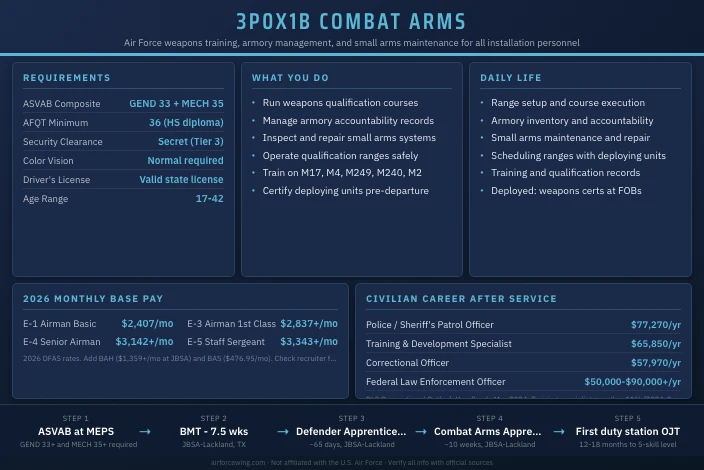
Air Force Combat Arms specialists are responsible for the weapons qualification, training management, small arms maintenance, and armory operations at Air Force installations worldwide. They teach and certify Airmen on pistols, rifles, crew-served weapons, and aircraft-mounted systems, and they maintain the accountability records for every weapon in the installation’s inventory.
Day-to-Day Duties
The core of the Combat Arms mission is training. Specialists plan and run qualification courses for all personnel on the installation who require weapons certification. That includes annual qualification days for hundreds of Airmen, specialized training for Security Forces patrols, and weapons certification for deploying units. Managing the range schedule alone, coordinating ammo draws, weather holds, personnel rosters, and range safety, can take up a significant portion of a specialist’s week.
Armory operations run parallel to the training mission. Combat Arms Airmen maintain custody records for all assigned weapons, conduct inventories, and process weapons in and out for personnel requiring them. Strict accountability standards apply: every serial number must be tracked, every transfer documented, and every discrepancy resolved immediately.
Small arms maintenance is the third pillar. Specialists disassemble, inspect, repair, and zero weapons across a wide inventory that typically includes the M17/M18 pistol, M4 carbine, M240 machine gun, M249 squad automatic weapon, and M2 .50-caliber machine gun. At some installations the inventory also includes aircraft-mounted weapons and vehicle-mounted systems. Correcting malfunctions, replacing worn components, and maintaining readiness records are daily tasks.
Specialized Roles
| Code | Title | Primary Mission |
|---|---|---|
| 3P0X1 | Security Forces Specialist | Base law enforcement and force protection patrol |
| 3P0X1A | Military Working Dog Handler | K-9 patrol and detection operations |
| 3P0X1B | Combat Arms | Weapons training, armory management, small arms maintenance |
The 3P0X1B is one of two shred-outs within the Security Forces career field. Both shreds begin with the same Defender apprentice course before branching into their specialized pipelines. Combat Arms personnel do not typically serve in patrol or gate guard roles, their assignment is the range, the armory, and the weapons training program.
Special Experience Identifiers can mark senior Combat Arms personnel for specific weapons qualifications or instructor certifications beyond the standard skillset.
Mission Contribution
Air Force doctrine requires every armed Airman to be qualified and proficient with their issued weapon. That qualification doesn’t happen automatically, it flows through Combat Arms. When a deploying unit needs to certify 200 personnel on rifles and pistols before wheels-up, Combat Arms makes that happen. When a new weapons system is fielded at the installation, Combat Arms trains the trainers. The readiness of every armed person on that installation runs through this shred.
Equipment and Technology
The daily inventory in a Combat Arms section typically includes the M17/M18 pistol family, M4 carbine, M249 SAW, M240B/L machine gun, M2HB heavy machine gun, M203 grenade launcher, and shotgun systems. Deployed assignments may add crew-served weapon systems and vehicle-mounted platforms. Specialists use weapons maintenance tools, bore scopes, gauging equipment, and digital armory management software for accountability. Range operations require target systems, shot timers, ammunition management tools, and safety equipment.
Salary
Combat Arms Airmen earn the same basic pay as all enlisted Airmen at equivalent grades. The pay structure below reflects 2026 DFAS rates.
Base Pay
| Grade | Title | Entry Pay (under 2 yrs) | At 4 Years | At 8 Years |
|---|---|---|---|---|
| E-1 | Airman Basic | $2,407/mo | $2,407/mo | , |
| E-2 | Airman | $2,698/mo | $2,698/mo | , |
| E-3 | Airman First Class | $2,837/mo | $3,198/mo | $3,198/mo |
| E-4 | Senior Airman | $3,142/mo | $3,659/mo | $3,816/mo |
| E-5 | Staff Sergeant | $3,343/mo | $3,947/mo | $4,299/mo |
| E-6 | Technical Sergeant | $3,401/mo | $4,069/mo | $4,613/mo |
Pay rates from DFAS 2026 military pay tables.
Allowances and Additional Pay
Base pay is only part of the total compensation package. Two tax-free allowances add significantly to take-home:
- BAH (Basic Allowance for Housing): Varies by duty station, pay grade, and dependent status. At Joint Base San Antonio, an E-4 without dependents receives $1,359/month; with dependents, $1,728/month. Rates at higher-cost installations run considerably higher.
- BAS (Basic Allowance for Subsistence): $476.95/month flat for all enlisted Airmen regardless of rank or location.
Enlistment bonuses for Security Forces shreds, including 3P0X1B, change by fiscal year. Check with your recruiter or the Air Force bonus page for current amounts. Retention bonuses are available for Combat Arms Airmen who reenlist; the Air Force releases updated lists each fiscal year.
Additional Benefits
TRICARE Prime covers active-duty Airmen and their families with no enrollment fees, no deductibles, and no copays for covered services, including medical, dental, vision, mental health, and prescriptions. The Post-9/11 GI Bill pays full in-state tuition at public universities after 36 months of qualifying service, plus a monthly housing allowance based on the E-5 with-dependents BAH rate at the school’s ZIP code. The Air Force Tuition Assistance program covers up to $4,500 per year for college courses taken while on active duty.
The Blended Retirement System (BRS) combines a pension worth 40% of your high-36 average basic pay at 20 years of service with a Thrift Savings Plan component where the government matches up to 4% of basic pay in contributions.
Work-Life Balance
Security Forces units including Combat Arms sections typically operate on shift schedules. Combat Arms specialists often work more regular weekday hours than patrol Defenders because range scheduling is driven by training calendars rather than around-the-clock law enforcement. That said, deployments, exercises, and unit requirements create irregular periods. The Air Force provides 30 days of paid leave per year accruing at 2.5 days per month, plus 11 federal holidays.
Qualifications
Prepare to study for the ASVAB before you talk to a recruiter. The 3P0X1B shred has a higher ASVAB bar than the base Defender track because the work involves mechanical systems. Use an ASVAB study guide to build your Mechanical and General scores before testing.
Qualification Requirements
| Requirement | Standard |
|---|---|
| Citizenship | U.S. citizen |
| Education | High school diploma or GED (AFQT 65+ with GED) |
| AFQT Minimum | 36 (HS diploma) |
| ASVAB Composite | GEND 33 (Security Forces baseline) + MECH 35 (Combat Arms shred) |
| Security Clearance | Secret (Tier 3 NACLC) |
| Color Vision | Normal color vision required |
| Driver’s License | Valid state license |
| Age | 17-42 at time of enlistment |
| Medical | Qualified for worldwide duty |
| Background | No disqualifying law enforcement record |
Requirements per military.com ASVAB reference and AFI 36-2101.
The Combat Arms shred requires both the GEND 33 baseline and a separate MECH 35 score. Scoring 33 on GEND alone qualifies you for the base Defender track but not the Combat Arms specialization. Study both composites before you test.
Application Process
- Take the ASVAB at a Military Entrance Processing Station (MEPS). Confirm your GEND and MECH scores meet the thresholds.
- Complete the physical examination and initial medical screening at MEPS.
- Request the Security Forces career field with your recruiter. If you want the Combat Arms shred specifically, state that preference in writing. Shred assignments depend on needs of the Air Force and are not guaranteed at enlistment.
- Undergo a background investigation for the Secret clearance. The National Agency Check, Local Agency Checks, and Credit Check (NACLC) process typically takes several weeks.
- Receive a job offer, sign enlistment contract, and await a ship date for BMT.
The process from MEPS visit to BMT ship date typically runs 30 to 180 days depending on training seat availability and clearance timelines.
Selection Criteria and Competitiveness
The Combat Arms shred is less competitive than the Military Working Dog Handler shred because there are more Combat Arms billets across the installation base. The Mechanical score requirement does screen out some candidates. Prior experience with firearms, hunting, competitive shooting, JROTC, can strengthen your case with a recruiter, though no formal prerequisite certifications are required. Candidates with a clean background record process faster through the clearance investigation.
Service Obligation
Enlisted Airmen who enter active duty typically incur a four-year initial service obligation. Airmen access service as an E-1 (Airman Basic) regardless of prior education. Those with college credits or specific prior training may receive accelerated promotion to E-2 or E-3 under Air Force accession policies, confirm current rules with your recruiter.
Work Environment
Combat Arms specialists work primarily in two settings: the range facility and the armory. Neither involves patrol vehicles or gate guard duty.
Setting and Schedule
The range environment is physical and often outdoor. Running a qualification course means hours on your feet, handling and clearing weapons, coaching firing positions, and managing range safety. Weather affects the schedule. Temperature extremes, dust, and noise are routine. The armory environment is more controlled, climate-conditioned storage with strict access protocols and a documentation-heavy workflow.
Most Combat Arms sections operate on a weekday-dominant schedule aligned with the training calendar, with range days scheduled in advance. That rhythm differs from patrol Defenders who rotate through 12-hour shift cycles covering all hours. Expect occasional weekend qualification events and early morning range opens to beat heat or coordinate with deploying units.
Leadership and Communication
Combat Arms sections are typically small, a handful of specialists managed by a Staff Sergeant or Technical Sergeant NCO. Direct communication with the section chief and weapons officer is common. Performance feedback comes through the Air Force Enlisted Performance Report (EPR) system, with annual reports prepared by your rater and additional rater. Feedback sessions should happen quarterly under AFI 36-2406 standards, though formal EPRs are annual.
Team Dynamics and Autonomy
The section is small enough that every person’s work is visible and consequential. A missed armory discrepancy or a range safety violation has immediate and serious consequences, which means accountability standards are high and autonomy is earned rather than assumed. Junior specialists work closely under supervision; experienced Combat Arms Airmen manage entire qualification cycles with significant independence.
Job Satisfaction and Retention
Combat Arms is a technically demanding specialty that produces deep expertise in weapons systems. Airmen who enjoy hands-on mechanical work, firearms, and instruction tend to find this track genuinely engaging. The specialized nature of the work and the limited number of billets can create assignment stability, many Combat Arms Airmen stay at the same installation longer than patrol Defenders who rotate more frequently. Retention rates for the shred track above the career field baseline given the technical investment the Air Force makes in training each specialist.
Training
The training pipeline for 3P0X1B has two stages: the shared Defender apprentice course that all Security Forces Airmen attend, followed by the Combat Arms apprentice course that qualifies specialists in weapons systems and instruction.
Bookmark your ASVAB prep resources now, both the GEND and MECH composites determine whether you qualify for this track.
Training Pipeline
| Phase | Location | Length | Focus |
|---|---|---|---|
| Basic Military Training (BMT) | JBSA-Lackland, TX | 7.5 weeks | Military bearing, physical fitness, Air Force fundamentals |
| Defender Apprentice Course (Tech School) | JBSA-Lackland, TX | ~65 days | Law enforcement, force protection, use of force, patrol procedures |
| Combat Arms Apprentice Course | JBSA-Lackland, TX | ~10 weeks | Weapons systems, armory management, range operations, small arms maintenance |
| On-the-Job Training (OJT) | First duty station | 12-18 months | Task certification toward 5-skill level |
Training pipeline per CFETP 3P0X1A/B and AETC Tech Training.
Initial Training Details
BMT at Lackland is the same for every enlisted Airman, 7.5 weeks of physical conditioning, drill, weapons familiarization, and Air Force doctrine. Upon graduating BMT, Security Forces recruits move directly into the Defender Apprentice Course (also at Lackland), covering law enforcement procedures, defensive tactics, use of force law, and weapons qualification common to all Defenders.
After completing the Defender course, personnel earmarked for the Combat Arms shred enter the Combat Arms Apprentice Course. This course covers the full inventory of Air Force small arms: how to disassemble, inspect, zero, and maintain each system; how to set up and run qualification ranges safely; armory accountability procedures; and the legal framework governing weapons use, storage, and transfer. Graduates leave qualified to operate a Combat Arms section at any Air Force installation.
Advanced Training
Experienced Combat Arms specialists can pursue additional weapons system qualifications that expand the range of platforms they can maintain and teach. Advanced courses cover crew-served weapons, aircraft-mounted guns, and specialized systems fielded at specific installations. Senior NCOs may attend the Air Force Advanced Instructor Course or equivalent programs that develop range management and curriculum design skills. The Air Force also supports professional development through Tuition Assistance, allowing Combat Arms Airmen to pursue degrees in criminal justice, emergency management, or technical fields relevant to the role.
Career Progression
Combat Arms Airmen progress through the standard Air Force enlisted skill level system: 3-skill (apprentice), 5-skill (journeyman), 7-skill (craftsman), and 9-skill (superintendent). Each level requires a combination of training completion, time in service, and task certification.
Rank and Progression Timeline
| Rank | Grade | Typical Time to Reach |
|---|---|---|
| Airman Basic | E-1 | Entry |
| Airman | E-2 | 6 months |
| Airman First Class | E-3 | 16 months |
| Senior Airman | E-4 | 36 months (or 3 years TIS) |
| Staff Sergeant | E-5 | ~4-6 years (board-selected) |
| Technical Sergeant | E-6 | ~9-11 years (board-selected) |
| Master Sergeant | E-7 | ~13-16 years (board-selected) |
| Senior Master Sergeant | E-8 | ~17-20 years |
| Chief Master Sergeant | E-9 | ~20+ years |
Promotion to E-5 and above is board-competitive. Your EPR record, decoration history, professional military education (PME) completion, and physical fitness scores all factor into the selection process.
Specialization and Growth
Combat Arms NCOs who demonstrate strong technical and instructional skills may be selected for positions managing base-level weapons programs, conducting inspections across multiple units, or serving as senior range operations officers. Assignments to major command (MAJCOM) staffs and Air Force Security Forces Center (AFSFC) positions are available to senior enlisted Combat Arms personnel. Special Experience Identifiers can be earned for specific qualifications that distinguish a member’s record on the assignment system.
Role Flexibility and Transfers
Security Forces Airmen can apply for retraining into other career fields through the voluntary retraining program, subject to Air Force needs and eligibility requirements. Within the Security Forces career field, lateral moves between shred-outs are possible with command approval and completion of the required apprentice course for the new shred. Combat Arms Airmen who want to return to patrol can pursue that through career development channels.
Performance Evaluation
The Enlisted Performance Report is the Air Force’s formal evaluation system. Your rater (typically your immediate supervisor) and additional rater assess your performance, leadership, and potential each year. EPR scores directly affect promotion board outcomes. Stratification statements, where you rank among your peers at that unit, carry significant weight for competitive promotions. Building a strong EPR record in Combat Arms means demonstrating technical mastery, meeting all training deadlines, and leading effectively in the range and armory environment.
Physical Demands
Combat Arms is less physically demanding than the patrol Defender role day-to-day, but it is not a sedentary job. Running range days, transporting weapons, and working in outdoor environments all require baseline fitness.
Physical Requirements
Range operations involve extended periods of standing, carrying weapons and equipment, and working in variable weather conditions. Some crew-served weapons are heavy, moving and setting up an M2 or M240 machine gun requires upper body strength. Protective equipment (ear protection, eye protection) is worn routinely on the range.
The physical demands of deployed assignments are higher. Combat Arms personnel supporting deployed operations may work in austere environments with additional physical requirements beyond the garrison range mission.
Air Force Fitness Assessment Standards
All Airmen, regardless of AFSC, take the Air Force Fitness Assessment annually. The test is age- and gender-normed and scored on a 100-point scale with a minimum passing composite of 75. You must also meet a minimum on each component.
| Component | Max Points | Under-25 Male Minimum | Under-25 Female Minimum |
|---|---|---|---|
| 1.5-Mile Run | 60 | 11:57 (min passing time) | 14:26 (min passing time) |
| Push-Ups (1 min) | 10 | 42 reps | 27 reps |
| Sit-Ups (1 min) | 10 | 38 reps | 38 reps |
| Waist Circumference | 20 | 39 inches max | 35.5 inches max |
Standards are age- and gender-normed; verify current values with official Air Force publications before testing.
Fitness Assessment standards apply to all Airmen regardless of AFSC. Failing the FA has career consequences including promotion ineligibility. Train consistently, don’t wait until the test is scheduled.
Medical Evaluations
Combat Arms Airmen must maintain worldwide duty qualification throughout their career. Hearing protection is mandatory on the range, but long-term noise exposure is an occupational concern, audiometric testing is conducted periodically. Normal color vision is required for initial entry and maintained throughout service. Any medical condition that affects the ability to safely handle, operate, or teach weapons use will be reviewed by medical authorities.
Deployment
Combat Arms specialists are assigned across the Air Force installation base wherever a weapons training program exists. That includes most major active-duty bases in the continental United States and overseas.
Deployment Details
Combat Arms Airmen deploy in support of Air Expeditionary Force (AEF) rotations, typically on six-month cycles. Deployed missions can include running weapons qualifications for personnel at forward operating bases, managing weapons accountability for the deployed unit, and supporting base defense operations. Air Force Security Forces units have deployed extensively in support of operations in the Middle East, and Combat Arms specialists have served in those environments. Deployment rates for Combat Arms personnel are broadly consistent with the larger Security Forces career field.
The deployed Combat Arms mission is different from garrison work in meaningful ways. At forward operating bases with limited infrastructure, range facilities may be improvised rather than established. Weapons accountability at a deployed location involves tracking weapons through a constantly rotating population of short-term personnel, which creates a different accountability challenge than a stable garrison installation. Deployed Combat Arms specialists must also coordinate ammunition draw and disposal under field conditions.
Some Combat Arms Airmen receive joint assignment to Army units or security assistance advisory missions that involve training host-nation security forces in weapons qualification and small arms maintenance. These assignments, while less common, are among the most professionally distinctive experiences available in the career field, working directly with foreign military counterparts requires both technical expertise and cross-cultural communication skills.
Combat Arms personnel at larger deployed installations may also support weapons qualification for personnel from other services, coalition partners, or deployed government civilians who require armed status. The range management skills developed in garrison transfer directly to these environments.
Location Flexibility
Duty station assignments are managed through the Air Force’s assignment system with input from the member through the Dream Sheet process. Major Combat Arms billets exist at bases including JBSA-Lackland TX, Eglin AFB FL, Langley AFB VA, Travis AFB CA, and overseas installations in Europe and the Pacific. Airmen who build strong EPRs in their first assignment earn more say in requesting preferred locations during subsequent moves.
Risk/Safety
Working daily with live weapons and explosives creates genuine hazards that Combat Arms training directly addresses.
Job Hazards
The primary occupational hazards in Combat Arms are firearms-related: accidental discharge, hearing damage from repeated noise exposure, and eye injuries from range debris. Ammunition handling and storage introduce explosives safety considerations. Airmen who work on crew-served weapon systems handle heavier equipment with mechanical failure modes that require specific safety protocols.
Safety Protocols
Air Force range safety rules follow AFI 36-2654 (Combat Arms Program). Every range operation requires a certified Range Safety Officer. Four-rule firearms safety is mandatory and constantly reinforced. Hearing and eye protection are required on any live-fire range. Ammunition is stored under strict accountability and environmental controls. Combat Arms Airmen are trained on emergency procedures for weapon malfunctions, misfires, and range accidents before they ever run a qualification event.
Security and Legal Requirements
The Secret security clearance requires a Tier 3 National Agency Check, Local Agency Checks, and Credit Check (NACLC). The clearance is renewed periodically throughout the career. Combat Arms Airmen are subject to Personnel Reliability Assurance Standards (PRAS) under AFI 31-117, which covers the suitability to be armed and to manage weapons. Any conduct that raises suitability concerns can result in removal from the Combat Arms position. Violating weapons accountability or armory procedures carries serious legal consequences under the UCMJ.
Impact on Family
Family Considerations
The Combat Arms schedule is more predictable than the rotating 12-hour patrol shifts that most Security Forces Defenders work. Garrison hours align more closely with a standard workweek, which makes childcare, school schedules, and family routines easier to manage. Deployments disrupt that rhythm the same as any other Security Forces shred, a six-month deployment is a six-month absence regardless of your MOS. The Air Force offers family support programs through Airman and Family Readiness Centers at every installation, covering everything from financial counseling to deployment support groups.
The more regular weekday schedule that Combat Arms Airmen typically keep translates directly to family life quality. Unlike patrol Defenders rotating through midnight and early morning shifts week to week, a Combat Arms Airman on a training-calendar-driven schedule can be home for dinner most weeknights, attend school events, and maintain consistent routines. That predictability is not guaranteed, exercises, deploying unit qualifications, and inspection cycles create bursts of irregular hours, but the baseline is more stable than the patrol track.
TRICARE Prime coverage is available to all dependents of active-duty Combat Arms Airmen. For families with children, the combination of zero-premium healthcare and on-base resources like the Child Development Center and the Airman and Family Readiness Center provides a support infrastructure that would cost substantially more to replicate in the civilian world. Spouses whose civilian employment is interrupted by PCS moves are eligible for the DoD Spouse Employment assistance programs, which offer career counseling, resume support, and connections to employer partnerships near Air Force installations.
Relocation and Flexibility
Permanent Change of Station (PCS) moves typically occur every two to four years. Combat Arms billets exist at most major installations, so the assignment pool is broader than some more specialized career fields. Families relocate frequently, school district changes, spouse employment disruptions, and housing market variations are real challenges. Many Combat Arms Airmen report that the more regular hours compared to patrol duty make the overall lifestyle more manageable for families than the shift-work alternative.
The government covers the cost of household goods shipment for each PCS move, up to service-grade-specific weight limits. A Dislocation Allowance is paid to offset the incidental costs of establishing a new household. Families can live on-base in government quarters or off-base with BAH covering the full projected rental cost at the new duty station. The Interstate Compact on Educational Opportunity for Military Children helps ease school enrollment transitions, particularly important for families that move mid-school-year.
Reserve and Air National Guard
The Combat Arms shred is available in both the Air Force Reserve and the Air National Guard, though billet availability varies by unit.
Component Availability
Air Force Reserve Combat Arms billets exist at bases with Security Forces squadrons that maintain an active weapons training mission. Air National Guard units in many states maintain Combat Arms positions because state Guard units require the same weapons qualification infrastructure as active-duty installations. Billet density is lower than active duty, and competitive interest can be higher in desirable locations.
Drill Schedule and Training Commitment
The standard Reserve/Guard commitment is one Unit Training Assembly (UTA) weekend per month plus 15 days of Annual Tour per year. Combat Arms personnel typically have additional annual requirements: range certifications, weapons accountability audits, and qualification event support that may require more than the standard drill commitment. Confirm the specific schedule with the unit you’re considering joining.
Part-Time Pay
An E-4 (Senior Airman) with the Combat Arms shred earns $3,142 to $3,659/month on active duty. A Reserve or Guard E-4 earns pay for four drill periods (two drill days x two periods per day) per UTA weekend, approximately $400 to $460 per drill weekend based on 2026 DFAS rates. Annual Tour activations pay full daily rate for 15+ days.
Benefits Comparison
| Factor | Active Duty | Air Force Reserve | Air National Guard |
|---|---|---|---|
| Monthly commitment | Full time | ~2 days/month + AT | ~2 days/month + AT |
| Base pay (E-4) | $3,142-$3,659/mo | ~$400-$460/drill weekend | ~$400-$460/drill weekend |
| Healthcare | TRICARE Prime (free) | TRICARE Reserve Select (premium) | TRICARE Reserve Select or state plan |
| Education | Federal TA + Post-9/11 GI Bill | Federal TA (limited); Montgomery GI Bill-SR | Federal TA + state tuition waivers (varies) |
| Retirement | 20-yr pension (40% high-36 + BRS TSP) | Points-based Reserve pension | Points-based Reserve pension |
| Deployment tempo | AEF rotation (~6 mo every 18-24 mo) | Periodic mobilization | Periodic mobilization + state activations |
The Air National Guard offers state-specific tuition benefits that active-duty Airmen don’t receive. Many states provide free or heavily subsidized tuition at state colleges for Guard members in good standing. USERRA protects civilian jobs during military activations.
Civilian Career Integration
Combat Arms pairs well with civilian careers in law enforcement, security management, and technical firearms fields. Reserve and Guard service in this shred does not typically conflict with civilian employers in those fields, the expertise is complementary. Federal law enforcement agencies that require weapons qualifications view Combat Arms experience favorably.
Post-Service
The skills built in Combat Arms translate into a specific cluster of civilian careers that value both technical firearms knowledge and instruction ability.
Civilian Career Prospects
| Civilian Job | Median Annual Salary | Job Outlook |
|---|---|---|
| Police and Sheriff’s Patrol Officer | $77,270 | +3% (2024-2034) |
| Correctional Officer | $57,970 | Stable |
| Training and Development Specialist | $65,850 | +11% (2024-2034) |
| Security Guard / Security Manager | $38,370-$109,350 | Varies by level |
| Federal Law Enforcement Officer (GS-5 to GS-9+) | $50,000-$90,000+ | Competitive |
Salary data from BLS Occupational Outlook Handbook, May 2024. Federal law enforcement salaries vary by agency and duty location adjustments.
Career Transition Paths
Combat Arms experience maps directly to civilian positions in three lanes. The first is law enforcement, local, state, and federal agencies recruit veterans heavily, and Security Forces credentials plus a clearance accelerate the hiring process. Federal agencies including the FBI, DEA, ATF, and federal protective services maintain veteran preference programs. The ATF and similar agencies specifically value documented small arms technical knowledge.
The second lane is private security and weapons instruction. Commercial ranges, shooting sports organizations, and private security contractors hire Combat Arms veterans for range safety officer, firearms instructor, and armory manager roles. Certifications from the NRA Instructor program or Law Enforcement Firearms Instructors Association (LEFIA) can stack on top of the military training record.
The third lane is defense contracting. Base operations support contracts and overseas security assistance programs hire former Combat Arms specialists at rates well above typical entry-level civilian security work.
Transition programs available before separation include the Transition Assistance Program (TAP) and Hiring Our Heroes, which connects veterans with corporate fellowship programs. The Post-9/11 GI Bill covers tuition for degree completion in criminal justice, public administration, or a technical field that opens additional career doors.
Is This a Good Job
Ideal Candidate Profile
Combat Arms is the right fit for Airmen who want to spend their career developing deep technical knowledge of weapons rather than running patrol. If you grew up hunting or shooting, have a mechanical aptitude, and enjoy teaching and certifying others in hands-on skills, this shred plays to those strengths. You need patience for documentation, armory accountability is strict, and errors have serious consequences. You also need to be comfortable being the safety authority in any situation involving live fire.
Strong candidates typically have:
- Mechanical aptitude and comfort with detailed technical procedures
- Interest in firearms as systems, not just as tools
- Teaching and communication skills, you’ll spend significant time in front of groups
- High attention to accuracy in record-keeping
- Physical fitness sufficient for outdoor range operations in variable conditions
Potential Challenges
Combat Arms is not the right fit if your goal is traditional law enforcement experience. You won’t run patrol, work criminal investigations, or build the patrol officer background that many civilian police departments want. If you enlist expecting the Security Forces patrol experience and get slotted into Combat Arms, the work can feel disconnected from that goal.
The shred also has fewer installation-level billets than the base Defender track, which means less flexibility if you want to transfer within the career field later. Small section size means a difficult relationship with your chain of command has limited escape valves.
Career and Lifestyle Alignment
For the right person, Combat Arms offers an unusual combination: technical depth, a more predictable schedule than patrol work, genuine expertise in a specialized field, and a direct path into civilian careers that value that expertise. If you want to leave the Air Force after four years with skills that a private security contractor or federal agency will pay for immediately, this track builds that profile. If you want broad law enforcement experience, operational variety, and the chance to work patrol and investigations, the base Defender track serves that goal better.
More Information
Talk to a Security Forces recruiter before finalizing your career decision. Shred-out availability changes with Air Force manpower requirements, and the recruiter can tell you which tracks have open seats in your enlistment window. An Air Force recruiter can walk you through the MEPS process, explain what a clean background check looks like, and connect you with prior Combat Arms Airmen who can give you a ground-level view of the job. Find your nearest recruiter at airforce.com.
When you speak with a recruiter, ask specifically about 3P0X1B availability, not just Security Forces in general. Shred assignments are driven by Air Force manpower needs at the time of your enlistment, and the Combat Arms track is not guaranteed by enlisting into 3P0X1. Understanding that distinction before you sign will prevent surprises after tech school.
Useful resources for further research:
- Air Force Security Forces Center (AFSFC), the command element that oversees all Air Force security forces programs including Combat Arms
- AFI 36-2654, the instruction governing the Air Force Combat Arms Program, covering range safety, instructor qualifications, and armory standards
- Bureau of Labor Statistics: Police and Detectives, civilian law enforcement career data for post-service transition planning
- Bureau of Labor Statistics: Training and Development Specialists, applicable for Combat Arms veterans moving into civilian weapons instruction or corporate training roles
- Hiring Our Heroes, veteran employment program with connections to law enforcement, security, and defense contractor employers
The ASVAB’s Mechanical composite (MECH) draws from Auto and Shop Information, Mechanical Comprehension, and Electronics Information subtests. If you need to raise your MECH score specifically, focus preparation on those three areas. An ASVAB prep course that covers all four composite areas will give you the best position for both the GEND and MECH requirements.
This site is not affiliated with the U.S. Air Force or any government agency. Verify all information with official Air Force sources before making enlistment or career decisions.
Explore more Air Force security forces careers such as 3P0X1 Security Forces Specialist and 3P0X1A Military Working Dog Handler.