3P0X1A Military Working Dog Handler
Most Security Forces Airmen patrol solo or in partner pairs. Military Working Dog Handlers work as a team of two, one handler, one dog, and the bond between them is the whole point. The 3P0X1A shred takes the standard Defender mission and adds a K-9 partner trained in patrol, explosive detection, and narcotics identification. Handlers deploy alongside their dogs to combat zones, conduct building searches, and support missions that a standard patrol team cannot do.
This isn’t an entry-level assignment. Handlers must already hold the 3P031 Security Forces AFSC and have at least one year of service before applying for the MWD course. The Air Force selects based on performance, fitness, and an evaluation process at the 341st Training Squadron. If you clear that hurdle, you enter one of the most specialized and operationally active tracks in the Security Forces career field.
Qualifying requires specific ASVAB line scores. Our ASVAB study guide covers what to target and how to prepare.
Job Role
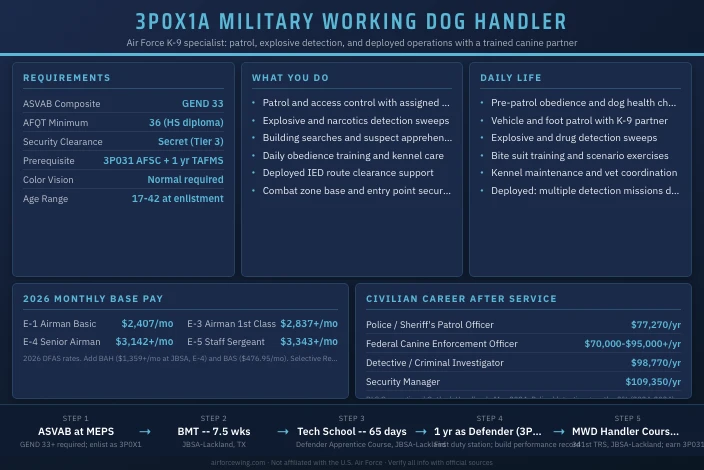
Military Working Dog Handlers are Security Forces Airmen who partner with individually assigned military working dogs to conduct patrol operations, detect narcotics and explosives, execute building searches, and support direct combat operations. They are responsible for every aspect of their dog’s readiness, training, health, welfare, and mission employment, in addition to fulfilling their core law enforcement duties as a Defender.
Day-to-Day Duties
Each handler is assigned to a specific dog. That relationship is the foundation of everything. Before a patrol starts, the handler runs obedience work, checks the dog’s physical condition, and inspects equipment. The dog is a weapon system with a heartbeat, and the Air Force treats it as one.
Operationally, MWD teams support access control, patrol installations, conduct explosive sweeps of aircraft and vehicles, and search buildings for suspects. Detection missions are among the most operationally valuable contributions MWD teams make, a single dog can clear a vehicle in seconds that would take human searchers several minutes to inspect manually.
At deployed locations, the pace shifts. MWD teams support entry control points, conduct route clearance for improvised explosive devices, and accompany response forces on high-risk entries. The handler and dog move together in all of these environments.
Specialized Roles
| Code | Title | Additional Training Required |
|---|---|---|
| 3P031 | Security Forces Apprentice (Defender) | Defender Apprentice Course, prerequisite for MWD shred |
| 3P0X1A | Military Working Dog Handler | MWD Handler Course (55 days, 341st TRS, JBSA-Lackland) |
The MWD shred is only available to Airmen who already hold the base 3P031 AFSC with one year of Total Active Federal Military Service. You cannot enlist directly into 3P0X1A, it is an earned qualification, not an entry job.
Advanced handlers can qualify as kennel masters, responsible for managing an entire MWD section, or as MWD course instructors at the 341st Training Squadron. Certain assignments carry Special Experience Identifier codes recognizing investigative and specialized operational qualifications.
Mission Contribution
The Air Force operates the Department of Defense’s primary Military Working Dog training program, headquartered at JBSA-Lackland since 1957. The 341st Training Squadron trains every MWD team in the joint force. Army, Navy, and Marine Corps handlers all come through the same pipeline. Air Force MWD teams have deployed to every theater since 9/11, and their explosive detection capability has directly prevented casualties downrange.
Equipment and Technology
Handlers work daily with patrol harnesses, bite suits, muzzles, and leashes. Detection work involves trained odor recognition kits and controlled training aids. In deployed environments, MWD teams may wear canine body armor and use specialized vehicle transport crates. Handlers carry the same sidearm and carbine as standard Security Forces Airmen. The dog is the primary detection and apprehension tool.
Salary
An Airman Basic (E-1) earns $2,407 per month in base pay during BMT. By the time most Airmen earn the MWD shred, typically after 12-18 months of service, they’re working toward or past Senior Airman (E-4).
2026 Base Pay: Security Forces / MWD Handler Career Path
| Rank | Grade | Monthly Base Pay |
|---|---|---|
| Airman Basic | E-1 | $2,407 |
| Airman | E-2 | $2,698 |
| Airman First Class | E-3 | $2,837 - $3,198 |
| Senior Airman | E-4 | $3,142 - $3,816 |
| Staff Sergeant | E-5 | $3,343 - $4,422 |
| Technical Sergeant | E-6 | $3,401 - $5,044 |
| Master Sergeant | E-7 | $3,932 - $5,537 |
| Senior Master Sergeant | E-8 | $5,867 - $7,042 |
| Chief Master Sergeant | E-9 | $7,182 - $8,248 |
DFAS 2026 military pay tables. Ranges reflect 0 to 20+ years of service.
Base pay is one part of total compensation. Airmen living off base receive Basic Allowance for Housing (BAH), which varies by duty location. A single E-4 at Joint Base San Antonio earns approximately $1,359/month in BAH; with dependents, that rises to $1,728/month. All enlisted Airmen also receive Basic Allowance for Subsistence (BAS) of $476.95/month.
Retention Bonus
The Air Force included MWD Handler among its most critical specialties eligible for the Selective Retention Bonus. Bonus amounts vary by contract length and career timing; verify current figures with your retention NCO or an Air Force recruiter.
Additional Benefits
TRICARE Prime covers active-duty Airmen at no cost, medical, dental, vision, mental health, and prescriptions. The Post-9/11 GI Bill covers full in-state tuition at public universities after separation, plus a monthly housing allowance. The private school cap is $29,920.95 for the 2025-2026 academic year. Air Force Tuition Assistance covers up to $4,500 per year while you’re on active duty. Retirement under the Blended Retirement System combines a 20-year pension at 40 percent of your high-36 average base pay with Thrift Savings Plan matching up to 5 percent of basic pay. Enlisted Airmen accrue 30 days of paid leave per year.
Qualifications
The 3P0X1A shred has a two-stage entry path. First, you enlist as a standard Security Forces Airman (3P031). Then, after meeting time and performance thresholds, you apply for the MWD Handler course.
Entry Requirements
| Requirement | Standard |
|---|---|
| ASVAB Composite | General (GEND) 33 minimum |
| Prerequisite AFSC | Must hold 3P031 (Security Forces Apprentice) |
| Time in Service | Minimum 1 year TAFMS before MWD course entry |
| Citizenship | U.S. citizen |
| Age at Enlistment | 17-42 |
| Education | High school diploma (non-graduates need AFQT 65+) |
| Driver’s License | Valid state license required |
| Security Clearance | Secret (Tier 3 NACLC investigation) |
| Color Vision | Normal color vision required |
| Medical | No disqualifying physical or mental health conditions |
The GEND composite draws on Word Knowledge, Paragraph Comprehension, Arithmetic Reasoning, and Mathematics Knowledge. A 33 is accessible if you’ve cleared the Air Force’s minimum AFQT of 36, most qualified applicants will already be close.
Background and Medical Disqualifiers
Security Forces disqualifiers apply in full to MWD candidates: documented gang affiliations, substance abuse history, mood disorders, ADHD, fear of confined spaces, and certain criminal records are all reviewed carefully. The MWD course also requires candidates to be physically sound, the work involves running in protective bite gear, repeated control exercises with large dogs, and sustained physical exertion.
The Secret clearance investigation (Tier 3 NACLC) covers criminal records, foreign contacts, and financial history. None of these automatically disqualify you, but all will be examined. Be honest with your recruiter from the start.
Application Process
The full path from enlistment to qualified handler typically takes 18 to 24 months. Unlike many technical shreds, the MWD Handler course has low attrition, around 5 to 7 percent, with most departures from injury or voluntary withdrawal, not academic failure.
Service Obligation
Standard Security Forces contracts are four or six years of active-duty service. Enlisting as a Defender starts at E-1 (Airman Basic). The MWD shred does not add a separate service obligation beyond any retention bonus agreement.
See our ASVAB study guide to build the General composite you need.
Work Environment
MWD Handler shifts follow the Security Forces rotation, 12-hour cycles covering days and nights, running through weekends and holidays. The difference from standard Defender work is that your schedule accounts for the dog’s needs too. Kennels require feeding, cleaning, and health checks that don’t wait for shift changes.
At a typical installation, handlers alternate between kennel duties, patrol, and detection sweeps. The day is more varied than standard gate or patrol work, but it’s not glamorous, a lot of it is kennel maintenance and obedience reinforcement that keeps the dog mission-ready.
Deployed environments change the tempo entirely. MWD teams in combat theaters may run multiple explosive-sweep missions daily, working in body armor with limited rest between taskings. The combination of heat, physical demand, and sustained alertness makes deployed handler work among the most demanding in Security Forces.
Leadership and Feedback
MWD sections operate within the larger Security Forces squadron structure, typically reporting to a Kennel Master at the TSgt or MSgt level. Day-to-day feedback is direct, your performance with the dog is visible to your supervisor on every patrol and during every training session. Formal performance evaluation comes through the standard Enlisted Performance Report (EPR) system, written annually and rated 1-5. Strong EPRs require demonstrated performance in both the law enforcement mission and K-9 operations.
Team Structure
The handler-dog pairing is the primary operational unit, but handlers work within a section. You share missions with other MWD teams, coordinate with standard patrol Airmen, and at deployed locations integrate with broader force protection and combat forces. The job blends deep individual accountability, nobody else can handle your dog, with unit-level coordination.
Training
Initial Training Pipeline
| Phase | Location | Length | Focus |
|---|---|---|---|
| Basic Military Training (BMT) | JBSA-Lackland, TX | 7.5 weeks | Military foundation, fitness, core Airman skills |
| Defender Apprentice Course | JBSA-Lackland, TX | 65 days | Law enforcement, force protection, weapons, tactics |
| MWD Handler Course, Block 1 | JBSA-Lackland, TX (341st TRS) | 5 days | Canine history, health, welfare, equipment basics |
| MWD Handler Course, Blocks 2-3 | JBSA-Lackland, TX (341st TRS) | ~50 days | Patrol, obedience, building search, detection (narcotics and explosives) |
The 341st Training Squadron at JBSA-Lackland runs the DoD’s primary MWD training program, it’s where joint-force handlers from all branches go through the same pipeline. Block 1 is mostly classroom work on canine biology, behavior, and handler responsibilities. Candidates don’t work with actual dogs in Block 1; instructors start with basic handling equipment so candidates build technique before the dog is introduced. Blocks 2 and 3 are almost entirely hands-on: building searches, firearm desensitization for the dog, patrol exercises in bite protection gear, and dual-purpose detection work on both narcotics and explosives odors.
The handler course maintains a 5-7 percent attrition rate. That’s low by military specialty standards. Most departures come from injury or a voluntary choice that the work isn’t a fit, not from failing to complete the coursework. Instructors evaluate on practical performance: can you and the dog complete the task? That’s the standard.
Advanced Training
Qualified handlers can pursue upgrade training to the 3P051A skill level through on-the-job performance and additional supervised operations. Kennel masters at the 5-skill level manage entire MWD sections and are responsible for the training standards of every team in the unit. Senior handlers can apply to return to the 341st TRS as instructors, shaping the next generation of handler teams.
The Air Force supports degree completion through Tuition Assistance while on active duty. Criminal justice programs pair directly with the Security Forces credential. Handlers interested in federal law enforcement post-service should note that OPM’s canine enforcement officer standards recognize military MWD handler experience as qualifying for GS-1801 positions.
Prepare for every phase of the pipeline with an ASVAB study guide that covers the General composite required for Security Forces.
Career Progression
Rank and Career Timeline
| Rank | Grade | Typical Time in Career |
|---|---|---|
| Airman Basic | E-1 | BMT only |
| Airman | E-2 | ~6 months |
| Airman First Class | E-3 | ~16 months |
| Senior Airman | E-4 | ~3 years |
| Staff Sergeant | E-5 | ~5-7 years |
| Technical Sergeant | E-6 | ~10-12 years |
| Master Sergeant | E-7 | ~15-17 years |
| Senior Master Sergeant | E-8 | ~18-20 years |
| Chief Master Sergeant | E-9 | ~22+ years |
Handlers typically earn the MWD shred (3P031A) in the E-3 to E-4 range. Advancement to SSgt and beyond follows the same competitive process as the broader Security Forces field: EPR scores, decorations, Professional Military Education completion, and promotion test performance all factor into board selection.
Specialization Paths
Beyond the handler role itself, experienced MWD Airmen can qualify as kennel masters, lead trainers at the 341st TRS, or technical advisors for joint MWD operations. The Kennel Master billet typically requires SSgt or above. Senior NCOs often transition into Flight Sergeant and Operations Superintendent roles within Security Forces squadrons.
A smaller number pursue commissioning through Officer Training School, moving into Security Forces Officer (31P) billets where they may oversee MWD sections as part of a broader command.
Performance Evaluation
The Air Force EPR system rates enlisted Airmen annually on a 1-5 scale. In the MWD track, the EPR narrative covers both the law enforcement mission and K-9 operations, a handler who can’t demonstrate proficiency with the dog won’t build a competitive record. PME completion, community involvement, and additional duties round out a strong report. Airmen aiming for promotion to SSgt and beyond should complete Community College of the Air Force (CCAF) coursework early; it’s a competitive factor that separates records at the board level.
Physical Demands
The MWD Handler role is physically demanding beyond the baseline Security Forces requirement. Running in bite suit protection during training, controlling dogs that can exceed 80 pounds, and operating in body armor and load-bearing equipment during deployed missions all require sustained physical conditioning.
Air Force Fitness Assessment Standards
All Airmen take the Air Force Fitness Assessment (FA) annually. It’s scored on a 100-point scale; the minimum composite is 75, and each component has its own floor. Standards are age- and gender-normed. The table below shows minimum passing scores for the under-25 bracket.
| Component | Male (Under 25) Min | Female (Under 25) Min | Max Points |
|---|---|---|---|
| 1.5-Mile Run | 13:36 | 16:22 | 60 |
| Push-Ups (1 min) | 33 reps | 18 reps | 10 |
| Sit-Ups (1 min) | 38 reps | 38 reps | 10 |
| Waist Circumference | 35 inches | 31.5 inches | 20 |
For current official standards, verify with af.mil. MWD Handlers are expected to exceed minimums consistently, the physical demands of the handler course and deployed missions require it.
Medical and Ongoing Requirements
Handlers receive standard annual medical evaluations through the military health system. Dog bite injuries are an occupational reality, training involves bite work, and field encounters carry risk. Back and joint issues are common over a long handler career given the physical nature of the work. Handlers assigned to nuclear-adjacent security programs may be subject to additional medical and behavioral review under the Personnel Reliability program.
Deployment
MWD Handlers deploy more frequently than most Security Forces Airmen. The dog’s capabilities, explosive detection especially, make handler teams high-demand assets in every theater. A first contract will almost certainly include at least one overseas deployment; multiple deployments across a career are the norm.
Deployment Patterns
Typical operational deployments run three to six months. MWD teams have supported operations in the Middle East, the Horn of Africa, and the Indo-Pacific region. Combat theater deployments involve IED sweep support, entry point security, and direct integration with combat forces. The handler and dog deploy together, logistics, kennel space, and dog food become part of the deployment planning package.
Duty Stations
MWD billets exist at major Air Force installations worldwide, but handler positions are fewer in total than standard Defender slots, which is part of what makes the shred competitive. Notable assignment hubs include:
- JBSA-Lackland, TX: 341st TRS permanent party and large handler population
- Ramstein AB, Germany: major European hub with active MWD mission
- Kadena AB, Japan / Misawa AB, Japan: Indo-Pacific assignments
- Elmendorf-Richardson, AK: northern assignment with unique patrol demands
- Nellis AFB, NV / Langley-Eustis, VA: active combat air force wings with MWD requirements
Assignment preferences go through AFPC; actual placements depend on billet availability and career field manning. MWD billets are limited, so assignments are less predictable than in higher-volume career fields.
Risk/Safety
MWD Handlers carry daily weapons, operate in law enforcement environments, and deploy to active combat zones. The risk profile is higher than most Air Force career fields, and the legal accountability that comes with law enforcement authority applies fully.
Job Hazards
Bite injuries are the most distinctive hazard in this specialty. Training involves regular protective bite work, and operational encounters with suspects add unpredictable risk. In deployed environments, the primary hazards are the same as for any force protection mission: IED exposure, direct attack, and hostile fire. Air Force MWD teams have operated in direct support of combat operations and have taken casualties in theater.
Dog handler fatigue is a real operational concern. A dog that is overworked or stressed becomes unreliable. Part of handler safety is managing the dog’s performance and wellness, ignoring that risk leads to missed detections or handler injuries.
Safety Protocols
Bite protection gear is mandatory during all patrol training. Weapons qualification occurs at regular intervals, and annual use-of-force refresher training applies to all Security Forces Airmen including handlers. MWD health inspections and mission readiness checks are built into every shift. Veterinary support is integrated into the MWD program, handlers have direct access to veterinary officers and technicians responsible for the dog’s care.
Security and Legal Requirements
The Secret clearance (Tier 3 NACLC) is required before assignment to Security Forces billets, including MWD Handler positions. Legal authority for law enforcement actions on Air Force installations flows from federal statute and the UCMJ. Handlers making use-of-force decisions, including canine deployment against a suspect, are held to the same legal standard as civilian law enforcement officers. Those decisions are documented, reviewed, and can result in criminal or administrative liability if procedures are not followed.
Impact on Family
The MWD commitment adds a layer to the standard Security Forces family dynamic. Handlers form strong bonds with their dogs, but those bonds come with responsibility that extends beyond the duty day. Kennel requirements don’t align with regular business hours, and deployment means the dog deploys too, the family is managing both the handler’s absence and the routine disruption that comes with any deployment.
Shift work remains the baseline. 12-hour rotations through days and nights, with deployments layered on top of a typical cycle every two to three years. Families benefit from the Air Force’s Family Readiness programs, Key Spouse networks, and installation support infrastructure, all of which are active at major installations.
Permanent Change of Station moves average every two to three years, and MWD billets add a variable: not every installation has handler slots, so PCS options may be more limited than for standard Defenders. The Air Force covers relocation costs under the Joint Travel Regulations. School transitions and spouse employment interruptions are real costs at every move.
Some handlers choose to adopt their dog upon the animal’s retirement from service. The Air Force has formal processes for handler adoption, and many handlers describe this as one of the most meaningful options the career provides.
Reserve and Air National Guard
The 3P0X1A shred is available in both the Air Force Reserve and the Air National Guard. Reserve and Guard MWD sections maintain the same qualification standards and deploy in support of active-duty requirements.
Reserve and Guard: What’s Different
Guard and Reserve MWD handlers must hold the base 3P0X1 Security Forces AFSC before qualifying for the MWD course, the same prerequisite as active duty. Reserve units deploy periodically for federal missions and maintain weapons and K-9 qualification year-round. Guard MWD sections may support state emergency missions requiring explosive detection, such as large-venue security operations.
The limited number of MWD billets in any component means handler positions in Reserve and Guard units fill quickly. Competition is real, and readiness standards are non-negotiable, a handler whose dog isn’t current on certifications doesn’t deploy.
Reserve Compensation
An E-4 earning approximately $3,142 per month on active duty draws roughly $251 per drill weekend (four drill periods at E-4 pay) in a Reserve or Guard unit. Annual two-week training periods bring additional base pay. MWD teams in Reserve components often require additional training days beyond the standard schedule for K-9 certification exercises.
Component Comparison
| Factor | Active Duty | Air Force Reserve | Air National Guard |
|---|---|---|---|
| Commitment | Full-time | 1 wknd/mo + 2 wks/yr | 1 wknd/mo + 2 wks/yr |
| Monthly Base Pay (E-4) | ~$3,142+ | ~$502/mo (2 weekends) | ~$502/mo (2 weekends) |
| Healthcare | TRICARE Prime (free) | TRICARE Reserve Select (premium) | TRICARE Reserve Select (premium) |
| Education | Federal TA + full GI Bill | Reduced GI Bill eligibility; Federal TA available | State tuition waivers (many states) + Federal TA |
| Deployment Tempo | High (frequent MWD deployments) | Moderate (periodic mobilizations) | Moderate (federal and state activations) |
| Retirement | 20-year active pension (BRS) | Points-based Reserve retirement | Points-based Reserve retirement |
Civilian Career Integration
Federal law enforcement agencies value MWD handler credentials directly. The OPM GS-1801 canine enforcement officer series recognizes Air Force MWD experience as qualifying. Civilian employers in security and law enforcement understand the military K-9 background, and USERRA protections apply during any period of federal activation.
Post-Service
The MWD Handler credential opens civilian doors that standard Security Forces experience doesn’t. Federal agencies that operate K-9 programs. Customs and Border Protection, the TSA, DEA, Secret Service, and Bureau of Prisons, recruit handlers with military working dog backgrounds. State and local law enforcement agencies with K-9 units value the structured training pipeline the military provides.
Civilian Career Prospects
| Job Title | Median Annual Salary | Projected Growth (2024-2034) |
|---|---|---|
| Police and Sheriff’s Patrol Officer | $77,270 | +3% |
| Detective / Criminal Investigator | $98,770 | +3% |
| Animal Trainer | $38,750 | +11% |
| Federal Canine Enforcement Officer (GS-9+) | $70,000 - $95,000+ | Stable |
| Security Manager | $109,350 | +4% |
Bureau of Labor Statistics Occupational Outlook Handbook and BLS OES May 2024. Salary ranges vary by locality and agency.
The “animal trainer” category on the BLS scale covers broad civilian dog training work. Most MWD handlers don’t aim there, they target federal law enforcement positions where their operational background earns direct qualification credit. OPM’s canine enforcement officer series starts at GS-5 and advances to GS-12 and above with experience. Federal law enforcement retirement benefits exceed standard GS employee retirement, making this a strong long-term path.
The transition assistance program (TAP) at every installation helps separating Airmen work through federal hiring processes. Handler experience translates almost directly on federal law enforcement applications, and Veterans’ Preference adds additional points in the federal hiring system.
Is This a Good Job
This shred attracts a specific kind of person. The handler-dog bond is real and demanding, some Airmen describe it as the best part of their career; others find the added responsibility and emotional weight more than they expected.
Who Thrives Here
Handlers who do well are usually self-directed, physically fit beyond the minimums, and genuinely interested in animals, not as pets, but as working partners. You’re responsible for a living system that can be injured, stressed, or undertrained. That responsibility follows you off the clock. Airmen who treat the dog as a tool rather than a partner tend to have worse operational outcomes and shorter handler careers.
Strong candidates also have competitive performance records as Defenders. The selection process looks at your EPR scores, fitness performance, and time-in-service behavior before anything else. Walking into the MWD course with a weak service record significantly reduces your chances of selection.
Potential Challenges
The biggest shock for new handlers is usually the scope of the job. You’re still a Security Forces Airman with full law enforcement duties. The dog doesn’t replace any of that, it adds to it. Kennel responsibilities, daily obedience work, and mission training layer on top of the standard patrol schedule. The workload is genuinely higher than the base Defender role.
Deployments are frequent and tend to run at higher operational tempo than standard Security Forces assignments. If extended time away from family is a significant concern, the MWD Handler track’s deployment rate should be a factor in your decision.
The emotional weight of the role is real and often underestimated. Dogs retire, get injured, and die. Handlers who lose a partner, in the kennels or in the field, carry that. The Air Force has support programs, but no program fully prepares someone for that experience.
Career and Lifestyle Fit
If you want one of the most distinctive and operationally active jobs in the Security Forces career field, the MWD Handler shred delivers it. You’ll deploy more, do more varied mission work, and build a credential that’s genuinely valued in federal law enforcement. The prerequisite path, enlisting as a Defender first, means you’ll have solid law enforcement experience before you ever work with a dog.
This isn’t the right choice if you want predictable hours, minimal deployment risk, or a path that leads primarily toward civilian technical work. But if you’re drawn to patrol work, can manage the dual responsibility of law enforcement and K-9 care, and want a post-service credential that opens federal law enforcement doors, this track earns its reputation.
More Information
Talk to an Air Force recruiter about Security Forces availability, current bonus programs, and how the path to the MWD shred works at your prospective enlistment timing. The shred is competitive, your recruiter can tell you what the current selection environment looks like and what preparation helps your application stand out.
Official resources for research and verification:
- Lackland AFB 341st Training Squadron, home of the Defense Military Working Dog Center, which trains all U.S. military working dog handlers and certifies dogs entering military service
- USAF Security Forces career overview, official entry requirements for the 3P0X1 base AFSC, which is the required entry point before MWD shred selection
- Transportation Security Administration K-9 Unit, one of the major federal employers that recruits military MWD handler veterans after service
Related career profiles on this site:
- Air Force Security Forces careers hub, all 3P career field profiles including the base 3P0X1 Specialist role and other shredout options
- 3P0X1 Security Forces Specialist, the base AFSC that every MWD handler enters first before earning the handler shredout
Practical next steps:
You cannot select the MWD handler shredout at enlistment, you enter as a 3P0X1 Security Forces Airman first and apply for the handler program after completing initial qualification training. The selection criteria include physical fitness performance, academic evaluations during Security Forces Tech School, and documented interest through a formal application. Ask your recruiter what the current MWD school selection rate is and how many seats per year the Air Force typically fills.
For ASVAB preparation, the General (GEND) composite is the qualifying score for base 3P0X1 entry. The ASVAB study guide covers all four contributing subtests: Word Knowledge, Paragraph Comprehension, Arithmetic Reasoning, and Mathematics Knowledge. A strong composite, well above the minimum, improves your standing in the competitive application pool for MWD school. The PiCAT lets you practice at home with a qualifying version of the exam before committing to an official MEPS appointment.
Personal affinity for working with animals is genuinely important here. The handler-dog bond is a professional relationship built over months, and handlers who treat it as purely tactical rather than relational tend to perform less effectively in certification evaluations. If you have experience training or working with dogs, professionally or personally, make sure your recruiter and selection board know that.
This site is not affiliated with the U.S. Air Force or any government agency. Verify all information with official Air Force sources before making enlistment or career decisions.
Explore more Air Force Security Forces careers such as 3P0X1 Security Forces Specialist and 3P0X1B Combat Arms.