3P0X1 Security Forces
Security Forces is the Air Force’s military police. These Airmen guard the gates, enforce the law on base, protect nuclear weapons storage sites, and defend installations from ground attack. The same person who writes you a speeding ticket on base may be running a vehicle checkpoint in a combat zone six months later. That dual mission, law enforcement and force protection, makes 3P0X1 unlike any civilian police job.
The Air Force calls them Defenders. Around 36,000 serve across active duty, Reserve, and Guard units worldwide. If you want structured law enforcement training, federal career credentials, and the chance to work in operational environments that no municipal police department can match, this field is worth a serious look.
Qualifying requires specific ASVAB line scores. Our ASVAB study guide covers what to target and how to prepare.
Job Role
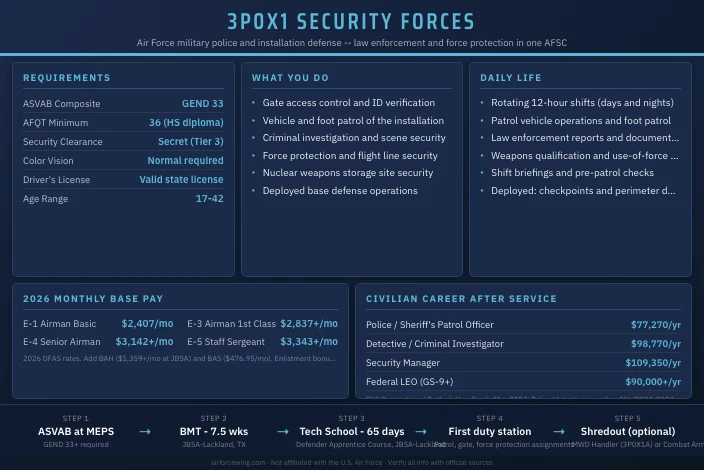
Security Forces Airmen serve as the Air Force’s combined law enforcement and installation defense force. They enforce federal law and the Uniform Code of Military Justice on Air Force installations, control base access, protect assets including nuclear weapons, respond to emergencies, and execute ground defense operations when installations come under threat.
Day-to-Day Duties
Most days in Security Forces rotate through a few core mission areas. Patrol is the baseline, vehicle and foot patrol of the installation, responding to incidents, conducting traffic stops, and enforcing installation regulations. At the entry control points, Security Forces Airmen screen vehicles and personnel coming onto base, verifying credentials and watching for threats. Gate guard sounds routine, but a busy Air Force installation processes thousands of people daily.
The law enforcement work goes beyond patrol. Security Forces Airmen respond to crimes, secure scenes, collect evidence, write reports, and process detainees. They apply civilian police procedures operating under both federal law and the UCMJ. Many units also maintain a desk function, dispatching patrols and coordinating with on-base agencies like the Office of Special Investigations.
Force protection missions are the other half of the job. These include defending flight lines, weapons storage areas, and critical infrastructure. At installations with nuclear weapons, Security Forces Airmen hold one of the most demanding security responsibilities in the U.S. military, the protocols are strict, the oversight is constant, and the stakes are obvious.
Specialized Roles
| Code | Title | Additional Training Required |
|---|---|---|
| 3P0X1 | Security Forces Specialist (Defender) | None beyond Defender apprentice course |
| 3P0X1A | Military Working Dog Handler | MWD handler apprentice course (post-Tech School) |
| 3P0X1B | Combat Arms | Combat arms apprentice course (post-Tech School) |
The Defender track is the baseline assignment and accounts for the largest share of billets. MWD Handlers work alongside trained patrol and detection dogs on specialized missions including narcotics and explosives detection and direct support to combat operations. Combat Arms Airmen qualify, maintain, and track every weapon system on an installation rather than running patrol.
Special Experience Identifiers (SEIs) are awarded to senior Security Forces personnel who complete specific mission qualifications. SEI 321 recognizes Security Forces Investigators who conduct criminal investigations at the staff sergeant level and above.
Mission Contribution
Security Forces protect the people, assets, and operations that make the Air Force function. Airpower depends on runways, aircraft, weapons, and the personnel who operate them. If those installations aren’t secured, the entire mission unravels. Security Forces are the layer of defense between an installation’s assets and every threat, criminal, terrorist, or conventional, that could compromise them. During overseas contingency operations, Security Forces Airmen have defended forward operating bases, conducted counter-IED patrols, and trained partner nation security forces.
Equipment and Technology
Security Forces Airmen work daily with standard-issue sidearms (M17 or M18 series pistol), M4 carbine, patrol vehicles, military working dogs, and portable radio systems. Force protection missions may involve crew-served weapons, vehicle-mounted systems, and night-vision equipment. Many installations use electronic access control systems and surveillance networks that Security Forces personnel operate and monitor. The work is both physical and technology-driven depending on the assignment.
Salary
Pay starts the moment you raise your right hand. An Airman Basic (E-1) earns $2,407 per month in base pay during Basic Military Training. By the time most Security Forces Airmen complete Tech School and reach their first unit, they’re collecting Senior Airman (E-4) pay or working toward it.
2026 Base Pay: Security Forces Career Path
| Rank | Grade | Monthly Base Pay |
|---|---|---|
| Airman Basic | E-1 | $2,407 |
| Airman | E-2 | $2,698 |
| Airman First Class | E-3 | $2,837 - $3,198 |
| Senior Airman | E-4 | $3,142 - $3,816 |
| Staff Sergeant | E-5 | $3,343 - $4,422 |
| Technical Sergeant | E-6 | $3,401 - $5,044 |
| Master Sergeant | E-7 | $3,932 - $5,537 |
| Senior Master Sergeant | E-8 | $5,867 - $7,042 |
| Chief Master Sergeant | E-9 | $7,182 - $8,248 |
Ranges reflect 0 to 20+ years of service per the DFAS 2026 military pay tables.
Base pay is only part of the picture. Most Security Forces Airmen living off base receive Basic Allowance for Housing (BAH), which varies by duty location and dependency status. A single E-4 at Joint Base San Antonio earns roughly $1,359/month in BAH; with dependents that figure rises to around $1,728/month. All enlisted Airmen also receive Basic Allowance for Subsistence (BAS) of $476.95/month.
Enlistment Bonus
3P0X1 is currently listed as a critical AFSC. Enlistment bonuses for Security Forces have reached up to $15,000 for four- and six-year contracts under recent Air Force incentive programs. Bonus availability shifts with recruiting cycles, so verify current amounts with an Air Force recruiter.
Additional Benefits
Healthcare through TRICARE Prime covers medical, dental, vision, mental health, and prescriptions at no cost to active-duty Airmen. Dental and vision carry no premium or copay. Prescription drugs through the Military pharmacy system are free.
The Post-9/11 GI Bill covers full in-state tuition at public universities after separation, plus a monthly housing allowance based on the school’s ZIP code. The private school annual cap is $29,920.95 for the 2025-2026 academic year. While on active duty, Air Force Tuition Assistance covers up to $4,500 per year toward a degree. Security Forces Airmen frequently use this to earn criminal justice credits that count toward civilian law enforcement applications.
Retirement under the Blended Retirement System combines a 20-year pension worth 40 percent of your high-36 average base pay with Thrift Savings Plan matching of up to 5 percent of basic pay. Active-duty Airmen also accrue 30 days of paid leave per year.
Qualifications
Security Forces requires a clean background, this is a law enforcement credential and the Air Force treats it as one.
Entry Requirements
| Requirement | Standard |
|---|---|
| ASVAB Composite | General (GEND) 33 minimum |
| Combat Arms shred (3P0X1B) | MECH 35 also required |
| Citizenship | U.S. citizen |
| Age | 17-42 at enlistment |
| Education | High school diploma (non-graduates need AFQT 65+) |
| Driver’s License | Valid state license required |
| Security Clearance | Secret (Tier 3 investigation) |
| Color Vision | Normal color vision required |
| Medical | No disqualifying physical or mental health conditions |
The GEND composite combines the Word Knowledge, Paragraph Comprehension, Arithmetic Reasoning, and Mathematics Knowledge subtests. A score of 33 is a relatively accessible threshold, the minimum AFQT for Air Force enlistment is 36, so most qualified applicants will already be close.
Background and Medical Disqualifiers
Security Forces has specific disqualifiers beyond the standard enlistment medical screen. The Air Force looks closely at history of drug or alcohol abuse, any documented gang affiliations, mood disorders, sleep disorders, ADD or ADHD, and any fear of heights or confined spaces. These screen-outs reflect the nature of the work: Security Forces Airmen carry firearms daily and make high-stakes law enforcement decisions under stress.
A Tier 3 National Agency Check, Local Agency Checks, and Credit Check (NACLC) investigation is required for the Secret clearance. An interim Secret may be granted at accession while the full investigation completes. Any criminal record, financial issues, or foreign contacts will be reviewed, they don’t automatically disqualify you, but they will be examined carefully.
Minor traffic offenses are generally not disqualifying, but a DUI, drug charge, or serious misdemeanor will require a waiver and may not be approvable. Be honest with your recruiter about your background before you enlist.
Application Process
The typical time from ASVAB to first duty station runs four to six months for Security Forces, assuming no pipeline hold-ups. The shred specialties (MWD, Combat Arms) add additional weeks after the Defender course.
Service Obligation
Enlisted Security Forces contracts are typically four or six years of active-duty service. Recruits enter service at the E-1 (Airman Basic) pay grade.
See our ASVAB study guide for strategies to hit these line scores.
Work Environment
Security Forces Airmen work rotating shifts around the clock. Installations never close, gates never close, and neither does the patrol schedule. Expect 12-hour shifts on a standard rotation, typically a pattern of days on and days off that cycles through days and nights. Panama and 4-10 schedule variations exist at different bases. Shift work is the norm, not the exception.
The physical environment varies with the assignment. CONUS bases mean patrol vehicles, gate booths, and controlled access points. Deployed environments mean tactical checkpoints, bunkers, and base perimeter operations in conditions ranging from desert heat to mountain cold. Security Forces Airmen who spend an entire career on active duty will almost certainly serve in both environments.
Leadership and Feedback
Security Forces units operate under a Flight structure: a Flight Commander (officer) leads each flight, with a Flight Sergeant (senior NCO) running day-to-day operations. The chain of command is direct and present. You’ll receive feedback through formal Enlisted Performance Reports (EPRs) annually, but in a law enforcement environment, performance gets evaluated on every incident response. Your supervisor sees your work in real time.
Performance in Security Forces gets measured on concrete outcomes: incident reports, use-of-force reviews, weapons qualification scores, physical fitness, and gate clearance rates. There’s limited room to hide mediocrity in a patrol job.
Team Structure
Security Forces Airmen typically work in partner pairs or small teams during patrol, but gate assignments may have you working independently for hours at a time. The job blends both, you need to trust your partner and operate alone when the situation demands it. Flight cohesion matters: you share the same shifts, same drills, and same deployments as your Flight.
Job satisfaction in Security Forces tends to be polarized. Airmen who thrive are drawn to the physical work, law enforcement mission, and operational variety. Those who struggle often cite the repetitive nature of gate guard and access control duties, which make up the majority of day-to-day shifts at most CONUS installations.
Training
Initial Training Pipeline
| Phase | Location | Length | Focus |
|---|---|---|---|
| Basic Military Training (BMT) | JBSA-Lackland, TX | 7.5 weeks | Military foundation, fitness, core Airman skills |
| Defender Apprentice Course (Tech School) | JBSA-Lackland, TX | 65 days (~13 weeks) | Law enforcement, force protection, weapons, tactics |
| MWD Handler Course (3P0X1A only) | Lackland / Detachment sites | Several weeks (varies) | K-9 patrol, detection, handler certification |
| Combat Arms Course (3P0X1B only) | JBSA-Lackland, TX | Several weeks | Weapons qualification, armory operations, small arms maintenance |
BMT and the Defender apprentice course run consecutively at the same installation, so Security Forces Airmen spend a significant stretch of their first year in San Antonio. The Defender course is deliberately demanding: physical fitness standards remain high throughout, and the attrition rate is higher than many other Tech Schools.
The apprentice course covers criminal law and procedures, use of force law, patrol tactics, vehicle operations, first aid, defensive driving, and qualification on standard Air Force weapons. Graduates earn college credits in criminal justice from the American Council on Education (ACE), which count toward a degree at most accredited universities.
Advanced Training
Security Forces Airmen can qualify for a range of follow-on courses throughout their career. Formal training opportunities include the Combat Application Training Course, the Security Forces Investigations Course, the USAF K-9 handler upgrade school, and various joint exercises and partner-nation training programs. Assignments to special units, including base defense squadrons deploying in a more tactical posture, come with additional pre-deployment training packages.
The Air Force also supports degree completion through Tuition Assistance. A criminal justice degree pursued while serving translates directly to civilian law enforcement hiring requirements. Federal agencies like the FBI, DEA, and Border Patrol all recognize the Air Force law enforcement background.
Everything starts with qualifying ASVAB scores. Our study guide covers what to study first.
Career Progression
Rank and Career Timeline
| Rank | Grade | Typical Time in Career |
|---|---|---|
| Airman Basic | E-1 | BMT only |
| Airman | E-2 | ~6 months |
| Airman First Class | E-3 | ~16 months |
| Senior Airman | E-4 | ~3 years |
| Staff Sergeant | E-5 | ~5-7 years |
| Technical Sergeant | E-6 | ~10-12 years |
| Master Sergeant | E-7 | ~15-17 years |
| Senior Master Sergeant | E-8 | ~18-20 years |
| Chief Master Sergeant | E-9 | ~22+ years |
Promotion to SSgt and above is competitive and based on a combination of EPR scores, decorations, education credits, and promotion test scores. Security Forces is a large career field with a consistent promotion pipeline, but competition stiffens above the E-5 level as the pyramid narrows.
Specialization Paths
Security Forces Airmen can pursue shredout qualifications (MWD Handler, Combat Arms) or earn SEI codes through specialized assignments. The SEI 321 (Security Forces Investigator) designation is earned by personnel who complete formal investigative training and serve in a criminal investigations billet at or above E-5. Personnel who complete combat-focused assignments may accumulate Combat Arms qualification badges and formal recognition in their records.
Senior NCOs often move into Flight Sergeant, Operations Superintendent, and First Sergeant roles. A handful pursue a commissioning path through Officer Training School, transitioning to Security Forces Officer (31P) billets.
Performance Evaluation
The Air Force evaluates enlisted personnel through the Enlisted Performance Report (EPR) system. EPRs are written annually and rated on a 1-5 scale. In Security Forces, the narrative reflects law enforcement performance, leadership of junior Airmen, professional military education completion, and fitness scores. A “4” or “5” EPR is required for promotion board consideration. The EPR covers the full reporting period, one strong quarter doesn’t erase a weak nine months.
Succeeding in Security Forces comes down to showing up physically ready, performing your law enforcement duties by the book, completing Professional Military Education (PME) on time, and earning your supervisor’s narrative. Airmen who also pursue criminal justice education and volunteer for additional duties, investigations, physical security augmentation, exercise planning, build records that stand out on promotion boards.
Physical Demands
Security Forces is one of the more physically demanding non-special operations career fields in the Air Force. The patrol cycle includes vehicle dismounts, foot patrol, pursuit on foot, detainee control, and the occasional use-of-force scenario. Force protection missions can require sustained physical effort under load in full body armor and battle rattle.
Air Force Fitness Assessment Standards
All Airmen take the Air Force Fitness Assessment (FA) annually. The FA is scored on a 100-point scale; the minimum passing composite score is 75. Each component has its own minimum that must be met regardless of the composite. The table below shows minimum passing scores for the under-25 age bracket.
| Component | Male (Under 25) Min | Female (Under 25) Min | Max Points |
|---|---|---|---|
| 1.5-Mile Run | 13:36 | 16:22 | 60 |
| Push-Ups (1 min) | 33 reps | 18 reps | 10 |
| Sit-Ups (1 min) | 38 reps | 38 reps | 10 |
| Waist Circumference | 35 inches | 31.5 inches | 20 |
Standards are age- and gender-normed. Security Forces Airmen are expected to consistently score well above minimums given the physical nature of their duties. Failing the FA triggers a fitness improvement program and can result in administrative separation or hold on promotion. For current official standards, verify with af.mil.
Medical and Ongoing Requirements
Security Forces Airmen receive standard annual medical evaluations as part of the military health system. Those assigned to nuclear weapons security programs undergo more frequent security and medical reviews. Combat Arms instructors are subject to annual hearing tests given weapons range exposure. The high physical demands of the job make musculoskeletal injuries, knee, ankle, and back, the most common occupational health concerns in the field.
Deployment
Security Forces deploy frequently. The career field has maintained a high operational tempo since 2001. Most active-duty Airmen can expect at least one overseas assignment or deployment in a first four-year contract, and multiple deployments are common across a career.
Deployment Patterns
Typical overseas deployments run four to six months, though the specific length depends on the theater and mission. Security Forces Airmen have deployed to the Middle East, Africa, and the Indo-Pacific region. Missions range from base defense at forward operating bases to theater security cooperation with partner nations. The nuclear security mission generates distinct deployment requirements for Airmen assigned to those programs.
Duty Stations
Security Forces billets exist at virtually every Air Force installation worldwide. Major assignment hubs include:
- JBSA-Lackland, TX: training base and large permanent party population
- Dyess AFB, TX / Ellsworth AFB, SD: B-1/B-21 bomber wings with significant SF requirements
- Minot AFB, ND: nuclear bomber and ICBM mission, among the most demanding SF assignments
- Ramstein AB, Germany / Misawa AB, Japan / Kadena AB, Japan: overseas permanent party
- Pope AAF, NC: airlift support, joint environment
Assignment preferences are submitted through Air Force Personnel Center (AFPC), but actual assignments depend on billet availability and career field manning. Security Forces is a large field with broad geographic coverage, there are few bases without a Security Forces squadron.
Risk/Safety
Security Forces is a law enforcement and armed security role. Daily weapons carry is standard. Use-of-force decisions are made in real time under legal authority, and those decisions carry legal weight.
Job Hazards
The risk profile varies by assignment. At a quiet CONUS installation, the primary daily hazards are traffic accidents during patrol and potential assault during law enforcement encounters. At deployed locations or nuclear weapons sites, the threat profile includes direct attack, IED exposure, and hostile action. Security Forces Airmen assigned to forward-deployed positions have taken casualties in combat operations.
Safety Protocols
Use-of-force training is continuous, not a one-time certification. Security Forces Airmen qualify on their service weapons at regular intervals and complete annual refresher training in defensive tactics and use of force law. Body armor, protective equipment, and tactical vehicles are standard gear for deployed missions. Every unit maintains a Safety program with scheduled inspections and incident reviews.
Security and Legal Requirements
The Secret clearance (Tier 3 NACLC investigation) is required before assignment to most Security Forces billets. Personnel assigned to nuclear security programs may require a higher-level clearance and are subject to the Personnel Reliability Program (PRP), which involves ongoing behavioral, medical, and psychological review. The PRP has strict standards and can remove personnel from nuclear duties for conditions that would not otherwise end a career.
Security Forces Airmen operate under both federal civilian law (Title 18 USC authority on military installations) and the UCMJ. Unlawful use of force, evidence mishandling, and procedure violations carry the same legal consequences as they would for a civilian law enforcement officer, sometimes more. Legal accountability is built into every shift brief.
Impact on Family
Shift work defines the Security Forces family experience more than almost any other factor. When you’re on nights, your family is on a different schedule. When your rotation shifts, everyone adjusts. It’s manageable, but it requires planning and communication that a standard 9-to-5 job doesn’t demand.
Deployments add the other major variable. A four-to-six-month deployment every two to three years is a reasonable expectation in this career field. Families have access to the Family Readiness program, Key Spouse networks, and Air Force Family Support Centers during deployments and reintegration. The Air Force has invested significantly in family support infrastructure, and Security Forces squadrons typically have active family programs given the high deployment tempo of the field.
Permanent Change of Station (PCS) moves happen on average every two to three years. Families relocate with the Airman, and the Air Force covers moving expenses through the Joint Travel Regulations. School transitions and spouse employment disruptions are real costs. On the positive side, large installations like JBSA-Lackland and Ramstein have well-developed infrastructure for military families: schools, childcare, medical, and recreation facilities all on or near base.
Housing on base or off is available at most installations. Security Forces shifts can make childcare logistics complicated, 12-hour nights don’t line up neatly with daycare hours. Many Security Forces families solve this through base Family Child Care providers or by working opposite schedules.
Reserve and Air National Guard
3P0X1 is available in both the Air Force Reserve (AFR) and the Air National Guard (ANG), and both components maintain active Security Forces squadrons with real law enforcement authority on their installations.
Reserve and Guard: What’s Different
Guard Security Forces units often carry a law enforcement mission for the state as well as the federal mission. Some Guard Airmen work as civilian law enforcement officers and serve in Security Forces on the same set of skills, the two careers reinforce each other directly. Reserve units also deploy in support of active-duty requirements and maintain the same weapons qualification standards.
Drill weekends typically follow the standard one weekend per month schedule. Some Security Forces units require additional training days beyond the standard schedule for range qualification, tactical exercises, or force protection certifications.
Reserve Compensation
An E-4 with less than two years of service earns roughly $3,142 per month on active duty. The same Airman serving in the Reserve earns approximately $251 per drill weekend (four drill periods at E-4 base pay divided across the month). Annual two-week training periods bring additional base pay.
Component Comparison
| Factor | Active Duty | Air Force Reserve | Air National Guard |
|---|---|---|---|
| Commitment | Full-time | 1 wknd/mo + 2 wks/yr | 1 wknd/mo + 2 wks/yr |
| Monthly Base Pay (E-4) | ~$3,142+ | ~$502/mo (2 weekends) | ~$502/mo (2 weekends) |
| Healthcare | TRICARE Prime (free) | TRICARE Reserve Select (premium) | TRICARE Reserve Select (premium) |
| Education | Federal TA + full GI Bill | Reduced GI Bill eligibility; Federal TA available | State tuition waivers (many states) + Federal TA |
| Deployment Tempo | High (multiple deployments expected) | Moderate (periodic mobilizations) | Moderate (federal and state activations) |
| Retirement | 20-year active pension (BRS) | Points-based Reserve retirement | Points-based Reserve retirement |
Guard Airmen in many states receive state tuition benefits in addition to federal education programs, a significant financial advantage for those pursuing criminal justice degrees concurrently with military service.
Civilian Career Integration
Civilian law enforcement and Security Forces part-time service are among the most naturally compatible combinations in the military. Reserve and Guard service strengthens federal law enforcement applications. Federal law under the Uniformed Services Employment and Reemployment Rights Act (USERRA) protects civilian jobs during activations, and many law enforcement agencies actively prefer candidates with military police backgrounds.
Post-Service
Security Forces training produces a direct civilian law enforcement credential. The Defender apprentice course is ACE-credited and widely recognized by civilian agencies as equivalent to a basic law enforcement academy. Many graduates walk into police hiring processes with their military experience doing most of the work for them.
Civilian Career Prospects
| Job Title | Median Annual Salary | Projected Growth (2024-2034) |
|---|---|---|
| Police and Sheriff’s Patrol Officer | $77,270 | +3% |
| Detectives and Criminal Investigators | $98,770 | +3% |
| Security Manager | $109,350 | +4% |
| Correctional Officer | $50,580 | -5% |
| Federal Law Enforcement Officer (GS-9+) | $90,000+ | Stable |
Wage data from the Bureau of Labor Statistics Occupational Outlook Handbook, May 2024. Approximately 62,200 police and detective job openings are projected annually through 2034.
Federal agencies. FBI, DEA, CBP, TSA, and the Air Force civilian police program, actively recruit Security Forces veterans. The federal LEO retirement system offers enhanced pension benefits compared to standard federal civilian retirement. Many Security Forces Airmen transition directly into federal law enforcement positions with preference points under the Veterans’ Preference Act.
For those who want to continue in government security, GS-0083 (Police) and GS-0085 (Security Guard) positions exist at installations worldwide. Criminal justice degrees, which many Security Forces Airmen complete while on active duty through Tuition Assistance, satisfy the educational requirements for GS-7 and above federal positions.
The transition assistance program (TAP) at every installation helps separating Airmen with resume translation, federal hiring process navigation, and law enforcement agency connections. Security Forces members with clean records, strong EPRs, and a criminal justice degree enter the civilian workforce with strong credentials on paper.
Is This a Good Job
Security Forces suits people who want physical work with a clear mission and real authority from day one. You carry a weapon, enforce the law, and make decisions that matter, sometimes under pressure. That appeals to a specific kind of person.
Who Thrives Here
The Airmen who do well in Security Forces generally have a few things in common. They’re comfortable with physical discomfort, standing gate guard in July heat or patrolling in body armor isn’t glamorous, and it takes up a lot more of the duty day than any recruiter brochure suggests. They’re detail-oriented about rules and procedures, because law enforcement work leaves no room for selective compliance. And they’re stable under pressure, the job includes situations that require calm, clear thinking when most people would panic.
A background or interest in criminal justice helps, but it isn’t required. Many Security Forces Airmen arrive with zero law enforcement experience and build the foundation entirely through military training.
Potential Challenges
The honest reality of Security Forces is that a significant portion of the job, at a typical CONUS assignment, is repetitive. Gate guard, access control, and routine patrol account for the majority of shifts. Airmen who enlist expecting constant tactical action will find most duty days considerably quieter. Deployments bring operational variety, but they also bring extended time away from home.
Shift work is a real lifestyle factor. Nights, weekends, and holidays are part of the rotation. The work-life rhythm is different from a Monday-Friday career field, and that affects families differently depending on their circumstances.
If your primary goal is a civilian law enforcement career, Security Forces is one of the most direct paths in the military. The training is law enforcement training, the experience is law enforcement experience, and federal agencies treat the background accordingly.
Career and Lifestyle Fit
Security Forces is worth pursuing if you want a federal law enforcement credential, can handle shift work and periodic deployments, and find the combination of patrol work and force protection missions genuinely interesting. It’s a poor fit if you want predictable hours, resent authority structures, or are looking for a technical specialty that leans heavily on STEM skills.
The career field produces strong civilian candidates, but only if you invest in your own development while you’re in. Airmen who complete a criminal justice degree, maintain a clean record, and earn strong EPRs have excellent post-service options. Those who coast through without building credentials are just another applicant.
More Information
Talk to an Air Force recruiter to confirm current 3P0X1 availability, bonus amounts, and shred preferences at the time you enlist. Bonus figures and billet availability shift frequently, and only a recruiter with access to current AFPC data can give you accurate information about what’s on the table right now. Bring your questions about the Security Forces and Guard options, civilian career goals, and prior background, the recruiter needs the full picture to advise you honestly.
Official resources for research and verification:
- JBSA-Lackland, TX Security Forces Training, Security Forces training runs at the same installation as BMT, making it one of the few AFSCs where trainees stay at Lackland through Tech School
- Department of Justice law enforcement careers, relevant for Airmen interested in post-service federal law enforcement with DOJ agencies
- airforce.com Security Forces overview, official recruiting entry requirements and career overview
Related career profiles on this site:
- Air Force Security Forces careers hub, all Security Forces AFSC profiles including shredout options within the 3P career group
- 3P0X1A Military Working Dog Handler, the MWD shredout for Defenders who want specialized K-9 operations assignments
Practical next steps:
The General (GEND) composite is the qualifying score for 3P0X1. It draws from Word Knowledge, Paragraph Comprehension, Arithmetic Reasoning, and Mathematics Knowledge. An ASVAB study guide covers all four subtests. If you want to practice before your official MEPS appointment, the PiCAT lets you test at home with a qualifying version of the exam.
Prior criminal history, even minor offenses, must be disclosed on your SF-86 background investigation form and may affect enlistment eligibility for this career field. Security Forces requires a security clearance investigation, and any adverse criminal background will be reviewed during that process. Discuss your specific situation with a recruiter before beginning the application process.
If a civilian law enforcement career is your post-service goal, confirm with your recruiter whether the criminal justice degree program through Community College of the Air Force is available to you through Tuition Assistance. Starting that degree during service puts you in a much stronger position when you apply to federal agencies after separation.
This site is not affiliated with the U.S. Air Force or any government agency. Verify all information with official Air Force sources before making enlistment or career decisions.
Explore more Air Force Security Forces careers.