3N1X1 Regional Band
Most people enlist in the Air Force to fix jets, defend bases, or write code. A small group auditions. The 3N1X1 Regional Band AFSC puts professional musicians in uniform, performing at military ceremonies, community concerts, and overseas tours while drawing a full Airman salary, health coverage, and retirement benefits. If you play at a high level and want a stable career in music without the grinding uncertainty of the civilian music industry, this is worth a serious look. Start with an ASVAB study guide to confirm your qualifying scores before scheduling your audition.
Qualifying requires specific ASVAB line scores. Our ASVAB study guide covers what to target and how to prepare.
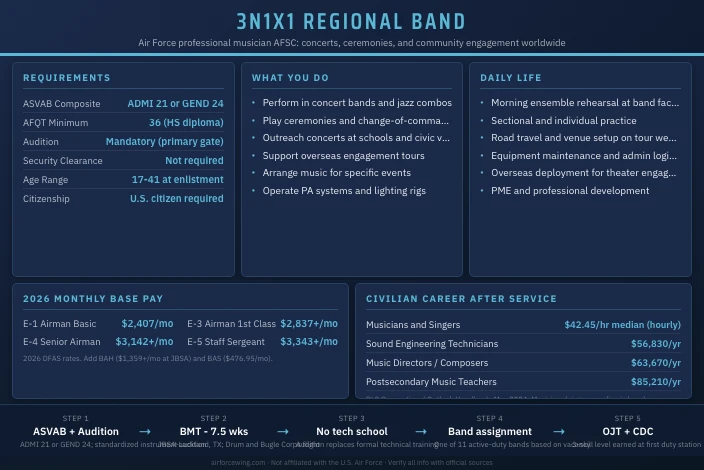
Job Role and Responsibilities
On any given week, a Regional Band Airman might play a full concert band program on Tuesday evening, a jazz combo set at a community event on Thursday, and a ceremonial march for a retirement ceremony on Friday morning. 3N1X1 Airmen perform as professional musicians in one of the Air Force’s active-duty bands, representing the service at events across the United States and internationally while supporting recruiting, retention, and community engagement missions.
Every musician in a Regional Band carries two sets of responsibilities: musical and administrative. On the musical side, that means rehearsals, individual practice, and full ensemble performances. On the administrative side, it means maintaining equipment, managing logistics for road trips, and occasionally handling the audio and lighting production for large-scale events.
Day-to-Day Responsibilities
A typical week in a Regional Band unit looks different from almost any other Air Force career field. Mornings often start with ensemble rehearsal. Afternoons shift to sectional practice or individual preparation. When the band has an event on the calendar, musicians spend road days traveling and setup days running sound checks and staging.
- Rehearse and perform in full concert bands, marching bands, jazz combos, and rock ensembles
- Play official ceremonies including change-of-command, retirement, and promotion events
- Perform community outreach concerts at schools, civic venues, and festivals
- Support international engagement tours and overseas Air Force installations
- Arrange music and develop programs tailored to specific events and audiences
- Operate and maintain audio equipment, stage lighting, and sound reinforcement systems
AFSC Codes and Specializations
The 3N1X1 code covers a wide range of instruments and roles. Every musician is assigned a shredout suffix that identifies their instrument or primary function.
| Suffix | Instrument or Role |
|---|---|
| 3N1X1A | Clarinet |
| 3N1X1B | Saxophone |
| 3N1X1C | Bassoon |
| 3N1X1D | Oboe |
| 3N1X1E | Flute |
| 3N1X1F | French Horn |
| 3N1X1G | Trumpet |
| 3N1X1H | Euphonium |
| 3N1X1J | Trombone |
| 3N1X1K | Tuba |
| 3N1X1L | Percussion |
| 3N1X1M | Piano |
| 3N1X1N | Guitar |
| 3N1X1P | Arranger |
| 3N1X1Q | Jazz Trumpet |
| 3N1X1R | Vocalist |
| 3N1X1S | String/Electric Bass |
| 3N1X1U | Drum Set |
| 3N1X1V | Audio Engineer |
Skill level suffixes follow standard Air Force enlisted progression: 3N131X (Apprentice), 3N151X (Journeyman), 3N171X (Craftsman), and 3N191 (Superintendent).
Mission Contribution
The Regional Band mission sits inside the Air Force public affairs enterprise. Bands serve as a direct link between the military and the communities around Air Force installations. A Regional Band concert at a high school gymnasium or a Fourth of July performance on the flight line builds public trust in ways that press releases cannot replicate. For recruiting, live music performances are one of the few tools the Air Force has to reach potential enlistees in their home communities in person.
Technology and Equipment
Musicians work primarily with their personal instrument, though the Air Force provides instruments for certain ensemble contexts and emergency replacements. Audio engineers and band support technicians operate professional-grade PA systems, digital mixing consoles, stage monitors, lighting rigs, and digital audio workstations. Marching and field ensembles use military percussion kits and portable sound systems designed for outdoor events.
Salary and Benefits
Pay follows the same military pay table that applies to every other Airman. There is no special pay specific to 3N1X1, but the total compensation package compares favorably to entry-level civilian music work when healthcare and housing are factored in.
Base Pay
| Rank | Pay Grade | Years of Service: 2 | Years of Service: 4 | Years of Service: 6 | Years of Service: 8 |
|---|---|---|---|---|---|
| Airman (Amn) | E-2 | $2,698 | $2,698 | $2,698 | - |
| Senior Airman (SrA) | E-4 | $3,303 | $3,659 | $3,816 | $3,816 |
| Staff Sergeant (SSgt) | E-5 | $3,599 | $3,947 | $4,109 | $4,299 |
| Technical Sergeant (TSgt) | E-6 | $3,743 | $4,069 | $4,236 | $4,613 |
Source: DFAS 2026 pay tables. Figures reflect the 2026 pay raise.
An E-4 Senior Airman with two years of service earns $3,303 per month in base pay. That is before housing and food allowances are added.
Allowances and Additional Compensation
- Basic Allowance for Housing (BAH): Varies by duty station and dependency status. An E-4 at Joint Base San Antonio earns $1,359 per month without dependents. Most band duty stations are at large installations in or near metropolitan areas, so BAH rates tend to be higher than the JBSA example.
- Basic Allowance for Subsistence (BAS): $477 per month for enlisted.
- Enlistment bonus: Not currently listed for this AFSC. Bonuses target high-demand technical specialties. Confirm current availability with a recruiter.
Additional Benefits
Active-duty Airmen receive TRICARE Prime at zero cost. Coverage includes medical care, mental health services, prescriptions, and hospitalization. Dental care at military treatment facilities is included. Annual eye exams and eyeglasses are available through MTF optometry at no charge.
The Post-9/11 GI Bill covers full in-state tuition at public universities, a monthly housing allowance tied to the E-5 BAH rate at the school’s ZIP code, and up to $1,000 per year in book stipends. Private school attendance is capped at $29,920.95 per academic year. Air Force Tuition Assistance covers up to $4,500 per year in off-duty college coursework while serving, with a per-credit-hour cap of $250.
Work-Life Balance
Band schedules are performance-driven rather than shift-driven. Most weeks follow a rehearsal-and-performance rhythm during normal duty hours. During peak performance seasons or touring periods, early calls and late evenings compress the schedule. Airmen in all career fields accrue 30 days of paid leave per year.
Qualifications and Eligibility
Entry into 3N1X1 requires passing standard Air Force enlistment screening and a competitive music audition. The audition is not a formality, seat openings are limited, and the Air Force selects only musicians who can perform at a professional level from day one.
Eligibility Requirements
| Requirement | Standard |
|---|---|
| Age | 17-41 at enlistment (must not reach 42 before shipping) |
| Citizenship | U.S. citizen |
| Education | High school diploma or GED |
| AFQT Minimum | 36 (HS diploma) / 65 (GED) |
| ASVAB Composite | ADMI 21 or GEND 24 |
| Audition | Mandatory standardized Air Force audition |
| Physical | Standard Air Force medical standards |
| Driver’s License | Required for government vehicle operation |
The ASVAB composite requirement for 3N1X1 (ADMI 21 or GEND 24) is among the lowest thresholds in the Air Force. Almost every candidate who passes the audition will clear the ASVAB bar. The audition is the actual selection gate for this career field. If you want to qualify faster, the PiCAT lets you test remotely before going to MEPS.
The Audition Process
The standardized Air Force music audition tests sight-reading ability, prepared repertoire, and ensemble compatibility. Auditions are evaluated by current band members and the band director. Candidates are expected to demonstrate proficiency comparable to a strong college-level player.
The audition typically includes:
- Prepared solo repertoire (requirements vary by instrument)
- Scales and technical exercises
- Sight-reading passages
- Ensemble excerpts appropriate to the instrument
Auditions only happen when a vacancy exists for a specific instrument at a specific band. Prospective candidates should work with a recruiter to confirm an open slot before preparing. Showing up to audition for a position that isn’t available wastes time on both sides.
Selection Criteria
Musicians selected for 3N1X1 typically have years of formal instruction and active ensemble experience, school bands, orchestras, community groups, or working bands. Vocalists need range, tonal control, and versatility across styles. Audio engineers need hands-on live production experience. The Air Force does not train entry-level musicians from scratch. You arrive ready to contribute.
Service Obligation
The initial enlistment is typically four years on active duty, with some six-year contract options available. Airmen enter service as Airman Basic (E-1) and follow standard enlisted promotion timelines.
Work Environment
Regional Band Airmen work primarily in performing arts environments: rehearsal halls, concert venues, community spaces, and outdoor stages. The job blends professional music performance with the structure and mission of the Air Force.
Setting and Schedule
Most of the workweek takes place indoors in a rehearsal facility or performance hall. Outdoor performances are regular, especially during summer concert seasons and major military celebrations. Travel is built into the job. Regional Bands tour within their geographic region and occasionally support events at other bases or overseas locations.
Work schedules follow the performance calendar rather than a fixed duty day. Rehearsal blocks are standard during the workday. Evening and weekend performances are common. The schedule looks more like a professional ensemble musician’s calendar than a conventional military day.
Leadership and Communication
Band units are led by an officer director, typically a senior captain or major with a graduate music degree, supported by a senior NCO staff. Because bands are small, every Airman interacts directly with leadership. Performance feedback is immediate and ongoing: the director evaluates every rehearsal and every performance in real time.
Team Dynamics and Autonomy
Regional Bands are tight by necessity. A 50-person ensemble that travels, rehearses daily, and performs publicly develops specific unit cohesion. Individual autonomy is higher than in many Air Force career fields, musicians are trusted professionals in their specialty, and leadership expects them to bring expertise to rehearsal without being managed at every step.
Job Satisfaction
Band Airmen consistently report strong career satisfaction, particularly those who have spent time in the civilian music market and understand what stable income and full benefits mean in comparison. Small unit size accelerates personal and professional relationships with leadership.
Training and Skill Development
Initial Training Pipeline
| Phase | Location | Length | Focus |
|---|---|---|---|
| Basic Military Training (BMT) | JBSA-Lackland, TX | 7.5 weeks | Core Airman skills; band candidates serve in the 737th TRG Drum and Bugle Corps flight |
| 3-Skill Level (OJT) | First duty station | Ongoing | Instrument qualification, Air Force band standards, unit mission readiness |
Unlike most Air Force AFSCs, 3N1X1 has no separate tech school following BMT. The audition replaces the technical training requirement. Airmen who pass have already demonstrated the foundational skill. The 3-skill level is awarded through on-the-job training at the assigned band. Use the time between enlistment and BMT to sharpen your instrument and confirm your ASVAB standing, the Air Force ASVAB study guide covers all the subtests that feed the GEND and ADMI composites.
During BMT at JBSA-Lackland, 3N1X1 candidates are assigned to the 737th Training Group Drum and Bugle Corps flight, a band-specific BMT track. You complete the full 7.5-week program, but your flight incorporates a performance component alongside the standard Airman training curriculum.
Advanced Training and Skill Development
After reporting to a Regional Band, Airmen complete a Career Development Course (CDC) covering Air Force band doctrine, music history, and administrative procedures. As they progress to the 5-level and 7-level, responsibilities expand to include section leadership, music arrangement, tour logistics, and mentoring junior musicians.
Musicians who develop arrangement skills can qualify for the 3N1X1P shredout, adding composition duties to their tasking. Audio engineers progress from standard PA operation to managing full concert-level production for large outdoor events.
The Air Force supports formal music education through both Tuition Assistance and the GI Bill, making it practical to complete a bachelor’s or graduate degree in music performance or education during a standard enlistment.
Career Progression and Advancement
Career advancement in 3N1X1 follows standard Air Force enlisted promotion timelines. Musicians who develop leadership and administrative skills within the band structure gain additional paths to senior NCO billets.
Promotion Timeline
| Grade | Title | Typical Time-in-Service |
|---|---|---|
| E-1 | Airman Basic (AB) | Entry |
| E-2 | Airman (Amn) | 6 months |
| E-3 | Airman First Class (A1C) | 16 months |
| E-4 | Senior Airman (SrA) | ~3 years |
| E-5 | Staff Sergeant (SSgt) | ~5 years (board-selected) |
| E-6 | Technical Sergeant (TSgt) | ~12 years (board-selected) |
| E-7 | Master Sergeant (MSgt) | ~17 years (board-selected) |
| E-8 | Senior Master Sergeant (SMSgt) | 20+ years |
| E-9 | Chief Master Sergeant (CMSgt) | 22+ years |
Promotions to E-5 and above require board selection. Enlisted Performance Reports, time-in-grade, and professional military education all factor into the board score.
Performance Evaluation
The EPR system scores Airmen on five performance factors on a 1-5 scale. In a band unit, musical performance quality directly shapes EPR narratives. A musician who anchors their section, handles solo repertoire professionally, and actively mentors junior members generates stronger bullets than one who simply shows up to rehearsal. The small unit size means contributions and shortfalls are both visible.
Role Flexibility
Retraining out of 3N1X1 to a different AFSC requires an approved retraining application and meeting the ASVAB composites for the target career field. Most band Airmen who retrain do so after completing a full first enlistment. Cross-training opportunities are available but competitive.
Musicians aiming for the senior NCO track should target the 3N191 (Superintendent) designation, which requires 7-level qualification and demonstrated experience directing band administrative functions. The 3N100 Band Manager position, a CMSgt billet, exists at only a handful of units Air Force-wide and represents the apex of the career field.
Keys to Advancement
Show up to rehearsal prepared. Volunteer for additional performances and solo opportunities. Develop a secondary skill such as arrangement, audio production, or administration. Complete PME (Professional Military Education) courses at each career stage. These are the inputs that drive EPR bullets and board scores. Musicians who treat the career field as purely artistic, without investing in the military development side, plateau well below their potential.
Physical Demands and Medical Evaluations
Physical Requirements
The 3N1X1 AFSC does not carry the extreme physical demands of combat or maintenance specialties, but all Airmen complete the Air Force Fitness Assessment annually regardless of career field. Physical demands of band work include extended standing during concerts, carrying and setting up heavy equipment, and outdoor performances in heat, cold, or wind. Percussionists and tuba players manage significant instrument weight during marching events.
Air Force Fitness Assessment Standards
| Component | Maximum Points | Notes |
|---|---|---|
| 1.5-Mile Run | 60 | Primary aerobic component |
| Waist Circumference | 20 | Body composition component |
| Push-Ups (1 min) | 10 | Muscular fitness |
| Sit-Ups (1 min) | 10 | Muscular fitness |
| Total | 100 | 75 minimum to pass |
Scoring is age- and gender-normed. A composite score of 75 passes; 90 and above earns an Excellent rating. Current standards for each age and sex bracket are published on af.mil. Component minimums must also be met, a high run score cannot compensate for a failing waist measurement.
Medical Evaluations
Standard MEPS physical at accession. No instrument-specific medical requirements beyond normal enlistment standards. Auditory health is practically critical for this career field even without a formal audiological entry standard. Musicians with hearing concerns should address them before beginning the audition process.
Deployment and Duty Stations
Duty Station Options
Regional Band Airmen are assigned to one of the Air Force’s active-duty regional bands, each at a major installation covering a specific geographic region or overseas theater. The separate 3N2X1 Premier Band at Joint Base Anacostia-Bolling, DC is a distinct AFSC and is not included here.
| Band | Location |
|---|---|
| USAF Band of Flight | Wright-Patterson AFB, OH |
| USAF Band of the Golden West | Travis AFB, CA |
| USAF Band of Mid-America | Scott AFB, IL |
| USAF Band of the Pacific, Hawaii | Joint Base Pearl Harbor-Hickam, HI |
| USAF Band of the Pacific, Asia | Yokota AB, Japan |
| USAF Band of the West | JBSA-Lackland, TX |
| USAF Heartland of America Band | Offutt AFB, NE |
| USAF Heritage of America Band | Joint Base Langley-Eustis, VA |
| USAFE Band | Germany |
| USAF Central Command Band | Al Udeid AB, Qatar |
Assignment depends on which band has an opening in your instrument. Your instrument, audition result, and current vacancy list determine where you go, geographic preference is a secondary factor.
Deployment Details
Regional Band Airmen deploy less frequently than most Air Force career fields. Deployments support overseas engagement missions, Joint Force exercises, and international ceremonies rather than combat operations. The USAFE Band in Germany and the USAF Central Command Band conduct the most frequent overseas tours in support of theater commander requirements. Deployment lengths vary but tend to be shorter than the standard 120-180 day cycles common in operational specialties.
Risk, Safety, and Legal Considerations
Job Hazards
The primary occupational hazard in 3N1X1 is noise-induced hearing loss from sustained exposure to high sound pressure levels during rehearsal and performance. Indoor rehearsal rooms routinely reach 90-100 dB, above the 85 dB time-weighted average threshold used by both OSHA and the Air Force Hearing Conservation Program. Brass and percussion sections are the most exposed. Unlike industrial noise, musical sound pressure is variable and hard to predict, which makes consistent protection more important than in a factory setting. Physical risks include musculoskeletal strain from instrument carrying and stage setup, slips on wet outdoor stages, and vehicle incidents during road tours.
Safety Protocols
All band vehicles operate under standard Air Force vehicle safety requirements. Equipment setup (truss loading, outdoor stage rigging, electrical connections for amplification) follows unit safety SOPs and must be signed off by an NCO before each event. Wet stage policies require immediate shutdown of electrical equipment and may cancel an outdoor performance entirely. The Air Force Hearing Conservation Program requires annual audiometric testing for all 3N1X1 Airmen. Musicians are issued custom-fitted musician earplugs (typically Etymotic or equivalent) that attenuate volume evenly across frequencies, preserving musical fidelity far better than standard industrial foam plugs. Wearing them during high-decibel rehearsals is strongly encouraged and increasingly mandated by unit policy.
Security Requirements
3N1X1 does not require a security clearance for basic AFSC award. Overseas assignments, particularly the USAFE Band in Germany, may involve access requirements depending on installation-specific policies. A recruiter working a specific vacancy can clarify whether clearance work is needed for that position.
Impact on Family and Personal Life
Family Considerations
Band duty stations are at permanent, established Air Force installations with full on-base support infrastructure. Families have access to on-base housing, commissary and exchange services, TRICARE coverage, and the complete range of Military OneSource resources. The touring schedule is the biggest variable for families. Domestic tours typically last one to two weeks and happen multiple times per year, while international tours can run up to 30 days. Evening and weekend performances are common, especially during holiday seasons and community event cycles, so childcare planning around the performance calendar is essential. Families enrolled in the Exceptional Family Member Program (EFMP) benefit from the stability of fixed duty stations, since band billets rarely trigger involuntary PCS moves that could disrupt specialized care arrangements.
Relocation
PCS moves in 3N1X1 are less frequent than in many other AFSCs because band billets are fixed and limited. Some Airmen spend most or all of an enlistment at their initial duty station, which provides unusual stability for school-age children. Enrollment continuity is a genuine quality-of-life advantage in a military career. Spouses also benefit from the predictability, since staying at one installation long enough to build a civilian career or finish a degree is more realistic in this AFSC than in most others. When openings appear at other bands, the process requires both a formal assignment request and confirmation that your instrument fills the new unit’s need.
Reserve and Air National Guard
Component Availability
The Reserve component has always had limited 3N1X1 positions given the small active-duty footprint of the career field. Reserve musicians who do serve typically fill administrative and support roles alongside active-duty band members.
Part-Time Pay
An E-4 Senior Airman in a Reserve band position earns pay for four Inactive Duty Training (IDT) periods per standard drill weekend. At the 2026 E-4 base rate of $3,142 per month (under 2 years), a drill weekend yields roughly $419. Annual training adds two full weeks of daily pay on top of that.
Benefits Comparison
| Factor | Active Duty | Air Force Reserve |
|---|---|---|
| Commitment | Full-time | Part-time (limited positions) |
| Monthly Pay (E-4, under 2 yrs) | $3,142 | ~$419/drill weekend |
| Healthcare | TRICARE Prime (free) | TRICARE Reserve Select (premiums apply) |
| Education | TA + Post-9/11 GI Bill (Ch. 33) | Montgomery GI Bill - Selected Reserve (Ch. 1606) |
| Retirement | BRS pension + TSP at 20 years | Points-based; pays at age 60 |
| Deployment Tempo | Low | Very low |
| ANG Availability | N/A | All ANG bands inactivated (Apr 2024) |
The Blended Retirement System pension pays 40% of the average high-36 basic pay after 20 years, plus TSP matching up to 5% of basic pay. Reserve retirement uses a points-based formula and pays out at age 60.
Post-Service Opportunities
Civilian Transition
3N1X1 veterans enter the civilian workforce with verified professional performance experience, ensemble leadership credentials, and in many cases a degree completed during service. Those are concrete assets in a competitive music job market. For audio engineers in the 3N1X1V shredout, civilian opportunities are broader and more stable: live sound, recording studio work, broadcast audio, and corporate AV production all value proven military production experience.
Civilian Career Prospects
| Civilian Career | Median Pay | Job Outlook (2024-2034) |
|---|---|---|
| Musicians and Singers | $42.45/hr (most work part-time or intermittently) | +1% (slower than average) |
| Music Directors and Composers | $63,670/yr | Little to no change |
| Sound Engineering Technicians | $56,830/yr | +2% (as fast as average) |
| Postsecondary Music Teachers | $85,210/yr | Positive growth |
Career outlook figures are drawn from the U.S. Bureau of Labor Statistics Occupational Outlook Handbook (May 2024). Musician figures reflect the median hourly rate; most civilian performers work part-time or combine multiple income sources rather than holding a single full-time position.
Military performance experience translates well into music education. Many 3N1X1 veterans pursue teaching credentials and enter K-12 or university programs after separation. The GI Bill fully covers a teaching certification program or a graduate degree in music education.
The Transition Assistance Program (TAP) provides resume writing, interview prep, and employer connections starting 12 months before separation. Hiring Our Heroes and VA education counseling offer additional support for musicians transitioning into civilian careers.
Is This a Good Job for You? The Right (and Wrong) Fit
Who Thrives in 3N1X1
The ideal candidate has been playing seriously for at least five to seven years, performs regularly in community or collegiate ensembles, and wants a stable professional music career without the income swings of freelancing. Confirm your ASVAB scores early so the audition is the only gate left. If you’ve watched talented friends grind through gigging and adjuncting while wondering how to cover rent, the Regional Band model looks very different.
This job also suits musicians who enjoy performance variety. You will play symphonic band repertoire, jazz sets, pops concerts, and marching events, sometimes in the same week. Performers who insist on a single genre will find the breadth frustrating rather than rewarding.
Potential Challenges
3N1X1 is a poor fit for Airmen who want rapid advancement, high operational tempo, or frequent duty station changes. Promotion timelines mirror every other enlisted career field, musical talent does not accelerate the board. Musicians uncomfortable with the military environment, chain of command, uniform standards, fitness requirements, physical training, will find the job harder than they expected.
Instrument openings are limited. Oboe, bassoon, and French horn players may wait longer for an audition opportunity than trumpet or clarinet players. Players of less common instruments need to be patient and flexible about assignment location.
Long-Term Fit
For musicians who want a 20-year career, 3N1X1 offers a compelling model. A military pension, lifetime healthcare access at retirement, and the financial stability of two decades of service is difficult to match in civilian music. For those who serve one or two enlistments, the combination of performance experience, GI Bill benefits, and a professional network from military music is a real foundation for what comes next.
More Information
Talk to an Air Force recruiter specifically about open 3N1X1 instrument vacancies. Because audition opportunities are tied to current band seat openings, timing matters, a position that doesn’t exist today may open in three to six months. A recruiter with access to the band assignment system can give you a realistic timeline for your instrument.
Before that conversation, confirm you clear the ASVAB composite minimum. The threshold is low, but use an Air Force ASVAB prep guide to eliminate that variable early. Use the preparation window to sharpen your instrument to audition-ready level, both happen in parallel. Recruiting contacts are available at airforce.com.
This site is not affiliated with the U.S. Air Force or any government agency. Verify all information with official Air Force sources before making enlistment or career decisions.
Explore more Air Force public affairs careers such as 3N0X6 Public Affairs.