3N0X6 Public Affairs
Most Airmen never have a camera pointed at them. Public Affairs Airmen are the ones holding it. The 3N0X6 Public Affairs AFSC is the Air Force’s sole enlisted specialty for media and communications, covering writing, broadcast production, and photography inside one consolidated career field. Graduates of the Defense Information School at Fort George G. Meade, Maryland, deploy to every theater the Air Force operates in, documenting missions, managing press relationships, and shaping how the public understands American airpower. If you want a military job that builds a real civilian media skill set that translates directly into journalism, public relations, or broadcast production, this is the most direct path the Air Force offers.
Qualifying requires specific ASVAB line scores. Our ASVAB study guide covers what to target and how to prepare.
Job Role
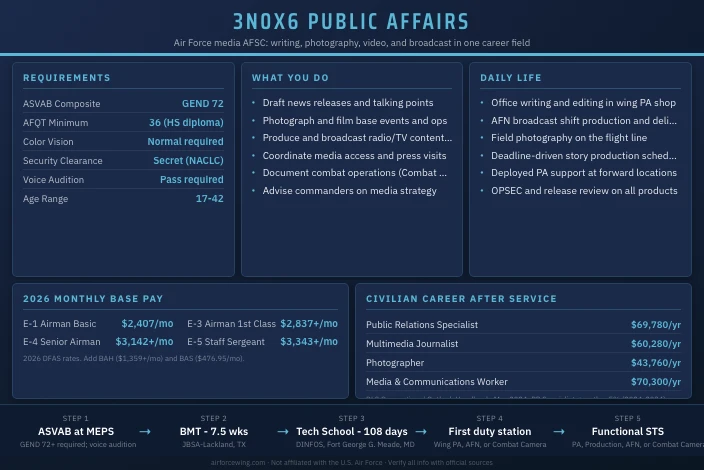
3N0X6 Public Affairs Airmen plan, produce, and distribute communications content on behalf of the Air Force. They write news releases, shoot still and video imagery, produce broadcast segments, manage social media platforms, and serve as the primary liaison between Air Force commanders and media organizations. At deployed locations, they document combat and humanitarian operations. Stateside, they run installation newspapers, TV stations, and public affairs offices that respond to media inquiries around the clock.
The day-to-day work spans three disciplines that every 3N0X6 Airman trains in before specializing at their unit.
Writing and Media Relations
Airmen in this track draft news releases, develop talking points for commanders, and coordinate interviews with civilian reporters. They monitor local and national coverage of their installation, brief leadership on press activity, and respond to Freedom of Information Act requests. Strong deadline writing and comfort with being grilled by a journalist are both job requirements, not optional.
Broadcast and Radio/TV Production
American Forces Radio and Television Service (AFRTS) detachments operate at bases worldwide, and 3N0X6 Airmen staff them. Tasks include anchoring news segments, producing radio programs, editing video packages, and operating studio equipment. Voice auditions are required during the accession process. This track is not open to candidates who can’t meet broadcast speech standards.
Visual Information and Photography
Still and video documentation of Air Force operations falls to this track. Airmen shoot unit exercises, official ceremonies, congressional visits, and combat operations when deployed. Their imagery feeds Air Force news outlets, Defense Visual Information Distribution Service (DVIDS), and national media pools. Combat camera assignments within this track are among the most demanding and most sought-after positions in the career field.
AFSC Codes and Shredouts
The 3N0X6 code replaced three legacy codes in 2020: 3N0X1 (Public Affairs writer), 3N0X2 (Broadcast Journalist), and 3N0X5 (Photojournalist). All Airmen now enter under the single 3N0X6 designation. Skill level suffixes follow standard Air Force progression: 3N031 (Apprentice), 3N051 (Journeyman), 3N071 (Craftsman), and 3N091 (Superintendent).
Salary
Base pay is set by rank and years of service, and it applies uniformly across all Air Force career fields. These are 2026 DFAS rates.
| Rank | Grade | Monthly Base Pay (Entry) |
|---|---|---|
| Airman Basic | E-1 | $2,407 |
| Airman | E-2 | $2,698 |
| Airman First Class | E-3 | $2,837 |
| Senior Airman | E-4 | $3,142 |
| Staff Sergeant | E-5 | $3,343 |
| Technical Sergeant | E-6 | $3,401 |
Base pay is only part of total compensation. Most Airmen living off-base receive Basic Allowance for Housing (BAH), which varies by duty station, pay grade, and dependent status. At a mid-tier installation like Joint Base San Antonio, an E-4 without dependents receives roughly $1,359/month in BAH. Add Basic Allowance for Subsistence (BAS) of $476.95/month and total monthly compensation for a junior Airman reaches well above their base pay figure.
Healthcare and Education
Active-duty Airmen and their families receive TRICARE Prime coverage with no enrollment fee, no deductibles, and zero copays for most care. That includes medical, dental, vision, prescriptions, and mental health services.
The Post-9/11 GI Bill covers full in-state tuition at public universities after three years of active service, plus a monthly housing stipend based on the E-5 BAH rate at the school’s ZIP code. Annual book stipends run $1,000. For private schools, the annual cap is $29,920.95 for the 2025-2026 academic year. Tuition Assistance (TA) lets Airmen pursue degrees while on active duty, covering up to $4,500 per year toward tuition at $250 per semester hour.
Retirement
The Blended Retirement System (BRS) combines a 20-year pension worth 40% of the average of your highest 36 months of basic pay with a Thrift Savings Plan (TSP) component. The Air Force contributes 1% of basic pay automatically and matches up to 4% of what you contribute, for a total of up to 5% if you’re maximizing contributions.
Leave
Active-duty Airmen earn 30 days of paid leave per year at an accrual rate of 2.5 days per month. Combined with 11 federal holidays, the annual time-off package exceeds most private-sector positions.
Qualifications
The 3N0X6 AFSC has a higher ASVAB threshold than many enlisted specialties because it selects for verbal, reasoning, and communications skills.
| Requirement | Standard |
|---|---|
| ASVAB Composite | General (GEND): 72 minimum |
| AFQT Minimum | 36 (high school diploma); 65 (GED or non-graduate) |
| Citizenship | U.S. citizen |
| Age | 17-42 at enlistment |
| Color Vision | Normal required |
| Speech | No speech impediments; must speak clearly and distinctly |
| Driver’s License | Valid state license required |
| Security Clearance | National Agency Check with Local Agency Checks and Credit (NACLC): Secret |
The General (GEND) composite draws from four ASVAB subtests: Word Knowledge, Paragraph Comprehension, Arithmetic Reasoning, and Mathematics Knowledge. A score of 72 puts you well above the minimum required for most enlisted jobs, so you’ll need focused prep on the verbal subtests in particular. An Air Force ASVAB study guide can help you target the right sections.
The voice audition requirement is real and non-waivable for candidates pursuing broadcast assignments. Recruiters can assess this early in the process, so don’t wait until MEPS to find out.
Application Process
Service Obligation
Initial enlistment is typically four years for active-duty 3N0X6 Airmen.
Competitiveness
The GEND 72 threshold screens out candidates with weak verbal scores. People who read widely, write clearly, and have any background in school journalism, photography, or broadcasting have an advantage in both selection and Tech School performance.
Work Environment
Public affairs units are small. A typical base public affairs office might have six to twelve Airmen covering an installation of thousands. That ratio means junior Airmen carry real responsibility quickly. You’re not hidden in a large section waiting for assignments to trickle down.
Setting and Schedule
Stateside assignments split time between an office environment (writing, editing, planning events) and field work: covering exercises, unit activities, and installation events with a camera or a notebook. When a base is in the news, the hours get long fast. Deployed environments are more unpredictable. You might be embedded with a unit, operating out of a DFAC, or supporting a joint task force public affairs shop depending on the mission.
There’s no standard shift structure in public affairs the way there is in maintenance or medical. Events drive the schedule. Congressional visits, change-of-command ceremonies, air shows, and press inquiries don’t follow a nine-to-five clock.
Team Dynamics
Public affairs Airmen work in tight teams under the direct supervision of a commissioned officer (usually a 35P Public Affairs Officer). The relationship between enlisted specialists and their PAO shapes daily work significantly. Junior Airmen typically own a specific functional area (the base newspaper, social media, or broadcast) while the NCOIC coordinates across all functions and manages relationships with media and the command.
Performance Feedback
Performance is tracked through the Enlisted Performance Report (EPR) system. EPRs are written annually and assess job performance, leadership, and professional development. In a small career field with a visible output, it’s easy for a supervisor to point to specific products (a news release that got national pickup, a photo package that ran on DVIDS) when writing your EPR bullets. That visibility cuts both ways.
Training
Initial Training Pipeline
| Phase | Location | Length | Focus |
|---|---|---|---|
| Basic Military Training (BMT) | JBSA-Lackland, TX | 7.5 weeks | Military fundamentals, physical training, weapons qualification |
| Technical School (DINFOS) | Fort George G. Meade, MD | ~108 days | Writing, broadcast production, photography, media relations, digital content |
The Defense Information School (DINFOS) is a joint-service schoolhouse operated by the Defense Media Activity. Air Force, Army, Navy, Marine Corps, and Coast Guard students all attend the same courses, which means you’re building professional contacts across the services from day one.
The Basic Public Affairs Specialist (BPAS) course at DINFOS covers:
- News writing and editing under deadline
- Broadcast journalism fundamentals (scripting, on-camera delivery, audio production)
- Still photography and video production
- Social media strategy and digital content
- Media relations and press event management
- Visual information release procedures and copyright law
Completing DINFOS awards the 3N031 (Apprentice) skill level and partial college credit toward a Mass Communications degree at some institutions.
Advanced Training
After reaching the journeyman skill level (3N051), Airmen can pursue:
- Intermediate Public Affairs Specialist Course (IPASC): a two-week course at DINFOS for NCOs focused on media operations management
- Content Management Course: four weeks covering digital content strategy and multimedia production
- Additional combat camera and visual information certifications depending on unit requirements
- Defense Information School senior-level courses for TSgt and above
The Air Force also supports off-duty education through Tuition Assistance. Journalism, communications, and mass media degree programs are natural fits that directly reinforce job skills.
Everything starts with qualifying ASVAB scores. Our study guide covers what to study first.
Career Progression
| Rank | Typical Time-in-Grade | Career Milestone |
|---|---|---|
| Airman Basic (E-1) | 6 months | BMT graduation; enter DINFOS |
| Airman First Class (E-3) | ~6 months post-Tech School | First duty assignment, 3N031 skill level awarded |
| Senior Airman (E-4) | ~3 years total service | 5-skill level (3N051) upgrade complete |
| Staff Sergeant (E-5) | ~5-6 years total service | NCOIC responsibilities, first leadership billet |
| Technical Sergeant (E-6) | ~10-12 years | Section Chief or Flight NCOIC, IPASC completion |
| Master Sergeant (E-7) | ~15-16 years | Senior PA NCOIC, wing-level PA shop |
| Senior Master Sergeant (E-8) | ~18-20 years | Superintendent track |
| Chief Master Sergeant (E-9) | ~22+ years | Career field functional manager |
Promotion to Senior Airman (E-4) is largely time-based. Staff Sergeant (E-5) and above are competitive, with points coming from EPR ratings, decorations, professional military education (PME), and time-in-grade. In a visible, product-driven career field like public affairs, high-quality work gets noticed and documented.
Specialization Opportunities
Within the 3N0X6 career field, Airmen often develop functional specialties based on unit assignment and personal aptitude:
- Combat camera assignments document operations in austere and deployed environments
- AFRTS broadcast positions at American Forces Radio and Television Service stations worldwide
- Wing-level PAO support focusing on media relations and commander communication
- Joint assignments at combatant commands, the Pentagon, or international headquarters
There’s no separate shredout code for these tracks. They’re managed through assignment preferences and unit needs, not formal AFSC designators.
Retraining and Transfers
Airmen can apply for AFSC retraining after completing their initial skills training and serving a minimum time in their current specialty. Given the broad skill set 3N0X6 builds (writing, digital production, communications strategy), retraining into a related field or transitioning to civilian work is a common outcome.
Physical Demands
Day-to-day physical demands in public affairs are moderate. Most work involves office-based writing and editing, studio production, or field photography. Deployed assignments can be more physically demanding, involving camera equipment loads, movement with ground units, and austere operating conditions.
All Airmen must pass the Air Force Fitness Assessment (FA) annually. The FA is the same for all Airmen regardless of AFSC.
| Component | Max Points |
|---|---|
| 1.5-Mile Run | 60 |
| Push-Ups (1 minute) | 10 |
| Sit-Ups (1 minute) | 10 |
| Waist Circumference / Body Composition | 20 |
| Total | 100 |
Minimum composite passing score is 75. Each component has its own floor, and failing a single component fails the overall assessment regardless of the total score. Standards are age- and gender-normed. For current scoring tables by age and gender bracket, see official Air Force fitness assessment guidance.
Normal color vision is required for this AFSC due to photography, video production, and color-accurate media work. This is tested at MEPS and is not waivable.
Medical Evaluations
Beyond MEPS screening, Airmen undergo periodic medical exams throughout their service. No special flight or altitude physicals are required for 3N0X6. The clearance investigation process includes a credit and background review, and maintaining financial responsibility is part of keeping the NACLC current.
Deployment
Deployment Patterns
Public affairs Airmen deploy regularly. The Air Force embeds PA specialists with combat and humanitarian operations, and the demand for documentation and media support at deployed locations is constant. Typical deployments run six months, though shorter rotational assignments of 90 to 120 days also exist at some locations.
Deployment frequency depends on unit and career stage. Airmen at operationally focused wings deploy more often. Combat camera assignments have some of the highest deployment rates in the career field.
Duty Stations
3N0X6 Airmen are assigned to bases with active public affairs offices, which covers virtually every major Air Force installation. Common assignment locations include:
- Joint Base San Antonio-Lackland, TX (Air Force Public Affairs Agency)
- Pentagon, Arlington, VA (Air Force Media Operations Center)
- Joint Base Langley-Eustis, VA
- Joint Base Pearl Harbor-Hickam, HI
- Ramstein AB, Germany (USAFE)
- Kadena AB, Japan (PACAF)
- AFRTS stations in the Pacific, Europe, and CONUS
Assignment preferences can be submitted through the Air Force assignment system, but the needs of the Air Force drive final placement. Overseas tours typically run two to three years.
Risk/Safety
The most significant hazard in public affairs comes with combat camera and deployed assignments. Airmen documenting operations in conflict zones face the same environmental and security risks as any deployed Airman. Media operations in austere environments require sound tactical awareness even for non-combat specialists.
Stateside, the job involves minimal physical hazard. Studio environments and office settings are the norm. Equipment handling (cameras, lighting rigs, broadcast gear) carries the usual care-and-maintenance obligations.
Security and Legal
The NACLC investigation grants access to Secret-level material. Airmen working with sensitive imagery, command communications, and pre-release information are responsible for handling that material correctly. Unauthorized disclosure of classified or pre-decisional information is a serious legal matter under both military law and the UCMJ.
Visual information products, photography, video, graphics, carry intellectual property and release authority considerations. All imagery intended for public release must go through the Defense Visual Information Distribution Service (DVIDS) clearance process. Airmen learn this process at DINFOS, but compliance responsibility doesn’t end at Tech School.
Impact on Family
Public affairs units are small, and small units can create tight-knit communities or tight workloads, sometimes both. When a major story breaks or a high-visibility event is on the calendar, the hours extend without much notice. Families should understand that the schedule in this field is event-driven, not clock-driven.
Permanent Change of Station (PCS) moves happen every two to four years on average. Overseas tours at AFRTS stations in Japan or Germany mean significant relocation for families. Military families living overseas access DoD Dependents Schools (DoDDS) and on-base support services, but the adjustment period is real.
On the positive side, the public affairs community is well-connected within the service. Strong networks across installations mean resources like the Airman and Family Readiness Center, Military OneSource, and chaplain services are consistently available. The TRICARE coverage that comes with active-duty service includes dependents at no cost, which removes one major financial stressor.
Deployment periods are the hardest stretch for most families. Six months is a long time. Units typically have Family Readiness programs that help spouses and dependents stay connected and informed during a deployment cycle.
Reserve and Air National Guard
The 3N0X6 AFSC is available in both the Air Force Reserve and the Air National Guard (ANG). Many state National Guard units maintain public affairs shops staffed by traditional Guardsmen, these are real, functioning units that support both state emergency missions and federal deployments.
Drill Schedule
The standard Reserve/Guard commitment is one weekend per month (Unit Training Assembly, or UTA) plus two weeks of Annual Tour. Public affairs units often require additional training days for exercises and skill certification beyond the standard schedule.
Part-Time Pay
An E-4 in the Reserve or Guard earns pay for drill weekends based on active-duty base pay prorated by the number of daily training periods (four per weekend). At the 2026 E-4 base rate of $3,142/month, a drill weekend earns roughly $314 (four IDT periods at 1/30th of monthly pay each).
| Component | Commitment Model | Monthly Pay (E-4) | Healthcare | Education | Retirement |
|---|---|---|---|---|---|
| Active Duty | Full-time | $3,142 base | TRICARE Prime (free) | Full GI Bill + TA | 20-year pension (BRS) |
| Air Force Reserve | 1 wknd/mo + 2 wks/yr | ~$314/drill wknd | TRICARE Reserve Select (premium-based) | Federal TA; GI Bill on activation | Points-based Reserve retirement |
| Air National Guard | 1 wknd/mo + 2 wks/yr | ~$314/drill wknd | TRICARE Reserve Select; state tuition waiver (varies) | State tuition waivers vary; Federal TA | Points-based Reserve retirement |
Benefits Differences
Reserve and Guard Airmen pay premiums for TRICARE Reserve Select, unlike active-duty members whose coverage is free. Air National Guard members in many states qualify for state tuition waivers, a significant benefit that can cover full in-state tuition at public universities independent of federal GI Bill eligibility.
The Reserve retirement system is points-based rather than a 20-year active service pension. Reserve Airmen accumulate retirement points through drill, annual training, and any active-duty periods. Retirement pay is not available until age 60 in most cases (reduced for deployment service under certain conditions).
Civilian Career Integration
This is where 3N0X6 Reserve and Guard service stands out. The skills translate directly to civilian media and communications roles. A Guard Airman working as a journalist, PR professional, or video producer during the week is doing almost identical work on drill weekends, and the military portfolio, security clearance, and DVIDS-published work add tangible resume value. Most civilian employers view communications-focused military service favorably, and USERRA protections ensure your civilian position is protected during mobilizations.
Deployment
Reserve and Guard 3N0X6 Airmen do mobilize. Public affairs support is needed on virtually every contingency operation, and PA units have deployed in support of operations in the Middle East, Europe, and the Pacific. Mobilization lengths typically mirror active-duty deployment schedules, six to twelve months for larger activations.
Post-Service
The 3N0X6 skill set maps cleanly onto civilian careers in media, communications, and public relations. DINFOS training, a portfolio of published work, and documented media relations experience are credentials that civilian employers in news, PR, and content production recognize.
| Civilian Career | Median Annual Salary (May 2024) | Outlook (2024-2034) |
|---|---|---|
| Public Relations Specialist | $69,780 | +5% (faster than average) |
| News Analyst / Reporter / Journalist | $60,280 | -4% (declining) |
| Public Relations Manager | $138,520 | Positive growth |
| Multimedia Artist / Video Producer | Varies by sector | Stable to growing |
Source: Bureau of Labor Statistics Occupational Outlook Handbook
The PR specialist and PR manager tracks are the strongest civilian outcomes for most veterans. Management roles become realistic with a combination of military leadership experience, a communications degree (pursued through TA while on active duty), and a visible portfolio of work.
Transition Programs
The Transition Assistance Program (TAP) is mandatory for separating Airmen and covers resume writing, job search strategy, and VA benefits. For 3N0X6 veterans, the Hiring Our Heroes fellowship program has placed communications and public affairs veterans with corporate partners.
Certifications from the Public Relations Society of America (PRSA) can supplement military experience for civilian hiring managers who aren’t familiar with DVIDS or military media credentials. Some Airmen pursue these certifications while still on active duty.
Separation procedures are governed by Air Force policy. If circumstances change and military service no longer fits your goals, separation options include normal end-of-contract discharge, administrative separation, and in some cases early release programs when the Air Force implements drawdown measures. Your commander and the base legal office can explain specific options.
Is This a Good Job
The Right Fit
3N0X6 attracts people who genuinely like to write, produce, and communicate, and who want a platform larger than most civilian entry-level roles provide. You’ll have your byline on official Air Force stories, your photos distributed through DVIDS to national news outlets, and your video packages potentially aired on network television within your first few years. That kind of early visibility is rare.
The best candidates tend to share a few traits:
- Strong writing skills, especially under deadline pressure
- Visual thinking, composition, color, framing
- Comfort in front of cameras or microphones, or willingness to develop that comfort
- Genuine curiosity about what the Air Force does and why it matters
- Adaptability when the schedule changes without warning
People who came up through school journalism, yearbook, photography clubs, or community broadcasting have a natural head start. It’s not a prerequisite, but the background translates directly.
The Wrong Fit
If you want a highly technical specialty or a clear certification pathway to a licensed trade, public affairs isn’t it. The civilian job market for journalism is contracting, not growing, and if your only goal is job security after service, the PR and communications track is stronger than the journalism track. Be honest with yourself about which civilian outcomes you’re aiming for before committing to this AFSC.
The schedule unpredictability is also real. Public affairs does not work fixed shifts. If you need rigid structure and predictable hours, this field will frustrate you.
Finally, small unit size cuts both ways. You’ll have visibility and responsibility early. You’ll also have very limited ability to disappear into the background when your work isn’t good. Every product you produce is attributed and public.
More Information
Talk to an Air Force recruiter to confirm current ASVAB score requirements, available enlistment options, and whether 3N0X6 slots are open in your preferred region. Recruiters can also arrange the voice audition that is part of the qualification process. You can find recruiting contacts at airforce.com. For a broader look at what the training pipeline covers, the Defense Information School publishes course information and student resources on its official site.
- Prepare for the ASVAB with our study guide to make sure your line scores qualify
This site is not affiliated with the U.S. Air Force or any government agency. Verify all information with official Air Force sources before making enlistment or career decisions.
Explore more Air Force public affairs careers to learn about the full scope of the 3N0X6 career field, including broadcast, photography, and media relations tracks.