1W0X1 Weather
Every combat sortie begins with a weather brief. Before a pilot straps in, a 1W0X1 Weather specialist has already analyzed satellite imagery, processed atmospheric data, and briefed conditions that could make or break the mission. That brief isn’t a formality, it’s a direct factor in whether the flight happens, how the route gets planned, and whether the crew comes home. If you want a career that blends science with real operational stakes, this AFSC puts you at that intersection every single day.
Qualifying requires specific ASVAB line scores. Our ASVAB study guide covers what to target and how to prepare.
Job Role
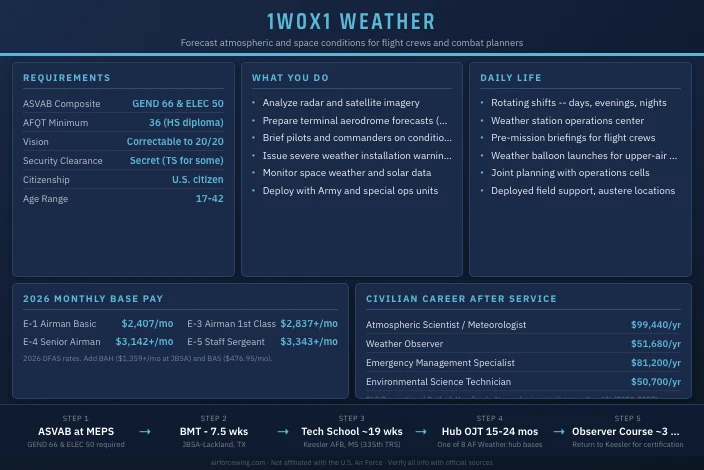
Air Force Weather specialists (AFSC 1W0X1) collect, analyze, and disseminate atmospheric and space weather data to support military flight operations and ground missions. They interpret radar and satellite imagery, prepare weather forecasts, issue warnings, and brief pilots and commanders on conditions that could affect mission success or crew safety. The role operates across fixed base weather stations, deployable field teams, and joint operations with Army ground forces.
Daily Tasks
Weather Airmen work shifts around the clock because weather doesn’t follow duty hours. A typical day involves:
- Collecting data from fixed and deployable meteorological sensors
- Analyzing satellite imagery, radar returns, and upper-air observations
- Preparing terminal aerodrome forecasts (TAFs) and area forecasts
- Briefing flight crews and mission planners on weather impacts
- Issuing severe weather watches and warnings to the installation
- Monitoring space weather events that could affect communications or satellite-dependent systems
- Coordinating with Army units during joint operations to provide battlefield weather support
Specialization Codes
The 1W0X1 career field uses shredouts and Special Experience Identifiers (SEIs) to track specific capabilities:
| Code | Designation | Focus |
|---|---|---|
| 1W0X1 | Weather | Base AFSC, all weather operations |
| SEI 274 | Space Environmental Applications | Space weather forecasting and analysis |
| SEI 040 | Joint Terminal Attack Controller Support | Weather support to JTAC/SOF units |
Mission Contribution
Air Force Weather is one of the few enlisted career fields that operates directly inside special operations and Army units. Weather Airmen deploy alongside Rangers, Special Forces, and other ground combat elements to provide real-time atmospheric data at the point of need. A bad weather call can delay a helicopter insertion, compromise a low-altitude bombing run, or trigger a force recall. Getting it right matters at every level, from the airfield tower to the forward operating base.
Equipment and Technology
The job puts you in front of a wide range of systems. You’ll work with:
- AN/TMQ-53 tactical meteorological observing system
- Radiosonde equipment for upper-air balloon launches
- Doppler radar and satellite downlink workstations
- GCCS-M and other command and control networks
- Space weather monitoring software and solar data feeds
- Automated Surface Observing Systems (ASOS) at airfields
Salary
Base Pay
All Air Force pay comes from DFAS and applies uniformly across all enlisted Airmen. Weather specialists earn the same base pay as all Airmen at equivalent rank and years of service.
| Rank | Pay Grade | Years of Service: 2 | Years of Service: 4 | Years of Service: 6 | Years of Service: 8 |
|---|---|---|---|---|---|
| Airman (Amn) | E-2 | $2,698 | $2,698 | $2,698 | - |
| Senior Airman (SrA) | E-4 | $3,303 | $3,659 | $3,816 | $3,816 |
| Staff Sergeant (SSgt) | E-5 | $3,599 | $3,947 | $4,109 | $4,299 |
| Technical Sergeant (TSgt) | E-6 | $3,743 | $4,069 | $4,236 | $4,613 |
Source: DFAS 2026 pay tables. Figures reflect the 2026 pay raise.
Most Weather Airmen reach Senior Airman (E-4) within about two years and Staff Sergeant (E-5) within four to six years, so actual pay climbs quickly with time in service.
Allowances and Special Pay
Base pay is only part of the picture. Airmen living off-base receive Basic Allowance for Housing (BAH), which varies by duty location, pay grade, and dependent status. At Joint Base San Antonio-Lackland, an E-4 without dependents receives $1,359/mo in BAH; with dependents, that figure rises to $1,728/mo. Duty stations in higher-cost areas pay significantly more. All enlisted Airmen also receive Basic Allowance for Subsistence (BAS) of $476.95/mo.
Some Weather Airmen qualify for assignment incentive pay when filling deployable or special operations support billets, though exact amounts vary by assignment and fiscal year. Ask your recruiter about current incentive pay availability for this AFSC.
Additional Benefits
Healthcare: Active duty Airmen and their families are covered under TRICARE Prime at no cost, zero enrollment fee, no deductible, and no copays for authorized care. Coverage includes medical, dental, vision, prescriptions, and mental health services.
Education: The Air Force covers up to $4,500/year in tuition assistance for approved college courses while on active duty. After separating, the Post-9/11 GI Bill covers full in-state tuition at public schools or up to $29,920.95/year at private institutions, plus a monthly housing stipend and an annual book stipend of $1,000. GI Bill benefits require at least 90 days of qualifying active service.
Retirement: Airmen who serve 20 or more years receive a pension under the Blended Retirement System (BRS). The BRS pension pays 40% of your high-36 average base pay at 20 years, with 2% added for each year beyond 20. The government also contributes up to 5% of your base pay to the Thrift Savings Plan (TSP), which you keep after two years of service.
Leave: Airmen earn 30 days of paid leave per year (2.5 days per month) with up to 60 days carryover.
Qualifications
Requirements Table
| Requirement | Standard |
|---|---|
| ASVAB Composite | GEND 66 and ELEC 50 |
| AFQT Minimum | 36 (HS diploma) / 65 (GED) |
| Citizenship | U.S. citizen |
| Age | 17-42 |
| Vision | Correctable to 20/20 |
| Speech | Must speak distinctly |
| Security Clearance | Secret (some assignments require Top Secret) |
| Education | High school diploma or equivalent |
The dual composite requirement (GEND 66 and ELEC 50) is what separates this AFSC from many others. The general score reflects reading comprehension and arithmetic, while the electronics score measures science and technical aptitude, both are needed because forecasting combines written communication with quantitative data analysis.
The GEND composite is calculated from Word Knowledge, Paragraph Comprehension, Arithmetic Reasoning, and Mathematics Knowledge subtests. The ELEC composite draws from General Science, Arithmetic Reasoning, Mathematics Knowledge, and Electronics Information. Strong performance in both areas is the fastest path to qualifying.
Application Process
- Contact an Air Force recruiter and take the ASVAB at a Military Entrance Processing Station (MEPS)
- Confirm scores meet the GEND 66 and ELEC 50 minimums
- Complete a medical evaluation at MEPS to confirm vision and hearing standards
- Undergo a background investigation for the required Secret clearance
- Receive a job offer and ship date, active duty contracts are typically 4 or 6 years
Selection and Competitiveness
Weather is a small, specialized career field and competition for slots can be real. Scoring above the minimums on both composites, particularly pushing the GEND score above 70, strengthens your position. No prior civilian meteorology experience is required, though basic physics and math coursework helps with the technical training ahead.
Some 1W0X1 assignments support space weather operations and special operations forces, which require a Top Secret clearance. If your background investigation reveals disqualifying information at the Secret level, those assignments will be unavailable. Clearance eligibility is assessed after enlistment, not before.
Service Obligation
Active duty enlistment is typically four years, with many recruits opting for a six-year contract to access better assignment preferences or bonuses. After initial skills training, Airmen commit to completing the full pipeline, including the OJT phase at a hub base.
Entry into service at the E-1 (Airman Basic) grade is standard. Recruits with college credits may enter at E-2 or E-3, depending on the number of verified credits.
See our ASVAB study guide for strategies to hit these line scores, or take the PiCAT from home if you are a first-time tester.
Work Environment
Setting and Schedule
Weather Airmen work in two distinct environments: the base weather station and deployed locations. The base weather station is an operations room with multiple workstations, display screens, and communications systems. The work feels more like a scientific operations center than a traditional military office, quiet during routine periods, fast-paced when severe weather or a major flying operation is in progress.
Shift work is the norm. Weather flights cover a 24-hour mission, so you’ll rotate through days, evenings, and nights throughout your career. On flying bases, the pace picks up before and during heavy flying periods. During a large-scale exercise or real-world contingency, the weather section can run at near-continuous tempo for days.
Deployed positions with Army units or special operations forces look very different. You may operate out of a forward operating base, a forward arming and refueling point, or in the field with ground forces. Those billets require the same technical output under considerably more austere conditions.
Leadership and Autonomy
Weather shops are small, most base weather flights have between five and fifteen Airmen, depending on the installation’s mission. That means junior Airmen carry real responsibility early. A Senior Airman working the forecast desk during the night shift isn’t a trainee following instructions. They’re the qualified operator on duty, making calls that affect live missions.
Performance feedback is documented through the Enlisted Performance Report (EPR) system. Weather NCOs evaluate their Airmen on technical proficiency, leadership contribution, and mission impact. Ratings directly affect promotion board scores, so strong EPRs in a small career field matter a great deal.
Team Dynamics
The Weather section works closely with flying squadrons, mission planning cells, and the operations group. Strong written and verbal communication is essential, you’re not just collecting data, you’re translating it into briefings that non-scientists can act on. Airmen who enjoy both the analytical side of the job and the interpersonal side tend to advance faster and report higher satisfaction.
Retention in weather tends to be solid. The combination of a specialized skill set, strong civilian career prospects, and a mission with clear operational relevance keeps many Airmen committed past their initial contract.
Training
Training Pipeline
| Phase | Location | Length | Focus |
|---|---|---|---|
| Basic Military Training (BMT) | JBSA-Lackland, TX | 7.5 weeks | Military fundamentals |
| Technical School, Initial Skills | Keesler AFB, MS (335th TRS) | 133 days (~19 weeks) | Meteorology, forecasting, sensor operations |
| On-the-Job Training (OJT) | Hub base assignment | 15-24 months | Supervised operational forecasting |
| Weather Observer Course | Keesler AFB, MS | ~3 months | Observer qualification certification |
The technical school at Keesler AFB is one of the longer enlisted pipelines in this career group. Students cover atmospheric thermodynamics, synoptic weather analysis, radar interpretation, satellite imagery, upper-air observations, and space weather fundamentals. The coursework is academically demanding, and students earn college credits toward meteorological operations at completion.
After tech school, graduates do not immediately report to a permanent base. They are assigned to one of eight major Air Force Weather hub bases for 15 to 24 months of intensive supervised OJT. Hub installations include Barksdale AFB (Louisiana), Shaw AFB (South Carolina), Davis-Monthan AFB (Arizona), Scott AFB (Illinois), Elmendorf AFB (Alaska), Hickam AFB (Hawaii), Yokota AB (Japan), and Sembach AB (Germany).
Following the OJT phase, Airmen return to Keesler AFB to complete the formal Weather Observer Course before receiving their first permanent duty station assignment. This three-month course qualifies them for full independent operations. The complete pipeline from BMT to first permanent duty station typically takes two to three years.
Advanced Training
Once at a permanent duty station, Weather Airmen can pursue additional qualifications. These include:
- Special Operations Weather Team (SOWT) training: a highly selective pipeline for Airmen seeking to embed with special operations units; this track is physically demanding and requires a separate selection process
- Space environmental applications training: qualifies Airmen for space weather monitoring and forecasting duties
- Formal instructor certification: senior Airmen and NCOs may return to Keesler as instructors
- Joint meteorological and oceanographic (METOC) courses offered through sister service schools
The Air Force also supports education through Tuition Assistance and distance learning programs. Several community colleges and universities have articulation agreements with the Weather career field that credit technical training toward an associate or bachelor’s degree in atmospheric science or a related field.
Everything starts with qualifying ASVAB scores, our study guide covers what to study first.
Career Progression
Rank Progression
| Rank | Grade | Typical Timeline | Role |
|---|---|---|---|
| Airman Basic | E-1 | Entry | BMT student |
| Airman | E-2 | 6 months | BMT/Tech School |
| Airman First Class | E-3 | 1 year | Tech School or OJT |
| Senior Airman | E-4 | 3 years | Journeyman forecaster |
| Staff Sergeant | E-5 | 4-6 years | NCO, shift supervisor |
| Technical Sergeant | E-6 | 8-10 years | Flight section lead |
| Master Sergeant | E-7 | 12-16 years | Senior NCO |
| Senior Master Sergeant | E-8 | 18-20 years | Superintendent candidate |
| Chief Master Sergeant | E-9 | 20+ years | Career field manager |
Advancement to Senior Airman (SrA) typically happens around the three-year mark after completing OJT and the Observer Course. Most Airmen who reenlist make Staff Sergeant within their first six-year contract, provided they score well on the Weighted Airman Promotion System (WAPS) which combines EPR scores, promotion test performance, and time-in-grade.
Shredouts and Specialization
The Weather career field opens several paths as Airmen gain skill levels. The 5-skill level (Journeyman) is the first independent operating qualification. The 7-skill level (Craftsman) qualifies Airmen to supervise and train others. The 9-skill level (Superintendent) is a leadership designation for senior NCOs managing the flight or section.
Airmen who earn SEI 040 (JTAC support) or complete the SOWT pipeline access the most operationally demanding billets in the career field, direct support to combat units with higher deployment tempo and, in some cases, additional pay.
Performance Evaluation
The EPR system rates Airmen across five categories: mission impact, communications, leadership, innovation, and resource stewardship. In a career field as small and tightly knit as Weather, a single strong EPR from a respected supervisor during a key assignment can significantly affect a promotion board outcome. Airmen who perform well during the hub OJT phase often enter their first permanent station with an edge.
Physical Demands
Fitness Requirements
All Airmen take the Air Force Fitness Assessment annually. The assessment scores four components on a 100-point scale:
| Component | Maximum Points |
|---|---|
| 1.5-Mile Run | 60 |
| Waist Circumference / Body Composition | 20 |
| Push-Ups (1 minute) | 10 |
| Sit-Ups (1 minute) | 10 |
The minimum passing composite is 75 points. Each component also has a minimum floor, failing any single component fails the overall assessment regardless of composite score. Standards are age- and gender-normed. Airmen who fail face a mandatory fitness improvement program and repeat assessments.
Weather is not a physically extreme AFSC for most base assignments. The job is cognitively demanding rather than physically taxing. That changes for Airmen pursuing the special operations weather track, which involves a physically demanding selection and qualification pipeline comparable to combat control and pararescue in intensity.
Medical Standards
Beyond the standard MEPS medical screening, Weather Airmen must meet specific vision standards (correctable to 20/20) and demonstrate clear speech, since pilot briefings require precise verbal communication. Hearing standards are also evaluated, given the radio communications requirement. Periodic occupational health exams may be required for Airmen operating in deployed environments.
Deployment
Deployment Patterns
Weather Airmen deploy regularly, but tempo varies significantly by assignment. Base weather flights at standard installations see sporadic short deployments, typically 90 to 180 days, often to support air operations at deployed locations in the Central and Indo-Pacific Commands. Airmen assigned to special operations weather support or Army weather support billets can expect higher deployment frequency, sometimes 6-9 months per year.
Overseas permanent change of station (PCS) assignments are available and common. Japan (Yokota AB), Germany (Ramstein AB and Sembach AB), Hawaii (Hickam/JBPHH), and Alaska (Elmendorf-Richardson) all have established weather flights and have hosted Weather Airmen throughout the career field’s history.
Deployment work for base-assigned Weather Airmen typically means supporting an established air operations center or deployed weather flight at a major theater base. The work is similar to garrison operations, shift-based forecasting, pilot briefings, and severe weather warnings, but with a compressed staff and higher mission stakes. Airmen who perform well during hub OJT and demonstrate solid forecast accuracy tend to get the most operationally interesting deployment locations.
For Weather Airmen who earned SEI 040 (JTAC support) or who are assigned to Army weather support billets, the deployment experience looks different. These Airmen embed with ground combat units and provide battlefield weather support in the same forward operating environments as the Army units they support. That means field conditions, not an operations center, and a fundamentally different set of physical and tactical demands.
Duty Station Options
Hub assignments during OJT place new graduates across a broad geographic spread from the outset. After completing the Observer Course, permanent duty station assignments are based on Air Force needs balanced against Airman preferences through the assignment system. Popular and frequently available duty locations include:
- Barksdale AFB, Louisiana
- Shaw AFB, South Carolina
- Davis-Monthan AFB, Arizona
- Scott AFB, Illinois
- Kadena AB, Japan
- Ramstein AB, Germany
- Joint Base Elmendorf-Richardson, Alaska
- Joint Base Pearl Harbor-Hickam, Hawaii
The hub base OJT assignment is not the permanent duty station, it’s a supervised operational training billet. During the 15 to 24 months at a hub, Airmen learn the operational forecast cycle under experienced NCO supervision. The hub system concentrates new Weather Airmen at installations with high flying operations tempo so they gain meaningful experience quickly. After completing the Observer Course back at Keesler, they submit preferences for their first permanent assignment through the standard Air Force assignment process.
Risk/Safety
Job Hazards
Most Weather Airmen face minimal occupational hazard at base assignments. The primary risks involve working outdoors during severe weather when conducting surface observations, launching weather balloons in high-wind conditions, and operating in austere or combat environments when deployed. Airmen in special operations weather billets face risks comparable to combat arms personnel during direct support missions.
Weather balloon launches introduce wind, lightning, and cold-weather exposure risks that most Airmen in other AFSCs don’t encounter. Standard protocols require wind speed checks before launch and lightning standoff distances when thunderstorms are within a defined radius of the launch site. At high-latitude assignments like Elmendorf-Richardson in Alaska, cold-weather exposure during outdoor surface observation duties requires specific gear and situational awareness for hypothermia risk.
Fatigue is an underappreciated hazard in shift-work careers. Weather Airmen rotating between night and day shifts experience circadian disruption that impairs cognitive performance, a concern in a field where forecast errors can have operational consequences. Most weather flights manage this through scheduled overlap periods and supervisor check-in protocols during critical briefing windows.
Safety Protocols
Weather stations maintain strict protocols for self-protection during hazardous weather observation requirements. Deployed Airmen receive standard force protection training, and those operating with combat units complete additional pre-deployment training including chemical warfare defense and combat casualty care. Lightning safety standoff protocols, wind-speed launch criteria for balloon operations, and cold-weather gear standards at northern installations are enforced at the unit level. The Air Force Occupational Safety and Health (AFOSH) program covers the Weather career field, and unit safety officers conduct periodic hazard assessments of weather station facilities and equipment.
Security and Legal Requirements
A Secret security clearance is required for entry into the career field. This involves a Tier 3 background investigation (T3) covering criminal history, financial records, foreign contacts, and personal references. Some assignments, particularly those supporting national intelligence collection, special operations, or space weather missions, require a Top Secret/Sensitive Compartmented Information (TS/SCI) clearance, which involves a more intensive Tier 5 (T5) investigation.
Clearing the Secret level typically takes 3-6 months after application. TS/SCI processing can take considerably longer depending on complexity.
Weather Airmen who produce official forecasts used in flight operations carry professional responsibility for forecast accuracy. While the Air Force covers legal liability for actions taken within scope of duties under federal law, Weather Airmen are expected to maintain professional standards of forecast quality. Forecasts that contribute to mishaps can trigger safety investigations, not to prosecute the forecaster, but to identify process failures that need correction. Understanding the legal and professional framework governing operational meteorology helps Weather Airmen approach their work with the appropriate level of care.
Impact on Family
Family Considerations
Shift work is a genuine quality-of-life factor to plan for. Because weather flights operate 24 hours a day, Airmen rotate through evening and overnight shifts throughout their careers. That schedule affects family routines, especially with children in school. Families adapt, but it takes planning.
The long initial training pipeline is another factor. Between BMT, tech school at Keesler (roughly five months), the hub OJT assignment (15-24 months), and a return to Keesler for the Observer Course, new Weather Airmen may spend close to two to three years moving through assignments before arriving at a stable long-term duty station. Families who start this process expecting relocation flexibility tend to handle it better than those expecting early stability.
The Air Force provides solid family support through Military OneSource, installation family support centers, and base housing programs. Medical coverage for dependents through TRICARE is full-scope and free for active duty families.
Relocation
Weather Airmen PCS on the standard Air Force cycle of roughly every 2-4 years. Overseas assignments are available and, for many Weather Airmen, represent some of the most professionally and personally rewarding tours of their careers. Accompanied tours at most overseas locations allow families to live with the Airman at government expense.
Reserve and Air National Guard
Component Availability
The 1W0X1 Weather AFSC exists in all three components: Active Duty, Air Force Reserve, and Air National Guard. The Air National Guard has a particularly strong presence in Weather, with several states maintaining dedicated Weather flights that support both state emergency management missions and federal deployments.
Commitment and Drill Schedule
| Component | Commitment Model | Monthly Pay (E-4) | Healthcare | Education Benefits | Retirement |
|---|---|---|---|---|---|
| Active Duty | Full-time | $3,142+/mo base | TRICARE Prime (free) | Full Tuition Assistance + GI Bill | 20-yr pension (BRS) |
| Air Force Reserve | ~39 days/yr | ~$497/drill weekend | TRICARE Reserve Select (premium required) | Federal TA + GI Bill (service-dependent) | Points-based Reserve retirement |
| Air National Guard | ~39 days/yr | ~$497/drill weekend | TRICARE Reserve Select (premium required) | Federal TA + state tuition waivers (varies by state) | Points-based Reserve retirement |
Standard Reserve and Air National Guard commitment is one drill weekend per month (4 Unit Training Assemblies) plus two weeks of Annual Training per year. Weather Airmen in the Reserve and Guard may need additional training days for annual certification maintenance and exercises, particularly those assigned to deployable weather units.
Part-Time Pay
A Reserve or Guard E-4 earns approximately $497 per drill weekend (4 UTAs at roughly $124 each), based on 2026 DFAS rates for two days of E-4 base pay. That compares to $3,142/mo for active duty at the same grade. Reserve and Guard service is best thought of as a supplement to civilian income, not a replacement.
Civilian Career Integration
The Weather AFSC pairs exceptionally well with civilian careers in meteorology, atmospheric research, federal civil service, and emergency management. Several Weather Airmen work as civilian forecasters for the National Weather Service, private weather companies, or broadcast television stations while simultaneously serving in the Guard or Reserve. Civilian employers in weather-dependent industries generally view military meteorological training favorably.
USERRA protections prevent civilian employers from discriminating against Guard and Reserve members for training and deployment absences, and many federal agencies actively seek to hire veterans with active clearances.
Deployment Tempo
Reserve and Guard Weather Airmen deploy less frequently than their active duty counterparts but can and do get mobilized for real-world operations. Mobilization lengths vary from 90 days to a full year, depending on the requirement. Reserve component Weather units have supported operations across every major theater in recent decades.
Post-Service
Civilian Career Prospects
Military meteorological training translates directly into civilian atmospheric science careers. Weather Airmen leave service with hands-on experience operating meteorological instruments, interpreting radar and satellite data, producing written forecasts, and briefing non-technical audiences, skills that directly map to NWS positions, private sector forecasting, and broadcast meteorology.
Federal civil service positions through the Air Force Civilian Service, NOAA, and the National Weather Service specifically recruit veterans with military weather experience. GS-7 and GS-9 entry-level forecaster positions are the most common entry point for transitioning Weather Airmen.
| Civilian Career | Median Annual Salary | Job Outlook |
|---|---|---|
| Atmospheric Scientist / Meteorologist | $99,440/yr | +6% (2023-2033) |
| Weather Observer | $51,680/yr | Stable |
| Emergency Management Specialist | $81,200/yr | +5% (2023-2033) |
| Environmental Science Technician | $50,700/yr | +7% (2023-2033) |
| Federal Civil Service Meteorologist (GS-9+) | $65,000-$100,000+/yr | Steady demand |
Salary data from the BLS Occupational Outlook Handbook and OPM pay scales. Figures are national medians and will vary by location.
Transition Programs
The Air Force’s Transition Assistance Program (TAP) connects separating Airmen with resume help, job placement resources, and education counseling. The American Meteorological Society (AMS) and the National Weather Association both have veteran outreach programs. Some state National Weather Service offices and emergency management agencies actively recruit separating Weather Airmen for civil service positions.
Clearance holders transitioning to federal positions have an advantage, active or recently lapsed clearances shorten the federal hiring timeline significantly.
Is This a Good Job
Who Thrives in This AFSC
Weather is a strong fit if you:
- Genuinely enjoy science, particularly physics, math, and environmental systems
- Can communicate clearly under pressure (pilot briefings happen fast)
- Perform well on shift work and adapt to irregular schedules
- Want a technical specialty with a direct operational impact
- Are interested in a civilian meteorology or federal science career after service
The AFSC rewards intellectual curiosity. Forecasters who stay sharp on atmospheric science and push to understand the “why” behind weather patterns advance faster and build reputations that follow them through the career field.
Potential Challenges
Shift work is not for everyone. Rotating through nights and weekends for years affects sleep, relationships, and off-duty activities. Airmen who need a predictable daily schedule will find this career field genuinely difficult.
The training pipeline is long and involves multiple moves before reaching a stable first permanent duty station. Young Airmen who want to settle quickly into one location may find the two-to-three-year initial pipeline frustrating. And the hub OJT phase, while professionally valuable, can feel like an extended period of supervised probation for Airmen eager to operate independently.
Airmen pursuing the special operations weather track need to be honest about physical readiness. That pipeline is elite-level demanding and has a significant attrition rate.
Career and Lifestyle Alignment
Weather is one of the Air Force’s smaller career fields, which creates both opportunity and constraint. Promotion boards see the same names repeatedly, and reputation within the career field matters more than in a large AFSC. Strong performers who communicate well, volunteer for deployable billets, and build technical credibility tend to advance steadily. Airmen who coast after tech school often find themselves stagnant.
For someone drawn to science, comfortable with shift work, and interested in a career that bridges military operations and atmospheric research, 1W0X1 is one of the most distinctive paths in the enlisted Air Force.
More Information
Talk to an Air Force recruiter to confirm current ASVAB score requirements, open training slots, and any active bonuses for the Weather career field. Recruiter availability and contact information can be found through airforce.com. Bring your ASVAB practice scores to the conversation, a recruiter can tell you quickly whether you’re competitive for this AFSC and what steps to take next.
The dual composite requirement (GEND 66 and ELEC 50) is meaningful, don’t assume a strong overall ASVAB score is enough without checking both composites specifically. An ASVAB study guide with targeted coverage of the General and Electronics subtests is the most direct preparation path.
Useful resources for further research:
- 335th Training Squadron at Keesler AFB, the unit that runs the 1W0X1 technical school and Observer Course
- Air Force Weather Agency (AFWA), the major command element responsible for Air Force Weather operations worldwide
- American Meteorological Society (AMS), professional organization with veteran outreach programs and certification pathways
- Bureau of Labor Statistics: Atmospheric Scientists, civilian career data for post-service meteorology employment
- National Weather Service: Federal Career Opportunities, primary federal employer for transitioning Weather Airmen
If you’re interested in the special operations weather track, research the selection requirements and physical demands before contracting. The SOWT pipeline is separate from the standard 1W0X1 training path and requires a physical fitness level comparable to combat control or pararescue selection. Starting a fitness regimen well before your MEPS date gives you the best foundation.
This site is not affiliated with the U.S. Air Force or any government agency. Verify all information with official Air Force sources before making enlistment or career decisions.
Explore more Air Force operations careers including 1C1X1 Air Traffic Control and other flight operations AFSCs in this group.