1C8X3 Radar, Airfield, and Weather Systems
Every radar scope, every runway light controller, every weather sensor feeding a pilot’s preflight briefing, none of it works without someone who knows the hardware inside out. The 1C8X3 Radar, Airfield, and Weather Systems (RAWS) AFSC is the technical backbone of Air Force flight operations. You won’t be directing aircraft or writing weather forecasts. You’ll be keeping the systems alive that make both of those things possible. That’s a harder job to explain at a party, but it’s one of the most consequential electronics roles the Air Force offers and one of the clearest paths to a high-paying civilian career in aviation or federal service.
If you score high in electronics and want to spend your career working with sophisticated equipment rather than sitting behind a desk, this AFSC deserves a serious look. Before you talk to a recruiter, confirm your ELEC composite stands up with an ASVAB study guide that covers the electronics and science subtests in depth.
Job Role
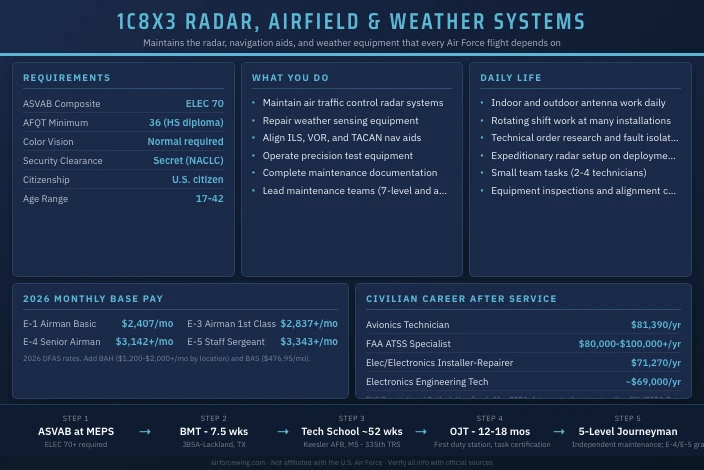
The 1C8X3 RAWS AFSC covers installation, maintenance, and repair of fixed and mobile radar systems, navigational aids, meteorological equipment, and airfield communication systems. Specialists in this career field keep the technical infrastructure of military airfields running, from the precision approach radar that guides aircraft in low visibility to the weather sensors that feed real-time conditions to pilots and forecasters. Without RAWS technicians, a military airfield cannot safely operate.
The scope of the work is broad by design. One assignment might focus on ground-controlled approach (GCA) radar systems. Another puts you on weather sensing and display equipment. A third might involve navigation aids like VORs, ILS glide slope systems, or TACAN units that aircraft use to find the runway in poor conditions. Over a career, most RAWS Airmen work across multiple equipment families.
Daily Tasks
- Perform scheduled and unscheduled maintenance on air traffic control radar systems
- Troubleshoot and repair weather sensing and display equipment
- Inspect, test, and align navigational aids including ILS, VOR, and TACAN systems
- Operate test equipment to diagnose faults in radar and communications hardware
- Complete maintenance documentation and equipment logs to Air Force standards
- Direct maintenance inspection teams and supervise junior technicians
Specializations
The 1C8X3 AFSC does not currently use formal shredout suffixes in the way some other career fields do, but assignments and Special Experience Identifiers (SEIs) differentiate specialists by equipment type. Senior technicians develop depth in one or more of three primary equipment areas:
| Equipment Focus | Systems Covered |
|---|---|
| Air Traffic Control Radar | AN/GPN-22 PAR, ASR surveillance radar, approach control systems |
| Navigational Aids | ILS (instrument landing system), VOR, TACAN, localizer, glideslope |
| Weather and Meteorological | WSR-88D Doppler radar, ASOS, AWOS, tactical weather sensing units |
Mission Contribution
Air traffic controllers need working radar. Weather forecasters need working sensors. Pilots shooting instrument approaches in zero visibility need working navigation signals. RAWS technicians are the people who ensure those requirements are met before every mission. In deployed environments, that means setting up and maintaining expeditionary radar and communication systems in locations without the infrastructure of a permanent base. A broken approach radar at a deployed location doesn’t mean a maintenance delay, it means aircraft cannot land safely.
Equipment and Technology
The systems you’ll work on include precision approach radar, airport surveillance radar, microwave landing systems, Doppler weather radar, and tactical meteorological equipment. Many of these systems have civilian equivalents maintained by the FAA, which matters when it’s time to translate your experience into a federal career. Work involves digital and analog electronics, RF signal theory, antenna systems, and software-based diagnostics. Handheld and rack-mounted test equipment including spectrum analyzers, signal generators, and network analyzers are part of the daily toolkit.
Salary
Pay follows the 2026 DFAS military pay tables, which apply equally to all Airmen at the same grade and years of service. What changes with this career field is what sits on top of base pay: housing and food allowances that can add $1,800 or more per month depending on where you’re stationed.
Basic Pay (2026)
| Rank | Grade | Entry | 4 Years | 6 Years |
|---|---|---|---|---|
| Airman Basic | E-1 | $2,407/mo | , | , |
| Airman | E-2 | $2,698/mo | , | , |
| Airman First Class | E-3 | $2,837/mo | $3,198/mo | $3,198/mo |
| Senior Airman | E-4 | $3,142/mo | $3,659/mo | $3,816/mo |
| Staff Sergeant | E-5 | $3,343/mo | $3,947/mo | $4,109/mo |
| Technical Sergeant | E-6 | $3,401/mo | $4,069/mo | $4,236/mo |
2026 DFAS pay tables. Rates reflect the 3.8% across-the-board raise effective January 1, 2026.
Additional Allowances
Basic Allowance for Housing (BAH) varies by duty station and dependency status. A single E-4 at a major installation typically receives between $1,200 and $2,000 per month in BAH, tax-free. Basic Allowance for Subsistence (BAS) adds $476.95 per month for all enlisted Airmen regardless of grade. Neither allowance is taxable income, which makes the total compensation package larger than the base pay figures suggest.
Enlistment and reenlistment bonuses exist for qualified applicants. The Air National Guard bonus program lists 1C8X3 as a bonus-eligible AFSC, with non-prior service enlistment bonuses up to $50,000 for the reserve component. Active duty selective reenlistment bonuses vary by cycle and career field demand; verify current amounts with your recruiter at the time of reenlistment.
Healthcare, Education, and Retirement
All active duty Airmen and their families receive TRICARE Prime at no cost. There are no enrollment fees, deductibles, or copays for active duty members. Coverage includes medical, dental, vision, mental health, and prescriptions.
The Post-9/11 GI Bill covers full in-state tuition at public universities after discharge, or up to $29,920.95 per academic year at private schools, plus a monthly housing allowance tied to the E-5 BAH rate at the school’s location and an annual book stipend of $1,000. Tuition Assistance is available during service, covering up to $4,500 per year at $250 per semester hour.
The Air Force uses the Blended Retirement System (BRS), which combines a 20-year pension at 40% of high-36 average basic pay with automatic and matching Thrift Savings Plan (TSP) contributions. The government automatically contributes 1% of basic pay to your TSP and matches up to an additional 4%.
Work-Life Balance
Airmen accrue 30 days of paid leave per year. Shift-based schedules are common in this AFSC because radar and navigation systems require around-the-clock maintenance coverage at busy installations. Schedules vary by unit, but most RAWS Airmen work structured rotations rather than unpredictable on-call arrangements.
Qualifications
This is one of the more technically demanding enlisted AFSC qualifications in the operations career group. The electronics composite score requirement reflects the depth of knowledge needed to work on precision RF and navigation systems.
Qualification Table
| Requirement | Standard |
|---|---|
| ASVAB Composite | ELEC 70 |
| AFQT Minimum | 36 (high school diploma); 65 (GED or alternate credential) |
| Citizenship | U.S. citizen |
| Age | 17-42 at enlistment |
| Color Vision | Normal color vision required |
| Security Clearance | Secret (NACLC) |
| Physical | No disqualifying fear of heights; valid state driver’s license |
| Medical | Must meet Air Force medical enlistment standards |
Verify current requirements at the official ASVAB jobs list and the airforce.com career page before enlisting.
Understanding the ELEC Composite
The Air Force Electronics (ELEC) composite is calculated from four ASVAB subtests: General Science (GS), Arithmetic Reasoning (AR), Mathematics Knowledge (MK), and Electronics Information (EI). Scoring 70 or higher requires solid performance across all four areas. The EI subtest is the most AFSC-relevant and the one most candidates need to study deliberately. If your current ASVAB scores fall short, targeted preparation on electronics fundamentals, basic algebra, and scientific principles will move the needle the fastest.
The ELEC 70 composite is among the highest electronics requirements in the Air Force enlisted career fields. It’s comparable to what’s required for some avionics maintenance and communications systems AFSCs. If you’re scoring around 60-65, a focused ASVAB prep course targeting EI and GS subtests can close that gap before you go to MEPS.
Application Process
Selection Criteria
Seats for 1C8X3 are competitive because the ELEC 70 requirement filters out a significant portion of applicants. Beyond the score itself, recruiters look for demonstrated technical aptitude. Prior experience with electronics, amateur radio, or IT systems strengthens your application. A clean background check speeds up the clearance process and avoids delays in training pipeline scheduling.
Service Obligation
The standard enlistment for 1C8X3 is four years of active duty service. Because of the length and complexity of technical training, the Air Force invests heavily in each RAWS technician, and that investment is reflected in the service commitment.
Work Environment
RAWS technicians work in a mix of indoor and outdoor environments depending on the equipment and the mission. Some days are in a controlled equipment room running diagnostics on radar signal processors. Other days are on the antenna pad or approach light system working on hardware exposed to weather. Deployed assignments add austere field conditions to the mix.
Setting and Schedule
Most permanent duty station assignments involve shift rotations. Radar and navigation systems don’t operate on banker’s hours, and preventive maintenance windows are often scheduled during low-traffic periods overnight or early morning. Expect a mix of day, swing, and mid-shift assignments, though not all units run continuous 24-hour operations.
The work environment is technically focused. Daily activity involves reading technical orders, interpreting circuit diagrams, using precision test equipment, and documenting work to exact standards. It’s methodical work that rewards patience and attention to detail.
Leadership and Communication
The RAWS career field uses the standard Air Force NCO development model. At the Staff Sergeant level, you begin supervising junior technicians and signing off on maintenance documentation. By Technical Sergeant, most Airmen lead a maintenance team and interface directly with unit leadership on equipment status and readiness. Communication flows up through the flight chief to the squadron commander, with formal and informal feedback through the Enlisted Performance Report system.
Team Dynamics
Most RAWS work is done in small teams of two to four technicians. For complex troubleshooting, the team dynamic matters. Senior technicians mentor apprentices on equipment theory and fault isolation procedures. Individual autonomy increases with skill level, a 5-level technician is expected to troubleshoot independently, while 3-level apprentices work under direct supervision.
Job Satisfaction
RAWS Airmen frequently cite the technical depth of the work and the variety of equipment as sources of satisfaction. The field is not repetitive in the way some maintenance specialties are, the range of systems and the complexity of the troubleshooting keeps the work engaging over a career. The most common frustration is parts availability and the administrative overhead of documentation requirements at some installations.
Training
Training Pipeline
| Phase | Location | Duration | Focus |
|---|---|---|---|
| Basic Military Training (BMT) | JBSA-Lackland, TX | 7.5 weeks | Military fundamentals, fitness, discipline |
| Technical School (1C8X3 Course) | Keesler AFB, MS | ~52 weeks | Radar systems, navigation aids, weather equipment, electronics theory |
| On-the-Job Training (OJT) | First duty station | 12-18 months | Hands-on system qualification, task certification |
Basic Military Training
All enlisted Airmen complete BMT at Joint Base San Antonio-Lackland, TX. The 7.5-week course covers Air Force customs and courtesies, physical fitness, weapons qualification, and core military skills. There is no AFSC-specific content at BMT, that comes in Tech School.
Technical School
Tech School for 1C8X3 is conducted by the 335th Training Squadron at Keesler AFB, Mississippi. The course runs approximately 52 weeks, making it one of the longer enlisted technical pipelines in the Air Force. That length reflects the scope of the systems covered. Students learn electronics fundamentals, signal theory, radar system operation and maintenance, navigation aid alignment and testing, and meteorological equipment calibration.
Keesler AFB hosts several of the Air Force’s technical training programs, including courses for weather (1W0X1) and air traffic control (1C1X1). RAWS students train alongside these communities, which matters later when you’re working alongside controllers and forecasters at your first assignment.
Completion of the 1C8X3 course earns credits toward an Electronic Systems Technology credential, which has direct value in both federal employment and private industry after service. Airmen who use the ASVAB study guide before enlisting arrive at Tech School with stronger electronics fundamentals and a shorter adaptation curve in the first weeks of the course.
Advanced Training and Development
After reaching the 5-skill level, Airmen can pursue additional coursework through Air Force training and civilian technical programs. The Air Force funds relevant technical courses under Tuition Assistance, and many RAWS Airmen pursue associate or bachelor’s degrees in electronics engineering technology or information technology while on active duty. Professional certifications in electronics (such as those from AAMI or manufacturer-specific training) are available and valued. Senior NCOs often attend formal leadership courses at Airman Leadership School and the NCO Academy, which are required for promotion to E-5 and E-7 respectively.
Career Progression
Rank Progression
| Skill Level | Grade | Typical Time Frame | Role |
|---|---|---|---|
| 3-Level (Apprentice) | E-1 to E-3 | 0-18 months | Tech School and OJT completion |
| 5-Level (Journeyman) | E-4 to E-5 | 18 months to 5 years | Independent maintenance, task certification |
| 7-Level (Craftsman) | E-6 to E-7 | 5-12 years | Team leadership, supervision, training |
| 9-Level (Superintendent) | E-8 to E-9 | 12+ years | Flight or squadron-level management |
Promotion through the first four ranks happens on a fairly predictable timeline. From E-5 onward, promotion is competitive and depends on Enlisted Performance Report scores, decorations, education, and peer standing in the promotion board process.
Role Flexibility
Retraining within the Air Force is possible after completing initial service obligations and meeting receiving AFSC requirements. RAWS technicians who want to move into communications, cyber, or other electronics-heavy fields have a strong academic foundation that translates well. Cross-training requires AFPC approval and availability of training seats.
EPR and Performance Evaluation
The Enlisted Performance Report is the Air Force’s primary promotion document. Supervisors write an EPR every year (or at key career milestones). The quality of the narrative, combined with stratification rankings within the unit, determines how competitive an Airman is for promotion. In a technically complex AFSC like 1C8X3, demonstrating technical proficiency and mentoring junior Airmen both carry weight in EPR narratives. Airmen who seek additional duties, as unit training managers, dorm managers, or professional development advisors, generate material that helps EPRs stand out.
Succeeding in This Career
The technicians who advance fastest in this field share a few traits: they read technical orders carefully rather than relying on tribal knowledge, they document their work completely even when it’s tedious, and they seek out systems they haven’t worked on yet rather than staying in a comfortable lane. The Air Force rewards depth, but breadth matters for promotion because it shows adaptability. Taking on leadership roles early, even informal mentoring of 3-level technicians, builds the supervisory track record that EPRs need to be competitive at the E-6 and E-7 level.
Physical Demands
Daily Physical Requirements
The physical demands of this AFSC are moderate. Antenna maintenance, equipment racks, and outdoor systems require climbing, lifting, and working in restricted spaces. Working at heights on antenna structures is a routine part of the job at some assignments, hence the requirement for no disqualifying fear of heights. You’ll carry equipment and tools, operate in outdoor environments in various weather conditions, and occasionally work in tight equipment spaces requiring bending and kneeling.
There is no extreme physical demand comparable to special operations or maintenance career fields, but staying in good physical condition matters for both safety and fitness test performance.
Air Force Fitness Assessment (2026)
All Airmen take the Air Force Fitness Assessment annually. Standards are age- and gender-normed. The table below shows minimum passing scores for the under-25 age bracket.
| Component | Male (Under 25) Min | Female (Under 25) Min | Max Points |
|---|---|---|---|
| 1.5-Mile Run | 13:36 | 16:22 | 60 |
| Push-Ups (1 min) | 42 | 27 | 10 |
| Sit-Ups (1 min) | 42 | 38 | 10 |
| Waist Circumference | Per age/gender table | Per age/gender table | 20 |
| Composite Minimum | 75 points | 75 points | 100 |
Standards are the same across all enlisted AFSCs. Verify current component requirements at af.mil.
Medical Evaluations
After the initial MEPS physical, RAWS Airmen undergo periodic occupational health evaluations consistent with exposure to radar emissions and RF environments. Normal color vision must be maintained throughout service, as it’s required for equipment status indicator interpretation. Routine annual physical fitness evaluations continue throughout the career.
Deployment
Deployment Profile
The 1C8X3 AFSC deploys regularly in support of Air Expeditionary Force rotations. RAWS technicians set up and maintain expeditionary radar and navigation systems at deployed operating bases, often working alongside civil engineers and communications specialists to stand up airfield infrastructure from scratch. Deployments typically run 4-6 months and rotate on an Air Expeditionary Force cycle, though this varies by unit and global demand.
Not every RAWS Airman deploys every cycle, but deployment is a routine part of the career rather than an exception. The work in deployed locations is more autonomous and higher-stakes than at permanent duty stations because fewer resources and personnel are available.
Duty Station Options
RAWS Airmen serve at installations worldwide with active flight operations. Common assignments include:
- Air Combat Command bases: Langley AFB (VA), Shaw AFB (SC), Mountain Home AFB (ID), Nellis AFB (NV)
- Air Mobility Command bases: Dover AFB (DE), Travis AFB (CA), Scott AFB (IL)
- Overseas locations: Ramstein AB (Germany), Kadena AB (Japan), Osan AB (South Korea), Spangdahlem AB (Germany)
- Keesler AFB (MS): Training and some operational assignments
Assignment preferences are submitted through the Air Force Personnel Center (AFPC) assignment system. First-term Airmen have limited control over initial assignments, but preferences carry more weight with increased experience and seniority.
Risk/Safety
Job Hazards
Working with radar and navigation systems carries specific hazards that require deliberate safety training. High-voltage equipment, RF radiation exposure, and antenna structures at height are the primary risks. RAWS technicians work with radar emitters that produce non-ionizing radiation in the microwave and radar frequency bands. Safe standoff distances and lockout/tagout procedures protect against RF exposure during maintenance.
Electrical hazards from high-voltage transmitter components are a serious concern. Air Force technical orders specify exact safety procedures, and deviation from those procedures is a disciplinary and safety failure. Work on antenna structures requires fall protection training and equipment.
Safety Protocols
The Air Force enforces strict technical order compliance for all maintenance activities. Every task has a documented procedure, and work is performed and verified by qualified technicians. Lockout/tagout ensures systems are de-energized before anyone opens a transmitter cabinet. Radar interlock systems and range safety markers are in place at operating sites to prevent exposure during transmission. RF monitors are standard issue at radar sites.
Security Clearance and Legal Requirements
The Secret clearance requires a National Agency Check with Local Agency Checks and Credit (NACLC). The background investigation reviews criminal history, financial responsibility, foreign contacts, and drug use. Applicants with prior marijuana use within a certain window, significant debt, or certain legal history may require waivers, talk to a recruiter honestly about your background before MEPS.
Maintaining the clearance requires ongoing adherence to reporting requirements. Any foreign travel, significant financial changes, or contact with foreign nationals must be reported per security guidelines. Losing a clearance typically means losing the AFSC.
Impact on Family
Family Considerations
PCS moves happen on a 2-4 year cycle for most RAWS Airmen, which means regular relocation. For dual-military couples or families with school-age children, frequent moves require planning. On-installation housing is available at most duty stations, and BAH covers off-post rent at competitive rates in most military communities.
Deployment cycles of 4-6 months are manageable for most families with good communication and support systems, but they require honest conversation before enlistment. The Air Force provides family support through Airman and Family Readiness Centers, chaplain services, and military family life counseling programs at every major installation.
Shift work at some assignments means non-traditional schedules that can affect family routines. This is more common at busy installations or when assigned to a unit with continuous 24-hour maintenance requirements.
Support Systems
Military OneSource provides 24/7 counseling and referral services for Airmen and their families. On-base schools, recreational facilities, commissaries, and exchanges help offset the cost-of-living impacts of frequent moves. The Exceptional Family Member Program (EFMP) assists families with special-needs dependents in getting appropriate assignments.
Relocation Flexibility
Early in a career, assignment location is largely determined by Air Force needs. By the mid-career NCO level, Airmen have more influence over assignments through stated preferences and volunteer for certain locations. Exceptional performers with good EPRs have more pull in the assignment process than the average Airman, but no enlisted member controls their assignments entirely.
Reserve and Air National Guard
The 1C8X3 AFSC is available in both the Air Force Reserve and the Air National Guard, and both components actively recruit for this specialty. The technical skills required, radar, navigation aids, weather systems, translate directly to state mission requirements, particularly for Air National Guard units that maintain aviation infrastructure at state-owned facilities.
Component Comparison
| Factor | Active Duty | Air Force Reserve | Air National Guard |
|---|---|---|---|
| Commitment | Full-time | 1 weekend/mo + 2 weeks/yr | 1 weekend/mo + 2 weeks/yr |
| Monthly Pay (E-4, 4 yrs) | $3,659/mo | ~$489/weekend (2 drill days) | ~$489/weekend (2 drill days) |
| Healthcare | TRICARE Prime (free) | TRICARE Reserve Select (premiums apply) | TRICARE Reserve Select or state plan |
| Education | Full Tuition Assistance + GI Bill | Federal TA; GI Bill after mobilization | Federal TA + state tuition waivers (varies by state) |
| Deployment Tempo | Moderate (4-6 mo rotations) | Lower; depends on unit activation | Lower; depends on state/federal activation |
| Retirement | 20-year pension at 40% high-36 | Points-based reserve retirement | Points-based reserve retirement |
Drill Schedule and Training Commitment
The standard Unit Training Assembly (UTA) weekend runs one weekend per month, with an Annual Training (AT) period of two weeks per year. RAWS Airmen in the reserve components may have additional training requirements tied to equipment recertification and system-specific currency, particularly for radar and navigation aid proficiency. Some units conduct additional training days for annual equipment inspections.
Civilian Career Integration
The 1C8X3 AFSC pairs exceptionally well with civilian careers in aviation electronics. FAA Airway Transportation Systems Specialists (ATSS) maintain the same types of systems, approach radar, navigation aids, weather sensors, that RAWS technicians work on in the Air Force. Guard and Reserve service in this AFSC is generally viewed favorably by civilian aviation employers, not as a conflict. USERRA protections require civilian employers to hold jobs and benefits for employees called to active duty.
Air National Guard service specifically can provide access to state tuition assistance programs that supplement federal benefits, with some states offering full tuition waivers for ANG members.
Post-Service
The civilian job market for RAWS technicians is strong. The combination of radar, navigation aid, and meteorological equipment experience is directly applicable to the FAA, aviation contractors, and defense industry employers, and military training credits reduce the time needed to meet FAA certification requirements.
Civilian Career Prospects
| Job Title | Median Annual Pay | Outlook (2024-2034) |
|---|---|---|
| Avionics Technician | $81,390 | +5% (faster than avg) |
| Electrical/Electronics Installer-Repairer | $71,270 | Stable |
| FAA Airway Transportation Systems Specialist | $80,000-$100,000+ | High demand |
| Electronics Engineering Technologist | ~$69,000 | Stable |
BLS Occupational Outlook Handbook, May 2024 figures.
FAA Pathway
The FAA ATSS career track is the most direct post-service option for RAWS technicians. ATSS specialists maintain the National Airspace System infrastructure, including airport surveillance radar, terminal Doppler weather radar, instrument landing systems, and communication systems. The military maintenance experience and Security Clearance background make RAWS veterans competitive applicants. FAA positions carry federal benefits, stable schedules, and pay that increases significantly with experience.
Transition Programs
The Air Force Transition Assistance Program (TAP) begins 12 months before separation and includes resume writing, interview preparation, and employer connection events. The Hiring Our Heroes program at hiringourheroes.org specifically connects veterans with aviation industry employers. Community College of the Air Force (CCAF) credits earned during Tech School and service convert to an associate degree in Electronic Systems Technology, which satisfies the educational requirement for many federal technician positions.
Education Benefits
The Post-9/11 GI Bill provides up to 36 months of education benefits after qualifying service. Used at a public university, it covers full in-state tuition and fees. Used at a private or out-of-state school, it covers up to $29,920.95 per academic year. RAWS Airmen who pursued a degree during service through Tuition Assistance often leave with significant credits already completed, reducing the time and cost of finishing a degree after separation.
Is This a Good Job
Who This Job Suits
The candidates who thrive in 1C8X3 tend to enjoy taking things apart to understand how they work and putting them back together correctly. If you built computers, worked on vehicles, or tinkered with electronics as a hobby, that impulse maps directly to the daily work. The job rewards systematic thinking, the ability to isolate a fault through logical elimination rather than random parts swapping.
Strong candidates typically have:
- A genuine interest in electronics and how signals work
- Patience with documentation and procedural compliance
- Comfort working at heights and in outdoor environments in varying weather
- The analytical discipline to follow technical orders step by step
- Interest in a long-term career in aviation or federal technical service
Potential Challenges
The 52-week tech school is the longest initial commitment in the operations career group, and the academic pace is demanding. Students who struggle with mathematics and electronics fundamentals on the ASVAB will face real difficulty keeping up with the curriculum. The shift-work schedule at many assignments doesn’t suit everyone, particularly those with strong preferences for predictable family schedules.
Deployed environments can be harsh. Setting up an expeditionary radar site in a forward operating location is not the same as maintaining a fixed installation. Airmen who expect all their work to happen in climate-controlled equipment rooms will be surprised.
The ELEC 70 composite is a hard requirement with no waiver available. If your current ASVAB scores are below that threshold, you cannot enter this career field without retesting. Investing in ASVAB electronics preparation before testing is the only path forward for candidates scoring in the 55-65 range.
Career and Lifestyle Alignment
This AFSC works well for people who want a structured technical career with clear civilian applications. The training is long and rigorous, but the payoff is marketable skills in a field where demand outpaces supply. It’s a poor fit for someone who wants rapid deployment or a physically demanding, high-adrenaline assignment. The RAWS field provides steady, meaningful technical work with moderate operational tempo, not the pace of a special operations support role or a combat controller.
If your goal is a career in aviation maintenance, FAA employment, or defense electronics contracting after service, 1C8X3 is one of the most direct paths in the enlisted Air Force.
More Information
Talk to an Air Force recruiter to confirm current enlistment availability for 1C8X3, verify your ASVAB composite score breakdown, and ask about any active duty enlistment bonuses. Recruiters can also initiate your security clearance background investigation early, which reduces delays in the training pipeline. Visit airforce.com for the official career overview and current enlistment information. If your ELEC composite needs work, a PiCAT prep course is the most direct way to raise your electronics score before MEPS.
Official resources for research and verification:
- Keesler AFB 81st Training Wing, manages the 1C8X3 Tech School; the 52-week program is one of the longest initial skills courses in the enlisted Air Force
- FAA Aviation Careers, relevant for Airmen considering federal civilian employment with the FAA after service; military electronics maintenance experience is directly valued
- airforce.com 1C8X3 overview, official entry requirements and career description
Related career profiles on this site:
- Air Force operations careers hub, compare 1C8X3 with other operations support AFSCs that require electronics or technical backgrounds
- 1C1X1 Air Traffic Control, the operations role that uses the radar and navigation systems you would maintain in 1C8X3
- 1W0X1 Weather, closely related specialty that focuses on meteorological forecasting and observation rather than equipment maintenance
Practical preparation:
The ELEC 70 composite is the hardest ASVAB gate to clear for this career field. Electronics and science vocabulary, basic circuit theory, and Ohm’s law fundamentals are all tested on the subtests that build the ELEC score. If your current practice scores are close to the minimum, focus your study time on Electronics Information and General Science, those two subtests have the most room for improvement in a short timeline.
The Secret clearance investigation should be started as early in the recruiting process as possible, given the 52-week Tech School commitment. Any delays in clearance adjudication can hold up your training progression. Be honest and thorough on the SF-86 form, unexplained gaps or omissions create longer investigative timelines than disclosed issues.
This site is not affiliated with the U.S. Air Force or any government agency. Verify all information with official Air Force sources before making enlistment or career decisions.
Explore more Air Force operations careers including 1C1X1 Air Traffic Control and 1W0X1 Weather.