1C7X1 Airfield Management
Every military flight depends on more than pilots and controllers. Someone has to make sure the runway is safe, the lighting is working, the hazard reports are current, and every agency on the airfield is coordinating properly. That’s the 1C7X1 Airfield Management AFSC. These Airmen run the base operations function that ties together flight scheduling, airfield safety, and real-time coordination between ground crews, tower, and aircrews. If anything on the airfield breaks down before a jet takes off, the airfield manager is the one who fixes it or shuts it down.
Qualifying requires specific ASVAB line scores. Our ASVAB study guide covers what to target and how to prepare.
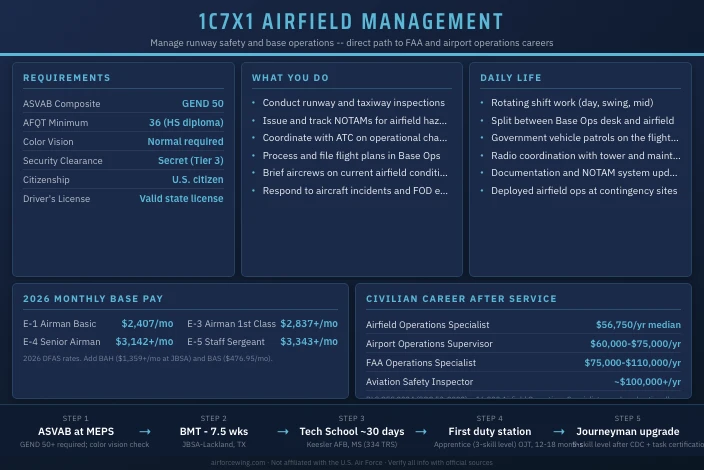
Job Role
Airfield Management specialists in the 1C7X1 AFSC manage the daily operations of military airfields to ensure safe aircraft movement. They coordinate with air traffic control, maintenance, and operations personnel to resolve airfield hazards, process flight plans, manage airfield data, and enforce safety standards. At deployed locations they may open and operate entire airfields with minimal support.
The job is a combination of administrative precision and real-time situational awareness. Airfield managers maintain the airfield operating records, brief aircrews on current NOTAMs (Notices to Airmen) and hazards, and serve as the primary point of contact when something on the airfield needs immediate action. They inspect runways and taxiways, track bird-strike data, and coordinate airfield maintenance closures to minimize impact on flying operations.
Daily Tasks
- Conduct runway and taxiway inspections and document conditions in airfield operating records
- Issue and track NOTAMs for hazards, lighting outages, and construction near the flight line
- Coordinate with air traffic control on airfield restrictions and operational changes
- Process and file flight plans and manage airfield data through Base Operations
- Brief incoming and outgoing aircrews on current airfield conditions and hazard status
- Respond to airfield emergencies including aircraft incidents and foreign object debris events
- Operate airfield equipment including vehicles, lighting control systems, and communications consoles
Specializations and Codes
The 1C7X1 career field does not currently use shredout suffixes that create separate AFSC codes. Career progression is tracked through skill levels and, at senior levels, through Special Experience Identifiers (SEIs) for specific qualifications such as contingency response or airfield survey. Some billets carry functional designators identifying positions at specific command levels.
| Code | Designation | Description |
|---|---|---|
| 1C731 | 3-Skill Level (Apprentice) | Entry-level qualification earned through OJT at first duty station |
| 1C751 | 5-Skill Level (Journeyman) | Full task proficiency; eligible for non-commissioned officer ranks |
| 1C771 | 7-Skill Level (Craftsman) | Supervisory level; eligible for E-7 and above |
| 1C791 | 9-Skill Level (Superintendent) | Senior enlisted leadership; CMSgt-level management of the career field |
Mission Contribution
Without a qualified airfield manager on duty, most military airfields cannot maintain their operational status. The FAA and ICAO standards that govern airfield certification require continuous inspection and documentation, and the Air Force replicates those standards at every installation and contingency location. In deployed environments where airlift and combat support operations run around the clock, 1C7X1 Airmen set up and sustain the base operations functions that let every other aircraft mission proceed.
Equipment and Technology
Airfield managers work with a mix of operational systems and standard office tools. On the technical side they use airfield lighting control panels, direct communications with the tower, ground vehicle radio systems, and aircraft mishap reporting databases. They also operate the Flight Service Information Management System (FSIMS), the Automated NOTAMs system, and various command-specific airfield management software platforms. In contingency environments they may set up portable operations centers and work with survey equipment to assess austere airfield conditions.
Salary
Military pay is determined by rank and time in service, not by AFSC. The table below shows 2026 base pay for enlisted grades common to the 1C7X1 career field, based on current DFAS pay tables.
Base Pay (2026)
| Rank | Grade | Less than 2 Yrs | 4 Yrs | 6 Yrs |
|---|---|---|---|---|
| Airman Basic | E-1 | $2,407/mo | $2,407/mo | , |
| Airman First Class | E-3 | $2,837/mo | $3,198/mo | $3,198/mo |
| Senior Airman | E-4 | $3,142/mo | $3,659/mo | $3,816/mo |
| Staff Sergeant | E-5 | $3,343/mo | $3,947/mo | $4,109/mo |
| Technical Sergeant | E-6 | $3,401/mo | $4,069/mo | $4,236/mo |
| Master Sergeant | E-7 | $3,932/mo | $4,663/mo | $4,842/mo |
Base pay is only part of your total compensation. Single Airmen living in the barracks receive meals and housing at no charge. Those living off-base receive Basic Allowance for Housing (BAH), which varies by duty station and dependent status. At Joint Base San Antonio-Lackland, for example, a single E-4 receives $1,359/mo BAH and a dependent E-4 receives $1,728/mo. Basic Allowance for Subsistence (BAS) adds $476.95/mo for all enlisted members.
Additional Benefits
Active-duty Airmen are covered under TRICARE Prime at no cost. TRICARE covers medical, dental, vision, mental health, and prescription costs with no enrollment fee or copays while on active duty. Education benefits include up to $4,500 per year in tuition assistance while serving, and the Post-9/11 GI Bill covers full in-state tuition at public universities (or up to $29,920.95 per year at private schools for the 2025-2026 academic year) after separation.
The Blended Retirement System (BRS) combines a 20-year pension worth 40% of your high-36 average basic pay with a Thrift Savings Plan that receives automatic government contributions from day one. The government matches up to 4% of basic pay if you contribute.
Work-Life Balance
Active-duty Airmen earn 30 days of paid leave per year. Airfield management typically operates on rotating shifts because airfields don’t close, so expect to work days, evenings, and occasional mid shifts. Panama schedules and 8-hour rotating shifts are common at larger installations. Deployments introduce irregular schedules, but home-station assignments at established bases generally follow a predictable operational tempo.
Qualifications
Entry Requirements
| Requirement | Standard |
|---|---|
| ASVAB Composite | GEND 50 minimum |
| AFQT Minimum | 36 (high school diploma) |
| Citizenship | U.S. citizen required |
| Age | 17-42 |
| Security Clearance | Secret (Tier 3 Investigation) |
| Color Vision | Normal color vision required |
| Driver’s License | Valid state driver’s license required |
| Speech | Ability to communicate clearly by radio |
The General (GEND) composite is the primary ASVAB requirement. The GEND composite is derived from Word Knowledge, Paragraph Comprehension, Arithmetic Reasoning, and Mathematics Knowledge. A score of 50 or higher is required for 1C7X1 selection. This is a mid-range score by Air Force standards, so it’s achievable with focused preparation on the verbal and math subtests. The ASVAB study guide covers all four sections that make up the GEND composite.
The GEND composite score is one of the most commonly tested areas across Air Force career fields. Strong preparation on the Word Knowledge and Paragraph Comprehension subtests will benefit you across multiple AFSC options.
A Secret security clearance is required for award and retention of the 1C7X1 AFSC. Entry at the apprentice skill level is authorized with an interim Secret clearance while the full Tier 3 (T3) Investigation is completed. The T3 investigation includes a National Agency Check, Local Agency Checks, and a Credit check (NACLC). A clean financial and legal history improves clearance processing speed.
Normal color vision is required because airfield managers read and interpret airfield lighting systems and light gun signals used for aircraft emergencies when radio communications fail. A valid driver’s license is required to operate government vehicles on the airfield.
Application Process
- Take the ASVAB at a Military Entrance Processing Station (MEPS) and confirm your GEND composite meets or exceeds 50
- Pass the Armed Forces medical examination and color vision test at MEPS
- Work with your Air Force recruiter to request the 1C7X1 AFSC in your enlistment contract
- Undergo a background investigation to initiate the Secret clearance process
- Ship to Basic Military Training at Joint Base San Antonio-Lackland, TX
- Proceed to Tech School at Keesler AFB, MS
Selection Competitiveness
The 1C7X1 AFSC is generally an accessible career field for qualified applicants. The GEND 50 minimum is lower than comparable operations AFSCs like 1C1X1 Air Traffic Control (GEND 55) and 1C3X1 Command Post (ADMI 55 and GEND 67). Recruiter availability depends on current manning levels and Air Force needs. Demonstrating reliability, attention to detail, and prior aviation or logistics experience can strengthen your application, though none of those are required.
Service Obligation
Enlisted Airmen enter at the E-1 Airman Basic grade. The standard initial enlistment is four to six years depending on your enlistment contract. Active-duty commitments vary by bonus programs and specialty needs at the time of enlistment. Confirm the current obligation requirement with your recruiter, as these change with Air Force manning priorities.
Work Environment
Airfield management is a mixed-environment job. Part of the shift happens indoors at the Base Operations desk, processing flight plans, updating records, and coordinating via phone and radio. The other part happens outside, on foot or in a vehicle, inspecting runways, clearing debris, and responding to airfield conditions in all weather. Shift work is the norm at most installations.
Setting and Schedule
Most airfield management positions operate around the clock. The Base Operations function must be manned whenever the airfield is active, which at major installations means 24/7. Shifts typically run 8 to 12 hours. Swing and mid shifts are routine. At smaller installations or during lower flight activity periods, the schedule may be more regular, but airfield managers should expect rotating shifts throughout their career.
Work happens in base operations facilities (climate-controlled, console-based), in government vehicles patrolling the airfield, and on foot during runway inspections. In contingency environments you may work from a tent or portable operations center with limited amenities.
Team Dynamics and Autonomy
Airfield managers work closely with air traffic control, aircraft maintenance, wing operations, and base safety offices. At the journeyman level you’ll operate with significant independence on inspections and routine coordination. Senior NCOs manage the shift and serve as the primary point of contact for airfield decisions. The job requires good communication skills because you’re constantly coordinating between organizations that have competing priorities.
Job Satisfaction
Airfield management tends to attract Airmen who want structured responsibility without being confined to a single technical specialty. The breadth of the role means you rarely do the same thing twice in a shift. Airmen who prefer a mix of desk work, outdoor activity, and real-time problem-solving generally find the job satisfying. Those who prefer deep technical specialization in a single system may find it less engaging over time.
Training
Training Pipeline
| Phase | Location | Duration | Focus |
|---|---|---|---|
| Basic Military Training (BMT) | JBSA-Lackland, TX | 7.5 weeks | Military foundations, fitness, discipline |
| Airfield Management Apprentice Course | Keesler AFB, MS | ~30 days | Airfield operations, NOTAMs, flight planning, safety |
| On-the-Job Training (OJT) at first duty station | Varies | 12-18 months | Unit-specific systems, 3-skill level qualification |
BMT at Joint Base San Antonio-Lackland, TX runs 7.5 weeks and covers military customs, fitness, and basic Airman standards. All enlisted Airmen complete BMT before proceeding to their specialty training.
Tech School at Keesler AFB, Biloxi, Mississippi is one of the shorter courses in the Air Force, running approximately 30 days. The Airfield Management Apprentice Course is delivered at the 334th Training Squadron and covers airfield inspection procedures, NOTAM processing, flight plan filing, airfield safety, and emergency response procedures. Upon completion you’ll depart Keesler with a 3-skill level (apprentice designation) and proceed to your first permanent duty station.
On-the-Job Training and Advancement
The real depth of the training happens at your first duty station. You’ll complete a Career Development Course (CDC) through distance learning while simultaneously performing OJT tasks under the supervision of qualified Airmen and NCOs. Your supervisor documents task certifications in your training record. Completing the CDC and all required tasks at the 3-skill level leads to upgrade to the 5-skill level (Journeyman), which typically takes 12 to 18 months from tech school graduation. If you want to get ahead on ASVAB prep before shipping to BMT, the PICAT prep course can help you verify your scores and lock in your career field selection.
Advanced Training Opportunities
Senior Airmen and NCOs in 1C7X1 can attend the Contingency Response Force (CRF) pipeline for advanced deployment operations, including austere airfield assessments and initial airfield opening procedures. This training qualifies Airmen for positions with Air Mobility Command’s contingency response elements. Additional courses through Air Education and Training Command (AETC) cover specialized topics like airfield pavement evaluation and international aviation standards.
Career Progression
Rank Progression Timeline
| Rank | Grade | Typical Time-in-Service | Notes |
|---|---|---|---|
| Airman Basic | E-1 | Entry | Accession rank |
| Airman | E-2 | 6 months | Automatic promotion |
| Airman First Class | E-3 | 16 months | Automatic promotion |
| Senior Airman | E-4 | 36 months (or 28 if below-the-zone) | Competitive below-the-zone option available |
| Staff Sergeant | E-5 | ~4-5 years | Competitive board promotion |
| Technical Sergeant | E-6 | ~8-10 years | Competitive board promotion; requires 5-skill level |
| Master Sergeant | E-7 | ~14-16 years | Competitive; requires 7-skill level |
| Senior Master Sergeant | E-8 | ~18-20 years | Highly competitive |
| Chief Master Sergeant | E-9 | ~22+ years | Top 1% of enlisted force |
Promotion through SSgt requires completion of Professional Military Education (PME), solid EPR scores, and job-specific task certification. At the SSgt level and above, the Enlisted Performance Report (EPR) becomes the primary promotion tool. EPR ratings run on a 5-point scale; anything below a 4 will significantly slow career progression. Supervisors rate Airmen annually with a written performance summary that feeds directly into promotion boards.
Specialization and Advanced Roles
At the 7-skill level, many 1C7X1 Craftsmen move into superintendent roles managing entire airfield operations functions. Others branch into staff roles at wing, numbered air force, or MAJCOM headquarters. Some senior NCOs pursue Flight Operations Officer (FOO) positions that carry additional administrative oversight for airfield certification compliance.
Assignment to Contingency Response Groups (CRG) or Air Mobility Command’s contingency response elements represents another specialization path. Those positions deploy more frequently but provide exposure to diverse airfield environments and leadership opportunities earlier in a career.
Performance Evaluation
The Air Force EPR system rates Airmen annually on a scale of 1 to 5. A rating of 5 (“Exceeds Standards”) places you in the top tier considered for promotion. Ratings of 4 are above average; ratings of 3 or below require a referral EPR and can stall career progression. For 1C7X1 Airmen, strong EPR bullets focus on airfield inspection records with zero discrepancies, coordination outcomes during real incidents, and leadership of junior Airmen during shift operations.
Physical Demands
Airfield management is not a combat specialty, but it involves regular outdoor physical activity. Runway inspections require walking and driving on airfield surfaces in all weather. Emergency response situations may require rapid movement to aircraft mishap scenes. The job is not as physically demanding as security forces or special warfare, but it’s not purely sedentary either.
Air Force Fitness Assessment Standards (2026)
All Airmen, regardless of AFSC, must pass the Air Force Fitness Assessment annually. The assessment is scored on a 100-point scale; a minimum composite score of 75 is required to pass. Each component also has a minimum threshold that must be met.
| Component | Max Points | Notes |
|---|---|---|
| 1.5-Mile Run | 60 | Primary aerobic component |
| Waist Circumference / Body Composition | 20 | Age- and gender-normed |
| Push-Ups (1 minute) | 10 | Age- and gender-normed |
| Sit-Ups (1 minute) | 10 | Age- and gender-normed |
Standards are normed by age and gender. Failing any single component results in an overall failure regardless of total score. Airmen failing the assessment are placed on a fitness improvement plan (FIP) and face potential administrative action with continued failures.
Medical Requirements
The medical evaluation at MEPS assesses general health fitness for enlistment. 1C7X1-specific requirements beyond the standard include normal color vision (required for interpreting airfield lighting and light gun signals) and the ability to communicate clearly by radio. Ongoing periodic medical evaluations are standard for all active-duty Airmen. There are no aviation-class medical requirements for this AFSC.
Deployment
Deployment Patterns
Airfield management Airmen deploy regularly, particularly those assigned to Air Mobility Command or Air Combat Command units. Typical deployment lengths run 120 to 179 days for most contingency taskings. In high-tempo periods, some Airmen deploy multiple times in a four-year assignment cycle.
Deployed 1C7X1 Airmen often support contingency airfield operations at established forward locations or as part of Contingency Response Groups opening austere airfields in permissive or semi-permissive environments. The work at deployed locations is more operationally intense than at home station, with longer shifts and a smaller team covering the same functions.
Airmen assigned to Contingency Response Group (CRG) positions typically deploy more frequently than those at standard installation base operations billets. If deployment tempo is a factor in your decision, discuss assignment preferences with your assignment officer or career advisor early.
Duty Stations
1C7X1 Airmen are assigned wherever the Air Force operates airfields, which covers a wide range of domestic and overseas installations. Common duty station types include:
- Major CONUS air bases with active flying operations (e.g., Langley AFB, VA; Travis AFB, CA; Scott AFB, IL)
- OCONUS installations in Europe, the Pacific, and Southwest Asia
- Air Mobility Command hubs that support global airlift missions
- Contingency Response Group home stations for high-tempo deployment billets
Assignment preferences are submitted through the Air Force assignment system, but actual assignments are based on Air Force needs. NCOs with more time in service typically have greater influence in requesting specific installations.
Risk/Safety
Job Hazards
Working on an active airfield carries inherent hazards. Aircraft move at high speed on runways and taxiways, and mishaps during runway inspections or emergency responses can be fatal. Jet blast, propeller wash, and rotor downwash present serious risks to anyone working near operating aircraft without proper training and awareness. Most airfield-related mishaps involve vehicle and pedestrian conflicts on the airfield surface.
Safety Protocols
Airfield management Airmen complete Airfield Driving training before operating any vehicle on the movement area. This training is mandatory and must be refreshed periodically. Radio communications with the tower are required before entering or crossing any active runway. Personal protective equipment, including high-visibility vests and hearing protection, is required in proximity to aircraft.
The Air Force’s airfield safety program follows both Air Force Manual 13-204 standards and, at many installations, FAA Advisory Circulars that govern civilian airport operations. Compliance with these standards is documented and inspected regularly.
Security and Legal Requirements
The Secret clearance required for 1C7X1 is a standard Tier 3 investigation and carries standard obligations around the handling of classified material. Airfield managers routinely work in areas with sensitive information about flight operations, aircraft movements, and mission schedules. Mishandling classified information or violating airfield access control procedures can result in administrative action, loss of clearance, or criminal charges under the Uniform Code of Military Justice (UCMJ).
Impact on Family
Military life requires adaptability, and airfield management doesn’t make that easier or harder than most Air Force jobs. Deployments happen, shift work is real, and PCS moves are typically every two to three years.
Family Support
The Air Force provides a range of family support programs through the Airman and Family Readiness Center (AFRC) at every installation. These include financial counseling, deployment support, school liaison services for children transitioning between installations, and childcare programs. Shift work can strain family routines, but many families manage it with planning and communication.
Spouses who work professionally may find frequent PCS moves more disruptive than the Airman’s schedule. Spouse employment assistance programs exist but vary significantly by installation and local job market. OCONUS assignments in particular require flexibility from the whole family. The Military OneSource program provides free confidential counseling sessions (up to 12 per issue per year) for service members and their families, covering relationship stress, deployment anxiety, and adjustment difficulties at new duty stations.
Shift Work and Family Routines
Rotating shifts are the defining lifestyle challenge for 1C7X1 families. When you work mid shifts (2300 to 0700), your sleep schedule inverts and household routines adjust around your availability. Families with young children often find that the non-military spouse handles most of the evening and morning routines during shift rotations. Communication about scheduling expectations before problems arise makes the adjustment smoother.
Holidays and weekends are not guaranteed off. Airfields operate continuously, so you will work Thanksgiving, Christmas, and other holidays on a rotating basis. Most units try to distribute holiday shifts fairly, but the operational schedule takes priority.
Relocation
PCS moves happen every two to four years on average. The Air Force pays for household goods shipping and provides a Dislocation Allowance (DLA) to offset moving costs. Families with school-age children should factor the timing of moves into their planning. The School Liaison Officer program at most installations helps families connect with schools at gaining locations. The Interstate Compact on Educational Opportunity for Military Children ensures that children transferring between states receive consistent enrollment, placement, and graduation accommodations.
Reserve and Air National Guard
Component Availability
The 1C7X1 AFSC is available in both the Air Force Reserve and the Air National Guard. Many Air National Guard units with flying missions maintain organic airfield management positions as part of their base operations function. Reserve component positions exist at installations where Reserve flying units operate.
Component Comparison
| Factor | Active Duty | Air Force Reserve | Air National Guard |
|---|---|---|---|
| Commitment | Full-time | ~38 days/yr + deployments | ~38 days/yr + deployments |
| Monthly Base Pay (E-4) | $3,142+/mo | ~$576/drill weekend | ~$576/drill weekend |
| Healthcare | TRICARE Prime (free) | TRICARE Reserve Select (premium) | TRICARE Reserve Select (premium) |
| Education | Tuition assistance ($4,500/yr) + GI Bill | Federal TA available | State tuition waiver (varies by state) |
| Deployment Tempo | High (120-179 day rotations) | Periodic mobilizations | Periodic mobilizations |
| Retirement | 20-year pension (BRS) | Points-based at age 60 | Points-based at age 60 |
Drill Schedule and Training
Standard Reserve and ANG commitment is one weekend per month (Unit Training Assembly, or UTA) plus two weeks of Annual Tour. Airfield management positions in ANG flying units may require additional training days to maintain qualification currency, particularly if the unit operates an active airfield with certification requirements.
Drill weekend pay is based on four inactive duty training (IDT) periods at the current daily rate. An E-4 at less than two years earns approximately $144 per IDT period, or roughly $576 for a standard drill weekend in 2026.
Reserve Retirement
Reserve and ANG members earn retirement points rather than a time-based pension. Each drill weekend, annual tour day, and deployment day earns points toward a retirement that begins at age 60 (or earlier if deployed in certain qualifying periods). A full career of Reserve or ANG service typically accumulates 2,000 to 3,000 points, which translates to a partial pension significantly smaller than the active-duty 20-year pension.
Civilian Career Integration
1C7X1 pairs particularly well with civilian airport operations, airline operations, or FAA careers. Guard members working civilian airfield or aviation jobs can apply military skills directly in their civilian role. Most civilian employers are supportive of Guard and Reserve service, and USERRA (Uniformed Services Employment and Reemployment Rights Act) protects your civilian job rights when you’re activated.
Post-Service
Military airfield management experience translates directly to civilian aviation operations careers. Airfield managers who complete at least one enlistment develop skills in airfield safety, flight plan processing, emergency coordination, and air traffic procedures that civilian aviation employers value.
Civilian Career Prospects
| Civilian Job Title | Median Annual Salary | Job Outlook |
|---|---|---|
| Airfield Operations Specialist | $56,750/yr | Stable (~16,900 employed) |
| Airport Operations Supervisor | $60,000-$75,000/yr | Moderate growth |
| Aviation Safety Inspector | ~$100,000+/yr | Steady demand |
| Air Traffic Manager (Non-Controller) | $70,000-$95,000/yr | Varies by employer |
| Federal Aviation Administration (FAA) Operations Specialist | $75,000-$110,000/yr | Steady federal demand |
Salary data based on BLS Occupational Employment Statistics and O*NET (2024). Airfield Operations Specialists (SOC 53-2022) had approximately 16,900 employed workers with a median annual wage of $56,750.
Veterans with 1C7X1 experience often qualify for FAA positions without a four-year degree, particularly in operations, safety, and airfield management roles. The FAA’s Veterans Employment Initiative and federal hiring preferences for veterans make federal aviation positions accessible early in the post-service career.
Programs such as Hiring Our Heroes provide transition fellowships and job placement support specifically for military veterans entering civilian aviation and logistics careers.
Transition Programs
The Air Force Transition Assistance Program (TAP) provides mandatory pre-separation counseling and job placement resources. Airfield management veterans may also benefit from the FAA’s Military Experience and Training program, which maps military aviation training to FAA certifications in certain cases. The Post-9/11 GI Bill supports degree completion in aviation management, business administration, or related fields.
Is This a Good Job
The Right Fit
Airfield management suits Airmen who want to be at the center of aviation operations without sitting in a tower or cockpit. You’ll work with aircraft and aircrews daily, manage real safety responsibilities, and deal with a variety of agencies and coordination challenges on every shift. The job has structure, but no two shifts are identical.
Candidates who do well in this career field tend to:
- Communicate clearly and confidently by radio and phone, especially under pressure
- Pay close attention to detail because documentation errors have real consequences
- Stay calm when multiple tasks demand simultaneous attention during airfield incidents
- Adapt quickly to changing conditions: weather, aircraft emergencies, unexpected maintenance
- Work comfortably both independently and as part of a coordinated team
Potential Challenges
Rotating shift work is the biggest lifestyle challenge for most 1C7X1 Airmen. If you strongly prefer a predictable daytime schedule, this career field may frustrate you over time. Deployments happen regularly, and contingency response billets carry higher deployment frequency than standard installation positions.
The paperwork and documentation requirements are substantial. Airfield management is not a purely hands-on role; a meaningful portion of every shift involves maintaining records, processing flight data, and keeping regulatory compliance documentation current. Airmen who dislike administrative work may find that aspect of the job draining.
Career and Lifestyle Fit
This AFSC works well for people who want a career in aviation without the years of schooling required for a pilot or controller license. It builds directly transferable civilian skills, and the Secret clearance adds value across defense and government sectors. The deployment pace is moderate for most billets, and the home-station work-life balance at larger installations is generally reasonable.
If you’re drawn to aviation but want a role that’s operational rather than purely technical, 1C7X1 offers a solid career with direct civilian value on the back end.
More Information
Talk to an Air Force recruiter about current 1C7X1 manning needs, bonus availability, and duty station options. Recruiter contact information is available at airforce.com. Before that conversation, confirm your ASVAB General score meets the GEND 50 minimum and that you can pass the color vision test, as both are checked at MEPS. The ASVAB study guide covers all four subtests that make up the GEND composite, and the PiCAT prep guide explains how to take the ASVAB from home and verify your scores at MEPS.
Questions to ask your recruiter:
- What is the current wait time for a 1C7X1 training seat in the Delayed Entry Program?
- Are there any enlistment bonuses currently offered for this AFSC?
- Which duty stations have the most openings for first-term Airmen?
- Is there a Contingency Response Group billet available, and what does the deployment tempo look like?
Useful official resources:
- Air Force Personnel Center (AFPC), Career field descriptions and CFETP documents
- DFAS Military Pay Tables, Current-year pay charts for all grades
- BLS Occupational Outlook: Airfield Operations Specialists, Civilian salary and employment data
- 334th Training Squadron, Keesler AFB, Tech school information for 1C7X1
This site is not affiliated with the U.S. Air Force or any government agency. Verify all information with official Air Force sources before making enlistment or career decisions.
Explore more Air Force operations careers such as 1C1X1 Air Traffic Control and 1C3X1 Command Post.