1C3X1 Command Post
When a nuclear-capable aircraft goes missing from radar or a wing commander needs to execute an emergency action message at 3 a.m., the call goes to the command post. The 1C3X1 Command Post AFSC is the communications nerve center for every Air Force installation, running 24 hours a day, seven days a week, whether the base is at routine operations or full wartime alert. If you’re the kind of person who stays composed when multiple things go wrong at once, this is one of the most consequential enlisted jobs in the Air Force.
Qualifying requires specific ASVAB line scores. Our ASVAB study guide covers what to target and how to prepare.
Job Role
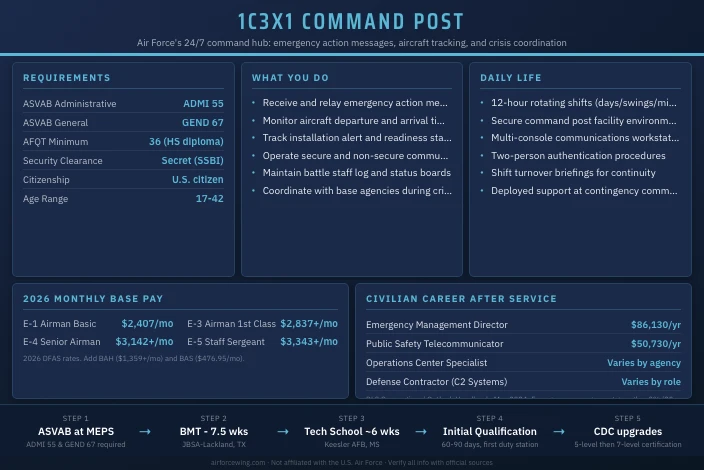
1C3X1 Command Post specialists operate and manage the command and control facilities that keep wing commanders informed and connected around the clock. They handle emergency action messages, track aircraft and crews, coordinate crisis communications, and serve as the primary information hub for installation leadership during routine operations, exercises, contingencies, and real-world emergencies.
The command post is not a passive monitoring station. Airmen in this role actively manage information flow between the wing, higher headquarters, and subordinate units. They receive and process emergency action messages with absolute precision, because errors in that process carry severe legal and operational consequences. They also log aircraft departures and arrivals, track aircraft overdue reports, coordinate search and rescue notifications, and maintain status boards that show commanders exactly what’s happening on and around the installation.
Daily Tasks
- Receive, authenticate, and relay emergency action messages to the wing commander
- Monitor aircraft departure and arrival times and initiate overdue reports
- Track unit alert status and report readiness posture to higher headquarters
- Maintain the battle staff duty log and situation boards
- Operate secure and non-secure communications systems
- Coordinate with base agencies during accidents, natural disasters, and security incidents
- Brief incoming shift personnel on all active situations before turnover
Specialized Roles and Codes
The 1C3X1 specialty uses skill-level suffixes to mark progression: 1C301 (Apprentice), 1C331 (Journeyman), 1C351 (Craftsman), 1C371 (Superintendent), and 1C300 (Helper). Special Experience Identifiers (SEIs) can be awarded for validated experience in areas like battle staff operations at MAJCOM or CCMD command centers, which broadens assignment options at senior grades.
| Code | Level | Typical Time Frame |
|---|---|---|
| 1C301 | Apprentice (3-skill level) | Tech School through ~1 year on the job |
| 1C331 | Journeyman (5-skill level) | ~2-3 years, requires OJT and CDCs |
| 1C351 | Craftsman (7-skill level) | ~5-6 years, supervisor and trainer roles |
| 1C371 | Superintendent (9-skill level) | Senior NCO, section chief and above |
Mission Contribution
Command post operators are the single point of contact between the wing and the entire Air Force command structure during a crisis. When a nuclear surety event occurs, a conventional strike tasking arrives, or a safety mishap requires immediate reporting, it runs through the command post. The role exists at every level: from single-base wing command posts to Combatant Command centers that oversee theater-wide operations. Senior 1C3X1s can serve at Air Operations Centers (AOCs) and National Military Command Centers, where the operational impact is global.
Technology and Equipment
Command post Airmen work with a mix of secure and non-secure communications systems. These include the Global High Frequency (HF) radio network, the Defense Switched Network (DSN), the Secret Internet Protocol Router Network (SIPRNet), and classified command-and-control systems tied to the Nuclear Command, Control, and Communications (NC3) architecture. You’ll also work with the Enhanced Command Post System (ECPS) and similar automated status-tracking tools. Most of this equipment is not publicly documented in detail, but you’ll receive full training on all systems during your initial qualification course.
Salary
Base pay is set by pay grade and years of service, the same tables that apply to every other enlisted Airman. What differs is where your total compensation ends up once housing and food allowances are added.
Base Pay Table (2026 DFAS Rates)
| Rank | Grade | Entry Pay | With 4 Years | With 8 Years |
|---|---|---|---|---|
| Airman Basic | E-1 | $2,407/mo | , | , |
| Airman | E-2 | $2,698/mo | , | , |
| Airman First Class | A1C / E-3 | $2,837/mo | $3,198/mo | , |
| Senior Airman | SrA / E-4 | $3,142/mo | $3,659/mo | $3,816/mo |
| Staff Sergeant | SSgt / E-5 | $3,343/mo | $3,947/mo | $4,299/mo |
| Technical Sergeant | TSgt / E-6 | $3,401/mo | $4,069/mo | $4,613/mo |
Most people who enlist in this AFSC will reach E-4 within 2-3 years. Add Basic Allowance for Housing (BAH), which varies by duty station and dependency status (a single E-4 at Joint Base San Antonio receives $1,359/mo without dependents), and Basic Allowance for Subsistence (BAS) of $476.95/mo, and take-home compensation rises substantially.
Additional Benefits
Healthcare through TRICARE Prime covers medical, dental, vision, mental health, and prescriptions with no premiums, no deductibles, and no copays for active-duty Airmen.
Education options include Air Force Tuition Assistance (up to $4,500/year for on-duty courses) and the Post-9/11 GI Bill, which covers full in-state tuition at public schools or up to $29,920.95/year at private institutions. The GI Bill also pays a monthly housing allowance tied to the school’s ZIP code.
Retirement under the Blended Retirement System (BRS) includes a 20-year pension paying 40% of your high-36 average basic pay, plus government matching contributions to the Thrift Savings Plan (TSP) up to 4% of basic pay.
Work-Life Balance
Command post runs on 12-hour rotating shifts, so schedule predictability is limited. Most installations operate a Panama schedule (2-2-3) or similar rotation, meaning your days off cycle through the week rather than landing on weekends. Airmen earn 30 days of paid leave per year and can carry up to 60 days over. The shift work is manageable long-term but does affect family scheduling and routine activities more than a standard day job.
Qualifications
The 1C3X1 AFSC requires the highest combined ASVAB score in the enlisted operations career group. You must meet both minimums. Falling short on either composite disqualifies you regardless of the other score.
Qualifications Table
| Requirement | Standard |
|---|---|
| ASVAB Administrative (ADMI) | 55 minimum |
| ASVAB General (GEND) | 67 minimum |
| AFQT Minimum | 36 (HS diploma), 65 (GED) |
| Security Clearance | Secret (SSBI required) |
| Citizenship | U.S. citizen |
| Age | 17-42 at enlistment |
| Vision | No specific waiver documented; normal color vision preferred |
| Speech | Must speak English clearly and distinctly |
| Medical | Normal emotional and psychological stability required |
| Education | High school diploma or equivalent |
The ADMI composite draws on General Science, Paragraph Comprehension, Word Knowledge, and Arithmetic Reasoning subtests. The GEND composite draws on Word Knowledge, Paragraph Comprehension, Arithmetic Reasoning, and Mathematics Knowledge. Strong scores in reading comprehension and verbal reasoning are the most direct path to meeting both minimums.
Application Process
Your path to 1C3X1 starts with the Armed Services Vocational Aptitude Battery (ASVAB) at a Military Entrance Processing Station (MEPS). If you meet the composite minimums, a recruiter can submit you for the job. Because command post involves classified communications, background investigation paperwork must be initiated before you ship to BMT. The full SSBI process takes several months and runs concurrently with your early service. Your recruiter will brief you on the specific documentation required.
Selection and Competitiveness
Command post is a moderately competitive AFSC. The dual composite requirement filters out a significant portion of applicants before the recruiter even reviews the packet. Recruiters occasionally look at work history or communications experience as supporting factors, but the ASVAB score is the primary gate. There is no waiver for the ASVAB minimums.
Service Obligation
Non-prior service enlistees sign a standard four-year active-duty contract. Some specific assignment options, especially those involving classified systems training, may carry additional service commitments. Confirm your contract terms with your recruiter before signing.
New Airmen enter the Air Force as Airman Basic (E-1) and can be promoted to Airman (E-2) after completing BMT, followed by promotion to Airman First Class (A1C, E-3) six months after arriving at their first duty station.
Prepare for the ASVAB early. Both the ADMI and GEND composites reward consistent reading habits and solid math fundamentals. An ASVAB prep course targeting the verbal and arithmetic subtests can make a real difference if your practice scores are close to the minimums.
Work Environment
Setting and Schedule
The command post floor is a secure, climate-controlled facility with multiple workstations, classified communications consoles, and status displays showing wing-level operations in real time. You won’t be outdoors, and you won’t be on the flight line. The environment is physically sedentary but mentally demanding because you’re managing multiple information streams simultaneously during a 12-hour shift.
Shift work is permanent and non-negotiable in this career field. Command posts operate continuously, so every three-person crew rotates through day, swing, and mid-shift cycles on a structured schedule. Some installations run a four-day work cycle with extended shifts; others use a more traditional rotation. You’ll know which schedule your duty station uses before you arrive.
Chain of Command and Communication
The command post section chief (typically a TSgt or MSgt) supervises daily shift operations. Above the section, the command post falls under the wing’s Operations Group. Shift supervisors evaluate performance directly and provide feedback after significant events such as emergency action message processing or real-world incident coordination. Performance reports (EPRs) at the 5-skill level and above carry weight toward promotion board scores.
Team Dynamics
Two or three Airmen work each shift together, with a senior specialist designated as shift supervisor. Decision-making authority during routine operations is relatively independent, but emergency action message processing follows a scripted, two-person authentication procedure with zero tolerance for deviation. Newer Airmen work alongside experienced shift supervisors until they complete qualification training.
Job Satisfaction
Command post tends to attract people who like structured, high-responsibility environments. The shift rotation can be a friction point, particularly for Airmen with young families. Retention in the AFSC is generally solid, partly because the experience is valued in both military and civilian emergency operations centers. Airmen who thrive here typically describe the job as one where preparation matters more than reaction time, because the checklists exist precisely to keep calm heads during chaos.
Training
All enlisted Airmen begin with 7.5 weeks of Basic Military Training at Joint Base San Antonio-Lackland, TX, before moving to their AFSC-specific Tech School.
Training Pipeline
| Phase | Location | Length | Focus |
|---|---|---|---|
| Basic Military Training (BMT) | JBSA-Lackland, TX | 7.5 weeks | Military foundation, fitness, discipline |
| Technical School (Tech School) | Keesler AFB, MS | ~6 weeks | Command post systems, communications procedures, emergency action operations |
| Initial Qualification Training (IQT) | First duty station | 60-90 days | Unit-specific systems, local procedures, on-the-job certification |
Tech School for 1C3X1 at Keesler AFB covers the foundational knowledge you need before arriving at your first unit: Air Force command structure, emergency action message procedures, communications security (COMSEC) principles, and the policies governing command post operations. The Air Force Institute of Technology (AFIT) provides some coursework that supplements classroom instruction at Keesler.
Career Development Courses
After arriving at your first assignment, you’ll complete Career Development Courses (CDCs): self-paced correspondence courses that test your knowledge at each skill level. Passing CDC end-of-course tests, combined with documented on-the-job training (OJT), is required to upgrade from the 3-skill level to the 5-skill level (Journeyman) and from the 5-skill level to the 7-skill level (Craftsman).
Advanced Training Opportunities
Senior 1C3X1 NCOs can attend Battle Staff courses and serve at MAJCOM or Combatant Command centers, which provide exposure to theater-level operations. Some assignments involve Nuclear Command, Control, and Communications (NC3) responsibilities that require additional certification and periodic recertification. The Air Force Personnel Center manages advanced assignment slates for qualified NCOs.
The Air Force also funds college coursework through the Tuition Assistance program while you’re on active duty. The structured communications and emergency operations background from this AFSC aligns well with emergency management and homeland security degree programs. If you haven’t taken the ASVAB yet, the ASVAB study guide covers the verbal and arithmetic subtests that feed both the ADMI and GEND composites this AFSC requires.
Career Progression
Rank Progression
| Rank | Grade | Typical Time Frame | Notes |
|---|---|---|---|
| Airman Basic | E-1 | Entry | Upon enlistment |
| Airman | E-2 | ~6 months | After BMT graduation |
| Airman First Class | E-3 | ~1 year TIS | First duty station arrival |
| Senior Airman | E-4 | ~2-3 years TIS | Must pass 5-level upgrade |
| Staff Sergeant | E-5 | ~4-6 years | Promotion board selection |
| Technical Sergeant | E-6 | ~8-10 years | Promotion board selection |
| Master Sergeant | E-7 | ~14-16 years | Highly competitive |
| Senior Master Sergeant | E-8 | ~18-20 years | Very selective |
| Chief Master Sergeant | E-9 | ~22+ years | Top 1% of enlisted force |
Promotion from E-1 through E-4 happens through time-in-service and skill-level completion milestones. From SSgt (E-5) onward, promotion is competitive and based on Enlisted Performance Report (EPR) scores, promotion fitness exam results, and a scored performance record that the central board evaluates.
Role Flexibility and Transfers
1C3X1 Airmen can apply for retraining after completing their first enlistment obligation. The retraining process requires supervisor endorsement and an approved AFPC slot. Airmen who want to cross-train often move toward related operations AFSCs or, in some cases, apply for commissioning through Officer Training School if they complete a bachelor’s degree while on active duty.
Assignment preferences can be submitted through the Assignment Management System, but operational needs of the Air Force drive most placement decisions at junior grades. Senior NCOs carry more weight in the assignment process.
Performance Evaluation
The Air Force uses the Enlisted Performance Report (EPR) to evaluate every Airman from E-3 upward. Raters at the SSgt level and above write narrative evaluations that describe specific job contributions and leadership. These reports feed directly into promotion board scoring and are among the most important career documents an Airman maintains. Supervisors conduct mid-term feedback sessions to discuss performance before the formal EPR period closes.
Success in the 1C3X1 career field comes down to reliability and precision. Airmen who receive strong EPRs typically have a record of zero-defect emergency action message handling, supervisor-level shift certifications, and documented contributions to exercise performance and inspection scores.
Physical Demands
Command post is a low-physical-demand job on a daily basis. Most of your shift is spent seated at a console. The physical challenges come from shift rotation and maintaining fitness standards across a career, not from the work itself.
Air Force Fitness Assessment Standards
All Airmen take the Air Force Fitness Assessment (FA) annually. The FA is scored on a 100-point scale. You must earn a minimum composite score of 75 and meet the minimum standard on each component. There are no AFSC-specific exemptions.
| Component | Max Points | Minimum Passing (Under 25, Male) | Minimum Passing (Under 25, Female) |
|---|---|---|---|
| 1.5-Mile Run | 60 | Varies by age/gender norm | Varies by age/gender norm |
| Push-Ups (1 min) | 10 | Must meet minimum reps | Must meet minimum reps |
| Sit-Ups (1 min) | 10 | Must meet minimum reps | Must meet minimum reps |
| Waist Circumference | 20 | Must meet standard | Must meet standard |
Exact minimum rep counts and run times by age and gender are set by Air Force Instruction and published annually. Check current standards at af.mil before your assessment cycle.
Medical Evaluations
Beyond the standard Military Entrance Processing Station (MEPS) physical, 1C3X1 personnel undergo periodic medical reviews required by their security clearance. Psychological stability is a documented requirement for the AFSC given the stress of emergency action message handling. Airmen with a history of emotional instability on record may be flagged during the background investigation or MEPS screening process.
Deployment
Deployment Patterns
1C3X1 Airmen deploy in support of Combatant Command operations worldwide. Deployments typically run 90 to 180 days and place Airmen in command and control roles at Air Operations Centers, contingency command posts, and expeditionary wing operations centers. The AFSC deploys regularly, particularly for ongoing Air Force operations in the Middle East and the Indo-Pacific region, but tempo varies by assignment and global conditions.
Deployed command post operators perform the same core functions as they do at home station, with adaptations for contingency communications infrastructure. The work is demanding and important in deployed environments because the command post is often the only fully operational communications hub at a forward installation.
Duty Station Options
Command posts exist at virtually every Air Force installation that has a flying mission. Major duty stations include Langley AFB (VA), Tinker AFB (OK), Travis AFB (CA), Kadena AB (Japan), Ramstein AB (Germany), and Al Udeid AB (Qatar), among dozens of others. Geographic preference requests can be submitted but are not guaranteed. Most junior Airmen receive their first assignment based on Air Force needs.
Assignment decisions at higher grades incorporate both individual preferences and mission requirements. Senior NCOs in this AFSC often serve at MAJCOM command centers or Combatant Command headquarters, which tend to be concentrated in the National Capital Region, Colorado Springs, or Honolulu.
Risk/Safety
Job Hazards
The physical hazards of the command post environment are minimal. The significant risks are legal and operational. Emergency action message mishandling, authentication errors, procedural deviations, or unauthorized disclosure, can carry severe consequences under the Uniform Code of Military Justice (UCMJ). Every command post Airman receives explicit training on these legal obligations before being certified to operate unsupervised.
Security and Legal Requirements
The Secret clearance required for entry into this AFSC is maintained through periodic reinvestigation. Access to classified communications systems requires adherence to strict COMSEC protocols. Violations, even inadvertent ones, can trigger an investigation and result in suspension or revocation of access, which effectively ends your ability to serve in the 1C3X1 career field.
The Air Force handles classified information under Title 18 of the U.S. Code. Airmen in this AFSC sign Non-Disclosure Agreements at the start of their career and must report any foreign contacts or activities that could affect their clearance eligibility. Deployments to conflict zones do not change these obligations; in practice, they heighten them because of increased exposure to foreign nationals and potentially compromising situations.
Safety Protocols
Shift supervisors conduct a detailed battle staff briefing at every shift change to ensure continuity. Emergency action message checklists are two-person authenticated, which prevents single-point error. Procedures are reviewed after any discrepancy, and units undergo periodic inspections from higher headquarters to verify compliance with command post operating instructions.
Impact on Family
Shift work is the defining quality-of-life factor for 1C3X1 families. Rotating through days, swings, and mids on a multi-week cycle means that holidays, weekends, and school events will not always align with your schedule. Families who have lived this schedule describe it as manageable once everyone adjusts expectations, but the adjustment period is real.
Family Support Resources
The Air Force provides several resources specifically for families managing shift work and the operational tempo that comes with it. Airman and Family Readiness Centers (AFRCs) at each installation offer financial counseling, deployment preparation, and family transition support. Military OneSource provides confidential counseling and referrals for family issues at no cost to the member.
Relocation
Permanent Change of Station (PCS) moves happen every 2-4 years on average. The Air Force pays relocation costs through the Permanent Change of Station travel entitlement, but the disruption to spouses’ careers, children’s schools, and family networks is a genuine consideration. Installations with large command post staffing, like Joint Base Langley-Eustis and Ramstein AB, tend to have stronger support infrastructure for dependent families.
Overseas assignments (Kadena, Ramstein, and other OCONUS bases) come with specific housing and support arrangements and can be a positive experience for families who are open to living abroad, especially when accompanied tours are approved.
Reserve and Air National Guard
Component Availability
The 1C3X1 AFSC is available in both the Air Force Reserve (AFR) and the Air National Guard (ANG). Reserve command post units exist at installations with Air Reserve Component flying missions. Air National Guard units maintain their own command posts tied to the state Adjutant General’s emergency management mission, which gives ANG 1C3X1 Airmen a broader range of activation scenarios that include state-level disasters and emergencies.
Drill Commitment and Training
Both components follow the standard one weekend per month (Unit Training Assembly / UTA) plus 15 days annual training baseline commitment. Command post certification requires currency maintenance, so some units schedule additional training assemblies or annual exercises beyond the minimum commitment. Initial qualification still requires completing BMT and the full 1C3X1 Tech School at Keesler AFB before joining a Reserve or Guard unit, unless the member has prior active-duty experience in the career field.
Pay and Benefits Comparison
| Category | Active Duty | Air Force Reserve | Air National Guard |
|---|---|---|---|
| Commitment | Full-time | 1 UTA/mo + 15 days/yr | 1 UTA/mo + 15 days/yr |
| E-4 Monthly Pay | $3,142-$3,816/mo | ~$500-$600/drill weekend | ~$500-$600/drill weekend |
| Healthcare | TRICARE Prime (no cost) | TRICARE Reserve Select (premiums apply) | TRICARE Reserve Select (premiums apply) |
| Education | Full TA + GI Bill | Federal TA + GI Bill (reduced benefit with less than 36 months active duty) | Federal TA + state tuition waivers (vary by state) |
| Deployment Tempo | High (90-180 day rotations) | Lower (episodic mobilizations) | Lower (state and federal activations) |
| Retirement | 20-year pension (high-36) | Points-based at age 60 | Points-based at age 60 |
ANG Airmen may qualify for state tuition waivers that cover in-state tuition at public colleges, which is a significant benefit not available to active-duty or Reserve members. These programs vary by state. Employer protections under USERRA (Uniformed Services Employment and Reemployment Rights Act) protect civilian jobs during military activations for all Reserve Component members.
Civilian Career Integration
The command post background pairs well with emergency communications, 911 dispatch supervision, and emergency management roles in civilian government. Reserve and Guard service in this AFSC reinforces those civilian credentials without requiring full-time service. Many civilian emergency operations centers value applicants with documented military command post experience, and the clearance history can be an asset for defense contractor positions.
Post-Service
Civilian Career Transition
The 1C3X1 skill set translates directly into civilian emergency communications and operations management roles. The combination of high-stress communications experience, classified systems background, and multi-agency coordination makes veterans from this AFSC competitive for roles that don’t advertise specifically for military backgrounds but implicitly require the same competencies.
The Transition Assistance Program (TAP) provides pre-separation career counseling, resume workshops, and job placement resources at every installation. For 1C3X1 veterans, the most relevant civilian credentials to pursue before separation are emergency management certifications through FEMA and, if applicable, emergency communications dispatcher credentials.
Civilian Career Prospects
| Civilian Job Title | Median Annual Salary | Job Outlook (2024-2034) |
|---|---|---|
| Emergency Management Director | $86,130/yr | +3% (as fast as average) |
| Public Safety Telecommunicator (911 Dispatcher) | $50,730/yr | +3% (as fast as average) |
| Operations Center Specialist (Federal/Defense) | Varies by agency | Steady demand |
The Bureau of Labor Statistics Occupational Outlook Handbook provides the underlying May 2024 salary data for all three civilian roles above.
Defense contractors with command and control programs hire veterans from this AFSC for technical support, training development, and systems operations roles. Federal civilian positions at the GS-5 through GS-9 level are realistic entry points for separating Airmen, with advancement to GS-12 and above common for veterans who complete relevant degrees or certifications.
Is This a Good Job
Ideal Candidate Profile
The best candidates for 1C3X1 are detail-oriented, emotionally steady, and genuinely comfortable in a high-stakes information environment. You need to be someone who follows procedures exactly, even when you’re tired after six hours on a mid-shift, because the consequences of shortcuts in emergency action message handling are serious. Strong reading comprehension and verbal communication skills are more predictive of success here than technical aptitude.
People who succeed in command post often describe themselves as organized and methodical. They don’t improvise during crisis situations; they work the checklist. If you find rigid procedures stifling rather than reassuring, this AFSC will frustrate you.
Potential Challenges
Shift rotation is the top complaint from Airmen who leave the career field or request retraining. Not everyone can sustain rotating schedules long-term, especially once children arrive or other life factors change the equation. The physical environment is sedentary, which requires deliberate effort to stay fit across a full career. Some Airmen find the pace between major events slow, since command post can be quiet for stretches before suddenly becoming the busiest place on the installation.
The security clearance requirement also constrains your personal life in ways that aren’t always obvious at enlistment. Foreign travel, certain foreign associations, and financial issues can all affect clearance status. These are not insurmountable concerns for most people, but they require awareness throughout your career.
Who Thrives Here Long-Term
1C3X1 is a strong fit if you want a career in emergency management, public safety, or defense operations after service. The job builds a documented track record in a field that values experience over credentials. The clearance adds real value in the defense sector.
It’s a poor fit if you want variety in daily tasks, outdoor work, or a schedule that aligns with a conventional work week. The command post floor is consistent, controlled, and demanding in ways that aren’t always obvious from the outside. For the right person, those qualities make it one of the most satisfying enlisted jobs in the Air Force.
More Information
Talk to an Air Force recruiter to confirm current openings, verify your ASVAB scores qualify for 1C3X1, and get accurate information about enlistment bonuses or incentive programs that may be available when you ship. Bonus availability changes each fiscal year and is not guaranteed until it appears in a signed contract. Your recruiter can also walk you through the security clearance paperwork you’ll need to initiate before BMT.
Start your ASVAB prep now if your practice scores are near the minimums. The ADMI and GEND composites both reward reading and verbal skills that build gradually, not overnight. An ASVAB study course can help you identify which subtests to focus on before your test date.
Official resources for research and verification:
- Keesler AFB 2nd Air Force Training, manages the 1C3X1 Tech School; the 81st Training Wing website has information on the training environment and location
- AFPC career field management, official source for career field manning, special experience identifiers, and assignment system information
- airforce.com operations careers, official entry requirements and career overview for 1C3X1
Related career profiles on this site:
- Air Force operations careers hub, compare command post with other operations support AFSCs including weather, air traffic control, and airfield management
- 1C1X1 Air Traffic Control, a higher-ASVAB operations role that also involves 24/7 shift work in a communications-intensive environment
- 1W0X1 Weather, another operations support specialty with a similar analytical and communications skill profile
Practical preparation:
The Top Secret clearance investigation starts during the recruiting process. Candidates with complex backgrounds, foreign contacts, financial issues, prior drug use, should have that conversation with the recruiter before investing heavily in ASVAB preparation. A clearance disqualifier discovered after enlistment means reassignment to a different AFSC.
For the ASVAB, the General (GEND) composite is Word Knowledge, Paragraph Comprehension, Arithmetic Reasoning, and Mathematics Knowledge. The Administrative (ADMI) composite overlaps on reading but adds General Science. Both benefit from consistent reading and vocabulary work. An ASVAB study guide used before your official MEPS test date gives you the best chance of qualifying on the first attempt.
This site is not affiliated with the U.S. Air Force or any government agency. Verify all information with official Air Force sources before making enlistment or career decisions.
Explore more Air Force operations careers such as 1C1X1 Air Traffic Control and 1W0X1 Weather.