1C1X1 Air Traffic Control
Every aircraft that takes off or lands at a military airfield does so because a controller said it could. The 1C1X1 Air Traffic Control AFSC sits at the intersection of aviation safety and real-time decision-making, where a single mistake carries serious consequences. It’s one of the few enlisted jobs that requires federal certification, trains alongside FAA controllers, and opens a direct path to one of the highest-paying civilian careers in the transportation sector.
Qualifying requires specific ASVAB line scores. Our ASVAB study guide covers what to target and how to prepare.
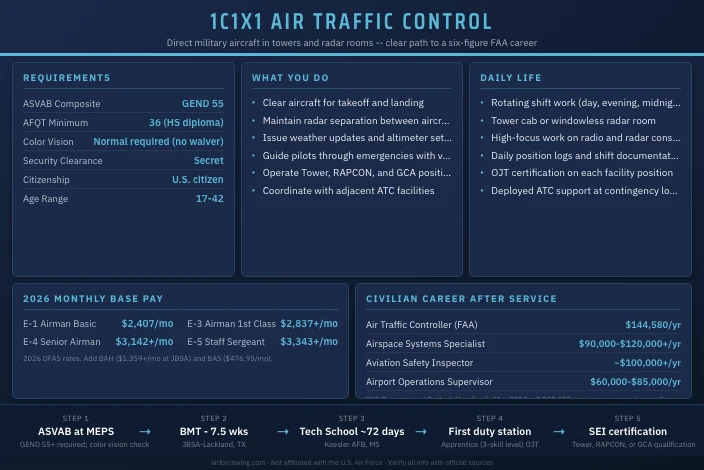
Job Role
Air Traffic Controllers in the 1C1X1 AFSC direct the movement of aircraft at military airfields worldwide. They use visual observation, radar, and radio communications to maintain safe separation between aircraft, sequence arrivals and departures, and coordinate with pilots during emergencies. The work happens in control towers, radar approach control (RAPCON) facilities, and ground-controlled approach (GCA) units.
The day-to-day depends on which facility you’re assigned to. Tower controllers clear aircraft for takeoff and landing and manage ground movement on the airfield. RAPCON controllers use radar to sequence aircraft at higher altitudes during approach and departure phases. GCA controllers talk pilots down to the runway using precision radar during low-visibility conditions. Most controllers work across multiple positions before specializing.
Daily Tasks
- Clear aircraft for departure and arrival sequences on assigned runways
- Issue altimeter settings, weather updates, and NOTAMs to inbound pilots
- Coordinate with adjacent facilities and military airspace managers
- Monitor radar scopes and maintain required separation between aircraft
- Assist pilots declaring emergencies by providing vectors and field information
- Complete position logs and shift documentation at every facility
Specializations and Codes
The 1C1X1 career field uses Special Experience Identifiers (SEIs) to document specific qualifications. Three primary SEIs drive career progression and assignment decisions:
| SEI | Facility Type | Description |
|---|---|---|
| RAPCON | Radar Approach Control | Radar separation and sequencing during approach/departure phases |
| Tower | Control Tower | Visual and radio control of aircraft on the ground and in the traffic pattern |
| GCA | Ground Controlled Approach | Precision approach radar used in low-visibility conditions |
Controllers must earn at least one SEI before wearing the Air Traffic Control basic badge. Most assignments require controllers to maintain multiple facility qualifications.
The Air Force assigns 1C1X1 controllers to positions designated under PEC 35114P during the apprentice phase. Shredouts (skill-level suffixes) are not currently part of the 1C1X1 AFSC structure; specialization is tracked through SEIs and skill levels instead.
Mission Contribution
A flight line that operates without controllers is a flight line that doesn’t operate at all. ATC keeps the Air Force’s airfield infrastructure running around the clock, supporting combat sorties, training missions, medevac flights, and airlift operations. During contingency operations, controllers at deployed locations manage simultaneous arrivals of combat aircraft in high-density airspace, often with limited equipment and no room for error.
Equipment and Technology
Controllers work with air traffic management systems including the AN/GPN-22 precision approach radar, digital Flight Data Processing systems, radio communication consoles, and traffic management units. Some installations use the Standard Terminal Automation Replacement System (STARS). Deployed environments may use expeditionary radar and voice switching equipment designed for quick setup in austere locations.
Salary
Military pay for 1C1X1 Airmen follows the 2026 DFAS pay schedule. All enlisted Airmen at the same grade and years of service receive identical basic pay regardless of AFSC.
Basic Pay (2026)
| Rank | Grade | Entry Pay | 4 Years | 6 Years |
|---|---|---|---|---|
| Airman Basic | E-1 | $2,407/mo | $2,407/mo | , |
| Airman First Class | E-3 | $2,837/mo | $3,198/mo | $3,198/mo |
| Senior Airman | E-4 | $3,142/mo | $3,659/mo | $3,816/mo |
| Staff Sergeant | E-5 | $3,343/mo | $3,947/mo | $4,109/mo |
| Technical Sergeant | E-6 | $3,401/mo | $4,069/mo | $4,236/mo |
2026 rates per the DFAS Military Pay Tables.
Basic pay is only part of total compensation. Airmen not living in barracks receive Basic Allowance for Housing (BAH), which varies by installation, pay grade, and dependency status. At Joint Base San Antonio-TX, a single E-4 receives $1,359/mo in BAH; an E-5 receives $1,500/mo. Basic Allowance for Subsistence (BAS) adds a flat $476.95/mo for all enlisted Airmen.
Additional Benefits
Healthcare under TRICARE Prime costs nothing out of pocket for active duty Airmen. Coverage includes medical, dental, vision, mental health, prescriptions, and hospitalization. The Post-9/11 GI Bill covers full in-state tuition at public schools and up to $29,920.95 annually at private institutions for Airmen who serve long enough to earn full eligibility. The Air Force Tuition Assistance program covers up to $4,500 per year toward courses taken while on active duty.
Retirement under the Blended Retirement System (BRS) combines a 20-year pension at 40% of average high-36 pay with Thrift Savings Plan contributions. The government matches up to 4% of basic pay plus an automatic 1% contribution beginning at 60 days of service.
Work-Life Balance
Controllers earn 30 days of paid leave per year. Shift work is standard across all ATC facilities, with most operating on a rotating schedule. Patterns vary by installation but commonly include day, evening, and midnight shifts on a rotating basis. Some bases operate on a Panama schedule (longer shifts with more consecutive days off). The operational nature of the AFSC means shift changes are built around mission requirements, not calendar preferences.
Qualifications
The ASVAB General (GEND) composite score for 1C1X1 is 55. This measures verbal and arithmetic reasoning ability and is the primary academic screen for the career field.
Qualification Requirements
| Requirement | Standard |
|---|---|
| ASVAB Composite | GEND 55 |
| AFQT Minimum | 36 (HS diploma); 65 (GED) |
| Citizenship | U.S. citizen |
| Age | 17-42 at enlistment |
| Security Clearance | Secret (National Agency Check + Local Agency Checks) |
| Medical Standard | Ground-based Aircraft Controller medical standards |
| Speech | Must speak English clearly and distinctly |
| Color Vision | Normal color vision required |
| Education | High school diploma (or GED with AFQT 65+) |
Verify current requirements at airforce.com.
Application Process
Enlistment into 1C1X1 runs through a Military Entrance Processing Station (MEPS). You’ll take the ASVAB there, complete a physical exam, and meet with an Air Force classifier who will determine which AFSCs you qualify for. Controllers must pass the MEPS medical physical and meet the Ground-based Aircraft Controller medical standard, which includes specific vision, hearing, and speech requirements beyond the standard MEPS physical.
The Secret clearance investigation begins after you enlist. It covers employment history, foreign contacts, financial background, and criminal record. The investigation must reach a favorable determination before you can work in a certified ATC position. Most applicants without complicating factors clear the investigation within a few months of enlisting.
Selection and Competitiveness
1C1X1 is a competitive AFSC with limited training seats. Controllers who score well above the GEND 55 minimum, show clean financial and legal backgrounds, and demonstrate strong verbal communication during the enlistment process have better odds of receiving the job guarantee. Existing aviation experience (student pilot certificates, sport pilot, military simulator time) is not required but stands out in an applicant’s file.
Service Obligation
Airmen who enlist into 1C1X1 typically incur a four-year active duty service commitment. Specific obligation lengths depend on bonus agreements if applicable and any training commitments tied to the pipeline. Retrainees from other AFSCs must meet the same qualification standards and complete the full tech school pipeline.
Entry Rank
All enlisted accessions enter at E-1 (Airman Basic). Recruits with college credits or Junior ROTC participation may enter at a higher grade per current Air Force policy.
See our ASVAB study guide for strategies to hit these line scores, or take the PiCAT from home if you are a first-time tester.
Work Environment
ATC is a shift-work career field. Control towers and radar facilities run 24 hours a day, seven days a week, which means controllers rotate through day, evening, and midnight shifts throughout their careers. Towers are elevated glass-enclosed structures with a direct view of the airfield; RAPCON facilities are often windowless rooms lit primarily by radar scopes and display screens. GCA vans at some installations are compact, climate-controlled environments that controllers share with minimal room for movement.
The job demands sustained concentration. During peak traffic periods, a tower controller may handle simultaneous communications on multiple frequencies while watching several aircraft on approach. During quiet periods, that same controller maintains situational awareness of all active aircraft in the traffic pattern while staying current on weather and NOTAM updates.
Leadership and Communication
Controllers work within a facility chain of command that runs from shift supervisor through operations supervisor to chief controller. Feedback is immediate and specific. If a controller issues an incorrect clearance or breaks separation, the debrief happens that shift. Performance is documented and directly tied to certification status. Losing a certification means stepping back from that position until recertification is complete.
Team Dynamics
No ATC position operates in isolation. Tower controllers coordinate with RAPCON on every departure and arrival. RAPCON coordinates with Air Route Traffic Control Centers on overflights and long-distance traffic. GCA controllers respond to requests from aircraft already in contact with the tower. Every position depends on clear, standard phraseology and disciplined communication. New controllers start on the lowest-traffic positions and progress to higher-complexity positions as they demonstrate proficiency.
Job Satisfaction
ATC has strong retention among Airmen who certify and get their first facility assignment. The structured progression, meaningful daily work, and direct impact on flight safety tend to keep certified controllers engaged. The challenge is the pipeline itself: Tech School and on-the-job certification are demanding, and some Airmen wash out before earning their first SEI. Those who do certify consistently cite the operational intensity and responsibility as the primary driver of job satisfaction.
Training
The 1C1X1 pipeline runs from BMT at JBSA-Lackland through ATC Tech School at Keesler AFB, then to an operational unit for on-the-job certification. Earning your first SEI at the duty station is what makes you a fully qualified controller.
Initial Training Pipeline
| Phase | Location | Duration | Focus |
|---|---|---|---|
| Basic Military Training (BMT) | JBSA-Lackland, TX | 7.5 weeks | Military fundamentals |
| ATC Technical School | Keesler AFB, MS | ~72 days (~14 weeks) | ATC principles, radar, phraseology, simulations |
| On-the-Job Training (OJT) | First duty station | 12-24 months | Facility-specific certification for SEI |
BMT covers military customs, physical fitness standards, and foundational Airman skills. Every enlisted Airman completes it at Joint Base San Antonio-Lackland, regardless of AFSC.
Tech School at Keesler AFB delivers classroom and simulator instruction in ATC principles, Federal Aviation Regulations, radar operation, emergency procedures, and standard phraseology. Graduates earn college credit toward an Air Traffic Operations and Management degree. The coursework is demanding, and students who struggle with the simulation scenarios may be counseled into a different AFSC before completing the program.
After Tech School, new controllers arrive at their first operational unit as Apprentices (3-skill level) and begin position-specific OJT. Certification on each position requires supervised performance, written exams, and an evaluation by a certified controller. The timeline to earn a first SEI varies by facility complexity and individual pace but typically runs twelve to twenty-four months.
Advanced Training
Experienced controllers can pursue advanced training across several paths:
- Multiple facility certifications: Earning Tower, RAPCON, and GCA SEIs makes a controller more versatile and competitive for assignments
- Radar certifications: Advanced radar training at specific installations qualifies controllers for high-complexity airspace
- Instructor certification: Senior controllers can become Certified ATC Instructors (CATCIs), training the next wave of apprentices at the facility
- Commissioned officer path: High-performing enlisted ATCs can pursue Officer Training School and commission into related aviation career fields
The Air Force also supports college education through Tuition Assistance while controllers are on active duty, which pairs well with the aviation-focused degree credit earned in Tech School.
Everything starts with qualifying ASVAB scores, our study guide covers what to study first.
Career Progression
Rank Progression Table
| Rank | Grade | Typical Time at Grade | Notes |
|---|---|---|---|
| Airman Basic | E-1 | 6 months | Entry upon accession |
| Airman | E-2 | 10 months | Automatic promotion |
| Airman First Class | E-3 | 14 months | Automatic promotion |
| Senior Airman | E-4 | ~3 years TIS | Automatic; below-zone possible |
| Staff Sergeant | E-5 | ~5-8 years TIS | Competitive promotion; EPR required |
| Technical Sergeant | E-6 | ~11-14 years TIS | Competitive; EPR and testing |
| Master Sergeant | E-7 | ~17-22 years TIS | Highly competitive |
| Senior Master Sergeant | E-8 | Senior career | Board-based selection |
| Chief Master Sergeant | E-9 | Senior career | Top 1-2% of enlisted force |
TIS = Time in Service (approximate; promotion timelines vary with Air Force needs and individual performance)
Promotion from E-4 to E-5 and above is competitive and driven by Enlisted Performance Reports (EPRs), promotion testing scores (the Weighted Airman Promotion System, or WAPS), and time in grade. Controllers who maintain multiple facility certifications, take on supervisory responsibilities at the facility, and pursue professional military education (PME) ahead of peers stand out in promotion boards.
Specialization Options
As controllers build experience, they can pursue specific assignment tracks:
- RAPCON specialist: High-complexity radar work at busy approach control facilities
- Airspace management: Positions in wing or major command airspace management offices
- Pentagon/MAJCOM staff: Senior NCOs with broad ATC experience fill policy and oversight roles at higher headquarters
- Formal Training Unit (FTU) instructor: Teaching at Keesler or operational FTUs at installation level
Performance Evaluation
The Air Force uses the Enlisted Performance Report (EPR) to evaluate every enlisted Airman annually. For controllers, EPRs document ATC certifications held, positions supervised, flight safety contributions, and leadership development. A “5” rating (the highest) is rare and competitive. EPRs are the primary document reviewed during promotion boards, and narratives that describe specific ATC achievements carry more weight than generic accomplishments.
Physical Demands
Fitness Assessment
All Air Force Airmen take the Air Force Fitness Assessment (FA) annually. The FA consists of four components scored on a 100-point scale. Airmen must pass each component and score at least 75 composite points to remain in good standing.
| Component | Max Points | Minimum (Males Under 25) | Minimum (Females Under 25) |
|---|---|---|---|
| 1.5-Mile Run | 60 | 9:34 | 11:57 |
| Push-Ups (1 min) | 10 | 42 reps | 27 reps |
| Sit-Ups (1 min) | 10 | 38 reps | 38 reps |
| Waist Circumference | 20 | Must meet max allowed | Must meet max allowed |
Standards are age- and gender-normed. Verify current minimums at af.mil.
Daily Physical Demands
ATC work is mentally intensive but physically moderate. Controllers spend most of their shift standing or sitting at a console. There are no heavy lifting requirements or physical endurance demands specific to the AFSC. The demanding part of the job is cognitive: sustained attention over long shifts, decision-making under time pressure, and the ability to hold multiple aircraft tracks in working memory simultaneously.
Medical Standards
Beyond the standard MEPS physical, 1C1X1 controllers must meet Ground-based Aircraft Controller medical standards. These standards govern vision, color vision, hearing, and speech. Specific requirements include normal color vision (no colorblindness waivers for this AFSC), correctable visual acuity, and the ability to speak English clearly without impediment. Periodic medical evaluations are required to maintain controller certification throughout a career. Controllers who develop disqualifying medical conditions may need to retrain into another AFSC.
Color vision deficiency is disqualifying for 1C1X1 with no waiver available. Check your color vision before investing time in this AFSC path.
Deployment
Deployment Details
Air Traffic Controllers deploy regularly in support of contingency operations, exercises, and theater airlift missions. Deployment lengths vary from 90 to 179 days for standard rotations, though some contingency assignments extend longer. Controllers at deployed locations staff expeditionary ATC facilities supporting combat aircraft, cargo missions, and medevac flights. The deployment pace depends on current Air Force operational tempo and which installation you’re assigned to.
Expeditionary ATC operations differ significantly from stateside facility work. Deployed controllers often operate with reduced crew sizes, older or field-expedient radar equipment, and non-standard airspace structures where military and civilian aircraft may share restricted airspace during operations. Controllers who have worked multiple SEI positions before deploying are better prepared for those conditions because they can fill any controller position a deployed facility needs. Some contingency locations operate around the clock at surge tempo for extended periods, deployment is not a lighter version of the garrison job.
Controllers assigned to Air Mobility Command (AMC) installations tend to see higher deployment frequency tied to airlift mission support. Those at fighter bases in Air Combat Command (ACC) deploy in support of combat air operations. Both tracks put deployed controllers in high-density airspace where timing and separation are critical. The Air Force Expeditionary Force (AEF) rotation system provides some predictability in deployment scheduling, though mission requirements can override it on short notice.
Duty Stations
1C1X1 controllers serve at installations worldwide wherever the Air Force operates active airfields. Common CONUS duty stations include:
- Keesler AFB, MS (tech school; some controllers remain as instructors)
- Travis AFB, CA (major AMC hub)
- Dover AFB, DE (airlift center)
- Nellis AFB, NV (high-tempo training environment)
- Langley AFB, VA / JBLE (ACC fighter operations)
- JBSA-Randolph, TX (training command)
OCONUS assignments include installations in Europe, the Pacific, and the Middle East. Assignment preferences can be submitted through the assignment system, but the Air Force balances individual preferences against manning requirements.
Risk/Safety
ATC carries inherent operational risk. A controller who breaks separation standards, issues a conflicting clearance, or misidentifies an aircraft on radar can create a collision hazard. The Air Force takes ATC incidents seriously. Safety investigation processes are separate from disciplinary action, but persistent performance failures can result in decertification or reassignment.
The decertification process is one of the more significant career risks in this AFSC. If a controller causes a runway incursion, loses required separation between aircraft, or fails a position check, they may be immediately removed from that position while an investigation is completed. The investigation evaluates whether the incident resulted from a training gap, a procedural error, or a systemic facility problem. Controllers who are decertified on a position must complete a formal recertification program before returning to that assignment. A pattern of decertification events can lead to AFSC reclassification.
Fatigue is an ongoing safety concern in shift-work ATC environments. Controllers who work midnight shifts are particularly affected during the period from 3:00 to 5:00 AM, when human alertness is at its lowest point in the circadian cycle. Air Force ATC facilities follow crew rest and duty hour policies designed to mitigate fatigue risk, but those policies require individual controllers to take rest seriously between shifts.
Controllers with security clearances are bound by information security obligations related to classified airspace, military flight schedules, and operational data they encounter on the job. Clearance violations can result in immediate suspension and potential UCMJ action. The Secret clearance must be maintained throughout the career; adverse financial, legal, or foreign contact developments must be reported.
Overseas and deployed ATC positions may involve service in or near combat zones. Controllers operating at forward-deployed locations face the same environmental risks as other Airmen at those installations. At some contingency locations, the ATC facility itself may be within range of hostile indirect fire, and force protection procedures apply even while controllers are on position.
Impact on Family
Shift work is the defining lifestyle factor for ATC families. Rotating schedules mean holidays, weekends, and family events frequently fall during a controller’s duty hours. Spouses and families who do well in ATC households tend to be independent and adaptable to schedule uncertainty.
The schedule variation across a typical week can be significant. A controller on a rotating schedule may work a 6:00 AM day shift for three days, switch to a 2:00 PM evening shift for three days, and then transition to a midnight shift within the same two-week period. Some installations use a Panama or modified Panama schedule that provides longer consecutive days off in exchange for longer individual shifts. Controllers and their families benefit from treating the schedule as fixed and immovable rather than expecting flexibility, because the facility runs around the clock and coverage gaps are not acceptable.
Certification requirements add a layer of career uncertainty that affects family planning. A controller who fails to certify at a new facility after a PCS move may need to retrain, which can affect assignment timelines, promotion eligibility, and family housing planning. Families moving to a new installation should understand that the ATC certification process at the new facility can take up to two years and that operational effectiveness, not personal convenience, governs when that process starts and finishes.
Permanent Change of Station (PCS) moves occur every two to four years on average. The Air Force provides relocation allowances and support through the Personal Property office and Military OneSource, but each move requires families to establish new schools, medical providers, and community connections. Controllers assigned to OCONUS locations may or may not be accompanied by family depending on the installation’s dependent-travel status.
Family Support Resources
- Military OneSource: Counseling, financial planning, and relocation support available at no cost
- Airman and Family Readiness Centers (A&FRC): On-base support offices for employment assistance, school-age programs, and deployment preparation
- TRICARE: Dependents covered under the same zero-cost plan as the active duty Airman
Reserve and Air National Guard
The 1C1X1 AFSC is available in both the Air Force Reserve and the Air National Guard. Many Air National Guard units operate state airfields or co-locate with active duty ATC facilities, giving Guard controllers access to the same operational environments as their active duty counterparts.
Side-by-Side Comparison
| Category | Active Duty | Air Force Reserve | Air National Guard |
|---|---|---|---|
| Commitment | Full-time | 1 weekend/mo + 2 wks/yr | 1 weekend/mo + 2 wks/yr |
| Monthly Pay (E-4, <2 yrs) | $3,142/mo + BAH + BAS | ~$628 per drill weekend | ~$628 per drill weekend |
| Healthcare | TRICARE Prime (no cost) | TRICARE Reserve Select (premiums apply) | TRICARE Reserve Select (premiums apply) |
| Education | Full Tuition Assistance + GI Bill | Federal TA available; GI Bill eligibility varies | State tuition waivers vary; GI Bill eligibility varies |
| Deployment Tempo | Regular rotations (90-179 days) | Lower; mission-dependent | Lower; state mission + federal activation |
| Retirement | 20-year active pension (BRS) | Points-based Reserve retirement | Points-based Reserve retirement |
Drill pay for an E-4 is calculated as two days of basic pay per drill. At the 2026 rate of $3,142/mo, that works out to approximately $314 per drill day, or about $628 for a standard drill weekend with four Unit Training Assemblies (UTAs).
Civilian Career Integration
The Guard and Reserve path pairs particularly well with a civilian ATC career. A Guard controller working at a state-operated airfield can simultaneously hold an FAA certificate and work as a civilian controller at an FAA TRACON or ATCT. FAA air traffic control positions are civilian federal jobs and are not affected by the Uniformed Services Employment and Reemployment Rights Act (USERRA) in the same way as private-sector employers. Many Guard and Reserve ATCs work for the FAA as their primary employer and maintain their military certification on drill weekends. This combination can produce combined incomes well above either job alone.
Deployment and Mobilization
Reserve and Guard 1C1X1 controllers are subject to Title 10 federal mobilization for contingency operations. During high operational tempo periods, mobilization rates for ATC Reserve and Guard units have increased. Typical mobilizations run 6 to 12 months. Controllers should expect at least one mobilization during a long Guard or Reserve career, though frequency is lower than for active duty assignments.
Post-Service
The 1C1X1 AFSC has one of the strongest civilian transition stories of any enlisted Air Force career. Military ATC experience translates directly into FAA-certified civilian controller positions, and the FAA prioritizes hiring veterans with controller backgrounds.
Civilian Career Prospects
| Civilian Job Title | Median Annual Salary | Job Outlook (2024-2034) |
|---|---|---|
| Air Traffic Controller (FAA) | $144,580 | +1% (slower than average) |
| Airspace Systems Specialist | $90,000-$120,000+ | Stable federal demand |
| Aviation Safety Inspector | ~$100,000+ | Steady federal government demand |
| Airport Operations Supervisor | ~$60,000-$85,000 | Variable by airport size |
The BLS Occupational Outlook Handbook projects about 2,200 ATC openings annually through 2034, primarily driven by retirement replacements.
The FAA pipeline for new hires typically requires completion of the FAA Academy in Oklahoma City. Veterans with military ATC experience can enter as Facility Rating Experience (FRE) candidates, bypassing some early training requirements and accelerating their certification timeline at a civilian facility. The $144,580 median salary reflects controllers at all experience levels; senior controllers at high-complexity facilities (Level 12 TRACONs, large ARTCCs) often earn significantly more.
Beyond the FAA, military ATC experience translates into aviation safety inspector roles at the FAA, airline operations center positions, and defense contractor jobs supporting ATC system upgrades and modernization programs.
Transition Programs
The Department of Defense Skillbridge program allows Airmen approaching separation to intern with civilian employers during their final 180 days of service. FAA partner programs under Skillbridge exist and allow controllers to begin civilian certification work before their last day of active duty. The Air Force also offers the Transition Assistance Program (TAP), which includes resume-writing workshops, benefits counseling, and job placement resources.
Is This a Good Job
Who Fits This AFSC
The ideal 1C1X1 candidate processes information quickly, speaks clearly under stress, and stays calm when multiple things demand attention at the same time. ATC rewards people who are naturally organized and deliberate, not reactive. If you’re the kind of person who stays methodical when things get complicated, this career field will feel natural.
Strong candidates typically share a few traits:
- High verbal and arithmetic aptitude (the GEND score reflects this directly)
- Genuine interest in aviation, not just as a job but as a subject
- Comfort with shift work and acceptance that schedule predictability is limited
- Willingness to be evaluated in real time on every position worked
The civilian career path is exceptional. A fully qualified controller who separates after one enlistment can walk into FAA hiring with credentials that most civilian applicants spend years trying to build.
Who Should Look Elsewhere
ATC is not a good fit for everyone. The medical requirements alone eliminate a significant percentage of applicants before the ASVAB comes into play. Color vision deficiency is disqualifying with no waiver available. Controllers with anxiety disorders, sleep difficulties, or conditions affecting sustained attention may struggle with both the certification process and the periodic medical evaluations that continue throughout a career.
The shift work is a real lifestyle constraint. Controllers who want evenings and weekends free will find those expectations incompatible with how ATC facilities operate. And the wash-out risk in Tech School and OJT is real. Airmen who don’t certify on a position may be reassigned into a different AFSC, so entering the pipeline requires genuine commitment to completing the certification process.
Failing to certify on assigned positions during OJT can result in AFSC reclassification. Research the job thoroughly before listing it as your top AFSC preference.
Career Alignment
For someone who wants technical work, aviation exposure, a federal job waiting on the other end of their enlistment, and a career field with a tight-knit community, 1C1X1 is one of the strongest enlisted choices in the Air Force. The demand for FAA controllers isn’t going away, the pay ceiling is high, and the skills transfer cleanly. For someone who needs schedule stability, has disqualifying medical factors, or doesn’t want the pressure of real-time aircraft separation, there are better fits elsewhere.
More Information
Talk to an Air Force recruiter to confirm current ASVAB requirements, available training seats, and any active enlistment incentives for this AFSC. Recruiters have access to the current MEPS medical standards checklist and can tell you whether your vision and color vision meet the Ground-based Aircraft Controller standard before you invest time in the application process. You can find recruiter contact information at airforce.com.
When you talk to a recruiter, ask specifically about color vision test results from MEPS and how they apply to 1C1X1. This is one of the most common disqualifying factors for interested candidates, and confirming it early saves everyone time. Also ask about current tech school class start dates and whether the job is available on your target ship date, 1C1X1 has limited training seats and is not always immediately available.
For research beyond this page, the following official sources are the most reliable:
- airforce.com/careers/aviation-and-flight/air-traffic-control, official Air Force AFSC overview
- FAA Air Traffic Organization, for understanding the civilian ATC career path this AFSC leads to
- FAA Academy information, relevant for post-service planning
- BLS Occupational Outlook Handbook: Air Traffic Controllers, civilian salary and job outlook data
The Air Force Personnel Center (AFPC) manages assignments and can be accessed through the myPers portal once you’re in service. Assignment officers for the 1C1X1 career field are the correct point of contact for questions about duty station preferences, special duty eligibility, and assignment timing.
- Prepare for the ASVAB with our study guide to make sure your line scores qualify
This site is not affiliated with the U.S. Air Force or any government agency. Verify all information with official Air Force sources before making enlistment or career decisions.
Explore more Air Force Operations careers to compare the full set of enlisted career options in this group.