1C0X2 Aviation Resource Management
Every flight that launches and recovers safely leaves a paper trail, and someone has to own it. Aviation Resource Management Specialists are the Airmen who track every flight hour, process every aviation pay entitlement, and maintain the qualification records that determine whether a pilot is cleared to fly the next mission. Without accurate records in the Aviation Resource Management System (ARMS), commanders can’t verify crew rest, finance can’t pay aircrew correctly, and schedulers can’t build a legal flight schedule. If you want a job at the center of flight operations without actually flying, this is it.
Job Role and Responsibilities
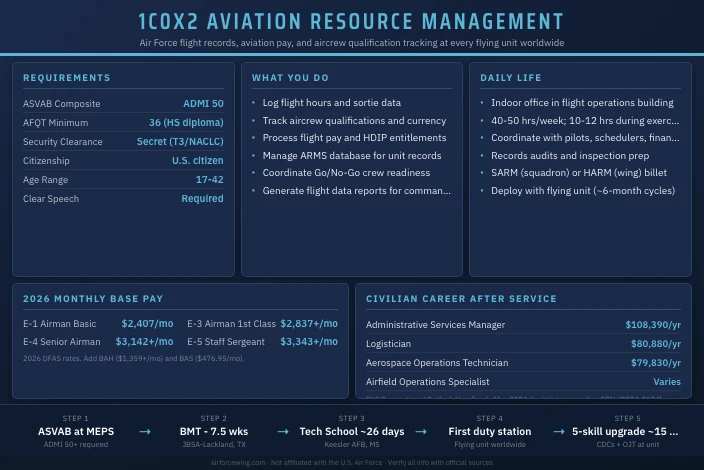
1C0X2 Aviation Resource Management Specialists perform and manage aviation and parachutist resource management functions for Air Force flying units. They maintain flight records, track aircrew qualifications, process flight pay and hazardous duty incentive pay (HDIP), schedule training, and administer the ARMS database that supports mission planning and regulatory compliance across the unit.
Day-to-Day Duties
The job centers on two operational environments. Squadron Aviation Resource Management (SARM) offices support a specific flying squadron, working directly with pilots, navigators, combat systems officers, and other aircrew members. Host Aviation Resource Management (HARM) offices serve the broader installation, providing oversight and auditing support across multiple units.
On a typical workday, ARM Specialists:
- Log flight hours and mission data after each sortie
- Monitor and update individual aircrew qualifications, certifications, and proficiency currency
- Process flight pay, including hazardous duty incentive pay and aviation career incentive pay
- Coordinate simulator and flight training scheduling
- Manage the Go/No-Go readiness system that determines mission-day crew eligibility
- Generate flight data reports for squadron commanders and wing leadership
- Conduct records audits and prepare for unit compliance inspections
The schedule follows flying operations. During high-tempo periods, exercises, inspections, or surge operations, shifts can run 10 to 12 hours. Normal garrison days are closer to a standard 40-50 hour week.
Specific Roles Within the Career Field
The 1C0X2 career field does not have formal shredouts the way some technical AFSCs do. Skill level is the primary differentiator, progressing from the 3-skill (apprentice) through the 5-skill (journeyman) to the 7-skill (craftsman) and 9-skill (superintendent) levels.
| Designation | Skill Level | Function |
|---|---|---|
| 1C031 | 3-Skill (Apprentice) | Entry-level; performs basic records maintenance under supervision |
| 1C051 | 5-Skill (Journeyman) | Independent ARMS database management; flight pay processing |
| 1C071 | 7-Skill (Craftsman) | Supervisory; manages SARM or HARM section operations |
| 1C091 | 9-Skill (Superintendent) | Senior NCO oversight; flight records program management for a wing |
Technology and Equipment
The primary tool is ARMS, the Aviation Resource Management System, a DoD database that tracks all aviation training, qualifications, flight hours, and pay data for rated and non-rated aircrew. ARM Specialists also work within Defense Finance and Accounting Service (DFAS) pay systems to process flight incentive pay, and they use unit scheduling tools tied into aircraft availability systems.
Salary and Benefits
Base Pay
Pay is determined by grade and years of service. The table below shows 2026 DFAS rates at typical milestones for this career field.
| Rank | Grade | Monthly Base Pay |
|---|---|---|
| Airman Basic | E-1 | $2,407 |
| Airman First Class | E-3 | $2,837, $3,198 |
| Senior Airman | E-4 | $3,142, $3,816 |
| Staff Sergeant | E-5 | $3,343, $4,422 |
| Technical Sergeant | E-6 | $3,401, $5,044 |
| Master Sergeant | E-7 | $3,932, $5,537 |
Base pay is only part of total compensation. Most Airmen also receive Basic Allowance for Housing (BAH), which varies by duty location, pay grade, and dependent status. At Joint Base San Antonio-Lackland, a single E-4 receives $1,359/month BAH; with dependents that rises to $1,728/month. Basic Allowance for Subsistence (BAS) adds a flat $476.95/month for all enlisted Airmen.
Additional Benefits
Healthcare is covered under TRICARE Prime at zero cost for active duty members, no enrollment fee, no deductible, no copays for medical, mental health, prescriptions, or hospitalization. Dental care at military treatment facilities is provided at no charge.
Education benefits include up to $4,500 per year in Tuition Assistance while on active duty, covering up to 18 semester hours per year at $250 per credit hour. After six or more years of service, the Post-9/11 GI Bill covers full in-state tuition at public universities (no dollar cap) or up to $29,920.95 per academic year at private schools, plus a monthly housing allowance and a $1,000 annual book stipend.
Retirement under the Blended Retirement System (BRS) combines a 20-year pension at 40% of high-36 average base pay with a Thrift Savings Plan (TSP) match of up to 5% of basic pay. The government contributes 1% automatically after 60 days and matches member contributions dollar-for-dollar on the first 3% and 50 cents on the dollar for the next 2%.
Work-Life Balance
Annual leave accrues at 2.5 days per month (30 days per year). With a maximum carryover of 60 days, most Airmen plan two or more periods of leave each year. The ARM work schedule is tightly tied to flying operations, so leave windows during stand-down periods and holidays are common. The 40-50 hour normal workweek and standard garrison schedule make this one of the more predictable schedules in the operations career group.
Qualifications and Eligibility
Enlistment requirements for 1C0X2 are straightforward compared to the more technically demanding AFSCs in the operations career group. Your ASVAB preparation should focus on the Administrative subtest, which covers verbal and clerical reasoning.
Qualification Requirements
| Requirement | Standard |
|---|---|
| ASVAB Composite | Administrative (ADMI) 50 |
| AFQT Minimum | 36 (high school diploma); 65 (GED) |
| Citizenship | U.S. citizen |
| Age | 17-42 at enlistment |
| Education | High school diploma or equivalent |
| Security Clearance | T3 Investigation (Secret) |
| Physical | Normal hearing and clear speech required; normal color vision is desirable |
| Other | Ability to speak distinctly |
Application Process
The enlistment process runs through a Military Entrance Processing Station (MEPS). Steps include the ASVAB (taken at a MEPS or Military Entrance Test site), a physical examination, and a background investigation. The T3 Investigation required for this AFSC is a National Agency Check, Local Agency Check, and Credit check (NACLC), which typically takes several weeks to complete. Recruiters will walk you through the paperwork and timeline; the process from initial contact to ship date averages two to six months for most applicants. An ASVAB study guide can help you focus your preparation on the verbal and clerical reasoning skills that drive the Administrative composite score.
Selection Criteria
1C0X2 is not considered a highly competitive AFSC, but recruiters assign jobs based on test scores, available training seats, and Air Force manning needs. A strong ADMI score above the minimum and a clean background with no adverse credit history will give you the best chance at this AFSC specifically.
Service Obligation
Enlisted Airmen typically serve a four-year initial enlistment on active duty. Tech School completion creates a Service Commitment of the length of Tech School, which for this short course is minimal. Airmen enter service at the grade of Airman Basic (E-1) and can expect promotion to Airman (E-2) within six months.
Work Environment
ARM Specialists work in office environments within flight operations buildings, squadron operations areas, or base operations centers. The workspace is indoors, climate-controlled, and centered around a computer workstation. Exposure to outdoor flight line conditions is limited to occasional coordination with flight line personnel or transit between buildings.
Key features of the physical work environment include:
- Location: Squadron or host-unit flight operations building, separate from the aircraft parking ramp
- Equipment: Government computer workstations running ARMS, DFAS pay systems, and unit scheduling software
- Atmosphere: Office environment shared with scheduling, intelligence, and operations support personnel
- Security posture: Access-controlled spaces due to classified and sensitive flight records
Schedule and Shifts
The schedule mirrors flying operations. Units with dawn-to-dusk flight schedules may require staggered shifts to cover early launches and late recoveries. Some installations run a standard Monday-through-Friday schedule; others, especially mobility and bomber units, operate around the clock. ARM Specialists are generally not on a rotating night shift the way controllers or security forces Airmen are, but flexibility to cover early morning or late afternoon hours is expected.
Chain of Command and Feedback
ARM Specialists work under a Flight Records NCO and report up through the squadron operations officer or a host-unit ARM functional manager. Performance feedback comes through the Air Force Enlisted Performance Report (EPR) system. Supervisors provide informal feedback throughout the year, with a formal EPR written annually. Senior NCOs also provide mentorship through the 5-skill upgrade process, which requires active training documentation.
Team and Autonomy
At the 3-skill level, most tasks are performed under direct supervision. Journeyman (5-skill) Airmen manage routine records and pay functions with significant independence, escalating complex or unusual cases to supervisors. Craftsmen (7-skill) run the section and are responsible for the accuracy of all records within their unit. The job rewards attention to detail and methodical work habits more than it rewards physical or tactical skill.
Training and Skill Development
Initial Training Pipeline
| Phase | Location | Length | Focus |
|---|---|---|---|
| Basic Military Training (BMT) | JBSA-Lackland, TX | 7.5 weeks | Military discipline, fitness, core skills |
| Technical School | Keesler AFB, MS | ~26 days | ARMS database, flight records, aviation pay, regulations |
Technical School is conducted by the 81st Training Wing at Keesler AFB in Biloxi, Mississippi. The curriculum covers ARMS database operations, aviation records management regulations, flight pay processing procedures, aircrew qualification tracking, and the legal and regulatory framework governing flight records. Students graduating Tech School are awarded AFSC 1C031 (3-skill level) and receive college credits toward an aviation management program. If you have not yet tested, the PiCAT prep guide explains how the at-home version of the ASVAB works and how to verify your scores before arriving at MEPS.
Upgrade Training and Skill Development
After arriving at the first duty station, upgrade training to the 5-skill level (Journeyman) begins immediately. This phase combines:
- Career Development Courses (CDCs), self-study materials covering the full scope of the specialty
- On-the-job task certification, documented in a structured task qualification record
- A minimum of 15 months of upgrade time (maximum 24 months)
Upgrade to the 7-skill level (Craftsman) requires:
- Promotion to Staff Sergeant (E-5 or above)
- Completion of 7-skill CDCs
- Completion of a 7-skill resident course
- Minimum 12 months in 7-skill upgrade training
The Air Force also offers tuition assistance and voluntary education programs at most installations, making it feasible to pursue an associate or bachelor’s degree during a first enlistment.
Career Progression and Advancement
Career Path
| Rank | Grade | Typical Time at Grade | Role |
|---|---|---|---|
| Airman Basic | E-1 | 6 months | Initial enlistment/BMT |
| Airman | E-2 | 10 months | Junior apprentice |
| Airman First Class | E-3 | 20 months | Apprentice, completing 3-level tasks |
| Senior Airman | E-4 | 36 months TIS | Journeyman; 5-skill upgrade |
| Staff Sergeant | E-5 | Competitive BTZ/normal | Section NCO; 7-level eligible |
| Technical Sergeant | E-6 | Competitive | SARM/HARM section chief |
| Master Sergeant | E-7 | Competitive | Flight records NCOIC; management |
| Senior Master Sergeant | E-8 | Competitive | Wing-level program oversight |
| Chief Master Sergeant | E-9 | Highly competitive | Career field manager |
Promotions to E-4 (Senior Airman) are time-based for the first several years. Starting at E-5, promotions are competitive and based on EPR scores, decoration points, professional military education (PME) completion, and time-in-grade. Senior ARM NCOs manage records programs across entire wings and can pursue assignment to Air Force Personnel Center (AFPC) or Air Force headquarters positions in aviation management.
Specialization and Advanced Assignments
Career growth for 1C0X2 follows a few distinct paths. Strong performers move into ARMS Functional Manager billets, overseeing the database and training programs for a wing. Others pursue assignments in training commands, where they develop and instruct the ARM course at Keesler. Some experienced Airmen move laterally into related functional areas like aviation operations or flight scheduling through the Air Force retraining program.
Performance Evaluation
The EPR is scored on a five-tier scale and directly affects promotion board standing. Supervisors evaluate initiative, job proficiency, leadership potential, and contribution to unit mission. In a records-management specialty, accuracy and compliance findings, especially during operational readiness inspections, carry significant weight in EPR narratives. Airmen who catch pay errors, pass inspections without discrepancies, and mentor junior Airmen build strong EPRs.
Physical Demands and Medical Evaluations
Daily Physical Requirements
1C0X2 is a desk-intensive AFSC. The daily physical demands of the job itself are minimal. Airmen sit at workstations, review records, and process transactions. There is no flight physical requirement, no vision standard beyond the ability to work at a computer, and no physical task that distinguishes this AFSC from other administrative roles.
That does not mean fitness is optional. All Airmen must pass the Air Force Fitness Assessment regardless of AFSC. Minimum passing standards apply to every component.
Air Force Fitness Assessment Standards
All Airmen are assessed annually on four components. The table below shows minimum component standards for the under-25 age bracket.
| Component | Males (Under 25) | Females (Under 25) |
|---|---|---|
| 1.5-Mile Run | 13:36 (minimum) | 16:22 (minimum) |
| Push-Ups (1 min) | 42 minimum | 27 minimum |
| Sit-Ups (1 min) | 38 minimum | 38 minimum |
| Waist Circumference | 35 inches maximum | 31.5 inches maximum |
| Composite Score | 75 of 100 (passing) | 75 of 100 (passing) |
Medical Standards
1C0X2 requires no special medical clearance beyond the standard MEPS physical. The ability to speak clearly and hear normally are listed as qualifying requirements due to coordination duties with aircrews and flight operations personnel. There is no requirement for flying class physical standards, special altitude waivers, or color vision certification, though normal color vision is considered desirable.
Deployment and Duty Stations
Deployment
ARM Specialists deploy with flying units across the spectrum of Air Force operations. Because flight records and pay must follow the squadron wherever it goes, 1C0X2 personnel are embedded in deployed unit structures. Typical deployment lengths run six months, consistent with Air Force Expeditionary Force rotation cycles, though contingency operations can extend this. Deployments are both overseas, to locations in Europe, the Middle East, and the Pacific, and occasionally domestic for exercises.
ARM Specialists are not direct combat roles. Deployed duties mirror garrison duties: maintaining records, processing pay, and tracking qualifications for the deployed unit. The operational pace is typically higher than garrison, given compressed schedules and expeditionary environments.
Duty Stations
Anywhere the Air Force flies, ARM Specialists are assigned. Active duty assignments include:
- Fighter wings (e.g., Langley AFB, VA; Luke AFB, AZ; Seymour Johnson AFB, NC)
- Bomber and tanker wings (e.g., Barksdale AFB, LA; Fairchild AFB, WA; Altus AFB, OK)
- Airlift wings (e.g., Travis AFB, CA; Dover AFB, DE; Scott AFB, IL)
- Special operations (e.g., Hurlburt Field, FL; Cannon AFB, NM)
- Overseas permanent party (e.g., Ramstein AB, Germany; Kadena AB, Japan)
Airmen submit base preferences through the assignment system, but needs of the Air Force ultimately determine the assignment. Gaining experience at a variety of aircraft and mission types is both common and professionally valuable in this career field.
Risk, Safety, and Legal Considerations
Job Hazards
The work environment for 1C0X2 is low-risk by Air Force standards. ARM Specialists are office workers within flight operations facilities, not on the flight line or in operational aircraft. Primary occupational considerations include:
- Eye strain from extended computer use reviewing records and processing pay transactions
- Ergonomic concerns from sustained keyboard and mouse work at a fixed workstation
- Occasional outdoor exposure when transiting between flight operations buildings across the flight line
- Stress from compliance deadlines during operational readiness inspections and unit audits
None of these hazards require special protective equipment or medical monitoring beyond standard occupational health programs available at most installations.
Safety Protocols
Standard base safety programs and building fire evacuation procedures apply. Classified information handling protocols are particularly relevant because some flight records contain sensitive mission data tied to combat operations, aircraft scheduling, and aircrew identities. Key protocols include:
- Locking workstations when leaving the work area unattended
- Using approved storage media and transmission channels for classified records
- Completing annual information assurance training required for all systems users
- Reporting potential security incidents to the unit security manager immediately
Airmen who mishandle classified information face Uniform Code of Military Justice (UCMJ) consequences, which is why the background investigation requirement exists before any ARMS access is granted.
Security and Legal Requirements
The T3 Investigation (NACLC) required for this AFSC is a Secret-level clearance investigation covering a national agency check, local police records check, and credit history review. The investigation is initiated at MEPS and must be completed and adjudicated favorably before the Airman can access ARMS and the classified systems connected to it. Maintaining the clearance requires reporting life changes, including foreign contacts, financial problems, and criminal charges, to the unit security manager on an ongoing basis.
Airmen serve under a Standard Enlistment Agreement and may be voluntarily or involuntarily extended during declared national emergencies under Stop Loss authority.
Impact on Family and Personal Life
Family Considerations
The regular schedule of this AFSC is a genuine quality-of-life advantage compared to career fields with rotating shifts or frequent deployments. ARM Specialists on active duty typically have predictable morning-to-afternoon duty hours in garrison, which allows for family routines, childcare schedules, and spouse employment planning.
Deployments are a reality. A six-month deployment cycle means separation from family for extended periods, sometimes on short notice during contingency activations. The Air Force provides support through the Airman and Family Readiness Center (AFRC) at most installations, which offers financial counseling, childcare referrals, deployment preparation programs, and reintegration support.
Relocation
Permanent Change of Station (PCS) moves occur every two to four years on average. The Air Force covers moving expenses through the household goods program, and BAH adjusts to reflect the new duty location. Frequent moves are a documented challenge for dual-income families and for spouses with professional licenses tied to specific states. Military OneSource and the AFRC provide relocation assistance, including school liaison programs for families with children.
Relocation resources available to ARM Specialists and their families:
- Household Goods (HHG) program: Government-arranged shipment of personal property to the new duty location
- BAH adjustment: Housing allowance recalculates to reflect the cost of living at the gaining installation
- School Liaison Program: Assists families in enrolling children in local schools and navigating interstate credit transfer
- AFRC relocation counselors: Provide community orientation, employer partnership referrals, and financial planning support
Reserve and Air National Guard
1C0X2 is available in both the Air Force Reserve (AFR) and the Air National Guard (ANG). Reserve component ARM billets exist at most flying wings and associate units.
Drill Schedule and Training Commitment
The standard drill commitment is one Unit Training Assembly (UTA) weekend per month (typically Saturday and Sunday, counting as four training days) plus a 15-day Annual Training (AT) period each year. ARM Specialists may need additional training days to maintain currency on ARMS and to prepare for unit compliance inspections, but the standard schedule is generally not significantly heavier than the baseline.
Part-Time Pay
An E-4 (Senior Airman) with over two years of service earns roughly $3,303/month on active duty or approximately $3,303 x 2/30 x 4 = ~$881 per drill weekend under the Reserve pay formula (two days’ base pay per drill day, four drill days per UTA). This is a meaningful supplement for civilians working in adjacent fields.
Benefits Comparison
| Feature | Active Duty | Air Force Reserve | Air National Guard |
|---|---|---|---|
| Commitment | Full-time | 1 UTA/month + 15 days AT | 1 UTA/month + 15 days AT |
| Monthly Base Pay (E-4) | $3,303+ | ~$881/UTA weekend | ~$881/UTA weekend |
| Healthcare | TRICARE Prime (free) | TRICARE Reserve Select (premiums apply) | TRICARE Reserve Select + possible state benefits |
| Education | Full TA + Post-9/11 GI Bill | Montgomery GI Bill Selected Reserve; GI Bill if activated | State tuition waivers vary; federal TA available on orders |
| Retirement | 20-year pension (BRS) | Points-based Reserve retirement at age 60 | Points-based Reserve retirement at age 60 |
| Deployment Tempo | Moderate; ~6-month cycles | Activated as needed; varies by unit | Activated as needed; state missions possible |
Civilian Career Integration
1C0X2 pairs naturally with civilian careers in aviation administration, records management, corporate flight departments, and government contracting. The ARMS skill set is directly relevant to FAA-regulated Part 135 and Part 121 operations where flight time record-keeping is a regulatory requirement. Most civilian employers view Reserve or ANG service favorably, and federal employers actively seek candidates with military clearance and records management experience.
USERRA protections require civilian employers to reemploy Airmen after deployments, protect seniority and benefits during mobilization, and prohibit discrimination based on military service obligations.
Post-Service Opportunities
The records management, aviation pay, and database administration skills from 1C0X2 transfer directly to civilian employment. The ARMS experience qualifies Airmen for aviation operations roles at airlines, corporate flight departments, and government aviation agencies.
Civilian Career Prospects
| Civilian Job Title | Median Annual Salary | Job Outlook (2024-2034) |
|---|---|---|
| Administrative Services Manager | $108,390 | +4% (as fast as average) |
| Logistician | $80,880 | +17% (much faster than average) |
| Airfield Operations Specialist | Varies by employer | Steady demand at airports and military contractors |
| Aerospace Engineering/Operations Technician | $79,830 | +8% (faster than average) |
Salary figures reflect Bureau of Labor Statistics Occupational Outlook Handbook data, May 2024.
Transition Programs
The Transition Assistance Program (TAP) is mandatory before separation and covers resume writing, federal job applications, interview preparation, and benefit enrollment. The DoD SkillBridge program allows Airmen to work with civilian employers during the final 180 days of service while still receiving military pay and benefits, a strong option for those targeting aviation administration roles with airlines or contractors.
The Secret clearance maintained in 1C0X2 adds measurable value in the federal contractor market. Government contractors supporting Air Force aviation programs actively recruit candidates with ARMS experience and active clearances.
Education Pathways
Aviation management associate and bachelor’s programs directly align with the 1C0X2 skill set. Embry-Riddle Aeronautical University, for example, accepts military credits and offers programs in aviation management and business that build on the Tech School credits awarded at Keesler. Post-9/11 GI Bill benefits make this path financially accessible for veterans meeting service thresholds.
Is This a Good Job for You?
The Right Fit
This AFSC is a strong match if you are organized, precise, and comfortable working independently with databases and regulatory documents. ARM Specialists spend their careers managing records that directly affect aircrew safety and pay accuracy. Errors have real consequences: a missed qualification entry could ground a pilot; an incorrect pay code could shortchange a crew member. People who take those stakes seriously and can manage detailed information without shortcuts tend to succeed.
The career field also suits Airmen who want a stable schedule and predictable work environment. Strong indicators that 1C0X2 is the right fit:
- Detail orientation: You catch errors others miss and find satisfaction in clean, accurate data
- Schedule preference: You prefer regular hours and a predictable garrison routine over physically demanding or tactical work
- Long-term thinking: You want a specialty that transfers to civilian aviation administration or government records management
- Team environment: You are comfortable working closely with aircrew, schedulers, and finance personnel in an office setting
The Wrong Fit
If you want hands-on technical work, outdoor assignments, or direct involvement in aircraft operations, 1C0X2 will frustrate you. The job is administrative. Most of the day involves data entry, record review, and email coordination, important work, but not exciting work for someone who enlisted hoping to be near aircraft.
Deployments are real and they follow the flying unit’s operations tempo, not a predictable schedule. Airmen assigned to high-tempo units, combat coded fighters, special operations, will deploy more frequently than those at training bases or mobility wings.
Career and Lifestyle Fit
Long-term, 1C0X2 is one of the better AFSCs for transitioning to a stable civilian career in aviation administration or government records management. The clearance has real market value. The schedule in garrison supports family and education goals. The technical skills are transferable to multiple industries. It’s not glamorous, but it’s dependable, and dependable careers that pay well are worth taking seriously.
More Information
Contact an Air Force recruiter to check current seat availability for 1C0X2 and get an honest assessment of what your ASVAB scores qualify you for. Recruiters have access to the current job board and can tell you whether this AFSC has open training slots and whether any enlistment incentives are currently attached to it. You can also visit airforce.com for the official career description and current eligibility requirements. For ASVAB preparation, the PICAT practice test lets you complete a pre-screening version of the ASVAB before your MEPS appointment.
This site is not affiliated with the U.S. Air Force or any government agency. Verify all information with official Air Force sources before making enlistment or career decisions.
Explore more Air Force operations careers such as 1C3X1 Command Post and 1C7X1 Airfield Management.