1A0X1 In-Flight Refueling (Boom Operator)
Boom operators are the reason fighter jets and bombers can fly a 10-hour mission without landing. From the back of a KC-135, KC-46, or KC-10 tanker, they fly a rigid steel boom into a small receptacle on a moving aircraft at 200 knots and transfer thousands of pounds of fuel without breaking contact. Every Air Force bomber strike, fighter escort, and long-range airlift depends on this happening correctly. The 1A0X1 In-Flight Refueling career field is one of the few enlisted jobs in any branch that puts you in the air on almost every mission, operating systems that directly determine whether aircraft reach their objectives.
This is a flying position with real physical and medical standards, a competitive ASVAB requirement, and a training pipeline that takes months to complete. If you’re considering this AFSC, here’s what you need to know.
Qualifying requires specific ASVAB line scores. Our ASVAB study guide covers what to target and how to prepare.
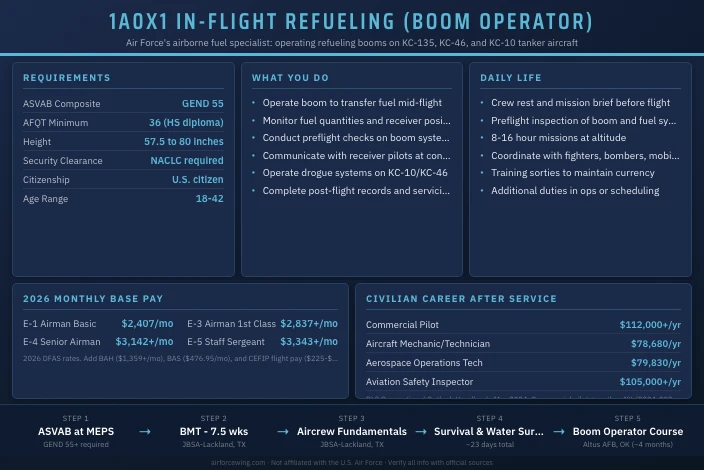
Job Role and Responsibilities
Boom operators are career enlisted aviators who transfer fuel from Air Force tanker aircraft to receiver aircraft during flight. They operate the refueling boom, a telescoping rigid tube extended from the rear of the tanker, and use a fly-by-wire control system to guide the boom into a small receptacle on the receiving aircraft. On aircraft equipped with a hose-and-drogue system, they also manage probe-and-drogue refueling for Navy and allied aircraft.
The job requires constant communication with receiver pilots, precise control inputs under turbulence, and quick decision-making when aircraft geometry drifts outside safe parameters.
Daily Tasks
On a typical flying day, a boom operator starts with crew rest, then attends mission planning and the preflight brief alongside pilots and other crew members. Before the aircraft launches, they inspect the boom assembly, fuel systems, and communications equipment to ensure everything is airworthy.
During the mission, the core task is executing the refueling contact. The boom operator lies prone in the rear of the aircraft looking through a window and a set of boom director lights, making real-time adjustments to guide the boom into the receiver’s refueling receptacle. A single contact can last only a few minutes, but a single sortie might involve a dozen or more contacts with different aircraft.
Between contacts, boom operators monitor fuel system status, track remaining offload quantities, and record transfer data. They also serve as an additional set of eyes for formation safety, especially during night or instrument conditions.
Specialized Roles and Aircraft
| Aircraft | Role | Notes |
|---|---|---|
| KC-135 Stratotanker | Boom refueling | Air Force primary tanker; active duty and ANG/Reserve |
| KC-46A Pegasus | Boom and drogue | New-generation tanker replacing KC-135; advanced digital systems |
| KC-10 Extender | Boom and drogue | Large-body tanker; being retired, limited billets |
The KC-46 is now the primary new-production tanker for the Air Force, and many boom operators will train and serve on both airframes during their career.
Mission Contribution
Air Force tanker missions make every long-range operation possible. Without aerial refueling, fighters from bases in Europe could not support operations in the Middle East, and strategic bombers could not execute global strike missions without a refueling stop. Boom operators are the actual crew members executing these transfers, making split-second decisions that determine whether a mission continues or an aircraft diverts.
Salary and Benefits
Base Pay and Flight Pay
Boom operators receive standard Air Force enlisted base pay plus Career Enlisted Flyer Incentive Pay (CEFIP), which is additional monthly compensation tied to years of aviation service. CEFIP for Air Force enlisted aviators runs from $225 to $600 per month depending on cumulative aviation service years.
| Rank | Grade | Base Pay (Entry) | Base Pay (Mid-Career) |
|---|---|---|---|
| Airman Basic | E-1 | $2,407/mo | , |
| Airman First Class | E-3 | $2,837/mo | $3,198/mo |
| Senior Airman | E-4 | $3,142/mo | $3,816/mo |
| Staff Sergeant | E-5 | $3,343/mo | $4,395/mo |
| Technical Sergeant | E-6 | $3,401/mo | $5,044/mo |
2026 DFAS pay rates. Verify current rates at dfas.mil.
Allowances and Additional Benefits
On top of base pay, most boom operators living off-base receive Basic Allowance for Housing (BAH), which varies by duty location. At a typical AMC installation, a single E-4’s BAH ranges from roughly $1,200 to $1,800 per month depending on local housing costs. Basic Allowance for Subsistence (BAS) adds $476.95 per month for all enlisted Airmen in 2026.
Active duty Airmen receive TRICARE Prime at no cost, zero enrollment fee, zero deductible, zero copay for medical, dental at military facilities, and annual vision exams. Education benefits include up to $4,500 annually through Tuition Assistance and, after service, the Post-9/11 GI Bill covering full in-state tuition plus a monthly housing allowance.
Retirement is through the Blended Retirement System (BRS), which combines a 20-year pension at 40% of high-36 average basic pay with a Thrift Savings Plan (TSP) matching contribution of up to 5% of basic pay.
Work-Life Balance
Active duty boom operators accrue 30 days of paid leave annually. Flying schedules can be irregular, with multi-day trips and TDY deployments mixed with periods of ground duties. Most tanker units operate on a standard day schedule when not flying, with crew rest requirements protecting rest periods before and after flights.
Qualifications and Eligibility
Requirements Table
| Requirement | Details |
|---|---|
| ASVAB Score | General (GEND) composite: 55 minimum |
| AFQT Minimum | 36 (high school diploma) |
| Age | 18-42 at time of enlistment |
| Citizenship | U.S. citizen required |
| Security Clearance | National Agency Check, Local Agency Checks and Credit (NACLC) |
| Height | 57.5 to 80 inches (standing) |
| Physical | Aircrew flight physical required (Class III) |
| Education | High school diploma; physics and math coursework desirable |
Requirements per airforce.com and AFI 36-2101.
ASVAB Details
The General (GEND) composite combines Word Knowledge, Paragraph Comprehension, Arithmetic Reasoning, and Mathematics Knowledge subtests. A score of 55 is competitive but achievable with focused preparation. Your GEND score reflects reading comprehension and math reasoning, which matter for the technical and computational demands of fuel management in flight. The ASVAB study guide can help you target these specific subtests.
The PICAT (Pre-screening Internet Computerized Adaptive Test) is now standard at many recruiting offices as a pre-screen before the full MEPS ASVAB. Strong PICAT performance can verify eligibility and speed up the process. The PICAT guide walks through what to expect.
Physical and Medical Standards
This is an aircrew position, which means the standards go beyond a standard MEPS physical. Applicants must pass a Class III aircrew flight physical at MEPS or a military treatment facility. Vision requirements allow for correctable vision, but specific uncorrected and corrected acuity standards apply and should be verified with a recruiter. The height range (57.5 to 80 inches) is firm, these limits are driven by the physical workspace in the boom operator pod.
Ongoing medical fitness for flying is required throughout the career. Any medical condition that disqualifies for aircrew duty will affect your continued service in this AFSC.
Selection Process
The process runs through a recruiter and MEPS. After the ASVAB and flight physical, the recruiter submits your package for a job code. Competition varies, this is a smaller-volume AFSC compared to maintenance or medical fields, so slots can be limited at certain times. Prior flight experience or aviation coursework can strengthen a package, though neither is required.
Service Obligation
Boom operators incur an Active Duty Service Commitment (ADSC) of at least two years upon completing initial qualification training. This is standard for aircrew AFSCs and reflects the training investment.
Aircrew flight physicals have specific vision, height, and medical standards that differ from a standard MEPS physical. Confirm you meet all Class III aircrew requirements with a recruiter before committing to this AFSC.
Work Environment
Setting and Schedule
Boom operators spend a significant portion of their time on actual aircraft. A typical flying week might include one to three sorties ranging from four to sixteen hours, depending on the mission type and aircraft. Long missions, transatlantic flights, combat support sorties, can run twelve hours or more.
When not flying, boom operators work in squadron operations buildings handling scheduling, training records, aircraft forms review, and additional duties. Some billets involve unit ground jobs such as flight scheduling NCO, life support NCO, or quality assurance positions.
Tanker units follow crew rest regulations strictly. After a long flight, crew members observe mandatory rest periods before the next duty period. This creates a different schedule rhythm than ground-based jobs, with irregular days and some concentrated rest periods.
Team Dynamics
The tanker crew is small, typically two pilots, and one or two boom operators depending on mission length and aircraft type. Boom operators work closely with pilots and coordinate directly with receiver aircraft crews via radio. The small crew means every member is accountable for their area with limited redundancy.
Within the squadron, boom operators work in sections organized by aircraft qualification, grade, and specialization. Senior boom operators mentor junior Airmen on contact techniques, emergency procedures, and fuel system management.
Job Satisfaction
Boom operators consistently cite the flying aspect as the primary reason they stay in the career field. The job is physically demanding and the hours are irregular, but operating a system that other aircrew depend on for mission completion carries real weight. The civilian aviation pathway is also a significant retention factor, boom operator experience translates to flight hours that count toward commercial aviation certificates.
Training and Skill Development
Training Pipeline
| Phase | Location | Duration | Focus |
|---|---|---|---|
| Basic Military Training (BMT) | JBSA-Lackland, TX | 7.5 weeks | Military fundamentals, physical conditioning |
| Aircrew Fundamentals Course | JBSA-Lackland, TX | ~3-4 weeks | Physiology, ejection, emergency procedures, water survival |
| Combat Survival Training | Spokane, WA area | ~19 days | Land navigation, survival skills, SERE basics |
| Water Survival Training | , | ~4 days | Ditching procedures, water egress |
| Basic Boom Operator Course | Altus AFB, OK | ~4 months | Systems, contact technique, aircraft qualification |
After BMT, enlisted students attend the Aircrew Fundamentals Course at Joint Base San Antonio-Lackland, which covers aerospace physiology, hypoxia training, and basic aircrew emergency procedures. Combat survival and water survival training follow before assignment to the aircraft-specific boom operator course.
The Basic Boom Operator Course at Altus Air Force Base, Oklahoma, is the primary qualification school. The 97th Air Mobility Wing at Altus AFB is the sole training base for KC-135 and KC-46 boom operators, training approximately 265 students annually including international partner nation crews. Students learn aircraft systems, fuel management, contact procedures, and emergency protocols before logging their first real contacts with receiver aircraft.
Advanced Training and Skill Development
After initial qualification, boom operators continue developing skills through recurring training events, evaluations, and upgrade programs. The path from basic qualification to 3-skill level to 5-skill level and eventually 7-skill level follows the standard Air Force Career Field Education and Training Plan (CFETP).
Opportunities for additional training include:
- Instructor upgrade: Qualified boom operators can become Instructor Boom Operators (IBO) and teach the next generation of students at Altus
- KC-46 transition: As the Air Force fields the KC-46, experienced boom operators cross-train to the new airframe
- Evaluator positions: Senior NCOs can become standardization and evaluation examiners
The Air Force covers education costs through Tuition Assistance while on active duty. Combined with the Post-9/11 GI Bill for after separation, boom operators have strong tools to pursue degrees in aviation, aerospace, or any other field.
Flight hours logged during boom operator service count toward FAA commercial certificate requirements. Many boom operators leave the Air Force with several thousand flight hours, which is a major asset for civilian aviation careers.
Everything starts with qualifying ASVAB scores. Our study guide covers what to study first.
Career Progression and Advancement
Rank Progression
| Rank | Grade | Time-in-Service (Typical) | Notes |
|---|---|---|---|
| Airman Basic | E-1 | Entry | BMT start rank |
| Airman | E-2 | ~6 months | Automatic promotion |
| Airman First Class | E-3 | ~16 months | Automatic promotion |
| Senior Airman | E-4 | ~3 years | Below-the-zone possible at ~2.5 years |
| Staff Sergeant | E-5 | ~5-7 years | Competitive board |
| Technical Sergeant | E-6 | ~10-12 years | Competitive board |
| Master Sergeant | E-7 | ~16-18 years | Competitive board |
| Senior Master Sergeant | E-8 | ~20+ years | Highly competitive |
| Chief Master Sergeant | E-9 | ~22+ years | Less than 1% of enlisted force |
Advancement from E-4 to E-5 requires a promotion test, an Enlisted Performance Report (EPR), and board review. The EPR system rates Airmen on performance, leadership, and contributions relative to their peers. Strong EPRs combined with additional duties, awards, and professional military education (PME) completion drive promotion rates up.
Retraining and Flexibility
Career retraining is available after completing an initial service commitment and meeting eligibility criteria. Boom operators who want to shift to a ground-based AFSC can apply, though availability depends on Air Force manning needs at the time. Some boom operators move into maintenance, operations support, or instructor roles within the aviation community.
Specializations
The 1A0X1 career field does not use a formal shredout designation, but boom operators develop informal specializations through aircraft qualification. Being qualified on both the KC-135 and KC-46 makes a Boom more versatile and competitive for assignments and leadership billets.
Senior boom operators often serve in ground-based leadership positions: Flight Chief, Chief Boom, standardization/evaluation roles, or as a First Sergeant. Some pursue the Senior Enlisted Leader (SEL) track.
Physical Demands and Medical Evaluations
Daily Physical Demands
The boom operator position requires lying prone in the rear of the aircraft for extended periods, sometimes hours per mission. In addition to the unusual body position, boom operators work in an environment with temperature variations, vibration, and the occasional turbulence that comes with low-altitude refueling tracks. Getting in and out of the boom pod requires physical agility, and aircraft maintenance-related duties on the ground involve walking around large aircraft in all weather.
This is not a job that requires extreme physical strength, but it demands good cardiovascular fitness, the ability to stay mentally focused over long flight periods, and the physical tolerance to work in a cramped prone position.
Air Force Fitness Assessment
All Airmen, including boom operators, must pass the Air Force Fitness Assessment annually. There are no AFSC-specific standards, the same assessment applies to everyone.
| Component | Max Points | Minimum Passing Notes |
|---|---|---|
| 1.5-Mile Run | 60 pts | Timed; age/gender-normed |
| Push-Ups (1 minute) | 10 pts | Age/gender-normed |
| Sit-Ups (1 minute) | 10 pts | Age/gender-normed |
| Waist Circumference | 20 pts | Measurement taken at navel |
Minimum composite passing score is 75 out of 100. Each component also has a minimum passing threshold. Standards are age- and gender-normed per af.mil.
Aircrew Medical Evaluations
Beyond the standard fitness assessment, boom operators require periodic Class III aircrew flight physicals to maintain flying status. These go further than a standard annual physical and include vision, hearing, cardiovascular, and neurological evaluation. A boom operator grounded for medical reasons cannot perform the primary duties of the AFSC, which can affect career progression.
Deployment and Duty Stations
Deployment Details
Tanker operations are continuous and global. Boom operators deploy regularly, typically two to four months per deployment cycle, depending on theater requirements and unit tasking. Some boom operators support combat operations directly through continuous refueling tracks in active conflict zones, while others support training exercises and theater security cooperation missions in lower-threat environments.
Deployed boom operators often operate from bare-base locations, forward operating bases, or allied airfields close to the operational area. Deployment frequency for active duty boom operators is generally one deployment per year or one every 18 months, though this varies by unit and mission demand.
Duty Stations
KC-135 and KC-46 units are concentrated at a set of major Air Mobility Command (AMC) bases. Major active duty boom operator assignments include:
- McConnell AFB, Kansas (KC-135/KC-46)
- Fairchild AFB, Washington (KC-135)
- Seymour Johnson AFB, North Carolina (KC-135)
- Beale AFB, California (KC-135)
- MacDill AFB, Florida (KC-135)
- Altus AFB, Oklahoma (training base)
- RAF Mildenhall, United Kingdom (KC-135, overseas)
- Kadena AB, Japan (KC-135, Pacific)
Air National Guard and Air Force Reserve tanker units are spread across more than a dozen states, from Washington to Maine. ANG/Reserve boom operators have a wide selection of home-state bases.
Location Flexibility
Initial assignment after training is based on Air Force needs, but Airmen can submit base preferences and may receive preferred assignments based on manning needs at target locations. With tanker units spread across CONUS and multiple overseas bases, there are real options for assignment variety over a career.
Risk, Safety, and Legal Considerations
Job Hazards
Aerial refueling carries real risk. The boom operator works at altitude, sometimes in turbulent conditions, and connects to aircraft that are flying in close formation. A contact breakaway, when a receiver aircraft disconnects suddenly or unexpectedly, can stress the boom and requires immediate crew response. Fuel spills, fire risk, and structural stress on the boom during rough contacts are recognized hazards addressed through strict procedural compliance.
Long-duration flying at altitude also exposes aircrew to hypoxia risk. Oxygen equipment and physiological training address this directly.
Safety Protocols
Boom operators follow detailed technical orders for every refueling procedure. Aircraft refueling checklists, crew briefings, and emergency procedure training reduce risk significantly. The Air Force requires periodic survival training, ejection seat familiarization (where applicable), and emergency egress training throughout a boom operator’s career.
Security and Legal Requirements
The NACLC security clearance required for this AFSC involves a background check covering criminal history, financial responsibility, and personal conduct. Most applicants without serious criminal or financial issues complete the process without problems.
The Active Duty Service Commitment tied to initial qualification means boom operators who finish training are obligated for at least two years of active service. Separation before that obligation is complete requires coordination with the unit and legal assistance office.
Impact on Family and Personal Life
Family Considerations
Frequent TDY and deployment is a consistent feature of tanker life. Boom operators at active duty bases spend weeks to months away from home during deployments, and shorter TDY trips for exercises or training add to cumulative time away. Families need to be prepared for this tempo.
The Air Force provides support through Military OneSource, Family Support Centers on every installation, and programs specifically designed for deployed families. Base housing, TRICARE coverage for dependents, and on-base schools and childcare help offset the demands of frequent moves.
Relocation
Career boom operators can expect a Permanent Change of Station (PCS) every two to four years. Each move is funded by the Air Force, including a weight allowance for household goods. Moves can be to domestic bases or overseas locations like Mildenhall or Kadena.
Moving with a family means spouse employment disruptions, school transitions for children, and rebuilding a local support network at each new base. These are real costs that servicemembers and their families weigh throughout a career.
Spouses of active duty Airmen can access MyCAA (My Career Advancement Account) scholarship funds for education and career certifications, a useful resource across PCS moves.
Reserve and Air National Guard
Component Availability
The 1A0X1 AFSC is available in both the Air Force Reserve and the Air National Guard. This is a significant benefit, tanker units exist across a large number of states, so Guard and Reserve boom operators often serve at a base near home.
Differences between components are mostly in assignment flexibility and deployment frequency. Reserve and ANG units may have fewer aircraft and training slots than active duty counterparts, but qualifications are identical.
Drill Schedule and Training Commitment
Standard Reserve and ANG commitment is one Unit Training Assembly (UTA) weekend per month plus two weeks of Annual Tour per year. Boom operators must also maintain annual flying currency, which typically requires additional inactive duty training (IDT) days beyond the standard schedule. Aircrew AFSCs generally have a heavier training commitment than non-flying Reserve positions.
Component Comparison
| Active Duty | Air Force Reserve | Air National Guard | |
|---|---|---|---|
| Commitment | Full-time | 1 UTA/mo + 2 wks/yr | 1 UTA/mo + 2 wks/yr |
| Monthly Pay (E-4) | $3,142-$3,816/mo | ~$475 for 4 drill days | ~$475 for 4 drill days |
| Healthcare | TRICARE Prime (free) | TRICARE Reserve Select (premiums) | TRICARE Reserve Select (premiums) |
| Education | TA + Post-9/11 GI Bill | Federal TA; GI Bill after 90 days mob | State tuition waivers may apply |
| Deployment Tempo | Moderate-high; ~1/yr | Varies; mission-driven | Varies; mission-driven |
| Retirement | 20-yr pension (BRS) | Points-based Reserve retirement | Points-based Reserve retirement |
Civilian Career Integration
Reserve and ANG boom operators who work for commercial airlines or in aviation-adjacent civilian jobs often find the two roles reinforce each other well. Flight hours logged in the Guard or Reserve count toward FAA certificate maintenance. Employers in the aviation sector tend to view military aircrew background favorably. USERRA protections guarantee job reinstatement rights when Airmen are called up for deployment or annual training.
Post-Service Opportunities
Transition to Civilian Life
Boom operators leave service with thousands of logged flight hours, aircraft systems knowledge, crew resource management training, and a verifiable track record in high-stakes environments. The primary civilian path is commercial aviation, where military flight experience is highly valued.
The Air Force Transition Assistance Program (TAP) provides pre-separation counseling, resume writing, and job placement resources. The Hiring Our Heroes program specifically targets veteran-friendly employers.
Civilian Career Prospects
| Civilian Career | Median Annual Salary | Job Outlook |
|---|---|---|
| Commercial Pilot | $112,000+/yr (varies widely) | +4% (2024-2034) |
| Airline Pilot, Copilot, Flight Engineer | $226,600/yr | +4% (2024-2034) |
| Aircraft Mechanic / Service Technician | $78,680/yr | +5% (2024-2034) |
| Aerospace Operations Technician | $79,830/yr | +8% (2024-2034) |
| Aviation Safety Inspector (FAA) | $105,000+/yr | Stable federal demand |
BLS Occupational Outlook Handbook (May 2024) data. Commercial pilot earnings vary significantly by airline, aircraft type, and seniority.
Boom operators who want to fly professionally face one key challenge: the FAA Airline Transport Pilot (ATP) certificate requires 1,500 total flight hours for most applicants, though military aviators may qualify under reduced-hour pathways depending on ratings held. A recruiter or FAA-designated examiner can clarify which pathway applies.
Certification and Licensing
Military flight experience does not automatically translate to FAA certificates, but it provides substantial credit. Veterans can pursue the FAA Commercial Pilot or ATP certificate through an aviation school or check with the FAA about military experience credit pathways.
Is This a Good Job for You? The Right (and Wrong) Fit
Ideal Candidate Profile
The best boom operators tend to have strong spatial awareness, calm under pressure, and the discipline to follow checklists precisely while also making real-time adjustments. You’ll be working a physical control system while talking on the radio, monitoring aircraft gauges, and tracking fuel quantities simultaneously. People who enjoy complex, high-stakes tasks with direct consequences do well in this role.
Comfort with irregular schedules and extended time away from home matters. Boom operators who struggle with the deployment tempo often find the job rewarding but personally costly. Going in with clear expectations about that balance makes the difference.
Potential Challenges
If you prefer a predictable schedule, a stable home life, or primarily ground-based work, this AFSC will test your tolerance. The multi-day missions, TDY trips, and deployment rotations accumulate. Some boom operators also find that after years of the aerial refueling mission, the repetitive nature of the core task, refueling contacts follow strict procedures with limited variation, becomes less engaging over time.
The aircrew medical requirement is also a real gatekeeping factor. Any health change that affects flying status can sideline a boom operator from their primary duties and complicate career planning.
Good Fit or Poor Fit
You’re probably a good fit if you want to be in the air on operational missions, you have the math and reading aptitude to meet the GEND 55 standard, and you’re comfortable with an irregular schedule and frequent relocation. The ASVAB general composite is the first hurdle, verify you’re on track before committing.
You’re probably not a good fit if you have medical conditions that could disqualify you from aircrew duty, you need schedule stability for family reasons, or you strongly prefer technical ground-based work over a flying role.
More Information
Talk to an Air Force recruiter to get current bonus availability, open boom operator slots, and base preference options. Recruiters can request your job guarantee in writing before you sign anything, and they have access to the most current ASVAB requirement and physical standard information. If your GEND score isn’t at 55 yet, the ASVAB study guide covers the specific subtests that feed the General composite. Verify everything in this guide against current official Air Force publications before making any enlistment decision.
This site is not affiliated with the U.S. Air Force or any government agency. Verify all information with official Air Force sources before making enlistment or career decisions.
Explore more Air Force operations careers such as 1C1X1 Air Traffic Control and 1W0X1 Weather.